gearbox BMW M3 CONVERTIBLE 2003 E46 User Guide
[x] Cancel search | Manufacturer: BMW, Model Year: 2003, Model line: M3 CONVERTIBLE, Model: BMW M3 CONVERTIBLE 2003 E46Pages: 166, PDF Size: 4.29 MB
Page 79 of 166
79
Cruise control is also deactivated when
the ignition key is in position 0.
The speed stored in memory is deleted.To store and maintain speed or to
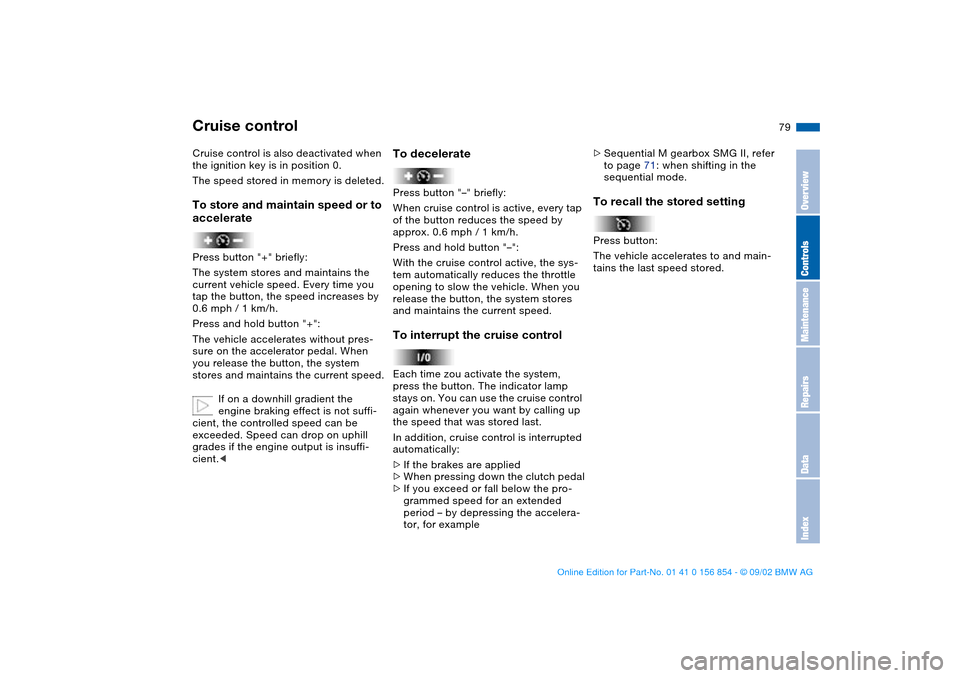
acceleratePress button "+" briefly:
The system stores and maintains the
current vehicle speed. Every time you
tap the button, the speed increases by
0.6 mph / 1 km/h.
Press and hold button "+":
The vehicle accelerates without pres-
sure on the accelerator pedal. When
you release the button, the system
stores and maintains the current speed.
If on a downhill gradient the
engine braking effect is not suffi-
cient, the controlled speed can be
exceeded. Speed can drop on uphill
grades if the engine output is insuffi-
cient.<
To deceleratePress button "–" briefly:
When cruise control is active, every tap
of the button reduces the speed by
approx. 0.6 mph / 1 km/h.
Press and hold button "–":
With the cruise control active, the sys-
tem automatically reduces the throttle
opening to slow the vehicle. When you
release the button, the system stores
and maintains the current speed.To interrupt the cruise controlEach time zou activate the system,
press the button. The indicator lamp
stays on. You can use the cruise control
again whenever you want by calling up
the speed that was stored last.
In addition, cruise control is interrupted
automatically:
>If the brakes are applied
>When pressing down the clutch pedal
>If you exceed or fall below the pro-
grammed speed for an extended
period – by depressing the accelera-
tor, for example
>Sequential M gearbox SMG II, refer
to page 71: when shifting in the
sequential mode.To recall the stored settingPress button:
The vehicle accelerates to and main-
tains the last speed stored.
Cruise control
OverviewControlsMaintenanceRepairsDataIndex
handbook.book Page 79 Tuesday, July 30, 2002 9:28 AM
Page 119 of 166
119
Do not exceed specified
maximum speeds
Never exceed the maximum
speed for which the winter tires
are rated.
Unprofessional attempts by laymen to
service tires can lead to damage and
accidents.
Have this work performed by skilled
professionals only. Your BMW center
will be glad to assist you with both their
expertise and the proper equipment for
your vehicle.<
Tire condition, tire pressureAt tread depth below approx. 3/16 in /
4 mm, their performance under winter
driving conditions deteriorates notice-
ably. Worn tires should therefore be
replaced for safety considerations.
Comply with the specified tire inflation
pressures – and be sure to have the
wheel and tire assembly balanced
every time you change a tire or wheel.
Snow chains*Only certain snow chains have been
tested by BMW and determined and
approved as roadworthy. Consult your
BMW center for more information.
BMW recommends using only these
approved fine-link snow chains. Use
them in pairs on winter tires, but only on
both rear wheels.
Comply with all manufacturer's safety
precautions when mounting the chains.
Do not exceed a speed of 30 mph /
50 km/h with snow chains.
After mounting or removing snow
chains, always reinitialize the sequential
M gearbox SMG II, refer to page 89.
It is not possible to mount snow
chains on tires with 18- and 19-
inch wheels.
Deactivate the Flat Tire Monitor when
using snow chains. Malfunction warn-
ings and undetected losses in pressure
are a possibility when driving with snow
chains.
For additional information, refer to
page 88.<
Winter tires
OverviewControlsMaintenanceRepairsDataIndex
handbook.book Page 119 Tuesday, July 30, 2002 9:28 AM
Page 147 of 166
147
Use only a nylon towing strap to tow
the vehicle, since the inherent resil-
ience of this material helps protect both
vehicles from sudden jerking move-
ments.
The towed vehicle should always
be the lighter of the two vehicles.
If this is not the case, it will not be pos-
sible to control vehicle handling.
Never attempt to use your vehicle to
push another vehicle, since damage to
the energy-absorbing bumpers could
result.Towing a vehicle1. Gearshift lever in Neutral
2. Towing speed:
Max. 45 mph / 70 km/h
3. Towing distance:
Max. 95 miles/150 km
4. Leave the ignition key at position 1 to
ensure that the brake lamps, turn sig-
nal indicators, horn and windshield
wipers remain operative, and to pre-
vent the steering lock detent from
engaging
5. Switch on the hazard-warning sys-
tem – observe applicable legal regu-
lations.
Find some means of identifying the
vehicle in tow, for instance, place a sign
or warning triangle in the rear window.
Make sure that the ignition key
remains in position 1 even when
the electrical system has failed to pre-
vent the steering lock from engaging.
The steering and brakes are without
power-assist when the engine is off.
This means that increased effort is
required for steering and braking.<
Vehicle with sequential M gearbox
SMG II:
To push or tow, engage selector lever
in position 0.
Never work on the vehicle with a
driving position engaged.<
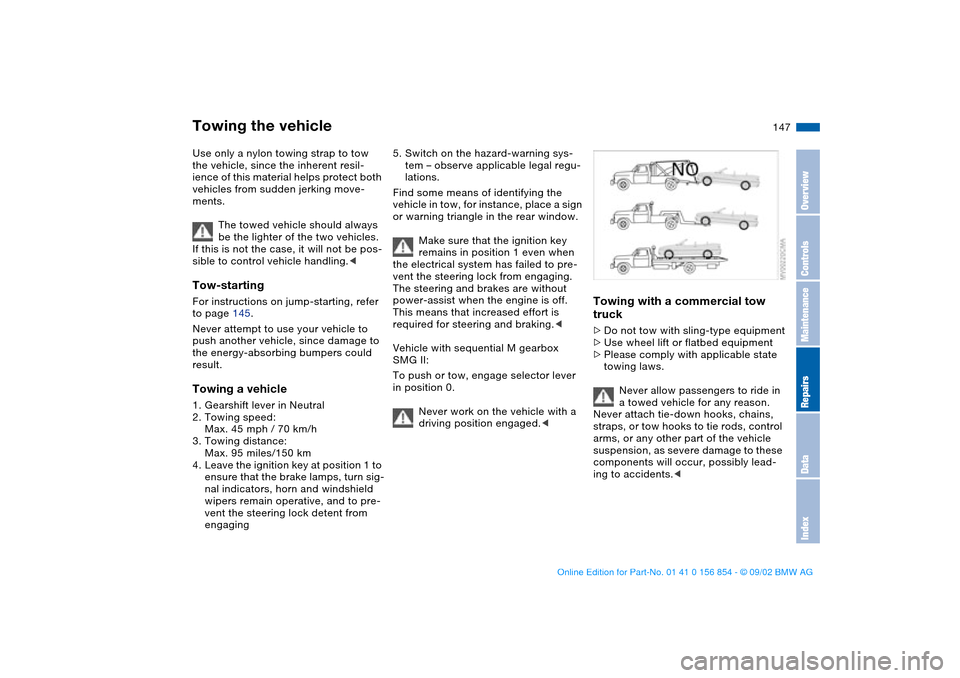
Towing with a commercial tow
truck>Do not tow with sling-type equipment
>Use wheel lift or flatbed equipment
>Please comply with applicable state
towing laws.
Never allow passengers to ride in
a towed vehicle for any reason.
Never attach tie-down hooks, chains,
straps, or tow hooks to tie rods, control
arms, or any other part of the vehicle
suspension, as severe damage to these
components will occur, possibly lead-
ing to accidents.<
Towing the vehicle
OverviewControlsMaintenanceRepairsDataIndex
handbook.book Page 147 Tuesday, July 30, 2002 9:28 AM
Page 158 of 166
Everything from A to ZEngine oil pressure
warning lamp 18
Engine speed 150
Entering the rear 51
Exterior mirrors 55
Eyelet, towing 146
F
False alarm, avoiding 39
Fault displays 82
First-aid kit 23
Flat tire 115
repairing 139
Flat Tire Monitor 88
indicator lamp 18, 19
Fog lamps 94
Fold down convertible top
compartment panel 37
Follow me home lamps 92
Footbrake 112
Footbrake, refer to Driving
notes 111
Footwell lamps 94
Front airbags 57
Front fog lamps 94
indicator lamp 20
Front seat adjustment 49
Frost protection,
radiator 126
Fuel 25
Fuel consumption 85
display 81Fuel filler door 24
release following an elec-
trical malfunction 24
Fuel gauge 81
Fuel specifications 25
Fuel tank capacity 153
Fuel tank display 81
Fuel tank gauge 81
Fuel-injection system 150
Fully automatic convertible
top 41
operation 41
Fuses 144
replacing 144
G
Gasoline 25
Gasoline gauge 81
Gearbox, sequential 71
Gearshift lever 70
Glove compartment 101
Grills 96
Gross vehicle weight 152
H
Hands-free system 102
Hardtop 113
Hazard warning flashers 14
Hazard warning triangle 23
Head restraints 50
Headlamp 92Headlamp cleaning system
122, 124, 153
Headlamp control 92
Headlamp flasher 76, 93
Heated mirror 55
Heated seats 54
Heavy loads 106
High beams 76, 93
indicator lamps 21
Holder for beverages 102
Hood release 120
Horn 14
Hydroplaning 111, 115
I
Ice warning 84
Ignition key 30
positions 66
Ignition lock 66
Imprint 4
Indicator lamps 18
Individual settings, Vehicle
Memory, Key Memory 65
Inflation pressure 25, 115
INSPECTION 82
Instrument cluster 16
Instrument lighting 93
Instrument panel 14, 16
Interface socket for onboard
diagnostics (OBD) 130
Interior lamps 32, 94
remote control 32Interior motion sensor 38
remote control 32
switching off 32, 39
Interior rearview mirror
automatic dimming
feature 56
Interior temperature
adjusting 98
Intermittent mode 77
J
Jump-starting 145
K
Key Memory 65
Keys 30
L
Lamp replacement 135
Lamps
daytime driving lamps 92
fog lamps 94
footwell lamps 94
headlamp flasher 76, 93
high beams 93
instrument lighting 93
interior lamps 94
low beams 92
parking lamps 92
reading lamps 94
standing lamps 93
Lashing fittings 107
handbook.book Page 158 Tuesday, July 30, 2002 9:28 AM
Page 160 of 166
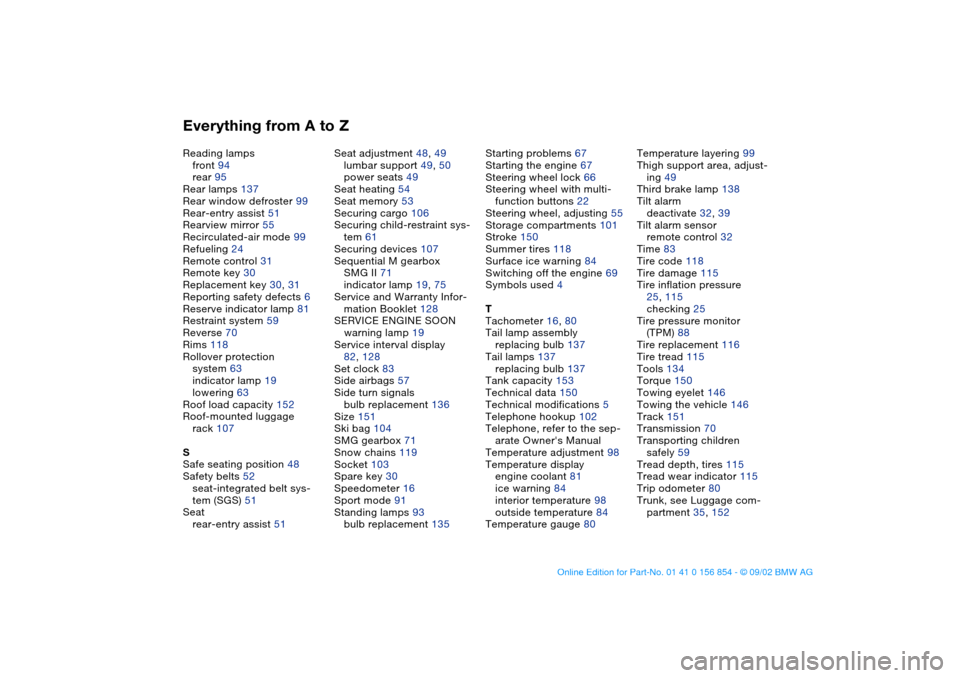
Everything from A to ZReading lamps
front 94
rear 95
Rear lamps 137
Rear window defroster 99
Rear-entry assist 51
Rearview mirror 55
Recirculated-air mode 99
Refueling 24
Remote control 31
Remote key 30
Replacement key 30, 31
Reporting safety defects 6
Reserve indicator lamp 81
Restraint system 59
Reverse 70
Rims 118
Rollover protection
system 63
indicator lamp 19
lowering 63
Roof load capacity 152
Roof-mounted luggage
rack 107
S
Safe seating position 48
Safety belts 52
seat-integrated belt sys-
tem (SGS) 51
Seat
rear-entry assist 51Seat adjustment 48, 49
lumbar support 49, 50
power seats 49
Seat heating 54
Seat memory 53
Securing cargo 106
Securing child-restraint sys-
tem 61
Securing devices 107
Sequential M gearbox
SMG II 71
indicator lamp 19, 75
Service and Warranty Infor-
mation Booklet 128
SERVICE ENGINE SOON
warning lamp 19
Service interval display
82, 128
Set clock 83
Side airbags 57
Side turn signals
bulb replacement 136
Size 151
Ski bag 104
SMG gearbox 71
Snow chains 119
Socket 103
Spare key 30
Speedometer 16
Sport mode 91
Standing lamps 93
bulb replacement 135Starting problems 67
Starting the engine 67
Steering wheel lock 66
Steering wheel with multi-
function buttons 22
Steering wheel, adjusting 55
Storage compartments 101
Stroke 150
Summer tires 118
Surface ice warning 84
Switching off the engine 69
Symbols used 4
T
Tachometer 16, 80
Tail lamp assembly
replacing bulb 137
Tail lamps 137
replacing bulb 137
Tank capacity 153
Technical data 150
Technical modifications 5
Telephone hookup 102
Telephone, refer to the sep-
arate Owner's Manual
Temperature adjustment 98
Temperature display
engine coolant 81
ice warning 84
interior temperature 98
outside temperature 84
Temperature gauge 80Temperature layering 99
Thigh support area, adjust-
ing 49
Third brake lamp 138
Tilt alarm
deactivate 32, 39
Tilt alarm sensor
remote control 32
Time 83
Tire code 118
Tire damage 115
Tire inflation pressure
25, 115
checking 25
Tire pressure monitor
(TPM) 88
Tire replacement 116
Tire tread 115
Tools 134
Torque 150
Towing eyelet 146
Towing the vehicle 146
Track 151
Transmission 70
Transporting children
safely 59
Tread depth, tires 115
Tread wear indicator 115
Trip odometer 80
Trunk, see Luggage com-
partment 35, 152
handbook.book Page 160 Tuesday, July 30, 2002 9:28 AM