lights BMW M3 CONVERTIBLE 2011 User Guide
[x] Cancel search | Manufacturer: BMW, Model Year: 2011, Model line: M3 CONVERTIBLE, Model: BMW M3 CONVERTIBLE 2011Pages: 174, PDF Size: 2.68 MB
Page 86 of 174
86
Dynamic Stability Control DSCThe conceptDSC supports vehicle stability, even in
critical driving situations.
DSC optimizes driving stability and
traction during acceleration and when
you are starting from a standstill. In
addition, it also recognizes unstable
vehicle conditions, such as understeer-
ing and oversteering. By reducing
engine power and applying brakes at
the wheels, DSC helps to keep the
vehicle on a steady course within phys-
ically feasible limits.
The system starts up automatically
each time you start the engine.
The laws of physics cannot be
repealed, even with DSC. The
driver remains responsible for the con-
sequences of any inadequate driving
style. Therefore, do not take any risks
because of the additional safety pro-
vided. Do not make any modifications
to the DSC system. Allow only autho-
rized technicians to perform service
procedures on the DSC.<
Indicator lamp for DSC
The indicator lamp in the instru-
ment cluster will go out shortly
after the ignition has been
switched on, refer to page 20.
>The indicator lamp flashes: DSC is
active and is controlling the drive
torque based on driving conditions
>The indicator lamp does not go out
after the engine is started or lights up
continuously while you are driving:
DSC has been deactivated via the
button or is defective.
Please consult your BMW center for
repairs.
You can continue to drive the vehicle
normally without DSC. In the event of a
malfunction, contact a BMW center or a
workshop that works according to
BMW requirements with appropriately
trained personnel.
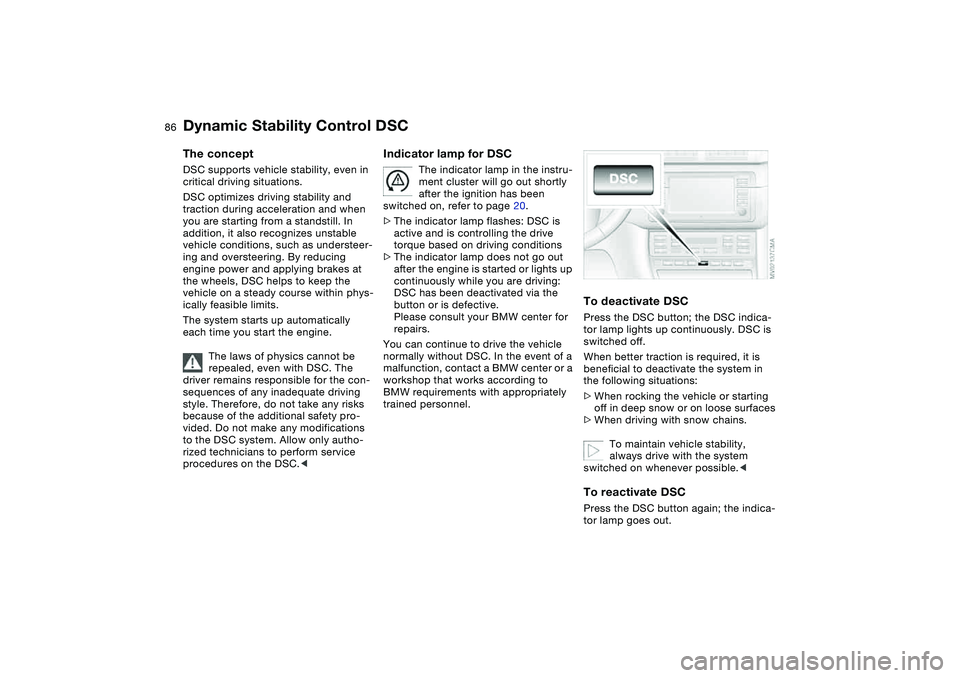
To deactivate DSCPress the DSC button; the DSC indica-
tor lamp lights up continuously. DSC is
switched off.
When better traction is required, it is
beneficial to deactivate the system in
the following situations:
>When rocking the vehicle or starting
off in deep snow or on loose surfaces
>When driving with snow chains.
To maintain vehicle stability,
always drive with the system
switched on whenever possible.
Page 87 of 174
87
Flat Tire MonitorThe conceptAs you drive, the Flat Tire Monitor
keeps track of pressure levels in all four
tires. The system alerts you whenever
the inflation pressure of a tire falls sig-
nificantly below the pressure of another
tire.
In the event of tire pressure loss, the
rolling radius of the tire changes, and
thereby the rotational speed of the
wheel. This change is detected, and a
flat tire warning is issued to the driver.Functional requirementsTo ensure a reliable flat tire warning,
the system must be initialized with the
correct tire inflation pressures.
Initialize the system immediately
after you have corrected a tire
inflation pressure, or changed the tire
or wheel.
vide you with advance warning of
sudden and severe tire damage caused
by external factors and does not detect
the balanced and very gradual pressure
loss that takes place in all four tires
over an extended period of time.<
The system could issue a false warning
or function in a delayed manner in the
following situations:
>System was not initialized
>You are driving on a snow-covered or
slippery road surface
>Performance-oriented driving: slip at
the drive wheels, high levels of lateral
acceleration
>You are driving with snow chains.Initializing the system
The initialization is completed
while you are driving, and can be
interrupted at any time. Initialization is
automatically continued when you con-
tinue driving. When driving with snow
chains, do not initialize the system.<
1. Before driving off, start the engine
but do not start driving
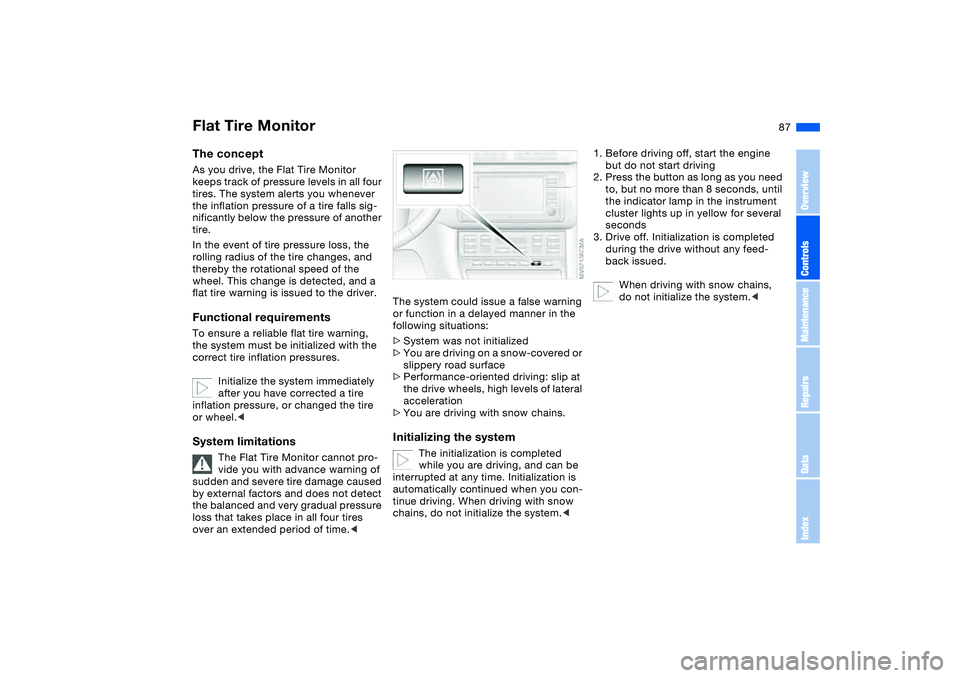
2. Press the button as long as you need
to, but no more than 8 seconds, until
the indicator lamp in the instrument
cluster lights up in yellow for several
seconds
3. Drive off. Initialization is completed
during the drive without any feed-
back issued.
When driving with snow chains,
do not initialize the system.<
OverviewControlsMaintenanceRepairsDataIndex
Page 88 of 174
88
To activate/deactivate the systemThe system is automatically activated in
ignition key position 2 and conse-
quently is on whenever the vehicle is
operated.
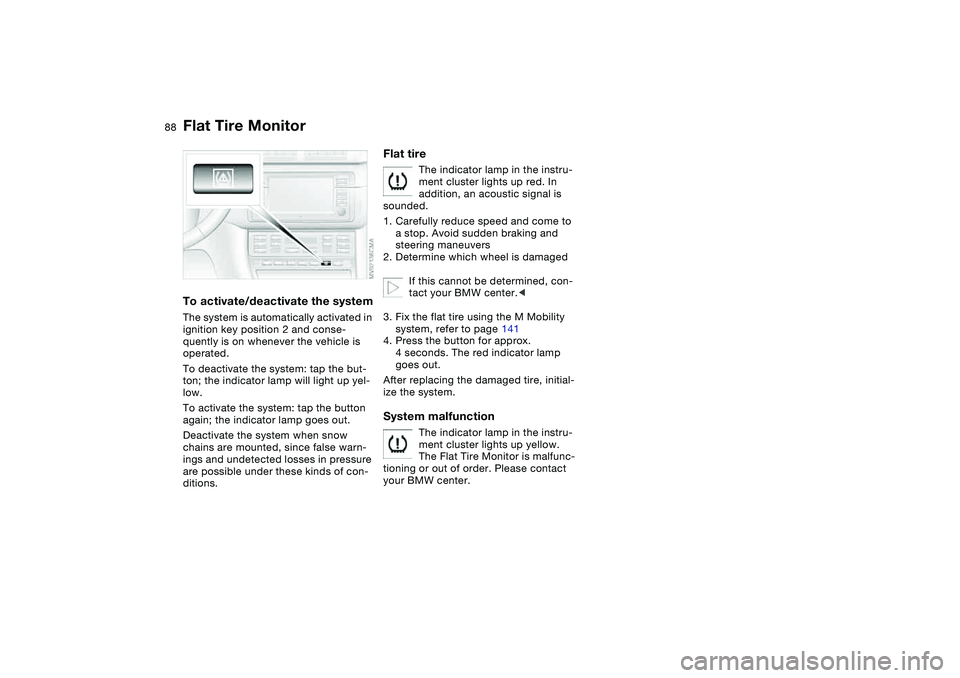
To deactivate the system: tap the but-
ton; the indicator lamp will light up yel-
low.
To activate the system: tap the button
again; the indicator lamp goes out.
Deactivate the system when snow
chains are mounted, since false warn-
ings and undetected losses in pressure
are possible under these kinds of con-
ditions.
Flat tire
The indicator lamp in the instru-
ment cluster lights up red. In
addition, an acoustic signal is
sounded.
1. Carefully reduce speed and come to
a stop. Avoid sudden braking and
steering maneuvers
2. Determine which wheel is damaged
If this cannot be determined, con-
tact your BMW center.<
3. Fix the flat tire using the M Mobility
system, refer to page 141
4. Press the button for approx.
4 seconds. The red indicator lamp
goes out.
After replacing the damaged tire, initial-
ize the system.
System malfunction
The indicator lamp in the instru-
ment cluster lights up yellow.
The Flat Tire Monitor is malfunc-
tioning or out of order. Please contact
your BMW center.
Flat Tire Monitor
Page 90 of 174
90Lamps
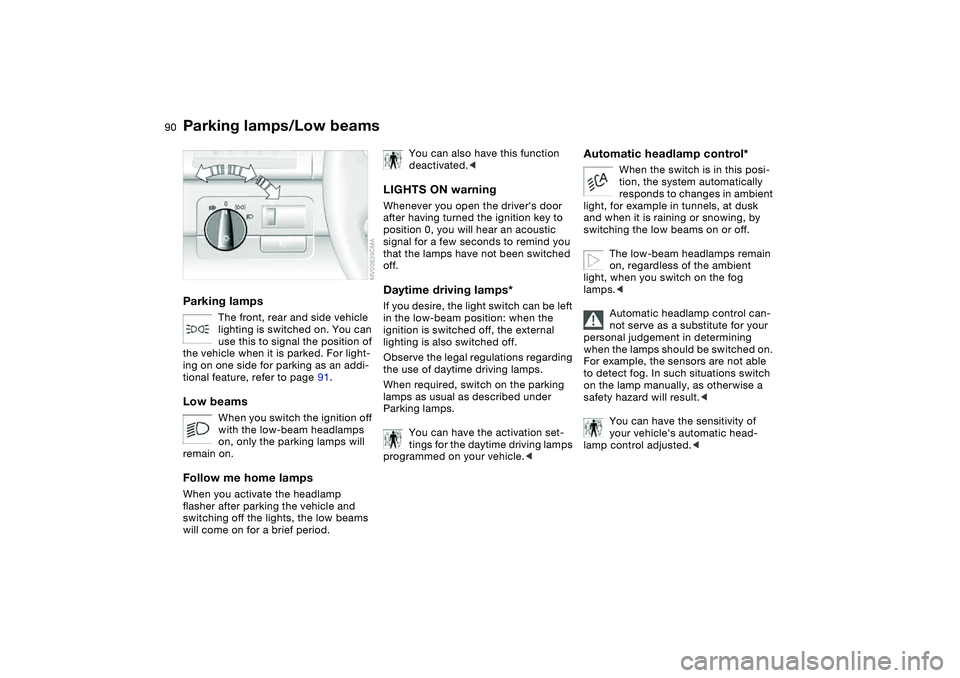
Parking lamps/Low beamsParking lamps
The front, rear and side vehicle
lighting is switched on. You can
use this to signal the position of
the vehicle when it is parked. For light-
ing on one side for parking as an addi-
tional feature, refer to page 91.
Low beams
When you switch the ignition off
with the low-beam headlamps
on, only the parking lamps will
remain on.
Follow me home lampsWhen you activate the headlamp
flasher after parking the vehicle and
switching off the lights, the low beams
will come on for a brief period.
You can also have this function
deactivated.<
LIGHTS ON warningWhenever you open the driver's door
after having turned the ignition key to
position 0, you will hear an acoustic
signal for a few seconds to remind you
that the lamps have not been switched
off.Daytime driving lamps*If you desire, the light switch can be left
in the low-beam position: when the
ignition is switched off, the external
lighting is also switched off.
Observe the legal regulations regarding
the use of daytime driving lamps.
When required, switch on the parking
lamps as usual as described under
Parking lamps.
You can have the activation set-
tings for the daytime driving lamps
programmed on your vehicle.<
Automatic headlamp control*
When the switch is in this posi-
tion, the system automatically
responds to changes in ambient
light, for example in tunnels, at dusk
and when it is raining or snowing, by
switching the low beams on or off.
The low-beam headlamps remain
on, regardless of the ambient
light, when you switch on the fog
lamps.<
Automatic headlamp control can-
not serve as a substitute for your
personal judgement in determining
when the lamps should be switched on.
For example, the sensors are not able
to detect fog. In such situations switch
on the lamp manually, as otherwise a
safety hazard will result.<
You can have the sensitivity of
your vehicle's automatic head-
lamp control adjusted.<
Page 92 of 174
92
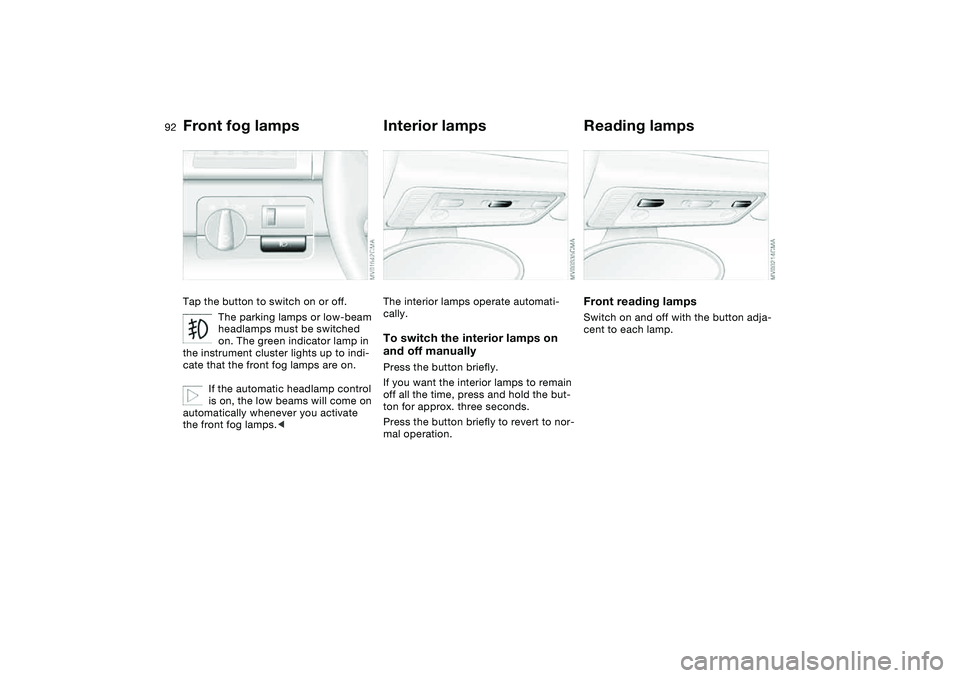
Front fog lampsTap the button to switch on or off.
The parking lamps or low-beam
headlamps must be switched
on. The green indicator lamp in
the instrument cluster lights up to indi-
cate that the front fog lamps are on.
If the automatic headlamp control
is on, the low beams will come on
automatically whenever you activate
the front fog lamps.<
Interior lampsThe interior lamps operate automati-
cally.To switch the interior lamps on
and off manuallyPress the button briefly.
If you want the interior lamps to remain
off all the time, press and hold the but-
ton for approx. three seconds.
Press the button briefly to revert to nor-
mal operation.
Reading lampsFront reading lampsSwitch on and off with the button adja-
cent to each lamp.
Page 146 of 174
146Giving and receiving assistance
Receiving assistanceThe BMW Group's Mobile Service
offers you 24-hour assistance in the
event of a breakdown, even on week-
ends and holidays.
The telephone numbers of the Mobile
Service control center in your country
are listed in the Contact brochure.
If your vehicle has the necessary equip-
ment, you can contact the Mobile Ser-
vice or issue an emergency call using
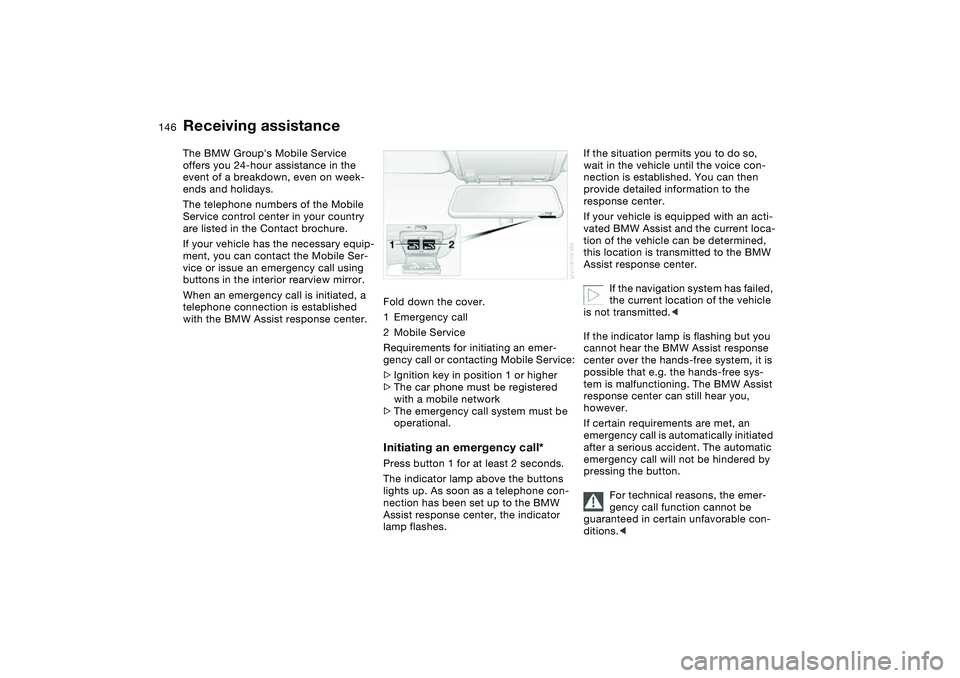
buttons in the interior rearview mirror.
When an emergency call is initiated, a
telephone connection is established
with the BMW Assist response center.Fold down the cover.
1Emergency call
2Mobile Service
Requirements for initiating an emer-
gency call or contacting Mobile Service:
>Ignition key in position 1 or higher
>The car phone must be registered
with a mobile network
>The emergency call system must be
operational.
Initiating an emergency call*Press button 1 for at least 2 seconds.
The indicator lamp above the buttons
lights up. As soon as a telephone con-
nection has been set up to the BMW
Assist response center, the indicator
lamp flashes.
If the situation permits you to do so,
wait in the vehicle until the voice con-
nection is established. You can then
provide detailed information to the
response center.
If your vehicle is equipped with an acti-
vated BMW Assist and the current loca-
tion of the vehicle can be determined,
this location is transmitted to the BMW
Assist response center.
If the navigation system has failed,
the current location of the vehicle
is not transmitted.<
If the indicator lamp is flashing but you
cannot hear the BMW Assist response
center over the hands-free system, it is
possible that e.g. the hands-free sys-
tem is malfunctioning. The BMW Assist
response center can still hear you,
however.
If certain requirements are met, an
emergency call is automatically initiated
after a serious accident. The automatic
emergency call will not be hindered by
pressing the button.
For technical reasons, the emer-
gency call function cannot be
guaranteed in certain unfavorable con-
ditions.<
Page 147 of 174
147
Mobile Service*To establish contact with the BMW
Group's Mobile Service:
Press button 2 for at least 2 seconds.
The indicator lamp above the buttons
lights up. As soon as a telephone con-
nection has been set up with the Mobile
Service, the indicator lamp flashes.
Depending on the country you are in,
your vehicle's current location will also
be transmitted if your vehicle is
equipped with an activated BMW Assist
function.
Jump-startingWhen your battery is discharged, you
can use two jumper cables to start your
vehicle with power from the battery in a
second vehicle. You can also use the
same method to help start another
vehicle. Use only jumper cables with
fully insulated handles on the terminal
clamps.
Do not touch high-voltage wiring
and cables on a running engine.
Contact with components carrying high
voltage can be harmful or fatal.
Carefully observe the following instruc-
tions to avoid personal injury and/or
damage to one or both vehicles.
approximately the same capacity –
measured in Ah. This information is
provided on the battery
2. Stop the engine of the support vehi-
cle
3. Switch off all consumers in both
vehicles.
Make absolutely certain that there
is no contact between the body-
work of the two vehicles, otherwise
there is a short circuit hazard.<
Connecting the jumper cables
Be sure to connect the jumper
cables in the right order; other-
wise there is a risk of injury due to
sparks being created near the battery.<
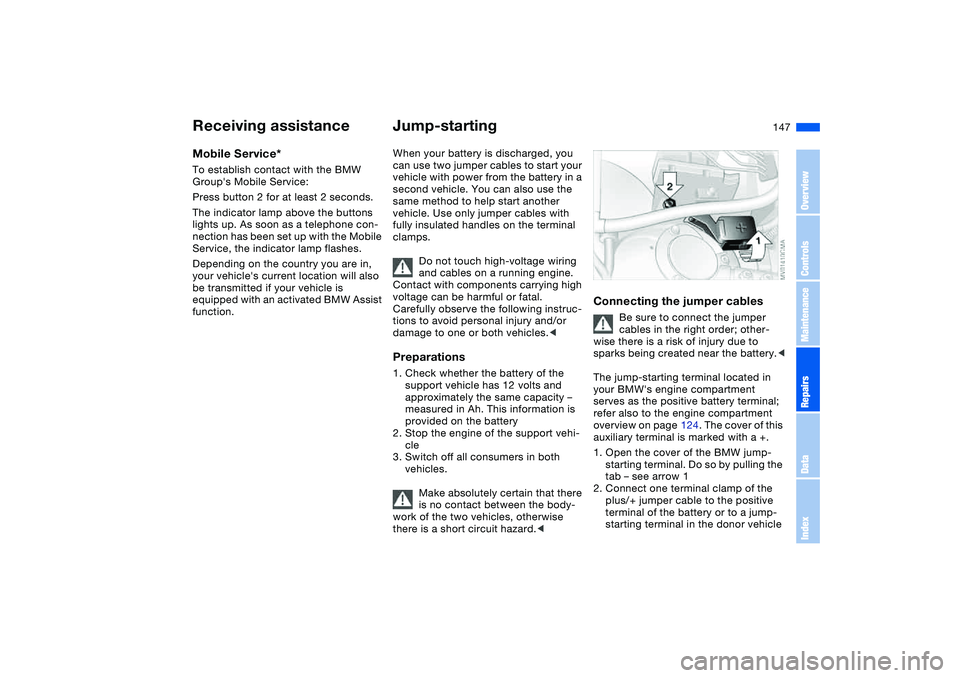
The jump-starting terminal located in
your BMW's engine compartment
serves as the positive battery terminal;
refer also to the engine compartment
overview on page 124. The cover of this
auxiliary terminal is marked with a +.
1. Open the cover of the BMW jump-
starting terminal. Do so by pulling the
tab – see arrow 1
2. Connect one terminal clamp of the
plus/+ jumper cable to the positive
terminal of the battery or to a jump-
starting terminal in the donor vehicle
Receiving assistance
OverviewControlsMaintenanceRepairsDataIndex
Page 165 of 174
Everything from A to Z
165
Interior lamps 92
remote control 30
Interior motion sensor 36, 37
switching off 37
Interior rearview mirror
automatic dimming
feature 53
Interior temperature
adjusting 96
Intermittent mode, wipers 76
Interval display, service 81
J
Jump-starting 147
K
Key Memory 64
Keys 28
with remote control 28
L
Lamp defect 137
Lamps
reading lamps 92
Lamps and bulbs 137
Lashing down loads, refer to
Cargo loading 104
Lashing eyelets, refer to
Securing cargo 106
Lashing fittings, refer to
Securing cargo 106LATCH child-restraint
mounting system 60
Leather care, refer to the
Caring for your vehicle
brochure
Leaving the vehicle 68
LEDs light-emitting
diodes 140
Length, refer to
Dimensions 155
License plate lamp
bulb replacement 140
Light switch 90
Light-emitting diodes
(LEDs) 140
Lighter 100
LIGHTS ON warning 90
Lights, refer to Parking
lamps/Low beams 90
Load, determining the maxi-
mum 104
Load, refer to Cargo
loading 104
Loading
vehicle 104
Load-securing devices 106
Lock buttons on doors, refer
to Locking 32
Lock, steering wheel 65
Locking
from inside 32
from outside 29, 31Locking and unlocking
doors
from inside 32
from outside 29, 31
Low beams 90
automatic 90
bulb replacement 137
indicator lamp, defective
lamp 81
Luggage compartment 35
capacity 156
emergency operation,
refer to Manual
operation 33
floor panel 35
increase volume 35
lid 33
lighting 33
opening from outside 33
opening, remote
control 30
opening/closing, refer to
Luggage compartment
lid 33
remote control 30
securing separately 33
volume 156Luggage compartment lid 33
emergency operation 33
emergency release 34
indicator lamp 81
opening from inside the
vehicle 33
opening from outside 33
remote control 30
unlocking manually 33
Luggage rack, refer to Roof-
mounted luggage rack 107
Lumbar support 48
M
M Engine dynamics
control 89
M Mobility system 141
Maintenance 81, 130
Maintenance system 130
Malfunction
convertible top 42
door lock 31
fuel filler door 24
Malfunction displays 81
Manual operation
convertible top 42
door lock 31
driver's door 31
fuel filler door 24
luggage compartment
lid 33
power convertible top 42
OverviewControlsMaintenanceRepairsDataIndex
Page 168 of 174
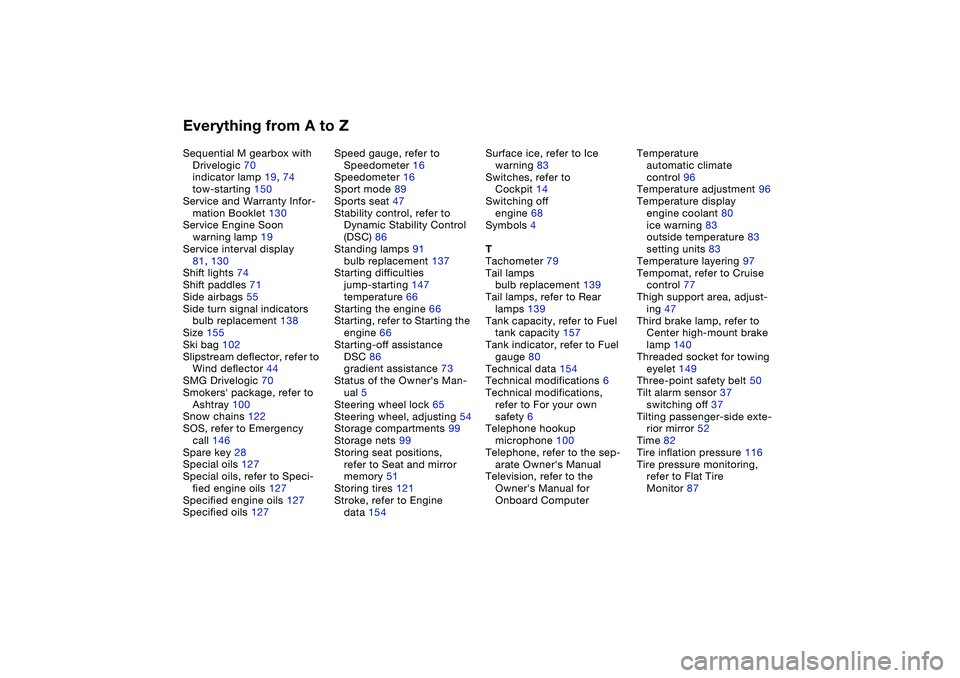
Everything from A to ZSequential M gearbox with
Drivelogic 70
indicator lamp 19, 74
tow-starting 150
Service and Warranty Infor-
mation Booklet 130
Service Engine Soon
warning lamp 19
Service interval display
81, 130
Shift lights 74
Shift paddles 71
Side airbags 55
Side turn signal indicators
bulb replacement 138
Size 155
Ski bag 102
Slipstream deflector, refer to
Wind deflector 44
SMG Drivelogic 70
Smokers' package, refer to
Ashtray 100
Snow chains 122
SOS, refer to Emergency
call 146
Spare key 28
Special oils 127
Special oils, refer to Speci-
fied engine oils 127
Specified engine oils 127
Specified oils 127Speed gauge, refer to
Speedometer 16
Speedometer 16
Sport mode 89
Sports seat 47
Stability control, refer to
Dynamic Stability Control
(DSC) 86
Standing lamps 91
bulb replacement 137
Starting difficulties
jump-starting 147
temperature 66
Starting the engine 66
Starting, refer to Starting the
engine 66
Starting-off assistance
DSC 86
gradient assistance 73
Status of the Owner's Man-
ual 5
Steering wheel lock 65
Steering wheel, adjusting 54
Storage compartments 99
Storage nets 99
Storing seat positions,
refer to Seat and mirror
memory 51
Storing tires 121
Stroke, refer to Engine
data 154Surface ice, refer to Ice
warning 83
Switches, refer to
Cockpit 14
Switching off
engine 68
Symbols 4
T
Tachometer 79
Tail lamps
bulb replacement 139
Tail lamps, refer to Rear
lamps 139
Tank capacity, refer to Fuel
tank capacity 157
Tank indicator, refer to Fuel
gauge 80
Technical data 154
Technical modifications 6
Technical modifications,
refer to For your own
safety 6
Telephone hookup
microphone 100
Telephone, refer to the sep-
arate Owner's Manual
Television, refer to the
Owner's Manual for
Onboard ComputerTemperature
automatic climate
control 96
Temperature adjustment 96
Temperature display
engine coolant 80
ice warning 83
outside temperature 83
setting units 83
Temperature layering 97
Tempomat, refer to Cruise
control 77
Thigh support area, adjust-
ing 47
Third brake lamp, refer to
Center high-mount brake
lamp 140
Threaded socket for towing
eyelet 149
Three-point safety belt 50
Tilt alarm sensor 37
switching off 37
Tilting passenger-side exte-
rior mirror 52
Time 82
Tire inflation pressure 116
Tire pressure monitoring,
refer to Flat Tire
Monitor 87
Page 169 of 174
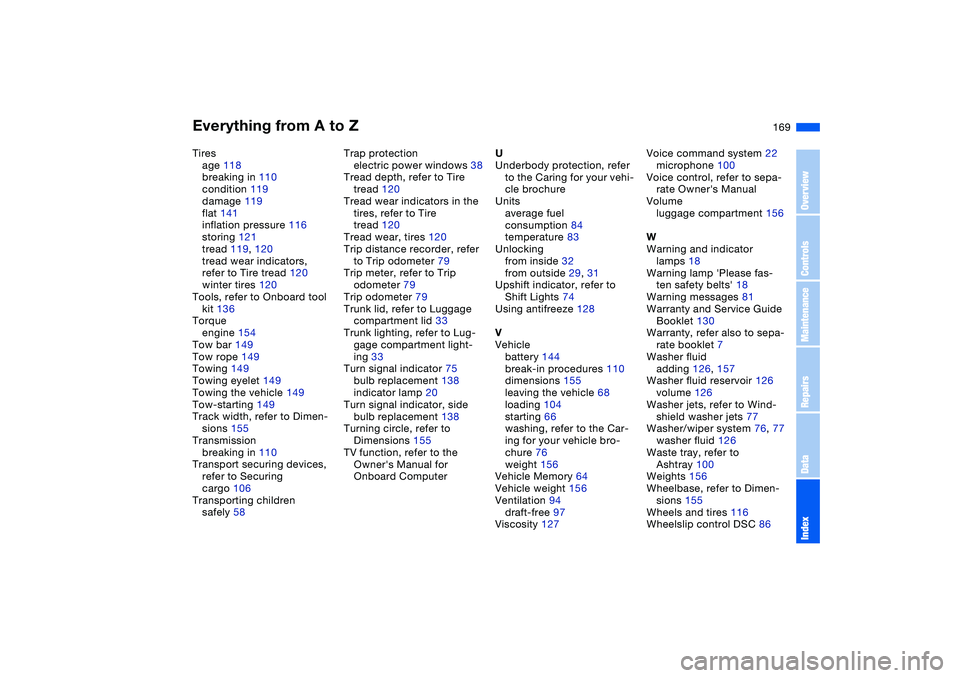
Everything from A to Z
169
Tires
age 118
breaking in 110
condition 119
damage 119
flat 141
inflation pressure 116
storing 121
tread 119, 120
tread wear indicators,
refer to Tire tread 120
winter tires 120
Tools, refer to Onboard tool
kit 136
Torque
engine 154
Tow bar 149
Tow rope 149
Towing 149
Towing eyelet 149
Towing the vehicle 149
Tow-starting 149
Track width, refer to Dimen-
sions 155
Transmission
breaking in 110
Transport securing devices,
refer to Securing
cargo 106
Transporting children
safely 58Trap protection
electric power windows 38
Tread depth, refer to Tire
tread 120
Tread wear indicators in the
tires, refer to Tire
tread 120
Tread wear, tires 120
Trip distance recorder, refer
to Trip odometer 79
Trip meter, refer to Trip
odometer 79
Trip odometer 79
Trunk lid, refer to Luggage
compartment lid 33
Trunk lighting, refer to Lug-
gage compartment light-
ing 33
Turn signal indicator 75
bulb replacement 138
indicator lamp 20
Turn signal indicator, side
bulb replacement 138
Turning circle, refer to
Dimensions 155
TV function, refer to the
Owner's Manual for
Onboard ComputerU
Underbody protection, refer
to the Caring for your vehi-
cle brochure
Units
average fuel
consumption 84
temperature 83
Unlocking
from inside 32
from outside 29, 31
Upshift indicator, refer to
Shift Lights 74
Using antifreeze 128
V
Vehicle
battery 144
break-in procedures 110
dimensions 155
leaving the vehicle 68
loading 104
starting 66
washing, refer to the Car-
ing for your vehicle bro-
chure 76
weight 156
Vehicle Memory 64
Vehicle weight 156
Ventilation 94
draft-free 97
Viscosity 127Voice command system 22
microphone 100
Voice control, refer to sepa-
rate Owner's Manual
Volume
luggage compartment 156
W
Warning and indicator
lamps 18
Warning lamp 'Please fas-
ten safety belts' 18
Warning messages 81
Warranty and Service Guide
Booklet 130
Warranty, refer also to sepa-
rate booklet 7
Washer fluid
adding 126, 157
Washer fluid reservoir 126
volume 126
Washer jets, refer to Wind-
shield washer jets 77
Washer/wiper system 76, 77
washer fluid 126
Waste tray, refer to
Ashtray 100
Weights 156
Wheelbase, refer to Dimen-
sions 155
Wheels and tires 116
Wheelslip control DSC 86
OverviewControlsMaintenanceRepairsDataIndex