ESP BMW M3 COUPE 2001 E46 User Guide
[x] Cancel search | Manufacturer: BMW, Model Year: 2001, Model line: M3 COUPE, Model: BMW M3 COUPE 2001 E46Pages: 183, PDF Size: 1.65 MB
Page 56 of 183
56n
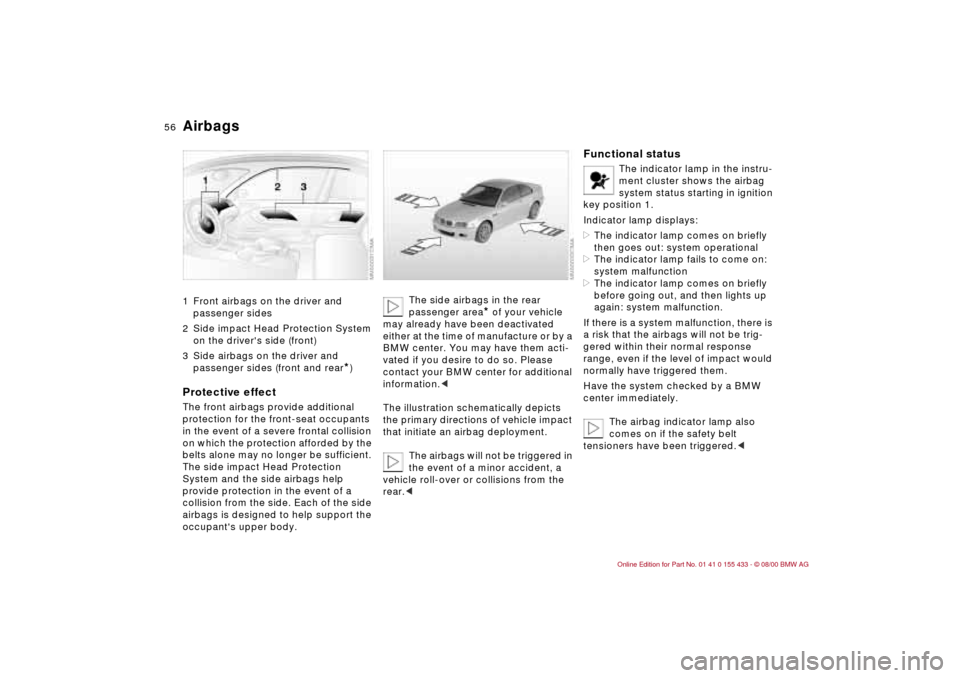
Airbags 1 Front airbags on the driver and
passenger sides
2 Side impact Head Protection System
on the driver's side (front)
3 Side airbags on the driver and
passenger sides (front and rear
*)
Protective effectThe front airbags provide additional
protection for the front-seat occupants
in the event of a severe frontal collision
on which the protection afforded by the
belts alone may no longer be sufficient.
The side impact Head Protection
System and the side airbags help
provide protection in the event of a
collision from the side. Each of the side
airbags is designed to help support the
occupant's upper body.
The side airbags in the rear
passenger area
* of your vehicle
may already have been deactivated
either at the time of manufacture or by a
BMW center. You may have them acti-
vated if you desire to do so. Please
contact your BMW center for additional
information.<
The illustration schematically depicts
the primary directions of vehicle impact
that initiate an airbag deployment.
The airbags will not be triggered in
the event of a minor accident, a
vehicle roll-over or collisions from the
rear.<
Functional status
The indicator lamp in the instru-
ment cluster shows the airbag
system status starting in ignition
key position 1.
Indicator lamp displays:
>The indicator lamp comes on briefly
then goes out: system operational
>The indicator lamp fails to come on:
system malfunction
>The indicator lamp comes on briefly
before going out, and then lights up
again: system malfunction.
If there is a system malfunction, there is
a risk that the airbags will not be trig-
gered within their normal response
range, even if the level of impact would
normally have triggered them.
Have the system checked by a BMW
center immediately.
The airbag indicator lamp also
comes on if the safety belt
tensioners have been triggered.<
Page 59 of 183
59n
IndexDataTechnologyRepairsCar careControlsOverview
Transporting children safelyCommercially available child restraint
systems are designed to be secured
with a lap belt or with the lap belt
portion of a combination lap/shoulder
belt. Improperly or inadequately
installed restraint systems can increase
the risk of injury to children. Always
read and follow the instructions that
come with the system.
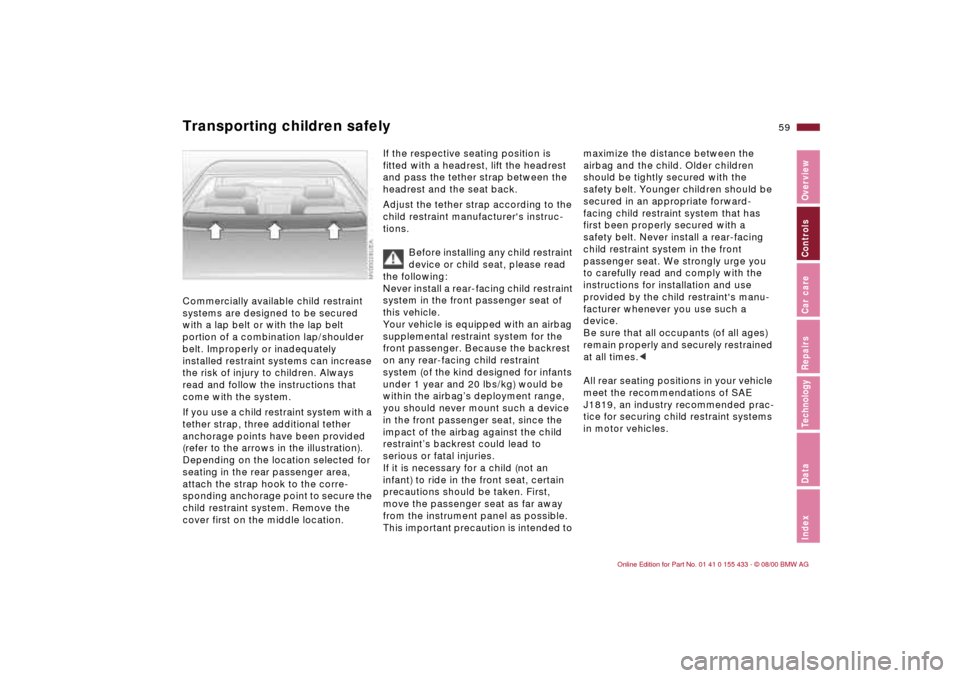
If you use a child restraint system with a
tether strap, three additional tether
anchorage points have been provided
(refer to the arrows in the illustration).
Depending on the location selected for
seating in the rear passenger area,
attach the strap hook to the corre-
sponding anchorage point to secure the
child restraint system. Remove the
cover first on the middle location.
If the respective seating position is
fitted with a headrest, lift the headrest
and pass the tether strap between the
headrest and the seat back.
Adjust the tether strap according to the
child restraint manufacturer's instruc-
tions.
Before installing any child restraint
device or child seat, please read
the following:
Never install a rear-facing child restraint
system in the front passenger seat of
this vehicle.
Your vehicle is equipped with an airbag
supplemental restraint system for the
front passenger. Because the backrest
on any rear-facing child restraint
system (of the kind designed for infants
under 1 year and 20 lbs/kg) would be
within the airbagÕs deployment range,
you should never mount such a device
in the front passenger seat, since the
impact of the airbag against the child
restraintÕs backrest could lead to
serious or fatal injuries.
If it is necessary for a child (not an
infant) to ride in the front seat, certain
precautions should be taken. First,
move the passenger seat as far away
from the instrument panel as possible.
This important precaution is intended to
maximize the distance between the
airbag and the child. Older children
should be tightly secured with the
safety belt. Younger children should be
secured in an appropriate forward-
facing child restraint system that has
first been properly secured with a
safety belt. Never install a rear-facing
child restraint system in the front
passenger seat. We strongly urge you
to carefully read and comply with the
instructions for installation and use
provided by the child restraint's manu-
facturer whenever you use such a
device.
Be sure that all occupants (of all ages)
remain properly and securely restrained
at all times.c
All rear seating positions in your vehicle
meet the recommendations of SAE
J1819, an industry recommended prac-
tice for securing child restraint systems
in motor vehicles.
Page 66 of 183
66n
Washer/Wiper system/Rain sensorRain sensor
*
When the rain sensor is activated, the
windshield wiper is controlled automati-
cally, depending on the degree of
wetness of the windshield (in both snow
and rain). You do not have to be
concerned with switching the wind-
shield wiper on or off or adjusting the
wipe interval between intermittent and
full wipe. Instead, you can concentrate
fully on the traffic conditions. This is
especially important under adverse
weather conditions.
The rain sensor is positioned on the
windshield, directly ahead of the inte-
rior rearview mirror.
To activate the rain sensor:
>From ignition key position 1, move
the lever to position 1. The wipers
travel once across the windshield,
regardless of the weather.
>You can leave the lever permanently
in position 1. It is then only necessary
to activate the rain sensor from igni-
tion key position 1. To do this
>give rotary dial 5 a quick turn or
>clean the windshield 5, refer to
page 66.
To adjust the sensitivity of the rain
sensor: turn rotary dial 5.Deactivating the rain sensor: put lever
in position 0.
Deactivate the rain sensor when
passing through an automatic car
wash. Failure to do so could result in
damage caused by undesired wiper
activation.<
Normal wiper speedWhen the vehicle is stationary, the
wipers switch automatically to intermit-
tent wipe (not on vehicles with rain
sensor).Fast wiper speedWhen the vehicle is stationary, the
wipers operate at normal speed (not on
vehicles with rain sensor).
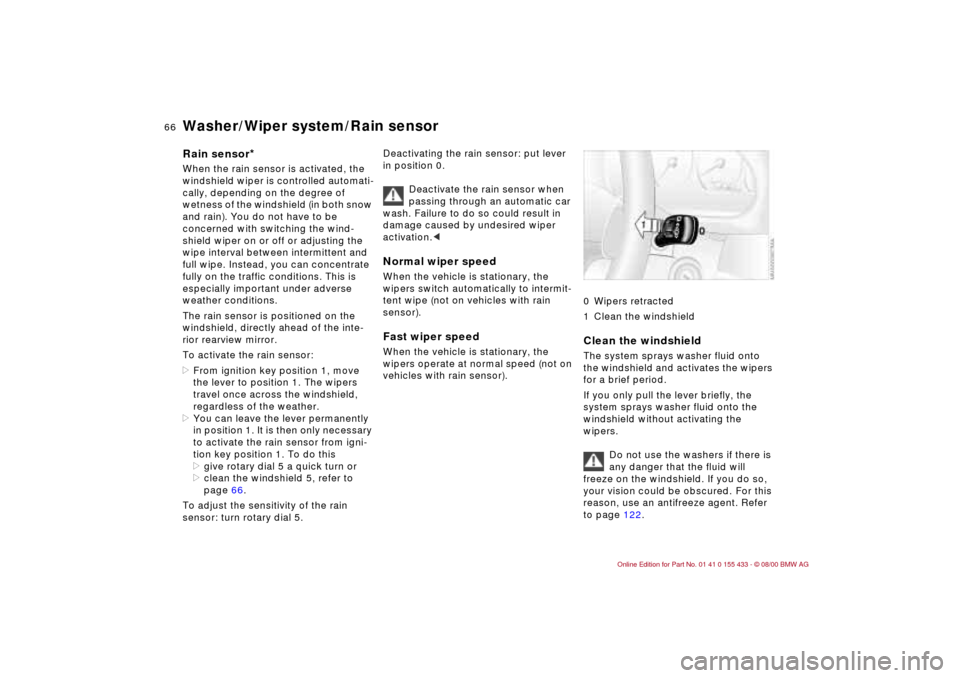
0 Wipers retracted
1 Clean the windshieldClean the windshieldThe system sprays washer fluid onto
the windshield and activates the wipers
for a brief period.
If you only pull the lever briefly, the
system sprays washer fluid onto the
windshield without activating the
wipers.
Do not use the washers if there is
any danger that the fluid will
freeze on the windshield. If you do so,
your vision could be obscured. For this
reason, use an antifreeze agent. Refer
to page 122.
Page 70 of 183
70n
Fuel gauge Coolant temperature gauge Once the indicator lamp stays on
continuously, there are still approx.
2 gallons (8 liters) of fuel in the fuel
tank.
For fuel tank capacity, refer to
page 169.
If the tilt of the vehicle varies (when you
are driving in mountainous areas, for
example), the needle may fluctuate
slightly.
Please refuel early, since driving
to the last drop of fuel can result in
damage to the engine and/or catalytic
converter.<
When the ignition is turned on, the indi-
cator lamp in the fuel display will light
up briefly as a functional check.
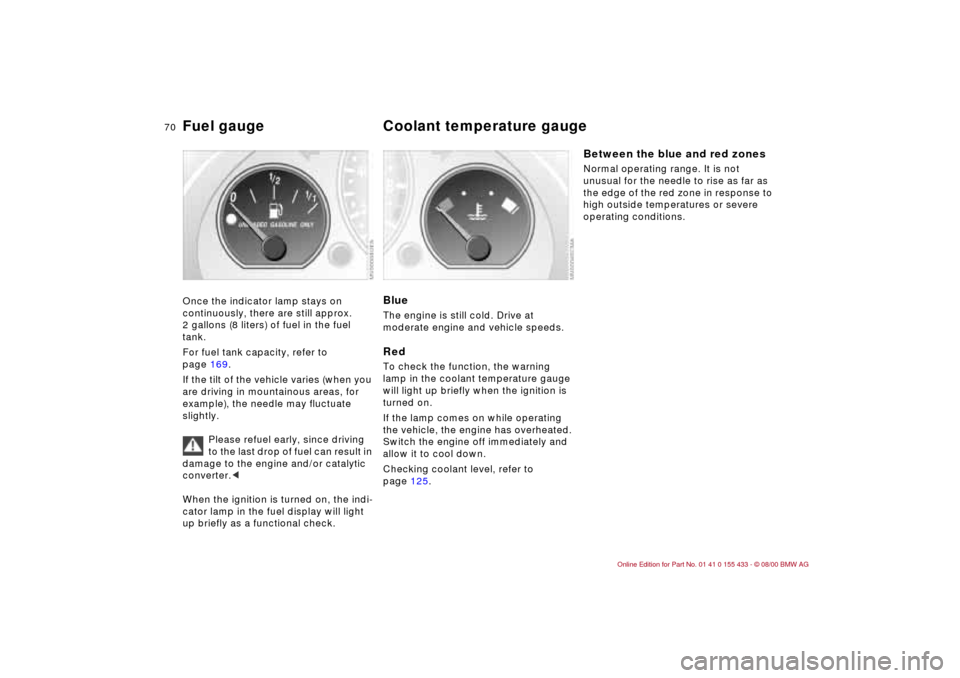
BlueThe engine is still cold. Drive at
moderate engine and vehicle speeds. RedTo check the function, the warning
lamp in the coolant temperature gauge
will light up briefly when the ignition is
turned on.
If the lamp comes on while operating
the vehicle, the engine has overheated.
Switch the engine off immediately and
allow it to cool down.
Checking coolant level, refer to
page 125.
Between the blue and red zonesNormal operating range. It is not
unusual for the needle to rise as far as
the edge of the red zone in response to
high outside temperatures or severe
operating conditions.
Page 75 of 183
75n
IndexDataTechnologyRepairsCar careControlsOverview
The conceptThe PDC assists you when you back
into a parking space. A signal warns
you of the distance to an obstacle. To
do this, four ultrasonic sensors in the
rear bumper measure the distance to
the nearest object. The range for the
sensors located at both rear corners
ends approx. 2 ft (60 cm) behind the
bumpers. The range for the two middle
sensors is slightly less than 4.9 ft
(1.50 meters).
The system is activated automatically
about one second after you engage
reverse with the ignition key in posi-
tion 2. PDC is deactivated when you
shift back out of reverse.
Acoustic signalsThe distance to the nearest object is
indicated by a tone sounding at various
intervals. As the distance between
vehicle and object decreases, the inter-
vals between the tones become
shorter. A continuous tone indicates the
presence of an object less than 1 ft.
(30 cm) away.
The warning signal is canceled after
approx. three seconds if the distance to
the obstacle remains constant during
this time (if you are moving parallel to a
wall, for instance).
System malfunctions will be indicated
by a continuous high-pitched tone
when the system is activated the first
time. Please have your BMW center
resolve the problem.The PDC does not remove the
driver's personal responsibility for
evaluating the distance between the
vehicle and any obstacles. Even when
sensors are involved, there is a blind
spot in which objects cannot be
detected. This applies especially in
those cases where the system
approaches the physical limits of ultra-
sonic measurement, as occurs with tow
bars and trailer couplings, and in the
vicinity of thin and painted objects.
Certain sources of sound, such as a
loud radio, could drown the PDC signal
tone.<
Keep the sensors clean and free
of ice or snow in order to ensure
that they continue to operate effec-
tively.
Do not apply high pressure spray to the
sensors for a prolonged period of time.
Always maintain a distance of more
than 4 in (10 cm). <
Park Distance Control (PDC)
*
Page 76 of 183
76n
Dynamic Stability Control (DSC) The conceptDSC maintains vehicle stability, even in
critical driving situations.
The system optimizes vehicle stability
during acceleration and when starting
from a full stop, as well as optimizing
traction. In addition, it also recognizes
unstable driving conditions such as
understeering or oversteering in curves,
and helps the vehicle remin on a steady
course by using the engine and brake
system to intervene at the different
wheels. This, of course, is true only
within physically teasible limits.
The DSC is operational every time you
start the engine. The laws of physics cannot be
repealed, even with DSC. It will
always be the driver's responsibility to
drive in a manner that matches road
conditions. We therefore urge you to
avoid using the additional safety margin
of the system as an excuse for taking
risks.
Do not make any modifications to the
DSC system. Allow only authorized
technicians to perform service proce-
dures on the DSC.<
At first, you may need some time to
become accustomed to this system's
intervention. However, it guarantees
optimum drive force and at the same
time, the best possible vehicle stability.
For additional details concerning DSC,
refer to the chapter "Advanced tech-
nology" on page 158.
Indicator lamp
The indicator lamp in the instru-
ment cluster will go out shortly
after the ignition has been
switched on. Refer to pages 21, 22.
>Indicator lamp flashes: the DSC is
active and is controlling the drive
torque based on driving conditions
>If the indicator lamp fails to go out
after the engine has been started, or
if it comes on during normal driving
and stays on: the DSC has been
switched off via the button or there is
a malfunction. You can continue to
drive the vehicle normally, but
without DSC. Please consult your
BMW center for repairs.
Page 80 of 183
80n
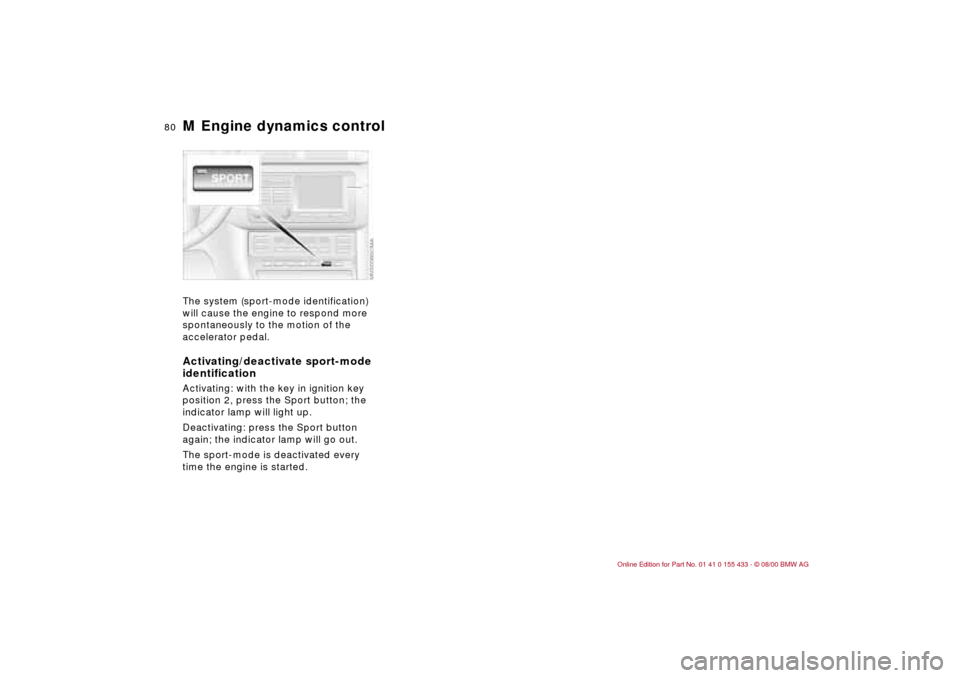
M Engine dynamics controlThe system (sport-mode identification)
will cause the engine to respond more
spontaneously to the motion of the
accelerator pedal. Activating/deactivate sport-mode
identificationActivating: with the key in ignition key
position 2, press the Sport button; the
indicator lamp will light up.
Deactivating: press the Sport button
again; the indicator lamp will go out.
The sport-mode is deactivated every
time the engine is started.
Page 85 of 183
85n
IndexDataTechnologyRepairsCar careControlsOverview
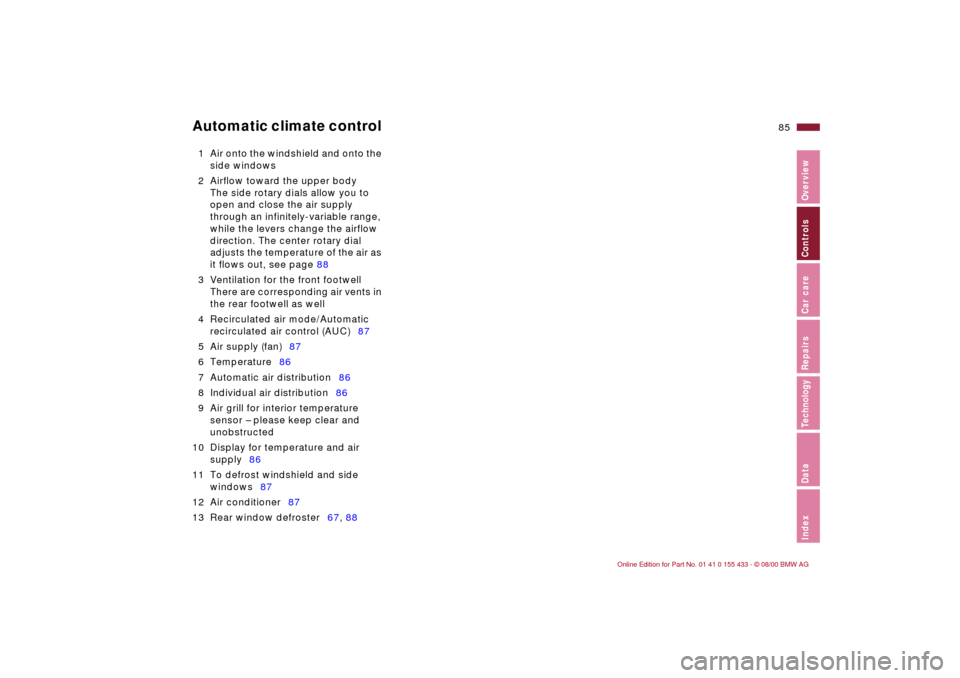
Automatic climate control 1 Air onto the windshield and onto the
side windows
2 Airflow toward the upper body
The side rotary dials allow you to
open and close the air supply
through an infinitely-variable range,
while the levers change the airflow
direction. The center rotary dial
adjusts the temperature of the air as
it flows out, see page 88
3 Ventilation for the front footwell
There are corresponding air vents in
the rear footwell as well
4 Recirculated air mode/Automatic
recirculated air control (AUC)87
5 Air supply (fan)87
6 Temperature86
7 Automatic air distribution86
8 Individual air distribution86
9 Air grill for interior temperature
sensor Ð please keep clear and
unobstructed
10 Display for temperature and air
supply86
11 To defrost windshield and side
windows87
12 Air conditioner87
13 Rear window defroster67, 88
Page 87 of 183
87n
IndexDataTechnologyRepairsCar careControlsOverview
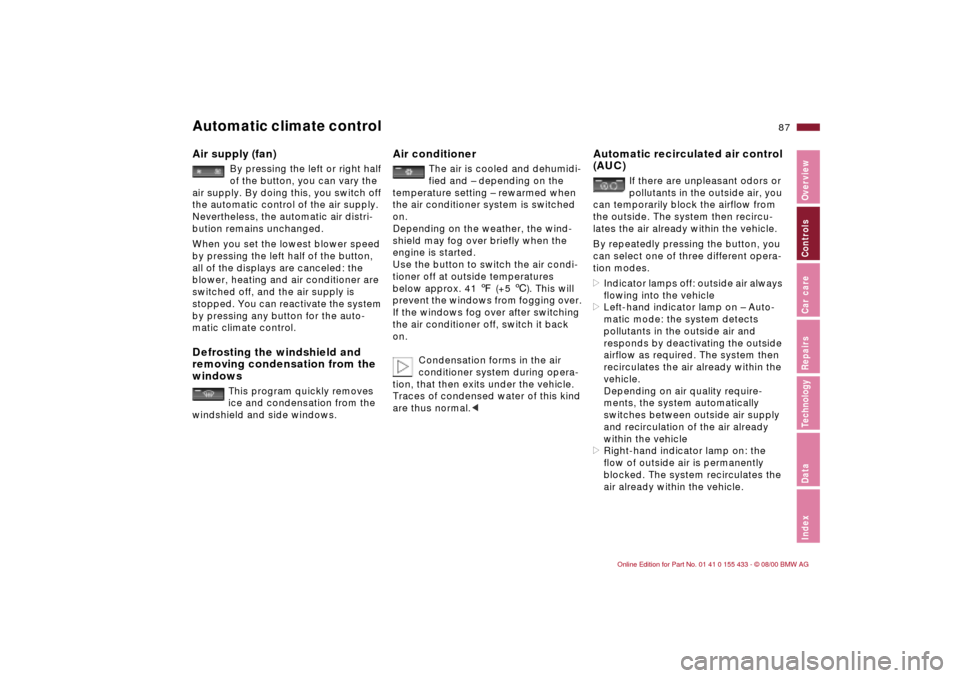
Automatic climate control Air supply (fan)
By pressing the left or right half
of the button, you can vary the
air supply. By doing this, you switch off
the automatic control of the air supply.
Nevertheless, the automatic air distri-
bution remains unchanged.
When you set the lowest blower speed
by pressing the left half of the button,
all of the displays are canceled: the
blower, heating and air conditioner are
switched off, and the air supply is
stopped. You can reactivate the system
by pressing any button for the auto-
matic climate control.
Defrosting the windshield and
removing condensation from the
windows
This program quickly removes
ice and condensation from the
windshield and side windows.
Air conditioner
The air is cooled and dehumidi-
fied and Ð depending on the
temperature setting Ð rewarmed when
the air conditioner system is switched
on.
Depending on the weather, the wind-
shield may fog over briefly when the
engine is started.
Use the button to switch the air condi-
tioner off at outside temperatures
below approx. 41 7 (+5 6). This will
prevent the windows from fogging over.
If the windows fog over after switching
the air conditioner off, switch it back
on.
Condensation forms in the air
conditioner system during opera-
tion, that then exits under the vehicle.
Traces of condensed water of this kind
are thus normal.<
Automatic recirculated air control
(AUC)
If there are unpleasant odors or
pollutants in the outside air, you
can temporarily block the airflow from
the outside. The system then recircu-
lates the air already within the vehicle.
By repeatedly pressing the button, you
can select one of three different opera-
tion modes.
>Indicator lamps off: outside air always
flowing into the vehicle
>Left-hand indicator lamp on Ð Auto-
matic mode: the system detects
pollutants in the outside air and
responds by deactivating the outside
airflow as required. The system then
recirculates the air already within the
vehicle.
Depending on air quality require-
ments, the system automatically
switches between outside air supply
and recirculation of the air already
within the vehicle
>Right-hand indicator lamp on: the
flow of outside air is permanently
blocked. The system recirculates the
air already within the vehicle.
Page 95 of 183
95n
IndexDataTechnologyRepairsCar careControlsOverview
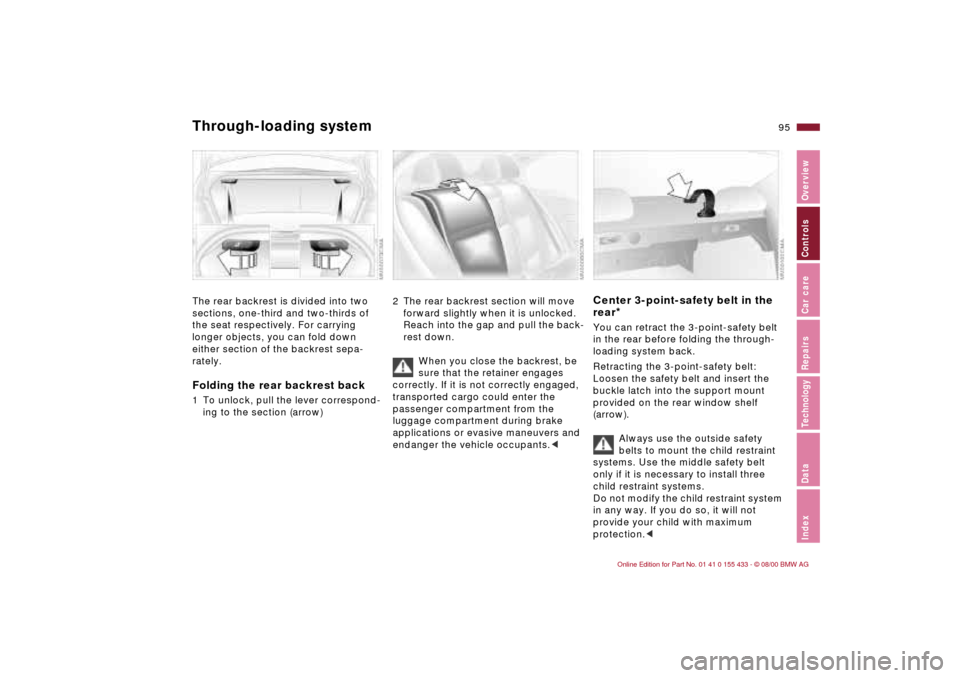
Through-loading systemThe rear backrest is divided into two
sections, one-third and two-thirds of
the seat respectively. For carrying
longer objects, you can fold down
either section of the backrest sepa-
rately.Folding the rear backrest back1 To unlock, pull the lever correspond-
ing to the section (arrow)
2 The rear backrest section will move
forward slightly when it is unlocked.
Reach into the gap and pull the back-
rest down.
When you close the backrest, be
sure that the retainer engages
correctly. If it is not correctly engaged,
transported cargo could enter the
passenger compartment from the
luggage compartment during brake
applications or evasive maneuvers and
endanger the vehicle occupants.<
Center 3-point-safety belt in the
rear
*
You can retract the 3-point-safety belt
in the rear before folding the through-
loading system back.
Retracting the 3-point-safety belt:
Loosen the safety belt and insert the
buckle latch into the support mount
provided on the rear window shelf
(arrow).
Always use the outside safety
belts to mount the child restraint
systems. Use the middle safety belt
only if it is necessary to install three
child restraint systems.
Do not modify the child restraint system
in any way. If you do so, it will not
provide your child with maximum
protection.<