instrument cluster BMW M3 COUPE 2001 E46 User Guide
[x] Cancel search | Manufacturer: BMW, Model Year: 2001, Model line: M3 COUPE, Model: BMW M3 COUPE 2001 E46Pages: 183, PDF Size: 1.65 MB
Page 82 of 183
82n
High beams/Parking lamp Fog lamps
Interior lamps
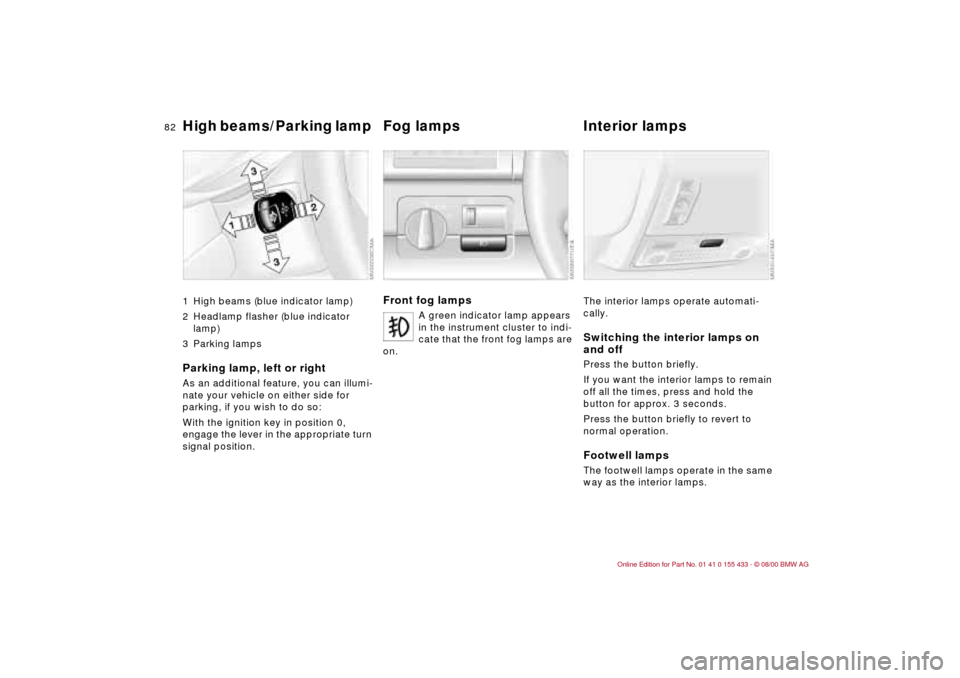
1 High beams (blue indicator lamp)
2 Headlamp flasher (blue indicator
lamp)
3 Parking lampsParking lamp, left or rightAs an additional feature, you can illumi-
nate your vehicle on either side for
parking, if you wish to do so:
With the ignition key in position 0,
engage the lever in the appropriate turn
signal position.
Front fog lamps
A green indicator lamp appears
in the instrument cluster to indi-
cate that the front fog lamps are
on.
The interior lamps operate automati-
cally.Switching the interior lamps on
and offPress the button briefly.
If you want the interior lamps to remain
off all the times, press and hold the
button for approx. 3 seconds.
Press the button briefly to revert to
normal operation.Footwell lampsThe footwell lamps operate in the same
way as the interior lamps.
Page 125 of 183
125n
IndexDataTechnologyRepairsCar careControlsOverview
Coolant
Do not add coolant to the cooling
system when the engine is hot. If
you do, escaping coolant can cause
burns.
To avoid the possibility of damage later
on, never use anything other than
factory-approved, nitrite and amino-
free extended-duty antifreeze with
corrosion inhibitor. Your BMW center is
familiar with the official specifications.
Antifreeze and anticorrosion agents are
hazardous to health. You should always
store them in original containers and in
a location inaccessible to children.
Extended-duty antifreeze with corro-
sion inhibitor contains ethylene glycol,
a flammable substance. For this reason,
do not spill long-life antifreeze with
corrosion inhibitor on hot engine parts.
It could catch fire and cause burns.<
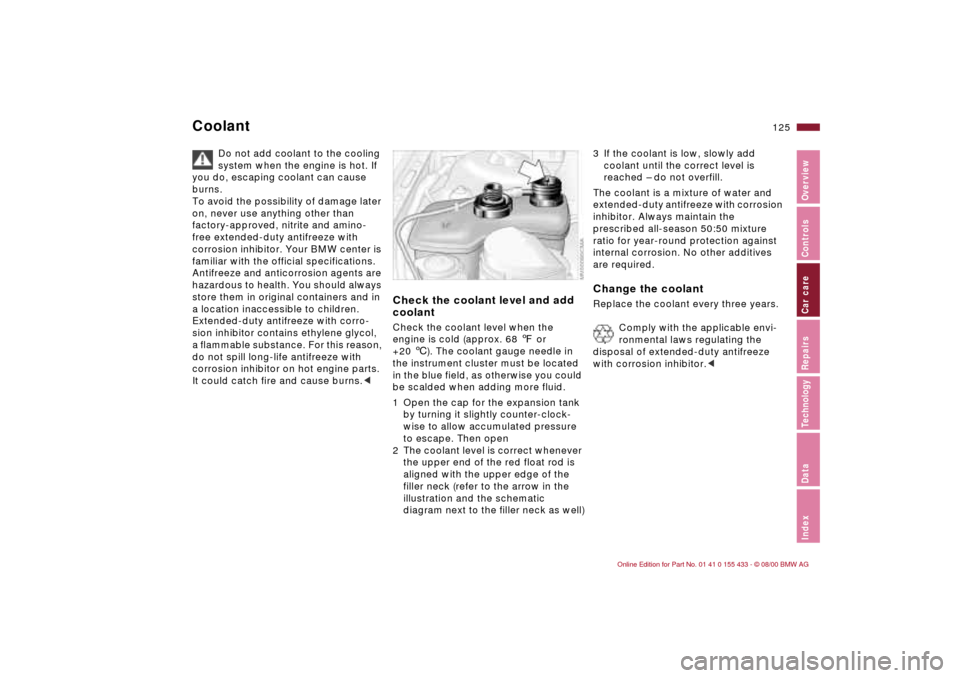
Check the coolant level and add
coolant Check the coolant level when the
engine is cold (approx. 68 7 or
+20 6). The coolant gauge needle in
the instrument cluster must be located
in the blue field, as otherwise you could
be scalded when adding more fluid.
1 Open the cap for the expansion tank
by turning it slightly counter-clock-
wise to allow accumulated pressure
to escape. Then open
2 The coolant level is correct whenever
the upper end of the red float rod is
aligned with the upper edge of the
filler neck (refer to the arrow in the
illustration and the schematic
diagram next to the filler neck as well)
3 If the coolant is low, slowly add
coolant until the correct level is
reached Ð do not overfill.
The coolant is a mixture of water and
extended-duty antifreeze with corrosion
inhibitor. Always maintain the
prescribed all-season 50:50 mixture
ratio for year-round protection against
internal corrosion. No other additives
are required.Change the coolantReplace the coolant every three years.
Comply with the applicable envi-
ronmental laws regulating the
disposal of extended-duty antifreeze
with corrosion inhibitor.<
Page 131 of 183

131n
IndexDataTechnologyRepairsCar careControlsOverview
Caring for your vehicleCaring for other vehicle
components and materials Light-alloy wheels should be treated
with alloy wheel cleaner, especially
during the winter months. However, do
not use aggressive products contain-
ing acids, strong alkalis or abrasives.
Do not use steam cleaners operating at
temperatures above 140 7 (+60 6).
Follow the manufacturer's instructions.
If your vehicle has chrome parts
* such
as window moldings, door handles or
similar items, clean these parts carefully
with ample clean water, and possibly a
shampoo additive, especially if there is
an accumulation of road salt. Use
chrome polish as an additional treat-
ment.
Plastic components, vinyl upholstery,
headliners, lamp lenses, the clear cover
of the instrument cluster and compon-
ents with a sprayed dull black surface
can be cleaned with water (add plastic
shampoo as required). Do not allow
moisture to soak through the seats or
headliner. Never use solvents such as
lacquer thinner, heavy-duty grease
remover, fuels, or similar substances.
Rubber components should be cleaned
with water only; a rubber treatment or
silicone spray may also be applied. The safety belts should be cleaned with
a mild soap and water solution without
being removed from the vehicle. Never
attempt chemical or dry cleaning, as
damage to the belt fabric could result.
After cleaning, never allow the inertia
reel to retract the belts until they are
completely dry. Dirty safety belts pre-
vent the inertia reel mechanism from
retracting the strap properly, and thus
constitute a safety hazard.
Heavily soiled floor carpets and mats
*
can be cleaned with an interior cleaner.
The floor mats can be removed from
the vehicle for cleaning.
Use only a damp cloth to clean trim
panels made of real wood
* and other
parts constructed of real wood
*. Follow
up by drying with a soft cloth.
Use the cleaning and car-care
products that you can obtain at
your BMW center.<
Care of upholstery materials Depressions in the upholstery that
result from everyday use can be
brushed smooth by brushing against
the nap with a lightly dampened brush.
The tendency of the pile to lie in a par-
ticular direction on velour upholstery is
not a quality defect. Just as with home
textiles or clothing, this cannot be
avoided.
Lint on upholstery materials, textile or
leather remnants that have been worn
into the upholstery may be removed
with a lint brush or a Velcro brush. A
cleaning glove is available for particu-
larly "stubborn" lint. Stains and fairly
large areas of dirt should be cleaned off
without delay, using lukewarm water
and an interior cleaner, stain remover or
appropriate cleaning fluid. Brush the
fabric afterwards to restore its appear-
ance.
If the vehicle will be stored for an
extended period or if it is exposed to
intense sunlight, cover all the seats or
the windows to prevent fading.
Use the cleaning and car-care
products that you can obtain at
your BMW center.<
Page 176 of 183

Everything from A to Zhigh-speed aspirated
engine160
speed166
starting62t
torque166
Engine concept M3160
Engine oil
add123t
capacity169
consumption123
pressure20
temperature69
Entry to the rear47
Exterior mirrors49
Eyelets, towing155tFFailure messages72t
Fan87
Fault, ABS105
Filler cap cover25
Filling capacities169
Filling the washer
reservoir122t
First-aid kit24t
Flat tire111
repairing145
Fog lamps82
bulb replacement141t
Folding rear backrest95
Follow-Me-Home lamps81
Footbrake106Footwell lamps82
bulb replacement144t
Frost protection,
radiator125
Fuel26
consumption74
consumption display70
gauge70
preparation166
quality26
reserve indicator lamp70
Fuel filler door
manual release after
electrical fault152t
Fuel tank capacity169
Fuel tank gauge70
Functional status, electrical
and electronic
systems162
Fuses151
replacing151t
GGasoline26
Gasoline gauge70
Glove compartment90
Glove compartment lamp,
bulb replacement144t
Gross vehicle weight168
HHandbrake63
Handsfree system92
Hazard warning
flashers24t
Hazard warning triangle24
Head restraint46
Headlamp cleaning
system121, 122, 169
Headlamp cover,
care139t
Headlamp flasher82
Headlamp washer system,
refer to headlamp cleaning
system
Heated seats89
Heavy loads97
Height167
HiFi system Ð harman
kardon90
High beams65, 82
indicator lamp22
High engine speed160
High Performance Synthetic
Oil124
High-mount brake lamp143
Holder for beverages91
Hood release118t
Horn17
IIce warning73
Identification, tires114
Ignition key30
Ignition lock62
Imprint4
Indicator lamps20t
Individual settings52
Inflation
pressure26t, 111t
INSPECTION71
Instrument cluster18
Instrument lighting81
Instrument panel18
Interaxle tire rotation113t
Interface socket
for Onboard
Diagnostics135
Interference
cellular phone110
Interior lamps34, 82
bulb replacement143t
remote control34
Interior motion sensor40
Interior rearview mirror
automatic dimming
feature50, 161
Intermittent mode, wiper
system65