steering wheel BMW M3 COUPE 2001 E46 User Guide
[x] Cancel search | Manufacturer: BMW, Model Year: 2001, Model line: M3 COUPE, Model: BMW M3 COUPE 2001 E46Pages: 183, PDF Size: 1.65 MB
Page 62 of 183
62n
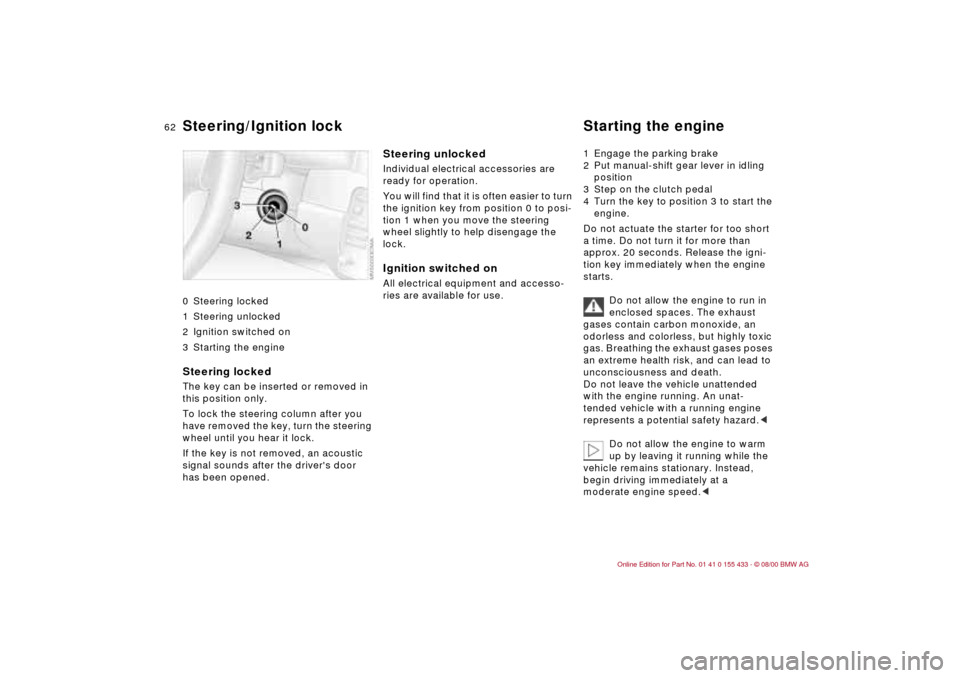
0 Steering locked
1 Steering unlocked
2 Ignition switched on
3 Starting the engine
Steering locked The key can be inserted or removed in
this position only.
To lock the steering column after you
have removed the key, turn the steering
wheel until you hear it lock.
If the key is not removed, an acoustic
signal sounds after the driver's door
has been opened.
Steering unlocked Individual electrical accessories are
ready for operation.
You will find that it is often easier to turn
the ignition key from position 0 to posi-
tion 1 when you move the steering
wheel slightly to help disengage the
lock. Ignition switched onAll electrical equipment and accesso-
ries are available for use. 1 Engage the parking brake
2 Put manual-shift gear lever in idling
position
3 Step on the clutch pedal
4 Turn the key to position 3 to start the
engine.
Do not actuate the starter for too short
a time. Do not turn it for more than
approx. 20 seconds. Release the igni-
tion key immediately when the engine
starts.
Do not allow the engine to run in
enclosed spaces. The exhaust
gases contain carbon monoxide, an
odorless and colorless, but highly toxic
gas. Breathing the exhaust gases poses
an extreme health risk, and can lead to
unconsciousness and death.
Do not leave the vehicle unattended
with the engine running. An unat-
tended vehicle with a running engine
represents a potential safety hazard.<
Do not allow the engine to warm
up by leaving it running while the
vehicle remains stationary. Instead,
begin driving immediately at a
moderate engine speed.<
Steering/Ignition lock Starting the engine
Page 63 of 183
63n
IndexDataTechnologyRepairsCar careControlsOverview
Starting the engine Switching off engine Parking brake If the engine does not start on the first
attempt (if the engine is very hot or
cold, for instance):
>Press the accelerator pedal halfway
down while engaging the starter.
Cold starts at very low temperatures,
starting at about +5 7 (Ð15 6) and
at high altitudes over 3,300 ft
(1,000 meters):
>On the first start attempt, engage the
starter for a longer period (approx.
10 seconds)
>Press the accelerator pedal halfway
down while engaging the starter.
Engine idle speed is controlled by the
engine computer system. Increased
speeds at startup are normal and
should decrease as the engine warms
up. If engine speed does not decrease,
service is required.
To prevent the battery from
discharging, always deactivate elec-
trical devices that are not in use. Switch
the ignition off when the vehicle is not
being driven.Turn the ignition key to position 1 or 0.
Do not remove the ignition key
while the vehicle is still moving. If
you do so, the steering will lock, making
it impossible to steer the vehicle.
When you leave the vehicle, always
remove the ignition key and engage
the steering lock.
Set the parking brake when parking on
steep hills, because under certain
conditions, putting the vehicle into first
gear or reverse may not be enough to
prevent it from rolling away.
The power assist is not available when
the engine is not on. This means that
more effort is required to apply the
brakes.<
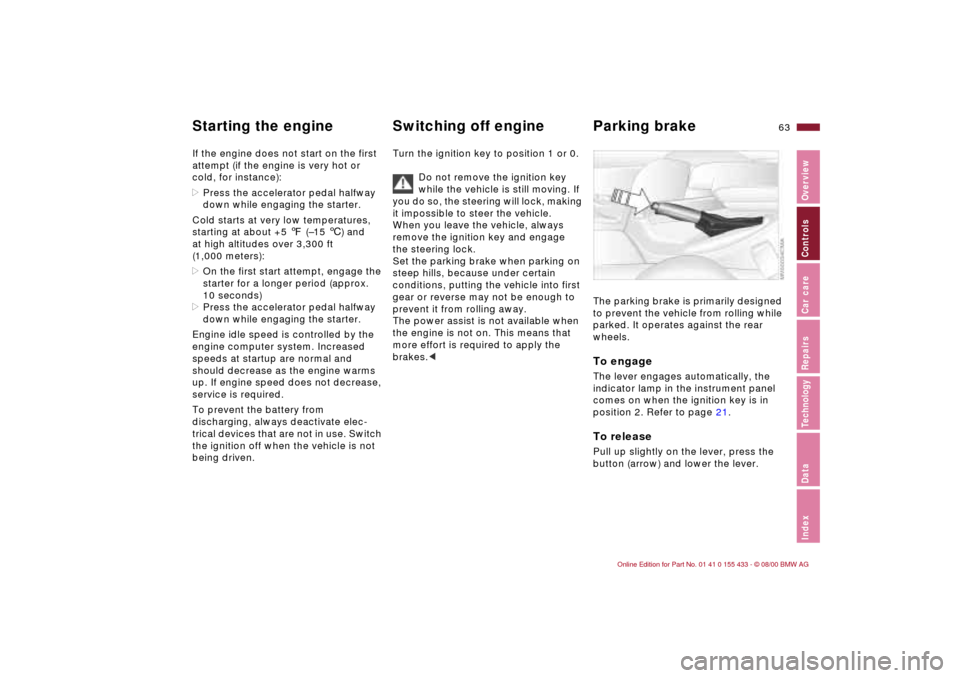
The parking brake is primarily designed
to prevent the vehicle from rolling while
parked. It operates against the rear
wheels. To engageThe lever engages automatically, the
indicator lamp in the instrument panel
comes on when the ignition key is in
position 2. Refer to page 21.To releasePull up slightly on the lever, press the
button (arrow) and lower the lever.
Page 76 of 183

76n
Dynamic Stability Control (DSC) The conceptDSC maintains vehicle stability, even in
critical driving situations.
The system optimizes vehicle stability
during acceleration and when starting
from a full stop, as well as optimizing
traction. In addition, it also recognizes
unstable driving conditions such as
understeering or oversteering in curves,
and helps the vehicle remin on a steady
course by using the engine and brake
system to intervene at the different
wheels. This, of course, is true only
within physically teasible limits.
The DSC is operational every time you
start the engine. The laws of physics cannot be
repealed, even with DSC. It will
always be the driver's responsibility to
drive in a manner that matches road
conditions. We therefore urge you to
avoid using the additional safety margin
of the system as an excuse for taking
risks.
Do not make any modifications to the
DSC system. Allow only authorized
technicians to perform service proce-
dures on the DSC.<
At first, you may need some time to
become accustomed to this system's
intervention. However, it guarantees
optimum drive force and at the same
time, the best possible vehicle stability.
For additional details concerning DSC,
refer to the chapter "Advanced tech-
nology" on page 158.
Indicator lamp
The indicator lamp in the instru-
ment cluster will go out shortly
after the ignition has been
switched on. Refer to pages 21, 22.
>Indicator lamp flashes: the DSC is
active and is controlling the drive
torque based on driving conditions
>If the indicator lamp fails to go out
after the engine has been started, or
if it comes on during normal driving
and stays on: the DSC has been
switched off via the button or there is
a malfunction. You can continue to
drive the vehicle normally, but
without DSC. Please consult your
BMW center for repairs.
Page 79 of 183
79n
IndexDataTechnologyRepairsCar careControlsOverview
Tire Pressure Warning (RDW)Activating/deactivating the
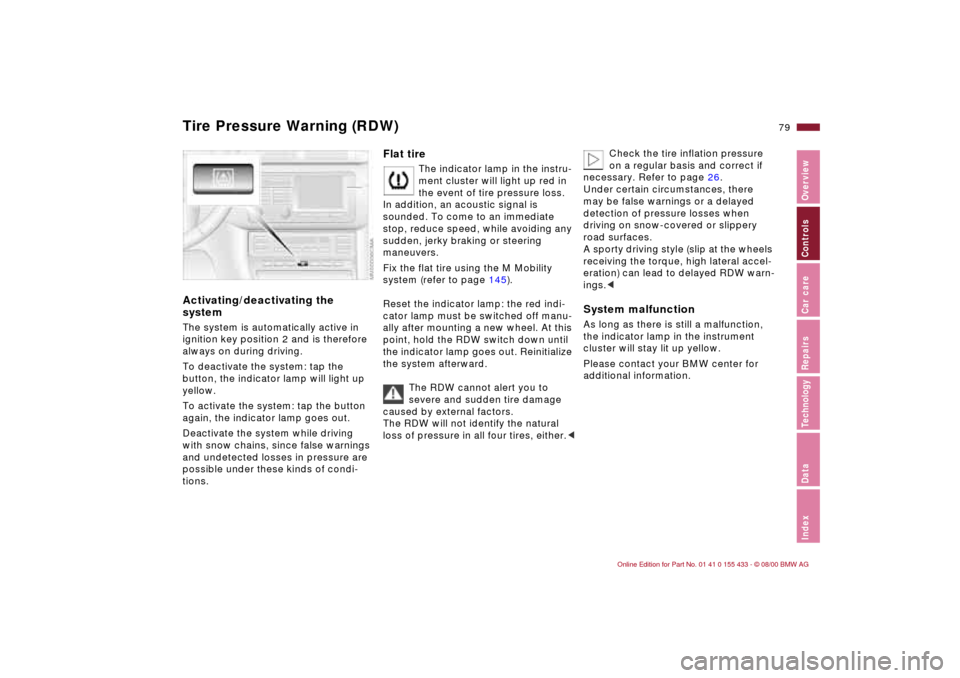
systemThe system is automatically active in
ignition key position 2 and is therefore
always on during driving.
To deactivate the system: tap the
button, the indicator lamp will light up
yellow.
To activate the system: tap the button
again, the indicator lamp goes out.
Deactivate the system while driving
with snow chains, since false warnings
and undetected losses in pressure are
possible under these kinds of condi-
tions.
Flat tire
The indicator lamp in the instru-
ment cluster will light up red in
the event of tire pressure loss.
In addition, an acoustic signal is
sounded. To come to an immediate
stop, reduce speed, while avoiding any
sudden, jerky braking or steering
maneuvers.
Fix the flat tire using the M Mobility
system (refer to page 145).
Reset the indicator lamp: the red indi-
cator lamp must be switched off manu-
ally after mounting a new wheel. At this
point, hold the RDW switch down until
the indicator lamp goes out. Reinitialize
the system afterward.
The RDW cannot alert you to
severe and sudden tire damage
caused by external factors.
The RDW will not identify the natural
loss of pressure in all four tires, either.<
Check the tire inflation pressure
on a regular basis and correct if
necessary. Refer to page 26.
Under certain circumstances, there
may be false warnings or a delayed
detection of pressure losses when
driving on snow-covered or slippery
road surfaces.
A sporty driving style (slip at the wheels
receiving the torque, high lateral accel-
eration) can lead to delayed RDW warn-
ings.<
System malfunctionAs long as there is still a malfunction,
the indicator lamp in the instrument
cluster will stay lit up yellow.
Please contact your BMW center for
additional information.
Page 101 of 183
Overview
Controls and features
Operation, care
and maintenance
Owner service procedures
Technical data
Index Advanced technology
101n
IndexDataTechnologyRepairsCar careControlsOverview
Special operating instructions:
Break-in procedures102
Driving notes103
Catalytic converter103
Antilock Brake System
(ABS)104
Disk brakes106
Brake system107
Winter operation108
Power steering110
Cellular phones110
Radio reception110
Wheels and tires:
Tire inflation pressure111
Tire condition111
Tire replacement112
Tire rotation113
Wheel and tire
combinations114
Winter tires115
Snow chains115
Approved wheel and tire
specifications116Under the hood:
Hood118
Engine compartment120
Washer fluids122
Washer nozzles122
Engine oil123
Coolant125
Brake fluid126
Vehicle Identification
Number126
Care and maintenance:
The BMW Maintenance
System127
Caring for your vehicle128
Airbags133
Vehicle storage133
Laws and regulations:
Technical modifications134
California Proposition
65 Warning134
OBD connector135
Car care
Page 104 of 183

104n
Antilock Brake System (ABS)The concept ABS keeps the wheels from locking
while braking, thereby enhancing active
driving safety. The reason: locked
wheels are dangerous. When the front
wheels slide, the driver loses steering
control over the vehicle. Traction loss at
the rear wheels can cause the rear end
to break into an uncontrolled skid.
Based on current road conditions, ABS
can brake the vehicle within the
shortest possible distance and with the
greatest possible driving stability (on
straight-aways and curves, asphalt, ice,
wet road surfaces, etc.).
ABS is designed to meet two essential
requirements during every brake appli-
cation:
>To help provide vehicle stability
>To help maintain steering control and
maneuverability Ð on all types of road
surfaces (asphalt, concrete, mud,
wet, snow, ice). Braking with ABSThe system becomes operative once
the vehicle exceeds a speed of approx.
6 mph (10 km/h). Whenever the
vehicle's speed drops below approx.
4 mph (6 km/h), the ABS is deactivated.
This means that the wheels can lock in the final phase of a panic stop Ð a factor
of no significance in actual use.
The ABS system works best in situa-
tions requiring maximum pressure on
the pedal ("panic stop"). Do not let up
on the brake pedal even after it starts
pulsating. Since the vehicle maintains
steering responsiveness, you can
nevertheless avoid possible obstacles
with a minimum of steering effort.
The ABS closed-loop control circuit
cycles in fractions of a second. Pulsa-
tion at the brake pedal shows you that
ABS is active, that you are braking
within the ABS' braking range and that
you are thus pushing the limit of the
system. In addition, a pulsation Ð a
result of the control function cycles Ð
indicates to the driver that the vehicle
speed should be reduced to adapt to
road surface conditions when there is
reduced traction and grip between tires
and road surface (slippery road
surface).
On road surfaces with a loose surface
layer over a firm base, e.g. on gravel or
snow, as well as when driving with
snow chains on, braking distances may
be longer for a locked-wheel condition.
However, ABS continues to provide
enhanced vehicle stability and steering
response under these conditions.
Information for your safetyNot even ABS can suspend the laws of
physics. The consequences of hitting
the brakes when there is inadequate
distance between vehicles, when the
vehicle is driven at excessive speeds
through curves, or during aquaplaning,
remain the driver's responsibility. You
should never allow the added safety of
ABS to lull you into a false sense of
security, or mislead you into taking risks
that could affect your own safety and
that of others.
Do not make any modifications to
the ABS system.
Service procedures on ABS are to be
performed by authorized technicians
only.< Antilock Brake System (ABS)/
Cornering Brake Control (CBC) CBC is an advanced engineering
design of the ABS. When braking while
cornering at high speed or braking
during high lateral acceleration, or
when braking during a lane change,
vehicle stability is improved and
steering response is enhanced.
Page 109 of 183

109n
IndexDataTechnologyRepairsCar careControlsOverview
Winter operationBrakingWinter road conditions substantially
reduce the amount of traction available
between the tires and the road surface;
the resulting increase in braking
distance is considerable and should
always be kept in mind.
ABS is intended to prevent the wheels
from locking during brake applications,
thus helping to maintain vehicle stability
and steering response.
If the ABS does not respond in a critical
braking situation and the wheels lock:
Reduce the pressure on the brake
pedal until the wheels just start to roll
again while still maintaining enough
force to continue braking. Then
increase the pressure, reduce the pres-
sure when the wheels lock, reapply
pressure etc.
This staggered braking procedure will
reduce stopping distances while
helping you maintain steering control.
You can then attempt to steer around
hazards after you have reduced pres-
sure on the brake pedal. Do not shift down on slick road
surfaces. Doing so could cause
the rear wheels to lose traction and
skid, which could result in the loss of
vehicle control.<
Depress the clutch during hard
braking on road surfaces which
provide only poor or uneven traction.<
Skid control Depress the clutch and let up on the
gas. Countersteer carefully and attempt
to regain control of the vehicle.
ParkingEngage first or reverse gear. Depending
on the steepness of the incline, you can
apply the parking brake as well. In order
to prevent the parking brake pads from
locking due to frost or corrosion, dry
them by gently applying the parking
brake as the vehicle is coming to a
stop. Make sure that following traffic
is not endangered.
The brake lamps do not light up
when the parking brake is
applied.<
Page 115 of 183

115n
IndexDataTechnologyRepairsCar careControlsOverview
Winter tires Snow chainsChoosing the right tire BMW recommends winter tires (M+S
radial tires) for operation under inclem-
ent winter driving conditions. While
so-called all season tires (M+S desig-
nation) provide better winter traction
than summer tires with the load ratings
H, V, W, Y and ZR, they generally do
not achieve the performance of winter
tires.
In the interests of safe tracking and
steering response, install radial tires
made by the same manufacturer and
with the same tread configuration on all
four wheels if you elect to mount winter
tires. Do not exceed specified
maximum speedsIn Germany: attach a corresponding
sign in accordance with the Federal
Motor Vehicles Safety Standards in
your field of vision if the maximum
speed of the vehicle is higher. This
sticker is available from the tire dealer
or your BMW center. Never exceed the maximum speed
for which the tires are rated.
Unprofessional attempts by laymen to
service tires can lead to damage and
accidents.
Have this work performed by skilled
professionals only. Your BMW center
will be glad to assist you with both their
expertise and the proper equipment for
your vehicle.<
Tire condition, tire pressureWinter tires display a perceptible loss in
their ability to cope with winter driving
conditions once the tread wears to
below 0.16 in (4 mm), and should thus
be replaced.
Comply with the specified tire inflation
pressure and be sure to have the
wheels balanced each time a tire or
wheel is changed. In addition, also have
the Tire Pressure Warning (RDW) reini-
tialized, for details refer to page 78.
The use of narrow-link BMW snow
chains on winter tires is approved only
in pairs and only on the rear wheels.
Comply with all manufacturer's safety
precautions when mounting the chains.
Deactivate the Tire Pressure
Warning (RDW) when using snow
chains. The snow chains can lead to
malfunction warnings and undetected
losses in pressure.
For further information, refer to
page 78.<
Page 133 of 183

133n
IndexDataTechnologyRepairsCar careControlsOverview
Airbags Vehicle storageImportant safety notices
Don't remove the airbag restraint
system's gas generator. Have
testing and service procedures per-
formed by specially-qualified techni-
cians only. In the event of any faults, if
the airbag stops working, or in the
event of function-oriented use (deploy-
ment) of the airbag restraint system,
entrust your BMW center alone with
repair or disassembly.
No modifications may be made to either
the wiring or to individual components.
These include the padded steering
wheel hub, the instrument panel, the
side trim panels of the front or rear
doors and the roof pillars or the sides of
the headliner. Do not apply adhesive
materials to these components, cover
or modify them in any way. Do not
remove or dismantle the steering wheel
yourself.
To ensure compliance with official
safety regulations, entrust disposal of
airbag generators to a BMW center.
Unprofessional attempts to service the
system could lead to failure in an emer-
gency or undesired airbag activation,
either of which could result in personal
injury.<
Consult your BMW center regarding
special procedures if you intend to
store the vehicle for more than three
months.
Page 145 of 183
IndexDataTechnologyRepairsCar careControlsOverview
145n
Repairing a flat tire
Precautions in case of a flat tire:
Stop the vehicle as far as possible
from passing traffic; switch on the
hazard warning flashers.
Switch on the hazard warning flashers.
Turn the steering wheel to the straight-
ahead position, remove the key and
engage the steering lock. Shift into 1st
or reverse gear and engage the parking
brake.
All passengers should be outside the
vehicle and well away from your imme-
diate working area (behind a guardrail,
for instance).
If a warning triangle or portable hazard
warning lamp is available, set it up on
the roadside at an appropriate distance
from the rear of the vehicle.
Comply with all safety guidelines and
regulations.<
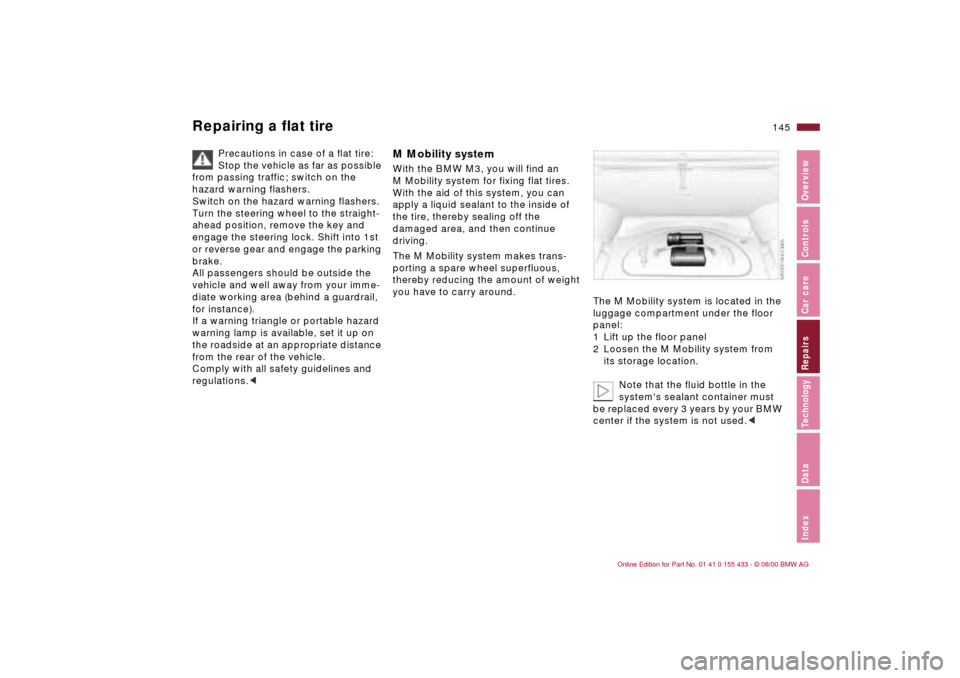
M Mobility system With the BMW M3, you will find an
M Mobility system for fixing flat tires.
With the aid of this system, you can
apply a liquid sealant to the inside of
the tire, thereby sealing off the
damaged area, and then continue
driving.
The M Mobility system makes trans-
porting a spare wheel superfluous,
thereby reducing the amount of weight
you have to carry around.
The M Mobility system is located in the
luggage compartment under the floor
panel:
1 Lift up the floor panel
2 Loosen the M Mobility system from
its storage location.
Note that the fluid bottle in the
system's sealant container must
be replaced every 3 years by your BMW
center if the system is not used.<