warning BMW M3 COUPE 2001 E46 User Guide
[x] Cancel search | Manufacturer: BMW, Model Year: 2001, Model line: M3 COUPE, Model: BMW M3 COUPE 2001 E46Pages: 183, PDF Size: 1.65 MB
Page 26 of 183
26n
Fuel specifications Tire inflation pressure Refuel with lead-freeThe engine uses lead-free gasoline
only.
Required fuel:
>Premium Unleaded Gasoline,
min. 91 AKI
AKI = Anti Knock Index
Do not use leaded fuels. The use
of leaded fuels will cause perma-
nent damage to the system's oxygen
sensor and the catalytic converter.<
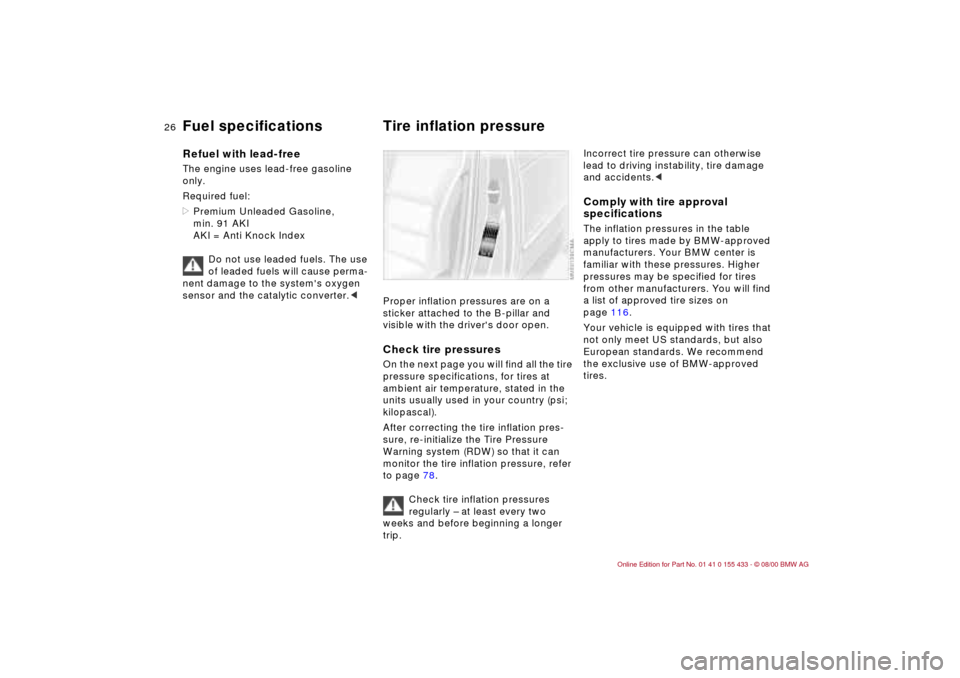
Proper inflation pressures are on a
sticker attached to the B-pillar and
visible with the driver's door open.Check tire pressuresOn the next page you will find all the tire
pressure specifications, for tires at
ambient air temperature, stated in the
units usually used in your country (psi;
kilopascal).
After correcting the tire inflation pres-
sure, re-initialize the Tire Pressure
Warning system (RDW) so that it can
monitor the tire inflation pressure, refer
to page 78.
Check tire inflation pressures
regularly Ð at least every two
weeks and before beginning a longer
trip.
Incorrect tire pressure can otherwise
lead to driving instability, tire damage
and accidents.< Comply with tire approval
specifications The inflation pressures in the table
apply to tires made by BMW-approved
manufacturers. Your BMW center is
familiar with these pressures. Higher
pressures may be specified for tires
from other manufacturers. You will find
a list of approved tire sizes on
page 116.
Your vehicle is equipped with tires that
not only meet US standards, but also
European standards. We recommend
the exclusive use of BMW-approved
tires.
Page 29 of 183
Overview
Controls and features
Operation, care
and maintenance
Owner service procedures
Technical data
Index Advanced technology
29n
IndexDataTechnologyRepairsCar careControlsOverview
Driving:
Steering/Ignition lock62
Starting the engine62
Switching off the engine63
Parking brake63
Manual transmission64
Turn signal indicator/Headlamp
flasher65
Wiper/Washer system/Rain
sensor65
Rear window defroster67
Cruise control67
Everything under control:
Odometer69
Tachometer69
Engine oil temperature gauge69
Fuel gauge70
Coolant temperature gauge70
Service Interval Display71
Check Control72
Computer72
Technology for driving comfort
and safety:
Park Distance Control (PDC)75
Dynamic Stability Control
(DSC)76
Tire Pressure Warning (RDW)78
M Engine dynamics control80Lamps:
Side lamps/Low beams81
Instrument lighting81
High beams/Parking lamp82
Fog lamps82
Interior lamps82
Reading lamps83
Controlling the climate
for pleasant driving:
Automatic climate control84
Heated seats89
Roller sun blind89
Interior conveniences:
HiFi system90
Glove compartment90
Storage compartments91
Cellular phone92
Ashtray, front92
Cigarette lighter93
Ashtray rear 93
Clothes hooks94
Loading and transporting
cargo:
Through-loading system95
Ski bag96
Cargo loading97
Roof-mounted luggage rack98
Page 31 of 183
31n
IndexDataTechnologyRepairsCar careControlsOverview
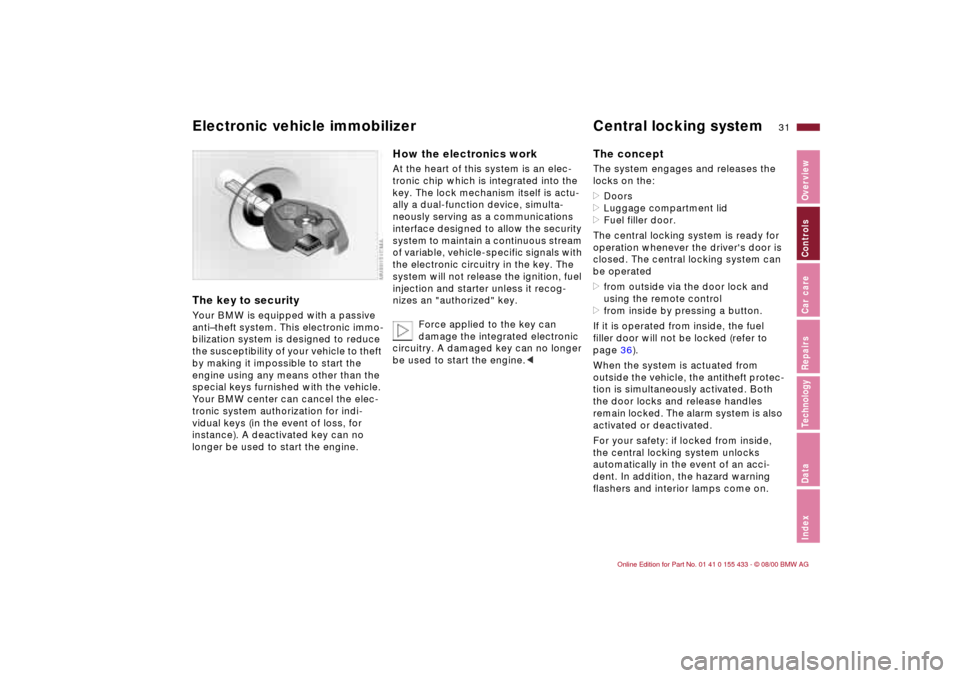
Electronic vehicle immobilizer Central locking systemThe key to security Your BMW is equipped with a passive
antiÐtheft system. This electronic immo-
bilization system is designed to reduce
the susceptibility of your vehicle to theft
by making it impossible to start the
engine using any means other than the
special keys furnished with the vehicle.
Your BMW center can cancel the elec-
tronic system authorization for indi-
vidual keys (in the event of loss, for
instance). A deactivated key can no
longer be used to start the engine.
How the electronics work At the heart of this system is an elec-
tronic chip which is integrated into the
key. The lock mechanism itself is actu-
ally a dual-function device, simulta-
neously serving as a communications
interface designed to allow the security
system to maintain a continuous stream
of variable, vehicle-specific signals with
the electronic circuitry in the key. The
system will not release the ignition, fuel
injection and starter unless it recog-
nizes an "authorized" key.
Force applied to the key can
damage the integrated electronic
circuitry. A damaged key can no longer
be used to start the engine.<
The conceptThe system engages and releases the
locks on the:
>Doors
>Luggage compartment lid
>Fuel filler door.
The central locking system is ready for
operation whenever the driver's door is
closed. The central locking system can
be operated
>from outside via the door lock and
using the remote control
>from inside by pressing a button.
If it is operated from inside, the fuel
filler door will not be locked (refer to
page 36).
When the system is actuated from
outside the vehicle, the antitheft protec-
tion is simultaneously activated. Both
the door locks and release handles
remain locked. The alarm system is also
activated or deactivated.
For your safety: if locked from inside,
the central locking system unlocks
automatically in the event of an acci-
dent. In addition, the hazard warning
flashers and interior lamps come on.
Page 40 of 183
40n
Alarm system
*
The conceptThe vehicle alarm system responds:
>When a door, the hood or the
luggage compartment lid is opened.
>To movement inside the vehicle (inte-
rior motion sensor).
>Altering the angle of the vehicle tilt
sensor, e. g. as would occur while
attempting to steal the wheels or tow
the vehicle (tilt sensor alarm system).
>To interruption of battery voltage.
The system responds to unauthorized
vehicle entry and attempted theft by
simultaneously activating the following:
>Sounding an acoustical alarm for
30 seconds.
>Activating the hazard warning
flashers for approx. five minutes.
>Flashing the high beams on and off in
rhythm with the hazard warning
flashers.
To activate and deactivate the
alarm systemWhen the vehicle is locked or unlocked
by using a key or the remote control,
the alarm system is also simultaneously
armed or disarmed.
The interior motion sensor and the
alarm system tilt sensor are activated
approx. 30 seconds after the last door
has been locked.
If the alarm system has been armed
correctly, the hazard warning flashers
flash once.
You can have a signal set as
acknowledgment for both setting
and deactivating the alarm.<
You can also open the luggage
compartment lid when the system is
armed by pressing button 3 of the
remote control (refer to page 34). When
it is closed, the lid is once again
secured.
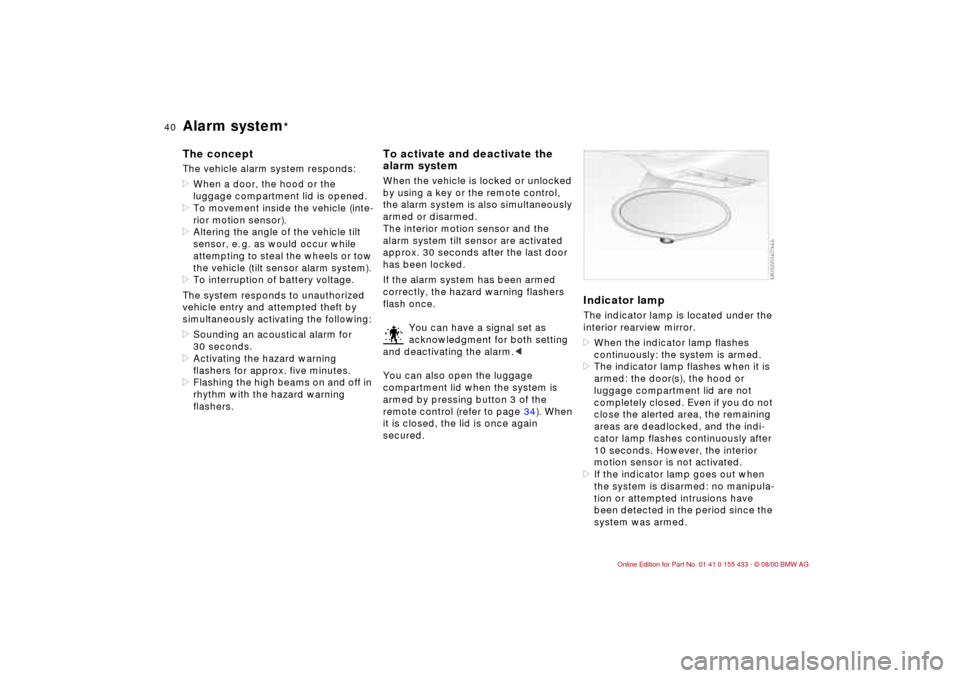
Indicator lampThe indicator lamp is located under the
interior rearview mirror.
>When the indicator lamp flashes
continuously: the system is armed.
>The indicator lamp flashes when it is
armed: the door(s), the hood or
luggage compartment lid are not
completely closed. Even if you do not
close the alerted area, the remaining
areas are deadlocked, and the indi-
cator lamp flashes continuously after
10 seconds. However, the interior
motion sensor is not activated.
>If the indicator lamp goes out when
the system is disarmed: no manipula-
tion or attempted intrusions have
been detected in the period since the
system was armed.
Page 69 of 183
69n
IndexDataTechnol-RepairsCar careControlsOverview
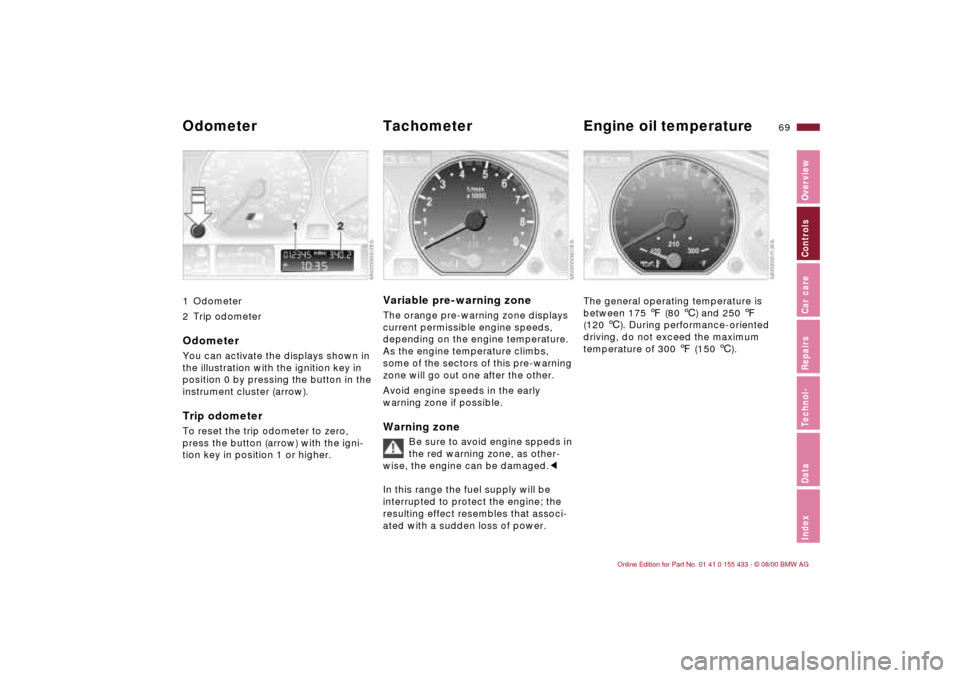
1 Odometer
2 Trip odometerOdometerYou can activate the displays shown in
the illustration with the ignition key in
position 0 by pressing the button in the
instrument cluster (arrow).Trip odometerTo reset the trip odometer to zero,
press the button (arrow) with the igni-
tion key in position 1 or higher.
Variable pre-warning zoneThe orange pre-warning zone displays
current permissible engine speeds,
depending on the engine temperature.
As the engine temperature climbs,
some of the sectors of this pre-warning
zone will go out one after the other.
Avoid engine speeds in the early
warning zone if possible.Warning zone
Be sure to avoid engine sppeds in
the red warning zone, as other-
wise, the engine can be damaged.<
In this range the fuel supply will be
interrupted to protect the engine; the
resulting effect resembles that associ-
ated with a sudden loss of power.
The general operating temperature is
between 175 7 (80 6) and 250 7
(120 6). During performance-oriented
driving, do not exceed the maximum
temperature of 300 7 (150 6).
Odometer Tachometer Engine oil temperature
Page 70 of 183
70n
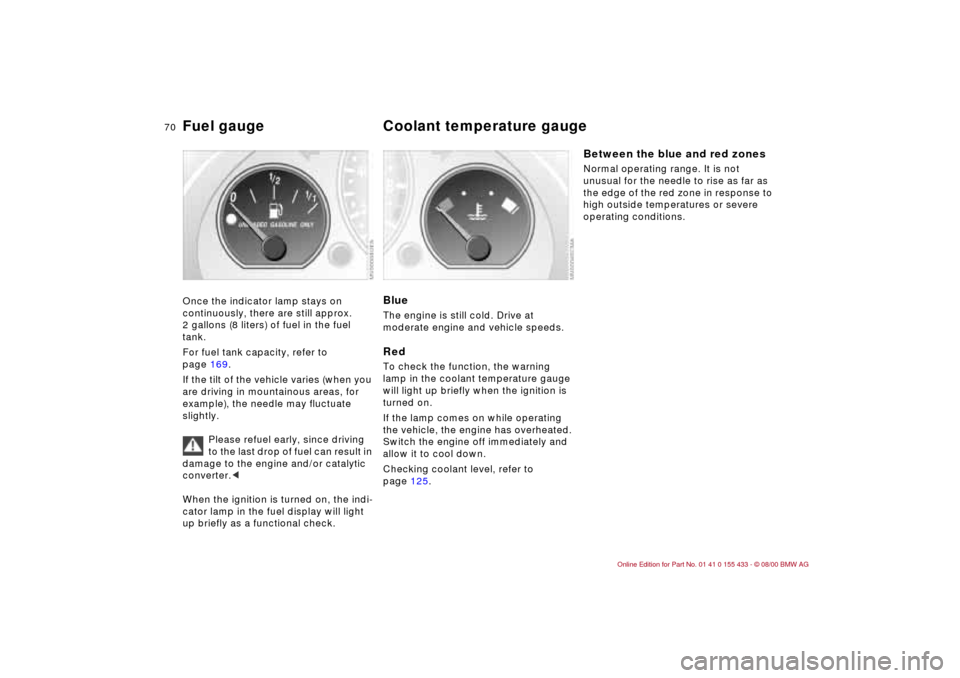
Fuel gauge Coolant temperature gauge Once the indicator lamp stays on
continuously, there are still approx.
2 gallons (8 liters) of fuel in the fuel
tank.
For fuel tank capacity, refer to
page 169.
If the tilt of the vehicle varies (when you
are driving in mountainous areas, for
example), the needle may fluctuate
slightly.
Please refuel early, since driving
to the last drop of fuel can result in
damage to the engine and/or catalytic
converter.<
When the ignition is turned on, the indi-
cator lamp in the fuel display will light
up briefly as a functional check.
BlueThe engine is still cold. Drive at
moderate engine and vehicle speeds. RedTo check the function, the warning
lamp in the coolant temperature gauge
will light up briefly when the ignition is
turned on.
If the lamp comes on while operating
the vehicle, the engine has overheated.
Switch the engine off immediately and
allow it to cool down.
Checking coolant level, refer to
page 125.
Between the blue and red zonesNormal operating range. It is not
unusual for the needle to rise as far as
the edge of the red zone in response to
high outside temperatures or severe
operating conditions.
Page 73 of 183
73n
IndexDataTechnologyRepairsCar careControlsOverview
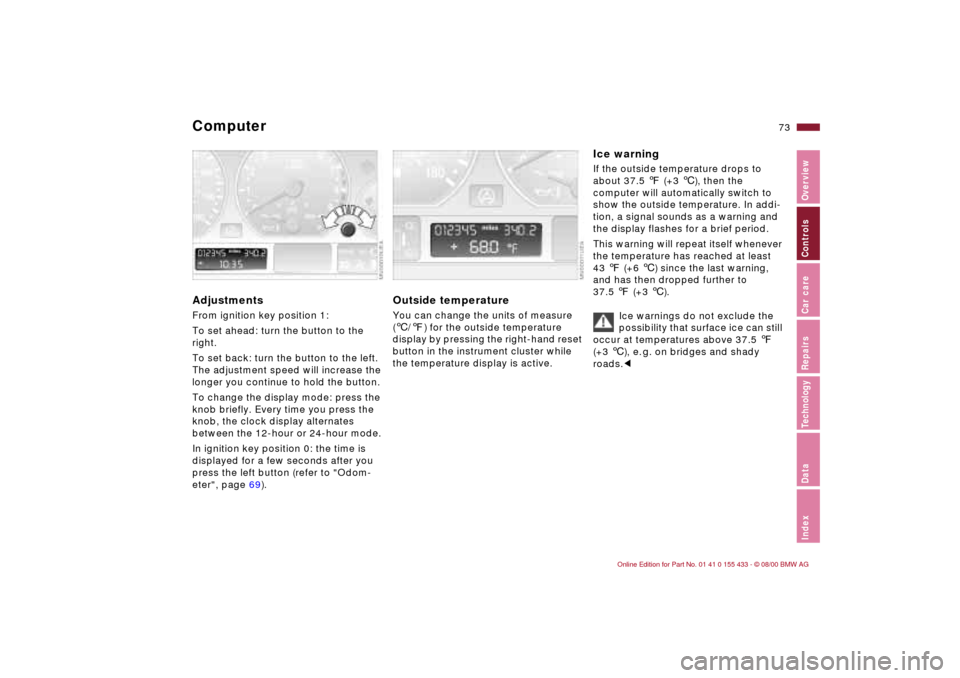
ComputerAdjustments From ignition key position 1:
To set ahead: turn the button to the
right.
To set back: turn the button to the left.
The adjustment speed will increase the
longer you continue to hold the button.
To change the display mode: press the
knob briefly. Every time you press the
knob, the clock display alternates
between the 12-hour or 24-hour mode.
In ignition key position 0: the time is
displayed for a few seconds after you
press the left button (refer to "Odom-
eter", page 69).
Outside temperature You can change the units of measure
(6/7) for the outside temperature
display by pressing the right-hand reset
button in the instrument cluster while
the temperature display is active.
Ice warning If the outside temperature drops to
about 37.5 7 (+3 6), then the
computer will automatically switch to
show the outside temperature. In addi-
tion, a signal sounds as a warning and
the display flashes for a brief period.
This warning will repeat itself whenever
the temperature has reached at least
43 7 (+6 6) since the last warning,
and has then dropped further to
37.5 7 (+3 6).
Ice warnings do not exclude the
possibility that surface ice can still
occur at temperatures above 37.5 7
(+3 6), e. g. on bridges and shady
roads.<
Page 75 of 183

75n
IndexDataTechnologyRepairsCar careControlsOverview
The conceptThe PDC assists you when you back
into a parking space. A signal warns
you of the distance to an obstacle. To
do this, four ultrasonic sensors in the
rear bumper measure the distance to
the nearest object. The range for the
sensors located at both rear corners
ends approx. 2 ft (60 cm) behind the
bumpers. The range for the two middle
sensors is slightly less than 4.9 ft
(1.50 meters).
The system is activated automatically
about one second after you engage
reverse with the ignition key in posi-
tion 2. PDC is deactivated when you
shift back out of reverse.
Acoustic signalsThe distance to the nearest object is
indicated by a tone sounding at various
intervals. As the distance between
vehicle and object decreases, the inter-
vals between the tones become
shorter. A continuous tone indicates the
presence of an object less than 1 ft.
(30 cm) away.
The warning signal is canceled after
approx. three seconds if the distance to
the obstacle remains constant during
this time (if you are moving parallel to a
wall, for instance).
System malfunctions will be indicated
by a continuous high-pitched tone
when the system is activated the first
time. Please have your BMW center
resolve the problem.The PDC does not remove the
driver's personal responsibility for
evaluating the distance between the
vehicle and any obstacles. Even when
sensors are involved, there is a blind
spot in which objects cannot be
detected. This applies especially in
those cases where the system
approaches the physical limits of ultra-
sonic measurement, as occurs with tow
bars and trailer couplings, and in the
vicinity of thin and painted objects.
Certain sources of sound, such as a
loud radio, could drown the PDC signal
tone.<
Keep the sensors clean and free
of ice or snow in order to ensure
that they continue to operate effec-
tively.
Do not apply high pressure spray to the
sensors for a prolonged period of time.
Always maintain a distance of more
than 4 in (10 cm). <
Park Distance Control (PDC)
*
Page 78 of 183
78n
Tire Pressure Warning (RDW)The conceptThe Tire Pressure Warning (RDW) moni-
tors the tire pressure in all four wheels
while driving. The system detects
whenever the inflation pressure in a tire
drops significantly.
Controlling the tire pressure is based
on monitoring the speed of the tires
relative to each other. A flat tire is
detected and reported because the
speed suddenly deviate drastically from
one another.
Initializing the systemInitializing is necessary to familiarize the
system with the correct inflation pres-
sure.
Repeat this process after any changes
in tire inflation pressure, tire rotation or
replacement. Do not carry out further
system initialization after correcting the
inflation pressure and letting the system
"learn" what condition is required.
1 Check the tire inflation pressure in all
the tires, comparing them with the
inflation pressure table (page 27),
and adjusting their pressure if neces-
sary
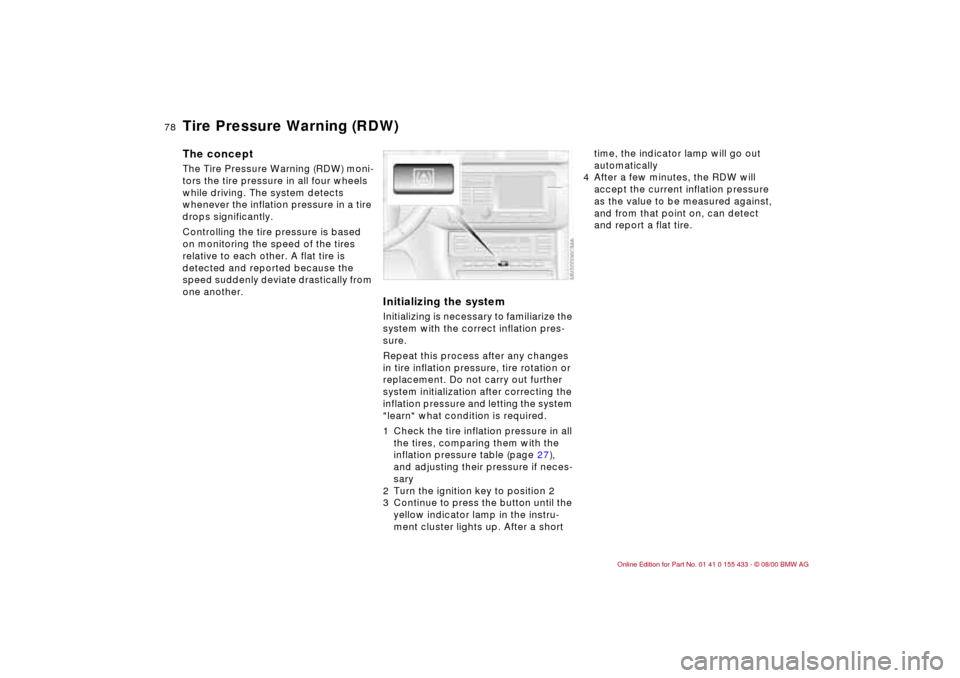
2 Turn the ignition key to position 2
3 Continue to press the button until the
yellow indicator lamp in the instru-
ment cluster lights up. After a short
time, the indicator lamp will go out
automatically
4 After a few minutes, the RDW will
accept the current inflation pressure
as the value to be measured against,
and from that point on, can detect
and report a flat tire.
Page 79 of 183
79n
IndexDataTechnologyRepairsCar careControlsOverview
Tire Pressure Warning (RDW)Activating/deactivating the
systemThe system is automatically active in
ignition key position 2 and is therefore
always on during driving.
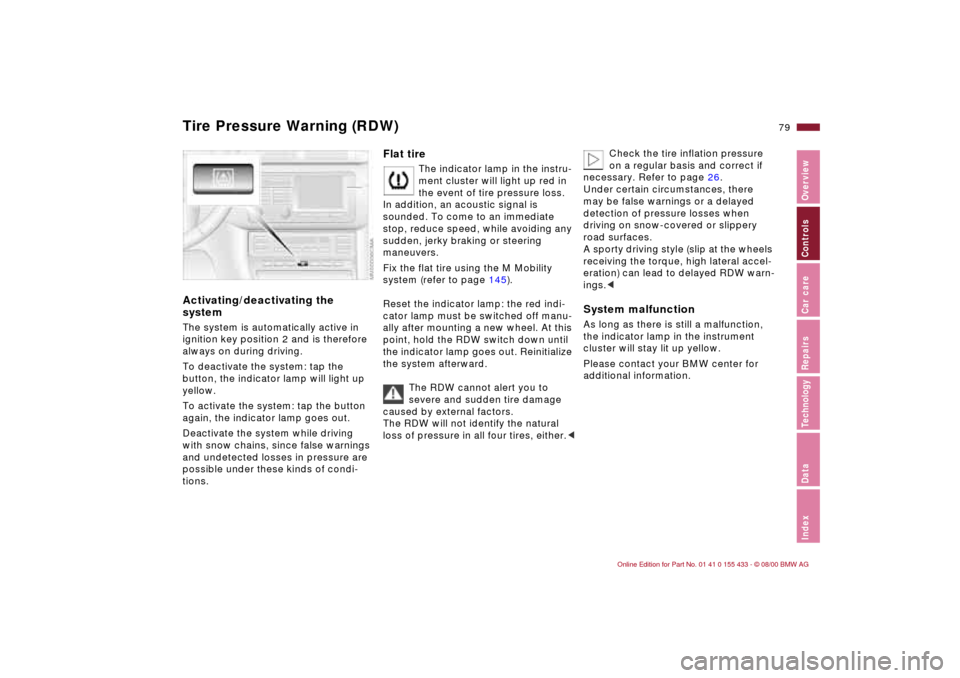
To deactivate the system: tap the
button, the indicator lamp will light up
yellow.
To activate the system: tap the button
again, the indicator lamp goes out.
Deactivate the system while driving
with snow chains, since false warnings
and undetected losses in pressure are
possible under these kinds of condi-
tions.
Flat tire
The indicator lamp in the instru-
ment cluster will light up red in
the event of tire pressure loss.
In addition, an acoustic signal is
sounded. To come to an immediate
stop, reduce speed, while avoiding any
sudden, jerky braking or steering
maneuvers.
Fix the flat tire using the M Mobility
system (refer to page 145).
Reset the indicator lamp: the red indi-
cator lamp must be switched off manu-
ally after mounting a new wheel. At this
point, hold the RDW switch down until
the indicator lamp goes out. Reinitialize
the system afterward.
The RDW cannot alert you to
severe and sudden tire damage
caused by external factors.
The RDW will not identify the natural
loss of pressure in all four tires, either.<
Check the tire inflation pressure
on a regular basis and correct if
necessary. Refer to page 26.
Under certain circumstances, there
may be false warnings or a delayed
detection of pressure losses when
driving on snow-covered or slippery
road surfaces.
A sporty driving style (slip at the wheels
receiving the torque, high lateral accel-
eration) can lead to delayed RDW warn-
ings.<
System malfunctionAs long as there is still a malfunction,
the indicator lamp in the instrument
cluster will stay lit up yellow.
Please contact your BMW center for
additional information.