engine BMW M3 COUPE 2001 E46 Service Manual
[x] Cancel search | Manufacturer: BMW, Model Year: 2001, Model line: M3 COUPE, Model: BMW M3 COUPE 2001 E46Pages: 183, PDF Size: 1.65 MB
Page 154 of 183
154n
Do not use spray starter fluids to start
the engine.
If the battery is discharged, the engine
can be started using two jumper cables
and another vehicle's battery. Use only
jumper cables with fully insulated
handles on the terminal clamps.
Do not touch high-voltage wiring
and cables on a running engine.
There is a risk of fatal injury if you do
this.
Carefully comply with the following
instructions to avoid personal injury or
damage to one or both vehicles.<
1 Be sure that the battery on the
support vehicle is also rated at
12 volts, and that the capacities of
the two batteries (Ah) are roughly
comparable (printed on casing)
2 Leave the discharged battery
connected to the vehicle's electrical
system
3 Make sure that there is no contact
between the bodywork of the two
vehicles Ð short circuit risk
4 Start by connecting the jumper cable
from the positive terminal of the
support vehicle to the positive
terminal connector located in your
BMW's engine compartment. The
cover of the positive terminal
connector is marked with a "+" sign.
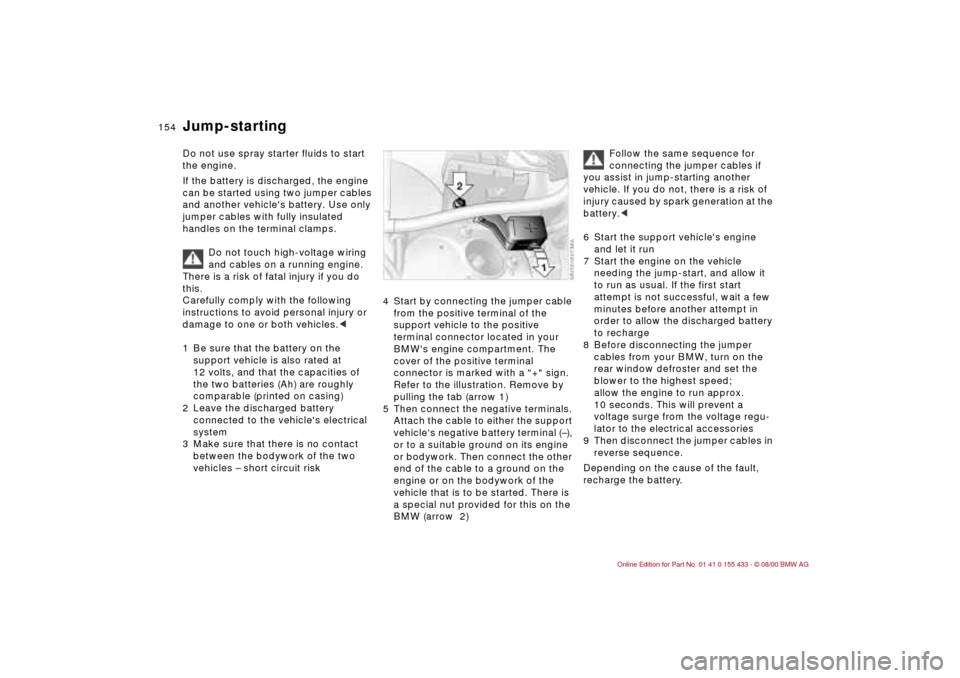
Refer to the illustration. Remove by
pulling the tab (arrow 1)
5 Then connect the negative terminals.
Attach the cable to either the support
vehicle's negative battery terminal (Ð),
or to a suitable ground on its engine
or bodywork. Then connect the other
end of the cable to a ground on the
engine or on the bodywork of the
vehicle that is to be started. There is
a special nut provided for this on the
BMW (arrow 2)
Follow the same sequence for
connecting the jumper cables if
you assist in jump-starting another
vehicle. If you do not, there is a risk of
injury caused by spark generation at the
battery.<
6 Start the support vehicle's engine
and let it run
7 Start the engine on the vehicle
needing the jump-start, and allow it
to run as usual. If the first start
attempt is not successful, wait a few
minutes before another attempt in
order to allow the discharged battery
to recharge
8 Before disconnecting the jumper
cables from your BMW, turn on the
rear window defroster and set the
blower to the highest speed;
allow the engine to run approx.
10 seconds. This will prevent a
voltage surge from the voltage regu-
lator to the electrical accessories
9 Then disconnect the jumper cables in
reverse sequence.
Depending on the cause of the fault,
recharge the battery.
Jump-starting
Page 157 of 183
157n
IndexDataTechnologyRepairsCar careControlsOverview
Overview
Controls and features
Operation, care
and maintenance
Technical data
Index Advanced technology
Airbags158
Radio reception158
Dynamic Stability Control
(DSC)159
Safety belt tensioner159
M3 Engine concept160
Rain sensor160
Interior rearview mirror with
automatic dimming
feature161
Self-diagnostics162
Xenon lamps163
Technology
Owner service procedures
Page 159 of 183
159n
IndexDataTechnologyRepairsCar careControlsOverview
The limitations inherent to radio recep-
tion in a moving vehicle have been
minimized by a number of innovative
system designs:
The "Radio Data System" (RDS) makes
sure that, for broadcast stations
sending on several frequencies, the
radio automatically tunes to the
frequency with the best reception
quality.
The Diversity Antenna system employs
several FM antennas integrated within
the rear window to provide three sepa-
rate sources for receiving broadcast
waves. An integral processor automati-
cally selects the antenna with the best
FM reception quality at any given time.
The selection of the antenna takes
place within milliseconds, and is there-
fore not noticed by the radio listener. The primary goal in developing the
Dynamic Stability Control (DSC) for the
BMW M3 is to achieve the greatest
amount of safety while at the same time
getting the most pleasure out of perfor-
mance-oriented driving.
Using highly sensitive sensors, the DSC
monitors current operating conditions
for your vehicle as they relate to driving
stability and traction. In addition, wheel
speeds, steering angle, lateral acceler-
ation, brake pressure and vehicle
movement around its vertical axis are
also ascertained and evaluated.
If the DSC detects unstable conditions
on a curve, then the DSC will intervene
in engine management within millisec-
onds, reducing drive torque or, if the
need arises, will individually slow one or
more wheels down to keep the vehicle
on a steady course.
If differences in wheel speed should
occur, the system will recognize the
dangers associated with wheel spin
and will reduce the drive torque; if
necessary, it will do so using brake
intervention at the rear wheels as well.
DSC offers the highest degree of
driving stability and safety not only
when you first start your vehicle, are
driving on straightaways or when
braking, but also when driving through
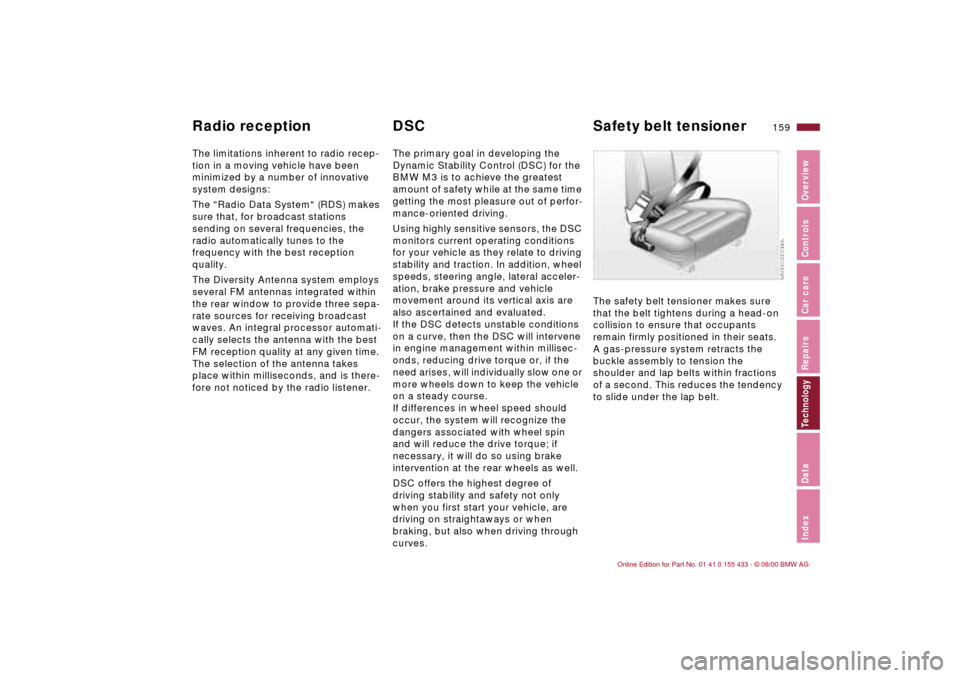
curves.The safety belt tensioner makes sure
that the belt tightens during a head-on
collision to ensure that occupants
remain firmly positioned in their seats.
A gas-pressure system retracts the
buckle assembly to tension the
shoulder and lap belts within fractions
of a second. This reduces the tendency
to slide under the lap belt. Radio reception DSC Safety belt tensioner
Page 160 of 183
160n
M3 Engine concept Rain sensor
*
BMW M will continue to develop BMW
engines for the performance-oriented,
yet responsible driver. That is why value
is placed on an engine design that
guarantees maximum thrust over a
wide engine speed range.
This is done by using high-grade mate-
rials and components with optimized
details. The engine thereby produces
higher speeds than can be achieved
with conventional engines.
Associated with the proper transmis-
sion gear ratio and an especially perfor-
mance-oriented engine electronics
system, the torque opens up with this
so-called "high-speed aspirated
engine" extremely evenly throughout
the entire engine speed range from
1,000 to max. 8 ,000 rpm.
In actual usage, this means improved
acceleration and more spontaneous
response throughout the engine speed
range, thus affording more driving plea-
sure.
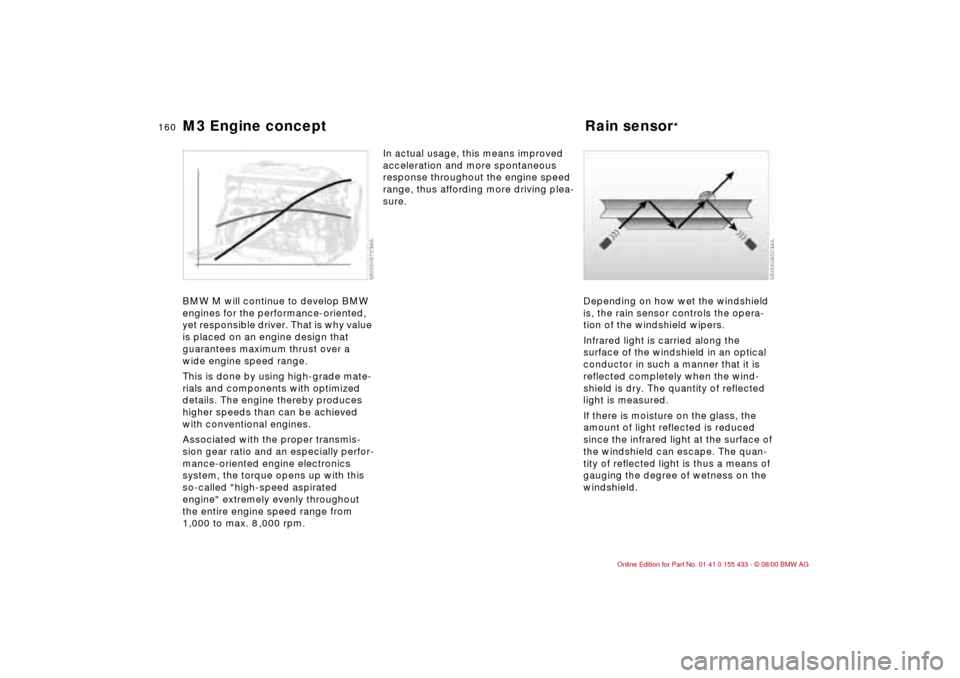
Depending on how wet the windshield
is, the rain sensor controls the opera-
tion of the windshield wipers.
Infrared light is carried along the
surface of the windshield in an optical
conductor in such a manner that it is
reflected completely when the wind-
shield is dry. The quantity of reflected
light is measured.
If there is moisture on the glass, the
amount of light reflected is reduced
since the infrared light at the surface of
the windshield can escape. The quan-
tity of reflected light is thus a means of
gauging the degree of wetness on the
windshield.
Page 162 of 183
162n
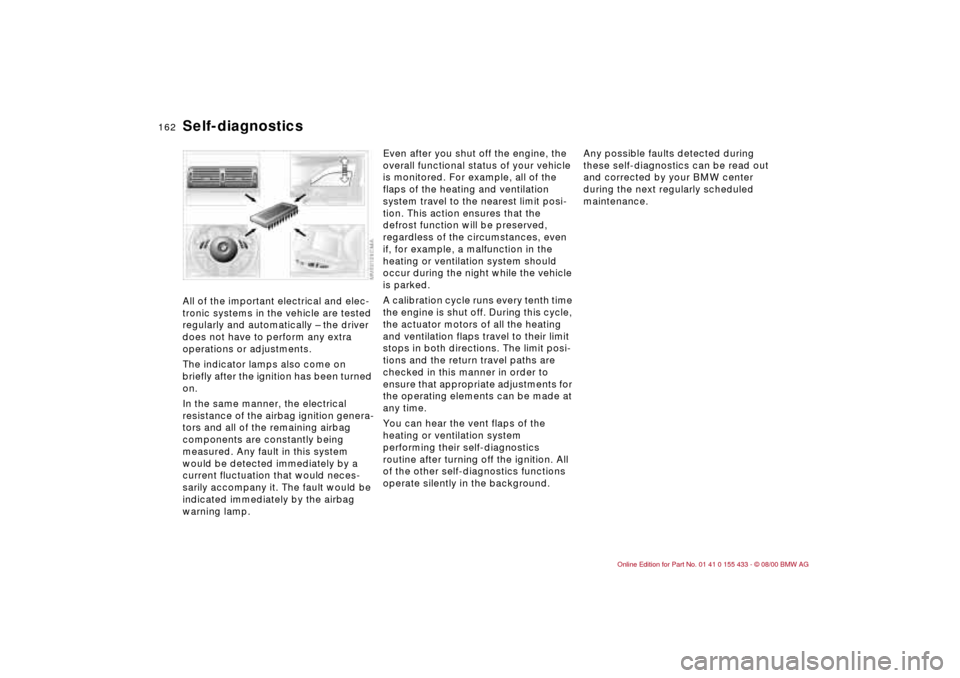
Self-diagnostics All of the important electrical and elec-
tronic systems in the vehicle are tested
regularly and automatically Ð the driver
does not have to perform any extra
operations or adjustments.
The indicator lamps also come on
briefly after the ignition has been turned
on.
In the same manner, the electrical
resistance of the airbag ignition genera-
tors and all of the remaining airbag
components are constantly being
measured. Any fault in this system
would be detected immediately by a
current fluctuation that would neces-
sarily accompany it. The fault would be
indicated immediately by the airbag
warning lamp.
Even after you shut off the engine, the
overall functional status of your vehicle
is monitored. For example, all of the
flaps of the heating and ventilation
system travel to the nearest limit posi-
tion. This action ensures that the
defrost function will be preserved,
regardless of the circumstances, even
if, for example, a malfunction in the
heating or ventilation system should
occur during the night while the vehicle
is parked.
A calibration cycle runs every tenth time
the engine is shut off. During this cycle,
the actuator motors of all the heating
and ventilation flaps travel to their limit
stops in both directions. The limit posi-
tions and the return travel paths are
checked in this manner in order to
ensure that appropriate adjustments for
the operating elements can be made at
any time.
You can hear the vent flaps of the
heating or ventilation system
performing their self-diagnostics
routine after turning off the ignition. All
of the other self-diagnostics functions
operate silently in the background.Any possible faults detected during
these self-diagnostics can be read out
and corrected by your BMW center
during the next regularly scheduled
maintenance.
Page 165 of 183
Overview
Controls and features
Operation, care
and maintenance
Owner service procedures
Technical data
Index Advanced technology
165n
IndexDataTechnologyRepairsCar careControlsOverview
Engine data166
Dimensions167
Weights168
Capacities169
Electrical system170
Drive belts170
Data
Page 166 of 183

166n
Displacement
Number of cylinders cu in (cmm) 198.1 (3,246)
6
Max. output
at engine speed hp (kW)
rpm333 (245)
7,900
Maximum torque
at engine speedlb-ft (Nm)
rpm262 (355)
4,900
Compression ratioe
11.5
Stroke
Borein (mm)
in (mm)3.58 (91)
3.43 (87)
Fuel-injection system Digital electronic
engine-management system
Engine data
Page 169 of 183

169n
IndexDataTechnologyRepairsCar careControlsOverview
Capacities
Notes
Fuel tank
Reserve gal. (liters)
gal. (liters)approx. 16.6 (approx. 63)
approx. 2.1 (approx. 8)Fuel specification: page 26
Windshield washer system/
Headlamp washer system quarts (liters) approx. 5.6 (approx. 5.3)For details: page 122
Cooling system including heater
circuitquarts (liters) approx. 6.3 (approx. 6.0) For details: page 125
Engine oil and filter change quarts (liters) approx. 6.9 (approx. 6.5) BMW High Performance
Synthetic Oil
For details: page 124
Manual transmission and differential Ð Ð Changing the oil during the
breaking-in inspection, after which
it is considered permanently filled
and not changed again
Page 174 of 183

Everything from A to Z
A
ABS (Antilock Brake System) 21, 104
Accessories 6
Activated-charcoal filter 88
Add brake fluid 121t, 126 t
Adding engine oil 123t
Adding washer fluid 122t
Adjusting the backrest 46
Adjusting the lumbar support 48
Adjusting the seat 47
Adjusting the steering wheel 52
Adjusting the temperature 86
Adjusting the thigh support 47
Adjusting the width of the backrests 48
Air conditioner 87
Air distribution, automatic 86
Air nozzles 84
Air outlets 84
Air pressure, tires 26, 111
Air supply 87
vents, recirculated air
mode 87
Airbags 56, 133 , 158
warning lamps 21Alarm system
40
Alcantara care 132
Antenna 110
Antenna, Diversity 159
Antifreeze 125
radiator 108
Antilock Brake System (ABS) 21, 104
Anti-theft alarm system 40
Anti-theft protection 31
Aquaplaning 103, 111
Armrest 91
Ashtray front 92
rear 93
Attach vacuum cleaner 93
AUC (Automatic recirculated air control) 87
Automatic car washes 128
Automatic climate control 84
Automatic cruise control 67
Automatic dimming, interior rearview mirror 50
Automatic recirculated air control (AUC) 87
Auxiliary terminal for jump- starting 121t
Average consumption 74
Average speed 74Avoiding unwanted
alarm 41
Axle loads 168
B
Backrest
adjusting 45
releasing 47
Backup lamps 64
bulb replacement 141t
Battery 148, 170
add distilled water 149t
capacity 170
charging 150t
current check lamp 20
removal and
installation 150
symbols 149
Belts 54
Beverage holder 91
BMW High Performance Synthetic Oil 124
BMW sports seat 46, 47
Bore 166
Bottle holder, refer to beverage holder 91
Brake hydraulic system 20
Brake lamps, bulb replacement 141t
Brake pads 107
indicator lamp for 21Brakes
driving notes 103
faults 107t
fluid change 71
fluid level 107
warning lamps 20
Break-in procedure 102
C
California Proposition
65 Warning 134
Can holder, refer to beverage holder 91
Capacities 169
Car Memory 52
Car phone 92
Car radio 110
reception 110, 158
refer also to the separate
Owner's Manual
Car vacuum cleaner, connecting 93
Car wash 128
Care exterior 129
interior 131
rubber seals and
components 108
upholstery 131
wool velour 131
Cargo loading 97
Page 175 of 183

Everything from A to Z
175n
IndexDataTechnologyRepairsCar careControlsOverview
Caring for the vehicle
finish129
Cassette operation, refer to
the radio Owner's Manual
Catalytic converter103
starting problems103
CBC (Cornering Brake
Control)21, 104
CD operaton, refer to the
radio Owner's Manual
Cellular phone110
refer also to the separate
Owner's Manual
Center armrest91
Center (high-mount) brake
lamp143
Central locking system31
key36
Check Control72t
Checking air pressure26t
Checking engine oil
level123t
Child restraint
system55, 59
Child seat safety55, 60
Cigarette lighter93
Clean the headlamps67
Clean the windshield66
Clock73
Clothes hooks94
Cockpit16Code, refer to the radio
Owner's Manual
Coin box91
Combination switch65
Compression166
Computer72
Configuring the settings52
Consumption74
Consumption display70
Control elements16
Coolant108, 121t, 125
antifreeze108
Coolant temperature
gauge70
Cooling system169
Copyright4
Cornering Brake Control
(CBC)21, 104
Cruise control67
Cruising range74
Cup holder, refer to
beverage holder91
Curb weight168
DDashboard16
Data
dimensions167
engine166
technical166
weights168Daytime-driving lamp
switch81
Deep water103
Defrost position87t
Defrostable rear window88
Defrosting the
windows87t
Difficult steering110t
Digital clock73
Dimensions167
Dipstick123
Disk brakes106
Displacement166
Display lighting81
Displays18
Disposal
used batteries151
used engine oil124
Distance warning75
Diversity Antenna159
Door key30
Door locks, care108
Doors
emergency
actuation32t
operating manually32
remote control33
unlocking and
locking32, 33
DOT Quality Grades112
Draft-free ventilation88
Drive belts170Driving in winter108
Driving lamps81
Driving notes
aquaplaning103
brakes103
disk brakes106
sliding109
slippery roads108
DSC (Dynamic Stability
Control)22, 76, 159
Dynamic Stability Control
(DSC)22, 76, 159
EElectric power windows42
Electrical accessories,
failure151t
Electrical failure
fuel filler door152t
sliding/tilt sunroof153t
Electrical system170
Electronic vehicle
immobilizer31
Emergency actuation
doors32t
fuel filler door152t
sliding/tilt sunroof153t
Engine
compartment120
coolant125, 169
data166
displacement166