light BMW M3 COUPE 2002 E46 Service Manual
[x] Cancel search | Manufacturer: BMW, Model Year: 2002, Model line: M3 COUPE, Model: BMW M3 COUPE 2002 E46Pages: 151, PDF Size: 2.14 MB
Page 127 of 151
127n
OverviewControlsMaintenanceRepairsDataIndex
Repairing a flat tire
Please keep in mind that the fluids
bottle in the system's sealant
container has to be changed every
3 years by your BMW center, if the unit
has not been used.<
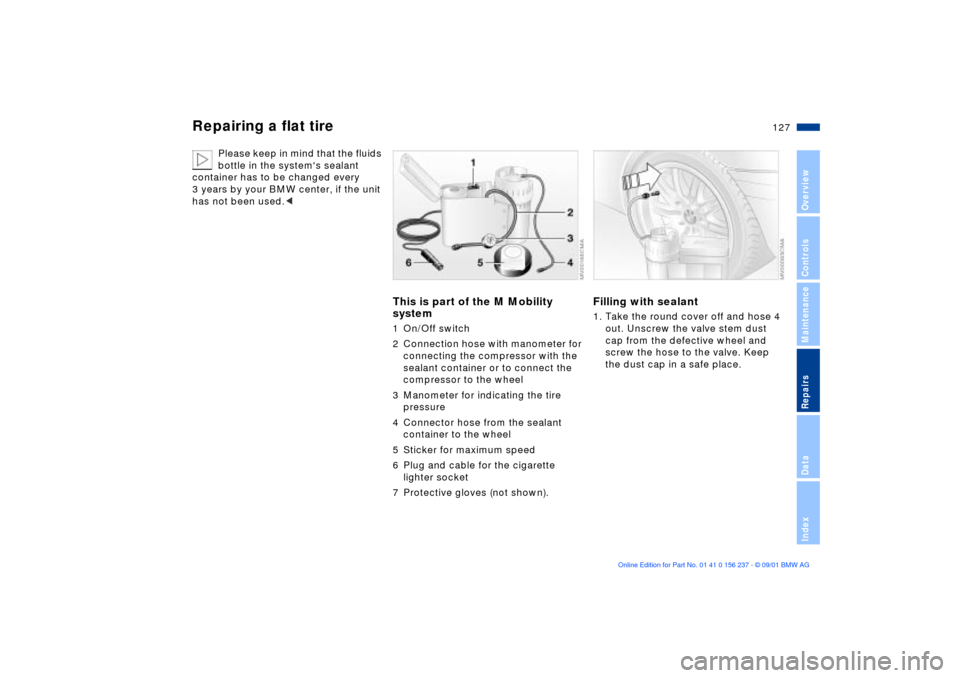
This is part of the M Mobility
system1 On/Off switch
2 Connection hose with manometer for
connecting the compressor with the
sealant container or to connect the
compressor to the wheel
3 Manometer for indicating the tire
pressure
4 Connector hose from the sealant
container to the wheel
5 Sticker for maximum speed
6 Plug and cable for the cigarette
lighter socket
7 Protective gloves (not shown).
Filling with sealant1. Take the round cover off and hose 4
out. Unscrew the valve stem dust
cap from the defective wheel and
screw the hose to the valve. Keep
the dust cap in a safe place.
Page 128 of 151
128n
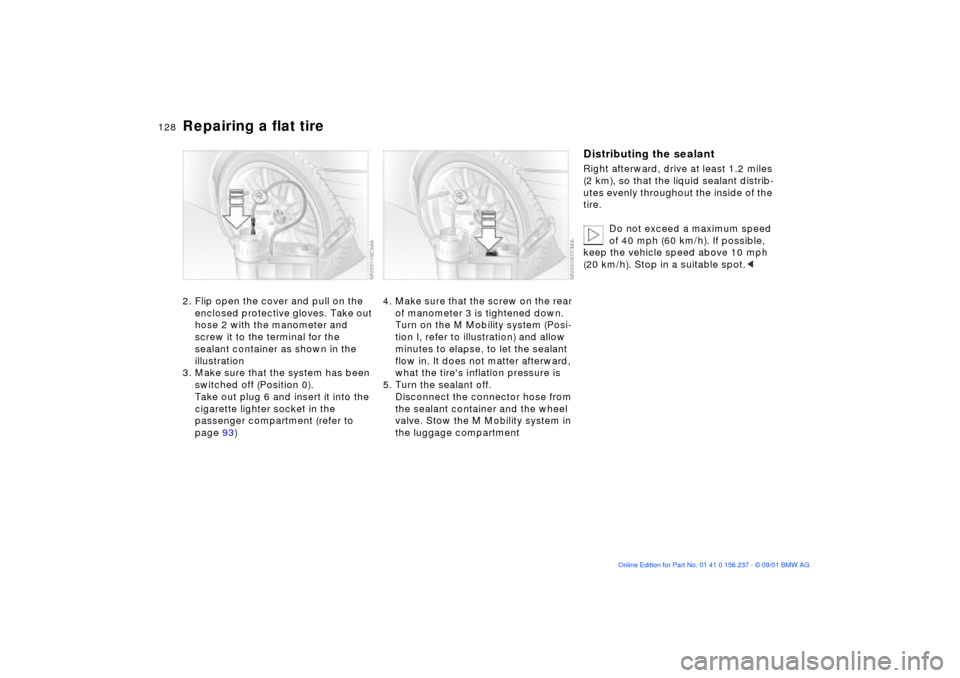
Repairing a flat tire2. Flip open the cover and pull on the
enclosed protective gloves. Take out
hose 2 with the manometer and
screw it to the terminal for the
sealant container as shown in the
illustration
3. Make sure that the system has been
switched off (Position 0).
Take out plug 6 and insert it into the
cigarette lighter socket in the
passenger compartment (refer to
page 93)
4. Make sure that the screw on the rear
of manometer 3 is tightened down.
Turn on the M Mobility system (Posi-
tion I, refer to illustration) and allow
minutes to elapse, to let the sealant
flow in. It does not matter afterward,
what the tire's inflation pressure is
5. Turn the sealant off.
Disconnect the connector hose from
the sealant container and the wheel
valve. Stow the M Mobility system in
the luggage compartment
Distributing the sealantRight afterward, drive at least 1.2 miles
(2 km), so that the liquid sealant distrib-
utes evenly throughout the inside of the
tire.
Do not exceed a maximum speed
of 40 mph (60 km/h). If possible,
keep the vehicle speed above 10 mph
(20 km/h). Stop in a suitable spot.<
Page 129 of 151
129n
OverviewControlsMaintenanceRepairsDataIndex
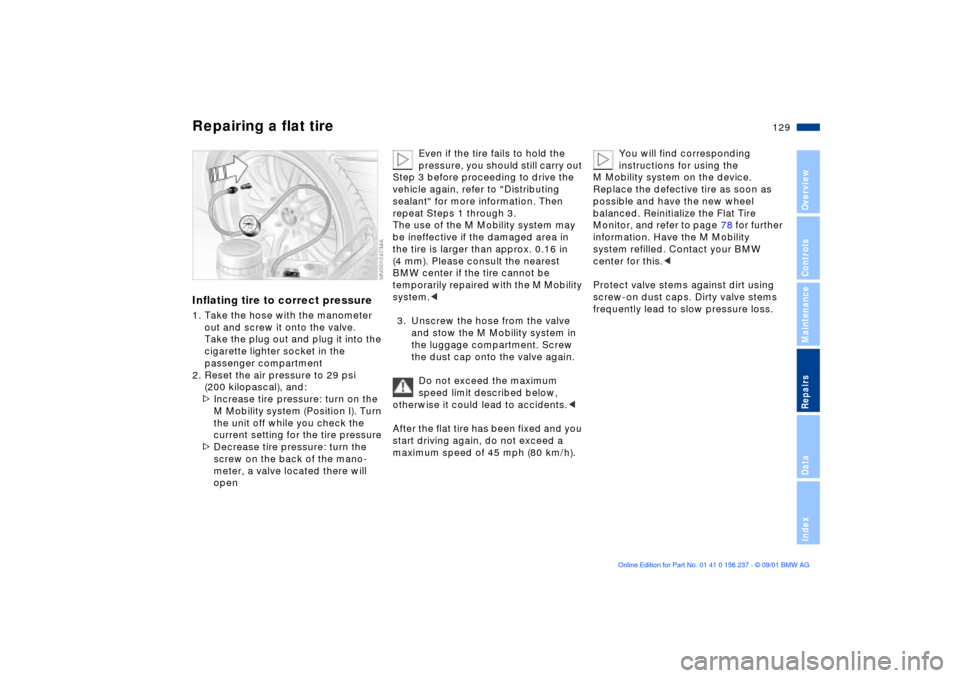
Repairing a flat tire Inflating tire to correct pressure1. Take the hose with the manometer
out and screw it onto the valve.
Take the plug out and plug it into the
cigarette lighter socket in the
passenger compartment
2. Reset the air pressure to 29 psi
(200 kilopascal), and:
>Increase tire pressure: turn on the
M Mobility system (Position I). Turn
the unit off while you check the
current setting for the tire pressure
>Decrease tire pressure: turn the
screw on the back of the mano-
meter, a valve located there will
open
Even if the tire fails to hold the
pressure, you should still carry out
Step 3 before proceeding to drive the
vehicle again, refer to "Distributing
sealant" for more information. Then
repeat Steps 1 through 3.
The use of the M Mobility system may
be ineffective if the damaged area in
the tire is larger than approx. 0.16 in
(4 mm). Please consult the nearest
BMW center if the tire cannot be
temporarily repaired with the M Mobility
system.<
3. Unscrew the hose from the valve
and stow the M Mobility system in
the luggage compartment. Screw
the dust cap onto the valve again.
Do not exceed the maximum
speed limit described below,
otherwise it could lead to accidents.<
After the flat tire has been fixed and you
start driving again, do not exceed a
maximum speed of 45 mph (80 km/h).
You will find corresponding
instructions for using the
M Mobility system on the device.
Replace the defective tire as soon as
possible and have the new wheel
balanced. Reinitialize the Flat Tire
Monitor, and refer to page 78 for further
information. Have the M Mobility
system refilled. Contact your BMW
center for this.<
Protect valve stems against dirt using
screw-on dust caps. Dirty valve stems
frequently lead to slow pressure loss.
Page 132 of 151
132n
Towing the vehicleTow fittingThe tow fitting, which can be
unscrewed, is in the luggage compart-
ment under the floor panel and must
remain in the vehicle. This fitting
is designed for installation in the tow
sockets located at the front and rear of
the vehicle. It is intended for towing on
paved road surfaces only.
It should not be used to pull a vehicle
out of deep snow, mud, sand, etc.
Comply with all applicable towing laws
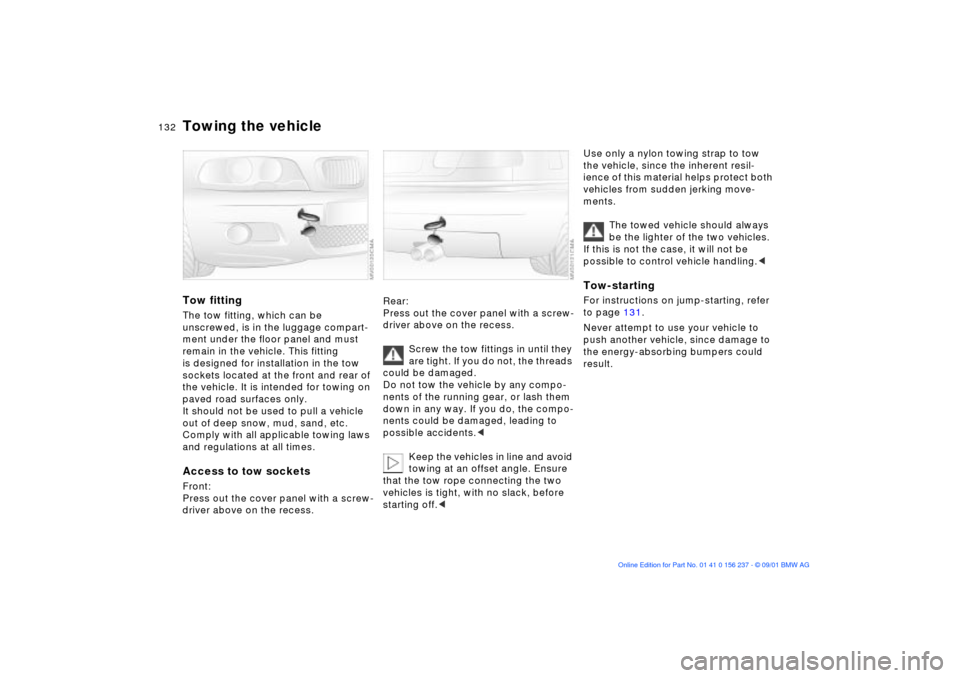
and regulations at all times.Access to tow socketsFront:
Press out the cover panel with a screw-
driver above on the recess.
Rear:
Press out the cover panel with a screw-
driver above on the recess.
Screw the tow fittings in until they
are tight. If you do not, the threads
could be damaged.
Do not tow the vehicle by any compo-
nents of the running gear, or lash them
down in any way. If you do, the compo-
nents could be damaged, leading to
possible accidents.<
Keep the vehicles in line and avoid
towing at an offset angle. Ensure
that the tow rope connecting the two
vehicles is tight, with no slack, before
starting off.<
Use only a nylon towing strap to tow
the vehicle, since the inherent resil-
ience of this material helps protect both
vehicles from sudden jerking move-
ments.
The towed vehicle should always
be the lighter of the two vehicles.
If this is not the case, it will not be
possible to control vehicle handling.
Never attempt to use your vehicle to
push another vehicle, since damage to
the energy-absorbing bumpers could
result.
Page 143 of 151

Everything from A to Z
143n
OverviewControlsMaintenanceRepairsDataIndex
Caring for headlamp covers,
refer to the "Caring for your
vehicle" manual
Caring for your vehicle's
paintwork, refer to the
"Caring for your vehicle"
manual
CBC (Cornering Brake
Control)101
warning lamp18
Cellular phone92
refer also to the separate
Owner's Manual
Center (high-mount) brake
lamp125
Center armrest91
Central locking system28
key33
Check Control72
Checking
engine coolant112t
engine oil level110t
tire inflation
pressures24t
Child seat security54
Child-restraint systems52
Cigarette lighter93
Clean the headlamps67 Clean the windshield67
Clock72
also refer to the "Radio
Owner's Manual"
Clothes hooks93
Cockpit14
Coin box91
Combination switch65
Compression136
Computer72
refer also to the "Onboard
Computer Owner's
Manual"
Configuring individual
settings with Vehicle and
Key Memory55
Connecting car vacuum
cleaner93
Consumption74
Consumption display71
Control elements14
Coolant112
Coolant system,
capacity139
Coolant temperature
gauge71
Copyright4 Cornering Brake Control
(CBC)101
warning lamp18
Cover, sun blinds89
Cruise control68
Cruising range74
Curb weight138
D
Data
dimensions137
engine136
technical136
weights138
Daytime driving lamps80
DBC (Dynamic Brake
Control)77
Deep water101
Defrostable rear window88
Defroster, rear window84
Defrosting windows87
Dimensions137
Dipstick, engine oil110
Disc brakes102
Displacement136
Display lighting81
Distance warning75
Divided rear backrest94
Door key28 Doors
electrical
malfunction29t
manual operation29t
operating manually29
remote control30
unlocking and
locking29, 30
Draft-free ventilation85, 88
Driving notes
aquaplaning101
brakes101
DSC (Dynamic Stability
Control)76
indicator lamp19
Dynamic Brake Control
(DBC)77
Dynamic Stability Control
(DSC)76
indicator lamp19
E
Electric power windows39
Electrical malfunction
doors29t
fuel filler door22t
luggage compartment
lid34
sliding/tilt sunroof41t
Page 145 of 151

Everything from A to Z
145n
OverviewControlsMaintenanceRepairsDataIndex
INSPECTION71
Instrument cluster15
Instrument lighting81
Instrument panel15
Interface socket
for Onboard
Diagnostics116
Interior lamps31, 82
remote control31
Interior motion
sensor37, 38
avoiding unintentional
alarms38
deactivate31
operating via remote
control31
Interior rearview mirror with
automatic dimming
feature49 J
Jump-starting131 K
Key28
with remote control28
Key Memory55
L
Lamps80, 120
LAMPS ON warning80
Lashing eyes97
LATCH child-restraint
system installation53
Leather care, refer to the
"Caring for your vehicle"
manual
Length137
License plate lamp
bulb replacement125t
Lighting, refer to lamps
Load-securing devices97
Locking luggage
compartment lid
separately34
Louvers83, 86
Low ambient
temperatures111
Low beams80
bulb replacement121t
Luggage compartment
capacity138
floor mat36
floor panel36
lighting34
operating via remote
control31 Luggage compartment
lid34
electrical malfunction34
emergency release from
luggage compartment's
interior36
locking it separately34
manual operation34t
Luggage rack97
Lumbar support,
adjusting43
M
M Engine dynamics
control79
M+S-tires106
Maintenance71, 114
Malfunction displays72
Manual operation
doors29t
fuel filler door22t
luggage compartment
lid34t
sliding/tilt sunroof41t
Manual transmission58
Master key28 MFL (Multifunction steering
wheel)21
Microfilter85, 89
Mirror memory46
Mirrors48
automatic curb
monitor48
Modifications,
technical10, 115
Multifunction steering wheel
(MFL)21
N
Navigation system, refer to
the "Onboard Computer
Owner's Manual"
Neckrest44 O
OBD interface socket116
Obstruction protection39
Odometer70
Oil
additives111
capacity139
quality111
specifications111
viscosity111