battery BMW M3 COUPE 2002 E46 Owner's Manual
[x] Cancel search | Manufacturer: BMW, Model Year: 2002, Model line: M3 COUPE, Model: BMW M3 COUPE 2002 E46Pages: 151, PDF Size: 2.14 MB
Page 6 of 151

Contents
Owner service procedures
Technical data
Index
Replacement procedures:
Onboard tool kit120
Windshield wiper blades120
Lamps and bulbs120
Repairing a flat tire126
Battery130
Fuses130
Giving and receiving
assistance:
Jump-starting131
Towing the vehicle132Engine data136
Dimensions137
Weights138
Capacities139Everything from A to Z142
Page 17 of 151
17n
OverviewControlsMaintenanceRepairsDataIndex
Indicator and warning lamps
Technology that monitors itself
Indicator and warning lamps that are
identified by "
l
" are tested for proper
functioning whenever the ignition key is
turned. They each light up once for
different periods of time.
If a fault should occur in one of these
systems, the corresponding lamp does
not go out after the engine is started or
it lights up while the vehicle is moving.
You will see how to react to this below.
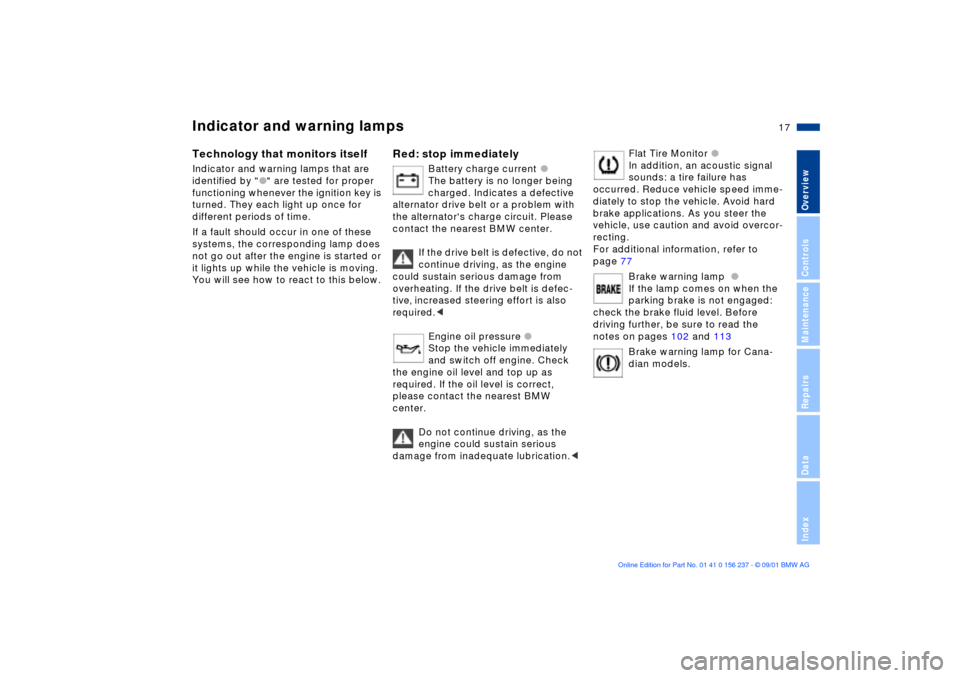
Red: stop immediately
Battery charge current
l
The battery is no longer being
charged. Indicates a defective
alternator drive belt or a problem with
the alternator's charge circuit. Please
contact the nearest BMW center.
If the drive belt is defective, do not
continue driving, as the engine
could sustain serious damage from
overheating. If the drive belt is defec-
tive, increased steering effort is also
required.
<
Engine oil pressure
l
Stop the vehicle immediately
and switch off engine. Check
the engine oil level and top up as
required. If the oil level is correct,
please contact the nearest BMW
center.
Do not continue driving, as the
engine could sustain serious
damage from inadequate lubrication.
<
Flat Tire Monitor
l
In addition, an acoustic signal
sounds: a tire failure has
occurred. Reduce vehicle speed imme-
diately to stop the vehicle. Avoid hard
brake applications. As you steer the
vehicle, use caution and avoid overcor-
recting.
For additional information, refer to
page 77
Brake warning lamp
l
If the lamp comes on when the
parking brake is not engaged:
check the brake fluid level. Before
driving further, be sure to read the
notes on pages 102 and 113
Brake warning lamp for Cana-
dian models.
Page 28 of 151
28n
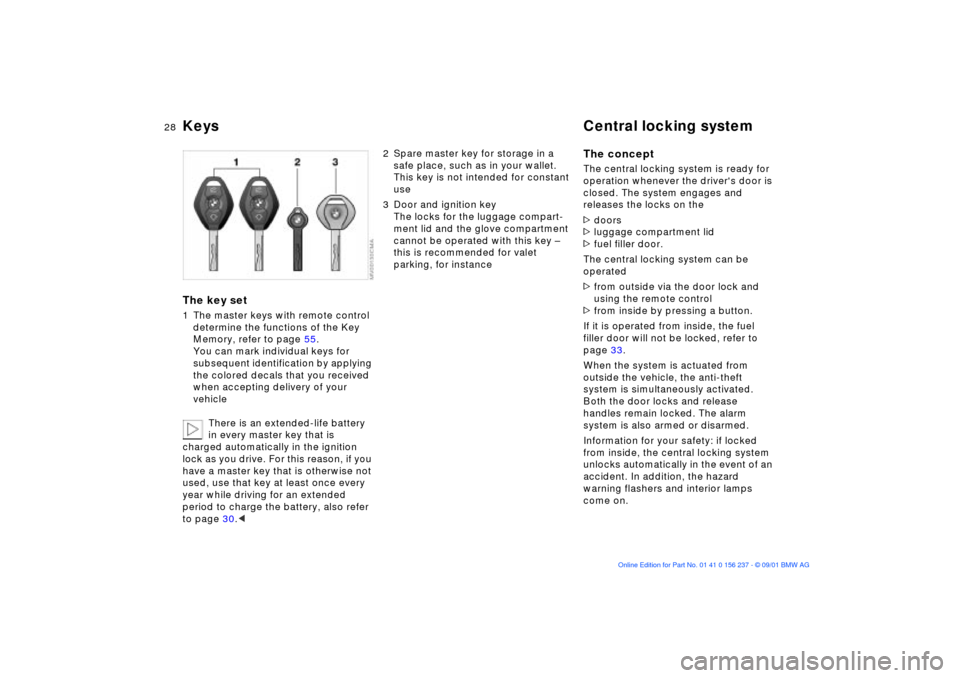
Keys Central locking systemThe key set1 The master keys with remote control
determine the functions of the Key
Memory, refer to page 55.
You can mark individual keys for
subsequent identification by applying
the colored decals that you received
when accepting delivery of your
vehicle
There is an extended-life battery
in every master key that is
charged automatically in the ignition
lock as you drive. For this reason, if you
have a master key that is otherwise not
used, use that key at least once every
year while driving for an extended
period to charge the battery, also refer
to page 30.<
2 Spare master key for storage in a
safe place, such as in your wallet.
This key is not intended for constant
use
3 Door and ignition key
The locks for the luggage compart-
ment lid and the glove compartment
cannot be operated with this key Ð
this is recommended for valet
parking, for instance
The conceptThe central locking system is ready for
operation whenever the driver's door is
closed. The system engages and
releases the locks on the
>doors
>luggage compartment lid
>fuel filler door.
The central locking system can be
operated
>from outside via the door lock and
using the remote control
>from inside by pressing a button.
If it is operated from inside, the fuel
filler door will not be locked, refer to
page 33.
When the system is actuated from
outside the vehicle, the anti-theft
system is simultaneously activated.
Both the door locks and release
handles remain locked. The alarm
system is also armed or disarmed.
Information for your safety: if locked
from inside, the central locking system
unlocks automatically in the event of an
accident. In addition, the hazard
warning flashers and interior lamps
come on.
Page 30 of 151
30n
Opening and closing Ð via the remote control The conceptThe remote control gives you an excep-
tionally convenient method for
unlocking and locking your vehicle.
Furthermore, it provides two additional
functions which you can only execute
via the remote control:
>Switch on the interior lamps, refer to
page 31.
With this function, you can also
"search for" your vehicle Ð when
parked in an underground garage, for
instance
>Open the luggage compartment lid,
refer to page 31.
The luggage compartment lid will
open slightly, regardless of whether it
was locked or unlocked.
The anti-theft system is also deacti-
vated/activated simultaneously with the
unlocking or locking of the vehicle, the
alarm system is disarmed/armed, and
the interior lamps are switched on/off.
You can have a signal set to
confirm that the vehicle's locks
have engaged securely.<
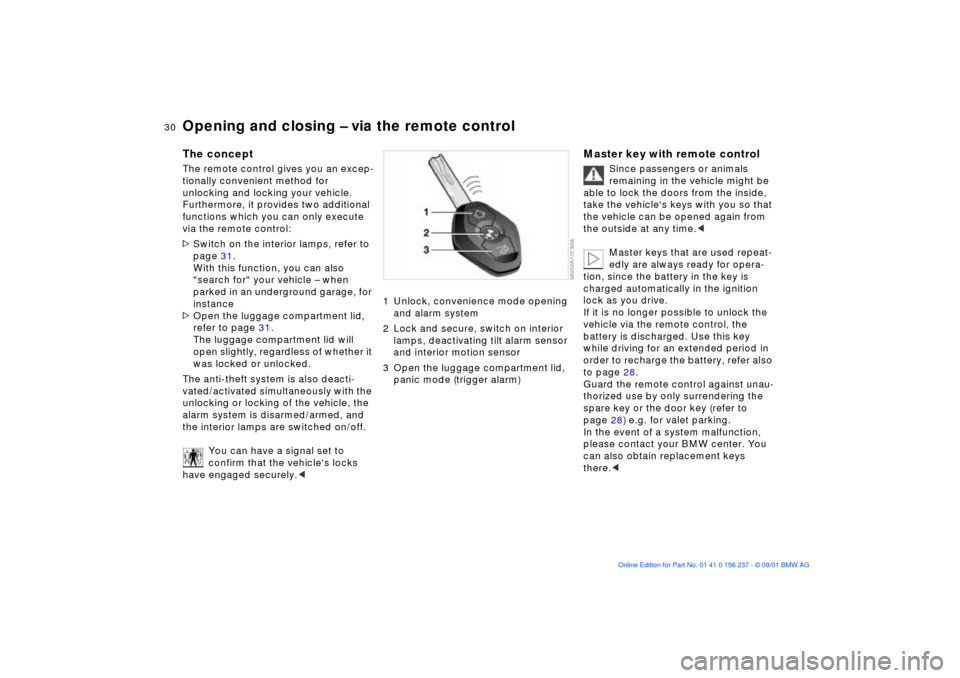
1 Unlock, convenience mode opening
and alarm system
2 Lock and secure, switch on interior
lamps, deactivating tilt alarm sensor
and interior motion sensor
3 Open the luggage compartment lid,
panic mode (trigger alarm)
Master key with remote control
Since passengers or animals
remaining in the vehicle might be
able to lock the doors from the inside,
take the vehicle's keys with you so that
the vehicle can be opened again from
the outside at any time.<
Master keys that are used repeat-
edly are always ready for opera-
tion, since the battery in the key is
charged automatically in the ignition
lock as you drive.
If it is no longer possible to unlock the
vehicle via the remote control, the
battery is discharged. Use this key
while driving for an extended period in
order to recharge the battery, refer also
to page 28.
Guard the remote control against unau-
thorized use by only surrendering the
spare key or the door key (refer to
page 28) e.g. for valet parking.
In the event of a system malfunction,
please contact your BMW center. You
can also obtain replacement keys
there.<
Page 37 of 151
37n
OverviewControlsMaintenanceRepairsDataIndex
Alarm system
*
The conceptThe vehicle alarm system responds:
>When a door, the hood or the
luggage compartment lid are opened
>To movement inside the vehicle (inte-
rior motion sensor)
>To variations in the vehicle tilt, as
would occur while attempting to steal
the wheels or tow the vehicle (tilt
alarm sensor)
>To interruption of battery voltage.
The system responds to unauthorized
vehicle entry and attempted theft by
simultaneously activating the following:
>Sounding an acoustic alarm for
30 seconds
>Activating the hazard warning
flashers for approx. five minutes
>Flashing the high beams on and off in
rhythm with the hazard warning
flashers.
To arm and disarm the alarm
systemWhen the vehicle is locked or unlocked
by using a key or the remote control,
the alarm system is also simultaneously
armed or disarmed.
You can have a signal set as
acknowledgment for both arming
and disarming the alarm.<
You can also open the luggage
compartment lid when the system is
armed by pressing the button of the
remote control, refer to page 31. When
it is closed, the lid is once again
secured.
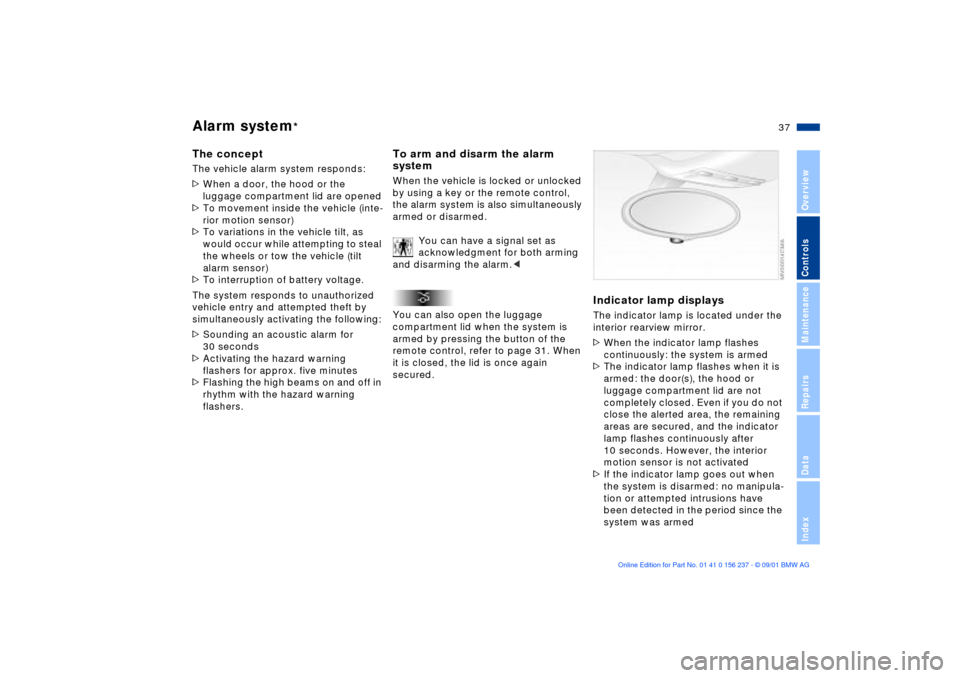
Indicator lamp displaysThe indicator lamp is located under the
interior rearview mirror.
>When the indicator lamp flashes
continuously: the system is armed
>The indicator lamp flashes when it is
armed: the door(s), the hood or
luggage compartment lid are not
completely closed. Even if you do not
close the alerted area, the remaining
areas are secured, and the indicator
lamp flashes continuously after
10 seconds. However, the interior
motion sensor is not activated
>If the indicator lamp goes out when
the system is disarmed: no manipula-
tion or attempted intrusions have
been detected in the period since the
system was armed
Page 57 of 151
57n
OverviewControlsMaintenanceRepairsDataIndex
Starting the engine Switching off the engine If the engine does not start on the first
attempt (the engine is very hot or cold,
for instance):
>Press the accelerator pedal halfway
down while engaging the starter.
Cold starts at very low temperatures,
starting at about +57 (Ð156) and at
high altitudes over 3,300 ft (over
1,000 m):
>On the first start attempt, engage the
starter for a longer period (approx.
10 seconds)
Extended starting attempts, char-
acterized by excessively frequent
or long periods with the starter
engaged, can lead to damage to the
catalytic converter.<
When driving, standing at idle,
and parking the vehicle, take care
to avoid contact between the exhaust
system and flammable materials (grass,
hay, leaves, etc.). Such contact could
lead to a fire, resulting in personal injury
and property damage.<
Engine idle speed is controlled by the
engine computer system. Increased
speeds at start-up are normal and
should decrease as the engine warms
up. If engine speed does not decrease,
service is required.
To prevent the battery from
discharging, always switch off electrical
devices that are not in use. Switch the
ignition off when the vehicle is not
being driven.Turn the ignition key to position 1 or 0.
Do not remove the ignition key
while the vehicle is still moving.
If you did so, the steering lock would
engage when the steering wheel is
turned.
When you leave the vehicle, always
remove the ignition key and engage the
steering lock.
Set the parking brake when parking on
steep hills, because under certain
conditions, putting the vehicle into first
or reverse gear may not be enough to
prevent it from rolling away.<
Vehicles with sequential M transmis-
sion
* SMG II: observe instructions on
page 60.
Page 82 of 151
82n
Fog lamps
Interior lamps Reading lamps
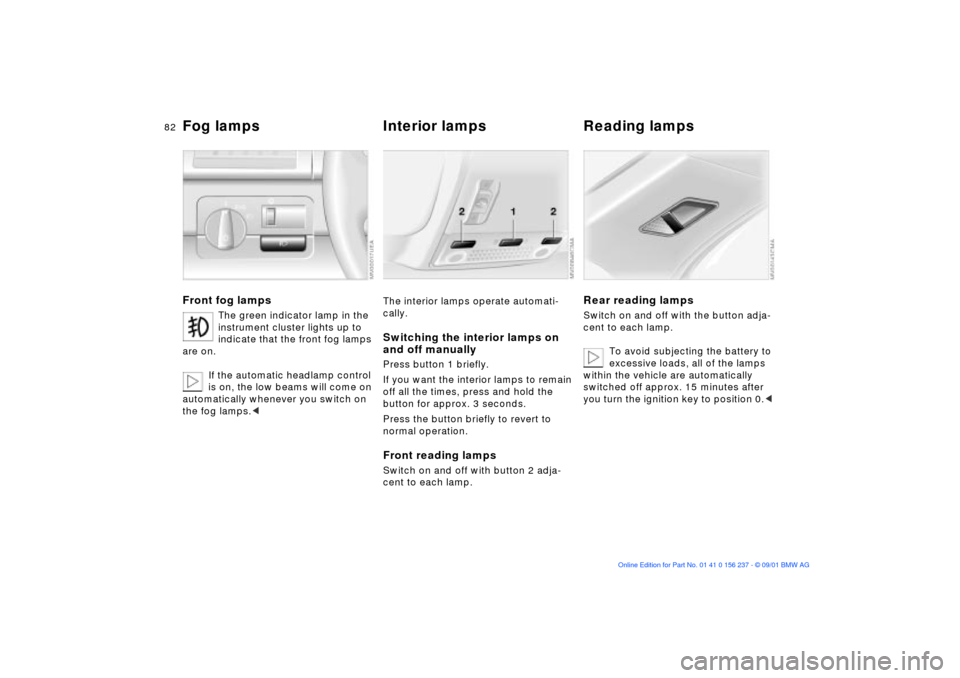
Front fog lamps
The green indicator lamp in the
instrument cluster lights up to
indicate that the front fog lamps
are on.
If the automatic headlamp control
is on, the low beams will come on
automatically whenever you switch on
the fog lamps.<
The interior lamps operate automati-
cally.Switching the interior lamps on
and off manuallyPress button 1 briefly.
If you want the interior lamps to remain
off all the times, press and hold the
button for approx. 3 seconds.
Press the button briefly to revert to
normal operation.Front reading lampsSwitch on and off with button 2 adja-
cent to each lamp.
Rear reading lampsSwitch on and off with the button adja-
cent to each lamp.
To avoid subjecting the battery to
excessive loads, all of the lamps
within the vehicle are automatically
switched off approx. 15 minutes after
you turn the ignition key to position 0.<
Page 120 of 151
120n
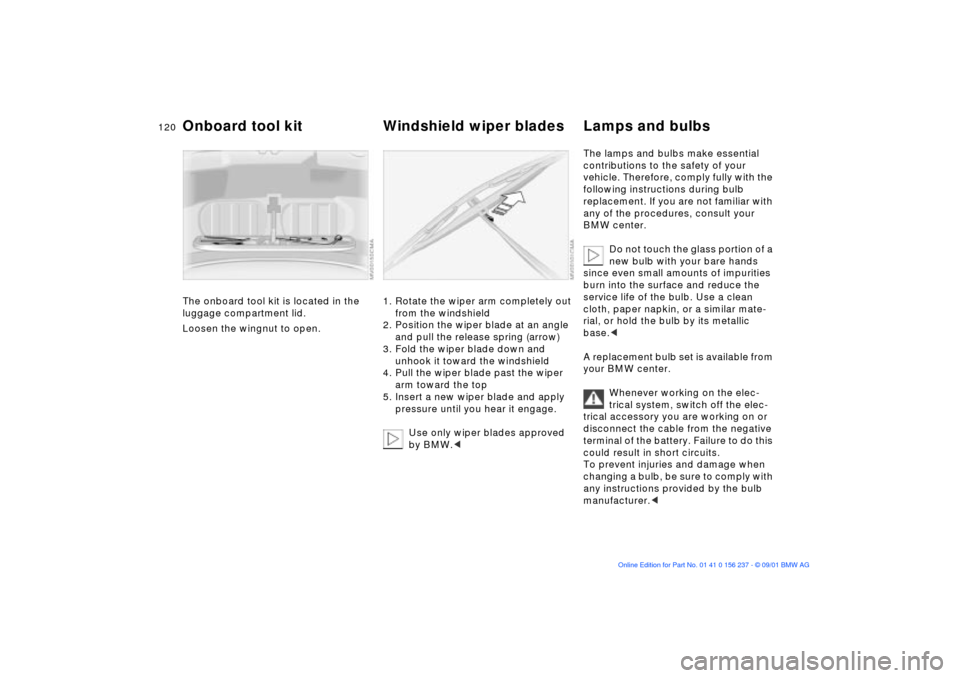
The onboard tool kit is located in the
luggage compartment lid.
Loosen the wingnut to open.
1. Rotate the wiper arm completely out
from the windshield
2. Position the wiper blade at an angle
and pull the release spring (arrow)
3. Fold the wiper blade down and
unhook it toward the windshield
4. Pull the wiper blade past the wiper
arm toward the top
5. Insert a new wiper blade and apply
pressure until you hear it engage.
Use only wiper blades approved
by BMW.<
The lamps and bulbs make essential
contributions to the safety of your
vehicle. Therefore, comply fully with the
following instructions during bulb
replacement. If you are not familiar with
any of the procedures, consult your
BMW center.
Do not touch the glass portion of a
new bulb with your bare hands
since even small amounts of impurities
burn into the surface and reduce the
service life of the bulb. Use a clean
cloth, paper napkin, or a similar mate-
rial, or hold the bulb by its metallic
base.<
A replacement bulb set is available from
your BMW center.
Whenever working on the elec-
trical system, switch off the elec-
trical accessory you are working on or
disconnect the cable from the negative
terminal of the battery. Failure to do this
could result in short circuits.
To prevent injuries and damage when
changing a bulb, be sure to comply with
any instructions provided by the bulb
manufacturer.<
Onboard tool kit Windshield wiper blades Lamps and bulbs
Page 130 of 151
130n
Battery Fuses
Battery posts, terminals, and
related accessories contain lead
and lead compounds. Wash hands after
handling.<
Battery careThe battery is completely maintenance-
free. That means that the original
battery acid will normally last for the
service life of the battery under
moderate climate conditions.
Please consult your BMW center
whenever you have any questions
concerning the battery. Since the
battery is absolutely maintenance-free,
the following statements are for your
information only.<
Never disconnect the battery
when the engine is running; the
ensuing voltage surge would seriously
damage the vehicle's onboard elec-
tronic systems.<
Charging the battery Charge the battery in the vehicle only
when the engine is not running. Use the
connections provided in the engine
compartment (for correct connections,
refer to "Jump-starting" on page 131.
Return used batteries to a recy-
cling point or your BMW center.
Maintain the battery in an upright posi-
tion for transport and storage. Secure
the battery against tilting in transit.<
Open the glove compartment and turn
the two white quick-release fasteners
outward.
Do not attempt to repair a burned
fuse or replace it with a fuse
having a different color or ampere
rating. To do this could cause a fire in
the vehicle resulting from a circuit over-
load.<
Page 131 of 151
131n
OverviewControlsMaintenanceRepairsDataIndex
Do not use spray starter fluids to start
the engine.
When your battery is discharged you
can use two jumper cables to start your
vehicle with power from the battery in a
second vehicle. You can also use the
same method to help start another
vehicle. Use only jumper cables with
fully insulated handles on the terminal
clamps.
Do not touch the parts conducting
current while the engine is
running. Failure to comply with this
creates a risk of fatal injury.
Carefully observe the following instruc-
tions to avoid personal injury and/or
damage to one or both vehicles.<
1. Ensure that the battery in the support
vehicle is also rated at 12 volts. This
information is provided on the top of
the battery casing
2. Do not disconnect your battery from
your vehicle's electrical system.
Switch off all electrical accessories in
both vehicles
3. Make absolutely certain that there is
no contact between the bodywork of
the two vehicles Ð short circuit
hazard
4. Start the engine on the support
vehicle and allow it to run
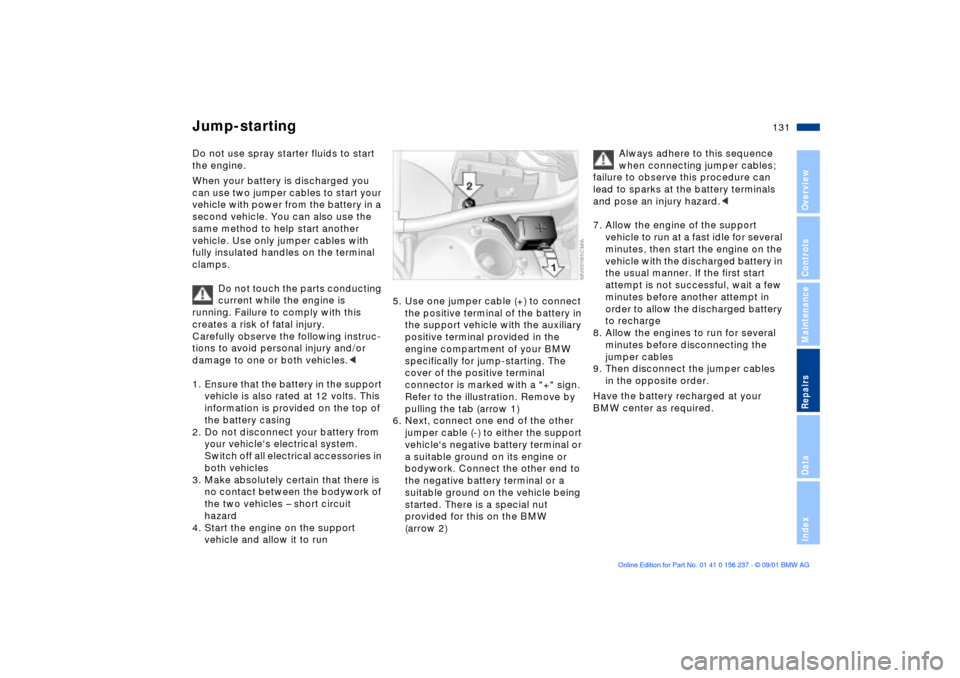
5. Use one jumper cable (+) to connect
the positive terminal of the battery in
the support vehicle with the auxiliary
positive terminal provided in the
engine compartment of your BMW
specifically for jump-starting. The
cover of the positive terminal
connector is marked with a "+" sign.
Refer to the illustration. Remove by
pulling the tab (arrow 1)
6. Next, connect one end of the other
jumper cable (-) to either the support
vehicle's negative battery terminal or
a suitable ground on its engine or
bodywork. Connect the other end to
the negative battery terminal or a
suitable ground on the vehicle being
started. There is a special nut
provided for this on the BMW
(arrow 2)
Always adhere to this sequence
when connecting jumper cables;
failure to observe this procedure can
lead to sparks at the battery terminals
and pose an injury hazard.<
7. Allow the engine of the support
vehicle to run at a fast idle for several
minutes, then start the engine on the
vehicle with the discharged battery in
the usual manner. If the first start
attempt is not successful, wait a few
minutes before another attempt in
order to allow the discharged battery
to recharge
8. Allow the engines to run for several
minutes before disconnecting the
jumper cables
9. Then disconnect the jumper cables
in the opposite order.
Have the battery recharged at your
BMW center as required.
Jump-starting