lights BMW M3 COUPE 2002 E46 Owner's Manual
[x] Cancel search | Manufacturer: BMW, Model Year: 2002, Model line: M3 COUPE, Model: BMW M3 COUPE 2002 E46Pages: 151, PDF Size: 2.14 MB
Page 17 of 151
17n
OverviewControlsMaintenanceRepairsDataIndex
Indicator and warning lamps
Technology that monitors itself
Indicator and warning lamps that are
identified by "
l
" are tested for proper
functioning whenever the ignition key is
turned. They each light up once for
different periods of time.
If a fault should occur in one of these
systems, the corresponding lamp does
not go out after the engine is started or
it lights up while the vehicle is moving.
You will see how to react to this below.
Red: stop immediately
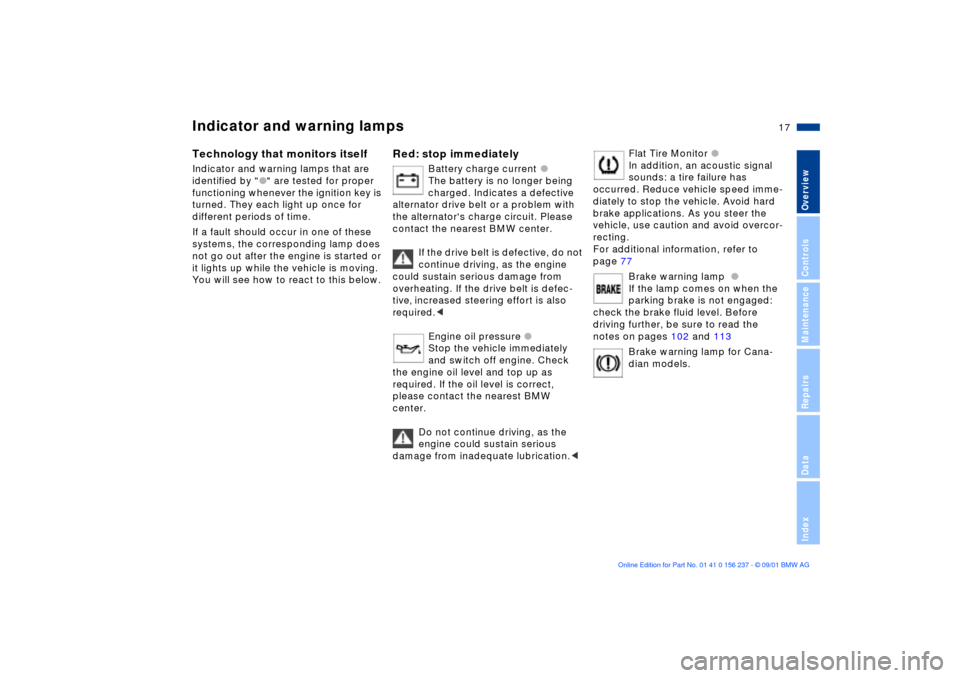
Battery charge current
l
The battery is no longer being
charged. Indicates a defective
alternator drive belt or a problem with
the alternator's charge circuit. Please
contact the nearest BMW center.
If the drive belt is defective, do not
continue driving, as the engine
could sustain serious damage from
overheating. If the drive belt is defec-
tive, increased steering effort is also
required.
<
Engine oil pressure
l
Stop the vehicle immediately
and switch off engine. Check
the engine oil level and top up as
required. If the oil level is correct,
please contact the nearest BMW
center.
Do not continue driving, as the
engine could sustain serious
damage from inadequate lubrication.
<
Flat Tire Monitor
l
In addition, an acoustic signal
sounds: a tire failure has
occurred. Reduce vehicle speed imme-
diately to stop the vehicle. Avoid hard
brake applications. As you steer the
vehicle, use caution and avoid overcor-
recting.
For additional information, refer to
page 77
Brake warning lamp
l
If the lamp comes on when the
parking brake is not engaged:
check the brake fluid level. Before
driving further, be sure to read the
notes on pages 102 and 113
Brake warning lamp for Cana-
dian models.
Page 18 of 151
18n
Indicator and warning lamps
Red: an important reminder
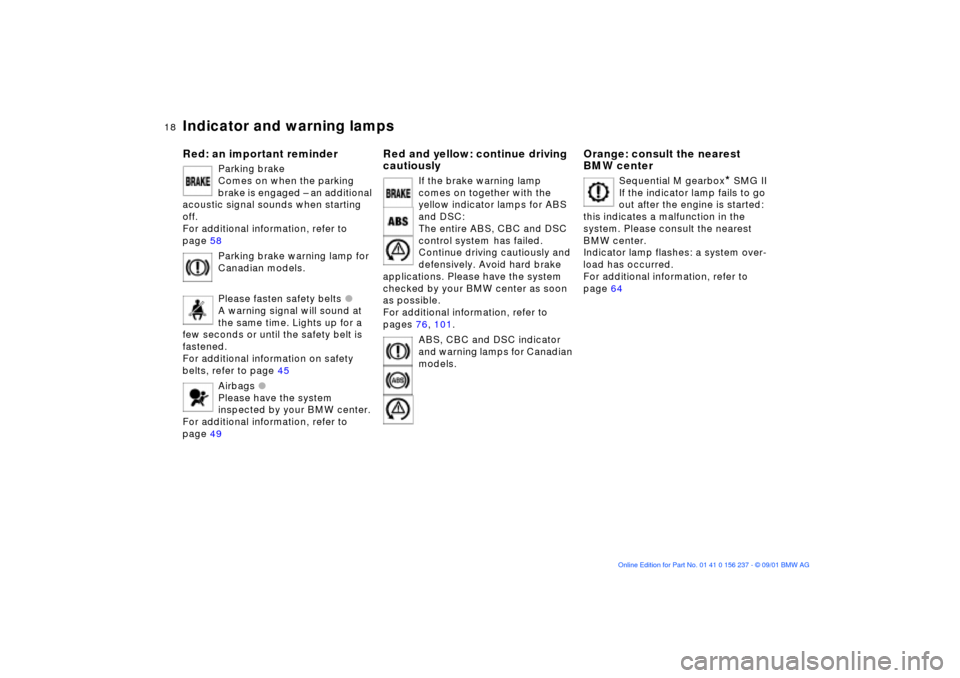
Parking brake
Comes on when the parking
brake is engaged Ð an additional
acoustic signal sounds when starting
off.
For additional information, refer to
page 58
Parking brake warning lamp for
Canadian models.
Please fasten safety belts
l
A warning signal will sound at
the same time. Lights up for a
few seconds or until the safety belt is
fastened.
For additional information on safety
belts, refer to page 45
Airbags
l
Please have the system
inspected by your BMW center.
For additional information, refer to
page 49
Red and yellow: continue driving
cautiously
If the brake warning lamp
comes on together with the
yellow indicator lamps for ABS
and DSC:
The entire ABS, CBC and DSC
control system
has failed.
Continue driving cautiously and
defensively. Avoid hard brake
applications. Please have the system
checked by your BMW center as soon
as possible.
For additional information, refer to
pages 76, 101.
ABS, CBC and DSC indicator
and warning lamps for Canadian
models.
Orange: consult the nearest
BMW center
Sequential M gearbox
*
SMG II
If the indicator lamp fails to go
out after the engine is started:
this indicates a malfunction in the
system. Please consult the nearest
BMW center.
Indicator lamp flashes: a system over-
load has occurred.
For additional information, refer to
page 64
Page 20 of 151
20n
Indicator and warning lamps
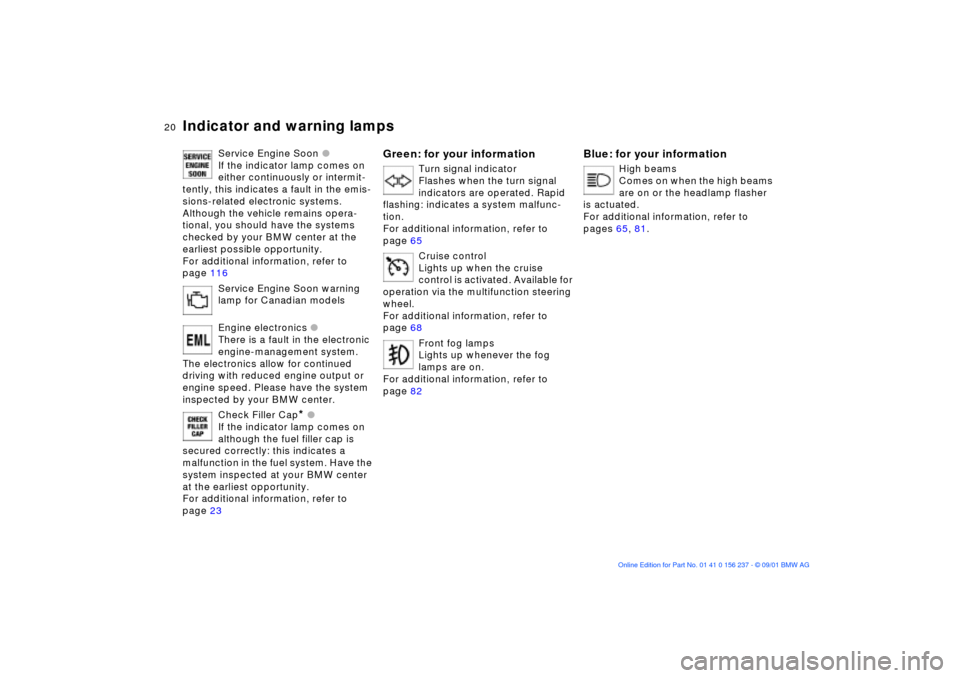
Service Engine Soon
l
If the indicator lamp comes on
either continuously or intermit-
tently, this indicates a fault in the emis-
sions-related electronic systems.
Although the vehicle remains opera-
tional, you should have the systems
checked by your BMW center at the
earliest possible opportunity.
For additional information, refer to
page 116
Service Engine Soon warning
lamp for Canadian models
Engine electronics
l
There is a fault in the electronic
engine-management system.
The electronics allow for continued
driving with reduced engine output or
engine speed. Please have the system
inspected by your BMW center.
Check Filler Cap
*
l
If the indicator lamp comes on
although the fuel filler cap is
secured correctly: this indicates a
malfunction in the fuel system. Have the
system inspected at your BMW center
at the earliest opportunity.
For additional information, refer to
page 23
Green: for your information
Turn signal indicator
Flashes when the turn signal
indicators are operated. Rapid
flashing: indicates a system malfunc-
tion.
For additional information, refer to
page 65
Cruise control
Lights up when the cruise
control is activated. Available for
operation via the multifunction steering
wheel.
For additional information, refer to
page 68
Front fog lamps
Lights up whenever the fog
lamps are on.
For additional information, refer to
page 82
Blue: for your information
High beams
Comes on when the high beams
are on or the headlamp flasher
is actuated.
For additional information, refer to
pages 65, 81.
Page 38 of 151

38n
Alarm system
*
>If the indicator lamp flashes for
10 seconds when the system is
disarmed: an attempted entry has
been detected in the period since the
system was armed.
Following triggering of an alarm, the
indicator lamp will flash continuously.Avoiding unintentional alarms The tilt alarm sensor and interior motion
sensor can be deactivated together.
Doing this prevents a false alarm from
being triggered, e.g. in garages with
elevator ramps or when the vehicle is
being transported on a car train:
Lock the vehicle twice (= arm the
system). Press button 2 on the remote
control twice in succession or lock the
vehicle twice with the key, refer to
page 31.
The indicator lamp lights up briefly and
then flashes continuously. The tilt alarm
sensor and the interior motion sensor
are deactivated as long as the system is
armed.
Arm the alarm system again to reacti-
vate the tilt alarm sensor and the inte-
rior motion sensor.
Interior motion sensorIn order for the interior motion sensor to
function properly, the windows and
sliding/tilt sunroof must be completely
closed.
Nevertheless, you should deactivate
the interior motion sensor (refer to
"Avoiding unintentional alarms") if you
>leave children or animals in the
vehicle
>the windows or sliding/tilt sunroof
should be left open.
Page 46 of 151
46n
Safety belts Seat and mirror memory
If the safety belt system has been
subjected to the stresses involved
in an accident or otherwise damaged:
Have the entire safety belt mechanism
replaced by your BMW center,
including the safety belt tensioner. In
addition, have your BMW center
inspect the safety belt anchors. If a
child-restraint system was in the
vehicle during an accident, consult the
manufacturer's instructions regarding
replacement.<
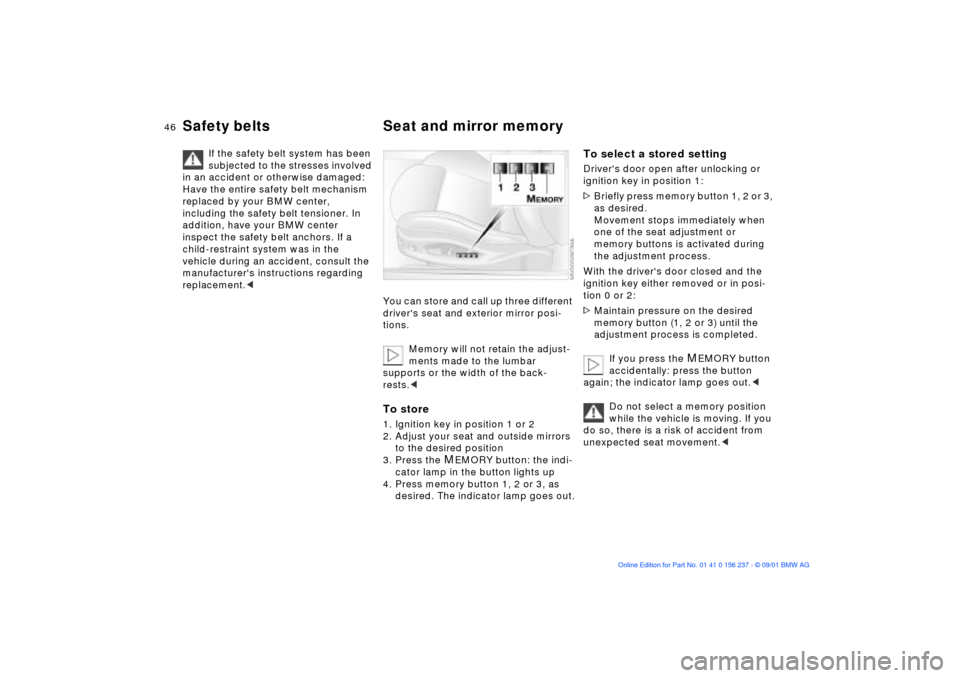
You can store and call up three different
driver's seat and exterior mirror posi-
tions.
Memory will not retain the adjust-
ments made to the lumbar
supports or the width of the back-
rests.
to the desired position
3. Press the
MEMORY button: the indi-
cator lamp in the button lights up
4. Press memory button 1, 2 or 3, as
desired. The indicator lamp goes out.
To select a stored settingDriver's door open after unlocking or
ignition key in position 1:
>Briefly press memory button 1, 2 or 3,
as desired.
Movement stops immediately when
one of the seat adjustment or
memory buttons is activated during
the adjustment process.
With the driver's door closed and the
ignition key either removed or in posi-
tion 0 or 2:
>Maintain pressure on the desired
memory button (1, 2 or 3) until the
adjustment process is completed.
If you press the
MEMORY button
accidentally: press the button
again; the indicator lamp goes out.<
Do not select a memory position
while the vehicle is moving. If you
do so, there is a risk of accident from
unexpected seat movement.<
Page 59 of 151
59n
OverviewControlsMaintenanceRepairsDataIndex
Manual transmission Sequential M gearbox
* SMG II
Reverse Select only when the vehicle is
completely stopped. Press the gearshift
lever to the left to overcome the slight
resistance.
As you do this, the backup lamps will
come on automatically when the igni-
tion key is in position 2.
Do not hold the vehicle in place on
slopes by slipping or "riding" the
clutch. Use the parking brake instead.
Riding the clutch causes the clutch
assembly to wear out sooner.<
The conceptThe sequential M gearbox SMG II is an
automated manual gearbox with which
clutching and shifting is assumed by an
electro-hydraulic system.
The SMG II is operated via two shift
paddles on the steering wheel and the
selector lever in the center console.
It offers the following functions:
>Sequential and automated shifting
mode
>Ability to choose between different
driving programs (Drivelogic)
>Gradient assistance
>Upshift display (shift lights)
>Throttle blip
>Driving dependent functions:
The respective driving situation (e.g.
cornering, mountain driving, braking)
is detected by sensors and taken into
account accordingly for shifting, e.g.
to achieve optimum gear selection
during deceleration and subsequent
acceleration>Slip recognition at the rear axle for
increasing driving stability, e.g.
during downshifting on slippery road
surfaces
>Operating safety through protection
against misshifting.
Page 64 of 151
64n
Sequential M gearbox* SMG II
The vehicle may roll slightly before
it is held by the gradient assis-
tance after releasing the footbrake.
Two seconds after the footbrake is
released, the vehicle begins to roll, as it
is no longer held with the gradient
assistance.<
The gradient assistance must be reacti-
vated before each use.
Indicator lamp
The transmission indicator lamp
in the instrument cluster goes
out after the engine is started.
>If it does not go out, or if it lights up
during driving, a fault has occurred.
The available functions may be
limited under certain circumstances.
Drive carefully and with the Dynamic
Stability Control (DSC) activated.
Have the system checked by the
nearest BMW center
>If the indicator lamp flashes while
driving, the system is overloaded.
Avoid high loads until the indicator
lamp goes out again permanently.
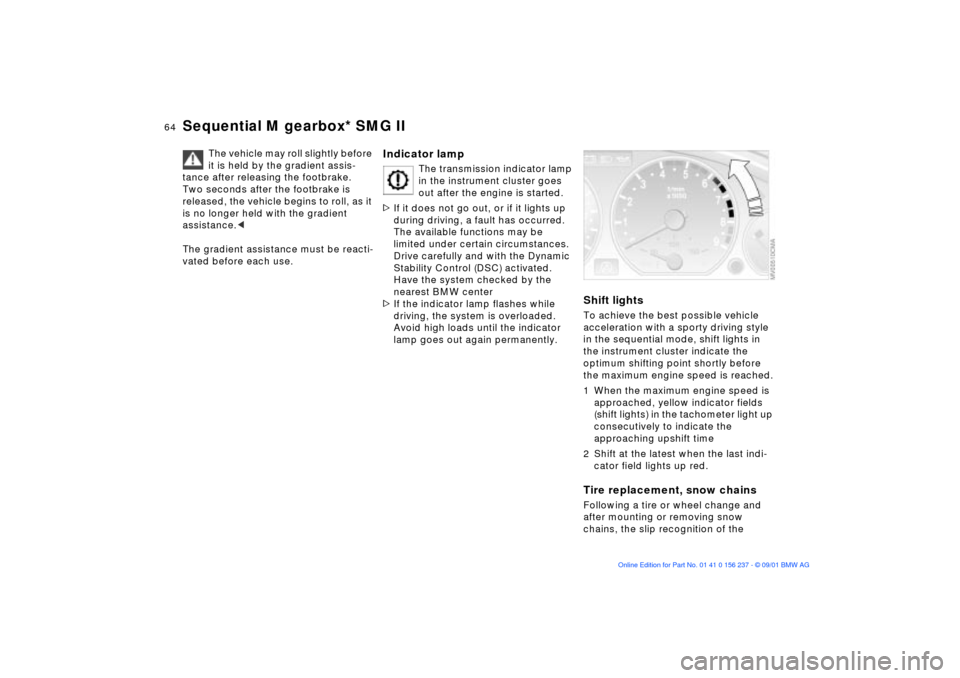
Shift lightsTo achieve the best possible vehicle
acceleration with a sporty driving style
in the sequential mode, shift lights in
the instrument cluster indicate the
optimum shifting point shortly before
the maximum engine speed is reached.
1 When the maximum engine speed is
approached, yellow indicator fields
(shift lights) in the tachometer light up
consecutively to indicate the
approaching upshift time
2 Shift at the latest when the last indi-
cator field lights up red.Tire replacement, snow chainsFollowing a tire or wheel change and
after mounting or removing snow
chains, the slip recognition of the
Page 71 of 151
71n
OverviewControlsMaintenanceRepairsDataIndex
Fuel gauge Temperature gauge Service Interval Display Once the indicator lamp stays on
continuously, there are still approx.
2 gallons (8 liters) of fuel in the fuel
tank.
Fuel tank capacity: approx. 16.6 gal.
(63 liters).
If the tilt of the vehicle varies (when you
are driving in mountainous areas, for
example), the needle may fluctuate
slightly.
Please refuel early, since driving
to the last drop of fuel can result in
damage to the engine and/or catalytic
converter.<
When you switch on the ignition, the
indicator lamp lights up briefly as a
functional check.
BlueThe engine is still cold. Drive at
moderate engine and vehicle speeds. RedWhen you switch on the ignition, the
warning lamp comes on briefly to
confirm that the system is operational.
If the lamp comes on while operating
the vehicle, the engine has overheated.
Switch off the engine immediately and
allow it to cool down.
Checking coolant level, refer to
page 112.Between the blue and red zonesNormal operating range. The needle
may rise as far as the edge of the red
sector in normal operation.
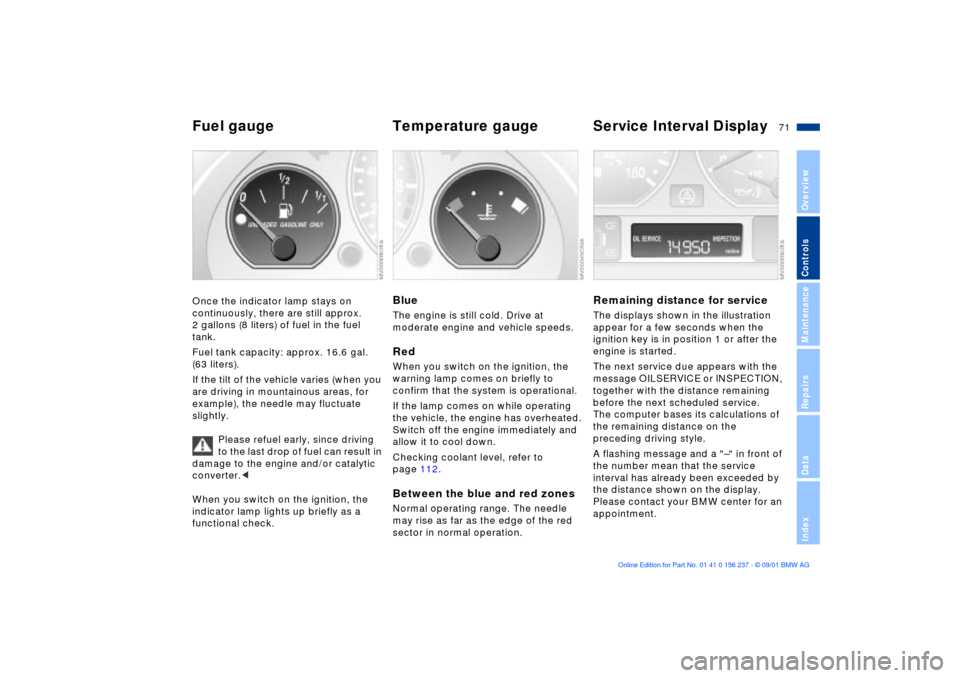
Remaining distance for serviceThe displays shown in the illustration
appear for a few seconds when the
ignition key is in position 1 or after the
engine is started.
The next service due appears with the
message OILSERVICE or INSPECTION,
together with the distance remaining
before the next scheduled service.
The computer bases its calculations of
the remaining distance on the
preceding driving style.
A flashing message and a "Ð" in front of
the number mean that the service
interval has already been exceeded by
the distance shown on the display.
Please contact your BMW center for an
appointment.
Page 78 of 151
78n
Flat Tire MonitorInitializing the systemInitializing is necessary to familiarize the
system with the correct tire inflation
pressure.
Repeat this process after any changes
in tire inflation pressure, tire replace-
ment or rotation.
1. Check the tire inflation pressure in all
the tires, comparing them with the
inflation pressure table (page 25),
and adjusting their pressure if neces-
sary
2. Turn the ignition key to position 2
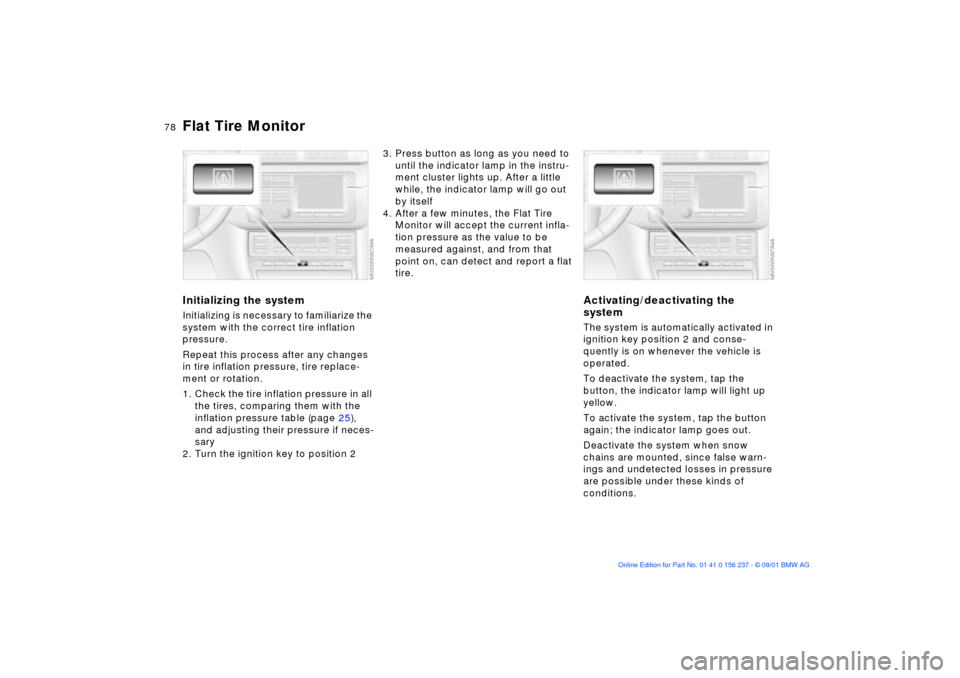
3. Press button as long as you need to
until the indicator lamp in the instru-
ment cluster lights up. After a little
while, the indicator lamp will go out
by itself
4. After a few minutes, the Flat Tire
Monitor will accept the current infla-
tion pressure as the value to be
measured against, and from that
point on, can detect and report a flat
tire.
Activating/deactivating the
systemThe system is automatically activated in
ignition key position 2 and conse-
quently is on whenever the vehicle is
operated.
To deactivate the system, tap the
button, the indicator lamp will light up
yellow.
To activate the system, tap the button
again; the indicator lamp goes out.
Deactivate the system when snow
chains are mounted, since false warn-
ings and undetected losses in pressure
are possible under these kinds of
conditions.
Page 80 of 151
80n
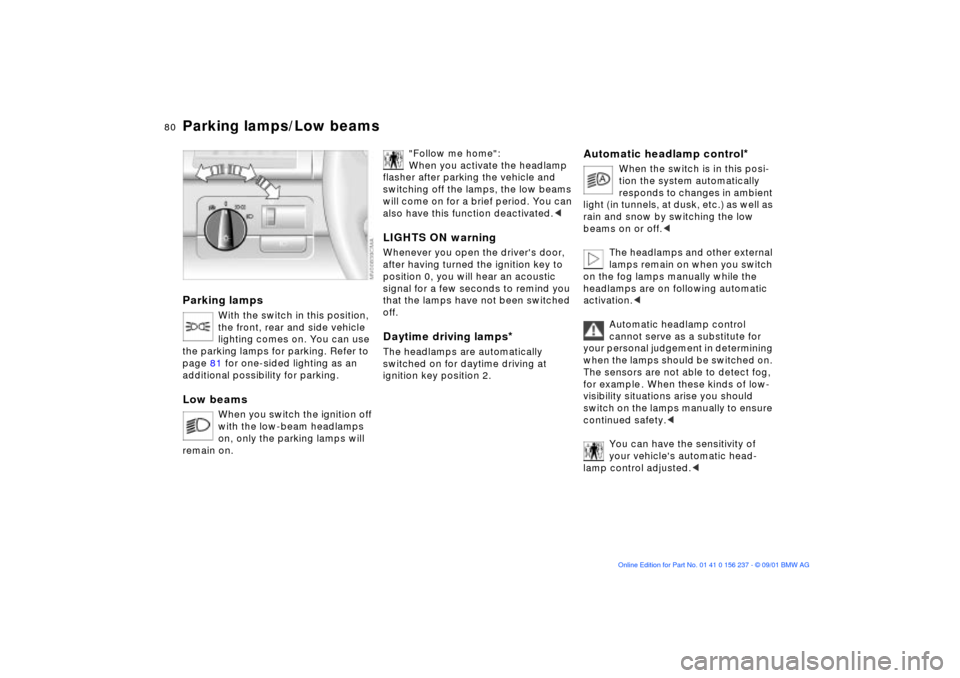
Parking lamps
With the switch in this position,
the front, rear and side vehicle
lighting comes on. You can use
the parking lamps for parking. Refer to
page 81 for one-sided lighting as an
additional possibility for parking.
Low beams
When you switch the ignition off
with the low-beam headlamps
on, only the parking lamps will
remain on.
"Follow me home":
When you activate the headlamp
flasher after parking the vehicle and
switching off the lamps, the low beams
will come on for a brief period. You can
also have this function deactivated.<
LIGHTS ON warningWhenever you open the driver's door,
after having turned the ignition key to
position 0, you will hear an acoustic
signal for a few seconds to remind you
that the lamps have not been switched
off.Daytime driving lamps
*
The headlamps are automatically
switched on for daytime driving at
ignition key position 2.
Automatic headlamp control
*
When the switch is in this posi-
tion the system automatically
responds to changes in ambient
light ( in tunnels, at dusk, etc.) as well as
rain and snow by switching the low
beams on or off.<
The headlamps and other external
lamps remain on when you switch
on the fog lamps manually while the
headlamps are on following automatic
activation.<
Automatic headlamp control
cannot serve as a substitute for
your personal judgement in determining
when the lamps should be switched on.
The sensors are not able to detect fog,
for example . When these kinds of low-
visibility situations arise you should
switch on the lamps manually to ensure
continued safety.<
You can have the sensitivity of
your vehicle's automatic head-
lamp control adjusted.<
Parking lamps/Low beams