engine oil BMW M3 COUPE 2004 E46 User Guide
[x] Cancel search | Manufacturer: BMW, Model Year: 2004, Model line: M3 COUPE, Model: BMW M3 COUPE 2004 E46Pages: 170, PDF Size: 2.62 MB
Page 124 of 170
124
However, if the vehicle is exposed to
temperatures below –47/–206 for
extended periods, please have your
BMW center recommend a suitable oil.
Coolant
Do not add coolant to the cooling
system when the engine is hot. If
you attempt to do so, escaping coolant
can cause burns.
Antifreeze and anti-corrosion agents
are hazardous to health. You should
always store them in their closed origi-
nal containers and in a location inac-
cessible to children. Antifreeze and
anti-corrosion agents are inflammable.
For this reason, do not spill them on hot
engine parts. They could ignite and
cause burns. Comply with the instruc-
tions on the containers.<
Comply with the applicable envi-
ronmental laws regulating the dis-
posal of antifreeze agents with corro-
sion inhibitor.<
Checking the coolant level and
adding coolantCheck the coolant level when the
engine is cold, approx. 687/+206.
1. Open the cap for the expansion tank
by turning it slightly counterclock-
wise to allow accumulated pressure
to escape. Then open
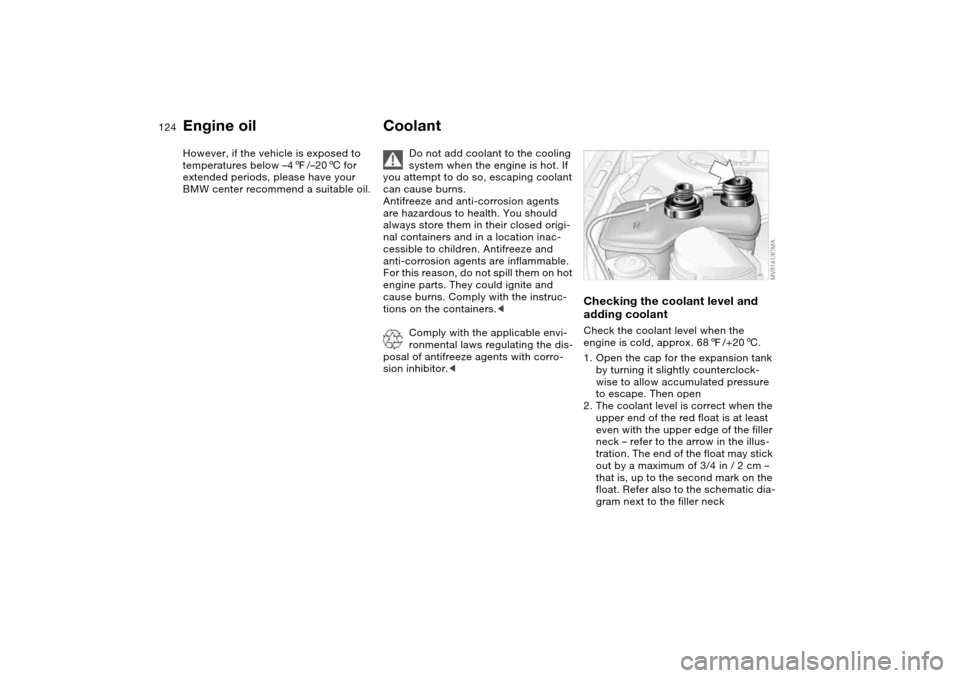
2. The coolant level is correct when the
upper end of the red float is at least
even with the upper edge of the filler
neck – refer to the arrow in the illus-
tration. The end of the float may stick
out by a maximum of 3/4 in / 2 cm –
that is, up to the second mark on the
float. Refer also to the schematic dia-
gram next to the filler neck
Engine oil
Page 126 of 170
126Maintenance
The BMW Maintenance SystemThe BMW Maintenance System has
been designed as a reliable means of
providing maximum driving and operat-
ing safety – and as cost-effectively for
you as possible.
Please keep in mind that regular main-
tenance is not only necessary for the
safety of your vehicle, but also plays a
significant role in maintaining the resale
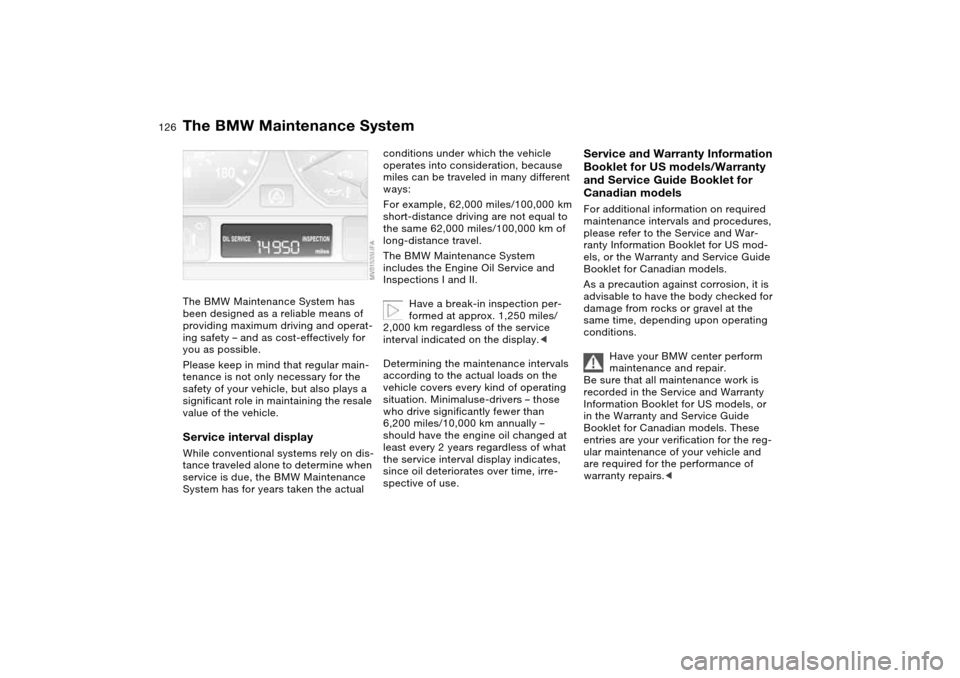
value of the vehicle.Service interval displayWhile conventional systems rely on dis-
tance traveled alone to determine when
service is due, the BMW Maintenance
System has for years taken the actual
conditions under which the vehicle
operates into consideration, because
miles can be traveled in many different
ways:
For example, 62,000 miles/100,000 km
short-distance driving are not equal to
the same 62,000 miles/100,000 km of
long-distance travel.
The BMW Maintenance System
includes the Engine Oil Service and
Inspections I and II.
Have a break-in inspection per-
formed at approx. 1,250 miles/
2,000 km regardless of the service
interval indicated on the display.<
Determining the maintenance intervals
according to the actual loads on the
vehicle covers every kind of operating
situation. Minimaluse-drivers – those
who drive significantly fewer than
6,200 miles/10,000 km annually –
should have the engine oil changed at
least every 2 years regardless of what
the service interval display indicates,
since oil deteriorates over time, irre-
spective of use.
Service and Warranty Information
Booklet for US models/Warranty
and Service Guide Booklet for
Canadian modelsFor additional information on required
maintenance intervals and procedures,
please refer to the Service and War-
ranty Information Booklet for US mod-
els, or the Warranty and Service Guide
Booklet for Canadian models.
As a precaution against corrosion, it is
advisable to have the body checked for
damage from rocks or gravel at the
same time, depending upon operating
conditions.
Have your BMW center perform
maintenance and repair.
Be sure that all maintenance work is
recorded in the Service and Warranty
Information Booklet for US models, or
in the Warranty and Service Guide
Booklet for Canadian models. These
entries are your verification for the reg-
ular maintenance of your vehicle and
are required for the performance of
warranty repairs.<
Page 128 of 170
128Laws and regulations
California Proposition 65 warningCalifornia laws require us to state the
following warning:
Engine exhaust and a wide variety
of automobile components and
parts, including components found in
the interior furnishings in a vehicle, con-
tain or emit chemicals known to the
State of California to cause cancer and
birth defects and reproductive harm. In
addition, certain fluids contained in
vehicles and certain products of com-
ponent wear contain or emit chemicals
known to the State of California to
cause cancer and birth defects or other
reproductive harm.
Battery posts, terminals and related
accessories contain lead and lead com-
pounds. Wash your hands after
handling.
Used engine oil contains chemicals that
have caused cancer in laboratory ani-
mals. Always protect your skin by
washing thoroughly with soap and
water.<
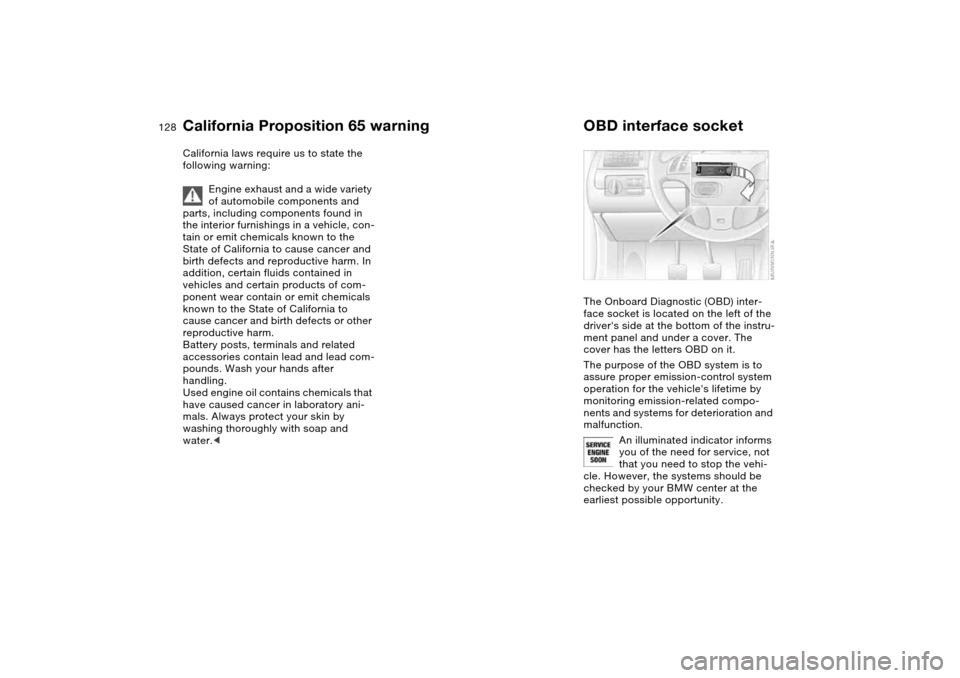
OBD interface socketThe Onboard Diagnostic (OBD) inter-
face socket is located on the left of the
driver's side at the bottom of the instru-
ment panel and under a cover. The
cover has the letters OBD on it.
The purpose of the OBD system is to
assure proper emission-control system
operation for the vehicle's lifetime by
monitoring emission-related compo-
nents and systems for deterioration and
malfunction.
An illuminated indicator informs
you of the need for service, not
that you need to stop the vehi-
cle. However, the systems should be
checked by your BMW center at the
earliest possible opportunity.
Page 153 of 170
153
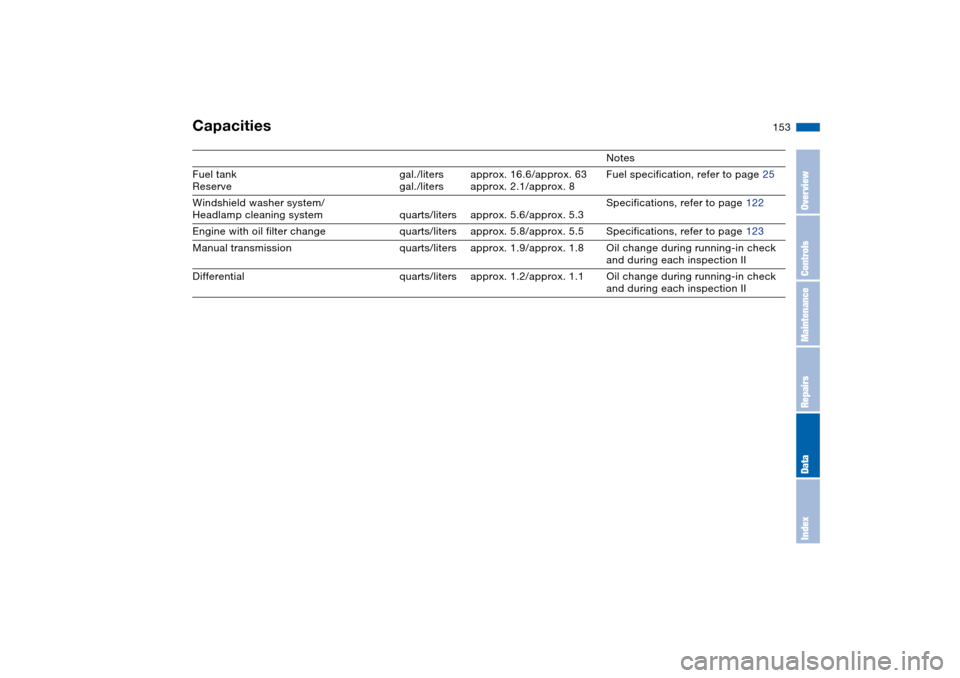
Capacities
Notes
Fuel tank
Reservegal./liters
gal./litersapprox. 16.6/approx. 63
approx. 2.1/approx. 8Fuel specification, refer to page 25
Windshield washer system/
Headlamp cleaning system quarts/liters approx. 5.6/approx. 5.3Specifications, refer to page 122
Engine with oil filter change quarts/liters approx. 5.8/approx. 5.5 Specifications, refer to page 123
Manual transmission quarts/liters approx. 1.9/approx. 1.8 Oil change during running-in check
and during each inspection II
Differential quarts/liters approx. 1.2/approx. 1.1 Oil change during running-in check
and during each inspection II
OverviewControlsMaintenanceRepairsDataIndex
Page 158 of 170
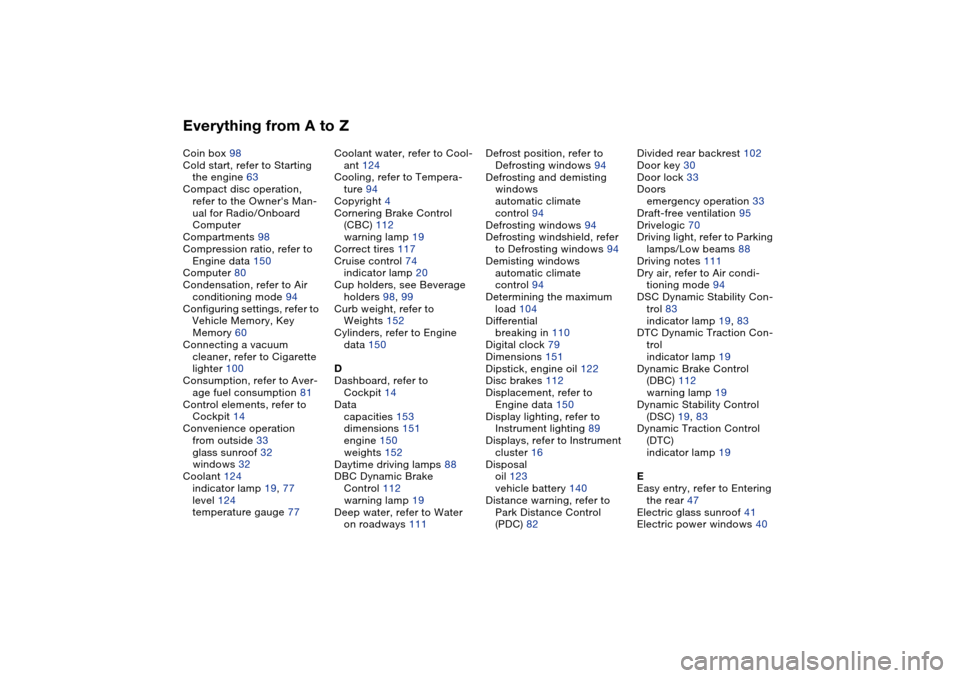
Everything from A to ZCoin box 98
Cold start, refer to Starting
the engine 63
Compact disc operation,
refer to the Owner's Man-
ual for Radio/Onboard
Computer
Compartments 98
Compression ratio, refer to
Engine data 150
Computer 80
Condensation, refer to Air
conditioning mode 94
Configuring settings, refer to
Vehicle Memory, Key
Memory 60
Connecting a vacuum
cleaner, refer to Cigarette
lighter 100
Consumption, refer to Aver-
age fuel consumption 81
Control elements, refer to
Cockpit 14
Convenience operation
from outside 33
glass sunroof 32
windows 32
Coolant 124
indicator lamp 19, 77
level 124
temperature gauge 77Coolant water, refer to Cool-
ant 124
Cooling, refer to Tempera-
ture 94
Copyright 4
Cornering Brake Control
(CBC) 112
warning lamp 19
Correct tires 117
Cruise control 74
indicator lamp 20
Cup holders, see Beverage
holders 98, 99
Curb weight, refer to
Weights 152
Cylinders, refer to Engine
data 150
D
Dashboard, refer to
Cockpit 14
Data
capacities 153
dimensions 151
engine 150
weights 152
Daytime driving lamps 88
DBC Dynamic Brake
Control 112
warning lamp 19
Deep water, refer to Water
on roadways 111Defrost position, refer to
Defrosting windows 94
Defrosting and demisting
windows
automatic climate
control 94
Defrosting windows 94
Defrosting windshield, refer
to Defrosting windows 94
Demisting windows
automatic climate
control 94
Determining the maximum
load 104
Differential
breaking in 110
Digital clock 79
Dimensions 151
Dipstick, engine oil 122
Disc brakes 112
Displacement, refer to
Engine data 150
Display lighting, refer to
Instrument lighting 89
Displays, refer to Instrument
cluster 16
Disposal
oil 123
vehicle battery 140
Distance warning, refer to
Park Distance Control
(PDC) 82Divided rear backrest 102
Door key 30
Door lock 33
Doors
emergency operation 33
Draft-free ventilation 95
Drivelogic 70
Driving light, refer to Parking
lamps/Low beams 88
Driving notes 111
Dry air, refer to Air condi-
tioning mode 94
DSC Dynamic Stability Con-
trol 83
indicator lamp 19, 83
DTC Dynamic Traction Con-
trol
indicator lamp 19
Dynamic Brake Control
(DBC) 112
warning lamp 19
Dynamic Stability Control
(DSC) 19, 83
Dynamic Traction Control
(DTC)
indicator lamp 19
E
Easy entry, refer to Entering
the rear 47
Electric glass sunroof 41
Electric power windows 40
Page 159 of 170
Everything from A to Z
159
Electrical accessories, fail-
ure 141
Electrical malfunction
door lock 33
driver's door 33
fuel filler door 24
glass sunroof 42
luggage compartment
lid 35
Electronic Stability Program
(ESP), refer to Dynamic
Stability Control (DSC) 83
Emergency call 142
Emergency operation
doors 33
driver's door 33
fuel filler door 24
glass sunroof 42
Emergency release
luggage compartment lid
35, 37
Engine
breaking in 110
data 150
electronics 19
indicator lamp 19
speed 76, 150
starting 63
switching off 65
Engine compartment 120
Engine coolant 124
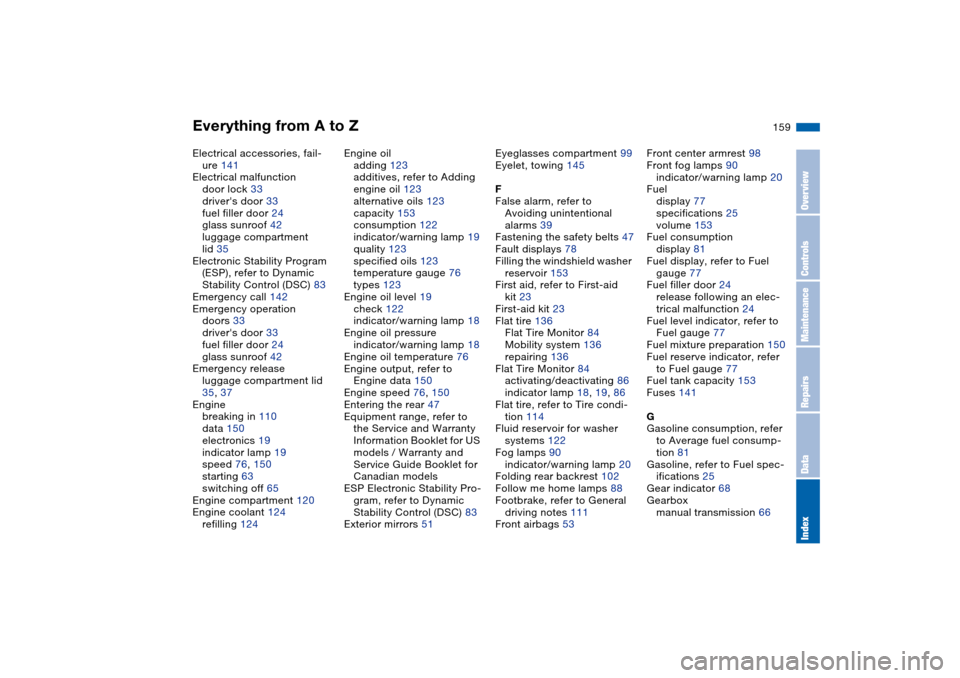
refilling 124Engine oil
adding 123
additives, refer to Adding
engine oil 123
alternative oils 123
capacity 153
consumption 122
indicator/warning lamp 19
quality 123
specified oils 123
temperature gauge 76
types 123
Engine oil level 19
check 122
indicator/warning lamp 18
Engine oil pressure
indicator/warning lamp 18
Engine oil temperature 76
Engine output, refer to
Engine data 150
Engine speed 76, 150
Entering the rear 47
Equipment range, refer to
the Service and Warranty
Information Booklet for US
models / Warranty and
Service Guide Booklet for
Canadian models
ESP Electronic Stability Pro-
gram, refer to Dynamic
Stability Control (DSC) 83
Exterior mirrors 51Eyeglasses compartment 99
Eyelet, towing 145
F
False alarm, refer to
Avoiding unintentional
alarms 39
Fastening the safety belts 47
Fault displays 78
Filling the windshield washer
reservoir 153
First aid, refer to First-aid
kit 23
First-aid kit 23
Flat tire 136
Flat Tire Monitor 84
Mobility system 136
repairing 136
Flat Tire Monitor 84
activating/deactivating 86
indicator lamp 18, 19, 86
Flat tire, refer to Tire condi-
tion 114
Fluid reservoir for washer
systems 122
Fog lamps 90
indicator/warning lamp 20
Folding rear backrest 102
Follow me home lamps 88
Footbrake, refer to General
driving notes 111
Front airbags 53Front center armrest 98
Front fog lamps 90
indicator/warning lamp 20
Fuel
display 77
specifications 25
volume 153
Fuel consumption
display 81
Fuel display, refer to Fuel
gauge 77
Fuel filler door 24
release following an elec-
trical malfunction 24
Fuel level indicator, refer to
Fuel gauge 77
Fuel mixture preparation 150
Fuel reserve indicator, refer
to Fuel gauge 77
Fuel tank capacity 153
Fuses 141
G
Gasoline consumption, refer
to Average fuel consump-
tion 81
Gasoline, refer to Fuel spec-
ifications 25
Gear indicator 68
Gearbox
manual transmission 66
OverviewControlsMaintenanceRepairsDataIndex
Page 162 of 170
Everything from A to ZMaximum speed
with winter tires 118
MC operation, refer to the
Owner's Manual for
Radio/Onboard Computer
MD operation, refer to the
Owner's Manual for
Radio/Onboard Computer
Mechanical seats 44
Memory, refer to Seat and
mirror memory 49
Memory, refer to Vehicle
Memory, Key Memory 60
Microfilter
automatic climate
control 96
Microphone, refer to Cellular
phone 99
Mini disc operation, refer to
the Owner's Manual for
Radio/Onboard Computer
Mirrors 51
automatic curb monitor 50
heated 51
memory, refer to Seat and
mirror memory 49
Mobile Service 142
Mobility system 136
Modifications, technical,
refer to For your own
safety 5Multifunction steering
wheel 22
Multifunction switch
turn signal indicator/head-
lamp flasher 72
washer/wiper system 73
N
Navigation system, refer to
the Owner's Manual for
Radio/Onboard Computer
Neck restraints, refer to
Head restraints 46
Nets 98
Nozzles, refer to
Ventilation 92
Nylon rope, refer to Towing
the vehicle 145
O
OBD interface socket 128
Odometer 76
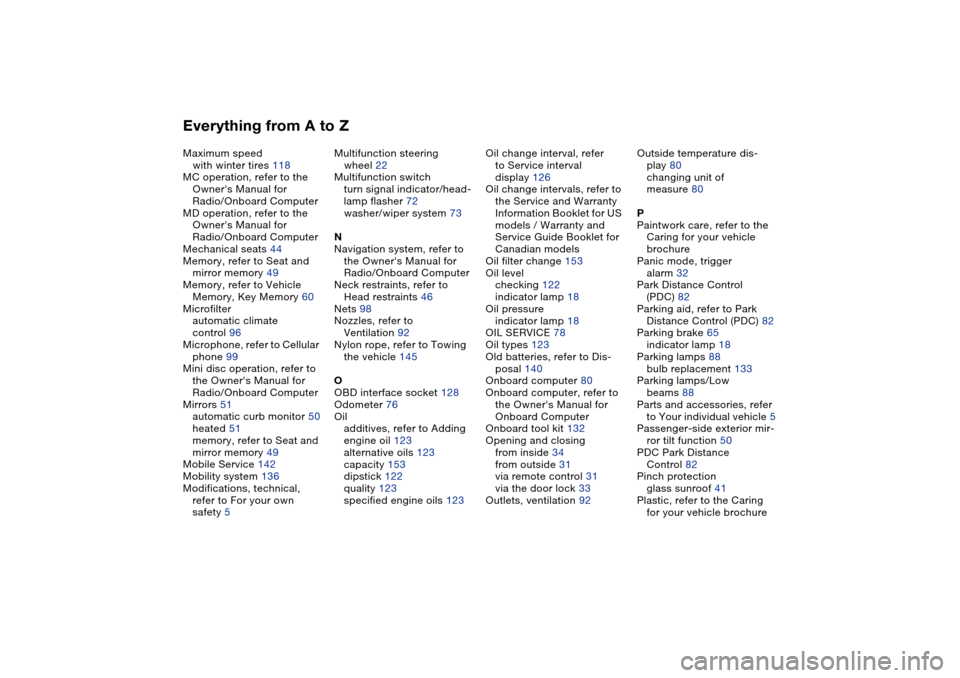
Oil
additives, refer to Adding
engine oil 123
alternative oils 123
capacity 153
dipstick 122
quality 123
specified engine oils 123Oil change interval, refer
to Service interval
display 126
Oil change intervals, refer to
the Service and Warranty
Information Booklet for US
models / Warranty and
Service Guide Booklet for
Canadian models
Oil filter change 153
Oil level
checking 122
indicator lamp 18
Oil pressure
indicator lamp 18
OIL SERVICE 78
Oil types 123
Old batteries, refer to Dis-
posal 140
Onboard computer 80
Onboard computer, refer to
the Owner's Manual for
Onboard Computer
Onboard tool kit 132
Opening and closing
from inside 34
from outside 31
via remote control 31
via the door lock 33
Outlets, ventilation 92Outside temperature dis-
play 80
changing unit of
measure 80
P
Paintwork care, refer to the
Caring for your vehicle
brochure
Panic mode, trigger
alarm 32
Park Distance Control
(PDC) 82
Parking aid, refer to Park
Distance Control (PDC) 82
Parking brake 65
indicator lamp 18
Parking lamps 88
bulb replacement 133
Parking lamps/Low
beams 88
Parts and accessories, refer
to Your individual vehicle 5
Passenger-side exterior mir-
ror tilt function 50
PDC Park Distance
Control 82
Pinch protection
glass sunroof 41
Plastic, refer to the Caring
for your vehicle brochure
Page 164 of 170
Everything from A to ZSequential M gearbox with
Drivelogic 67
indicator lamp 19, 71
Service and Warranty Infor-
mation Booklet 126
SERVICE ENGINE SOON
warning lamp 19
Service interval display
78, 126
Shift lights 71
Shift paddles 68
Side airbags 53
Side turn signal indicators
bulb replacement 134
Sitting safely
with airbags 43
with safety belts 43
Size 151
Ski bag 103
Sliding/tilt sunroof, refer to
Electric glass sunroof 41
SMG Drivelogic 67
Smokers' package, refer to
Ashtray 100
Snow chains 118
SOS, refer to Emergency
call 142
Spare key 30, 31
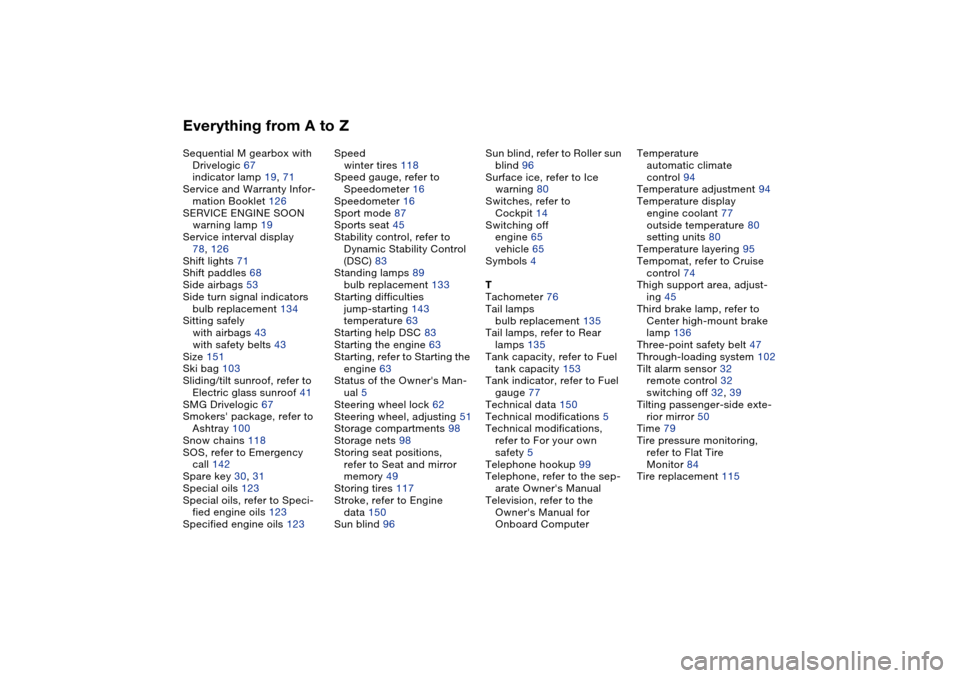
Special oils 123
Special oils, refer to Speci-
fied engine oils 123
Specified engine oils 123Speed
winter tires 118
Speed gauge, refer to
Speedometer 16
Speedometer 16
Sport mode 87
Sports seat 45
Stability control, refer to
Dynamic Stability Control
(DSC) 83
Standing lamps 89
bulb replacement 133
Starting difficulties
jump-starting 143
temperature 63
Starting help DSC 83
Starting the engine 63
Starting, refer to Starting the
engine 63
Status of the Owner's Man-
ual 5
Steering wheel lock 62
Steering wheel, adjusting 51
Storage compartments 98
Storage nets 98
Storing seat positions,
refer to Seat and mirror
memory 49
Storing tires 117
Stroke, refer to Engine
data 150
Sun blind 96Sun blind, refer to Roller sun
blind 96
Surface ice, refer to Ice
warning 80
Switches, refer to
Cockpit 14
Switching off
engine 65
vehicle 65
Symbols 4
T
Tachometer 76
Tail lamps
bulb replacement 135
Tail lamps, refer to Rear
lamps 135
Tank capacity, refer to Fuel
tank capacity 153
Tank indicator, refer to Fuel
gauge 77
Technical data 150
Technical modifications 5
Technical modifications,
refer to For your own
safety 5
Telephone hookup 99
Telephone, refer to the sep-
arate Owner's Manual
Television, refer to the
Owner's Manual for
Onboard ComputerTemperature
automatic climate
control 94
Temperature adjustment 94
Temperature display
engine coolant 77
outside temperature 80
setting units 80
Temperature layering 95
Tempomat, refer to Cruise
control 74
Thigh support area, adjust-
ing 45
Third brake lamp, refer to
Center high-mount brake
lamp 136
Three-point safety belt 47
Through-loading system 102
Tilt alarm sensor 32
remote control 32
switching off 32, 39
Tilting passenger-side exte-
rior mirror 50
Time 79
Tire pressure monitoring,
refer to Flat Tire
Monitor 84
Tire replacement 115
Page 169 of 170
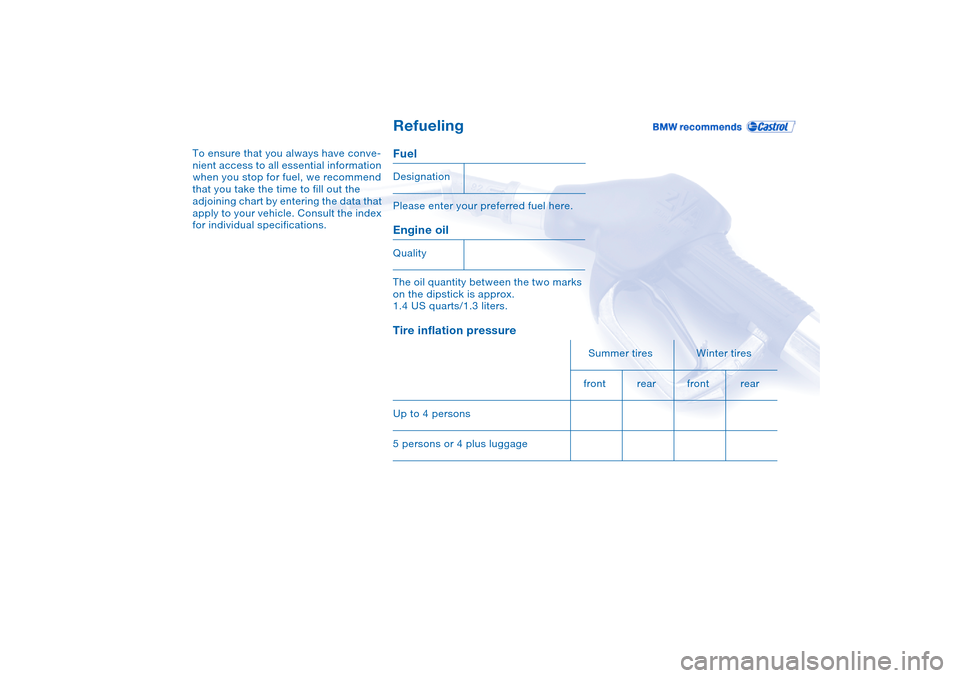
Refueling
To ensure that you always have conve-
nient access to all essential information
when you stop for fuel, we recommend
that you take the time to fill out the
adjoining chart by entering the data that
apply to your vehicle. Consult the index
for individual specifications.
FuelPlease enter your preferred fuel here.Engine oilThe oil quantity between the two marks
on the dipstick is approx.
1.4 US quarts/1.3 liters.Tire inflation pressureDesignation
Quality
Summer tires Winter tires
front rear front rear
Up to 4 persons
5 persons or 4 plus luggage