ECO mode BMW M5 SEDAN 2002 Owners Manual
[x] Cancel search | Manufacturer: BMW, Model Year: 2002, Model line: M5 SEDAN, Model: BMW M5 SEDAN 2002Pages: 154, PDF Size: 2.17 MB
Page 3 of 154

Congratulations, and thank you for choosing a BMW M5.
Thorough familiarity with your vehicle will provide you with enhanced control and
security when you drive it. We therefore have this request:
Please take the time to read this Owner's Manual and familiarize yourself with the
information that we have compiled for you before starting off in your new BMW. It
contains important data and instructions intended to assist you in gaining maximum
use and satisfaction from your BMW's unique range of technical features. This
manual also contains information on vehicle maintenance. This information is
intended to ensure optimal levels of operating safety while simultaneously helping
to maintain your BMW's value.
For more detailed information refer to the supplemental manuals.
This Owner's Manual should be considered a permanent part of this vehicle. It
should stay with the vehicle when sold to provide the next owner with important
operating, safety and maintenance information.
This manual is supplemented by a Service and Warranty Information Booklet
(US models) or a Warranty and Service Guide Booklet (Canadian models).
We recommend that you read this publication thoroughly.
Your BMW is covered by the following warranties:
>
New Vehicle Limited Warranty
>
Limited Rust Perforation Warranty
>
Federal Emissions System Defect Warranty
>
Federal Emissions Performance Warranty
>
California Emission Control System Limited Warranty
Detailed information on these warranties is listed in the Service and Warranty Infor-
mation Booklet (US models) or in the Warranty and Service Guide Booklet (Cana-
dian models).
We wish you an enjoyable driving experience.
BMW M
Preface
Page 9 of 154

9n
OverviewControlsMaintenanceRepairsDataIndex
Your individual vehicle
On buying your BMW, you have
decided in favor of a model with individ-
ualized equipment and features. This
Owner's Manual describes all models
and equipment that BMW offers within
the same group.
We hope you will understand that
equipment and features are included
which you might not have chosen for
your vehicle. You can easily identify any
differences with the aid of the asterisk
*
used to identify all optional equipment
and accessories.
If your BMW features equipment that is
not described in this Owner's Manual (a
car radio or telephone, for instance), we
have enclosed Supplementary Owner's
Manuals. We ask you to read these
manuals as well.
Status at time of printing
BMW pursues a policy of continuous,
ongoing development designed to
ensure that our vehicles continue to
embody the highest quality and safety
standards combined with advanced,
state-of-the-art technology. For this
reason, it is possible that the features
described in this Owner's Manual could
differ from those on your vehicle. Nor
can errors and omissions be entirely
ruled out. We therefore request your
understanding for the fact that we are
unable to recognize any legal claims
based on the data, illustrations or
descriptions in this manual.
Status at time of printing
Your individual vehicle
Page 17 of 154
17n
OverviewControlsMaintenanceRepairsDataIndex
Indicator and warning lamps
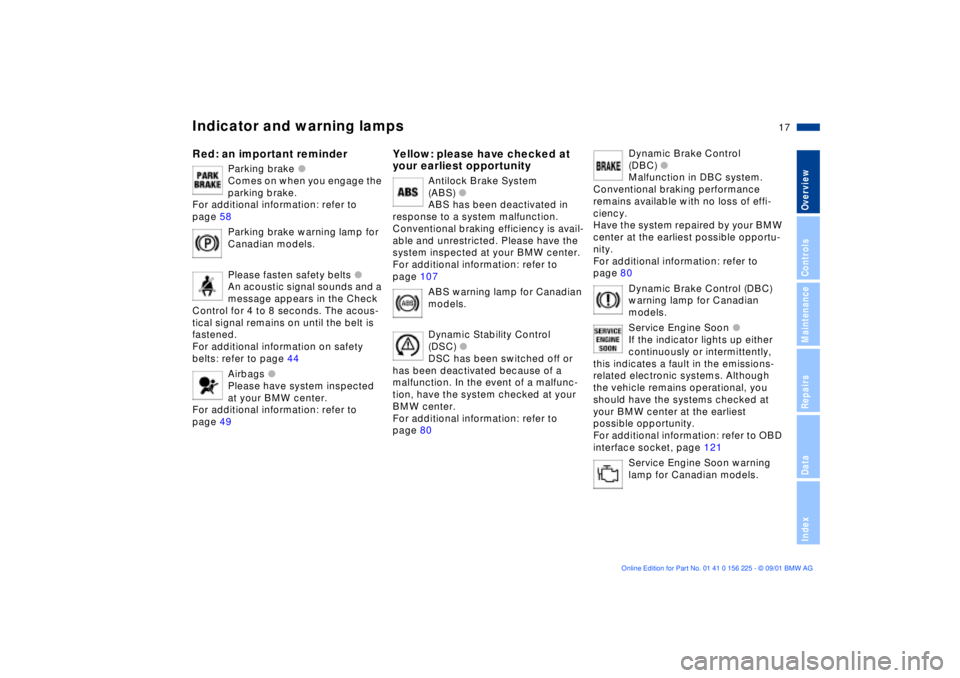
Red: an important reminder
Parking brake
l
Comes on when you engage the
parking brake.
For additional information: refer to
page 58
Parking brake warning lamp for
Canadian models.
Please fasten safety belts
l
An acoustic signal sounds and a
message appears in the Check
Control for 4 to 8 seconds. The acous-
tical signal remains on until the belt is
fastened.
For additional information on safety
belts: refer to page 44
Airbags
l
Please have system inspected
at your BMW center.
For additional information: refer to
page 49
Yellow: please have checked at
your earliest opportunity
Antilock Brake System
(ABS)
l
ABS has been deactivated in
response to a system malfunction.
Conventional braking efficiency is avail-
able and unrestricted. Please have the
system inspected at your BMW center.
For additional information: refer to
page 107
ABS warning lamp for Canadian
models.
Dynamic Stability Control
(DSC)
l
DSC has been switched off or
has been deactivated because of a
malfunction. In the event of a malfunc-
tion, have the system checked at your
BMW center.
For additional information: refer to
page 80
Dynamic Brake Control
(DBC)
l
Malfunction in DBC system.
Conventional braking performance
remains available with no loss of effi-
ciency.
Have the system repaired by your BMW
center at the earliest possible opportu-
nity.
For additional information: refer to
page 80
Dynamic Brake Control (DBC)
warning lamp for Canadian
models.
Service Engine Soon
l
If the indicator lights up either
continuously or intermittently,
this indicates a fault in the emissions-
related electronic systems. Although
the vehicle remains operational, you
should have the systems checked at
your BMW center at the earliest
possible opportunity.
For additional information: refer to OBD
interface socket, page 121
Service Engine Soon warning
lamp for Canadian models.
Page 29 of 154
29n
OverviewControlsMaintenanceRepairsDataIndex
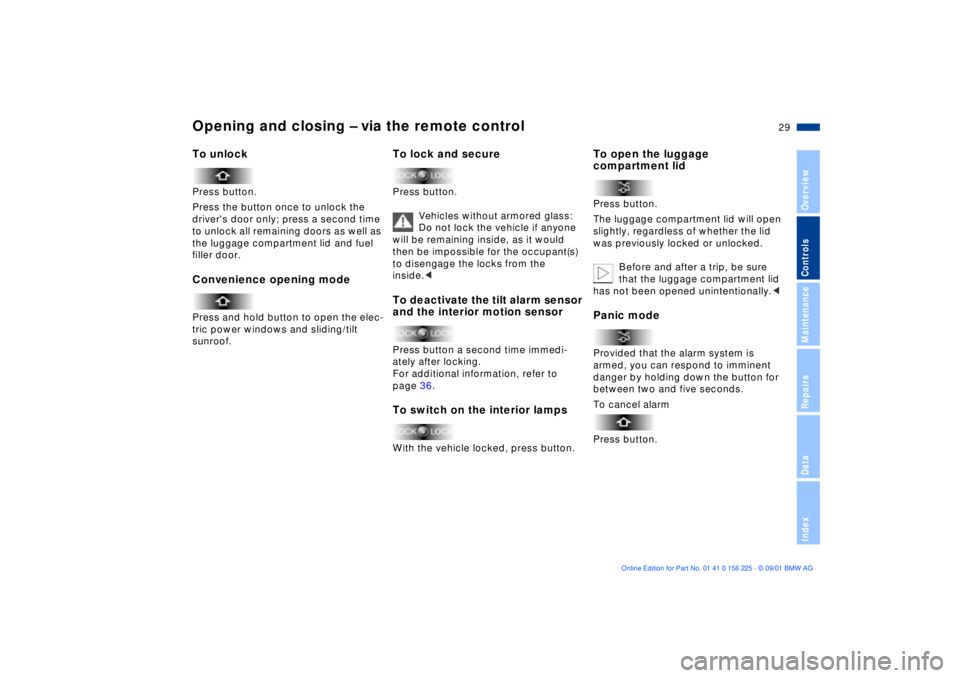
Opening and closing Ð via the remote control To unlockPress button.
Press the button once to unlock the
driver's door only; press a second time
to unlock all remaining doors as well as
the luggage compartment lid and fuel
filler door.Convenience opening modePress and hold button to open the elec-
tric power windows and sliding/tilt
sunroof.
To lock and secure Press button.
Vehicles without armored glass:
Do not lock the vehicle if anyone
will be remaining inside, as it would
then be impossible for the occupant(s)
to disengage the locks from the
inside.< To deactivate the tilt alarm sensor
and the interior motion sensorPress button a second time immedi-
ately after locking.
For additional information, refer to
page 36.To switch on the interior lampsWith the vehicle locked, press button.
To open the luggage
compartment lidPress button.
The luggage compartment lid will open
slightly, regardless of whether the lid
was previously locked or unlocked.
Before and after a trip, be sure
that the luggage compartment lid
has not been opened unintentionally.
danger by holding down the button for
between two and five seconds.
To cancel alarm
Press button.
Page 81 of 154
81n
OverviewControlsMaintenanceRepairsDataIndex
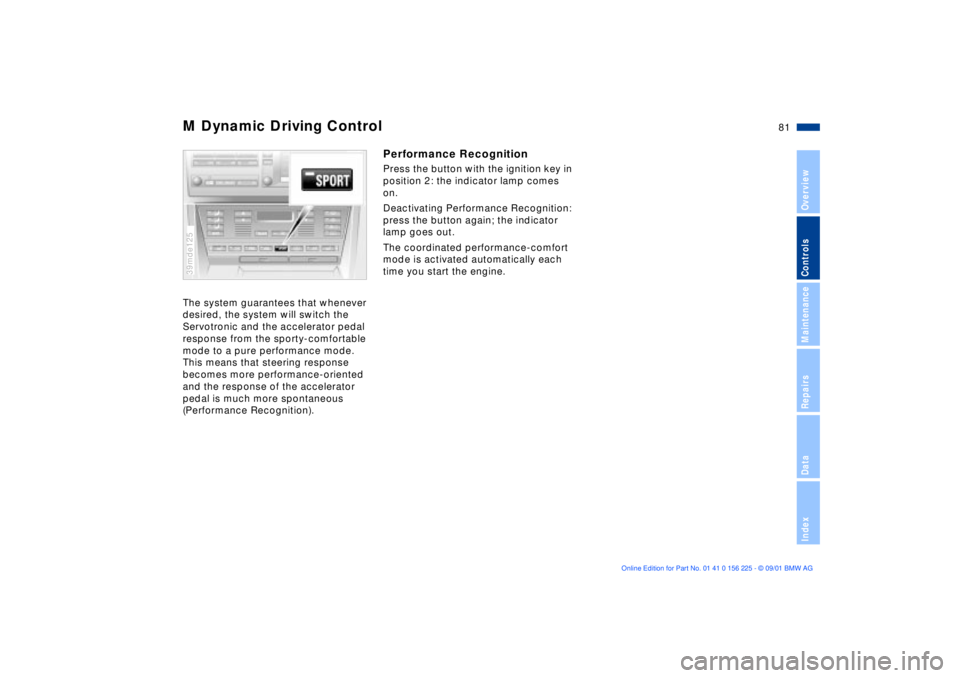
M Dynamic Driving ControlThe system guarantees that whenever
desired, the system will switch the
Servotronic and the accelerator pedal
response from the sporty-comfortable
mode to a pure performance mode.
This means that steering response
becomes more performance-oriented
and the response of the accelerator
pedal is much more spontaneous
(Performance Recognition). 39mde125
Performance Recognition Press the button with the ignition key in
position 2: the indicator lamp comes
on.
Deactivating Performance Recognition:
press the button again; the indicator
lamp goes out.
The coordinated performance-comfort
mode is activated automatically each
time you start the engine.
Page 82 of 154
82n
Flat Tire MonitorThe conceptThe Flat Tire Monitor keeps track of the
inflation pressures in your tires as you
drive. The system provides an alert
whenever the inflation pressure drops
significantly in one of the tires.
To initialize the Flat Tire Monitor system
with the correct tire pressures, start by
checking the inflation pressures in all
four tires, comparing them with the
figures specified in the tire pressure
table (page 23). Then correct the tire
pressures as necessary. Now you can
activate the system.
The Check Control (refer to page 66)
will inform you if the tire pressure of one
the tires has dropped significantly.
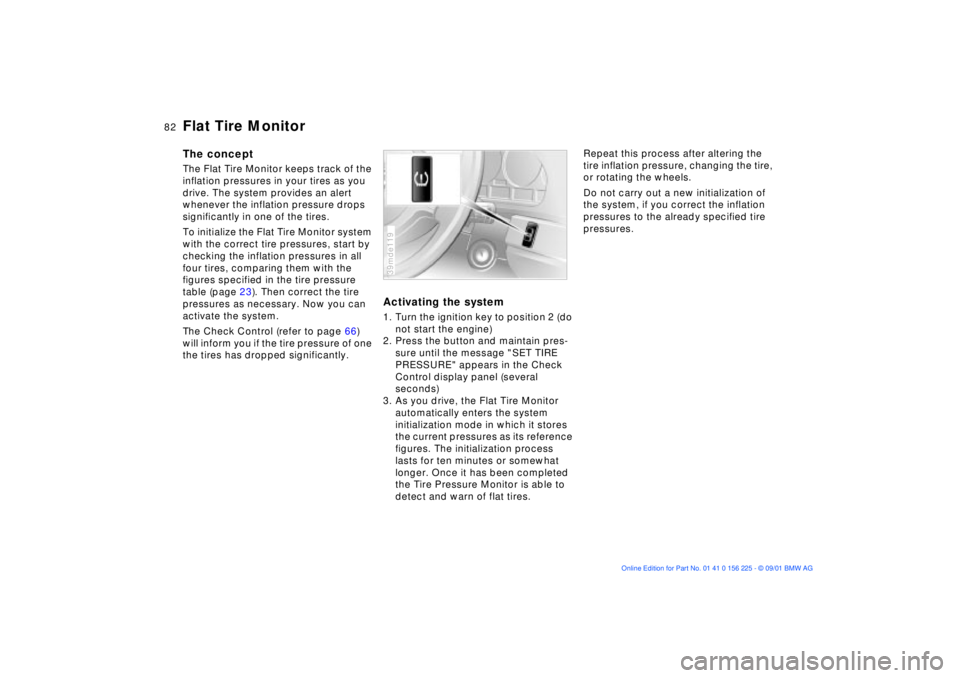
Activating the system1. Turn the ignition key to position 2 (do
not start the engine)
2. Press the button and maintain pres-
sure until the message "SET TIRE
PRESSURE" appears in the Check
Control display panel (several
seconds)
3. As you drive, the Flat Tire Monitor
automatically enters the system
initialization mode in which it stores
the current pressures as its reference
figures. The initialization process
lasts for ten minutes or somewhat
longer. Once it has been completed
the Tire Pressure Monitor is able to
detect and warn of flat tires.39mde119
Repeat this process after altering the
tire inflation pressure, changing the tire,
or rotating the wheels.
Do not carry out a new initialization of
the system, if you correct the inflation
pressures to the already specified tire
pressures.
Page 89 of 154
89n
OverviewControlsMaintenanceRepairsDataIndex
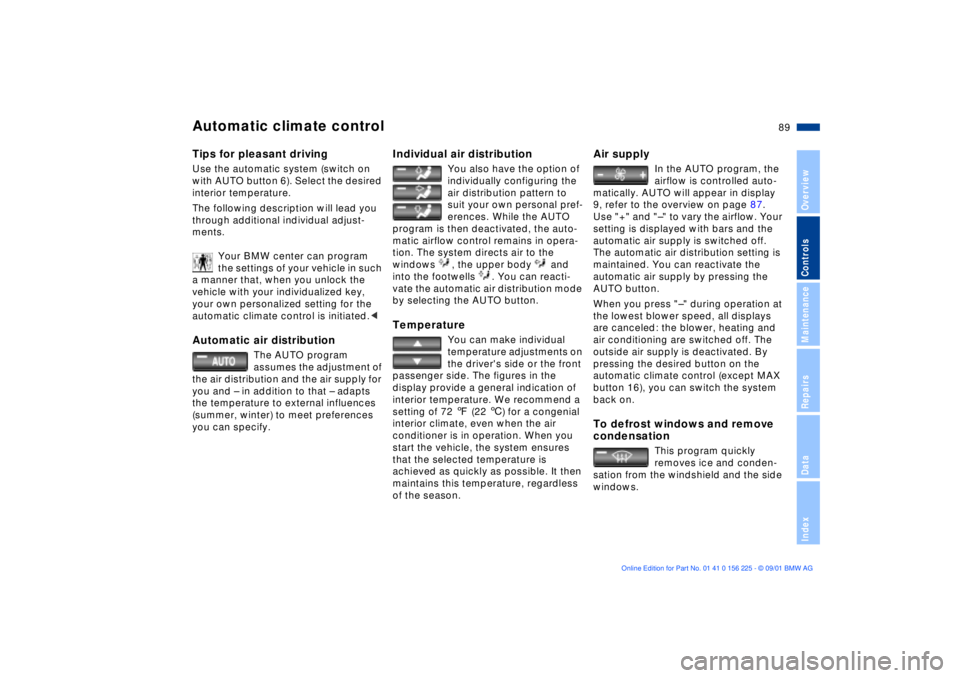
Automatic climate controlTips for pleasant drivingUse the automatic system (switch on
with AUTO button 6). Select the desired
interior temperature.
The following description will lead you
through additional individual adjust-
ments.
Your BMW center can program
the settings of your vehicle in such
a manner that, when you unlock the
vehicle with your individualized key,
your own personalized setting for the
automatic climate control is initiated.
assumes the adjustment of
the air distribution and the air supply for
you and Ð in addition to that Ð adapts
the temperature to external influences
(summer, winter) to meet preferences
you can specify.
Individual air distribution
You also have the option of
individually configuring the
air distribution pattern to
suit your own personal pref-
erences. While the AUTO
program is then deactivated, the auto-
matic airflow control remains in opera-
tion. The system directs air to the
windows , the upper body and
into the footwells . You can reacti-
vate the automatic air distribution mode
by selecting the AUTO button.
Temperature
You can make individual
temperature adjustments on
the driver's side or the front
passenger side. The figures in the
display provide a general indication of
interior temperature. We recommend a
setting of 72 7 (22 6) for a congenial
interior climate, even when the air
conditioner is in operation. When you
start the vehicle, the system ensures
that the selected temperature is
achieved as quickly as possible. It then
maintains this temperature, regardless
of the season.
Air supply
In the AUTO program, the
airflow is controlled auto-
matically. AUTO will appear in display
9, refer to the overview on page 87.
Use "+" and "Ð" to vary the airflow. Your
setting is displayed with bars and the
automatic air supply is switched off.
The automatic air distribution setting is
maintained. You can reactivate the
automatic air supply by pressing the
AUTO button.
When you press "Ð" during operation at
the lowest blower speed, all displays
are canceled: the blower, heating and
air conditioning are switched off. The
outside air supply is deactivated. By
pressing the desired button on the
automatic climate control (except MAX
button 16), you can switch the system
back on.
To defrost windows and remove
condensation
This program quickly
removes ice and conden-
sation from the windshield and the side
windows.
Page 90 of 154
90n
Automatic climate control Air conditioning
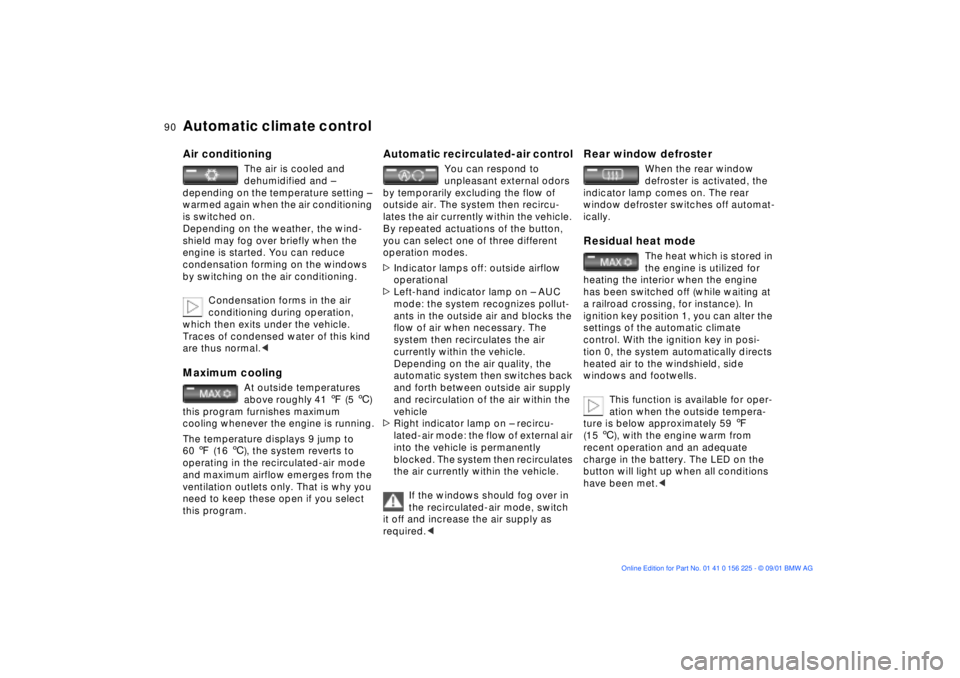
The air is cooled and
dehumidified and Ð
depending on the temperature setting Ð
warmed again when the air conditioning
is switched on.
Depending on the weather, the wind-
shield may fog over briefly when the
engine is started. You can reduce
condensation forming on the windows
by switching on the air conditioning.
Condensation forms in the air
conditioning during operation,
which then exits under the vehicle.
Traces of condensed water of this kind
are thus normal.<
Maximum cooling
At outside temperatures
above roughly 41 7 (5 6)
this program furnishes maximum
cooling whenever the engine is running.
The temperature displays 9 jump to
60 7 (16 6), the system reverts to
operating in the recirculated-air mode
and maximum airflow emerges from the
ventilation outlets only. That is why you
need to keep these open if you select
this program.
Automatic recirculated-air control
You can respond to
unpleasant external odors
by temporarily excluding the flow of
outside air. The system then recircu-
lates the air currently within the vehicle.
By repeated actuations of the button,
you can select one of three different
operation modes.
>Indicator lamps off: outside airflow
operational
>Left-hand indicator lamp on Ð AUC
mode: the system recognizes pollut-
ants in the outside air and blocks the
flow of air when necessary. The
system then recirculates the air
currently within the vehicle.
Depending on the air quality, the
automatic system then switches back
and forth between outside air supply
and recirculation of the air within the
vehicle
>Right indicator lamp on Ð recircu-
lated-air mode: the flow of external air
into the vehicle is permanently
blocked. The system then recirculates
the air currently within the vehicle.
If the windows should fog over in
the recirculated-air mode, switch
it off and increase the air supply as
required.<
Rear window defroster
When the rear window
defroster is activated, the
indicator lamp comes on. The rear
window defroster switches off automat-
ically.
Residual heat mode
The heat which is stored in
the engine is utilized for
heating the interior when the engine
has been switched off (while waiting at
a railroad crossing, for instance). In
ignition key position 1, you can alter the
settings of the automatic climate
control. With the ignition key in posi-
tion 0, the system automatically directs
heated air to the windshield, side
windows and footwells.
This function is available for oper-
ation when the outside tempera-
ture is below approximately 59 7
(15 6), with the engine warm from
recent operation and an adequate
charge in the battery. The LED on the
button will light up when all conditions
have been met.<
Page 95 of 154
95n
OverviewControlsMaintenanceRepairsDataIndex
BMW Universal Transmitter
*
1. Program the BMW Universal Trans-
mitter as described above under
"Programming"
2. Press and hold the programming key
on the receiver of the device for
about two seconds or until the
programming lamp on the device
comes on
3. Press the desired channel key on the
BMW Universal Transmitter three
times.
If you have additional questions,
please consult your BMW center
or call 1-800-355-3515.<
Deleting the channel keys
Read and comply with the safety
precautions on page 93.
<< < <
Individual channel keys cannot be
deleted. However, the three channel
keys can be deleted together in the
following manner:
>Press and hold the two outside
channel keys on the BMW Universal
Transmitter until the indicator lamp
flashes, then let go.
All channel keys are deleted.
User's informationDo not use this BMW Universal Trans-
mitter with any garage-door opener that
lacks safety "stop" and "reverse"
features as required by federal safety
standards, (this includes any garage-
door opener model manufactured
before April 1, 1982).
This device complies with Part 15 of the
FCC Rules. Operation is subject to the
following two conditions: (1) This device
may not cause harmful interference,
and (2) This device must accept any
interference received, including inter-
ference that may cause undesired
operation.
Page 108 of 154

108n
Brake systemBrake fluid level If the brake fluid level is too low and
brake pedal travel has become notice-
ably longer, there may be a defect in
one of the brake system's hydraulic
circuits.
Proceed to the nearest BMW
center. Higher brake application
pressure may be necessary under these
conditions, and the vehicle may exhibit
a slight tendency to pull to one side
when the brakes are applied. Braking
distances may also be longer. Please
remember to adapt your driving style
accordingly.<
Disc brakesLimited vehicle use, extended periods
with the vehicle parked or in storage,
and operating conditions in which
braking is restricted to gentle, low-
pressure applications will all increase
the tendency for corrosion to form on
the rotors; this is often accompanied by
a simultaneous accumulation of
contamination on the brake pads. The
pads must exert a certain minimal level
of pressure against the rotors for the
disc brakes' inherent self-cleaning
effect to remain effective; the pressure
available under the above conditions
may not provide adequate cleansing.
If the brake rotors are corroded, they
will tend to respond to braking with a
pulsating effect that even extended
brake applications will fail to cure.
When driving in heavy rain and on wet
roads it is a good idea to apply light
pressure to the brake pedal every few
miles. Monitor traffic conditions to
ensure that this maneuver does not
pose a hazard to you or to other road
users. The heat generated in this
process helps dry the pads and rotors
to ensure that your brake system will
respond with undiminished efficiency
when you need it.When descending steep hills and
extended grades, downshift to a gear
that will allow you to continue safely
with only a minimal amount of braking.
By minimizing the loads placed on the
brake system, this strategy helps
ensure that optimal brake system
response will remain available at all
times.
Do not coast with the clutch
depressed or with the transmis-
sion or selector lever in Neutral. Do not
coast with the engine shut off. The
engine provides no braking effect when
the clutch is depressed and there is no
power-assist for braking or steering
when the engine is not running.
Never allow floor mats, carpets or any
other objects to protrude into the area
around the accelerator, clutch and
brake pedals and obstruct their move-
ment.<
Brake pads
For your own safety: use only
brake pads that BMW has
approved for your particular vehicle
model. BMW cannot evaluate non-
approved brake pads to determine if
they are suited for use, and therefore
cannot ensure the operating safety of
the vehicle if they are installed.<