ECU BMW M5 SEDAN 2003 User Guide
[x] Cancel search | Manufacturer: BMW, Model Year: 2003, Model line: M5 SEDAN, Model: BMW M5 SEDAN 2003Pages: 155, PDF Size: 1.87 MB
Page 66 of 155
66n
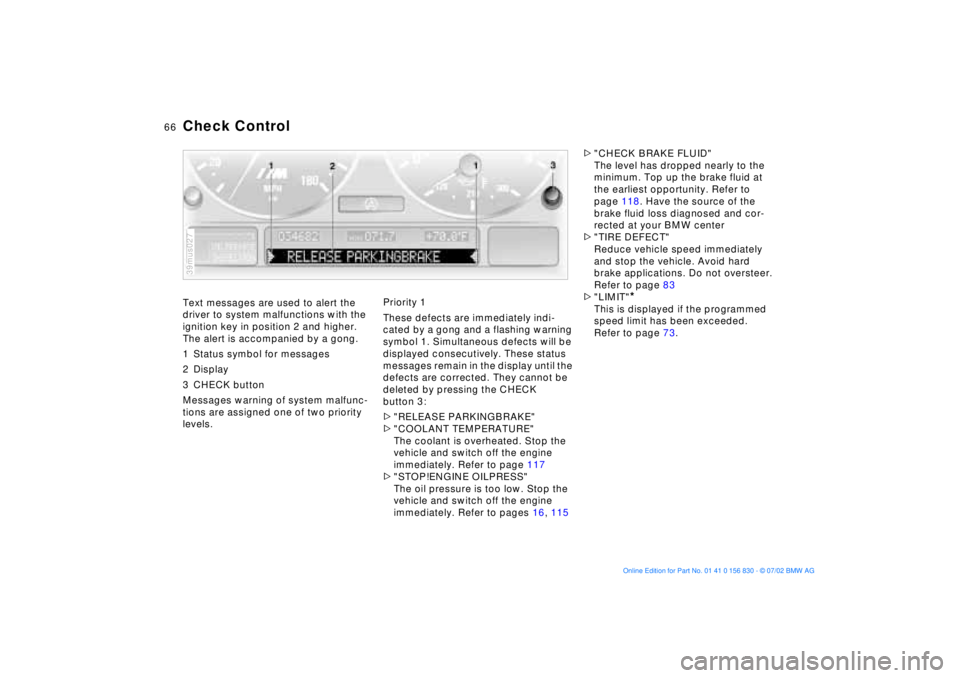
Text messages are used to alert the
driver to system malfunctions with the
ignition key in position 2 and higher.
The alert is accompanied by a gong.
1 Status symbol for messages
2 Display
3 CHECK button
Messages warning of system malfunc-
tions are assigned one of two priority
levels.
39mus027
Priority 1
These defects are immediately indi-
cated by a gong and a flashing warning
symbol 1. Simultaneous defects will be
displayed consecutively. These status
messages remain in the display until the
defects are corrected. They cannot be
deleted by pressing the CHECK
button 3:
>"RELEASE PARKINGBRAKE"
>"COOLANT TEMPERATURE"
The coolant is overheated. Stop the
vehicle and switch off the engine
immediately. Refer to page 117
>"STOP!ENGINE OILPRESS"
The oil pressure is too low. Stop the
vehicle and switch off the engine
immediately. Refer to pages 16, 115>"CHECK BRAKE FLUID"
The level has dropped nearly to the
minimum. Top up the brake fluid at
the earliest opportunity. Refer to
page 118. Have the source of the
brake fluid loss diagnosed and cor-
rected at your BMW center
>"TIRE DEFECT"
Reduce vehicle speed immediately
and stop the vehicle. Avoid hard
brake applications. Do not oversteer.
Refer to page 83
>"LIMIT"
*
This is displayed if the programmed
speed limit has been exceeded.
Refer to page 73.
Check Control
Page 68 of 155

68n
Check ControlDisplays after completion of a tripAll of the malfunctions registered during
the trip appear consecutively when the
key is turned to position 0.
The following displays will appear when
appropriate:
>"LIGHTS ON"
This display appears when you open
the driver's door after parking the
vehicle
>"KEY IN IGNITION LOCK"
>"CHECK ENGINE OIL LEV"
Add the engine oil at the earliest
opportunity (next stop to refuel).
Refer to page 115.
Status messages remain available for
a period of approx. three minutes after
the display goes out and the key is
removed from the ignition. Press the
CHECK button 3 to display these mes-
sages. If there were multiple messages,
press the CHECK button repeatedly to
view them all in sequence.
To check the Check ControlPress the CHECK button 3 with the
ignition key in position 2:
CHECK CONTROL OK appears in the
display.
There are no faults in the monitored
systems.ComputerYou can find descriptions of the com-
puter starting on page 73 and in the
"Owner's Manual for Onboard Com-
puter."
You can have the Check Control
and computer messages dis-
played in a different language.<
Page 99 of 155
99n
OverviewControlsMaintenanceRepairsDataIndex
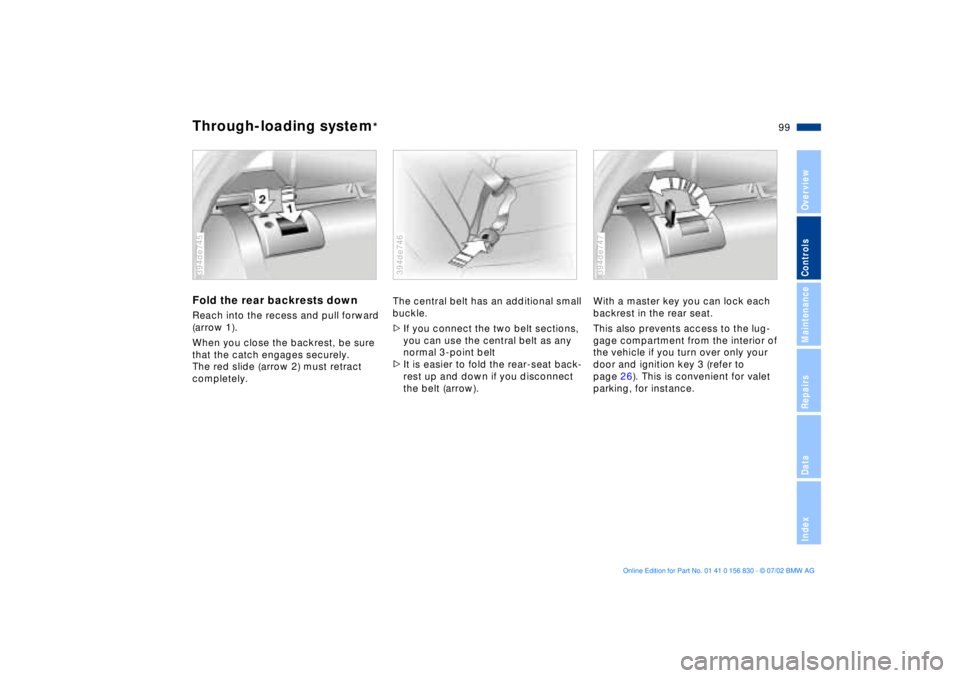
Fold the rear backrests downReach into the recess and pull forward
(arrow 1).
When you close the backrest, be sure
that the catch engages securely.
The red slide (arrow 2) must retract
completely.394de745
The central belt has an additional small
buckle.
>If you connect the two belt sections,
you can use the central belt as any
normal 3-point belt
>It is easier to fold the rear-seat back-
rest up and down if you disconnect
the belt (arrow).394de746
With a master key you can lock each
backrest in the rear seat.
This also prevents access to the lug-
gage compartment from the interior of
the vehicle if you turn over only your
door and ignition key 3 (refer to
page 26). This is convenient for valet
parking, for instance.394de747
Through-loading system
*
Page 101 of 155

101n
OverviewControlsMaintenanceRepairsDataIndex
Ski bag
*
Loading1. Press the release button (arrow 1):
the cover panel in the luggage com-
partment is unlocked
2. Press the detent levers (arrows 2)
inward and fold the cover to the front
3. Extend the ski bag between the front
seats. The zipper provides conve-
nient access to stored items. It may
be opened to allow the ski bag to dry394de749
4. Use the magnetic retainers to attach
the cover panel to the upper surface
(metal surface below rear tray) of the
luggage compartment.
To store the ski bag, perform the above
steps in reverse sequence.
An unsecured ski bag could lead
to loss of vehicle control and in
case of an accident to personal injury.< 394de750
Securing the load
Secure the bag's contents by
tightening down the retaining
strap at the buckle.<
Please be sure that the skis are clean
before loading them into the bag. Be
careful to avoid damage from sharp
edges.
530de284
Page 102 of 155
102n
Ski bag
*
Cargo loading
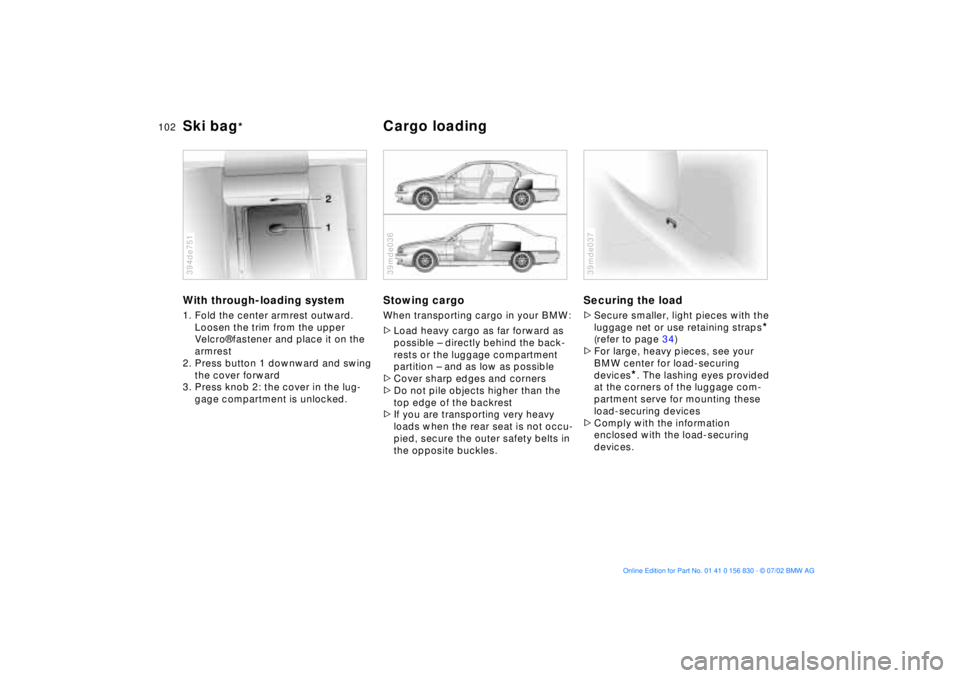
With through-loading system1. Fold the center armrest outward.
Loosen the trim from the upper
Velcro¨ fastener and place it on the
armrest
2. Press button 1 downward and swing
the cover forward
3. Press knob 2: the cover in the lug-
gage compartment is unlocked. 394de751
Stowing cargo When transporting cargo in your BMW:
>Load heavy cargo as far forward as
possible Ð directly behind the back-
rests or the luggage compartment
partition Ð and as low as possible
>Cover sharp edges and corners
>Do not pile objects higher than the
top edge of the backrest
>If you are transporting very heavy
loads when the rear seat is not occu-
pied, secure the outer safety belts in
the opposite buckles.39mde036
Securing the load >Secure smaller, light pieces with the
luggage net or use retaining straps
*
(refer to page 34)
>For large, heavy pieces, see your
BMW center for load-securing
devices
*. The lashing eyes provided
at the corners of the luggage com-
partment serve for mounting these
load-securing devices
>Comply with the information
enclosed with the load-securing
devices.
39mde037
Page 103 of 155
103n
OverviewControlsMaintenanceRepairsDataIndex
Cargo loading Roof-mounted luggage rack
*
Always position and secure the
load correctly. If you do not, it can
endanger the passengers during
braking or evasive maneuvers.
Never exceed either the approved
gross vehicle weight or the approved
loads for either of the axles (refer to
page 142), as overloading the vehicle
beyond the legally approved levels can
severely compromise its operating
safety.
Do not carry hard or heavy objects
unsecured in the passenger compart-
ment. If you do so, they may be pro-
jected through the air during braking
and evasive maneuvers, thus endan-
gering vehicle occupants.<
A special roof-rack system is available
as an optional extra for your BMW.
Please observe the precautions
included with the installation instruc-
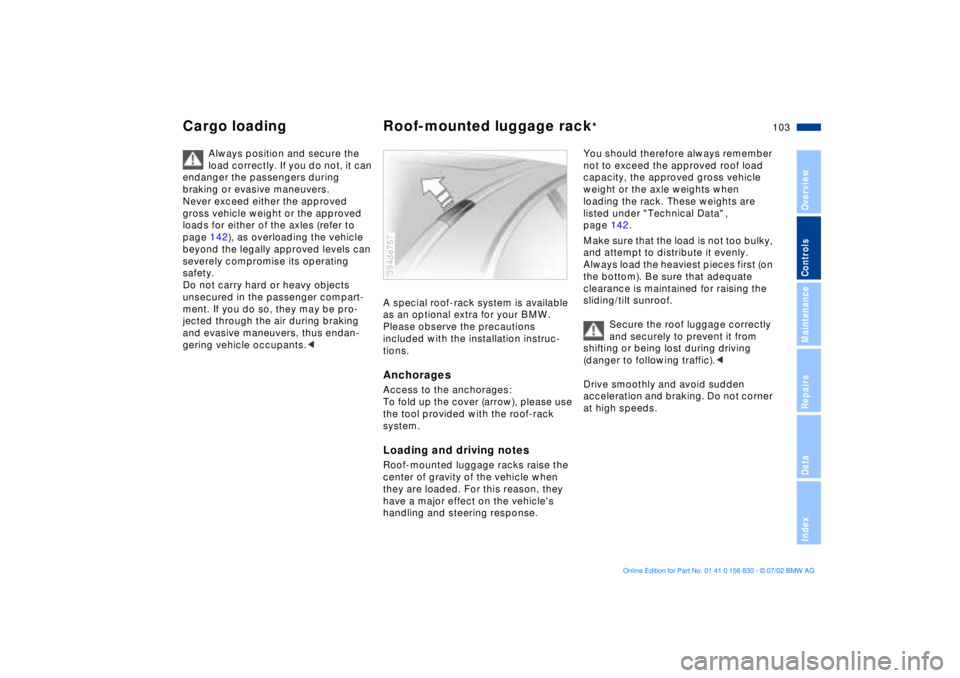
tions.AnchoragesAccess to the anchorages:
To fold up the cover (arrow), please use
the tool provided with the roof-rack
system.Loading and driving notesRoof-mounted luggage racks raise the
center of gravity of the vehicle when
they are loaded. For this reason, they
have a major effect on the vehicle's
handling and steering response.394de757
You should therefore always remember
not to exceed the approved roof load
capacity, the approved gross vehicle
weight or the axle weights when
loading the rack. These weights are
listed under "Technical Data" ,
page 142.
Make sure that the load is not too bulky,
and attempt to distribute it evenly.
Always load the heaviest pieces first (on
the bottom). Be sure that adequate
clearance is maintained for raising the
sliding/tilt sunroof.
Secure the roof luggage correctly
and securely to prevent it from
shifting or being lost during driving
(danger to following traffic).<
Drive smoothly and avoid sudden
acceleration and braking. Do not corner
at high speeds.
Page 113 of 155
113n
OverviewControlsMaintenanceRepairsDataIndex
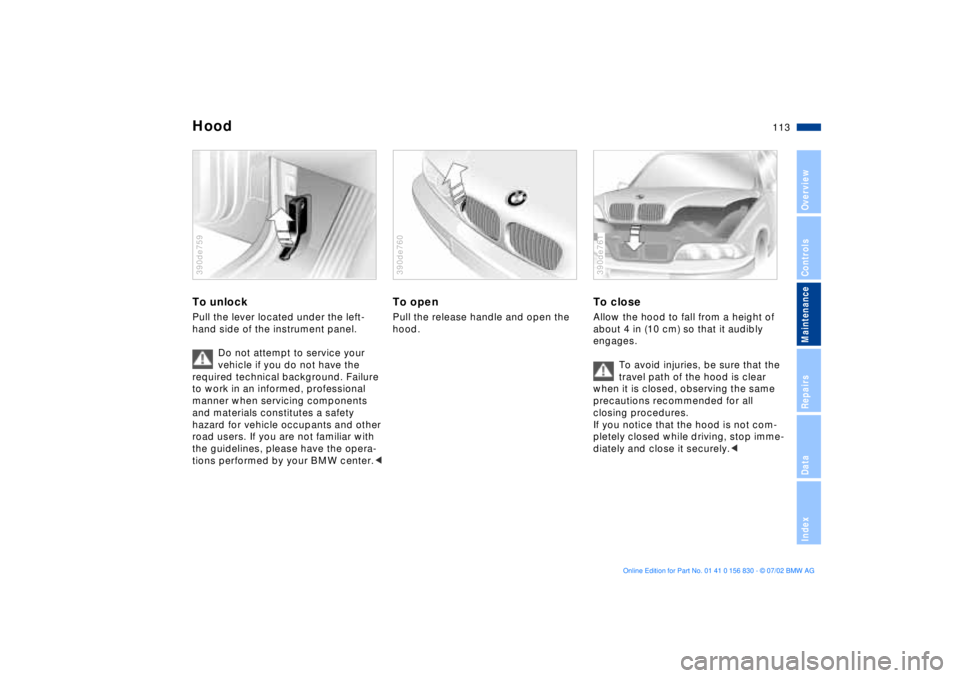
To unlockPull the lever located under the left-
hand side of the instrument panel.
Do not attempt to service your
vehicle if you do not have the
required technical background. Failure
to work in an informed, professional
manner when servicing components
and materials constitutes a safety
hazard for vehicle occupants and other
road users. If you are not familiar with
the guidelines, please have the opera-
tions performed by your BMW center.<390de759
To openPull the release handle and open the
hood. 390de760
To closeAllow the hood to fall from a height of
about 4 in (10 cm) so that it audibly
engages.
To avoid injuries, be sure that the
travel path of the hood is clear
when it is closed, observing the same
precautions recommended for all
closing procedures.
If you notice that the hood is not com-
pletely closed while driving, stop imme-
diately and close it securely.<390de761
Hood
Page 125 of 155
125n
OverviewControlsMaintenanceRepairsDataIndex
Lamps and bulbs Xenon lamps
The service life of these bulbs is very
long and the probability of a failure is
very low, provided that they are not
switched on and off an unusual number
of times. If one of these bulbs should
nevertheless fail, it is possible to con-
tinue driving with great caution using
the fog lamps, provided traffic laws in
your area do not prohibit this.
Never attempt to perform bulb
changes or any other service oper-
ations on the xenon lamps. Always have
them serviced by professional techni-
cians. The extremely high voltages at
which these lamps operate constitute a
potentially lethal safety hazard.<
When cleaning the headlamps,
please observe the following:
>Do not clean by wiping with a dry
cloth (this causes scratches). Never
use abrasives or strong solvents to
clean the covers
>Remove dirt and contamination (such
as insects) by soaking with BMW Car
Shampoo and then rinsing with
ample water
>Always use a deicer spray to remove
accumulated ice and snow Ð never
use a scraper.<
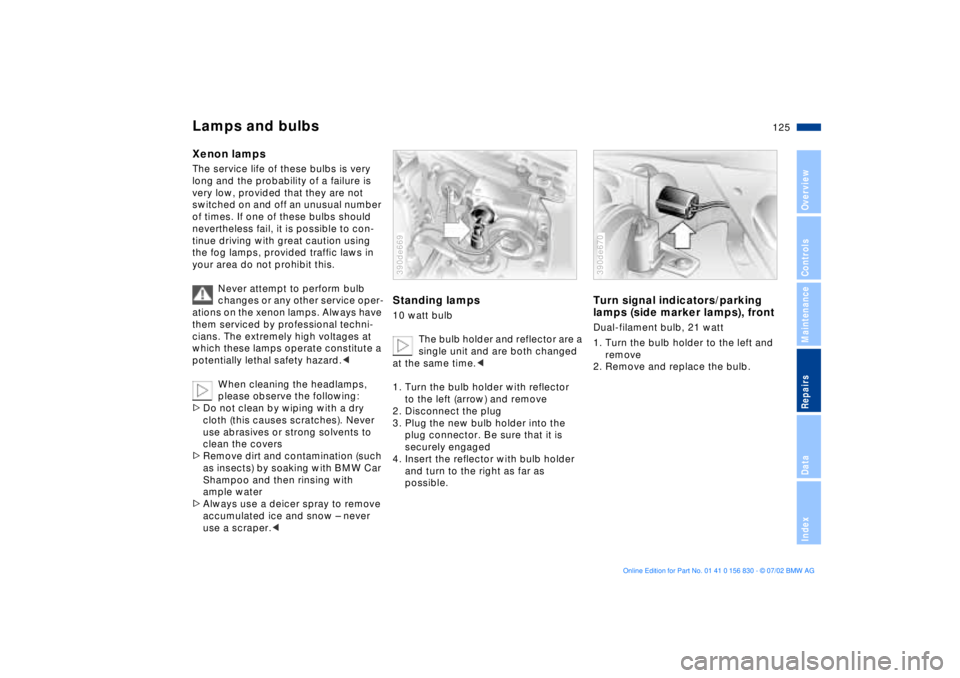
Standing lamps10 watt bulb
The bulb holder and reflector are a
single unit and are both changed
at the same time.<
1. Turn the bulb holder with reflector
to the left (arrow) and remove
2. Disconnect the plug
3. Plug the new bulb holder into the
plug connector. Be sure that it is
securely engaged
4. Insert the reflector with bulb holder
and turn to the right as far as
possible.390de669
Turn signal indicators/parking
lamps (side marker lamps), front Dual-filament bulb, 21 watt
1. Turn the bulb holder to the left and
remove
2. Remove and replace the bulb.390de670
Page 132 of 155
132n
Battery FusesCharging the battery Recharge the battery only with the
engine off, using the auxiliary terminals
provided in the engine compartment
(for information on these terminals refer
to "Jump-starting" on page 133).
Avoid environmental pollution
when disposing of old batteries.<
Return used batteries to a recy-
cling point or your BMW center.
Maintain the battery in an upright posi-
tion for transport and storage. Secure
the battery to prevent it from tilting
during transport.<
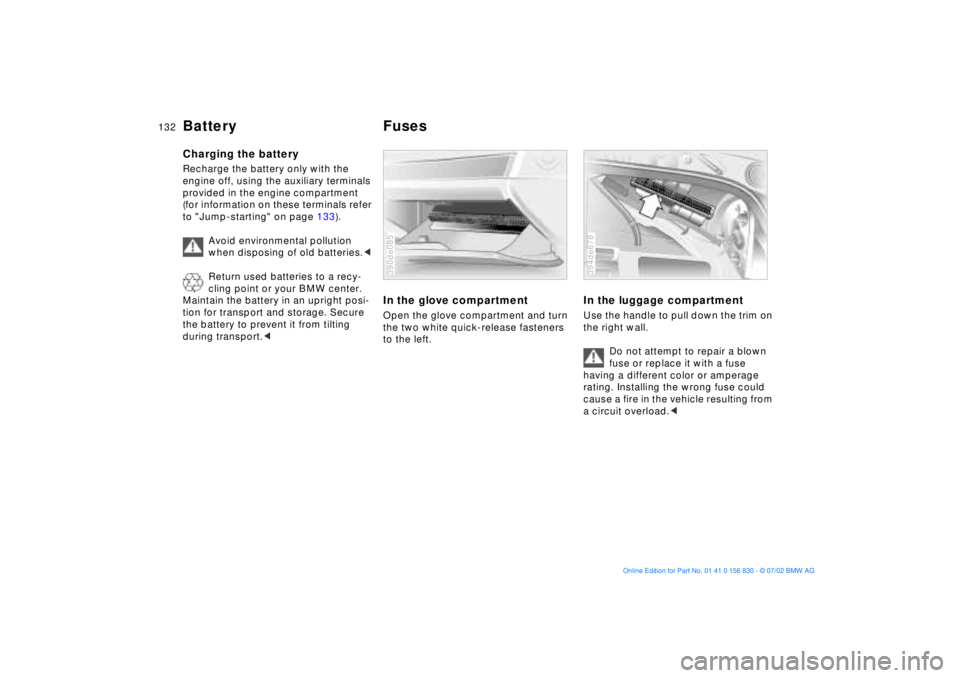
In the glove compartmentOpen the glove compartment and turn
the two white quick-release fasteners
to the left.390de085
In the luggage compartmentUse the handle to pull down the trim on
the right wall.
Do not attempt to repair a blown
fuse or replace it with a fuse
having a different color or amperage
rating. Installing the wrong fuse could
cause a fire in the vehicle resulting from
a circuit overload.<394de678
Page 135 of 155
135n
OverviewControlsMaintenanceRepairsDataIndex
Towing the vehicleTow fittingThe screw-in tow fitting is stored in the
onboard tool kit; be sure that it remains
in the vehicle at all times. This fitting
is designed for installation in the tow
sockets located at the front and rear of
the vehicle, and is intended for towing
on proper road surfaces only.
It should not be used to pull a vehicle
out of deep snow, mud, sand, etc.
Always observe all applicable towing
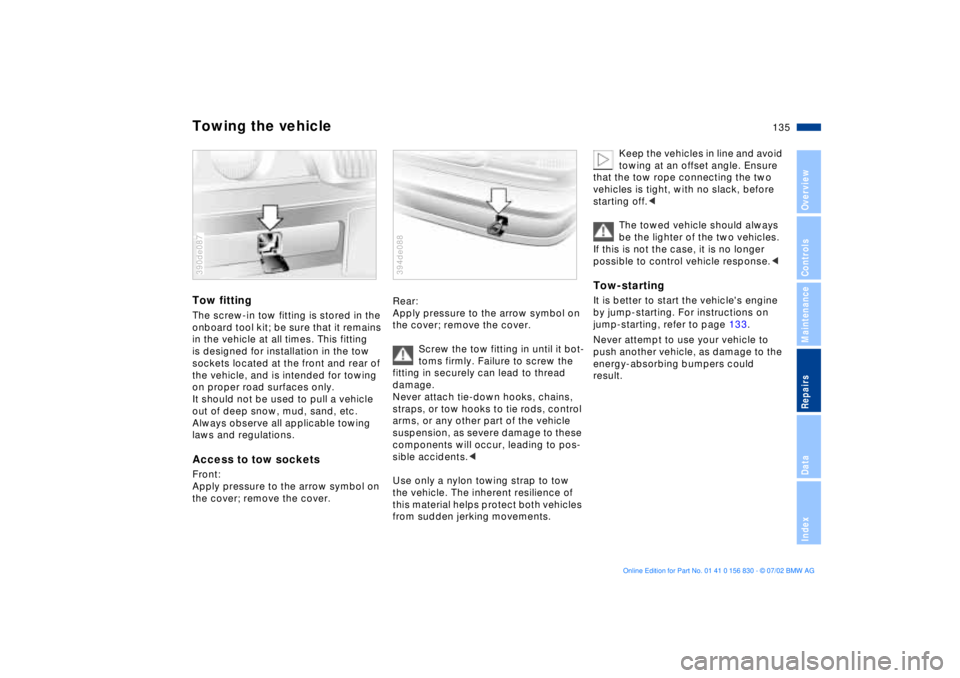
laws and regulations.Access to tow sockets Front:
Apply pressure to the arrow symbol on
the cover; remove the cover.390de087
Rear:
Apply pressure to the arrow symbol on
the cover; remove the cover.
Screw the tow fitting in until it bot-
toms firmly. Failure to screw the
fitting in securely can lead to thread
damage.
Never attach tie-down hooks, chains,
straps, or tow hooks to tie rods, control
arms, or any other part of the vehicle
suspension, as severe damage to these
components will occur, leading to pos-
sible accidents.<
Use only a nylon towing strap to tow
the vehicle. The inherent resilience of
this material helps protect both vehicles
from sudden jerking movements.394de088
Keep the vehicles in line and avoid
towing at an offset angle. Ensure
that the tow rope connecting the two
vehicles is tight, with no slack, before
starting off.<
The towed vehicle should always
be the lighter of the two vehicles.
If this is not the case, it is no longer
possible to control vehicle response.<
Tow-startingIt is better to start the vehicle's engine
by jump-starting. For instructions on
jump-starting, refer to page 133.
Never attempt to use your vehicle to
push another vehicle, as damage to the
energy-absorbing bumpers could
result.