belt BMW M5 SEDAN 2003 Owners Manual
[x] Cancel search | Manufacturer: BMW, Model Year: 2003, Model line: M5 SEDAN, Model: BMW M5 SEDAN 2003Pages: 155, PDF Size: 1.87 MB
Page 4 of 155
Contents
© 2002 BMW M GmbH
Munich, Germany
Reprinting, including excerpts,
only with the written consent of
BMW AG, Munich.
Order no. 01 41 0 156 830
US English IX/02
Printed in Germany
Printed on environmentally friendly paper
Ð bleached without chlorine, suitable for recycling.
Notes
Overview
Controls and features
About this Owner's Manual8
Symbols used8
Your individual vehicle8
Status at time of printing9
For your own safety9
Symbol on vehicle parts10
Service and Warranty10
Reporting safety defects10Cockpit14
Instrument cluster15
Indicator and warning lamps16
Steering wheel with multifunction
buttons19
Warning triangle20
First-aid kit20
Refueling20
Fuel specifications22
Tire inflation pressure22
Opening and closing:
Keys26
Central locking system26
Opening and closing Ð
via the door lock27
Opening and closing Ð
via the remote control28
Opening and closing Ð
from the inside31
Luggage compartment lid32
Luggage compartment34
Alarm system35
Electric power windows36
Sliding/tilt sunroof38
Adjustments:
Sitting safely40
Seats40
BMW M sport seat41
BMW comfort seat42
Head restraints43
BMW active seat43
Safety belts44
Seat, mirror and
steering wheel memory45
Seat heating46
Steering wheel47
Mirrors48
Contents
Page 16 of 155
16n
Indicator and warning lamps
Technology that monitors itself
The system runs a check on the
warning and indicator lamps marked
by "
l
" each time you switch on the
ignition. They each light up once for dif-
ferent periods of time.
If a fault should occur in one of these
systems, the corresponding lamp does
not go out after the engine is started or
it lights up while the vehicle is moving.
The following section describes how
you should respond.
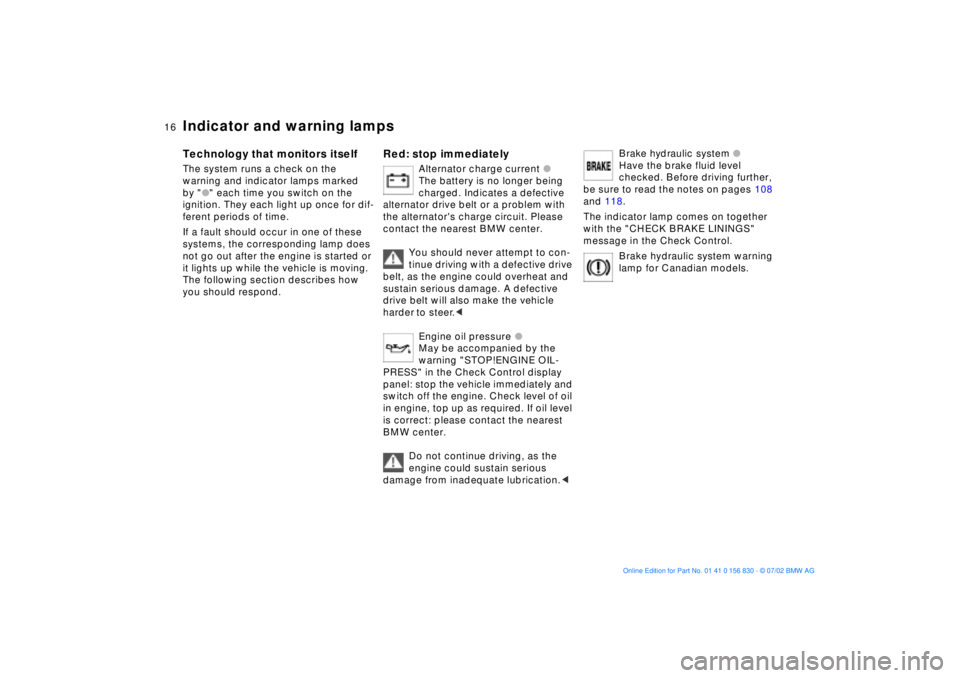
Red: stop immediately
Alternator charge current
l
The battery is no longer being
charged. Indicates a defective
alternator drive belt or a problem with
the alternator's charge circuit. Please
contact the nearest BMW center.
You should never attempt to con-
tinue driving with a defective drive
belt, as the engine could overheat and
sustain serious damage. A defective
drive belt will also make the vehicle
harder to steer.
<
Engine oil pressure
l
May be accompanied by the
warning "STOP!ENGINE OIL-
PRESS" in the Check Control display
panel: stop the vehicle immediately and
switch off the engine. Check level of oil
in engine, top up as required. If oil level
is correct: please contact the nearest
BMW center.
Do not continue driving, as the
engine could sustain serious
damage from inadequate lubrication.
<
Brake hydraulic system
l
Have the brake fluid level
checked. Before driving further,
be sure to read the notes on pages 108
and 118.
The indicator lamp comes on together
with the "CHECK BRAKE LININGS"
message in the Check Control.
Brake hydraulic system warning
lamp for Canadian models.
Page 17 of 155
17n
OverviewControlsMaintenanceRepairsDataIndex
Indicator and warning lamps
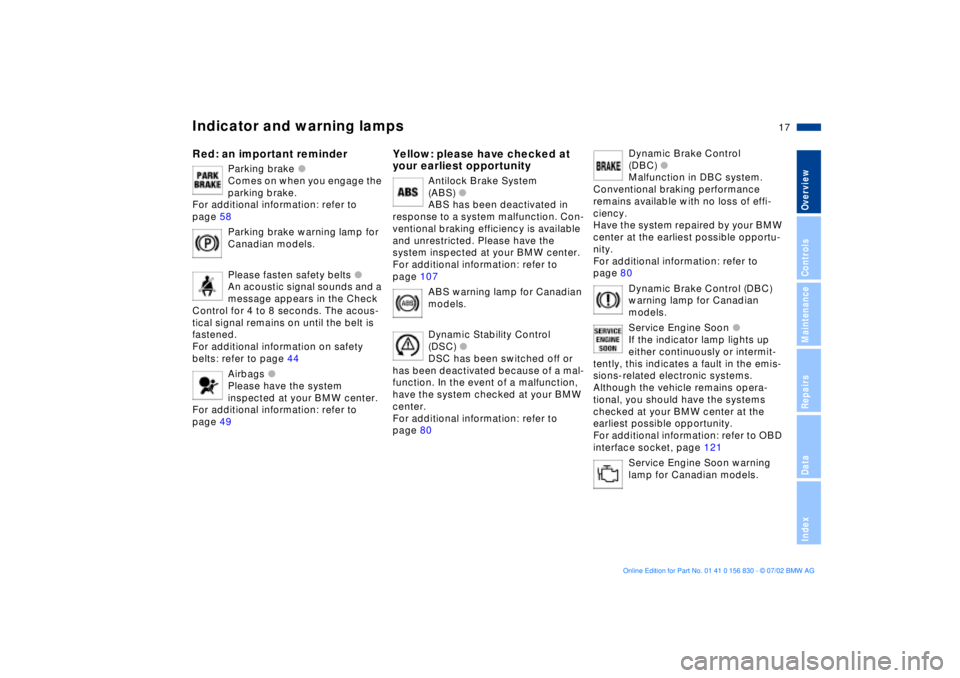
Red: an important reminder
Parking brake
l
Comes on when you engage the
parking brake.
For additional information: refer to
page 58
Parking brake warning lamp for
Canadian models.
Please fasten safety belts
l
An acoustic signal sounds and a
message appears in the Check
Control for 4 to 8 seconds. The acous-
tical signal remains on until the belt is
fastened.
For additional information on safety
belts: refer to page 44
Airbags
l
Please have the system
inspected at your BMW center.
For additional information: refer to
page 49
Yellow: please have checked at
your earliest opportunity
Antilock Brake System
(ABS)
l
ABS has been deactivated in
response to a system malfunction. Con-
ventional braking efficiency is available
and unrestricted. Please have the
system inspected at your BMW center.
For additional information: refer to
page 107
ABS warning lamp for Canadian
models.
Dynamic Stability Control
(DSC)
l
DSC has been switched off or
has been deactivated because of a mal-
function. In the event of a malfunction,
have the system checked at your BMW
center.
For additional information: refer to
page 80
Dynamic Brake Control
(DBC)
l
Malfunction in DBC system.
Conventional braking performance
remains available with no loss of effi-
ciency.
Have the system repaired by your BMW
center at the earliest possible opportu-
nity.
For additional information: refer to
page 80
Dynamic Brake Control (DBC)
warning lamp for Canadian
models.
Service Engine Soon
l
If the indicator lamp lights up
either continuously or intermit-
tently, this indicates a fault in the emis-
sions-related electronic systems.
Although the vehicle remains opera-
tional, you should have the systems
checked at your BMW center at the
earliest possible opportunity.
For additional information: refer to OBD
interface socket, page 121
Service Engine Soon warning
lamp for Canadian models.
Page 40 of 155

40n
For relaxed and fatigue-free driving you
should select a seating position that
reflects your personal requirements.
Correct seating position combines with
safety belts and airbags to enhance
occupant safety in the event of an acci-
dent. To ensure that the vehicle's safety
systems provide you with optimal pro-
tection, we request that you direct your
careful attention to the following sec-
tion.
For additional information on trans-
porting children, refer to page 51.
Sitting safely with airbags
Always maintain an adequate dis-
tance between yourself and
the airbags. Always hold the steering
wheel by the rim with the hands at the
9 and 3-o'clock positions to keep any
chance of injury to hands or arms to an
absolute minimum should the airbag be
deployed. Never allow any objects,
individuals or animals to obstruct the
areas between passengers and airbags.
Never use the front airbag's cover as a
storage tray or support for objects of
any kind. Never allow front passengers
to rest their feet or legs on the airbag
cover.<
For airbag locations and additional
information on airbags refer to page 49.Sitting safely with safety belt
Never allow more than one person
to wear a single safety belt. Never
allow infants or small children to ride in
a passenger's lap. Avoid twisting the
belt while routing it firmly across the
pelvis and shoulder, wear it as snugly
against your body as possible. Do not
allow the belt to rest against hard or
fragile objects in your pockets. Do not
route the belt across your neck, or run it
across sharp edges. Avoid wearing
bulky clothing and pull on the lap belt
periodically to retension it over your
shoulders. In the event of a frontal
impact, a loose lap belt could slide over
the hips, leading to abdominal injury. In
addition, the safety belt's restraint
effectiveness is reduced if it is worn
loosely. Expectant mothers should
always wear their safety belts, taking
care to position the lap belt against the
lower hips, where it will not exert pres-
sure against the abdominal area.<
For information on using the safety
belts refer to page 44.
When adjusting your seat, always
observe the following precautions
Never try to adjust your seat while
operating the vehicle. The seat
could respond with an unexpected
movement, and the ensuing loss of
vehicle control could lead to an acci-
dent. Never ride with the backrest
reclined to an extreme horizontal angle
(important for front passengers to
remember), otherwise, there is a risk
that you will slide under the safety belt
in an accident, thus negating the pro-
tection the safety belt provides.
Do not move the seats to the rear when
the vehicle is at an extreme angle (on
garage ramps or steep slopes, for
example). If you do so, the automatic
safety belt height adjustment can be
disengaged.<
Seat adjustment>BMW M sport seat, refer to page 41
>BMW comfort seat, refer to page 42
>Head restraints, refer to page 43
>BMW active seat, refer to page 43
Sitting safely Seats
Page 42 of 155
42n
BMW comfort seat
*
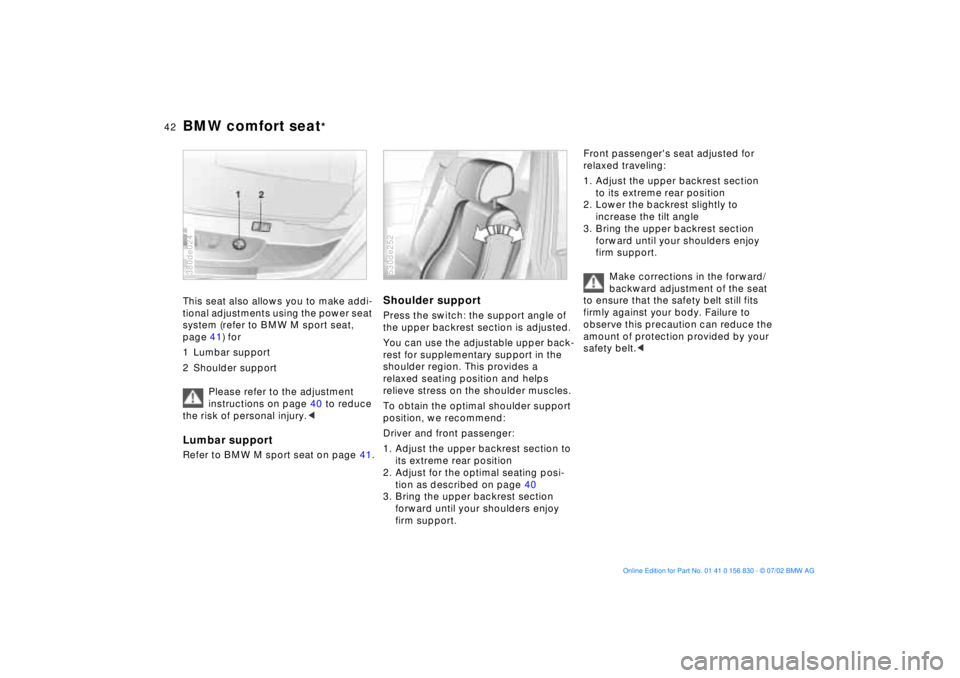
This seat also allows you to make addi-
tional adjustments using the power seat
system (refer to BMW M sport seat,
page 41) for
1 Lumbar support
2 Shoulder support
Please refer to the adjustment
instructions on page 40 to reduce
the risk of personal injury.
the upper backrest section is adjusted.
You can use the adjustable upper back-
rest for supplementary support in the
shoulder region. This provides a
relaxed seating position and helps
relieve stress on the shoulder muscles.
To obtain the optimal shoulder support
position, we recommend:
Driver and front passenger:
1. Adjust the upper backrest section to
its extreme rear position
2. Adjust for the optimal seating posi-
tion as described on page 40
3. Bring the upper backrest section
forward until your shoulders enjoy
firm support.530de252
Front passenger's seat adjusted for
relaxed traveling:
1. Adjust the upper backrest section
to its extreme rear position
2. Lower the backrest slightly to
increase the tilt angle
3. Bring the upper backrest section
forward until your shoulders enjoy
firm support.
Make corrections in the forward/
backward adjustment of the seat
to ensure that the safety belt still fits
firmly against your body. Failure to
observe this precaution can reduce the
amount of protection provided by your
safety belt.<
Page 44 of 155
44n
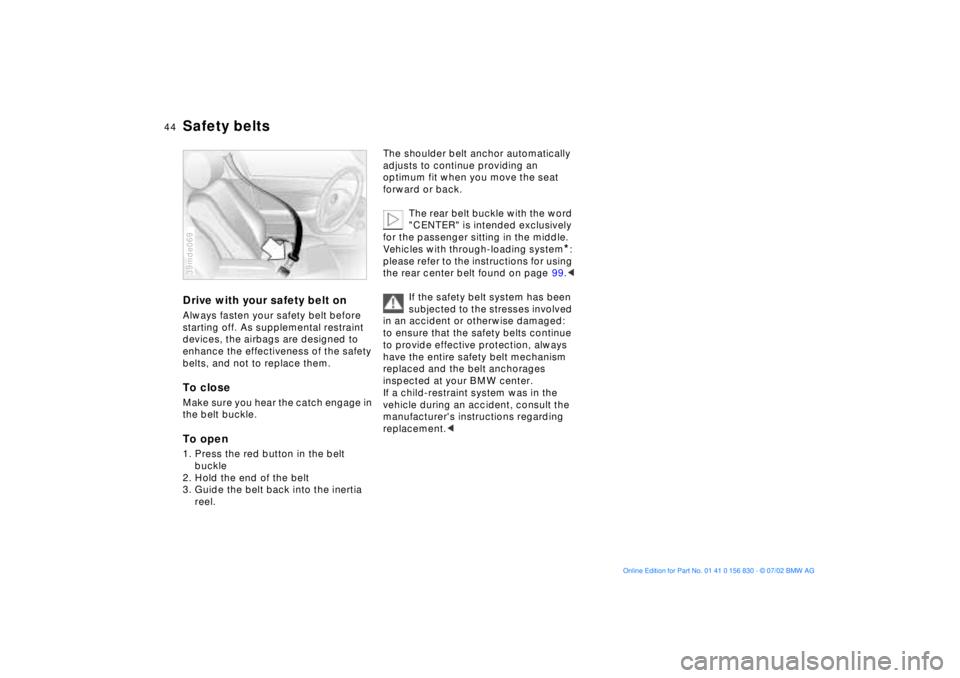
Safety belts Drive with your safety belt onAlways fasten your safety belt before
starting off. As supplemental restraint
devices, the airbags are designed to
enhance the effectiveness of the safety
belts, and not to replace them.To closeMake sure you hear the catch engage in
the belt buckle.To open1. Press the red button in the belt
buckle
2. Hold the end of the belt
3. Guide the belt back into the inertia
reel.39mde069
The shoulder belt anchor automatically
adjusts to continue providing an
optimum fit when you move the seat
forward or back.
The rear belt buckle with the word
"CENTER" is intended exclusively
for the passenger sitting in the middle.
Vehicles with through-loading system
*:
please refer to the instructions for using
the rear center belt found on page 99.<
If the safety belt system has been
subjected to the stresses involved
in an accident or otherwise damaged:
to ensure that the safety belts continue
to provide effective protection, always
have the entire safety belt mechanism
replaced and the belt anchorages
inspected at your BMW center.
If a child-restraint system was in the
vehicle during an accident, consult the
manufacturer's instructions regarding
replacement.<
Page 49 of 155
49n
OverviewControlsMaintenanceRepairsDataIndex
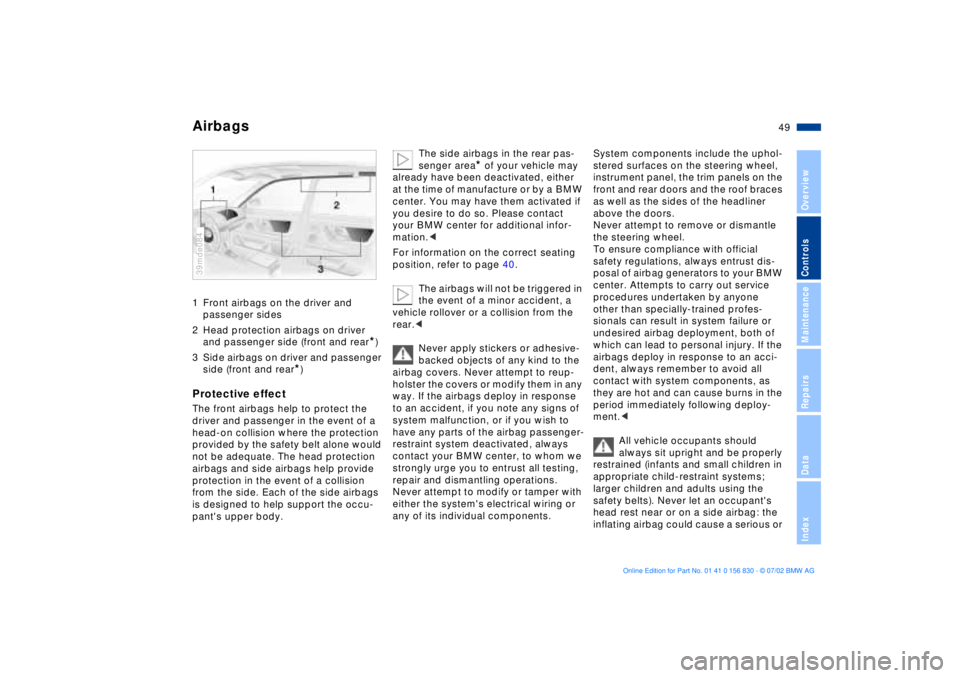
Airbags1 Front airbags on the driver and
passenger sides
2 Head protection airbags on driver
and passenger side (front and rear
*)
3 Side airbags on driver and passenger
side (front and rear
*)
Protective effectThe front airbags help to protect the
driver and passenger in the event of a
head-on collision where the protection
provided by the safety belt alone would
not be adequate. The head protection
airbags and side airbags help provide
protection in the event of a collision
from the side. Each of the side airbags
is designed to help support the occu-
pant's upper body.39mde084
The side airbags in the rear pas-
senger area
* of your vehicle may
already have been deactivated, either
at the time of manufacture or by a BMW
center. You may have them activated if
you desire to do so. Please contact
your BMW center for additional infor-
mation.<
For information on the correct seating
position, refer to page 40.
The airbags will not be triggered in
the event of a minor accident, a
vehicle rollover or a collision from the
rear.<
Never apply stickers or adhesive-
backed objects of any kind to the
airbag covers. Never attempt to reup-
holster the covers or modify them in any
way. If the airbags deploy in response
to an accident, if you note any signs of
system malfunction, or if you wish to
have any parts of the airbag passenger-
restraint system deactivated, always
contact your BMW center, to whom we
strongly urge you to entrust all testing,
repair and dismantling operations.
Never attempt to modify or tamper with
either the system's electrical wiring or
any of its individual components.
System components include the uphol-
stered surfaces on the steering wheel,
instrument panel, the trim panels on the
front and rear doors and the roof braces
as well as the sides of the headliner
above the doors.
Never attempt to remove or dismantle
the steering wheel.
To ensure compliance with official
safety regulations, always entrust dis-
posal of airbag generators to your BMW
center. Attempts to carry out service
procedures undertaken by anyone
other than specially-trained profes-
sionals can result in system failure or
undesired airbag deployment, both of
which can lead to personal injury. If the
airbags deploy in response to an acci-
dent, always remember to avoid all
contact with system components, as
they are hot and can cause burns in the
period immediately following deploy-
ment.<
All vehicle occupants should
always sit upright and be properly
restrained (infants and small children in
appropriate child-restraint systems;
larger children and adults using the
safety belts). Never let an occupant's
head rest near or on a side airbag: the
inflating airbag could cause a serious or
Page 50 of 155
50n
Airbagsfatal injury. Please note that the word
"Airbag" imprinted on the door trim
panel indicates the airbag's location.
Accident research shows that the
safest place for children in an automo-
bile is in the rear seat. However, a child
sitting in the rear seat and not properly
restrained may place his or her head on
or near the side airbag, if installed. For
example, a child Ð even though belted Ð
may fall asleep with his or her head
against the side airbag. It may be diffi-
cult for a driver to ensure that children
in the rear seat will remain properly
positioned at all times and do not place
their heads on or near the side airbag.
Therefore, we recommend that the
rear-seat side airbags, if provided, be
deactivated if you plan to transport chil-
dren in the rear seat.
The rear-seat side airbags may already
have been deactivated, either at the
time of manufacture or by a BMW
center. Labels in the rear door opening
should indicate the status of your rear-
seat side airbags. If you are uncertain of
their status, or wish to have the airbags
activated or deactivated, please con-
tact your BMW center.< Even when all these guidelines are fol-
lowed, there is still a small residual risk
of injuries to the face, hands and arms
occurring in isolated instances.
The ignition and inflation noise may
provoke a mild temporary hearing loss
in extremely sensitive individuals.
Airbag warning information is also pro-
vided on the sun visors.
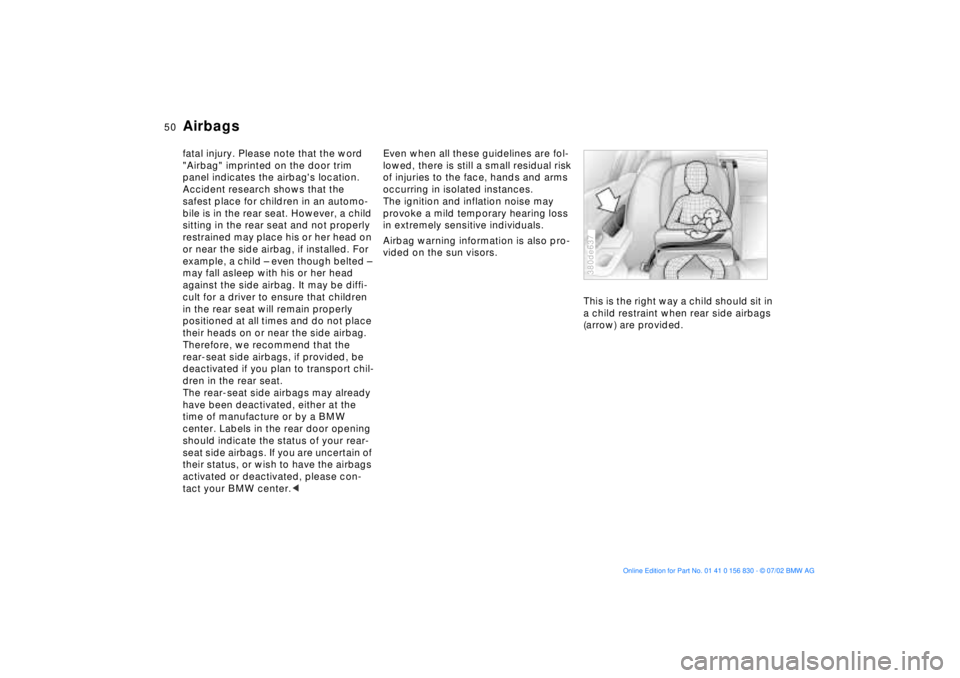
This is the right way a child should sit in
a child restraint when rear side airbags
(arrow) are provided.
380de637
Page 51 of 155
51n
OverviewControlsMaintenanceRepairsDataIndex
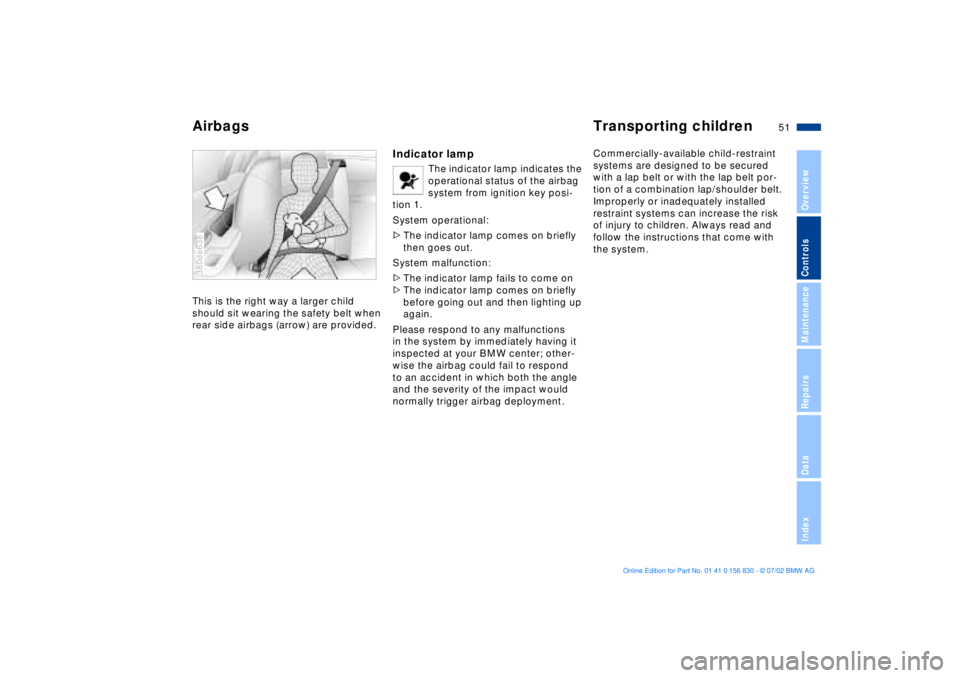
Airbags Transporting childrenThis is the right way a larger child
should sit wearing the safety belt when
rear side airbags (arrow) are provided.380de638
Indicator lamp
The indicator lamp indicates the
operational status of the airbag
system from ignition key posi-
tion 1.
System operational:
>The indicator lamp comes on briefly
then goes out.
System malfunction:
>The indicator lamp fails to come on
>The indicator lamp comes on briefly
before going out and then lighting up
again.
Please respond to any malfunctions
in the system by immediately having it
inspected at your BMW center; other-
wise the airbag could fail to respond
to an accident in which both the angle
and the severity of the impact would
normally trigger airbag deployment.
Commercially-available child-restraint
systems are designed to be secured
with a lap belt or with the lap belt por-
tion of a combination lap/shoulder belt.
Improperly or inadequately installed
restraint systems can increase the risk
of injury to children. Always read and
follow the instructions that come with
the system.
Page 53 of 155
53n
OverviewControlsMaintenanceRepairsDataIndex
Transporting children safelyThis important precaution is intended to
maximize the distance between the
airbag and the child. Older children
should be tightly secured with a safety
belt, after they have outgrown a booster
seat that is appropriate for their age,
height and weight.
Younger children should be secured in
an appropriate forward-facing child-
restraint system that has first been
properly secured with a safety belt.
Never install a rearward-facing child-
restraint system in the front passenger
seat. We strongly urge you to carefully
read and comply with the instructions
for installation and use provided by the
child restraint's manufacturer when-
ever you use such a device.
Be sure that all occupants (of all ages)
remain properly and securely restrained
at all times.<
All rear seating positions in your vehicle
meet the recommendations of SAE
J1819, an industry-recommended prac-
tice for securing child-restraint systems
in motor vehicles.
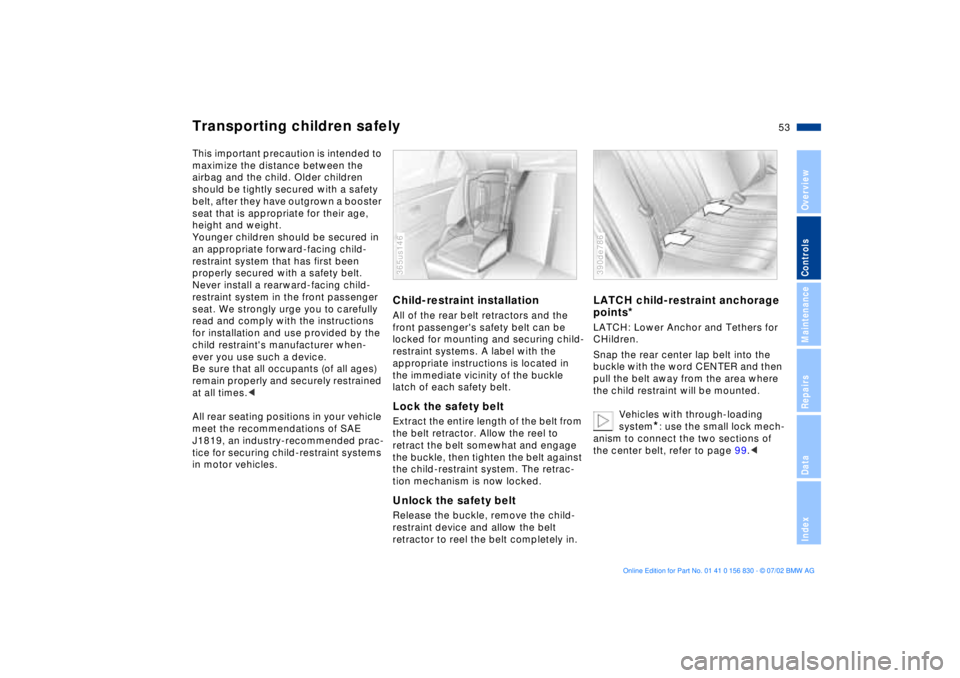
Child-restraint installationAll of the rear belt retractors and the
front passenger's safety belt can be
locked for mounting and securing child-
restraint systems. A label with the
appropriate instructions is located in
the immediate vicinity of the buckle
latch of each safety belt.Lock the safety beltExtract the entire length of the belt from
the belt retractor. Allow the reel to
retract the belt somewhat and engage
the buckle, then tighten the belt against
the child-restraint system. The retrac-
tion mechanism is now locked.Unlock the safety beltRelease the buckle, remove the child-
restraint device and allow the belt
retractor to reel the belt completely in.365us146
LATCH child-restraint anchorage
points
*
LATCH: Lower Anchor and Tethers for
CHildren.
Snap the rear center lap belt into the
buckle with the word CENTER and then
pull the belt away from the area where
the child restraint will be mounted.
Vehicles with through-loading
system
*: use the small lock mech-
anism to connect the two sections of
the center belt, refer to page 99.<
390de786