height BMW M5 SEDAN 2015 User Guide
[x] Cancel search | Manufacturer: BMW, Model Year: 2015, Model line: M5 SEDAN, Model: BMW M5 SEDAN 2015Pages: 239, PDF Size: 5.04 MB
Page 176 of 239
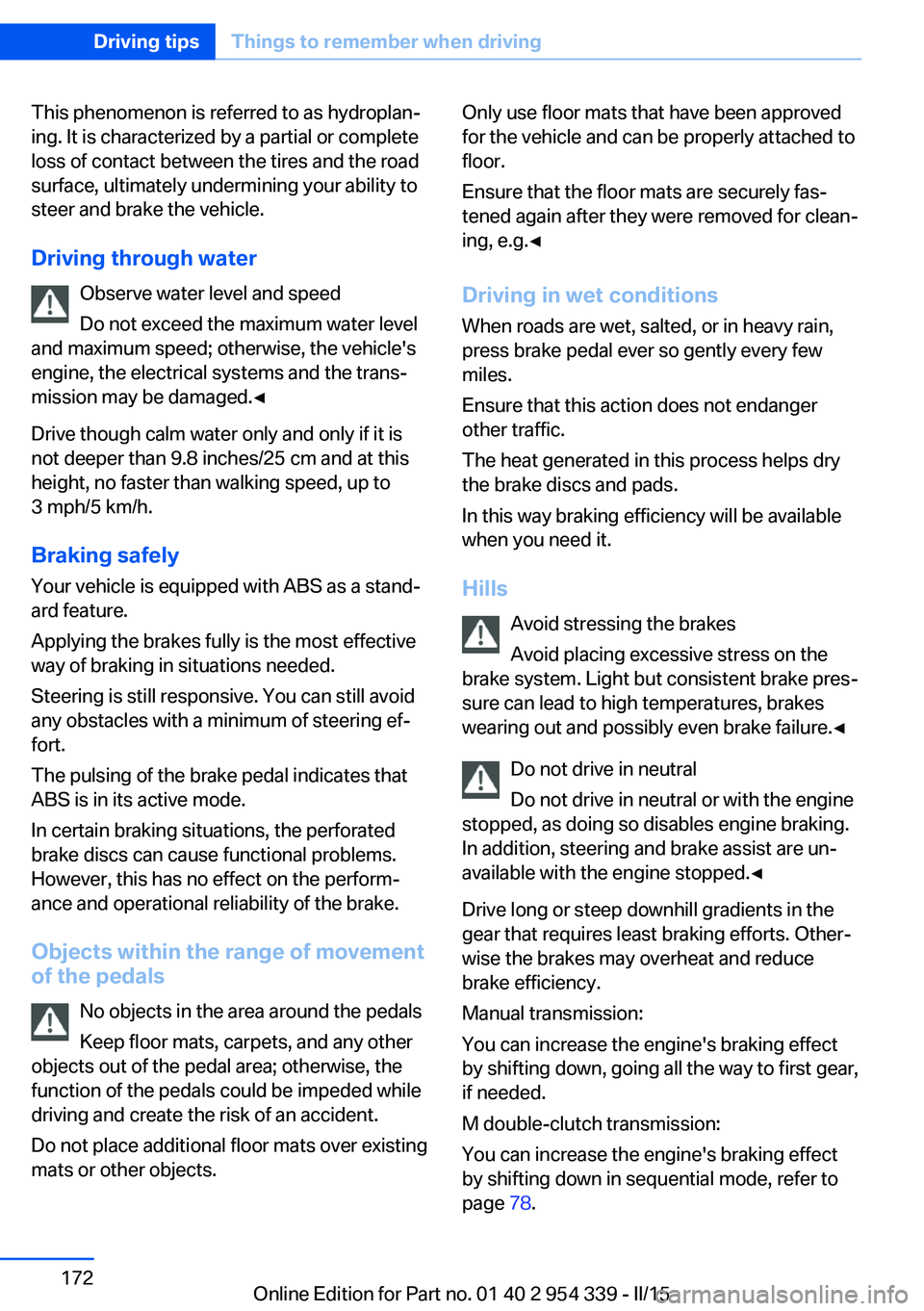
This phenomenon is referred to as hydroplan‐
ing. It is characterized by a partial or complete
loss of contact between the tires and the road
surface, ultimately undermining your ability to
steer and brake the vehicle.
Driving through water Observe water level and speed
Do not exceed the maximum water level
and maximum speed; otherwise, the vehicle's
engine, the electrical systems and the trans‐
mission may be damaged.◀
Drive though calm water only and only if it is
not deeper than 9.8 inches/25 cm and at this
height, no faster than walking speed, up to
3 mph/5 km/h.
Braking safely
Your vehicle is equipped with ABS as a stand‐
ard feature.
Applying the brakes fully is the most effective
way of braking in situations needed.
Steering is still responsive. You can still avoid
any obstacles with a minimum of steering ef‐
fort.
The pulsing of the brake pedal indicates that
ABS is in its active mode.
In certain braking situations, the perforated
brake discs can cause functional problems.
However, this has no effect on the perform‐
ance and operational reliability of the brake.
Objects within the range of movement
of the pedals
No objects in the area around the pedals
Keep floor mats, carpets, and any other
objects out of the pedal area; otherwise, the
function of the pedals could be impeded while driving and create the risk of an accident.
Do not place additional floor mats over existing
mats or other objects.Only use floor mats that have been approved
for the vehicle and can be properly attached to
floor.
Ensure that the floor mats are securely fas‐
tened again after they were removed for clean‐
ing, e.g.◀
Driving in wet conditions When roads are wet, salted, or in heavy rain,
press brake pedal ever so gently every few
miles.
Ensure that this action does not endanger other traffic.
The heat generated in this process helps dry
the brake discs and pads.
In this way braking efficiency will be available
when you need it.
Hills Avoid stressing the brakes
Avoid placing excessive stress on the
brake system. Light but consistent brake pres‐
sure can lead to high temperatures, brakes
wearing out and possibly even brake failure.◀
Do not drive in neutral
Do not drive in neutral or with the engine
stopped, as doing so disables engine braking.
In addition, steering and brake assist are un‐
available with the engine stopped.◀
Drive long or steep downhill gradients in the
gear that requires least braking efforts. Other‐
wise the brakes may overheat and reduce
brake efficiency.
Manual transmission:
You can increase the engine's braking effect
by shifting down, going all the way to first gear,
if needed.
M double-clutch transmission:
You can increase the engine's braking effect
by shifting down in sequential mode, refer to
page 78.Seite 172Driving tipsThings to remember when driving172
Online Edition for Part no. 01 40 2 954 339 - II/15
Page 193 of 239
sudden tire failure. The grade C corresponds
to a level of performance which all passenger
car tires must meet under the Federal Motor
Vehicle Safety Standard No. 109. Grades Band
A represent higher levels of performance on
the laboratory test wheel than the minimum re‐
quired by law.
Temperature grade for this tire
The temperature grade for this tire is es‐
tablished for a tire that is properly inflated and
not overloaded. Excessive speed, underinfla‐
tion, or excessive loading, either separately or
in combination, can cause heat buildup and
possible tire failure.
If necessary, have the vehicle towed.◀
M+S
Winter and all-season tires with better cold
weather performance than summer tires.
Tire tread Summer tires Do not drive with a tire tread depth of less than
0.12 in/3 mm.
There is an increased danger of hydroplaning if
the tire tread depth is less than 0.12 in/3 mm.
Winter tires
Do not drive with a tire tread depth of less than
0.16 in/4 mm.
Below a tread depth of 0.16 in/4 mm, tires are
less suitable for winter operation.Minimum tread depth
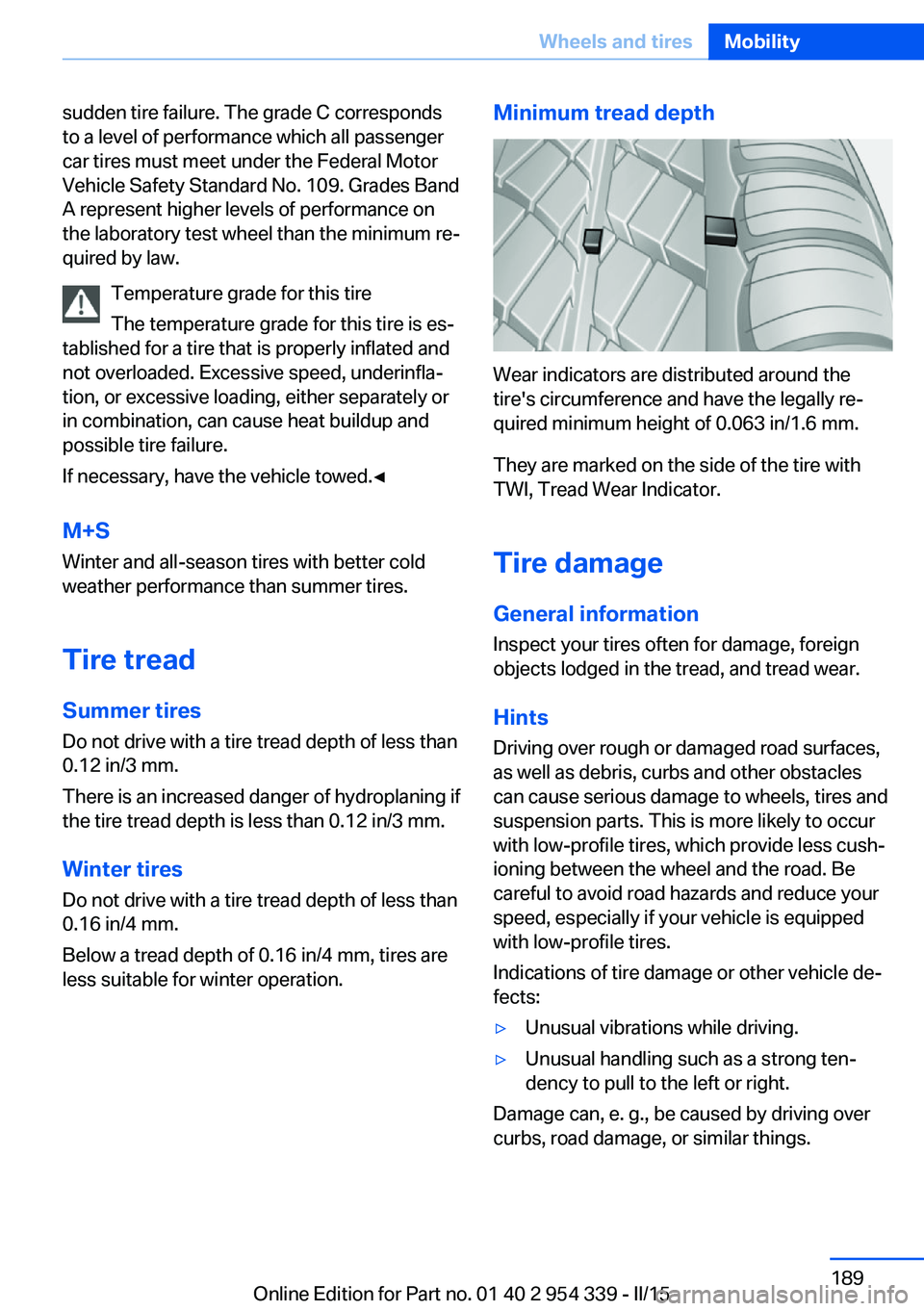
Wear indicators are distributed around the
tire's circumference and have the legally re‐
quired minimum height of 0.063 in/1.6 mm.
They are marked on the side of the tire with
TWI, Tread Wear Indicator.
Tire damage
General information
Inspect your tires often for damage, foreign
objects lodged in the tread, and tread wear.
Hints
Driving over rough or damaged road surfaces,
as well as debris, curbs and other obstacles
can cause serious damage to wheels, tires and
suspension parts. This is more likely to occur
with low-profile tires, which provide less cush‐
ioning between the wheel and the road. Be
careful to avoid road hazards and reduce your
speed, especially if your vehicle is equipped
with low-profile tires.
Indications of tire damage or other vehicle de‐
fects:
▷Unusual vibrations while driving.▷Unusual handling such as a strong ten‐
dency to pull to the left or right.
Damage can, e. g., be caused by driving over
curbs, road damage, or similar things.
Seite 189Wheels and tiresMobility189
Online Edition for Part no. 01 40 2 954 339 - II/15
Page 200 of 239
Never reach into the engine compart‐
ment
Never reach into spaces or gaps in the engine
compartment; otherwise, there is a risk of in‐
jury, e.g., from rotating or hot parts.◀
Danger of injury when the hood is open
There is a danger of injury from protrud‐
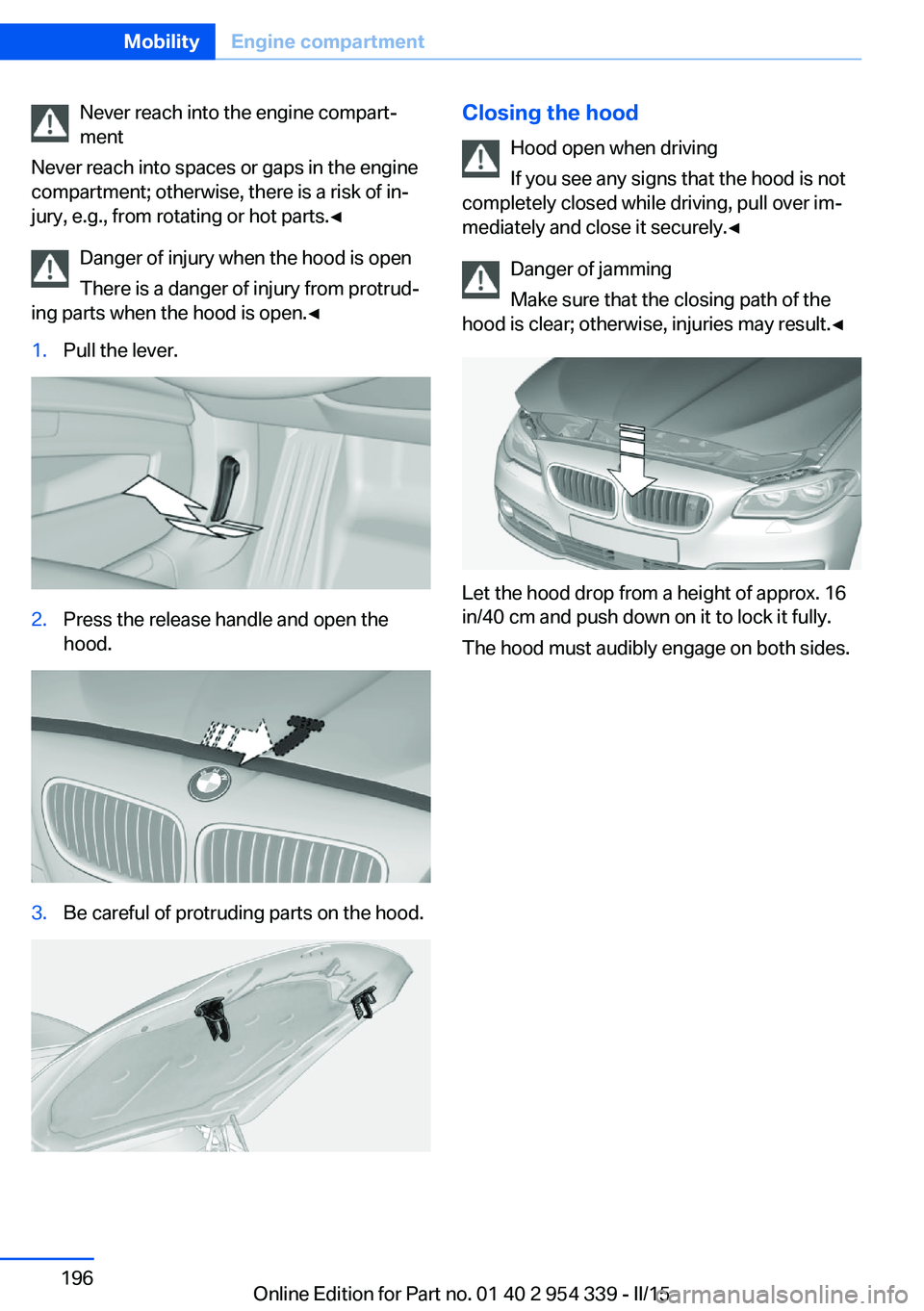
ing parts when the hood is open.◀1.Pull the lever.2.Press the release handle and open the
hood.3.Be careful of protruding parts on the hood.Closing the hood
Hood open when driving
If you see any signs that the hood is not
completely closed while driving, pull over im‐
mediately and close it securely.◀
Danger of jamming
Make sure that the closing path of the
hood is clear; otherwise, injuries may result.◀
Let the hood drop from a height of approx. 16
in/40 cm and push down on it to lock it fully.
The hood must audibly engage on both sides.
Seite 196MobilityEngine compartment196
Online Edition for Part no. 01 40 2 954 339 - II/15
Page 226 of 239
Technical dataVehicle features and options
This chapter describes all standard, country-
specific and optional features offered with the
series. It also describes features that are not
necessarily available in your car, e. g., due tothe selected options or country versions. This
also applies to safety-related functions and
systems. The respectively applicable country
provisions must be observed when using the
respective features and systems.
Note
The technical data and specifications in this
Owner's Manual are used as guidance values.
The vehicle-specific data can deviate from this,
for example, due to the selected special equip‐
ment, country version or country-specific
measurement method. Detailed values can befound in the approval documents, on informa‐
tion signs on the vehicle or can be obtained
from the service center.
The information in the vehicle documents al‐
ways has priority.
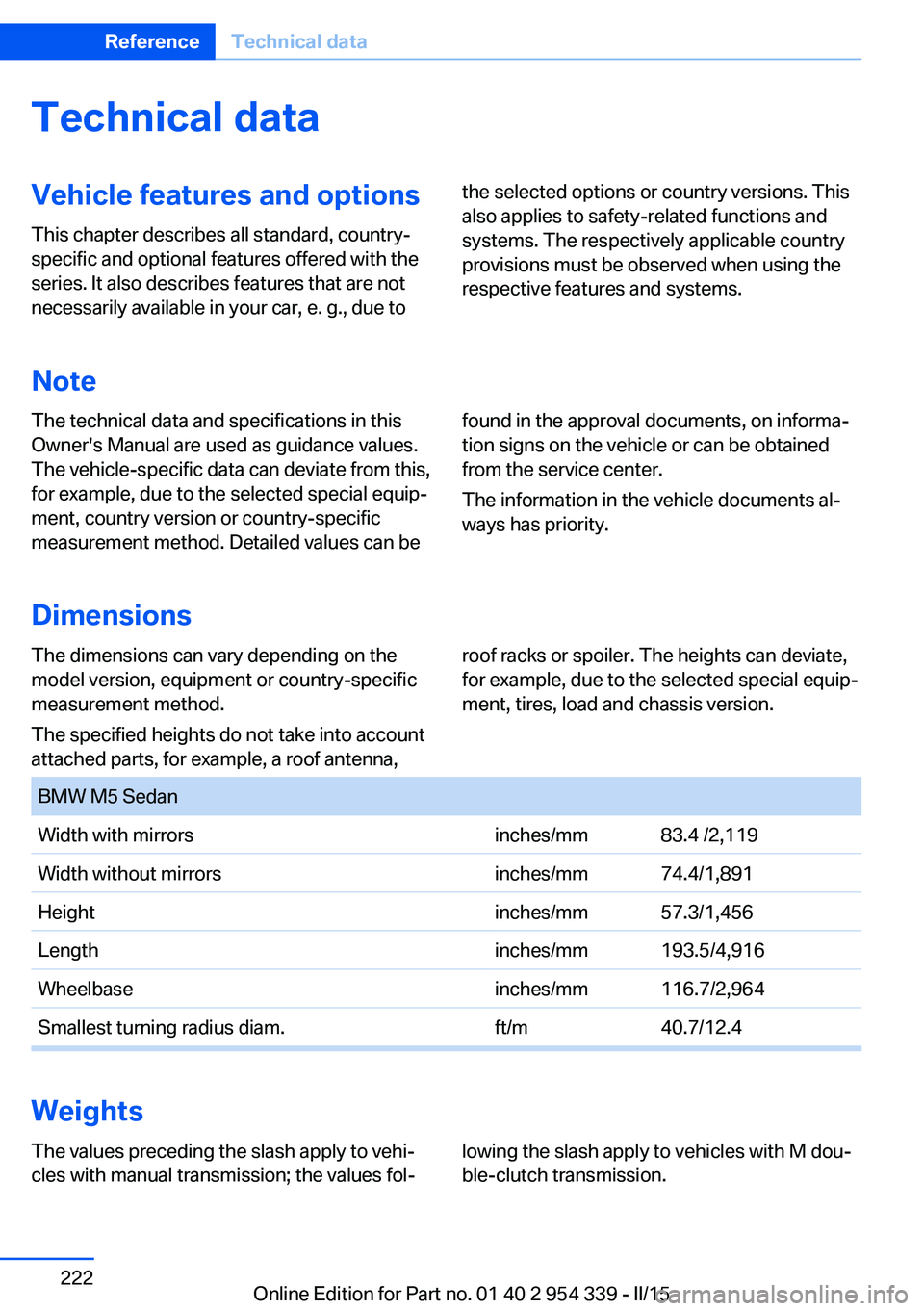
Dimensions
The dimensions can vary depending on the
model version, equipment or country-specific
measurement method.
The specified heights do not take into account
attached parts, for example, a roof antenna,roof racks or spoiler. The heights can deviate,
for example, due to the selected special equip‐
ment, tires, load and chassis version. BMW M5 SedanWidth with mirrorsinches/mm83.4 /2,119Width without mirrorsinches/mm74.4/1,891Heightinches/mm57.3/1,456Lengthinches/mm193.5/4,916Wheelbaseinches/mm116.7/2,964Smallest turning radius diam.ft/m40.7/12.4
Weights
The values preceding the slash apply to vehi‐
cles with manual transmission; the values fol‐lowing the slash apply to vehicles with M dou‐
ble-clutch transmission.Seite 222ReferenceTechnical data222
Online Edition for Part no. 01 40 2 954 339 - II/15
Page 231 of 239
Entering a car wash 216
Equipment, interior 151
Error displays, see Check Control 84
ESP Electronic Stability Pro‐ gram, refer to DSC 129
Exchanging wheels/tires 190
Exhaust system 171
Exterior mirror, automatic dimming feature 61
Exterior mirrors 60
External start 211
External temperature dis‐ play 88
External temperature warn‐ ing 88
Eyes for securing cargo 175
F
Failure message, see Check Control 84
False alarm, refer to Uninten‐ tional alarm 48
Fan, refer to Air flow 145
Filler neck for engine oil 198
Fine wood, care 218
First aid kit 211
Fitting for towing, see Tow fit‐ ting 214
Flat tire, changing wheels 207
Flat Tire Monitor FTM 111
Flat tire, Tire Pressure Moni‐ tor TPM 108
Flat tire, warning lamp 109, 111
Flooding 172
Floor carpet, care 219
Floor mats, care 219
Fold down the rear seat back‐ rest, see Though-loading
system 156
Fold-out position, wiper 76
Foot brake 172
Front airbags 105 Front-end collision warning
with City Braking func‐
tion 113
Front lights 204
front-seat passenger airbags, automatic deactivation 107
Front-seat passenger airbags, indicator lamp 107
FTM Flat Tire Monitor 111
Fuel 184
Fuel consumption, refer to Average fuel consump‐
tion 94
Fuel filler flap 182
Fuel gauge 87
Fuel lid 182
Fuel quality 184
Fuel recommendation 184
Fuel, tank capacity 223
Fuse 209
G
Garage door opener, refer to Universal Integrated Remote
Control 151
Gasoline 184
Gear change 79
Gear shift indicator 91
General driving notes 171
Glare shield 153
Glass sunroof, powered 50
Glove compartment 160
Gross vehicle weight, ap‐ proved 222
Ground clearance 173
H
Handbrake, refer to Parking brake 72
Hand-held transmitter, alter‐ nating code 152
Hazard warning flashers 210
Head airbags 105 Headlight control, auto‐
matic 101
Headlight courtesy delay fea‐ ture 100
Headlight courtesy delay fea‐ ture via remote control 38
Headlight flasher 74
Headlight glass 204
Headlights 204
Headlights, care 217
Headlight washer system 74
Head restraints 53
Head restraints, front 57
Head restraints, rear 58
Head-up Display 97
Head-up Display, care 219
Head-up display, M view 98
Head-up display, standard view 98
Heavy cargo, stowing 175
Height, vehicle 222
High-beam Assistant 102
High beams 74
High beams/low beams, refer to High-beam Assistant 102
Higher speed range 173
Hills 172
Hill start assistant, refer to Drive-off assistant 127
Hints 6
Holder for beverages 162
Homepage 6
Hood 195
Horn 14
Hotel function, trunk lid 42
Hot exhaust system 171
HUD Head-up Display 97
Hydroplaning 171
I Ice warning, see External temperature warning 88
Icy roads, see External tem‐ perature warning 88
Identification marks, tires 187 Seite 227Everything from A to ZReference227
Online Edition for Part no. 01 40 2 954 339 - II/15