tyre pressure BMW MOTORRAD K 1200 S 2006 Rider's Manual (in English)
[x] Cancel search | Manufacturer: BMW MOTORRAD, Model Year: 2006, Model line: K 1200 S, Model: BMW MOTORRAD K 1200 S 2006Pages: 163, PDF Size: 1.75 MB
Page 47 of 163
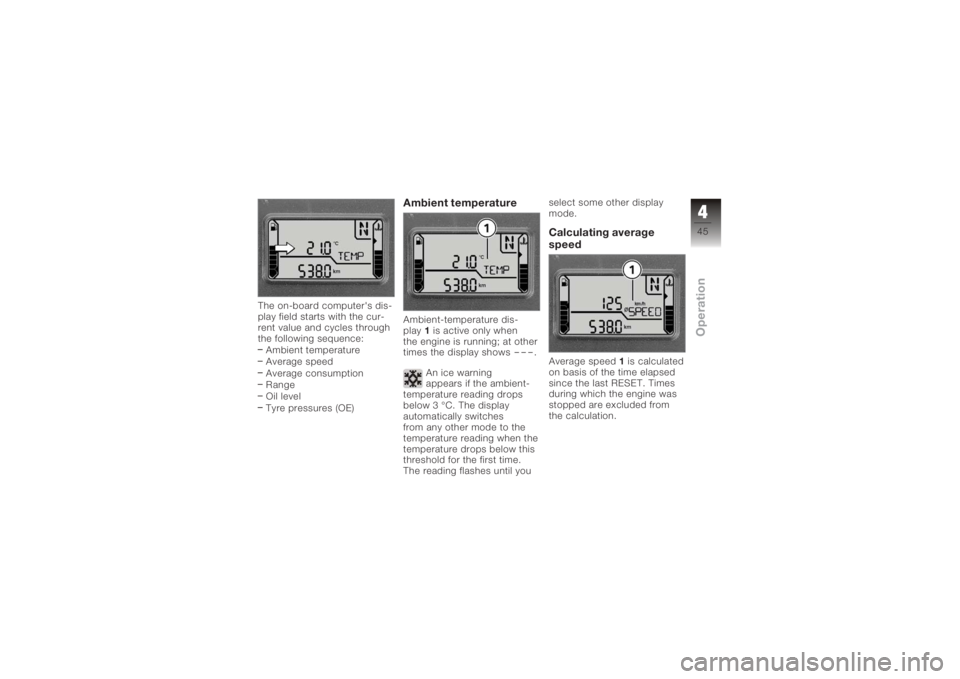
The on-board computer's dis-
play field starts with the cur-
rent value and cycles through
the following sequence:Ambient temperature
Average speed
Average consumption
Range
Oil level
Tyre pressures (OE)
Ambient temperatureAmbient-temperature dis-
play 1is active only when
the engine is running; at other
times the display shows
---
.
An ice warning
appears if the ambient-
temperature reading drops
below 3 °C. The display
automatically switches
from any other mode to the
temperature reading when the
temperature drops below this
threshold for the first time.
The reading flashes until you select some other display
mode.
Calculating average
speedAverage speed
1is calculated
on basis of the time elapsed
since the last RESET. Times
during which the engine was
stopped are excluded from
the calculation.
445zOperation
Page 62 of 163
COMF
Comfortable damping
characteristic
NORM
Normal damping
characteristic
SPORT
Sporty damping
characteristic
The setting shown on the
display is automatically
accepted as the damping
characteristic if you allow
a certain length of time
to pass without pressing
button 1. During the setting
procedure, the display
flashes.
Adjust spring preloadStart the engine.
You cannot adjust spring
preload while the motor-
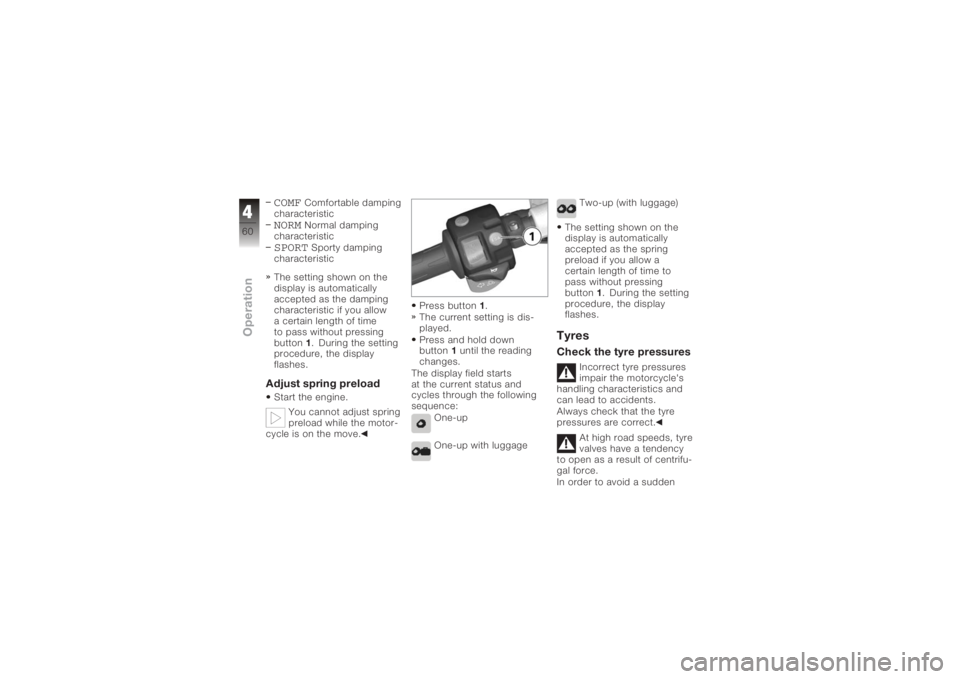
cycle is on the move. Press button
1.
The current setting is dis-
played.
Press and hold down
button 1until the reading
changes.
The display field starts
at the current status and
cycles through the following
sequence:
One-up
One-up with luggage Two-up (with luggage)
The setting shown on the
display is automatically
accepted as the spring
preload if you allow a
certain length of time to
pass without pressing
button 1. During the setting
procedure, the display
flashes.
TyresCheck the tyre pressures
Incorrect tyre pressures
impair the motorcycle's
handling characteristics and
can lead to accidents.
Always check that the tyre
pressures are correct.
At high road speeds, tyre
valves have a tendency
to open as a result of centrifu-
gal force.
In order to avoid a sudden
460zOperation
Page 63 of 163
loss of tyre pressure, fit a
metal valve cap with rubber
sealing ring to the rear tyre
and make sure that the cap is
screwed on firmly.Incorrect tyre pressure
reduces the operating
life of the tyres.
Always check that the tyre
pressures are correct.
Check that tyre pressures
are correct as per the data
below.
Tyre pressure, front
2.5 bar (One-up, tyre
cold)
2.5 bar (Two-up and/or
with luggage, tyre cold) Tyre pressure, rear
2.9 bar (One-up, tyre
cold)
2.9 bar (Two-up and/or
with luggage, tyre cold)
If tyre pressure is too low: Correct the tyre pressures.
461zOperation
Page 65 of 163

Riding
Safety instructions . . . . . . . . . . . . . 64
Checklist . . . . . . . . . . . . . . . . . . . . . . 66
Starting . . . . . . . . . . . . . . . . . . . . . . . 66
Running in . . . . . . . . . . . . . . . . . . . . 68
Parking your motorcycle . . . . . . . 69
Refuelling . . . . . . . . . . . . . . . . . . . . . 71
Tyre pressure control RDC
OE
.. 72
Brake system, general . . . . . . . . . 73
Brake system with BMW
Motorrad Integral ABS . . . . . . . . . 74
563zRiding
Page 66 of 163
Safety instructionsRider's equipmentDo not ride without the cor-
rect clothing. Always wear:Helmet
Motorcycling jacket and
trousers
Gloves
Boots
This applies even to short
journeys, and to every sea-
son of the year. Your author-
ised BMW Motorrad dealer
will be glad to advise you on
the correct clothing for every
purpose.SpeedIf you ride at high speed, al-
ways bear in mind that vari-
ous boundary conditions can
adversely affect the handling
of your motorcycle: Settings of the spring-strut
and shock-absorber system
Imbalanced load
Loose clothing
Insufficient tyre pressure
Poor tyre tread
Etc.
Correct loading
Overloading and imbal-
anced loads can ad-
versely affect the motorcycle's
handling.
Do not exceed the permiss-
ible gross weight and be sure
to comply with the instruc-
tions on loading.
Alcohol and drugs
Even small amounts of
alcohol or drugs will ad-
versely affect your percep-
tion and your ability to as-
sess situations and make de-
cisions, and slow down your reflexes. Medication can ex-
acerbate these effects.
Do not ride your motorcycle
after consuming alcohol,
drugs and/or medication.
Risk of poisoningExhaust fumes contain car-
bon monoxide, which is col-
ourless and odourless but
highly toxic.
Inhaling the exhaust
fumes therefore
represents a health hazard
and can even cause loss
of consciousness with fatal
consequences.
Do not inhale exhaust fumes.
Do not run the engine in an
enclosed space.
564zRiding
Page 68 of 163
ponents are not designed to
withstand. Damage caused in
this way is not covered by the
warranty.
Do not tamper with the
control unit of the electronic
engine-management
system.ChecklistUse the following checklist
to check important functions,
settings and wear limits be-
fore you ride off.Brakes
Brake-fluid levels, front and
rear
Clutch
Clutch fluid level
Shock absorber setting and
spring preload
Tyre-tread depth and tyre
pressures Cases correctly installed
and luggage secured
At regular intervals: Engine oil level (every refuel-
ling stop)
Brake-pad wear (every third
refuelling stop)
StartingSide standYou cannot start the motor-
cycle with the side stand ex-
tended and a gear engaged.
The engine will switch itself off
if you start it with the gearbox
in neutral and then engage a
gear before retracting the side
stand.GearboxYou can start the engine
when the gearbox is in neutral
or if you pull the clutch with
a gear engaged. Do not pull
the clutch until after you have switched on the ignition, as
otherwise the engine will
refuse to start. When the
gearbox is in neutral, the
green neutral telltale light is
on and the gear indicator
in the multifunction display
shows N.
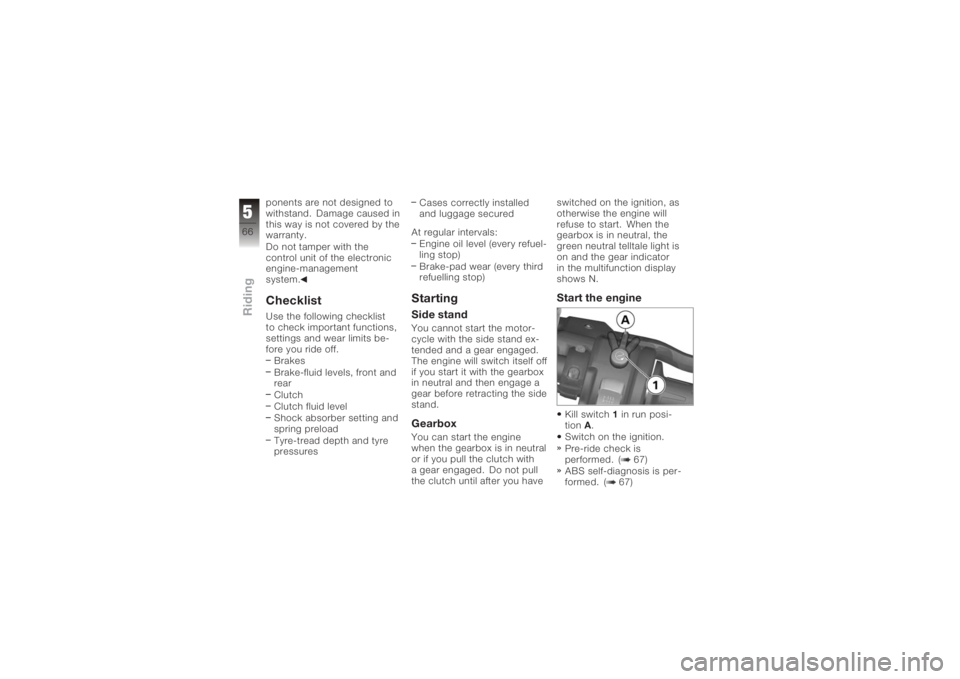
Start the engineKill switch
1in run posi-
tion A.
Switch on the ignition.
Pre-ride check is
performed. ( 67)
ABS self-diagnosis is per-
formed. ( 67)
566zRiding
Page 71 of 163
Running-in speeds
<7000 min
-1
No full-load acceleration.
Avoid low engine speeds at
full load.
Do not omit the first inspec-
tion after 500 - 1200 km.Brake padsNew brake pads must "bed
down" and therefore do not
achieve their optimum friction
levels during the first 500 km.
You can compensate for this
initial reduction in braking ef-
ficiency by exerting greater
pressure on the levers. New brake pads can ex-
tend stopping distance
by a significant margin.
Apply the brakes in good
time.
TyresNew tyres have a smooth
surface. This must be
roughened by riding in a
restrained manner at various
heel angles until the tyres
are run in. This running in
procedure is essential if the
tyres are to achieve maximum
grip.
Tyres do not have their
full grip when new and
there is a risk of accidents at
extreme angles of heel.
Avoid extreme angles of
heel.Parking your
motorcyclePlace the motorcycle on
side stand
If the ground is soft or
uneven, there is no guar- antee that the motorcycle will
rest firmly on the stand.
Always check that the ground
under the stand is level and
firm.
Switch off the engine.
Pull the handbrake lever.
Hold the motorcycle upright
and balanced.
Use your left foot to extend
the side stand fully. The side stand is de-
signed to support only
the weight of the motorcycle.
Do not lean or sit on the mo-
torcycle with the side stand
extended.
Slowly lean the motorcycle
to the side until its weight
is taken by the stand and
dismount to the left. If the motorcycle is on
the side stand, the sur-
face of the ground will de-
termine whether it is better
569zRiding
Page 74 of 163
Recommended fuel
grade
95 ROZ/RON (Premium
unleaded (fuel grade,
usable with power- and
consumption-related
restrictions)) Usable fuel capacity
19 l Reserve fuel
4l
Press the filler cap down
firmly to close.
Remove the key and close
the protective cap.
Tyre pressure control
RDC
OE
FunctionA sensor integrated into each
tyre measures the air tem-
perature and the air pressure
inside the tyre and transmits
this information to the control
unit.
Each sensor has a
centrifugal-force tripswitch
that does not enable
transmission of the measured
values until the motorcycle
has accelerated to about
30 km/h. The display shows--
for each tyre until the
tyre-pressure signal is
received for the first time. The
sensors continue to transmit
the measured-value signals
for approximately 15 minutes
after the motorcycle comes to
a stop. The control unit can
administrate four sensors, so
two different sets of wheels
with RDC sensors can be
alternated on the motorcycle.
An error message is issued
if wheels without sensors
are fitted to a motorcycle
equipped with an RDC control
unit.
Temperature
compensationThe tyre-pressure readings
shown by the multifunction
display are temperature-
compensated; the reference
tyre temperature for these
readings is always 20 °C.
The air lines available to
the public in petrol stations
and motorway service areas
almost invariably show
temperature-dependent
tyre pressures, so in most
instances these gauge
572zRiding
Page 75 of 163
readings will not tally with
the readings shown by the
multifunction display.Tyre-pressure rangesThe RDC control unit differ-
entiates between three air-
pressure ranges, all of which
are parameterised for the mo-
torcycle:Air pressure within permit-
ted tolerance.
Air pressure close to limit of
permitted tolerance.
Air pressure outside permit-
ted tolerance.Brake system, generalDescending mountain
passes
There is a danger of the
brakes fading if you use
only the rear brakes when
descending mountain passes.
Under extreme conditions, the brakes could overheat and
suffer severe damage.
Use both front and rear
brakes, and make use of the
engine's braking effect as
well.
Wet brakes
After the motorcycle has
been washed, ridden
through water or ridden in
the rain, the brake discs and
pads might be wet and the
brakes might not take effect
immediately.
Apply the brakes in good time
until the brakes have dried
out.
Salt on brakes
The brakes may fail to
take effect immediately
if the motorcycle was ridden
on salt-covered roads and the
brakes were not applied for
some time. Apply the brakes in good
time until the salt layer on the
brake discs and brake pads
has been removed.
Oil or grease on brakes
Oil and grease on the
brake discs and pads
considerably diminish braking
efficiency.
Especially after repair and
maintenance work, make
sure that the brake discs and
brake pads are free of oil and
grease.
Dirt or mud on brakes
When riding on loose
surfaces or muddy
roads, the brakes may fail
to take effect immediately
because of dirt or moisture on
the discs or brake pads.
Apply brakes in good time
until the brakes have been
cleaned.
573zRiding
Page 77 of 163

torrad Integral ABS must as-
sume an extremely low coef-
ficient of friction, so that the
wheels will continue to rotate
under all imaginable circum-
stances, because this is the
precondition for ensuring dir-
ectional stability. As soon as
is registers the actual circum-
stances, the system reacts
instantly and adjusts braking
force accordingly to achieve
optimum braking.What feedback does the
rider receive from the
BMW Motorrad Integral
ABS?If the ABS system has to re-
duce braking force on ac-
count of the circumstances
described above, vibration is
perceptible through the hand-
brake lever.
When the handbrake lever is
pulled, brake pressure is alsobuilt up at the rear wheel by
the integral function. If the
brake pedal is depressed
after the handbrake lever is
pulled, the brake pressure
built up beforehand is per-
ceptible as counter-pressure
sooner than is the case when
the brake pedal is depressed
either before or at the same
time as the brake lever is
pulled.
How can stopping
distance be minimised?Each time the brakes are
applied, a load distribution
shift takes place with the
load shifting forward from
the rear to the front wheel.
The sharper the motorcycle
decelerates, the more load
is shifted to the front wheel.
The higher the wheel load, the
more braking force can be
transmitted without the wheel
locking.
To optimise stopping dis-
tance, apply the front brakes
rapidly and keep on increas-
ing the force you apply to the
brake lever. This makes the
best possible use of the dy-
namic increase in load at the
front wheel. Remember to
pull the clutch at the same
time. In the "panic braking
situations" that are trained so
frequently braking force is ap-
plied as rapidly as possible
and with the rider's full force
applied to the brake levers;
under these circumstances
the dynamic shift in load dis-
tribution cannot keep pace
with the increase in decel-
eration and the tyres cannot
transmit the full braking force
to the surface of the road.
ABS has to intervene to keep
the front wheel from locking;
575zRiding