brake BMW SPORT WAGON 2001 Owner's Manual
[x] Cancel search | Manufacturer: BMW, Model Year: 2001, Model line: SPORT WAGON, Model: BMW SPORT WAGON 2001Pages: 238, PDF Size: 2.44 MB
Page 86 of 238
86n
Check ControlGraphic display
*
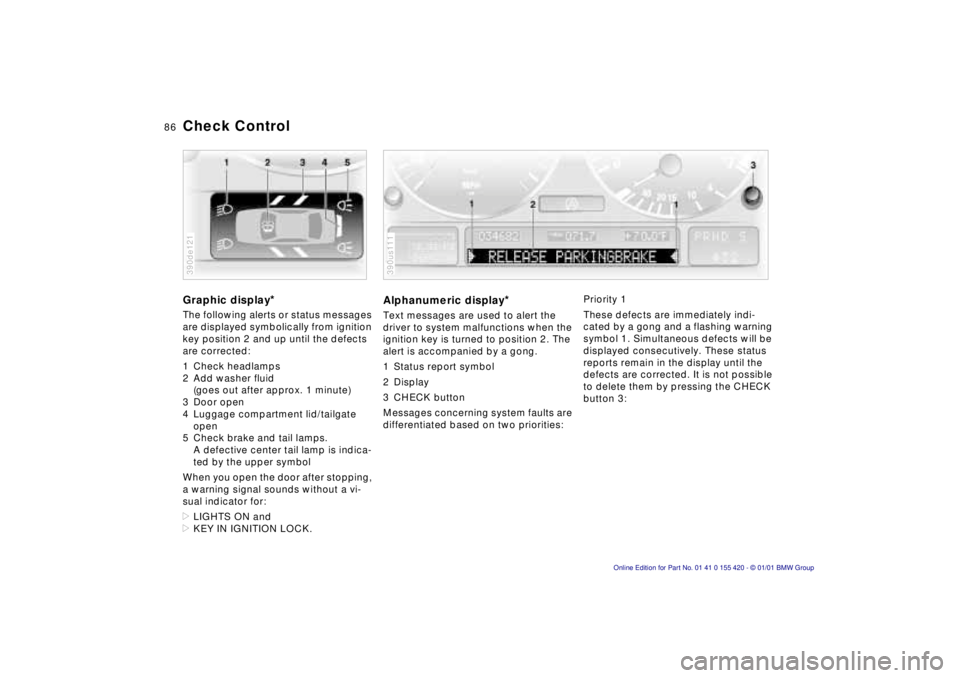
The following alerts or status messages
are displayed symbolically from ignition
key position 2 and up until the defects
are corrected:
1 Check headlamps
2 Add washer fluid
(goes out after approx. 1 minute)
3 Door open
4 Luggage compartment lid/tailgate
open
5 Check brake and tail lamps.
A defective center tail lamp is indica-
ted by the upper symbol
When you open the door after stopping,
a warning signal sounds without a vi-
sual indicator for:
>LIGHTS ON and
>KEY IN IGNITION LOCK.390de121
Alphanumeric display
*
Text messages are used to alert the
driver to system malfunctions when the
ignition key is turned to position 2. The
alert is accompanied by a gong.
1 Status report symbol
2 Display
3 CHECK button
Messages concerning system faults are
differentiated based on two priorities:390us111
Priority 1
These defects are immediately indi-
cated by a gong and a flashing warning
symbol 1. Simultaneous defects will be
displayed consecutively. These status
reports remain in the display until the
defects are corrected. It is not possible
to delete them by pressing the CHECK
button 3:
Page 87 of 238

IndexDataTechnologyRepairsCar careControlsOverview
87n
Check Control>RELEASE PARKINGBRAKE
>COOLANT TEMPERATURE
The coolant is overheated. Stop the
vehicle immediately and switch off
the engine. Refer to pages 85
and 16 7.
>STOP!ENGINE OILPRESS
The oil pressure is too low. Stop the
vehicle immediately and switch off
the engine. Refer to page 22.
>CHECK BRAKE FLUID
Indicates that brake fluid is down to
roughly minimum level. Top up the
brake fluid at the next opportunity.
Refer to page 168. Have the source
of the brake fluid loss diagnosed and
corrected by your BMW center.
>TIRE DEFECT
*
Reduce vehicle speed immediately
and stop the vehicle. Avoid hard
brake applications. Do not oversteer.
Refer to page 104.
>SELFLEVEL SUSP.INACT
Please consult the nearest authorized
BMW center. Refer to page 148.
>SPEED LIMIT
*
Display if the programmed speed
limit has been exceeded.Priority 2
These displays appear for 20 seconds
when the ignition key is turned to posi-
tion 2. The warning symbols remain
after the message disappears. You can
display the messages again by pressing
the CHECK button 3:
>TRUNKLID OPEN
Message appears only when the
vehicle is initially set in motion.
>DOOR OPEN
This message appears after a mini-
mal defined road speed has been ex-
ceeded.
>FASTEN SEAT BELTS
*
In addition to this message, a
warning lamp with the safety belt icon
appears and an acoustical signal
sounds.
>WASHER FLUID LOW
Too low; top up fluid at the next
opportunity. Refer to page 164.
>CHECK ENGINE OIL LEV
The oil level is at the absolute mini-
mum, and therefore engine oil should
be added as soon as possible. Refer
to page 165. Until then, do not drive
more than approx. 30 miles (50 km)>CHECK FILLER CAP
Check that the filler cap is closed
correctly, refer to page 28. A loose or
missing cap will activate the message
"CHECK FILLER CAP" in the Check
Control
* or the Service Engine Soon
lamp.
>OUTSIDE TEMP. +207 (–56)
This display is only an example. The
current temperature is displayed at
outside temperatures of +37.57
(+36) and below. Refer also to
page 83.
>SET TIRE PRESSURE
*
The RDC has imported the current in-
flation pressure in the tires as the tar-
get values which the system will
monitor. Refer to page 103.
>CHECK TIRE PRESSURE
*
Check and correct the tire inflation
pressure to specifications at the earli-
est opportunity (next stop for fuel).
Refer to page 104.
>TIRECONTROL INACTIVE
*
A temporary interference of the RDC
or a system fault. Refer to page 104.
>CHECK BRAKE LIGHTS
A lamp has failed or the electrical cir-
cuit has a fault. Refer to pages 186
and 196 or consult a BMW center.
Page 88 of 238

88n
Check Control>CHECK LOWBEAM LIGHTS
CHECK SIDE LIGHTS
CHECK REAR LIGHTS
CHECK FRONT FOGLAMPS
CHECK LICPLATE LIGHT
CHECK HIGHBEAM LIGHTS
CHECK BACK UP LIGHTS
Defective bulb or circuit. Refer to
pages 183 and 196 or consult your
BMW center.
>TRANS. FAILSAFE PROG
Please consult the nearest BMW
center. Refer to pages 74, 77.
>CHECK BRAKE LININGS
Have the brake pads inspected by
your BMW center. Refer to page 146.
>CHECK COOLANT LEVEL
Coolant too low, top up at the next
opportunity. Refer to page 167.
>ENGINE FAILSAFE PROG
*
The electronics allow for continued
driving with reduced engine output or
rpms.
Please have the system inspected by
your BMW center.
Displays after completion of tripAll of the malfunctions registered during
the trip appear consecutively when the
key is turned to position 0.
One of the following displays may ap-
pear:
>LIGHTS ON
>KEY IN IGNITION LOCK
>CHECK ENGINE OIL LEV
Add engine oil at the next opportunity
(next stop for fuel). Refer to page 16 5.
Display appears when you open the
driver's door after parking the vehicle.
A supplementary gong is also heard.
Status reports remain available for a
period of approx. three minutes after
the display goes out and the key is re-
moved from the ignition. Press the
CHECK button. If there were multiple
reports, press the CHECK button re-
peatedly to view them all in sequence.
To check the Check ControlPress the CHECK button 3 with the
ignition key in position 2:
CHECK CONTROL OK appears in the
display.
No malfunctions are present in the
monitored systems.
You can have the Check Control
messages displayed in a different
language.<
Page 104 of 238

104n
Tire Pressure Control (RDC)
*
Loss of tire pressureIf, after a certain period of time, the air
pressure has gone down significantly
(which is normal for any tire), the yellow
indicator lamp comes on or the mes-
sage "CHECK TIRE PRESSURE" ap-
pears in the Check Control.
This alerts you that you should have the
tires inflated to the specified pressures
as soon as possible.
If you are prompted to check the
tire pressure shortly after a cor-
rection has been made, this indicates
that the corrected values were not ac-
curate. Please check the inflation pres-
sure again and make corrections ac-
cording to the inflation pressure table.<
Flat tireIf there is a tire failure with a loss of air
pressure, the red indicator lamp comes
on or the message "TIRE DEFECT" ap-
pears in the Check Control. In addition,
a gong sounds.
If this occurs, reduce vehicle speed im-
mediately and stop the vehicle in a safe
location. Avoid hard brake applications.
Do not oversteer. Replace the flat tire.
The spare tire which is available in
your vehicle as standard equip-
ment is equipped with the electronics
required for RDC and, following activa-
tion of the system, is also monitored af-
ter it is mounted.<
The RDC cannot alert you to se-
vere and sudden tire damage
caused by external factors.<
Have the tires changed by your
authorized BMW center.
Your BMW center has the information
needed for working with RDC and is
equipped with the necessary special
tools.<
System interferenceDuring the period of the malfunction,
the yellow indicator lamp comes on
or the message "TIRECONTROL
INACTIVE" appears in the Check
Control.
You will also see the same message
>in the event of a system fault
>if a wheel is mounted without the
RDC electronics
>if, in addition to the spare tire,
additional wheels with RDC
electronics are on board.
Please contact your BMW center for
additional information.
Page 139 of 238
Index
Data
Technology
Repairs
Car care
Controls
Overview
Overview
Controls and features Operation, care
and maintenance
Owner service procedures
Technical dataIndex
Advanced technology
139
n
Special operating instructions:
Break-in procedure 140
Driving notes 141
Catalytic converter 142
Antilock Brake System (ABS) 143
Disc brakes 144
Brake system 146
Winter operation 146
Power steering 148
Level control system 148
Cellular phone 149
Radio reception 149
Wheels and tires:
Tire inflation pressure 150
Tire condition 150
Tire replacement 151
Tire rotation 152
Wheel and tire combinations 153
Winter tires 154
Snow chains 155
Approved wheel and tire specifications 156 Under the hood:
Hood
159
Engine compartment 160
Washer fluids 164
Washer nozzles 164
Engine oil 165
Coolant 167
Brake fluid 168
Vehicle Identification Number 169
Care and maintenance:
The BMW Maintenance System 170
Caring for your car 171
Airbags 176
Vehicle storage 176
Laws and regulations:
Technical modifications 177
California Proposition 65 Warning 177
OBD interface socket 178
Page 140 of 238

140nBreak-in procedure
To ensure that your vehicle provides
maximum economy throughout a long
service life, we request that you ob-
serve the following.
Engine and differential
Up to 1,200 miles (2,000 km):
Drive at varying engine speeds and
road speeds, but do not exceed
4,500 rpm and the following road
speeds during this initial period:
BMW 525i, 530i: 100 mph (160 km/h)
BMW 540i: 106 mph (170 km/h)
Obey your local and state maximum
speed limits.
Refrain from using full throttle and avoid
pressing the accelerator beyond the
kickdown point.
Once you have driven 1,200 miles
(2,000 km), engine and vehicle speeds
can gradually be increased.
You should also comply with these
break-in procedures if the engine or dif-
ferential is replaced later in the course
of the vehicle service life.
Tires
Due to technical factors associated
with their manufacture, tires do not
achieve their full traction potential until
an initial break-in period has elapsed
for this reason, drive with extra care
during the initial 200 miles (300 km).
Obey your local and state maximum
speed limits.
When the vehicle is operated on
wet or slushy roads, a wedge of
water may form between the tire and
the road surface. This phenomenon is
referred to as aquaplaning, or hydro-
planing, and can lead to partial or com-
plete loss of traction, vehicle control
and braking effectiveness. Reduce your
speed on wet roads. <
Brake system
Approximately 300 miles (500 km) must
elapse before the brake pads and ro-
tors achieve the optimal pad-surface
and wear patterns required for trouble-
free operation and long service life later
on.
To break in the separate parking brake
drums, apply the parking brake lightly
when coasting to a standstill (at a traffic
signal, for instance), provided that traf-
fic conditions allow you to do so. To
avoid corrosion, repeat this procedure
from time to time.
The brake lamps do not come on
when the parking brake is applied.
Vacuum for the brake system servo unit
on your BMW is available only when the
engine is running. When you move the
car with the engine shut off – when
towing, for instance – substantially
higher levels of pedal force will be
required to brake the vehicle. <
Clutch
The clutch will also begin to function
optimally after about 300 miles
(500 km). Engage the gears carefully
during the break-in period.
Page 141 of 238

Index
Data
Technology
Repairs
Car care
Controls
Overview
141nDriving notes
Brakes:
Do not drive with your foot resting
on the brake pedal. Even light but con-
sistent pedal pressure can lead to high
temperatures, brake wear and possibly
even brake failure.
Aquaplaning:
When driving on wet or slushy roads,
reduce road speed. If you do not, a
wedge of water can form between tires
and road surface. This phenomenon is
referred to as aquaplaning or hydro-
planing. It is characterized by a partial
or complete loss of contact between
the tires and the road surface. The ulti-
mate results are loss of steering and
braking control.
Driving through water:
Do not drive through water more than
1 ft (30 cm) deep. Drive only at walking
speed. Driving at a faster speed could
cause damage to the engine, the elec-
trical system and the transmission.Rear parcel tray:
Do not use the rear parcel tray to store
heavy or bulky objects. They could
pose a danger to the occupants during
braking, evasive maneuvers, or in an
accident.
Clothes hooks:
Hang items of clothing from the hooks
so that they will not obstruct the driver's
vision. Do not hang any heavy objects
on the hooks, as otherwise passengers
could be injured, e.g. during any hard
braking or evasive maneuvers, or dur-
ing an accident. <
Page 143 of 238

Index
Data
Technology
Repairs
Car care
Controls
Overview
143nAntilock Brake System (ABS)
The concept
ABS enhances active safety by helping
to prevent the wheels from locking un-
der braking. The reason: locked wheels
are dangerous, because the vehicle
cannot be steered when the front
wheels slip, and loss of traction at the
rear wheels can cause the rear end to
break into an uncontrolled skid.
ABS is designed to meet two essential
requirements during every brake appli-
cation:
>To help provide vehicle stability.
> To help retain steering and maneu-
vering capability on all types of road
surface (asphalt, concrete, dirt,
moisture, snow and ice).
With ABS, the shortest possible braking
distances are achieved under most
conditions (on straight-aways and in
curves, with different road surfaces).
Braking with ABS
The system becomes operative once
the vehicle exceeds a speed of approx.
6 mph (10 km/h). The ABS is deacti-
vated whenever the vehicle's speed
drops back below approx. 4 mph
(6 km/h). This means that the wheels
can lock in the final phase of a brake
application – a factor of no significance
in actual use.
The ABS system works best in situa-
tions requiring maximum pressure on
the pedal (full braking). Since the vehi-
cle maintains steering responsiveness,
you can nevertheless avoid possible
obstacles with a minimum of steering
effort.
The ABS closed-loop control circuit cy-
cles in fractions of a second. A pulsing
of the brake pedal, combined with the
sounds associated with the hydraulic
controls, tells you that the brake system
is within its maximum limit range and
reminds you that you should adapt your
vehicle's speed to road conditions. On road surfaces which have a loose
layer on a firm base (on gravel or snow,
for instance), the braking distances with
ABS may be longer than with the
wheels locked. This also applies to
driving with snow chains. However,
ABS continues to provide enhanced
vehicle stability and steering response
under these conditions.
Page 144 of 238

144nAntilock Brake System (ABS) Disc brakes
Information for your safety
Not even ABS can suspend the laws of
physics. The consequences of brake
applications with inadequate safety
clearances between vehicles, exces-
sive speed or if aquaplaning occurs are
always the responsibility of the driver.
You should never allow the added
safety margin of ABS to mislead you
into taking risks of any kind.
Do not make any modifications to
the ABS system.
Service procedures on ABS are to be
performed by authorized technicians
only. <
In the event of a fault
The ABS warning lamp in the in-
strument cluster comes on, refer
to page 23. The brake system
then reverts to conventional op-
eration as on vehicles without
ABS. However, have the brake
system checked by your BMW center
as soon as possible. To prevent unde-
tected defects and cumulative faults
from adversely affecting the brake sys-
tem, refer any problems to your BMW
center at the earliest opportunity.
Disc brakes furnish optimum decelera-
tion and braking control and greater
fade resistance under heavy use.
When the vehicle is driven only occa-
sionally, during extended periods when
the vehicle is not used at all, and in
operating conditions where brake appli-
cations are less frequent, there is an
increased tendency for corrosion of the
rotors and accumulation of contamina-
tion on the brake pads. This occurs
because the minimal pressure which
must be exerted by the pads during
brake applications to clean the rotors is
not reached.
If the brake rotors are corroded, they
will tend to respond to braking with a
pulsating effect which even extended
application will fail to cure.
For your own safety: use only
brake pads that BMW has
approved for your specific vehicle
model. BMW cannot evaluate non-
approved brake pads to determine if
they are suited for use, and therefore
cannot ensure the operating safety of
the vehicle if they are installed. <
Page 145 of 238

Index
Data
Technology
Repairs
Car care
Controls
Overview
145nDisc brakes
Driving notes
When driving in wet conditions and in
heavy rain, it is effective to apply light
pressure to the brake pedal every few
miles (kilometers). Watch traffic condi-
tions to ensure that this maneuver does
not endanger other road users. The
heat which is generated by the brake
applications helps to dry the brake
pads and rotors.
Maximum braking force is obtained
while the wheels continue to rotate,
peaking when the wheels remain on the
verge of locking without actually doing
so. ABS maintains this state automati-
cally. If the ABS fails, you should revert
to the staggered braking technique
described below (refer to page 147).
Extended or steep mountain descents
should be driven in the gear in which
only minimal periodic brake applica-
tions is required. This avoids excessive
strain on the brakes and possible im-
pairment of the braking effect.
The braking effect of the engine can be
further increased by downshifting, into
first gear, if necessary. In the manual
mode of the automatic transmission,
you can also downshift into first gear.
Refer to page 76. Should engine braking prove inade-
quate, you should still avoid extended,
continuous braking. Instead of main-
taining low to moderate pressure over
an extended period of time, you should
decelerate by applying more substantial
pressure to the brake pedal (watch for
following traffic!), then releasing the
pedal, then repeating the application.
This staggered braking technique
allows the brakes to cool in the intervals
between active braking phases,
preventing overheating and ensuring
that full braking capacity remains avail-
able at all times.
Do not coast with the clutch de-
pressed or with the transmission
or selector lever in Neutral. Do not
coast with the engine shut off. The
engine provides no braking effect when
the clutch is depressed or the transmis-
sion is in neutral, and there is no
power-assist for braking or steering
when the engine is not running.
Never allow floor mats, carpets or any
other objects to protrude into the area
around the accelerator, clutch and
brake pedals and obstruct their move-
ment. <
Dynamic Brake Control (DBC)*
If you apply the brakes rapidly, this
system automatically produces the
maximum braking force boost and thus
helps to achieve the shortest possible
braking distance during "panic stops."
All of the benefits of the ABS system
are exploited under these circum-
stances.
Do not reduce the pressure on the
brake pedal for the duration of the
brake application. When the brake
pedal is released, the DBC is deacti-
vated.
In the event of a malfunction, the yellow
warning lamp comes on. Conventional
braking efficiency is available without
limitations.
Have the system checked and repaired
at your BMW center as soon as possi-
ble.
For "Information for your safety"
covering the ABS system, refer to
page 144. This information also gener-
ally applies for DBC. <