brake BMW SPORT WAGON 2001 Owner's Guide
[x] Cancel search | Manufacturer: BMW, Model Year: 2001, Model line: SPORT WAGON, Model: BMW SPORT WAGON 2001Pages: 238, PDF Size: 2.44 MB
Page 146 of 238
146nBrake system Winter operation
Brake fluid level
The warning lamp for the brake
hydraulic system comes on, or
the "CHECK BRAKE FLUID"
message appears in the Check
Control.
The brake fluid level is too low in the
reservoir (refer to page 168).
If the brake fluid level is too low and
brake pedal travel has become notice-
ably longer, there may be a defect in
one of the brake system's hydraulic
circuits.
Proceed to the nearest BMW
center. Higher brake application
pressure may be necessary under these
conditions, and brake pedal travel may
be significantly longer. Please remem-
ber to adapt your driving style accord-
ingly. <
The warning lamp comes on together
with the "CHECK BRAKE PADS" mes-
sage in the Check Control.
Brake pads
The warning lamp for the brake
pads comes on, or the "CHECK
BRAKE LININGS" message
appears in the Check Control:
The brake pads have reached their
minimum pad thickness. Proceed to the
nearest BMW center as soon as possi-
ble to have the pads replaced.
For your own safety: use only
brake pads that BMW has
approved for your specific vehicle
model. BMW cannot evaluate non-
approved brake pads to determine if
they are suited for use, and therefore
cannot ensure the operating safety of
the vehicle if they are installed. <
The onset of winter is often accompa-
nied by rapid changes in weather.
Adaptations in driving style should be
accompanied by preparations on the
vehicle itself to ensure that your vehicle
operation through the winter remains
safe and trouble-free.
Coolant
Ensure that the coolant mixture con-
tains the year-round ratio of 50: 50 of
water and antifreeze/corrosion inhibitor.
This mixture provides protection
against freezing down to approx. -34 7
(-37 6). Replace the coolant every four
years.
Locks
BMW door lock deicer can be used to
free the locks if they are frozen. This
deicer also contains lubricant.
After using deicer, treatment with BMW
lock barrel grease is recommended.
Page 147 of 238

Index
Data
Technology
Repairs
Car care
Controls
Overview
147nWinter operation
Rubber seals and components
In order to prevent the weather-strip-
ping from freezing, apply BMW rubber
treatment or silicone spray to the seals
on the doors, hood and luggage com-
partment lid/tailgate.
A full range of car-care products is
available from your BMW center. <
Snow chains
BMW snow chains* can be mounted on
both summer and winter tires. Mount
them in pairs on the rear wheels only
and comply with the manufacturer's
safety precautions. Do not exceed a
maximum speed of 30 mph (50 km/h).
For maximum traction, we recommend
that you manually deactivate the
ASC+T/DSC
* when driving with snow
chains mounted. Refer to page 102.
Starting off
We recommend that you use the
manual control switch to deactivate
ASC+T/ DSC
* when starting off in deep
snow or when rocking the car to free it
(refer to page 102).
Driving on low-traction road
surfaces
Use smooth, gentle pressure to control
the accelerator pedal. Avoid excessive
engine speeds and shift to the next
higher gear at an early point. Adapt
your speed and driving style when ap-
proaching grades or slopes. Maintain
an adequate distance between yourself
and the vehicle ahead.
Brakes
Winter road conditions substantially
reduce the amount of traction available
between the tires and the road surface.
The resulting increases in braking dis-
tance are considerable and should be
kept in mind at all times.
ABS is intended to prevent the wheels
from locking during brake applications,
thus helping to maintain vehicle stability
and steering response. If the ABS does not respond in a critical
braking situation and the wheels lock:
reduce the pressure on the brake pedal
until the wheels just start to roll again
while still maintaining enough force to
continue braking.
Following that, increase pedal pressure
again. Reduce the pressure as the
wheels lock, then reapply pressure.
Repeat this procedure.
This type of staggered braking will
reduce the braking distance, and the
vehicle still remains responsive to
steering.
You can then attempt to steer around
hazards after you have reduced pres-
sure on the brake pedal.
Do not shift down on slick road
surfaces. Doing so could cause
the rear wheels to lose traction and
skid, which could result in the loss of
vehicle control. <
Depress the clutch during hard
braking on road surfaces which
provide only poor or uneven traction. <
Page 148 of 238

148nWinter operation Power steering Level control system*
Skid control
Release the accelerator pedal and
depress the clutch pedal. Countersteer
carefully and attempt to regain control
of the vehicle.
Parking
Engage 1st or reverse gear. If your
vehicle is equipped with an automatic
transmission, place the selector lever in
"Park." On vehicles with manual trans-
mission, also apply the parking brake
when parking on inclined surfaces. In
order to prevent the parking brake pads
from locking due to frost or corrosion,
dry them by gently applying the parking
brake as the vehicle is coming to a
stop. Make sure that following traffic is
not endangered.
The brake lamps do not come on
when the parking brake is
applied. <
If there is a change in steering behavior,
for instance greater steering effort or if
steering becomes lighter as speed
increases in vehicles equipped with
Servotronic
*:
Contact your BMW center for an
inspection.
If the power steering fails,
increased effort will be required
to steer the vehicle. <
The warning lamp for the level
control system comes on, or the
message "LEVEL CONTROL
INACTIVE" appears in the Check
Control
*: there is a malfunction in the
level control system.
Stop and inspect the vehicle. If it is
riding significantly lower in the rear than
in the front, or if it is sitting at an incline
(left rear compared to right rear),
consult the nearest authorized BMW
center. Drive with appropriate caution
in the meantime. The vehicle has
reduced ground clearance or driving
comfort is noticeably reduced.
Even if the attitude of the vehicle is
normal, you should consult the nearest
BMW center if the warning lamp indi-
cates a system fault.
Page 161 of 238

Index
Data
Technology
Repairs
Car care
Controls
Overview
161n
1 Auxiliary terminal for jump starting 200
2 Reservoir for brake fluid (under the housing of the microfilter) 168
3 Engine oil dipstick 165
4 Coolant expansion tank 167
5 Engine oil filler neck 165
6 Reservoir for intensive-cleaning system
*164
7 Reservoir for windshield and headlamp washer system
*164
Engine compartment – BMW 525i, 530i
Page 163 of 238

Index
Data
Technology
Repairs
Car care
Controls
Overview
163nEngine compartment – BMW 540i
1 Reservoir for brake fluid (under the
housing of the microfilter) 168
2 Auxiliary terminal for jump starting 200
3 Engine oil dipstick 165
4 Engine oil filler neck 165
5 Coolant expansion tank 167
6 Reservoir for intensive-cleaning system
*164
7 Reservoir for headlamp washer
* and
windshield washer system 164
Page 168 of 238
168nCoolant Brake fluid
Adding coolant
Wait until the engine cools before
removing the cap from the expansion
tank. The needle of the coolant temper-
ature gauge in the instrument cluster
must be located in the blue zone; other-
wise, there is a danger of scalding.
1 Start by turning the cap counter-
clockwise. Pause to allow any
accumulated pressure to escape,
then open.
2 If the coolant is low, slowly add coolant until the correct level is
reached – do not overfill.
The coolant is a mixture of water and
extended-duty antifreeze with corrosion
inhibitor. Always maintain the pre-
scribed all-season 50:50 mixture ratio
for year-round protection against inter-
nal corrosion. No other additives are re-
quired.
Replace the coolant every four years.
If the indicator lamp for the
brake hydraulic system comes
on or if the "CHECK BRAKE
FLUID" warning appears in the
Check Control
*: the brake fluid
level is too low in the reservoir.
The brake fluid reservoir is located
under the microfilter housing on the
driver's side of the car. Should you de-
termine that the brake fluid is low, refer
the problem to your BMW center, who
can trace and rectify any sources of
leakage when refilling the reservoir.
Your BMW center is familiar with the
specifications for approved brake
fluids (DOT 4).
Brake fluid loss results in extended
pedal travel. For this situation, refer to
the notes on page 146.
Brake fluid is hygroscopic, that is,
it absorbs moisture from the air
over time.
In order to ensure the safety and
reliability of the brake system, have
the brake fluid changed every two years
by an BMW center. Refer also to the
Service and Warranty Information
Booklet (US models) or to the Warranty
and Service Guide Booklet (Canadian
models).
Brake fluid is toxic and damages the
vehicle's paint. You should always store
it in its original container and in a loca-
tion which is out of reach of children.
Do not spill the fluid and do not fill the
brake fluid reservoir beyond the "MAX"
mark. The brake fluid could ignite upon
contact with hot engine parts and
cause serious burns. <
Comply with the applicable
environmental laws regulating the
disposal of brake fluid. <
Page 171 of 238

Index
Data
Technology
Repairs
Car care
Controls
Overview
171nCaring for your car
Washing your car
You can have your new BMW washed
in an automatic car wash. Car wash
systems that do not employ brushes
are preferable.
Wipe away tough dirt and loosen and
remove dead insects before washing
the vehicle.
To prevent spots, avoid washing when
the hood is still warm, or immediately
after and during exposure to strong
sunlight.
When using an automatic car wash, be
sure that:
>The car wash system is suited for the
dimensions of your vehicle.
> No damage will occur on vehicles
with attached body accessories (such
as spoilers or antennas). If you are
uncertain, consult the manager of the
car wash.
> The wheels and tires of your vehicle
cannot be damaged by the convey-
ance devices of the car wash system.
> The vehicle is cleaned with minimum
brush pressure, and that ample water
is available for washing and rinsing. Vehicles with rain sensor
*:
Clean the windshield regularly. Wax
from automatic car washes or insects,
for example, can cause malfunctions in
the function of the rain sensor.
Turn the rain sensor off in auto-
matic car washes. If you do not,
damage may occur if the wipers switch
on unintentionally. <
Parts of the vehicle which are inacces-
sible to the automatic washer – such as
door sills, door and hood edges, etc. –
should be cleaned by hand.
In the winter months, it is especially im-
portant to ensure that the vehicle is
washed on a regular basis. Large quan-
tities of dirt and road salt are difficult to
remove, and they also cause damage to
the vehicle. If spray wands or high-pressure
washers are used, be sure to
maintain an adequate distance between
the spray source and the vehicle's sur-
face. Inadequate distance and exces-
sive pressure can damage or weaken
the finish, making it more susceptible to
subsequent attack. In addition, mois-
ture could penetrate to vehicle compo-
nents, leading to long-term damage. < When cleaning the headlamps,
please observe the following:
> Do not wipe dry (scratches). Never
use abrasives or strong
solvents to clean the covers
> Remove dirt and contamination (such
as insects) by soaking with BMW Car
Shampoo and then rinsing with plenty
of water
> Always use a deicer spray to remove
accumulated ice and snow – never
use an ice scraper. <
After washing the car, apply the
brakes briefly to dry them. Braking
efficiency might otherwise be reduced
by the moisture, and the brake rotors
could also be corroded. <
Page 173 of 238

Index
Data
Technology
Repairs
Car care
Controls
Overview
173nCaring for your car
Caring for the vehicle finish
Regular washing is a preventive mea-
sure against long-term effects from
substances that are harmful to the vehi-
cle's finish, especially if you drive your
vehicle in areas with high levels of air
pollution or aggressive natural sub-
stances (tree resins, pollen).
Nevertheless, you should immediately
remove especially aggressive sub-
stances. Failure to do so can lead to
changes in the paint's chemical struc-
ture or to discoloration. Gasoline spilled
during refueling, oil, grease and brake
fluid should always be cleaned away
immediately, as should bird droppings
(finish damage).
Any contamination remaining on the
surface of the vehicle will be especially
conspicuous after washing. Use clean-
ing fluid or alcohol with a clean cloth or
cotton pad to remove. Remove tar
spots with tar remover. After cleaning,
the affected areas should be waxed to
ensure continued protection.
Use cleaning and car-care
products that you can obtain
at your BMW center. <
Waxing your car
Protect the finish using carnauba or
synthetic-based waxes only.
The best way to determine when the
finish needs to be waxed is by noting
when water stops beading on the sur-
face.
You can use a glass cleaner to remove
any wax or silicone that may have been
left on the windows during waxing.
Use cleaning and car-care
products that you can obtain
at your BMW center. <
Paint damage
You can touch up small areas of dam-
age with BMW spray paint or a BMW
touch-up stick.
The paint color code for your vehicle is
provided on a sticker located on the
right hand side under the hood and on
the first page of your Service and War-
ranty Information Booklet.
Damage caused by flying stones,
scratches, etc., must be touched up
without delay to prevent rust from form-
ing.
If corrosion has started to form in an
area with paint damage, remove all rust
and clean the area. Then prime the area
with a BMW Primer Stick. Finally, apply
the finish coat. After a few days, polish
and protect the touched-in areas.
More extensive paint damage should
be repaired professionally in accor-
dance with the manufacturer's instruc-
tions. Your BMW center uses original
BMW finish materials in accordance
with approved repair procedures.
Page 186 of 238
186nLamps and bulbs
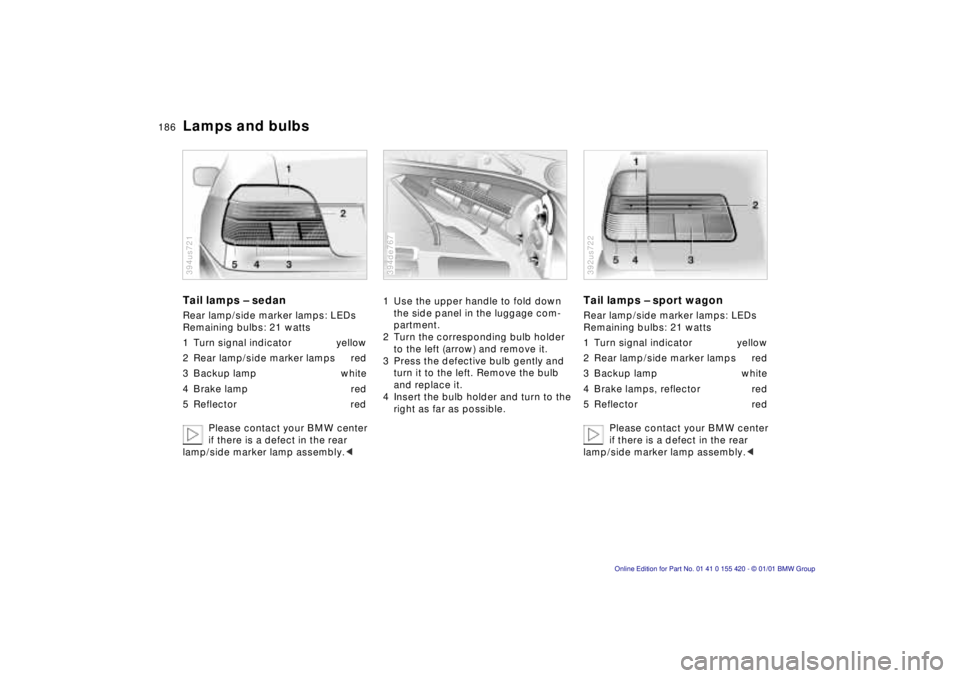
Tail lamps – sedan
Rear lamp/side marker lamps: LEDs
Remaining bulbs: 21 watts
1 Turn signal indicator yellow
2 Rear lamp/side marker lamps red
3 Backup lamp white
4 Brake lamp red
5 Reflector red
Please contact your BMW center
if there is a defect in the rear
lamp/side marker lamp assembly. <
394us721
1 Use the upper handle to fold down
the side panel in the luggage com-
partment.
2 Turn the corresponding bulb holder to the left (arrow) and remove it.
3 Press the defective bulb gently and turn it to the left. Remove the bulb
and replace it.
4 Insert the bulb holder and turn to the right as far as possible.
394de767
Tail lamps – sport wagon
Rear lamp/side marker lamps: LEDs
Remaining bulbs: 21 watts
1 Turn signal indicator yellow
2 Rear lamp/side marker lamps red
3 Backup lamp white
4 Brake lamps, reflector red
5 Reflector red
Please contact your BMW center
if there is a defect in the rear
lamp/side marker lamp assembly. <
392us722
Page 187 of 238
Index
Data
Technology
Repairs
Car care
Controls
Overview
187nLamps and bulbs
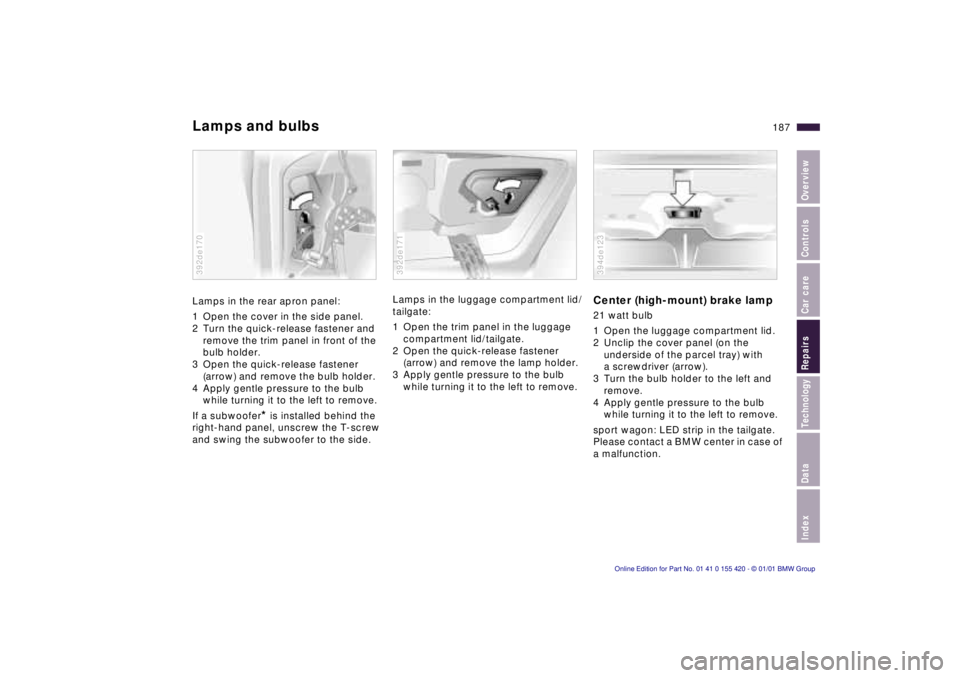
Lamps in the rear apron panel:
1 Open the cover in the side panel.
2 Turn the quick-release fastener and
remove the trim panel in front of the
bulb holder.
3 Open the quick-release fastener (arrow) and remove the bulb holder.
4 Apply gentle pressure to the bulb while turning it to the left to remove.
If a subwoofer
* is installed behind the
right-hand panel, unscrew the T-screw
and swing the subwoofer to the side.
392de170
Lamps in the luggage compartment lid/
tailgate:
1 Open the trim panel in the luggage compartment lid/tailgate.
2 Open the quick-release fastener (arrow) and remove the lamp holder.
3 Apply gentle pressure to the bulb while turning it to the left to remove.
392de171
Center (high-mount) brake lamp
21 watt bulb
1 Open the luggage compartment lid.
2 Unclip the cover panel (on the underside of the parcel tray) with
a screwdriver (arrow).
3 Turn the bulb holder to the left and remove.
4 Apply gentle pressure to the bulb while turning it to the left to remove.
sport wagon: LED strip in the tailgate.
Please contact a BMW center in case of
a malfunction.
394de123