tow BMW X3 2.5I 2004 E83 User Guide
[x] Cancel search | Manufacturer: BMW, Model Year: 2004, Model line: X3 2.5I, Model: BMW X3 2.5I 2004 E83Pages: 132, PDF Size: 3.62 MB
Page 73 of 132
Reference
At a glance
Controls
Driving tips
Mobility
71
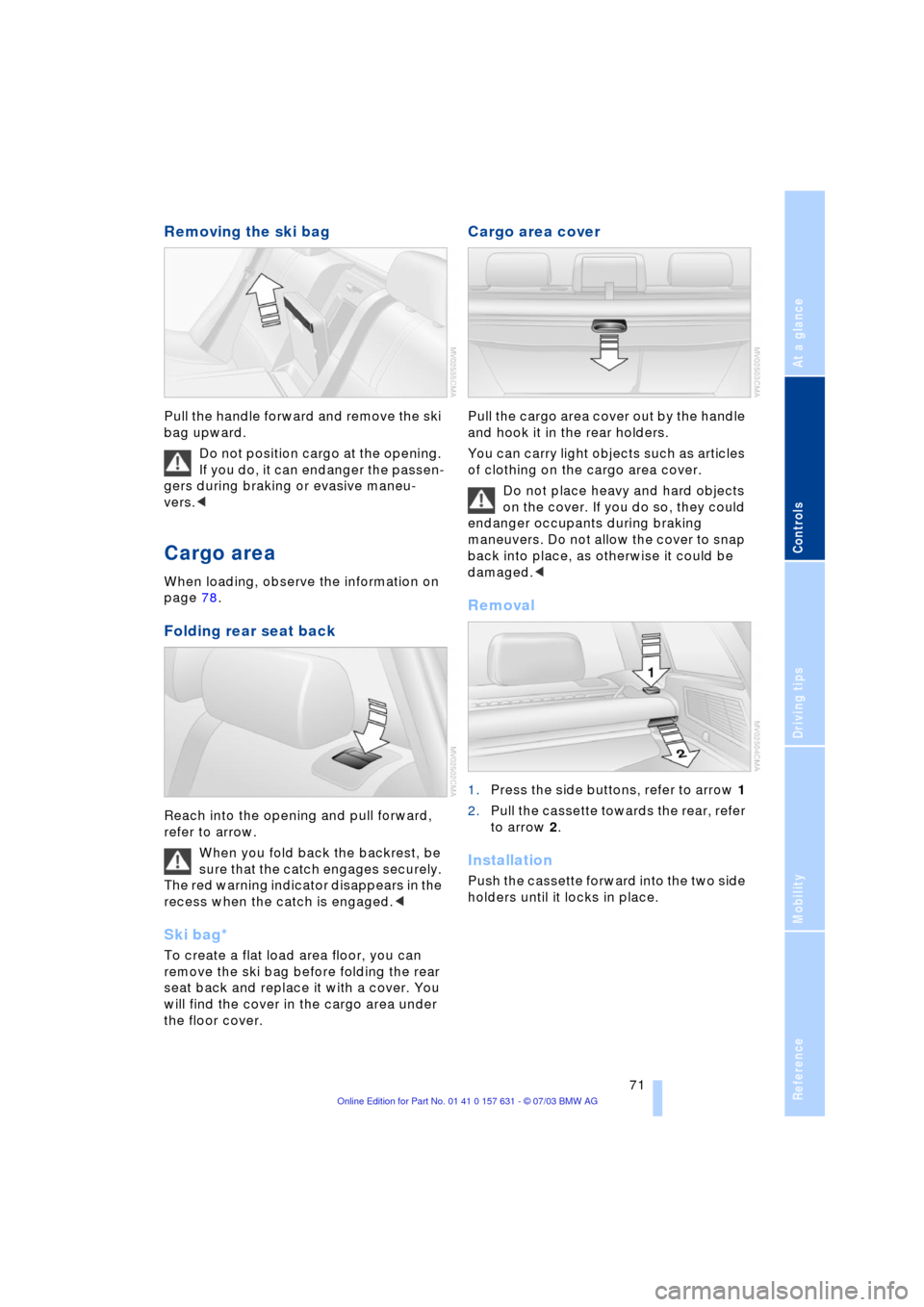
Removing the ski bag
Pull the handle forward and remove the ski
bag upward.
Do not position cargo at the opening.
If you do, it can endanger the passen-
gers during braking or evasive maneu-
vers.<
Cargo area
When loading, observe the information on
page 78.
Folding rear seat back
Reach into the opening and pull forward,
refer to arrow.
When you fold back the backrest, be
sure that the catch engages securely.
The red warning indicator disappears in the
recess when the catch is engaged.<
Ski bag*
To create a flat load area floor, you can
remove the ski bag before folding the rear
seat back and replace it with a cover. You
will find the cover in the cargo area under
the floor cover.
Cargo area cover
Pull the cargo area cover out by the handle
and hook it in the rear holders.
You can carry light objects such as articles
of clothing on the cargo area cover.
Do not place heavy and hard objects
on the cover. If you do so, they could
endanger occupants during braking
maneuvers. Do not allow the cover to snap
back into place, as otherwise it could be
damaged.<
Removal
1.Press the side buttons, refer to arrow 1
2.Pull the cassette towards the rear, refer
to arrow 2.
Installation
Push the cassette forward into the two side
holders until it locks in place.
Page 78 of 132
Things to remember when driving
76
Things to remember when driving
Break-in procedures
To ensure that your vehicle provides maxi-
mum economy throughout a long service
life, we request that you observe the fol-
lowing instructions:
Engine and differential
Up to 1,200 miles/2,000 km:
During this initial period you should attempt
to avoid constant, steady-state operation
and vary both vehicle and engine speeds
as often as possible. Until the break-in
period has been completed you should
also refrain from exceeding the following:
>4,500 rpm or 100 mph/160 km/h.
Always obey all official speed limits.
Refrain from using full throttle and avoid
pressing the accelerator beyond the kick-
down point.
Once you have driven 1,200 miles/
2,000 km, the engine and vehicle speeds
can be gradually increased.
You should also comply with these break-in
procedures should the engine or one of the
differentials be replaced later in the course
of the vehicle's service life.
Tires
Due to technical factors associated with
their manufacture, tires do not achieve their
full traction potential until after an initial
break-in period. For this reason, drive with
extra care during the initial 200 miles/
300 km.
Obey your local and state maximum speed
limits.
When the vehicle is operated on wet
or slushy roads, a wedge of water
may form between the tire and the road
surface. This phenomenon is referred to as
hydroplaning and can lead to partial or
complete loss of traction, vehicle control
and braking effectiveness. Reduce your
speed on wet roads.<
Brake system
Approx. 300 miles/500 km must elapse
before the brake pads and rotors achieve
the optimal pad-surface and wear patterns
required for trouble-free operation and
long service life later on.
To break in the separate handbrake drums,
apply the handbrake lightly when coasting
to a standstill Ð at a traffic signal, for
instance; use caution to avoid posing a
danger to other road users.
To avoid corrosion, repeat this procedure
from time to time.
The brake lamps do not come on when the
handbrake is set.
Vacuum for the brake system servo
unit on your BMW is available only
when the engine is running. When you
move the vehicle with the engine off Ð e.g.
by towing Ð substantially higher levels of
pedal force will be required to brake the
vehicle.<
Clutch
The function of the clutch is also only at its
optimized level after a distance driven of
approx. 300 miles/500 km. During this
break-in period, engage the clutch gently.
General driving notes
High temperatures
Extreme temperatures occur at the
catalytic converter on this and every
catalyst-equipped vehicle. Do not remove
the heat shields installed adjacent to vari-
ous sections of the exhaust system, and
never apply undercoating to them. When
driving, standing at idle and while parking
take care to avoid possible contact
between the hot exhaust system and any
highly flammable materials such as hay,
leaves, grass, etc. Such contact could lead
Page 80 of 132
Things to remember when driving
78 less frequent, there is an increased ten-
dency for corrosion to form on rotors, while
contaminants accumulate on the brake
pads. This occurs because the minimal
pressure which must be exerted by the
pads during brake applications to clean the
rotors is not reached.
Should corrosion form on the brake rotors,
the brakes will tend to respond with a pul-
sating effect that even extended applica-
tion will fail to cure.
Cargo loading
To avoid loading the tires beyond
their approved carrying capacity,
never overload the vehicle. Overloading
can lead to overheating and increases the
rate at which damage develops inside the
tires. The ultimate result can assume the
form of a sudden air loss.<
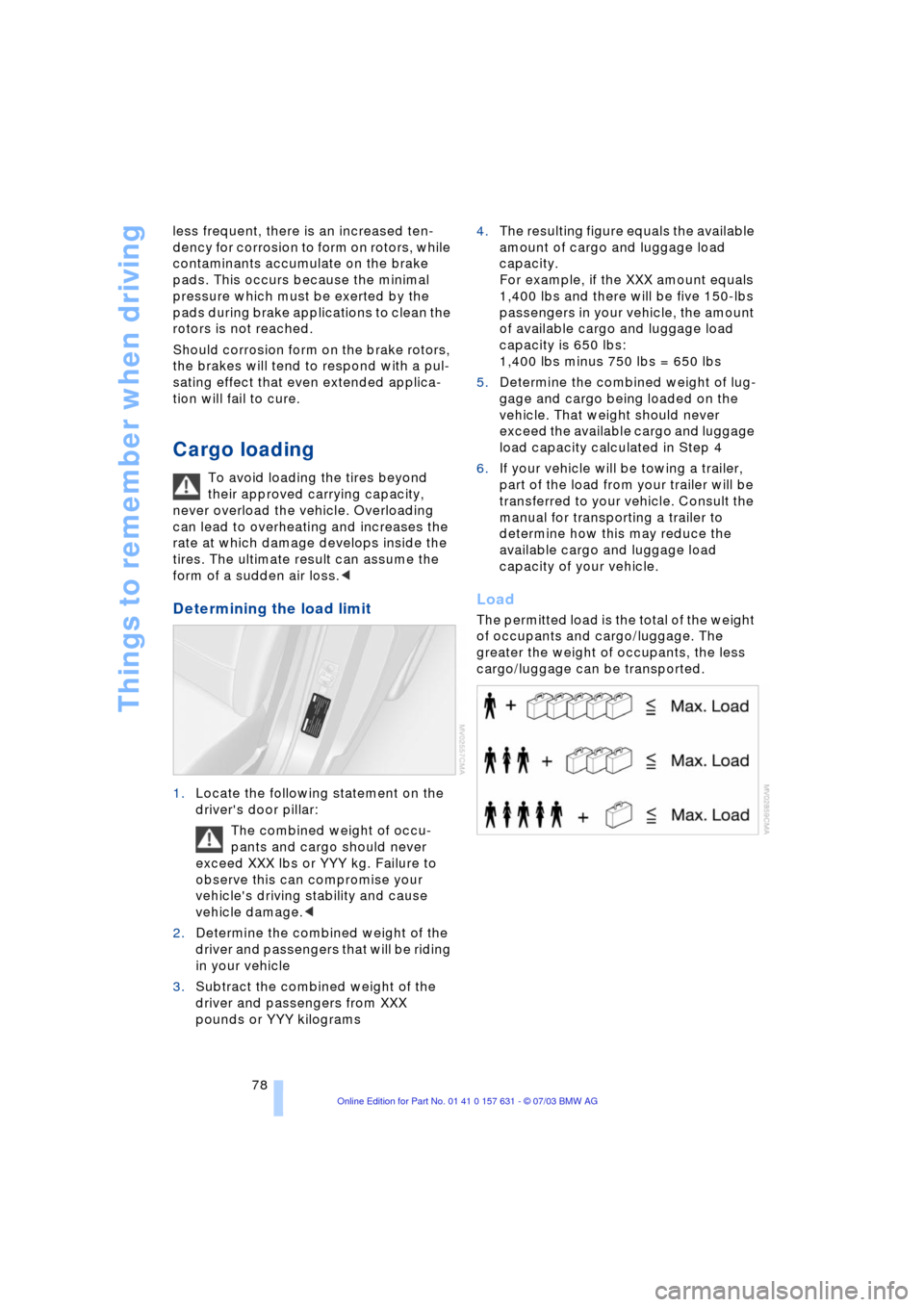
Determining the load limit
1.Locate the following statement on the
driver's door pillar:
The combined weight of occu-
pants and cargo should never
exceed XXX lbs or YYY kg. Failure to
observe this can compromise your
vehicle's driving stability and cause
vehicle damage.<
2.Determine the combined weight of the
driver and passengers that will be riding
in your vehicle
3.Subtract the combined weight of the
driver and passengers from XXX
pounds or YYY kilograms4.The resulting figure equals the available
amount of cargo and luggage load
capacity.
For example, if the XXX amount equals
1,400 lbs and there will be five 150-lbs
passengers in your vehicle, the amount
of available cargo and luggage load
capacity is 650 lbs:
1,400 lbs minus 750 lbs = 650 lbs
5.Determine the combined weight of lug-
gage and cargo being loaded on the
vehicle. That weight should never
exceed the available cargo and luggage
load capacity calculated in Step 4
6.If your vehicle will be towing a trailer,
part of the load from your trailer will be
transferred to your vehicle. Consult the
manual for transporting a trailer to
determine how this may reduce the
available cargo and luggage load
capacity of your vehicle.
Load
The permitted load is the total of the weight
of occupants and cargo/luggage. The
greater the weight of occupants, the less
cargo/luggage can be transported.
Page 81 of 132
Reference
At a glance
Controls
Driving tips
Mobility
79
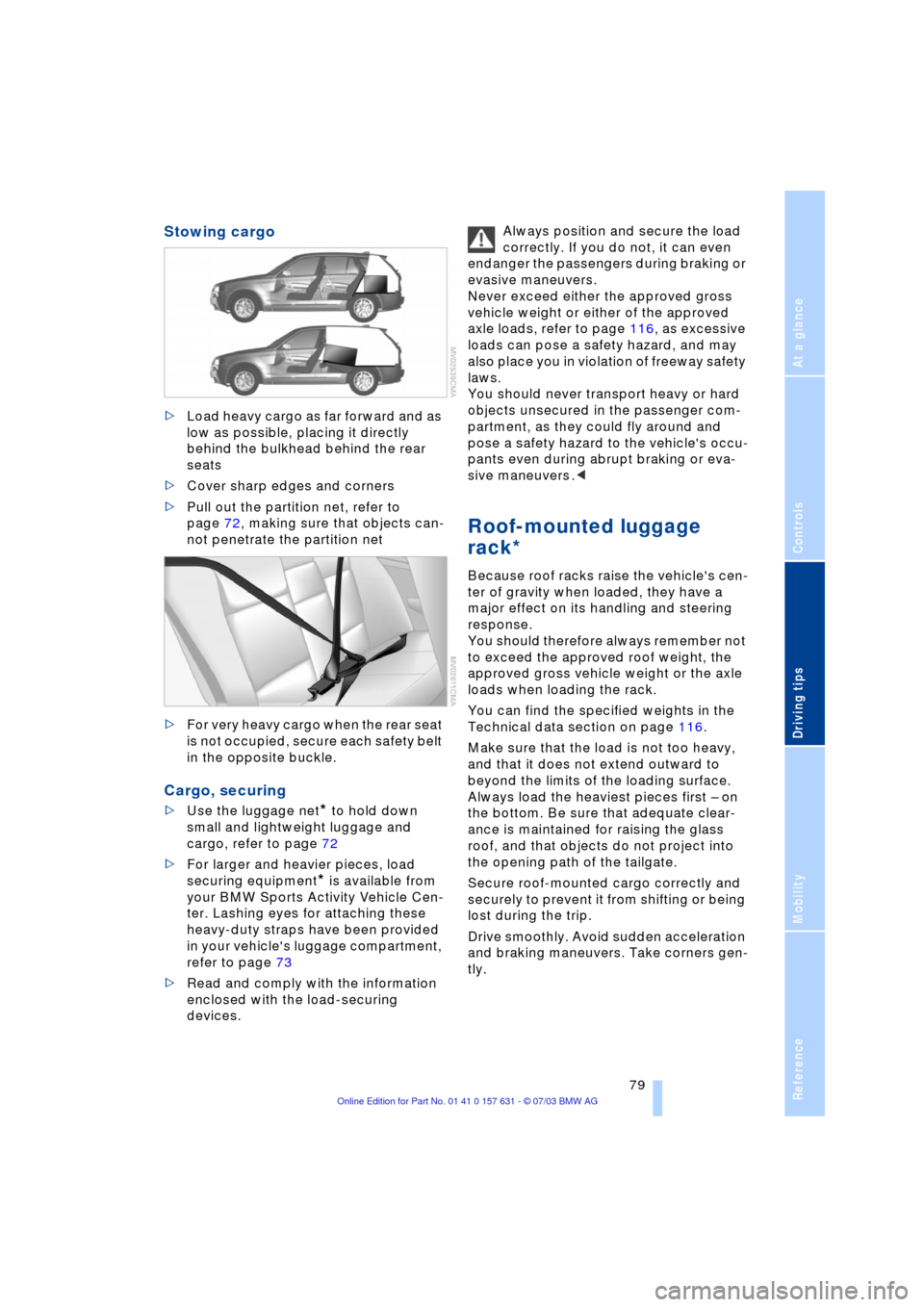
Stowing cargo
>Load heavy cargo as far forward and as
low as possible, placing it directly
behind the bulkhead behind the rear
seats
>Cover sharp edges and corners
>Pull out the partition net, refer to
page 72, making sure that objects can-
not penetrate the partition net
>For very heavy cargo when the rear seat
is not occupied, secure each safety belt
in the opposite buckle.
Cargo, securing
>Use the luggage net* to hold down
small and lightweight luggage and
cargo, refer to page 72
>For larger and heavier pieces, load
securing equipment
* is available from
your BMW Sports Activity Vehicle Cen-
ter. Lashing eyes for attaching these
heavy-duty straps have been provided
in your vehicle's luggage compartment,
refer to page 73
>Read and comply with the information
enclosed with the load-securing
devices.Always position and secure the load
correctly. If you do not, it can even
endanger the passengers during braking or
evasive maneuvers.
Never exceed either the approved gross
vehicle weight or either of the approved
axle loads, refer to page 116, as excessive
loads can pose a safety hazard, and may
also place you in violation of freeway safety
laws.
You should never transport heavy or hard
objects unsecured in the passenger com-
partment, as they could fly around and
pose a safety hazard to the vehicle's occu-
pants even during abrupt braking or eva-
sive maneuvers .<
Roof-mounted luggage
rack*
Because roof racks raise the vehicle's cen-
ter of gravity when loaded, they have a
major effect on its handling and steering
response.
You should therefore always remember not
to exceed the approved roof weight, the
approved gross vehicle weight or the axle
loads when loading the rack.
You can find the specified weights in the
Technical data section on page 116.
Make sure that the load is not too heavy,
and that it does not extend outward to
beyond the limits of the loading surface.
Always load the heaviest pieces first Ð on
the bottom. Be sure that adequate clear-
ance is maintained for raising the glass
roof, and that objects do not project into
the opening path of the tailgate.
Secure roof-mounted cargo correctly and
securely to prevent it from shifting or being
lost during the trip.
Drive smoothly. Avoid sudden acceleration
and braking maneuvers. Take corners gen-
tly.
Page 91 of 132
Reference
At a glance
Controls
Driving tips
Mobility
89
resistance to the generation of heat and its
ability to dissipate heat when tested under
controlled conditions on a specified indoor
laboratory test wheel.
Sustained high temperature can cause the
material of the tire to degenerate and
reduce tire life, and excessive temperature
can lead to sudden tire failure. The grade C
corresponds to a level of performance
which all passenger car tires must meet
under the Federal Motor Vehicle Safety
Standard No. 109. Grades B and A repre-
sent higher levels of performance on the
laboratory test wheel than the minimum
required by law.
The temperature grade for this tire is
established for a tire that is properly
inflated and not overloaded. Excessive
speed, underinflation, or excessive load-
ing, either separately or in combination,
can cause heat buildup and possible tire
failure.<
M+S
Winter and all-season tires.
These have better winter properties than
summer tires.
Tire condition
Inspect your tires frequently for treadwear,
signs of damage and for foreign objects
lodged in the tread. Check the tread pat-
tern depth.
Tire tread
The tread depth should not drop below
0.12 in/3 mm, although, for example, Euro-
pean legislation only specifies a minimum
tread depth of 0.063 in/1.6 mm. At tread
depths below 0.12 in/3 mm, there is an
increased risk of high-speed hydroplaning,
even when only small amounts of water are
present on the road surface.
As winter tires display a noticeable loss in
their ability to cope with cold-weather driv-
ing conditions once the tread wears to
below 0.16 in/4 mm, to ensure continued safety you should always have such tires
replaced.
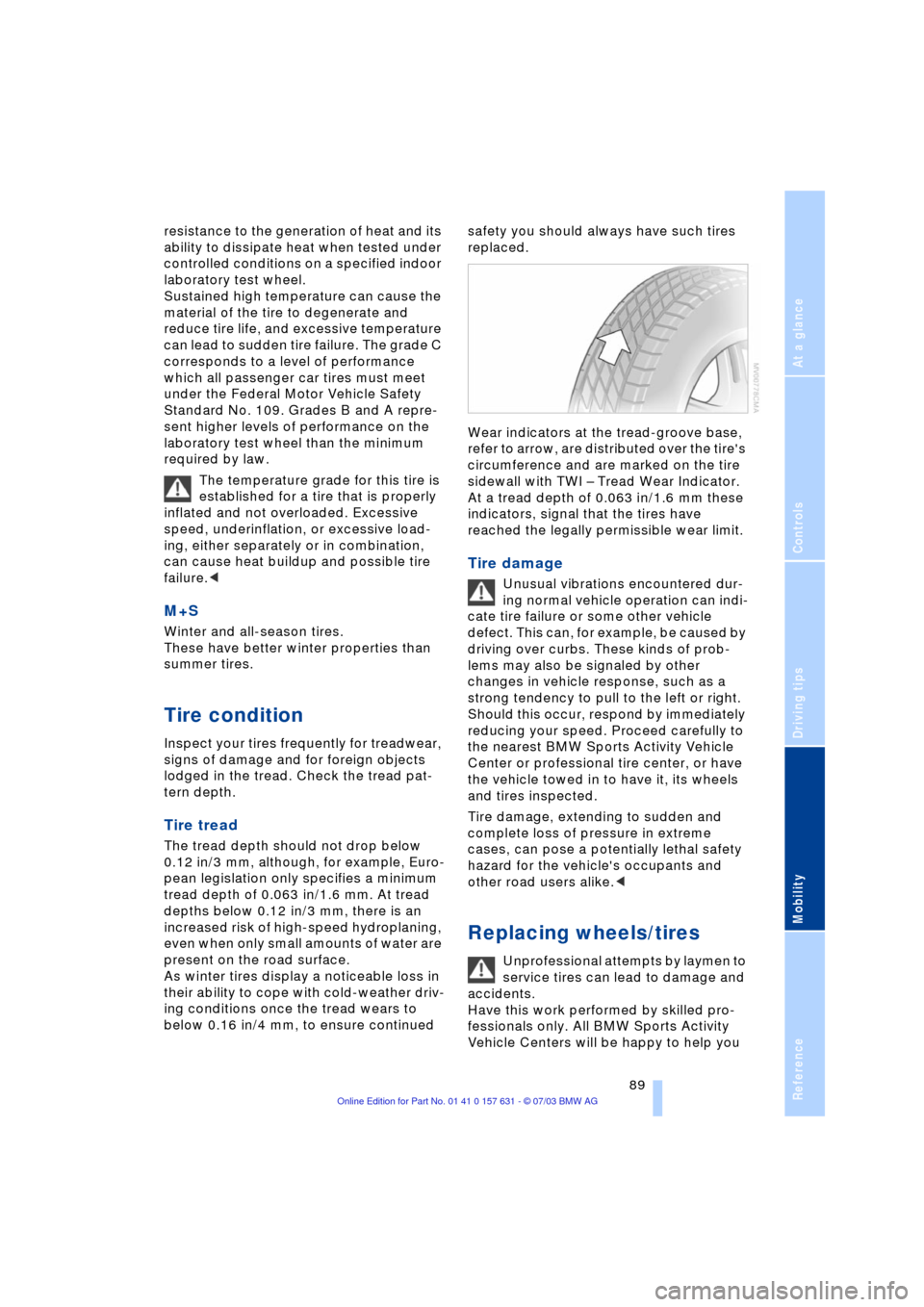
Wear indicators at the tread-groove base,
refer to arrow, are distributed over the tire's
circumference and are marked on the tire
sidewall with TWI Ð Tread Wear Indicator.
At a tread depth of 0.063 in/1.6 mm these
indicators, signal that the tires have
reached the legally permissible wear limit.
Tire damage
Unusual vibrations encountered dur-
ing normal vehicle operation can indi-
cate tire failure or some other vehicle
defect. This can, for example, be caused by
driving over curbs. These kinds of prob-
lems may also be signaled by other
changes in vehicle response, such as a
strong tendency to pull to the left or right.
Should this occur, respond by immediately
reducing your speed. Proceed carefully to
the nearest BMW Sports Activity Vehicle
Center or professional tire center, or have
the vehicle towed in to have it, its wheels
and tires inspected.
Tire damage, extending to sudden and
complete loss of pressure in extreme
cases, can pose a potentially lethal safety
hazard for the vehicle's occupants and
other road users alike.<
Replacing wheels/tires
Unprofessional attempts by laymen to
service tires can lead to damage and
accidents.
Have this work performed by skilled pro-
fessionals only. All BMW Sports Activity
Vehicle Centers will be happy to help you
Page 96 of 132
Under the engine hood
94
Washer fluid
Windshield and headlamp washer
system
Antifreeze agent for the washer sys-
tems is inflammable. For this reason,
keep it away from sources of flame and
store it only in its original containers. Store
it so that it is inaccessible to children.
Always observe the instructions for use
provided on the containers.<
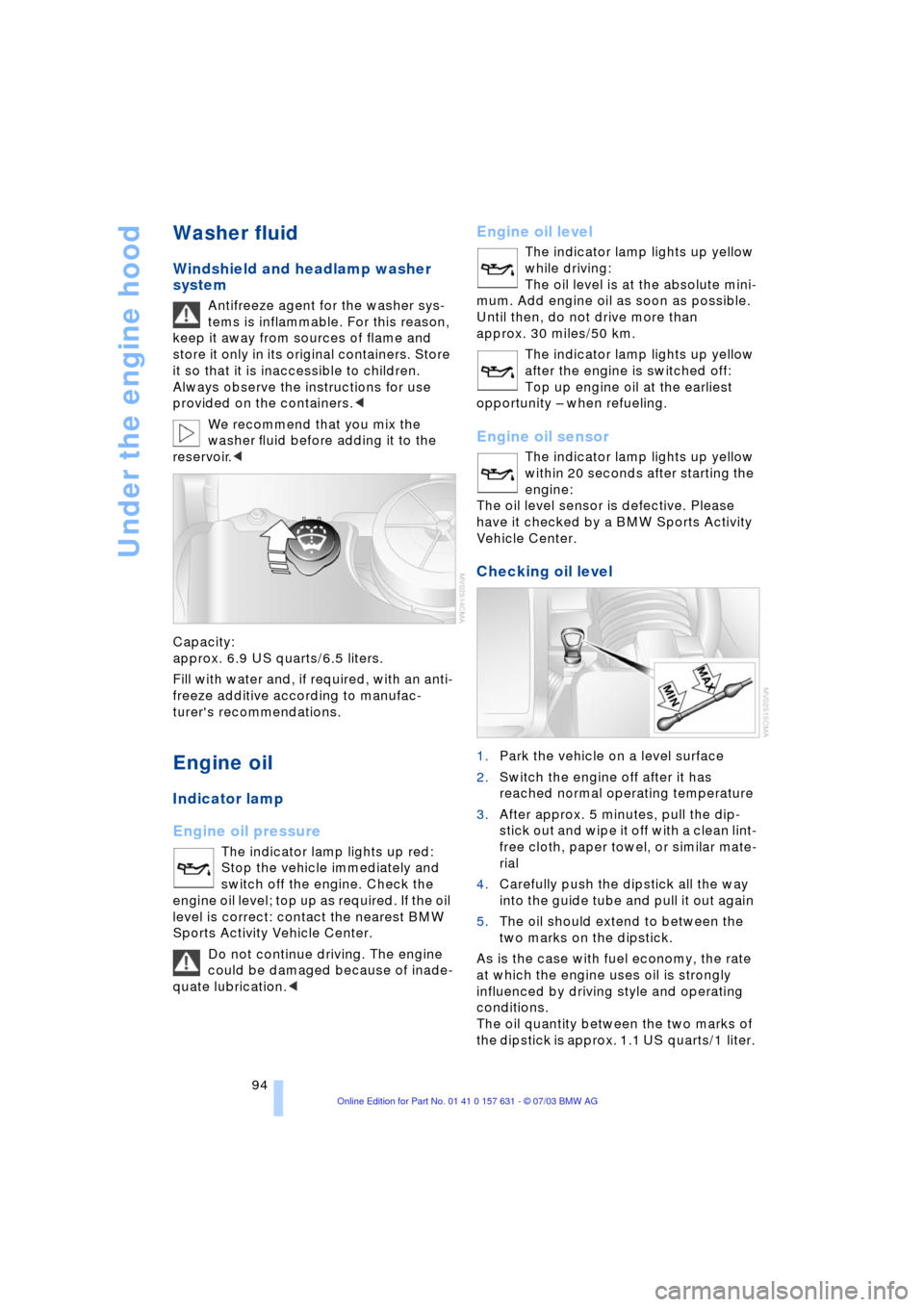
We recommend that you mix the
washer ßuid before adding it to the
reservoir.<
Capacity:
approx. 6.9 US quarts/6.5 liters.
Fill with water and, if required, with an anti-
freeze additive according to manufac-
turer's recommendations.
Engine oil
Indicator lamp
Engine oil pressure
The indicator lamp lights up red:
Stop the vehicle immediately and
switch off the engine. Check the
engine oil level; top up as required. If the oil
level is correct: contact the nearest BMW
Sports Activity Vehicle Center.
Do not continue driving. The engine
could be damaged because of inade-
quate lubrication.<
Engine oil level
The indicator lamp lights up yellow
while driving:
The oil level is at the absolute mini-
mum. Add engine oil as soon as possible.
Until then, do not drive more than
approx. 30 miles/50 km.
The indicator lamp lights up yellow
after the engine is switched off:
Top up engine oil at the earliest
opportunity Ð when refueling.
Engine oil sensor
The indicator lamp lights up yellow
within 20 seconds after starting the
engine:
The oil level sensor is defective. Please
have it checked by a BMW Sports Activity
Vehicle Center.
Checking oil level
1.Park the vehicle on a level surface
2.Switch the engine off after it has
reached normal operating temperature
3.After approx. 5 minutes, pull the dip-
stick out and wipe it off with a clean lint-
free cloth, paper towel, or similar mate-
rial
4.Carefully push the dipstick all the way
into the guide tube and pull it out again
5.The oil should extend to between the
two marks on the dipstick.
As is the case with fuel economy, the rate
at which the engine uses oil is strongly
influenced by driving style and operating
conditions.
The oil quantity between the two marks of
the dipstick is approx. 1.1 US quarts/1 liter.
Page 101 of 132
Reference
At a glance
Controls
Driving tips
Mobility
99
Replacing components
Onboard tool kit
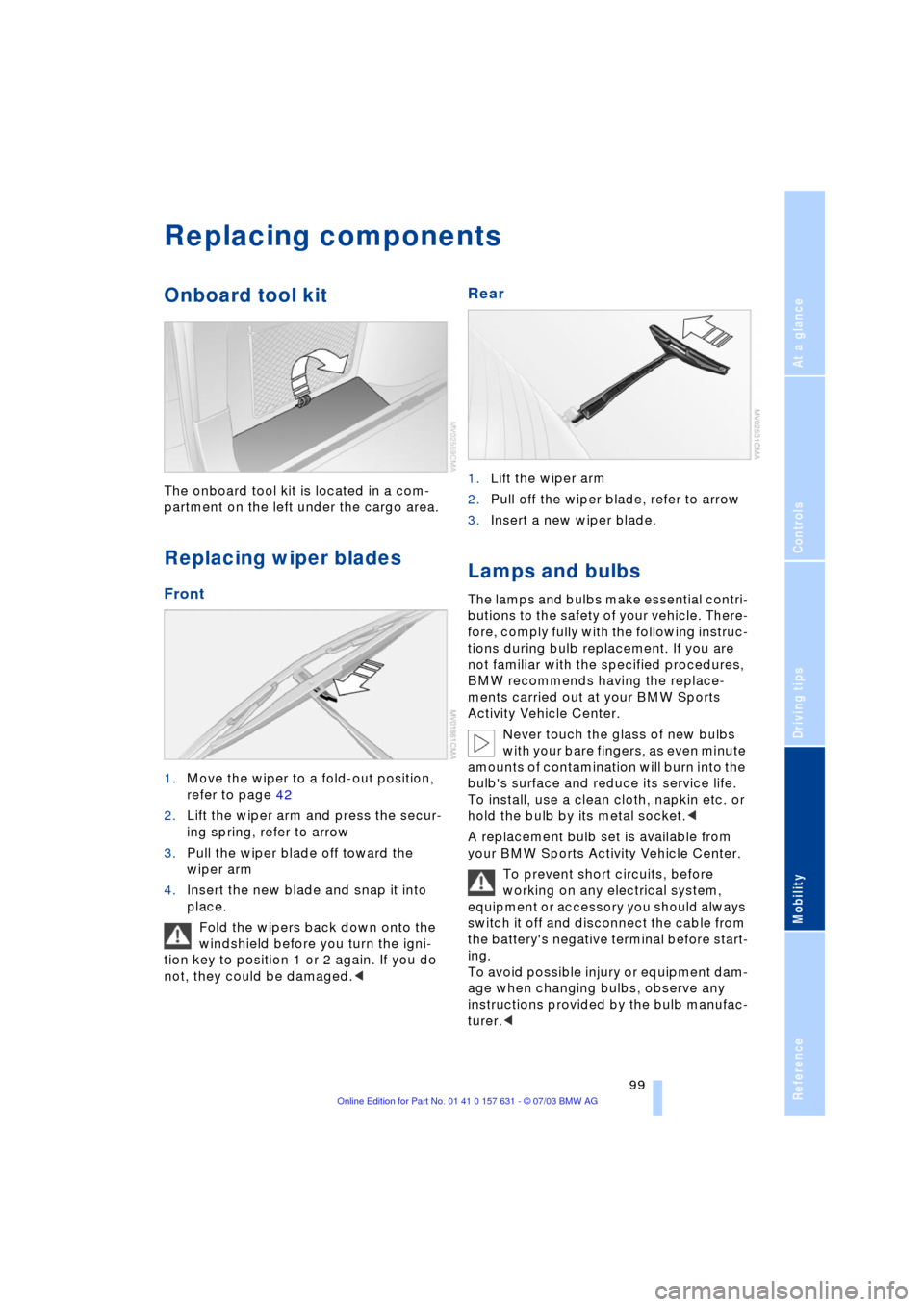
The onboard tool kit is located in a com-
partment on the left under the cargo area.
Replacing wiper blades
Front
1.Move the wiper to a fold-out position,
refer to page 42
2.Lift the wiper arm and press the secur-
ing spring, refer to arrow
3.Pull the wiper blade off toward the
wiper arm
4.Insert the new blade and snap it into
place.
Fold the wipers back down onto the
windshield before you turn the igni-
tion key to position 1 or 2 again. If you do
not, they could be damaged.<
Rear
1.Lift the wiper arm
2.Pull off the wiper blade, refer to arrow
3.Insert a new wiper blade.
Lamps and bulbs
The lamps and bulbs make essential contri-
butions to the safety of your vehicle. There-
fore, comply fully with the following instruc-
tions during bulb replacement. If you are
not familiar with the specified procedures,
BMW recommends having the replace-
ments carried out at your BMW Sports
Activity Vehicle Center.
Never touch the glass of new bulbs
with your bare fingers, as even minute
amounts of contamination will burn into the
bulb's surface and reduce its service life.
To install, use a clean cloth, napkin etc. or
hold the bulb by its metal socket.<
A replacement bulb set is available from
your BMW Sports Activity Vehicle Center.
To prevent short circuits, before
working on any electrical system,
equipment or accessory you should always
switch it off and disconnect the cable from
the battery's negative terminal before start-
ing.
To avoid possible injury or equipment dam-
age when changing bulbs, observe any
instructions provided by the bulb manufac-
turer.<
Page 106 of 132
Replacing components
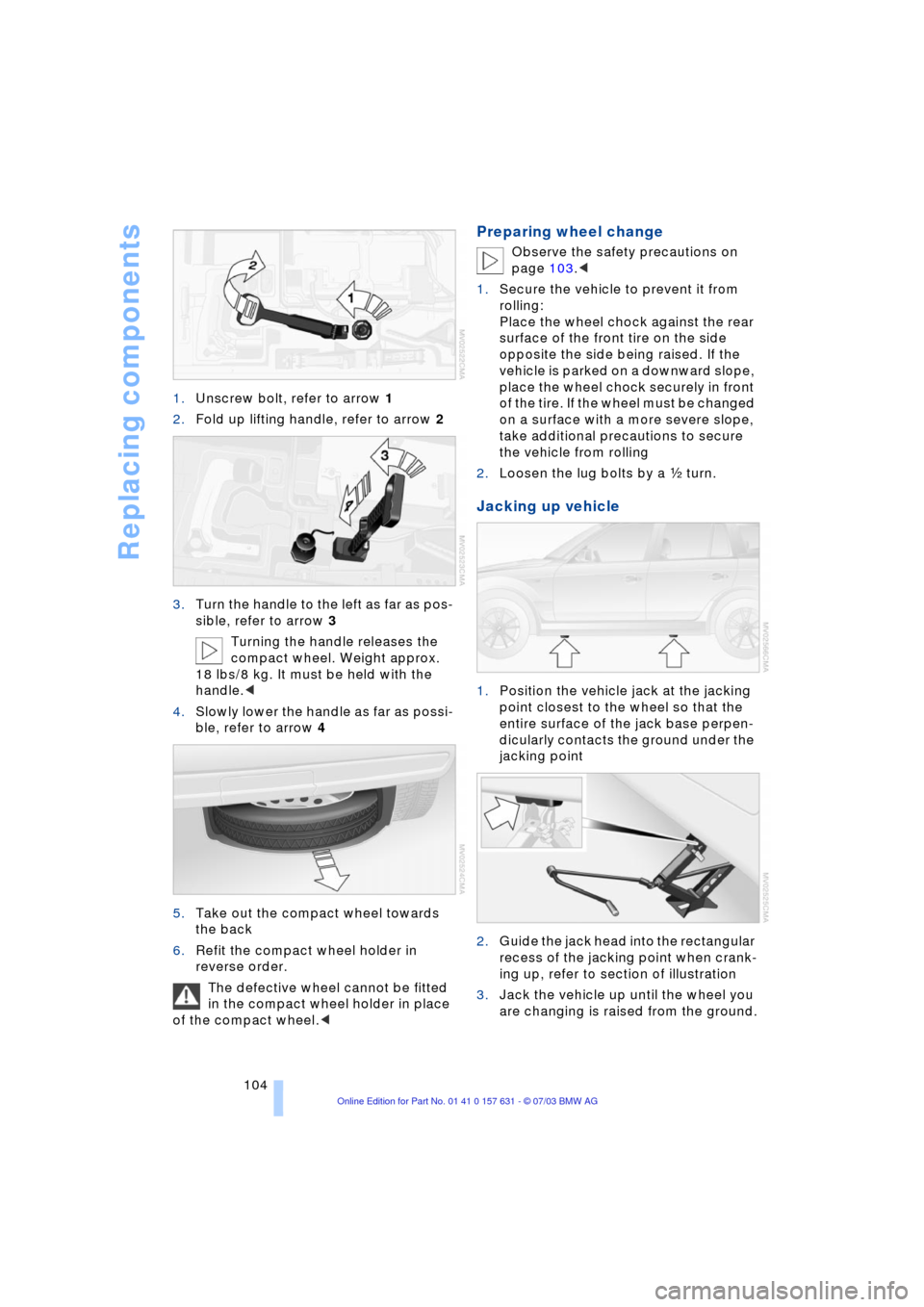
104 1.Unscrew bolt, refer to arrow 1
2.Fold up lifting handle, refer to arrow 2
3.Turn the handle to the left as far as pos-
sible, refer to arrow 3
Turning the handle releases the
compact wheel. Weight approx.
18 lbs/8 kg. It must be held with the
handle.<
4.Slowly lower the handle as far as possi-
ble, refer to arrow 4
5.Take out the compact wheel towards
the back
6.Refit the compact wheel holder in
reverse order.
The defective wheel cannot be fitted
in the compact wheel holder in place
of the compact wheel.<
Preparing wheel change
Observe the safety precautions on
page 103.<
1.Secure the vehicle to prevent it from
rolling:
Place the wheel chock against the rear
surface of the front tire on the side
opposite the side being raised. If the
vehicle is parked on a downward slope,
place the wheel chock securely in front
of the tire. If the wheel must be changed
on a surface with a more severe slope,
take additional precautions to secure
the vehicle from rolling
2.Loosen the lug bolts by a g turn.
Jacking up vehicle
1.Position the vehicle jack at the jacking
point closest to the wheel so that the
entire surface of the jack base perpen-
dicularly contacts the ground under the
jacking point
2.Guide the jack head into the rectangular
recess of the jacking point when crank-
ing up, refer to section of illustration
3.Jack the vehicle up until the wheel you
are changing is raised from the ground.
Page 107 of 132
Reference
At a glance
Controls
Driving tips
Mobility
105
Mounting compact wheel
1.Unscrew the lug bolts and remove the
wheel
2.Remove accumulations of mud or dirt
from the mounting surfaces of the
wheel and hub. Clean the lug bolts
3.Position the new wheel or compact
wheel. Secure the wheel by turning at
least two lug bolts into opposite bolt
holes
4.Screw in the remaining lug bolts.
Tighten all the bolts securely in a diag-
onal pattern
5.Lower the jack and remove it from
beneath the vehicle
6.Tighten the lug bolts in a diagonal pat-
tern
7.Check and correct the tire inflation
pressure at the earliest opportunity.
Protect valve stems and valve stem
seal caps against dirt and contamina-
tion. Dirt in valve stems is a frequent source
of gradual air loss.<
After mounting the compact wheel or cor-
recting the inflation pressure, reinitialize
the Flat Tire Monitor, refer to page 53.
The vehicle jack is designed for
changing wheels only. Do not attempt
to raise another vehicle model with it or to
raise any load of any kind. To do so could
cause accidents and personal injury.
To ensure safety, always have the lug bolts
checked with a calibrated torque wrench to
ensure that they are tightened to the spec-
ified torque of 101 lb ft/140 Nm as soon as
possible.<
Stow the defective wheel in the luggage
compartment.
When you mount wheels other than Genu-
ine BMW light-alloy wheels, different lug
bolts may also be required.
Replace the defective tire as soon as pos-
sible and have the new wheel/tire bal-
anced.
Driving with the compact wheel
Drive reservedly and do not exceed a
speed of 50 mph/80 km/h. Do not
deactivate DSC, as otherwise unstable
driving conditions may result.<
The driving characteristics change, for
example reduced track stability on braking,
extended braking distance, and altered
self-steering characteristics in the limit
range. In conjunction with winter tires,
these characteristics are more pro-
nounced.
Only one compact wheel may be
mounted. You should re-equipping to
wheels and tires of the original size as
quickly as possible.<
Battery
Battery care
The battery is 100% maintenance-free, i.e.,
the electrolyte will last for the life of the bat-
tery when the vehicle is operated in a tem-
perate climate.
Please contact your BMW Sports
Activity Vehicle Center with any ques-
tions concerning the battery.<
Do not disconnect the battery when
the engine is running. If you do so, the
ensuing voltage surge will damage the
vehicle's onboard electronics.<
Indicator lamp
The battery charge-current indica-
tor lamp lights up:
The battery is no longer being
charged. There is a defect on the alternator
V-belt or charge current circuit of the alter-
nator. Contact the nearest BMW Sports
Activity Vehicle Center.
Do not continue driving if the V-belt is
defective. The engine could be dam-
aged due to overheating.
Moreover, an increased amount of force is
required for steering if the onboard supply
voltage falls dramatically.<
Page 111 of 132
Reference
At a glance
Controls
Driving tips
Mobility
109
on page 93. The symbol + is embossed on
the cover.
1.Open the cover of the BMW auxiliary
terminal for jump-starting, refer to
arrow 1
2.Connect one terminal clamp of the pos-
itive/+ jumper cable to the positive ter-
minal of the battery or a auxiliary termi-
nal of the vehicle providing starting
assistance
3.Connect the second terminal clamp of
the positive/+ jumper cable to the posi-
tive terminal of the battery or to a auxil-
iary terminal of the vehicle to be started.
On your BMW, there is a special nut as
body ground or negative terminal on the
suspension strut dome, refer to arrow 2
4.Attach one end of the jumper cable
minus/Ð to the negative terminal of the
battery or to an engine or body ground
of the vehicle providing assistance
5.Connect the second terminal clamp of
the negative/Ð jumper cable to the neg-
ative terminal of the battery or to the
engine or body ground of the vehicle to
be started.
Starting the engine
1.Start the support vehicle's engine and
let it run at an increased idling speed for
a few minutes
2.Start the engine on the other vehicle in
the usual way.
If the first start attempt is not success-
ful, wait a few minutes before another
attempt in order to allow the discharged
battery to recharge
3.Allow the engines to run for several
minutes
4.Disconnect the jumper cables by
reversing the connection sequence.
If necessary, have the battery checked and
recharged at a BMW Sports Activity Vehi-
cle Center.
Never use spray fluids to start the
engine.<
Towing
Always observe all applicable towing
laws and regulations. Do not tow the
BMW X3 with the axle raised, as otherwise
the transfer case can be damaged.<
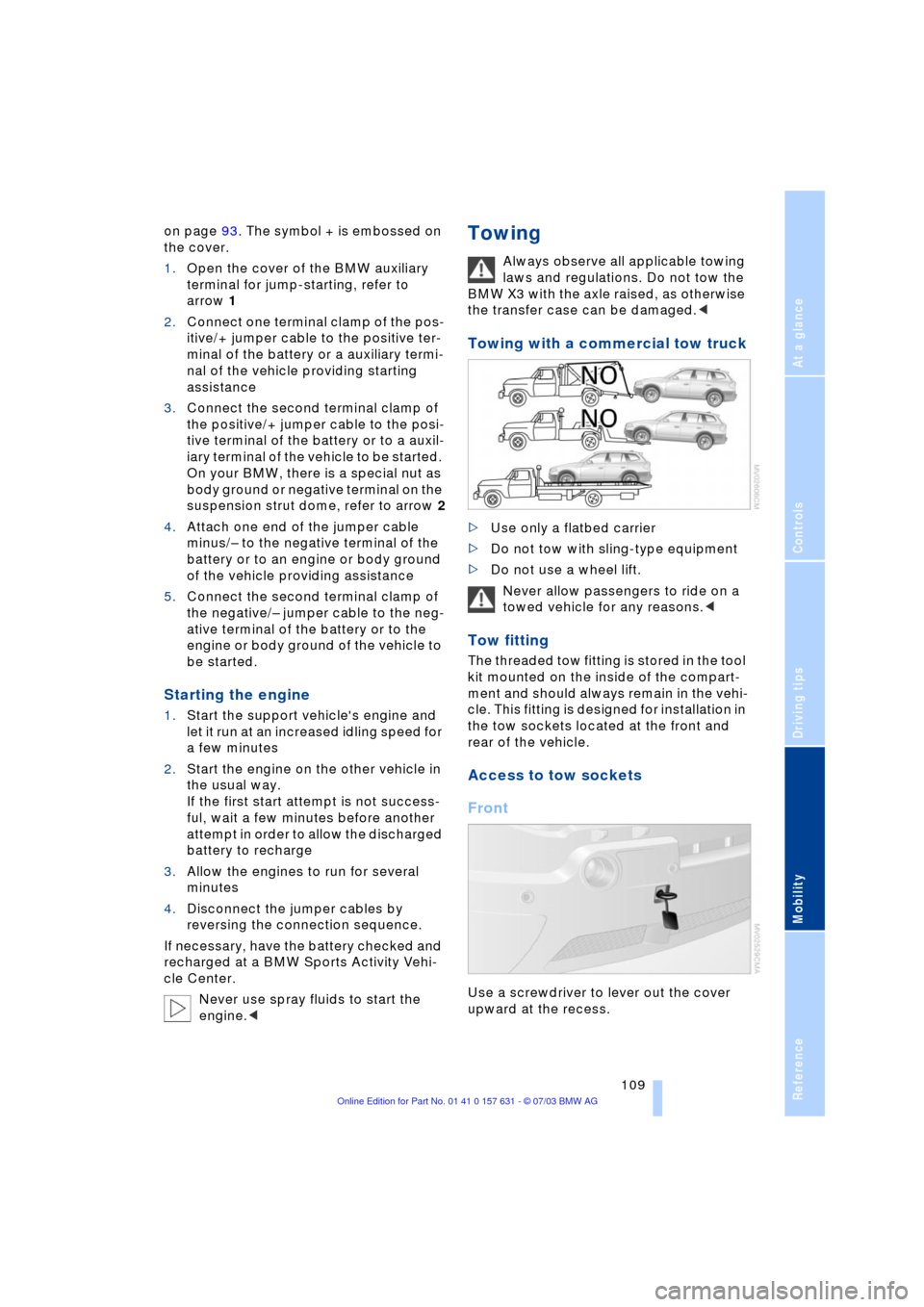
Towing with a commercial tow truck
>Use only a flatbed carrier
>Do not tow with sling-type equipment
>Do not use a wheel lift.
Never allow passengers to ride on a
towed vehicle for any reasons.<
Tow fitting
The threaded tow fitting is stored in the tool
kit mounted on the inside of the compart-
ment and should always remain in the vehi-
cle. This fitting is designed for installation in
the tow sockets located at the front and
rear of the vehicle.
Access to tow sockets
Front
Use a screwdriver to lever out the cover
upward at the recess.