ECU BMW X3 2.5I 2006 E83 User Guide
[x] Cancel search | Manufacturer: BMW, Model Year: 2006, Model line: X3 2.5I, Model: BMW X3 2.5I 2006 E83Pages: 133, PDF Size: 8.37 MB
Page 75 of 133
Reference
At a glance
Controls
Driving tips
Mobility
73
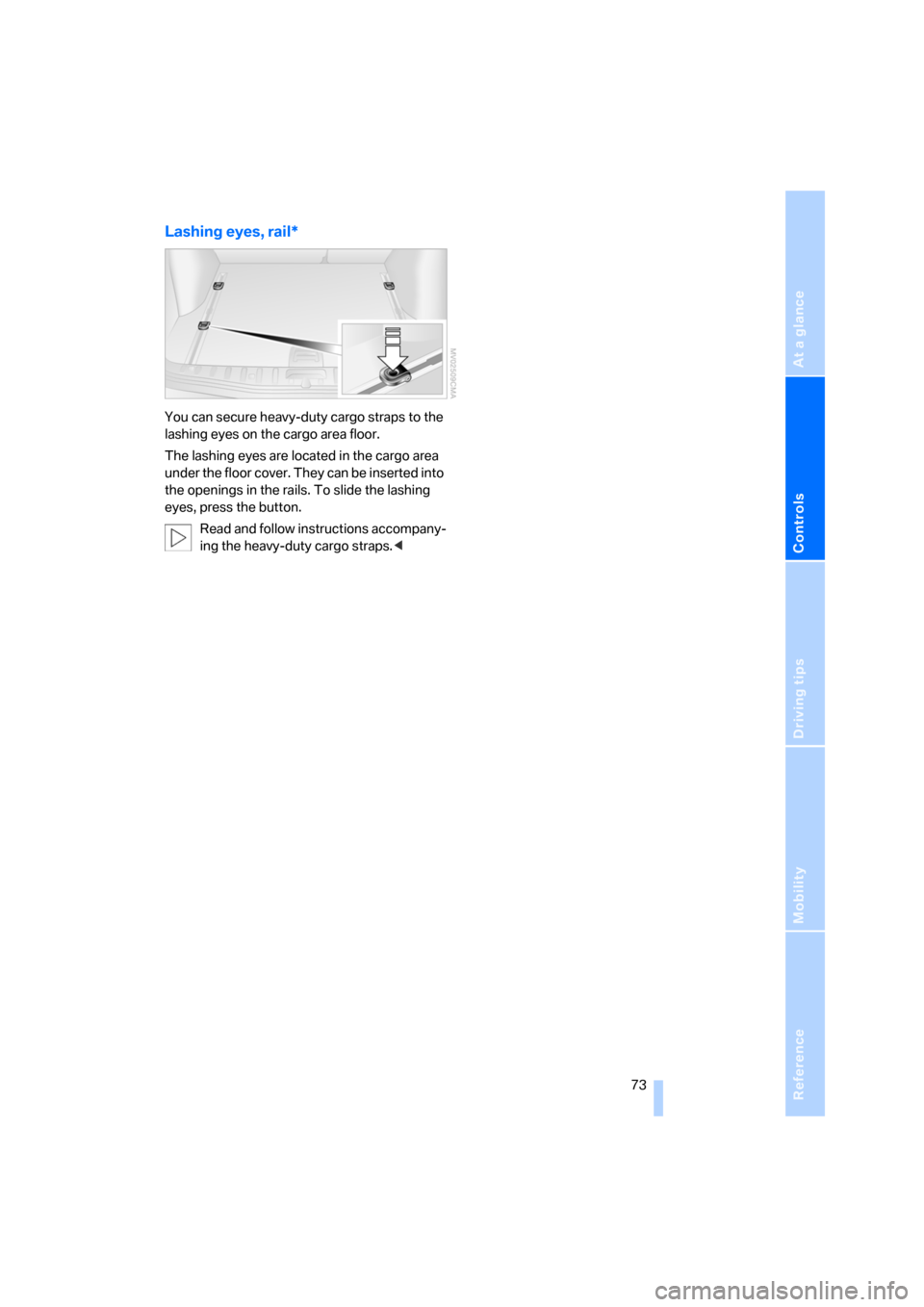
Lashing eyes, rail*
You can secure heavy-duty cargo straps to the
lashing eyes on the cargo area floor.
The lashing eyes are located in the cargo area
under the floor cover. They can be inserted into
the openings in the rails. To slide the lashing
eyes, press the button.
Read and follow instructions accompany-
ing the heavy-duty cargo straps.<
Page 81 of 133
Reference
At a glance
Controls
Driving tips
Mobility
79
3.Subtract the combined weight of the driver
and passengers from XXX lbs. or YYY kg.
4.The resulting figure equals the available
amount of cargo and luggage load capacity.
For example, if the XXX amount equals
990 lbs. and there will be five 150-lb. pas-
sengers in your vehicle, the amount of avail-
able cargo and luggage load capacity is
240 lbs.:
990 lbs. minus 750 lbs. = 240 lbs.
5.Determine the combined weight of luggage
and cargo being loaded into and/or onto the
vehicle. This combined weight may not
safely exceed the available cargo and lug-
gage load capacity calculated in step 4.
6.If your vehicle will be towing a trailer, part of
the load from your trailer will be transferred
to your vehicle. Consult the manual for
transporting a trailer to determine how this
may reduce the available cargo and luggage
load capacity of your vehicle.
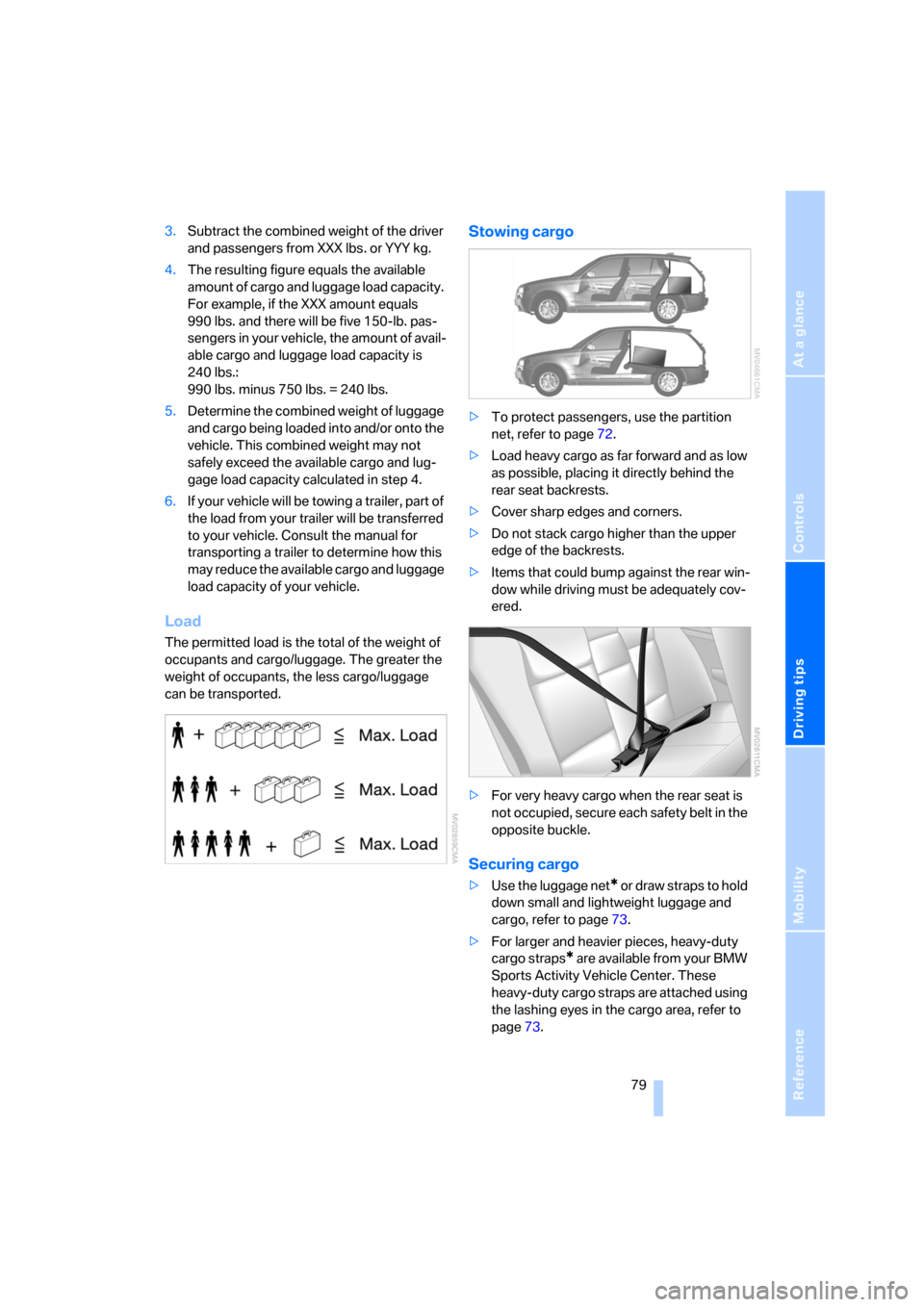
Load
The permitted load is the total of the weight of
occupants and cargo/luggage. The greater the
weight of occupants, the less cargo/luggage
can be transported.
Stowing cargo
>To protect passengers, use the partition
net, refer to page72.
>Load heavy cargo as far forward and as low
as possible, placing it directly behind the
rear seat backrests.
>Cover sharp edges and corners.
>Do not stack cargo higher than the upper
edge of the backrests.
>Items that could bump against the rear win-
dow while driving must be adequately cov-
ered.
>For very heavy cargo when the rear seat is
not occupied, secure each safety belt in the
opposite buckle.
Securing cargo
>Use the luggage net* o r d ra w s t r a p s t o h o l d
down small and lightweight luggage and
cargo, refer to page73.
>For larger and heavier pieces, heavy-duty
cargo straps
* are available from your BMW
Sports Activity Vehicle Center. These
heavy-duty cargo straps are attached using
the lashing eyes in the cargo area, refer to
page73.
Page 82 of 133
Things to remember when driving
80 Please read the information provided with
the heavy-duty cargo straps.
Always position and secure cargo as
described above. If you do not, it can
endanger the passengers during braking or
evasive maneuvers.
Use only the lashing eyes, refer to page73, to
fasten the heavy-duty cargo straps; otherwise,
the heavy-duty cargo straps could loosen or the
vehicle could be damaged.
Never exceed either the approved gross vehicle
weight or either of the approved axle loads, refer
to page116, as excessive loads can pose a
safety hazard and may also place you in viola-
tion of road safety laws.
You should never transport heavy or hard
objects unsecured in the passenger compart-
ment, as they could be thrown about and pose a
safety hazard to the vehicle's occupants during
abrupt braking or evasive maneuvers.<
Roof-mounted luggage rack*
A special rack system is available as an optional
accessory for your BMW. Please observe the
information contained in the installation instruc-
tions.
Loading luggage rack
Because roof racks raise the vehicle's center of
gravity when loaded, they have a major effect on
its handling and steering response. You should
therefore always remember not to exceed the
approved roof load capacity, the approved
gross vehicle weight, or the axle loads when
loading the rack.
These specifications can be found under
Weights on page116.
Make sure that the load is evenly distributed,
and that it does not extend outward beyond the
limits of the loading surface. Always stow the
heaviest pieces at the bottom. Be sure that ade-
quate clearance is maintained for raising the
glass sunroof and that objects do not project
into the opening path of the liftgate.Secure roof-mounted cargo correctly and
securely to prevent it from shifting or falling off
while you drive.
Drive smoothly. Avoid sudden acceleration and
braking maneuvers. Take corners gently.
Driving on poor roads
Your X3 is at home on all paved and unpaved
roads. It combines all-wheel drive with the
advantages of a normal passenger car.
Driving on unpaved terrain can cause
damage to the vehicle.<
When you are driving on poor roads, there are a
few points which you should strictly observe –
for your own safety and that of your passengers,
as well as to protect the vehicle:
>Familiarize yourself with the vehicle before
you begin driving. Do not take risks with the
vehicle under any circumstances.
>Always adapt the driving speed to the road
conditions. The more steep and uneven the
roadway is, the lower the speed should be.
>You can operate your vehicle on uphill and
downhill gradients with a maximum slope
of 50 %. If you wish to drive on uphill and
downhill grades of this nature, make sure
beforehand that the engine oil and coolant
levels are near the MAX mark, refer to
pages94 and95.
>When descending very steep hills, use
HDC Hill Descent Control, refer to page49.
It is possible to start off on inclines of up
to 32 %.
The permitted side tilt is 32 %.
>While driving, watch carefully for obstacles
such as rocks or holes. Try to avoid these
obstacles whenever possible.
>Avoid having the body make contact with
the ground, e.g. on the crests of hills and
bumpy roads. The ground clearance of the
vehicle is a maximum of approx. 8.0 in/
20 cm. Please be aware that the ground
clearance can vary depending on the load
and operating conditions of the vehicle.
Page 94 of 133
Under the hood
92
Under the hood
Never attempt to perform any service or
repair operations on your vehicle without
the required professional technical training. If
you are not familiar with the regulations to be
observed, have work on your vehicle carried out
only by your BMW Sports Activity Vehicle Cen-
ter or at a workshop that works according to
BMW repair procedures with appropriately
trained personnel. If this work is not carried out
properly, there is a danger of subsequent dam-
age and related safety hazards.<
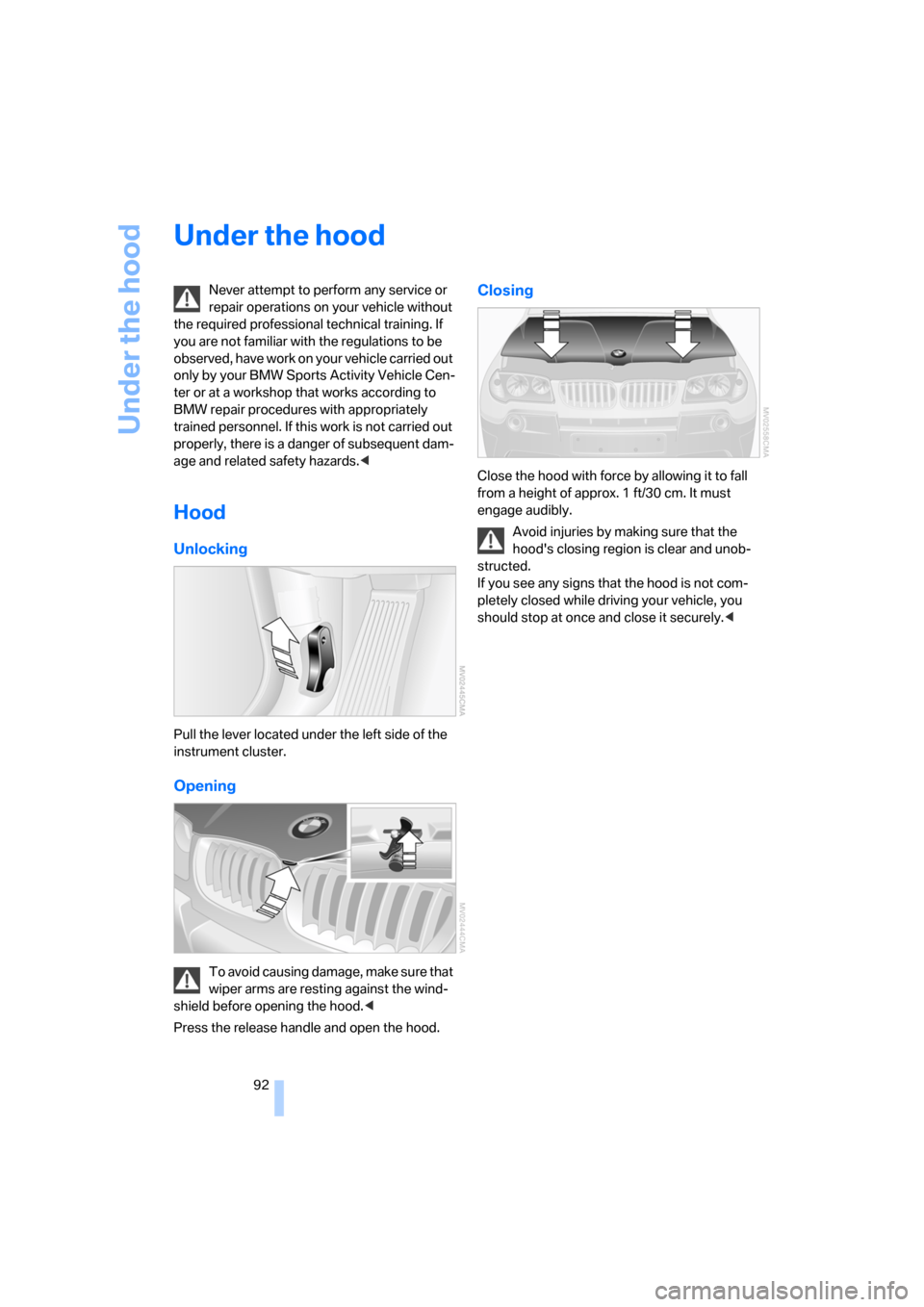
Hood
Unlocking
Pull the lever located under the left side of the
instrument cluster.
Opening
To avoid causing damage, make sure that
wiper arms are resting against the wind-
shield before opening the hood.<
Press the release handle and open the hood.
Closing
Close the hood with force by allowing it to fall
from a height of approx. 1 ft/30 cm. It must
engage audibly.
Avoid injuries by making sure that the
hood's closing region is clear and unob-
structed.
If you see any signs that the hood is not com-
pletely closed while driving your vehicle, you
should stop at once and close it securely.<
Page 101 of 133
Reference
At a glance
Controls
Driving tips
Mobility
99
Replacing components
Onboard tool kit
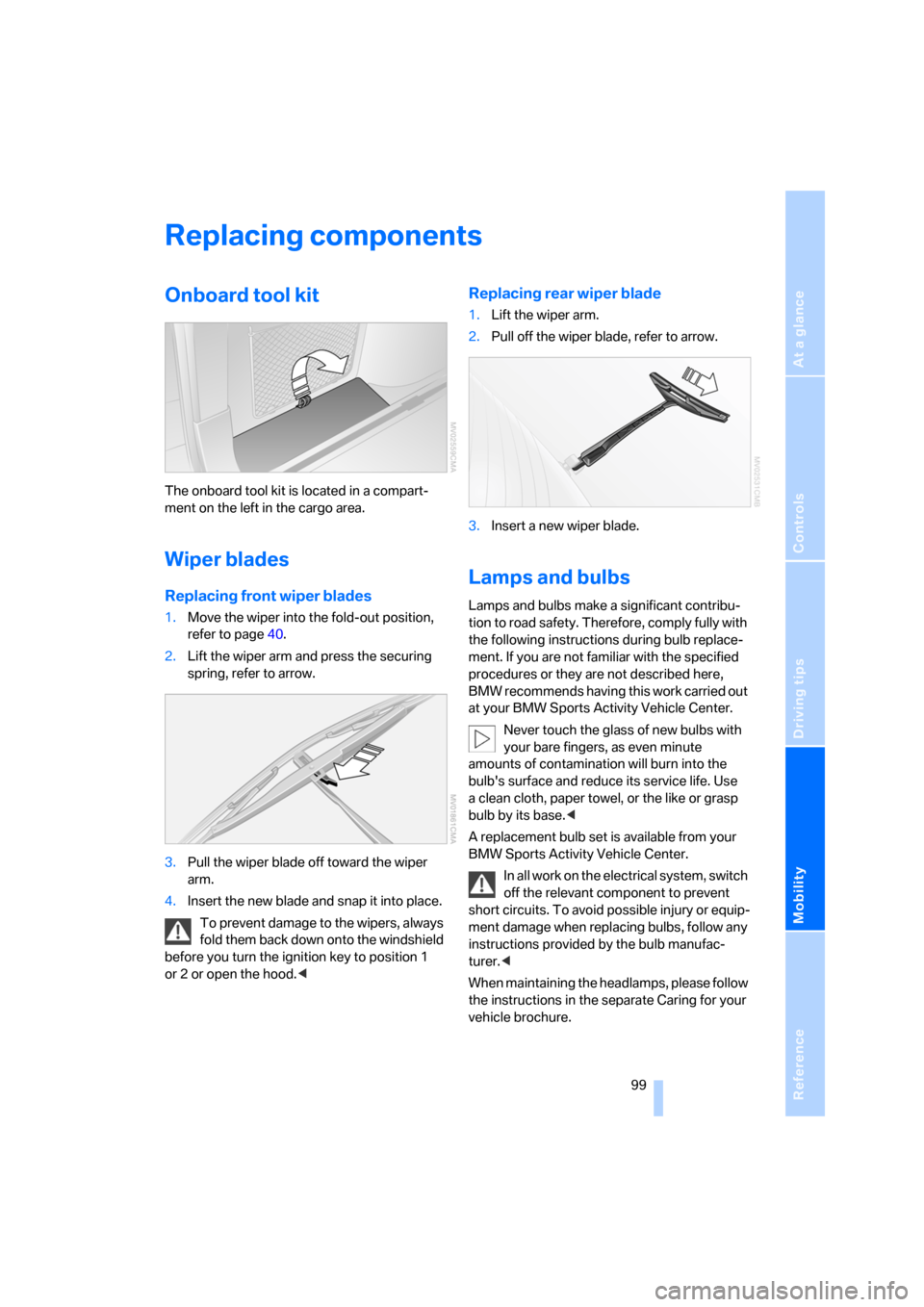
The onboard tool kit is located in a compart-
ment on the left in the cargo area.
Wiper blades
Replacing front wiper blades
1.Move the wiper into the fold-out position,
refer to page40.
2.Lift the wiper arm and press the securing
spring, refer to arrow.
3.Pull the wiper blade off toward the wiper
arm.
4.Insert the new blade and snap it into place.
To prevent damage to the wipers, always
fold them back down onto the windshield
before you turn the ignition key to position 1
or 2 or open the hood.<
Replacing rear wiper blade
1.Lift the wiper arm.
2.Pull off the wiper blade, refer to arrow.
3.Insert a new wiper blade.
Lamps and bulbs
Lamps and bulbs make a significant contribu-
tion to road safety. Therefore, comply fully with
the following instructions during bulb replace-
ment. If you are not familiar with the specified
procedures or they are not described here,
BMW recommends having this work carried out
at your BMW Sports Activity Vehicle Center.
Never touch the glass of new bulbs with
your bare fingers, as even minute
amounts of contamination will burn into the
bulb's surface and reduce its service life. Use
a clean cloth, paper towel, or the like or grasp
bulb by its base.<
A replacement bulb set is available from your
BMW Sports Activity Vehicle Center.
In all work on the electrical system, switch
off the relevant component to prevent
short circuits. To avoid possible injury or equip-
ment damage when replacing bulbs, follow any
instructions provided by the bulb manufac-
turer.<
When maintaining the headlamps, please follow
the instructions in the separate Caring for your
vehicle brochure.
Page 106 of 133
Replacing components
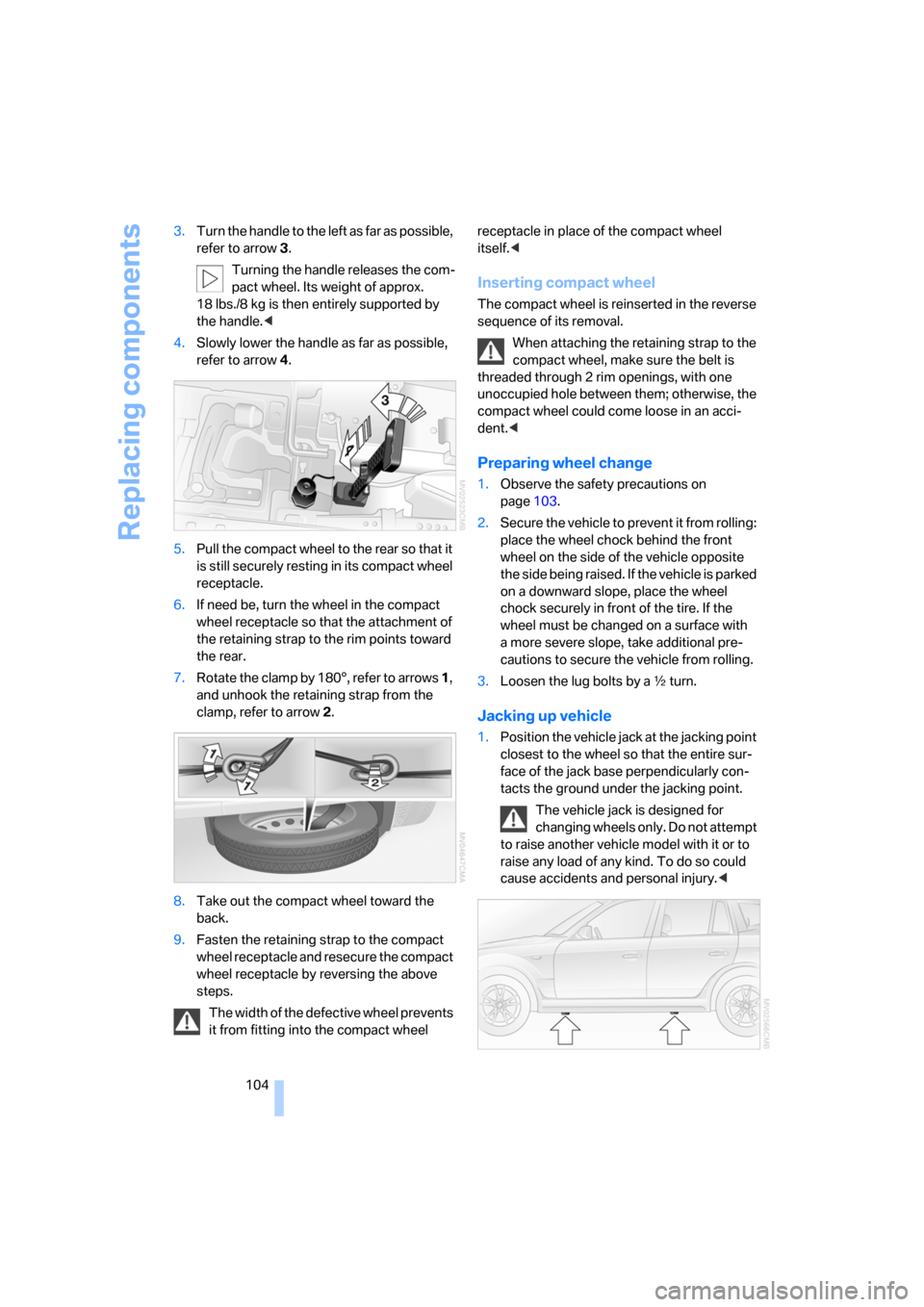
104 3.Turn the handle to the left as far as possible,
refer to arrow3.
Turning the handle releases the com-
pact wheel. Its weight of approx.
18 lbs./8 kg is then entirely supported by
the handle.<
4.Slowly lower the handle as far as possible,
refer to arrow4.
5.Pull the compact wheel to the rear so that it
is still securely resting in its compact wheel
receptacle.
6.If need be, turn the wheel in the compact
wheel receptacle so that the attachment of
the retaining strap to the rim points toward
the rear.
7.Rotate the clamp by 180°, refer to arrows 1,
and unhook the retaining strap from the
clamp, refer to arrow 2.
8.Take out the compact wheel toward the
back.
9.Fasten the retaining strap to the compact
wheel receptacle and resecure the compact
wheel receptacle by reversing the above
steps.
The width of the defective wheel prevents
it from fitting into the compact wheel receptacle in place of the compact wheel
itself.<
Inserting compact wheel
The compact wheel is reinserted in the reverse
sequence of its removal.
When attaching the retaining strap to the
compact wheel, make sure the belt is
threaded through 2 rim openings, with one
unoccupied hole between them; otherwise, the
compact wheel could come loose in an acci-
dent.<
Preparing wheel change
1.Observe the safety precautions on
page103.
2.Secure the vehicle to prevent it from rolling:
place the wheel chock behind the front
wheel on the side of the vehicle opposite
the side being raised. If the vehicle is parked
on a downward slope, place the wheel
chock securely in front of the tire. If the
wheel must be changed on a surface with
a more severe slope, take additional pre-
cautions to secure the vehicle from rolling.
3.Loosen the lug bolts by a γ turn.
Jacking up vehicle
1.Position the vehicle jack at the jacking point
closest to the wheel so that the entire sur-
face of the jack base perpendicularly con-
tacts the ground under the jacking point.
The vehicle jack is designed for
changing wheels only. Do not attempt
to raise another vehicle model with it or to
raise any load of any kind. To do so could
cause accidents and personal injury.<
Page 107 of 133
Reference
At a glance
Controls
Driving tips
Mobility
105
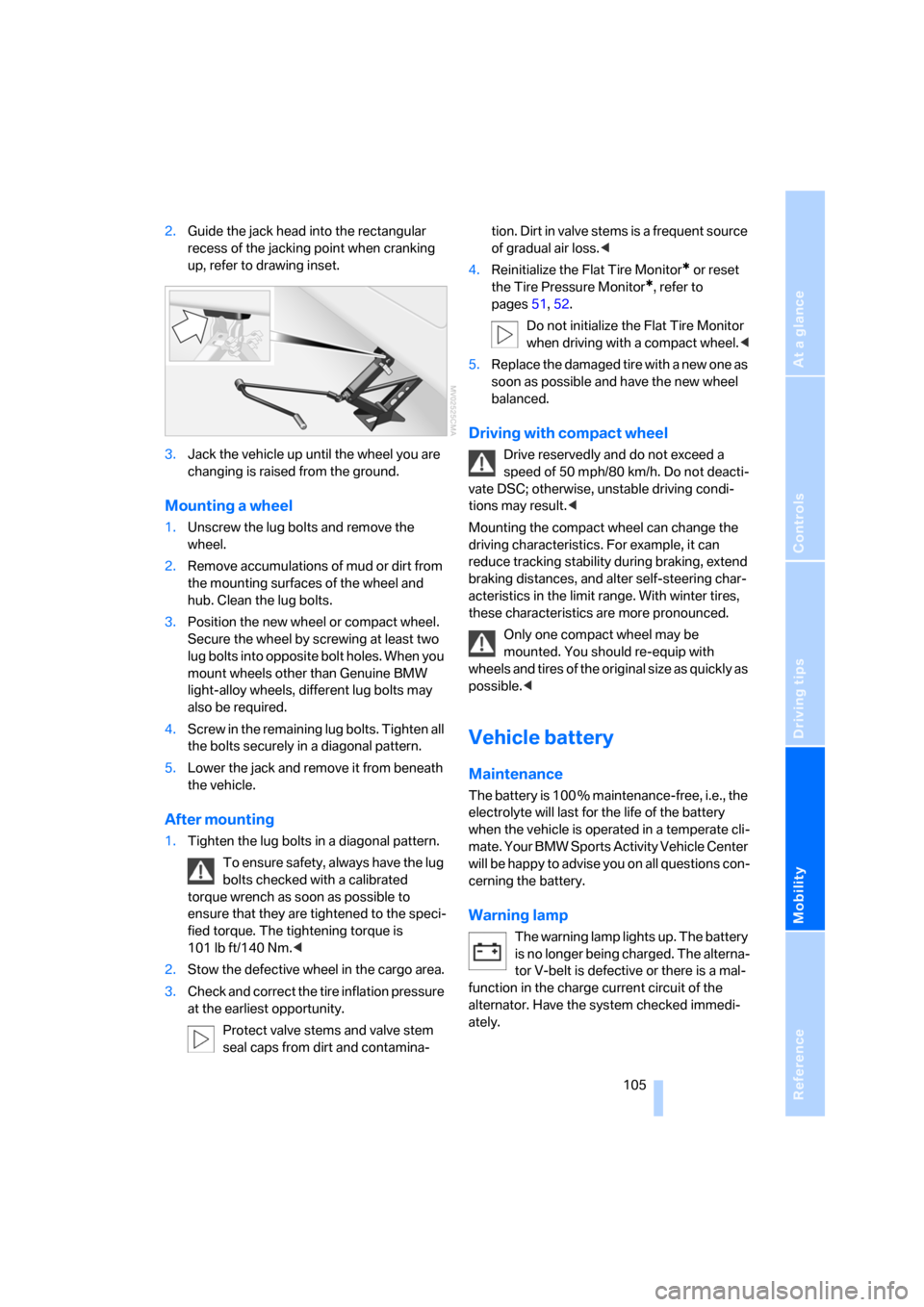
2.Guide the jack head into the rectangular
recess of the jacking point when cranking
up, refer to drawing inset.
3.Jack the vehicle up until the wheel you are
changing is raised from the ground.
Mounting a wheel
1.Unscrew the lug bolts and remove the
wheel.
2.Remove accumulations of mud or dirt from
the mounting surfaces of the wheel and
hub. Clean the lug bolts.
3.Position the new wheel or compact wheel.
Secure the wheel by screwing at least two
lug bolts into opposite bolt holes. When you
mount wheels other than Genuine BMW
light-alloy wheels, different lug bolts may
also be required.
4.Screw in the remaining lug bolts. Tighten all
the bolts securely in a diagonal pattern.
5.Lower the jack and remove it from beneath
the vehicle.
After mounting
1.Tighten the lug bolts in a diagonal pattern.
To ensure safety, always have the lug
bolts checked with a calibrated
torque wrench as soon as possible to
ensure that they are tightened to the speci-
fied torque. The tightening torque is
101lbft/140Nm.<
2.Stow the defective wheel in the cargo area.
3.Check and correct the tire inflation pressure
at the earliest opportunity.
Protect valve stems and valve stem
seal caps from dirt and contamina-tion. Dirt in valve stems is a frequent source
of gradual air loss.<
4.Reinitialize the Flat Tire Monitor
* or reset
the Tire Pressure Monitor
*, refer to
pages51, 52.
Do not initialize the Flat Tire Monitor
when driving with a compact wheel.<
5.Replace the damaged tire with a new one as
soon as possible and have the new wheel
balanced.
Driving with compact wheel
Drive reservedly and do not exceed a
speed of 50 mph/80 km/h. Do not deacti-
vate DSC; otherwise, unstable driving condi-
tions may result.<
Mounting the compact wheel can change the
driving characteristics. For example, it can
reduce tracking stability during braking, extend
braking distances, and alter self-steering char-
acteristics in the limit range. With winter tires,
these characteristics are more pronounced.
Only one compact wheel may be
mounted. You should re-equip with
wheels and tires of the original size as quickly as
possible.<
Vehicle battery
Maintenance
The battery is 100 % maintenance-free, i.e., the
electrolyte will last for the life of the battery
when the vehicle is operated in a temperate cli-
mate. Your BMW Sports Activity Vehicle Center
will be happy to advise you on all questions con-
cerning the battery.
Warning lamp
The warning lamp lights up. The battery
is no longer being charged. The alterna-
tor V-belt is defective or there is a mal-
function in the charge current circuit of the
alternator. Have the system checked immedi-
ately.
Page 108 of 133
Replacing components
106 Do not continue driving if the V-belt is
defective. The engine could be damaged
due to overheating.
Moreover, an increased amount of force is
required for steering if there is a sharp drop in
the onboard supply voltage.<
Charging battery
Charge the battery in the vehicle only when the
engine has been switched off. For connections,
refer to Jump starting on page108.
Disposal
Have old batteries disposed of following
replacement at your BMW Sports Activity
Vehicle Center or bring them to a collection
point. Maintain the battery in an upright position
for transport and storage. Always secure the
battery to prevent it from tipping over during
transport.<
Power failure
After a temporary power supply interruption,
some equipment is subject to limited use and
must be reinitialized. Individual settings are also
lost and must be updated again:
>Panorama glass sunroof
It may be only possible to raise the sunroof.
The system must be initialized, refer to
page23.
>Power windows
The pinch protection system must be reini-
tialized, refer to page22.
>Seat and mirror memory
The positions must be stored again, refer to
page29.
>Time
Must be set again, refer to page44.
Fuses
Never attempt to repair a blown fuse, and
do not replace a defective fuse with a sub-
stitute of another color or amperage rating, as
this could lead to a circuit overload, ultimately
resulting in a fire in the vehicle.<
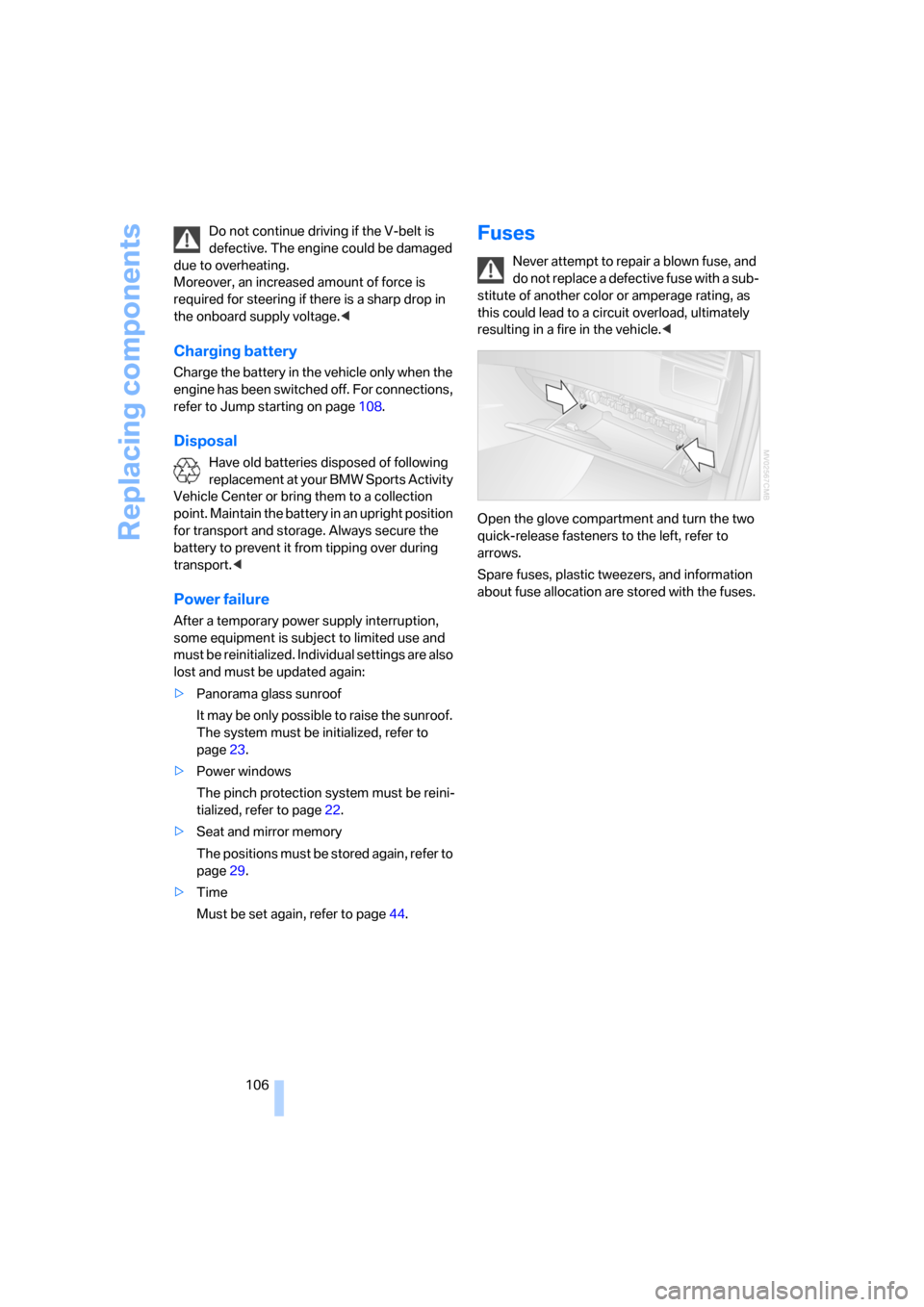
Open the glove compartment and turn the two
quick-release fasteners to the left, refer to
arrows.
Spare fuses, plastic tweezers, and information
about fuse allocation are stored with the fuses.
Page 112 of 133
Giving and receiving assistance
110
With tow bar
The towing vehicle must not be lighter
than the vehicle to be towed; otherwise,
it will not be possible to safely control vehicle
response.<
The tow fittings used should be on the same
side on both vehicles. Should it prove impossi-
ble to avoid mounting the tow bar at an offset
angle, please observe the following:
>Clearance and maneuvering capability will
be strictly limited in corners.
>When mounted at an angle, the tow bar will
exert lateral forces, tending to push the
vehicle sideways.
Secure the tow bar to the tow fittings
only. Otherwise, other vehicle parts could
be damaged.<
With tow-rope
When starting off in the towing vehicle, make
sure that the tow-rope is taut.
To avoid jerking and the associated
stresses on vehicle components when
towing, always use nylon ropes or nylon straps.
Secure the tow rope to the tow fittings only.
Otherwise, other vehicle parts could be dam-
aged.<
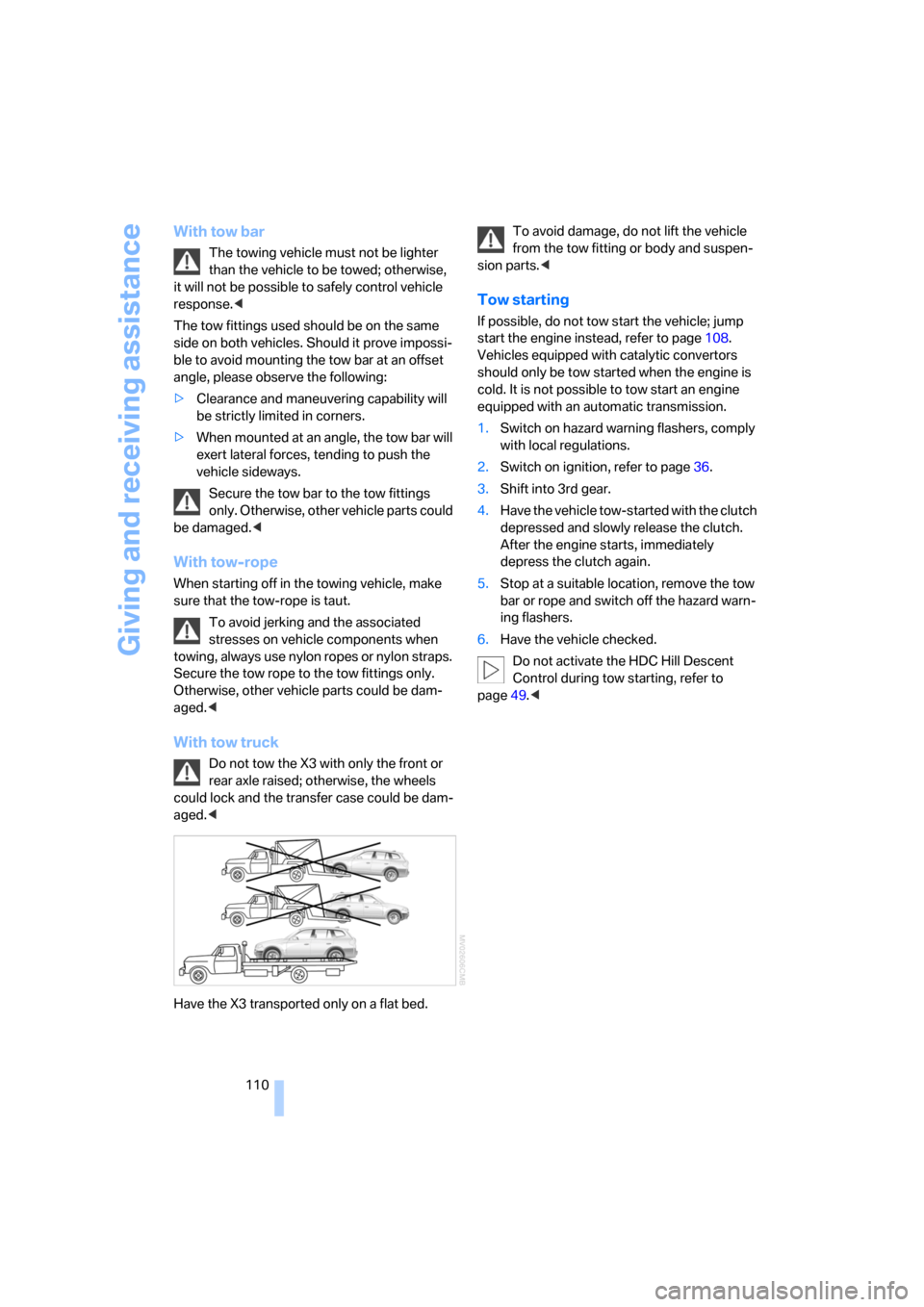
With tow truck
Do not tow the X3 with only the front or
rear axle raised; otherwise, the wheels
could lock and the transfer case could be dam-
aged.<
Have the X3 transported only on a flat bed.To avoid damage, do not lift the vehicle
from the tow fitting or body and suspen-
sion parts.<
Tow starting
If possible, do not tow start the vehicle; jump
start the engine instead, refer to page108.
Vehicles equipped with catalytic convertors
should only be tow started when the engine is
cold. It is not possible to tow start an engine
equipped with an automatic transmission.
1.Switch on hazard warning flashers, comply
with local regulations.
2.Switch on ignition, refer to page36.
3.Shift into 3rd gear.
4.Have the vehicle tow-started with the clutch
depressed and slowly release the clutch.
After the engine starts, immediately
depress the clutch again.
5.Stop at a suitable location, remove the tow
bar or rope and switch off the hazard warn-
ing flashers.
6.Have the vehicle checked.
Do not activate the HDC Hill Descent
Control during tow starting, refer to
page49.<
Page 121 of 133
Reference
At a glance
Controls
Driving tips
Mobility
119
Belts, refer to Safety belts29
Beverage holder, refer to Cup
holders66
Blower, refer to
– Air volume60
– Air volume, adjusting
manually63
BMW maintenance system97
Bottle holder, refer to Cup
holders66
Brake fluid96
– level96
– warning lamp96
Brake force display53
Brake lamps
– brake force display53
– indicator lamp, defective
bulb12,56
– replacing bulbs102
Brake light, refer to Brake
lamps102
Brake pads96
– breaking-in76
– warning lamp96
Brake pedal, refer to Safe
braking78
Brake rotors
– brake system76
– breaking-in76
Brakes78,96
– ABS48,78
– brake fluid96
– brake pads96
– breaking-in76
– handbrake37
– indicator/warning lamp12
Brake system96
– brake fluid96
– brake pads96
– breaking-in76
– disk brakes78
– warning lamp96
Brake wear warning
– refer to Brake pads96
– warning lamp96
Breakdown service, refer to
Receiving assistance107
Breaking-in76Bulb replacement, refer to
Lamps and bulbs99
Buttons on steering wheel13
C
California law
– Event Data Recorders98
– Proposition 65 Warning6
Calling, refer to telephone
Owner's Manual
Can holder, refer to Cup
holders66
Capacities116
Capacity, cargo area116
Car care, refer to Caring for
your vehicle brochure
Car-care products, refer to
Caring for your vehicle
brochure
Care, refer to Caring for your
vehicle brochure
Cargo, securing79
Cargo area21,70
– capacity116
– cover71
– emergency operation, refer
to Opening manually21
– enlarging70
– floor cover72
– folding rear seat backrest70
– lashing eyes73
– lid, refer to Liftgate21
– opening from outside21
– opening with remote
control19
– power socket69
Cargo loading78
– load79
– securing cargo79
– stowing cargo79
– vehicle78
Caring for artificial leather,
refer to Caring for your
vehicle brochure
Caring for carpet, refer to
Caring for your vehicle
brochureCaring for leather, refer to
Caring for your vehicle
brochure
Caring for plastic, refer to
Caring for your vehicle
brochure
Caring for vehicle finish, refer
to Caring for your vehicle
brochure
Car keys, refer to Key set18
Car phone, refer to separate
Owner's Manual
Car phone preparation69
Car radio, refer to Owner's
Manual for Radio/Onboard
Computer
Car wash77
– refer to Caring for your
vehicle brochure
Cassette operation, refer to
Owner's Manual for Radio/
Onboard Computer
CD operation, refer to Owner's
Manual for Radio/Onboard
Computer
Cellphone, refer to separate
Owner's Manual
Central locking system18
– interior20
Changes, technical, refer to
For your own safety6
Changing a wheel103
Changing gears
– automatic transmission with
Steptronic39
– manual transmission38
Changing wheels89
Charge-current indicator
lamp12,105
Charging battery106
Check Gas Cap, warning
lamp12,84
Checking oil level94
Child's seat, refer to Child
restraint systems33
Child-restraint fixing system
LATCH34