lock BMW X3 3.0I 2004 E83 User Guide
[x] Cancel search | Manufacturer: BMW, Model Year: 2004, Model line: X3 3.0I, Model: BMW X3 3.0I 2004 E83Pages: 132, PDF Size: 3.62 MB
Page 35 of 132
Reference
At a glance
Controls
Driving tips
Mobility
33
Vehicle Memory,
Key Memory
How the system functions
You have probably frequently wished that
you could configure individual functions of
your vehicle to reflect your own personal
requirements. In developing your vehicle,
BMW has incorporated a number of
options for personal adjustment. You can
have these programmed at your BMW
Sports Activity Vehicle Center.
There are vehicle-related and person-
related adjustments: Vehicle Memory and
Key Memory. You can configure up to four
different basic adjustments for four differ-
ent persons. The only requirement is that
each person uses his or her own master
key with remote control.
When your vehicle is unlocked with the
remote control, the vehicle recognizes the
individual user by means of a data
exchange with the key, and makes adjust-
ments accordingly.
In order for you to distinguish between the
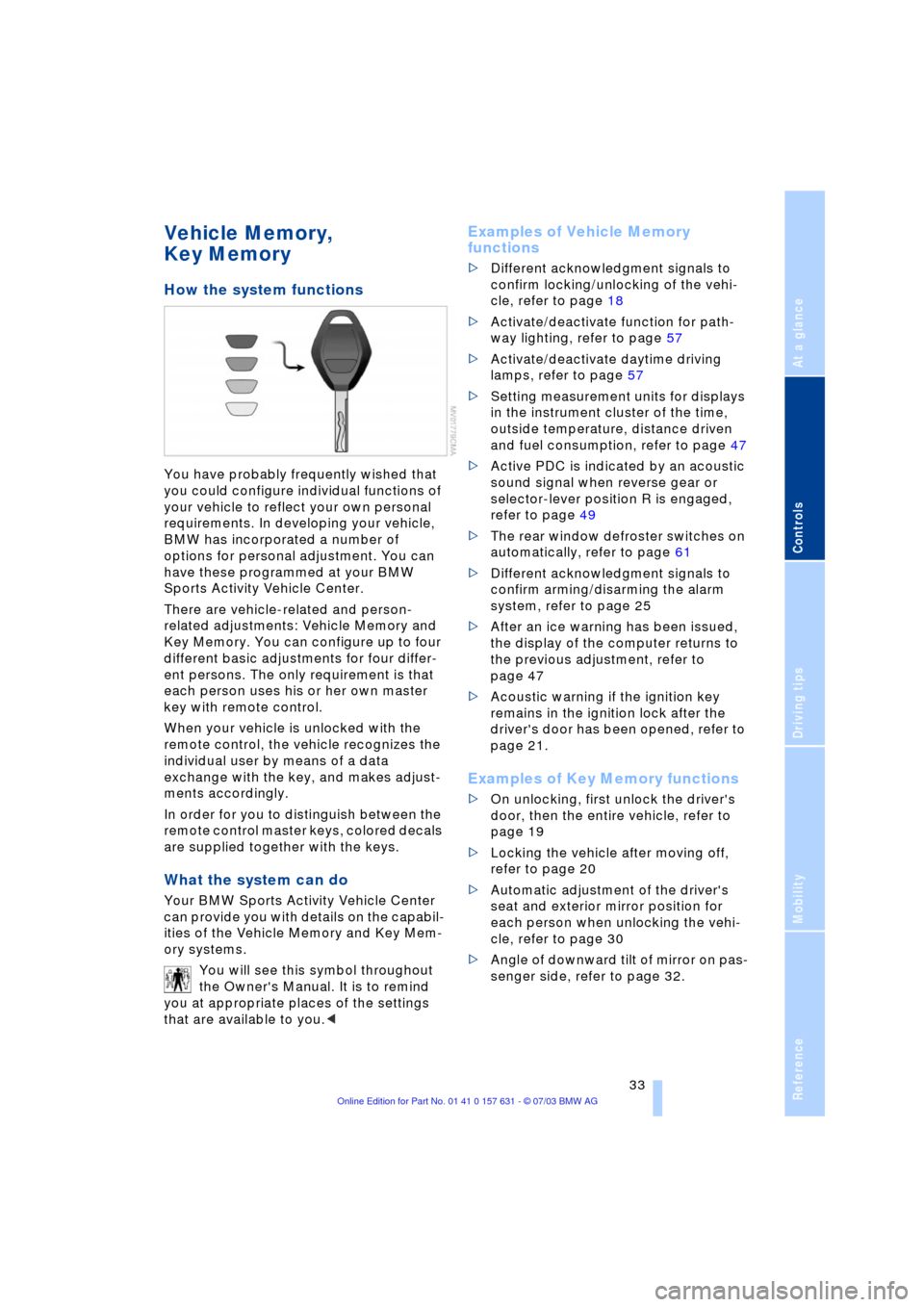
remote control master keys, colored decals
are supplied together with the keys.
What the system can do
Your BMW Sports Activity Vehicle Center
can provide you with details on the capabil-
ities of the Vehicle Memory and Key Mem-
ory systems.
You will see this symbol throughout
the Owner's Manual. It is to remind
you at appropriate places of the settings
that are available to you.<
Examples of Vehicle Memory
functions
>Different acknowledgment signals to
confirm locking/unlocking of the vehi-
cle, refer to page 18
>Activate/deactivate function for path-
way lighting, refer to page 57
>Activate/deactivate daytime driving
lamps, refer to page 57
>Setting measurement units for displays
in the instrument cluster of the time,
outside temperature, distance driven
and fuel consumption, refer to page 47
>Active PDC is indicated by an acoustic
sound signal when reverse gear or
selector-lever position R is engaged,
refer to page 49
>The rear window defroster switches on
automatically, refer to page 61
>Different acknowledgment signals to
confirm arming/disarming the alarm
system, refer to page 25
>After an ice warning has been issued,
the display of the computer returns to
the previous adjustment, refer to
page 47
>Acoustic warning if the ignition key
remains in the ignition lock after the
driver's door has been opened, refer to
page 21.
Examples of Key Memory functions
>On unlocking, first unlock the driver's
door, then the entire vehicle, refer to
page 19
>Locking the vehicle after moving off,
refer to page 20
>Automatic adjustment of the driver's
seat and exterior mirror position for
each person when unlocking the vehi-
cle, refer to page 30
>Angle of downward tilt of mirror on pas-
senger side, refer to page 32.
Page 37 of 132
Reference
At a glance
Controls
Driving tips
Mobility
35
Installing child-restraint
systems
Before installing any child-restraint system
or child seat, read the following:
Observe the child-restraint system
manufacturer's instructions for instal-
lation and use. Otherwise the degree of
protection can be reduced.
After an accident, have all parts of the rele-
vant vehicle safety belt system checked by
a BMW Sports Activity Vehicle Center and
replaced if necessary.<
Commercially-available child-restraint sys-
tems are designed to be secured with a lap
belt or with the lap belt portion of a combi-
nation lap/shoulder belt. Improperly or
inadequately installed restraint systems
can increase the risk of injury to children.
Always read and follow the instructions that
come with the system.
Child seat security
All of the rear belt retractors and the front
passenger's safety belt can be locked for
mounting and securing child-restraint sys-
tems.
Information regarding this is located near
the buckle latch of each safety belt.
To lock the safety belt
Pull the entire length of the belt from the
belt retractor. Allow the reel to retract the
belt somewhat and engage the buckle,
then tighten the belt against the child-
restraint system. The retraction mechanism
is now locked.
To unlock the safety belt
Release the buckle, remove the child-
restraint system and allow the belt retractor
to reel the belt completely in.
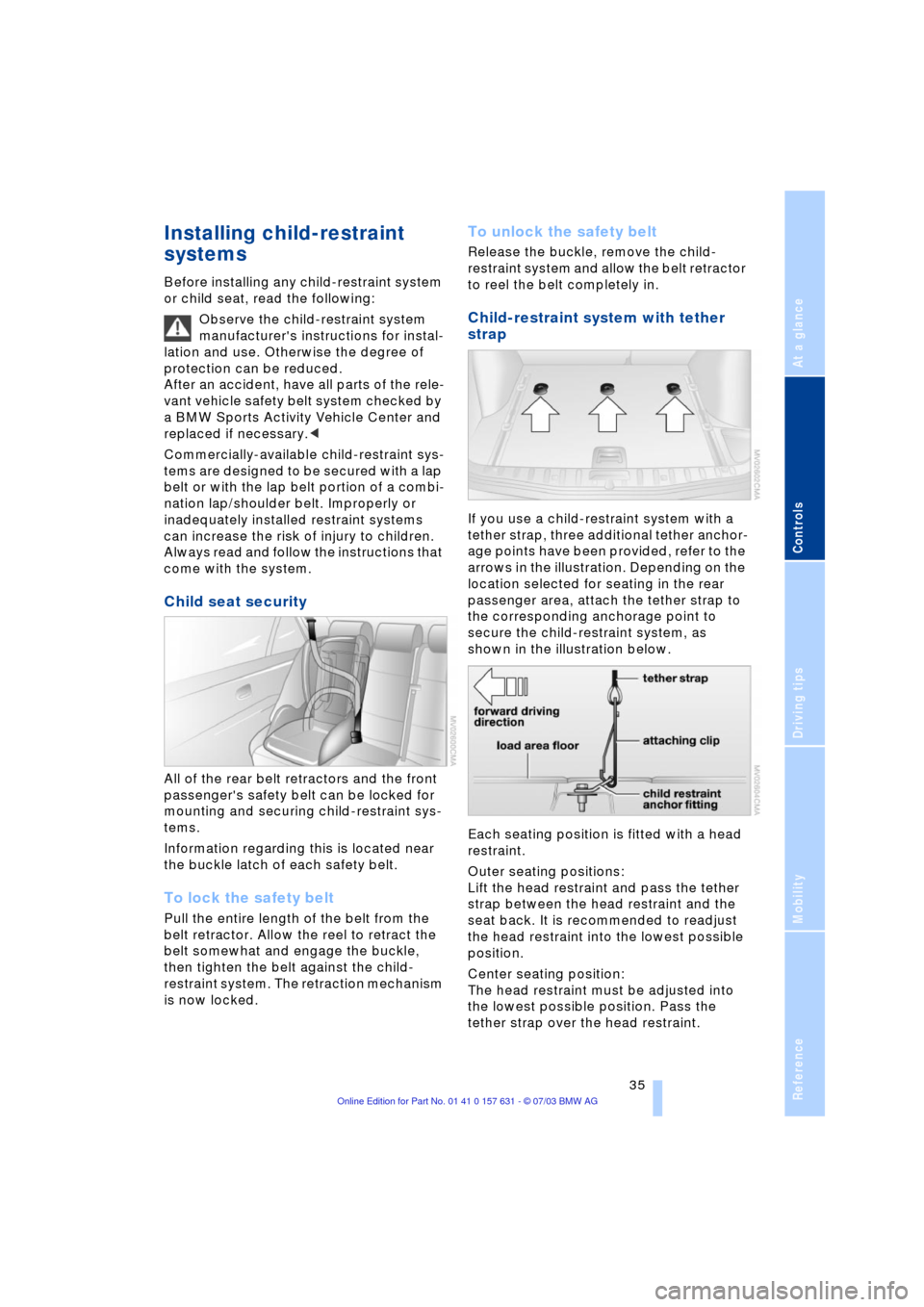
Child-restraint system with tether
strap
If you use a child-restraint system with a
tether strap, three additional tether anchor-
age points have been provided, refer to the
arrows in the illustration. Depending on the
location selected for seating in the rear
passenger area, attach the tether strap to
the corresponding anchorage point to
secure the child-restraint system, as
shown in the illustration below.
Each seating position is fitted with a head
restraint.
Outer seating positions:
Lift the head restraint and pass the tether
strap between the head restraint and the
seat back. It is recommended to readjust
the head restraint into the lowest possible
position.
Center seating position:
The head restraint must be adjusted into
the lowest possible position. Pass the
tether strap over the head restraint.
Page 38 of 132
Transporting children safely
36 Adjust the tether strap according to
the child-restraint manufacturer's
instructions.<
LATCH* child-restraint fixing
LATCH: Lower Anchor and Tethers for
CHildren.
The rear outer seating positions are pro-
vided with anchors for a LATCH child-
restraint fixing.
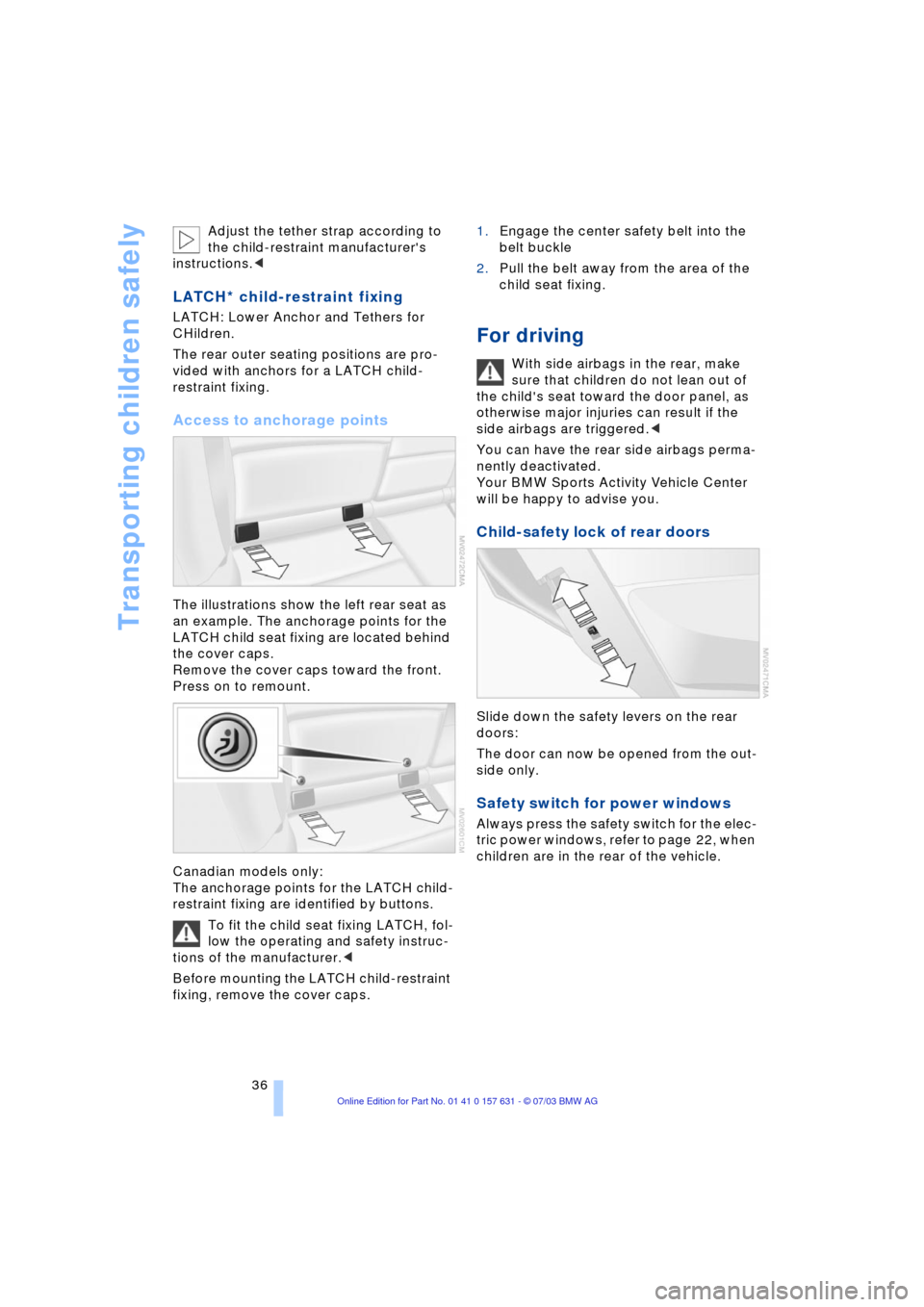
Access to anchorage points
The illustrations show the left rear seat as
an example. The anchorage points for the
LATCH child seat fixing are located behind
the cover caps.
Remove the cover caps toward the front.
Press on to remount.
Canadian models only:
The anchorage points for the LATCH child-
restraint fixing are identified by buttons.
To fit the child seat fixing LATCH, fol-
low the operating and safety instruc-
tions of the manufacturer.<
Before mounting the LATCH child-restraint
fixing, remove the cover caps.1.Engage the center safety belt into the
belt buckle
2.Pull the belt away from the area of the
child seat fixing.
For driving
With side airbags in the rear, make
sure that children do not lean out of
the child's seat toward the door panel, as
otherwise major injuries can result if the
side airbags are triggered.<
You can have the rear side airbags perma-
nently deactivated.
Your BMW Sports Activity Vehicle Center
will be happy to advise you.
Child-safety lock of rear doors
Slide down the safety levers on the rear
doors:
The door can now be opened from the out-
side only.
Safety switch for power windows
Always press the safety switch for the elec-
tric power windows, refer to page 22, when
children are in the rear of the vehicle.
Page 39 of 132
Reference
At a glance
Controls
Driving tips
Mobility
37
Driving
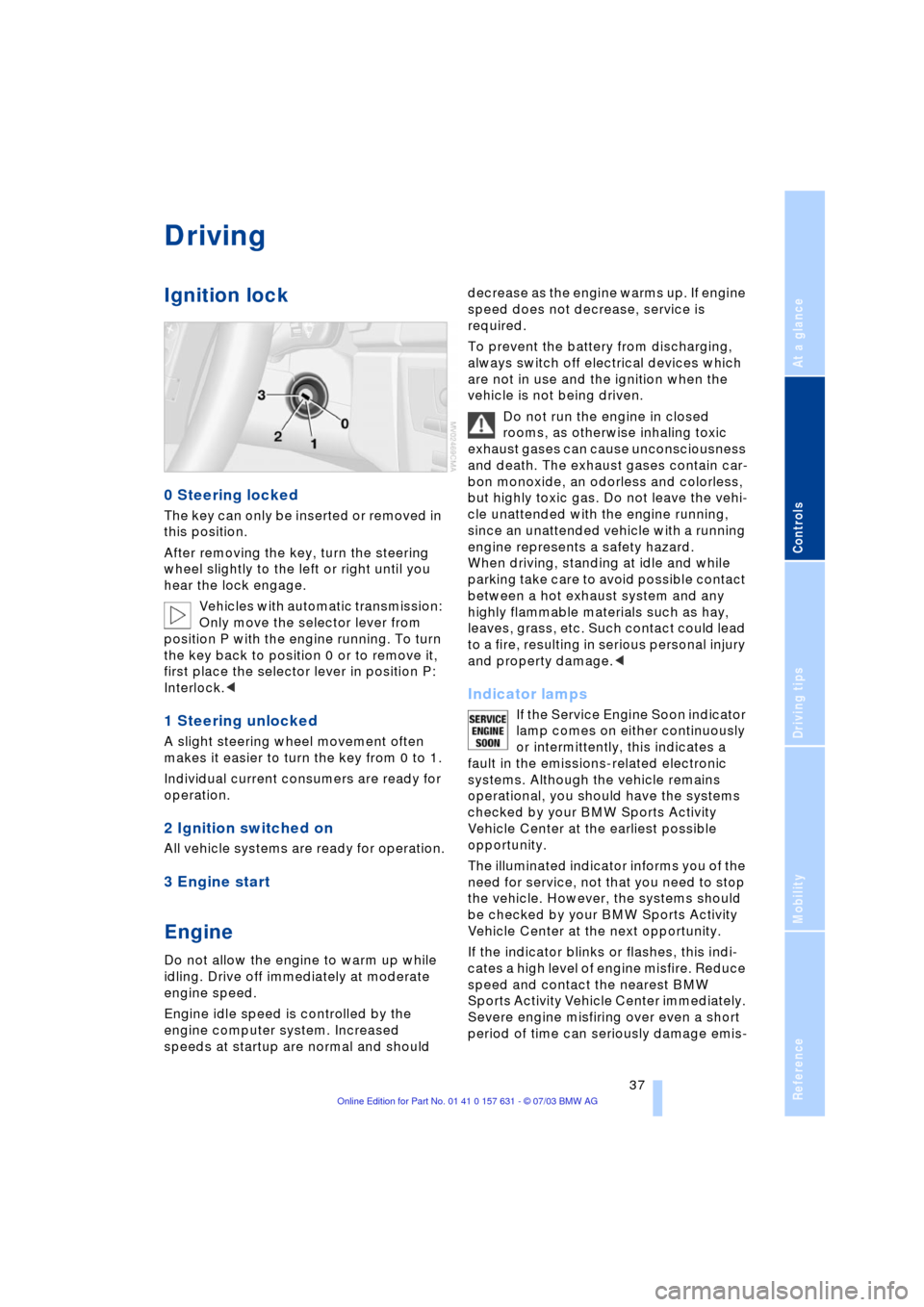
Ignition lock
0 Steering locked
The key can only be inserted or removed in
this position.
After removing the key, turn the steering
wheel slightly to the left or right until you
hear the lock engage.
Vehicles with automatic transmission:
Only move the selector lever from
position P with the engine running. To turn
the key back to position 0 or to remove it,
first place the selector lever in position P:
Interlock.<
1 Steering unlocked
A slight steering wheel movement often
makes it easier to turn the key from 0 to 1.
Individual current consumers are ready for
operation.
2 Ignition switched on
All vehicle systems are ready for operation.
3 Engine start
Engine
Do not allow the engine to warm up while
idling. Drive off immediately at moderate
engine speed.
Engine idle speed is controlled by the
engine computer system. Increased
speeds at startup are normal and should decrease as the engine warms up. If engine
speed does not decrease, service is
required.
To prevent the battery from discharging,
always switch off electrical devices which
are not in use and the ignition when the
vehicle is not being driven.
Do not run the engine in closed
rooms, as otherwise inhaling toxic
exhaust gases can cause unconsciousness
and death. The exhaust gases contain car-
bon monoxide, an odorless and colorless,
but highly toxic gas. Do not leave the vehi-
cle unattended with the engine running,
since an unattended vehicle with a running
engine represents a safety hazard.
When driving, standing at idle and while
parking take care to avoid possible contact
between a hot exhaust system and any
highly flammable materials such as hay,
leaves, grass, etc. Such contact could lead
to a fire, resulting in serious personal injury
and property damage.<
Indicator lamps
If the Service Engine Soon indicator
lamp comes on either continuously
or intermittently, this indicates a
fault in the emissions-related electronic
systems. Although the vehicle remains
operational, you should have the systems
checked by your BMW Sports Activity
Vehicle Center at the earliest possible
opportunity.
The illuminated indicator informs you of the
need for service, not that you need to stop
the vehicle. However, the systems should
be checked by your BMW Sports Activity
Vehicle Center at the next opportunity.
If the indicator blinks or flashes, this indi-
cates a high level of engine misfire. Reduce
speed and contact the nearest BMW
Sports Activity Vehicle Center immediately.
Severe engine misfiring over even a short
period of time can seriously damage emis-
Page 40 of 132
Driving
38 sion control system components, espe-
cially the catalytic converter.
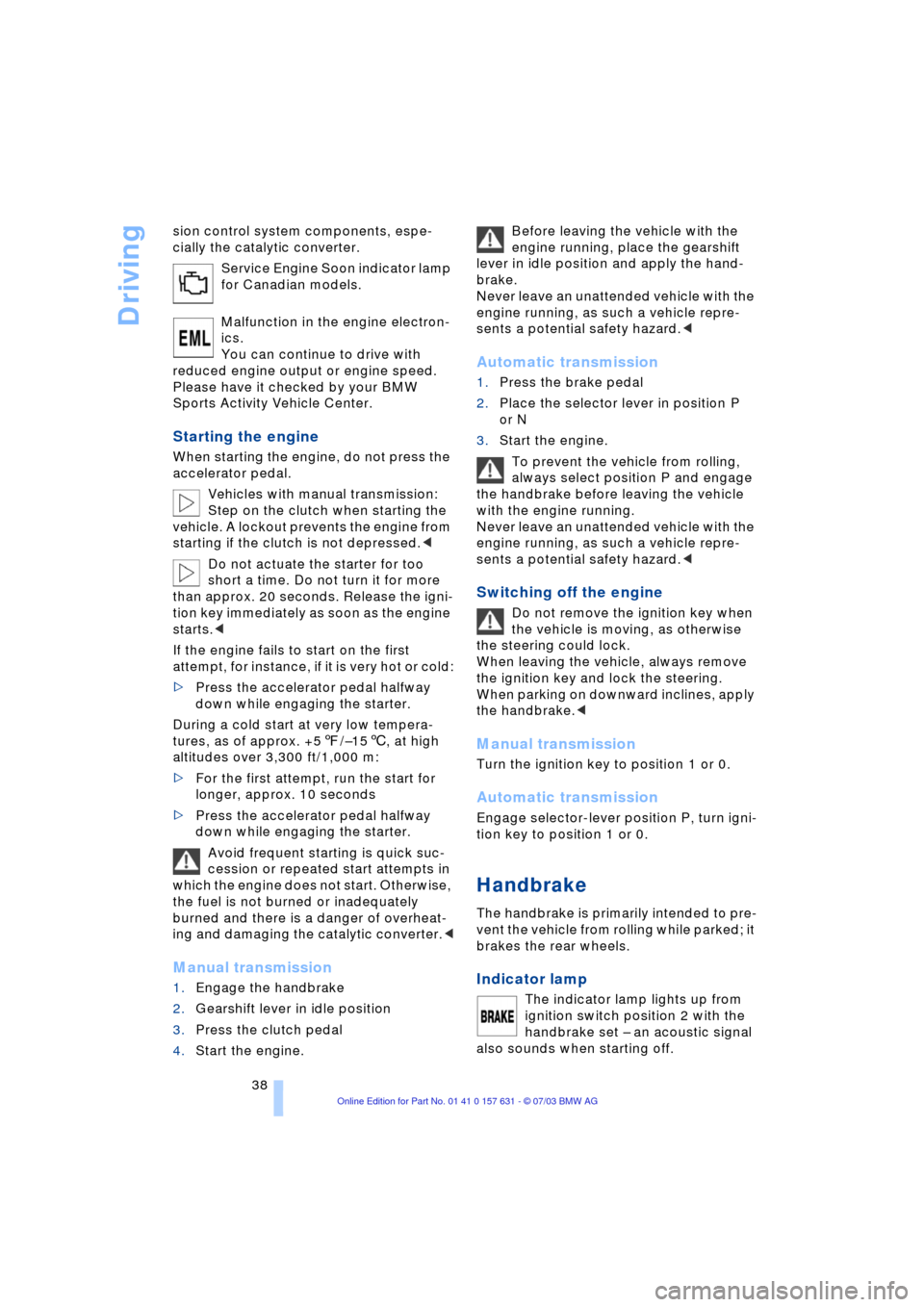
Service Engine Soon indicator lamp
for Canadian models.
Malfunction in the engine electron-
ics.
You can continue to drive with
reduced engine output or engine speed.
Please have it checked by your BMW
Sports Activity Vehicle Center.
Starting the engine
When starting the engine, do not press the
accelerator pedal.
Vehicles with manual transmission:
Step on the clutch when starting the
vehicle. A lockout prevents the engine from
starting if the clutch is not depressed.<
Do not actuate the starter for too
short a time. Do not turn it for more
than approx. 20 seconds. Release the igni-
tion key immediately as soon as the engine
starts.<
If the engine fails to start on the first
attempt, for instance, if it is very hot or cold:
>Press the accelerator pedal halfway
down while engaging the starter.
During a cold start at very low tempera-
tures, as of approx. +57/Ð156, at high
altitudes over 3,300 ft/1,000 m:
>For the first attempt, run the start for
longer, approx. 10 seconds
>Press the accelerator pedal halfway
down while engaging the starter.
Avoid frequent starting is quick suc-
cession or repeated start attempts in
which the engine does not start. Otherwise,
the fuel is not burned or inadequately
burned and there is a danger of overheat-
ing and damaging the catalytic converter.<
Manual transmission
1.Engage the handbrake
2.Gearshift lever in idle position
3.Press the clutch pedal
4.Start the engine.Before leaving the vehicle with the
engine running, place the gearshift
lever in idle position and apply the hand-
brake.
Never leave an unattended vehicle with the
engine running, as such a vehicle repre-
sents a potential safety hazard.<
Automatic transmission
1.Press the brake pedal
2.Place the selector lever in position P
or N
3.Start the engine.
To prevent the vehicle from rolling,
always select position P and engage
the handbrake before leaving the vehicle
with the engine running.
Never leave an unattended vehicle with the
engine running, as such a vehicle repre-
sents a potential safety hazard.<
Switching off the engine
Do not remove the ignition key when
the vehicle is moving, as otherwise
the steering could lock.
When leaving the vehicle, always remove
the ignition key and lock the steering.
When parking on downward inclines, apply
the handbrake.<
Manual transmission
Turn the ignition key to position 1 or 0.
Automatic transmission
Engage selector-lever position P, turn igni-
tion key to position 1 or 0.
Handbrake
The handbrake is primarily intended to pre-
vent the vehicle from rolling while parked; it
brakes the rear wheels.
Indicator lamp
The indicator lamp lights up from
ignition switch position 2 with the
handbrake set Ð an acoustic signal
also sounds when starting off.
Page 42 of 132
Driving
40
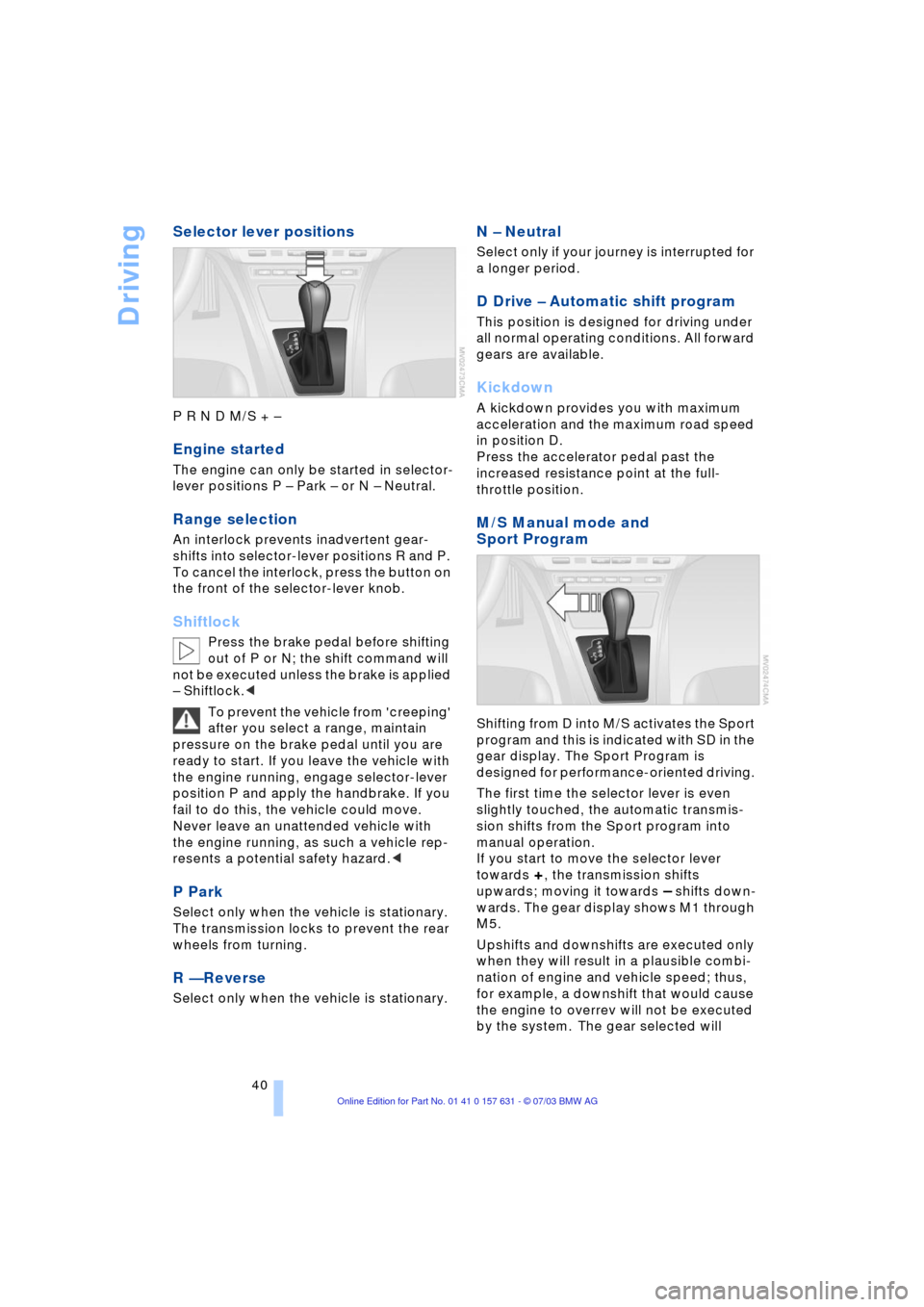
Selector lever positions
P R N D M/S + Ð
Engine started
The engine can only be started in selector-
lever positions P Ð Park Ð or N Ð Neutral.
Range selection
An interlock prevents inadvertent gear-
shifts into selector-lever positions R and P.
To cancel the interlock, press the button on
the front of the selector-lever knob.
Shiftlock
Press the brake pedal before shifting
out of P or N; the shift command will
not be executed unless the brake is applied
Ð Shiftlock.<
To prevent the vehicle from 'creeping'
after you select a range, maintain
pressure on the brake pedal until you are
ready to start. If you leave the vehicle with
the engine running, engage selector-lever
position P and apply the handbrake. If you
fail to do this, the vehicle could move.
Never leave an unattended vehicle with
the engine running, as such a vehicle rep-
resents a potential safety hazard.<
P Park
Select only when the vehicle is stationary.
The transmission locks to prevent the rear
wheels from turning.
R Ñ Reverse
Select only when the vehicle is stationary.
N Ð Neutral
Select only if your journey is interrupted for
a longer period.
D Drive Ð Automatic shift program
This position is designed for driving under
all normal operating conditions. All forward
gears are available.
Kickdown
A kickdown provides you with maximum
acceleration and the maximum road speed
in position D.
Press the accelerator pedal past the
increased resistance point at the full-
throttle position.
M/S Manual mode and
Sport Program
Shifting from D into M/S activates the Sport
program and this is indicated with SD in the
gear display. The Sport Program is
designed for performance-oriented driving.
The first time the selector lever is even
slightly touched, the automatic transmis-
sion shifts from the Sport program into
manual operation.
If you start to move the selector lever
towards
+, the transmission shifts
upwards; moving it towards
Ð shifts down-
wards. The gear display shows M1 through
M5.
Upshifts and downshifts are executed only
when they will result in a plausible combi-
nation of engine and vehicle speed; thus,
for example, a downshift that would cause
the engine to overrev will not be executed
by the system. The gear selected will
Page 48 of 132
Everything under control
46
Between the blue and red fields
Normal operating range. The dial may wan-
der into the red field.
Red
Comes on while driving:
The engine is overheated. Switch off the
engine immediately and allow it to cool
down.
Checking coolant level, refer to page 96.
When you switch on the ignition, the warn-
ing lamp 1 comes on briefly to confirm that
the system is operational.
Service Interval Display
Remaining distance until next
service due
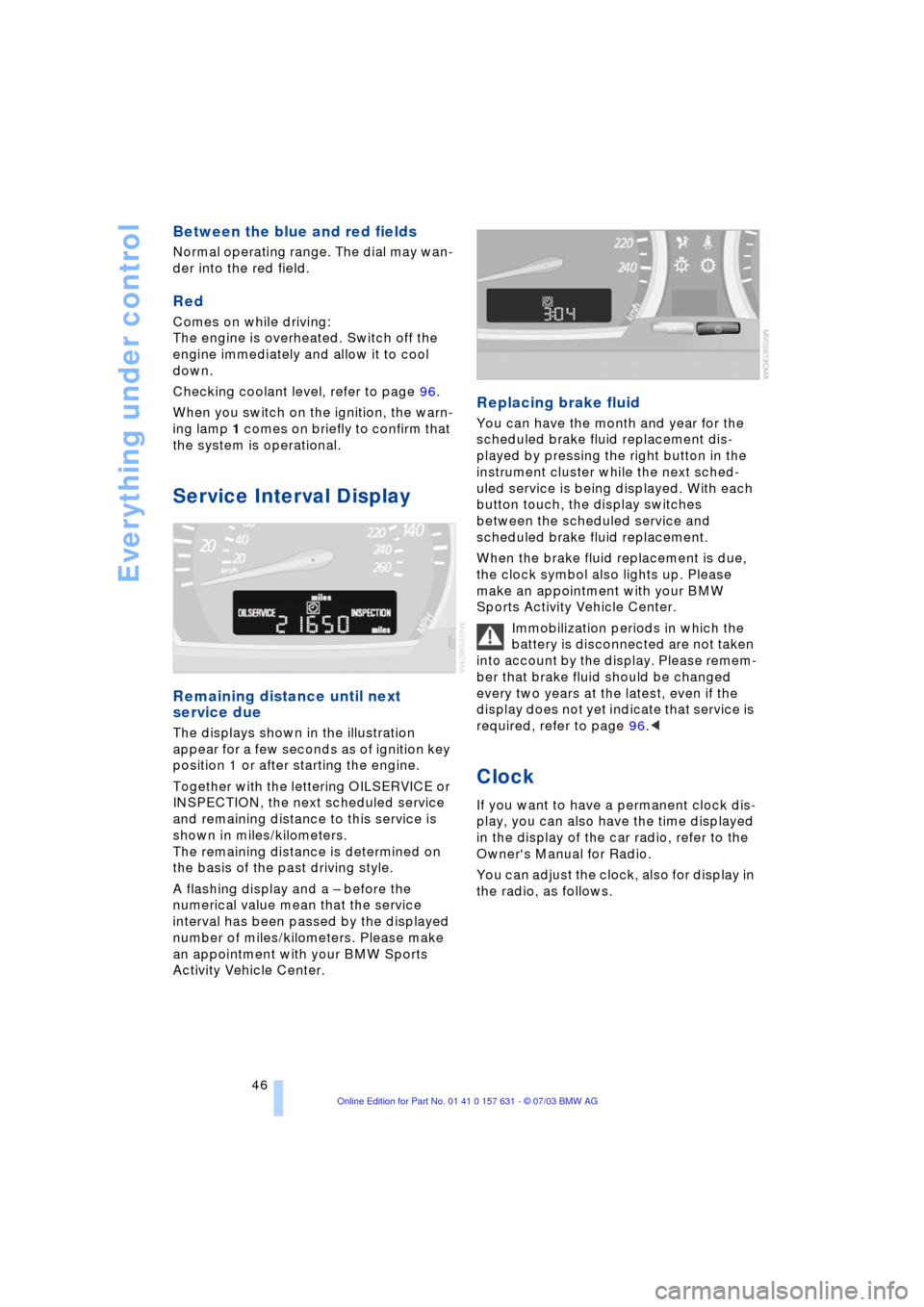
The displays shown in the illustration
appear for a few seconds as of ignition key
position 1 or after starting the engine.
Together with the lettering OILSERVICE or
INSPECTION, the next scheduled service
and remaining distance to this service is
shown in miles/kilometers.
The remaining distance is determined on
the basis of the past driving style.
A flashing display and a Ð before the
numerical value mean that the service
interval has been passed by the displayed
number of miles/kilometers. Please make
an appointment with your BMW Sports
Activity Vehicle Center.
Replacing brake fluid
You can have the month and year for the
scheduled brake fluid replacement dis-
played by pressing the right button in the
instrument cluster while the next sched-
uled service is being displayed. With each
button touch, the display switches
between the scheduled service and
scheduled brake fluid replacement.
When the brake fluid replacement is due,
the clock symbol also lights up. Please
make an appointment with your BMW
Sports Activity Vehicle Center.
Immobilization periods in which the
battery is disconnected are not taken
into account by the display. Please remem-
ber that brake fluid should be changed
every two years at the latest, even if the
display does not yet indicate that service is
required, refer to page 96.<
Clock
If you want to have a permanent clock dis-
play, you can also have the time displayed
in the display of the car radio, refer to the
Owner's Manual for Radio.
You can adjust the clock, also for display in
the radio, as follows.
Page 50 of 132
Everything under control
48 perature display. In addition, an acoustic
signal sounds and the display flashes for a
short time.
After an ice warning has been issued,
the display returns to the previous
setting. You can have this activated/deacti-
vated.<
Please bear in mind that the ice warn-
ing does nothing to alter the fact that
glare ice may be present on roads at tem-
peratures higher than +37.57/+36, for
instance, on bridges and shaded roads.<
Clock
12 or 24 hour mode
If your vehicle is equipped with a computer,
you can have the time displayed in the 12
or 24 hour mode.
During the display, hold down the com-
puter button in the turn indicator lever until
the display changes.
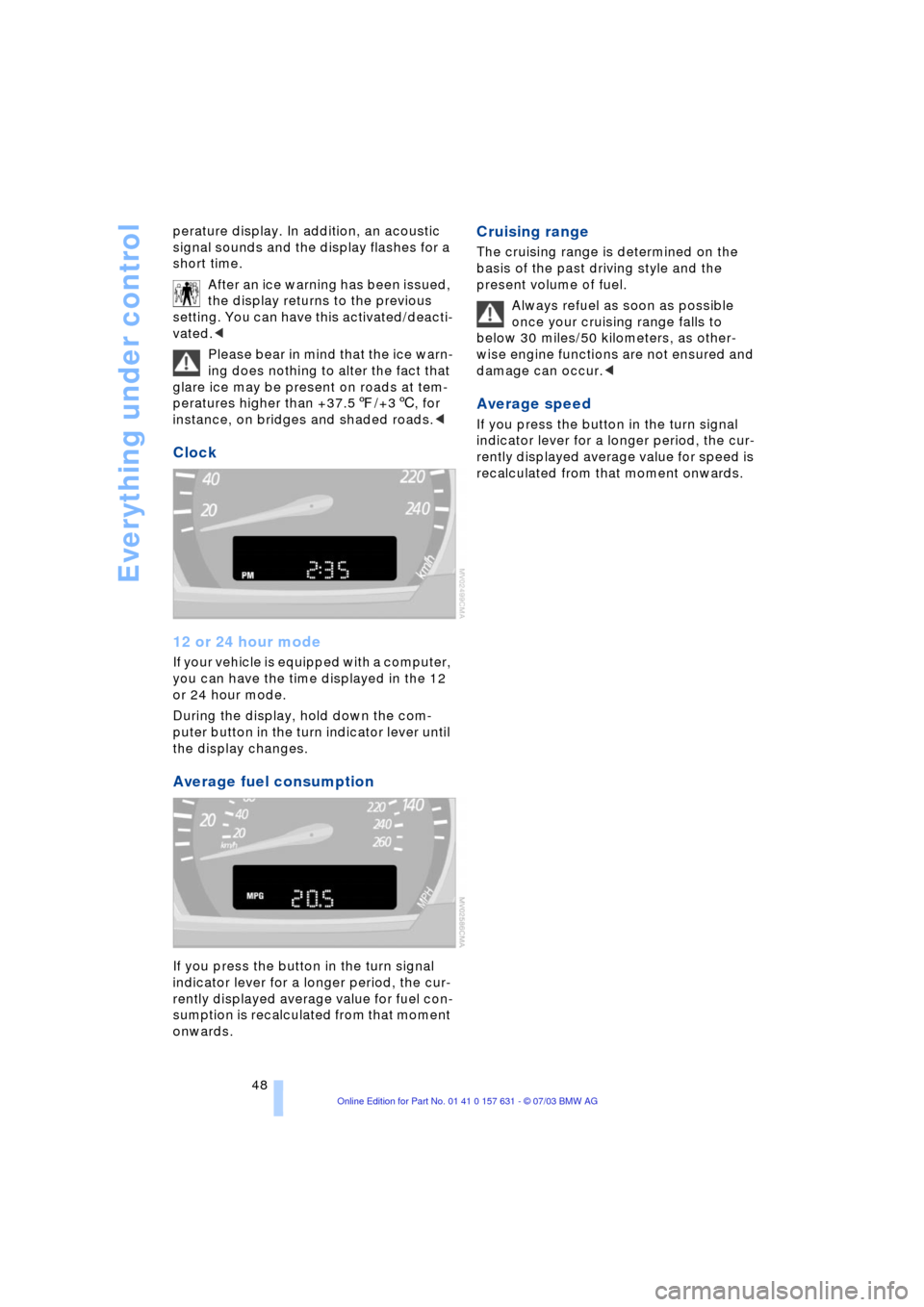
Average fuel consumption
If you press the button in the turn signal
indicator lever for a longer period, the cur-
rently displayed average value for fuel con-
sumption is recalculated from that moment
onwards.
Cruising range
The cruising range is determined on the
basis of the past driving style and the
present volume of fuel.
Always refuel as soon as possible
once your cruising range falls to
below 30 miles/50 kilometers, as other-
wise engine functions are not ensured and
damage can occur.<
Average speed
If you press the button in the turn signal
indicator lever for a longer period, the cur-
rently displayed average value for speed is
recalculated from that moment onwards.
Page 52 of 132
Technology for comfort, convenience and safety
50
Limits of the system
Even with PDC, final responsibility for
estimating the distance between the
vehicle and any obstructions always
remains with the driver. Even when sensors
are involved, there is a blind spot in which
objects cannot be detected. The system is
also subject to the physical limits that apply
to all forms of ultrasonic measurement,
such as those encountered with tow bars
and trailer couplings, or thin and wedge-
shaped objects etc. Low objects already
displayed, e.g. a curb, can also disappear
from the detection area of the sensors
again before a continuous tone sounds.
Loud sources of sound, inside and outside
the vehicle, could drown out the PDC sig-
nal tone.<
Keep the sensors clean and free of ice
or snow in order to ensure that they
will continue to operate effectively.
Do not apply high pressure spray to the
sensors for a prolonged period of time.
Keep the spray at least 4 in/10 cm away
from the sensors.<
Driving stability control
systems
Your BMW is equipped with an extended
array of systems designed to enhance and
maintain vehicle stability under extreme
conditions. The following section describes
these functions based on ABS, DSC, HDC
and xDrive.
Antilock Brake System ABS
ABS enhances active safety by preventing
the wheels from locking under braking. The
vehicle continues to be steerable during
hard braking.
ABS also includes Electronic brake-force
distribution EBV.
Safe braking, refer to page 77.
Electronic brake-force distribution
EBV
EBV controls the brake system's applica-
tion pressure at the rear wheels to ensure
stable deceleration.
Dynamic Brake Control DBC
The Dynamic Brake Control actively sup-
ports the driver in dangerous braking situa-
tions. Quickly pumping the brake pedal
increases the braking effect with low pedal
pressure so that the shortest possible
braking distance is achieved. This system
exploits all of the benefits provided by ABS.
Do not reduce the pressure on the brake
pedal for the duration of the brake applica-
tion. DBC is deactivated when you release
the brake pedal.
Dynamic Stability Control DSC
The concept
DSC maintains vehicle stability, even in
critical driving situations.
The DSC is operational every time you start
the engine.
The system optimizes the driving stability
during acceleration and when starting from
a standstill. The system recognizes any
tendency for the vehicle to assume an
unstable attitude such as oversteer or
understeer; it then counteracts this ten-
dency with a combination of graduated
reductions in engine torque and selective
braking intervention at individual wheels.
DSC provides optimal stability within the
limits defined by the laws of physics.
The laws of physics cannot be
repealed, even with DSC. An appro-
priate driving style always remains the
responsibility of the driver. Avoid using the
additional safety margin provided by the
system as an excuse for taking unneces-
sary risks.
Do not make any modifications to the DSC
system. Never allow anyone other than
authorized professional technicians to
carry out service or repairs on the system.<
Page 53 of 132
Reference
At a glance
Controls
Driving tips
Mobility
51
Indicator lamp
The indicator lamp in the instrument
cluster goes out soon after you start
the engine.
If the indicator lamp flashes:
DSC is active and is regulating the drive
and braking forces.
The indicator lamp stays lit:
DSC has been switched off using the but-
ton and the stabilizing interventions are no
longer available.
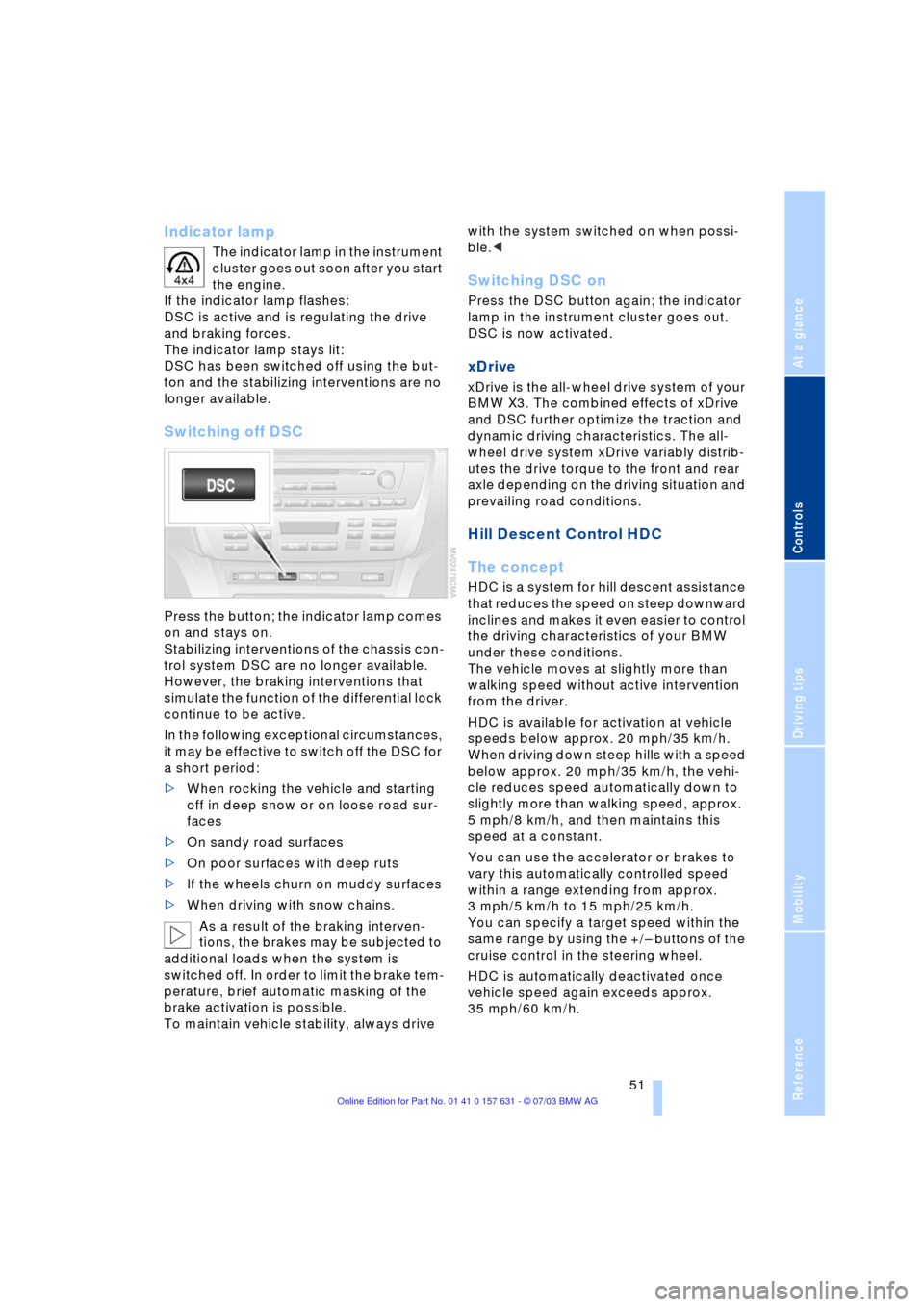
Switching off DSC
Press the button; the indicator lamp comes
on and stays on.
Stabilizing interventions of the chassis con-
trol system DSC are no longer available.
However, the braking interventions that
simulate the function of the differential lock
continue to be active.
In the following exceptional circumstances,
it may be effective to switch off the DSC for
a short period:
>When rocking the vehicle and starting
off in deep snow or on loose road sur-
faces
>On sandy road surfaces
>On poor surfaces with deep ruts
>If the wheels churn on muddy surfaces
>When driving with snow chains.
As a result of the braking interven-
tions, the brakes may be subjected to
additional loads when the system is
switched off. In order to limit the brake tem-
perature, brief automatic masking of the
brake activation is possible.
To maintain vehicle stability, always drive with the system switched on when possi-
ble.<
Switching DSC on
Press the DSC button again; the indicator
lamp in the instrument cluster goes out.
DSC is now activated.
xDrive
xDrive is the all-wheel drive system of your
BMW X3. The combined effects of xDrive
and DSC further optimize the traction and
dynamic driving characteristics. The all-
wheel drive system xDrive variably distrib-
utes the drive torque to the front and rear
axle depending on the driving situation and
prevailing road conditions.
Hill Descent Control HDC
The concept
HDC is a system for hill descent assistance
that reduces the speed on steep downward
inclines and makes it even easier to control
the driving characteristics of your BMW
under these conditions.
The vehicle moves at slightly more than
walking speed without active intervention
from the driver.
HDC is available for activation at vehicle
speeds below approx. 20 mph/35 km/h.
When driving down steep hills with a speed
below approx. 20 mph/35 km/h, the vehi-
cle reduces speed automatically down to
slightly more than walking speed, approx.
5 mph/8 km/h, and then maintains this
speed at a constant.
You can use the accelerator or brakes to
vary this automatically controlled speed
within a range extending from approx.
3 mph/5 km/h to 15 mph/25 km/h.
You can specify a target speed within the
same range by using the +/Ð buttons of the
cruise control in the steering wheel.
HDC is automatically deactivated once
vehicle speed again exceeds approx.
35 mph/60 km/h.