mode BMW X3 3.0I 2006 E83 Owner's Guide
[x] Cancel search | Manufacturer: BMW, Model Year: 2006, Model line: X3 3.0I, Model: BMW X3 3.0I 2006 E83Pages: 133, PDF Size: 8.37 MB
Page 62 of 133
Air conditioner
60
Air volume
You can vary the air volume in
steps 1 through 4. The heating or
cooling output is more effective
with a higher air volume.
Switching system on/off
Turn air volume rotary switch to 0. The blower
and air conditioning system are completely
switched off, the air flow is shut off.
To switch on the air conditioning system, set an
arbitrary air volume.
Temperature
To increase the temperature, turn
to the right, toward red.
For a lower temperature, turn the
rotary switch counterclockwise
toward blue.
Air distribution
You can direct air to flow onto the
windows , toward the upper
body and into the footwell .
Intermediate settings are possible.
Rear window defroster
The rear window heating switches
off automatically after a certain
amount of time.
Switching cooling function on/off
When the air conditioning is on, the
air is cooled, dehumidified, and
then reheated depending on the
temperature setting.
Depending on the weather, the windshield may
fog over briefly when the engine is started.
Recirculated-air mode
You can respond to unpleasant
odors outside the vehicle by tem-
porarily suspending the supply of
outside air. The system then recirculates the air
currently within the vehicle.
If condensation starts to form on the
inside window surfaces during operation
in the recirculated-air mode, you should switch
it off and increase the air supply as needed.
The recirculated-air mode should not be used
over a sustained period of time; otherwise, the
air quality inside the vehicle will steadily deteri-
orate.<
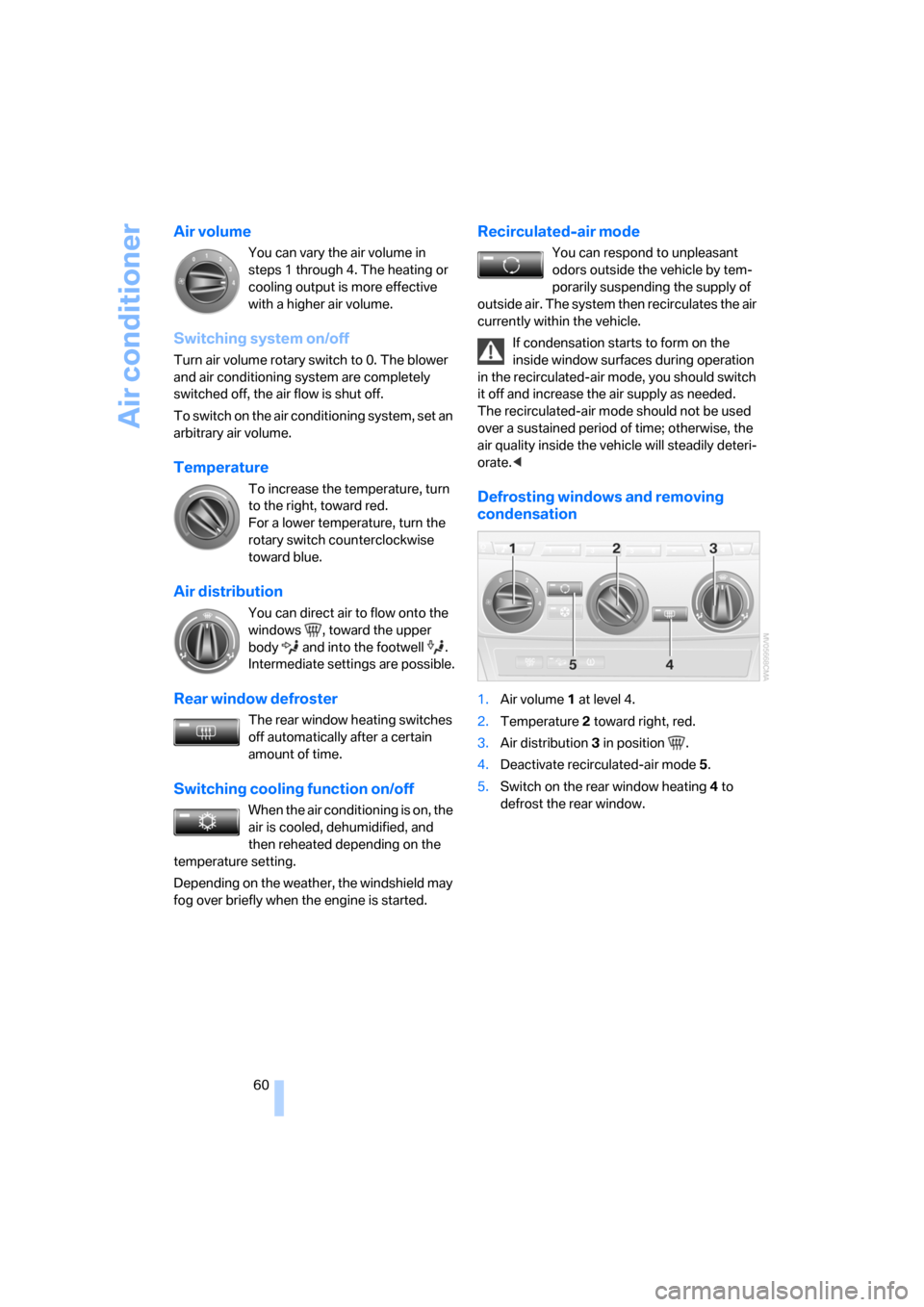
Defrosting windows and removing
condensation
1.Air volume 1 at level 4.
2.Temperature 2 toward right, red.
3.Air distribution 3 in position .
4.Deactivate recirculated-air mode 5.
5.Switch on the rear window heating 4 to
defrost the rear window.
Page 64 of 133
Air conditioner
62
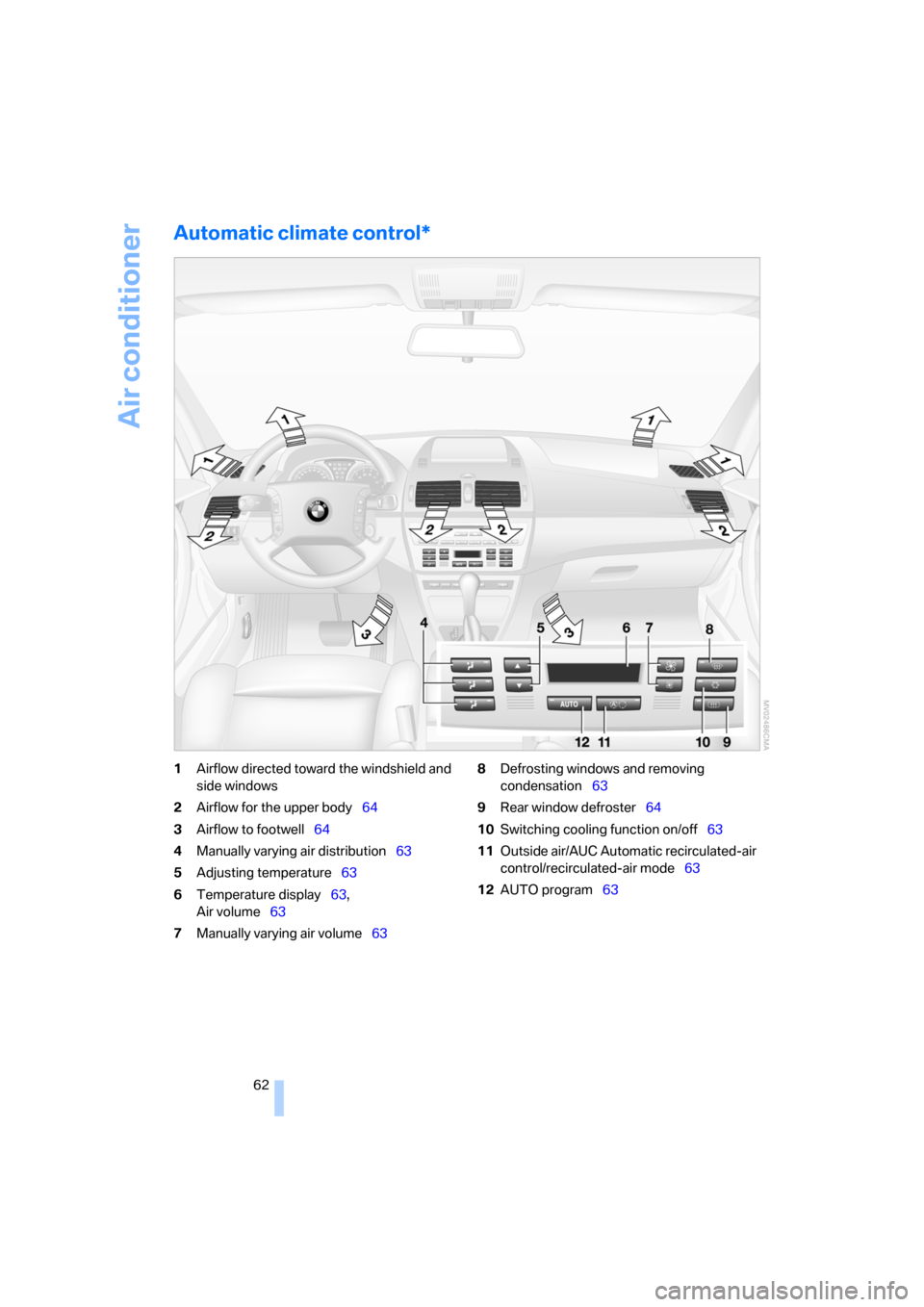
Automatic climate control*
1Airflow directed toward the windshield and
side windows
2Airflow for the upper body64
3Airflow to footwell64
4Manually varying air distribution63
5Adjusting temperature63
6Temperature display63,
Air volume63
7Manually varying air volume638Defrosting windows and removing
condensation63
9Rear window defroster64
10Switching cooling function on/off63
11Outside air/AUC Automatic recirculated-air
control/recirculated-air mode63
12AUTO program63
Page 65 of 133
Reference
At a glance
Controls
Driving tips
Mobility
63
A congenial climate
For almost all conditions, the AUTO pro-
gram12 offers the optimal air distribution and
air volume, refer to AUTO program below. You
need only select an interior temperature that
you find pleasant.
The following sections contain more detailed
information on the available setting options.
Your vehicle has been designed to auto-
matically select your personal climate-
control settings whenever you unlock the doors
using your individually programmed remote
control.<
AUTO program
The AUTO program handles the
adjustment of air distribution to the
windshield and side windows, in
the direction of the upper body, and in the foot-
well. It also adapts your instructions for the air
volume and temperature to outside influences
throughout the year, e.g. solar radiation or win-
dow condensation.
The cooling is switched on automatically along
with the AUTO program.
Manually switching air distribution on/
off
You can direct air to flow onto the
windows , toward the upper
body and into the footwell .
You can reactivate the automatic
air distribution mode by selecting
the AUTO button.
Temperature
Set the desired temperature.
The automatic climate control
assures that this temperature is
reached as quickly as possible any
time of year, using maximum cool-
ing or heating capacity as needed, and then
keeps this temperature constant.When you change between different tem-
perature settings in rapid succession, the
system does not have enough time to achieve
the desired temperature.<
Manually adjusting air volume
By pressing the lower button, you
can reduce the air volume. You can
increase it by pressing the upper
button.
You can reactivate the automatic
air volume mode by pressing the AUTO button.
Switching system on/off
At the lowest fan speed, press the lower button
to turn off the automatic climate control com-
pletely. All displays disappear.
Press any button to turn the automatic climate
control back on again.
Defrosting windows and removing
condensation
This program quickly removes ice
and condensation from the wind-
shield and front door windows.
Switching cooling function on/off
When the air conditioning is on, the
air is cooled, dehumidified, and
then reheated depending on the
temperature setting. Depending on the
weather, the windshield may fog over briefly
when the engine is started.
The cooling function is automatically switched
on along with the AUTO program. It is only pos-
sible to cool the passenger compartment with
the engine running.
AUC Automatic Recirculated-air
Control/recirculated air mode
You can set the desired operating
mode by pressing the button
repeatedly:
>LEDs off: outside air continuously flows into
the vehicle.
Page 66 of 133
Air conditioner
64 >Left LED on, AUC mode: a sensor detects
pollutants in the outside air. The system
suspends the supply of outside air as
needed and recirculates the air currently
within the vehicle. As soon as the concen-
tration of pollutants in the outside air has
decreased sufficiently, the system switches
automatically back to supplying outside air.
>Right LED on, recirculated-air mode: the
outside air supply into the vehicle is shut off
continuously. The system then recirculates
the air currently within the vehicle.
If condensation starts to form on the
inside window surfaces during operation
in the recirculated-air mode, you should switch
it off and increase the air supply as needed.
The recirculated-air mode should not be used
over a sustained period of time; otherwise, the
air quality inside the vehicle will steadily deteri-
orate.<
Rear window defroster
The rear window heating switches
off automatically after a certain
amount of time.
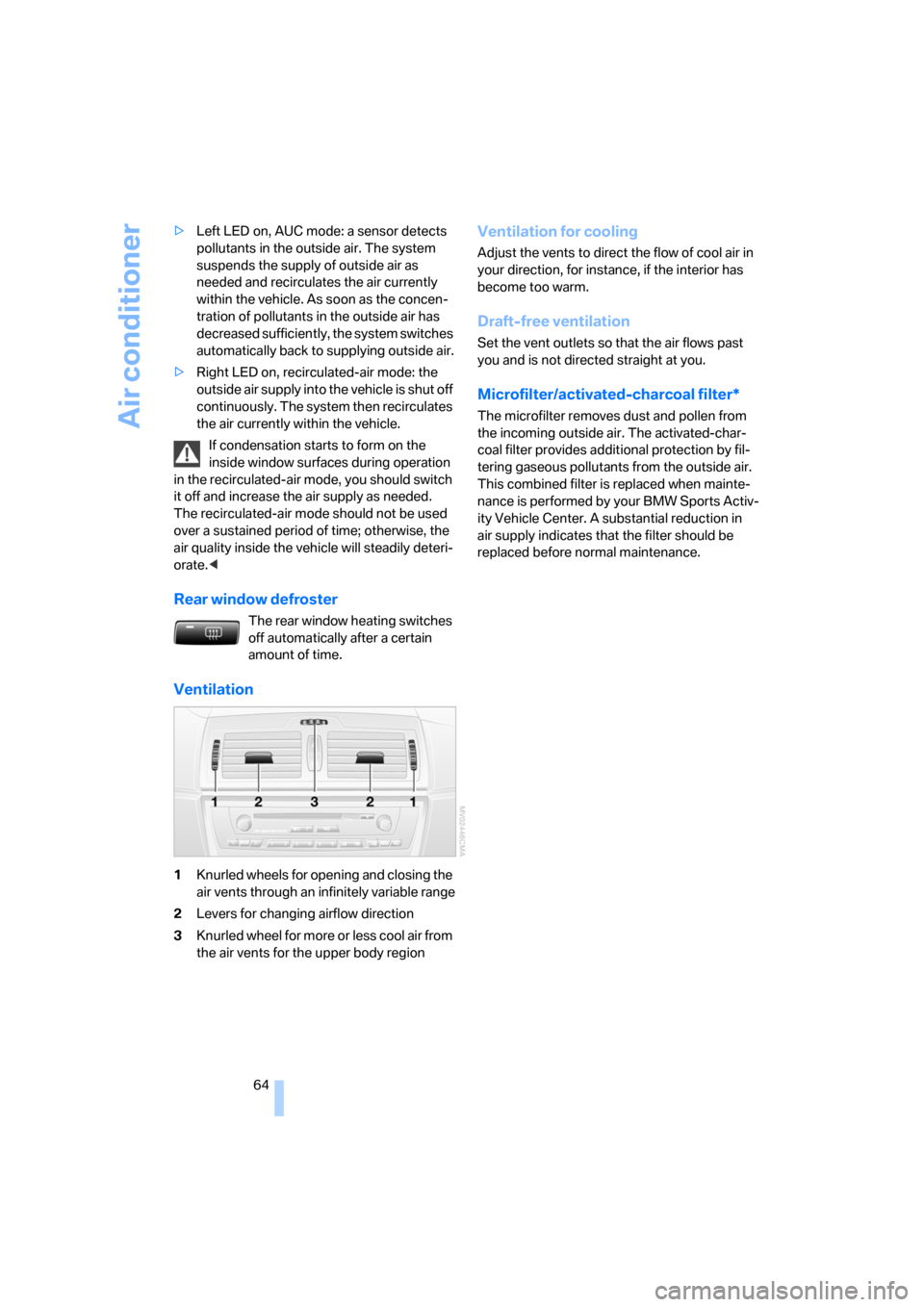
Ventilation
1Knurled wheels for opening and closing the
air vents through an infinitely variable range
2Levers for changing airflow direction
3Knurled wheel for more or less cool air from
the air vents for the upper body region
Ventilation for cooling
Adjust the vents to direct the flow of cool air in
your direction, for instance, if the interior has
become too warm.
Draft-free ventilation
Set the vent outlets so that the air flows past
you and is not directed straight at you.
Microfilter/activated-charcoal filter*
The microfilter removes dust and pollen from
the incoming outside air. The activated-char-
coal filter provides additional protection by fil-
tering gaseous pollutants from the outside air.
This combined filter is replaced when mainte-
nance is performed by your BMW Sports Activ-
ity Vehicle Center. A substantial reduction in
air supply indicates that the filter should be
replaced before normal maintenance.
Page 80 of 133
Things to remember when driving
78
Safe braking
Your BMW is equipped with ABS as standard
equipment. In situations in which it is required, it
is best to apply the brakes fully. Since the vehi-
cle maintains steering responsiveness, you can
nevertheless avoid possible obstacles with a
minimum of steering effort.
Pulsation at the brake pedal combined with
sounds from the hydraulic circuits indicates to
the driver that ABS is in its active mode.
Wet roads
On wet roads or in heavy rain, briefly apply light
pressure to the brake pedal every few miles.
Watch traffic conditions to ensure that this
maneuver does not endanger other road users.
The heat that is generated by the brake applica-
tions helps to dry the brake pads and rotors.
The full braking force will then be available
when you need it.
Hills
To prevent overheating and reduced effi-
ciency of the brake system, drive long or
steep downhill grades in the gear in which the
least braking is required. Otherwise, even light
but continuous pressure on the brake can lead
to high temperatures, brake wear and possibly
even brake failure.<
The braking action of the engine can be further
intensified by downshifting, all the way down to
first gear if need be. This strategy helps you
avoid placing excessive loads on the brake sys-
tem. Downshifting in manual mode of automatic
transmission, refer to page39. When descend-
ing hills slowly, use HDC Hill Descent Control,
refer to page49.
Never drive with the clutch depressed,
with the transmission in neutral, or with
the engine switched off; otherwise, you will
have neither the braking action of the engine or
nor its power assistance to the brakes or steer-
ing.
Never allow floor mats, carpeting, or other arti-
cles to protrude into the area around the brake
or accelerator pedals and obstruct their move-
ment.<
Corrosion on brake rotors
When the vehicle is driven only occasionally,
during extended periods when the vehicle is not
used at all, and in operating conditions where
brake applications are less frequent, there is an
increased tendency for corrosion to form on
rotors, while contaminants accumulate on the
brake pads. This occurs because the minimal
pressure which must be exerted by the pads
during brake applications to clean the rotors is
not reached.
Should corrosion form on the brake rotors, the
brakes will tend to respond with a pulsating
effect that even extended application will fail to
cure.
Cargo loading
To avoid loading the tires beyond their
approved carrying capacity, never over-
load the vehicle. Overloading can lead to over-
heating and increases the rate at which damage
develops inside the tires. The ultimate result
can assume the form of a sudden blow-out.<
Determining load limit
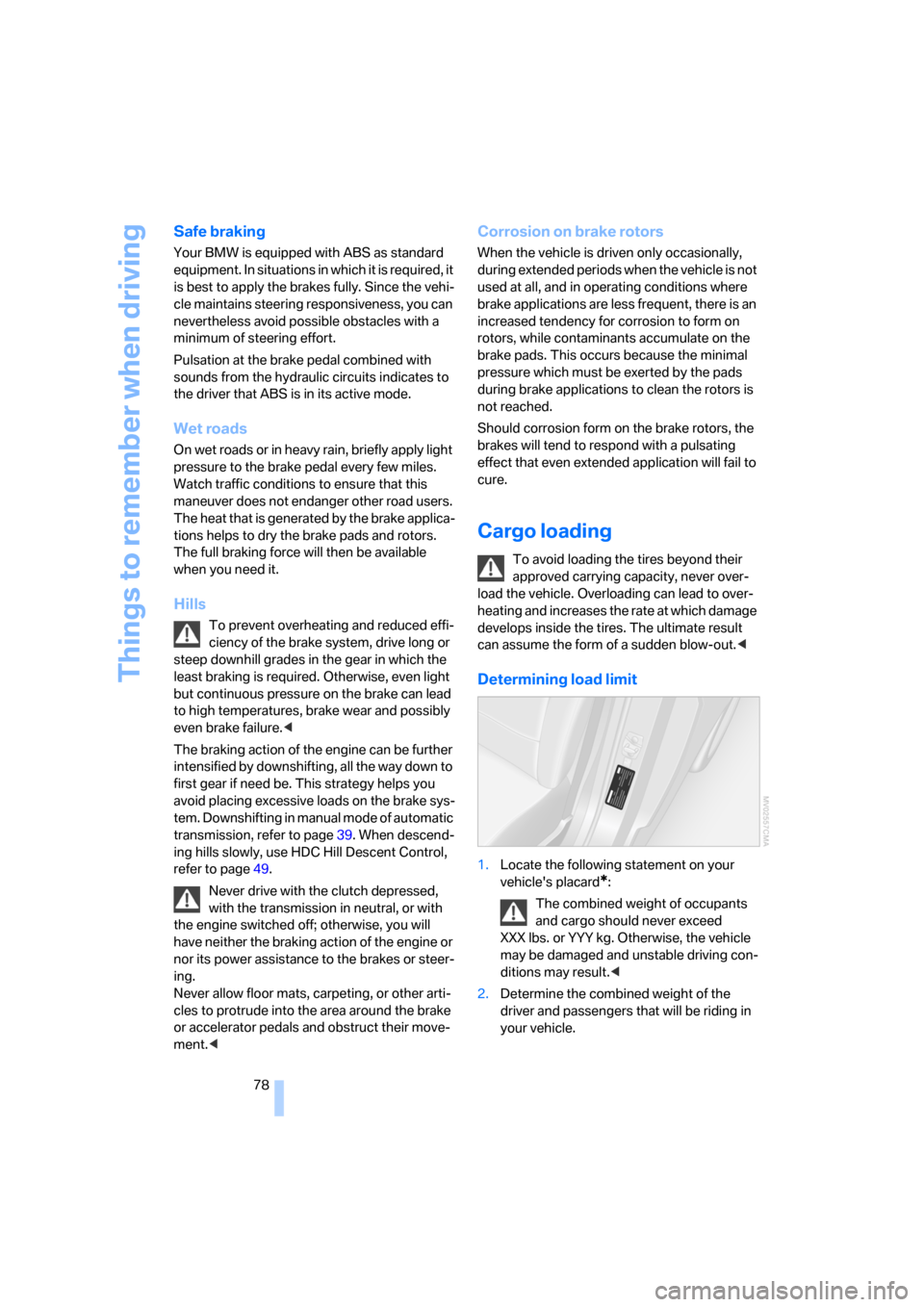
1.Locate the following statement on your
vehicle's placard
*:
The combined weight of occupants
and cargo should never exceed
XXX lbs. or YYY kg. Otherwise, the vehicle
may be damaged and unstable driving con-
ditions may result.<
2.Determine the combined weight of the
driver and passengers that will be riding in
your vehicle.
Page 98 of 133

Under the hood
96
Brake system
Malfunction
Brake fluid
The warning lamp lights up red despite
the handbrake being released. Stop
immediately.
The brake fluid in the reservoir has fallen to
below the minimum level. At the same time, a
considerably longer brake pedal travel may be
noticeable. Have the system checked immedi-
ately.
During continued driving, increased brake
pedal travel may be necessary, and con-
siderably longer braking distances may result.
Please adapt your driving style accordingly.<
Display of the previously described mal-
function on Canadian models.
Brake pads
The warning lamp lights up.
The brake pads have reached their min-
imum pad thickness. Have brake pads
replaced immediately.
For your own safety, use only brake pads
that BMW has approved for your particu-
lar vehicle model. As BMW cannot assess the
suitability of other brake pads for use in your
vehicle, we are unable to assume continued
responsibility for the vehicle's operating safety
if non-approved pads are installed.<
Page 99 of 133
Reference
At a glance
Controls
Driving tips
Mobility
97
Maintenance
The BMW maintenance
system
The BMW maintenance system supports the
preservation of the road and operating safety of
your BMW.
Regular maintenance is not only required for
the safety of the vehicle, it also improves the
resale value.
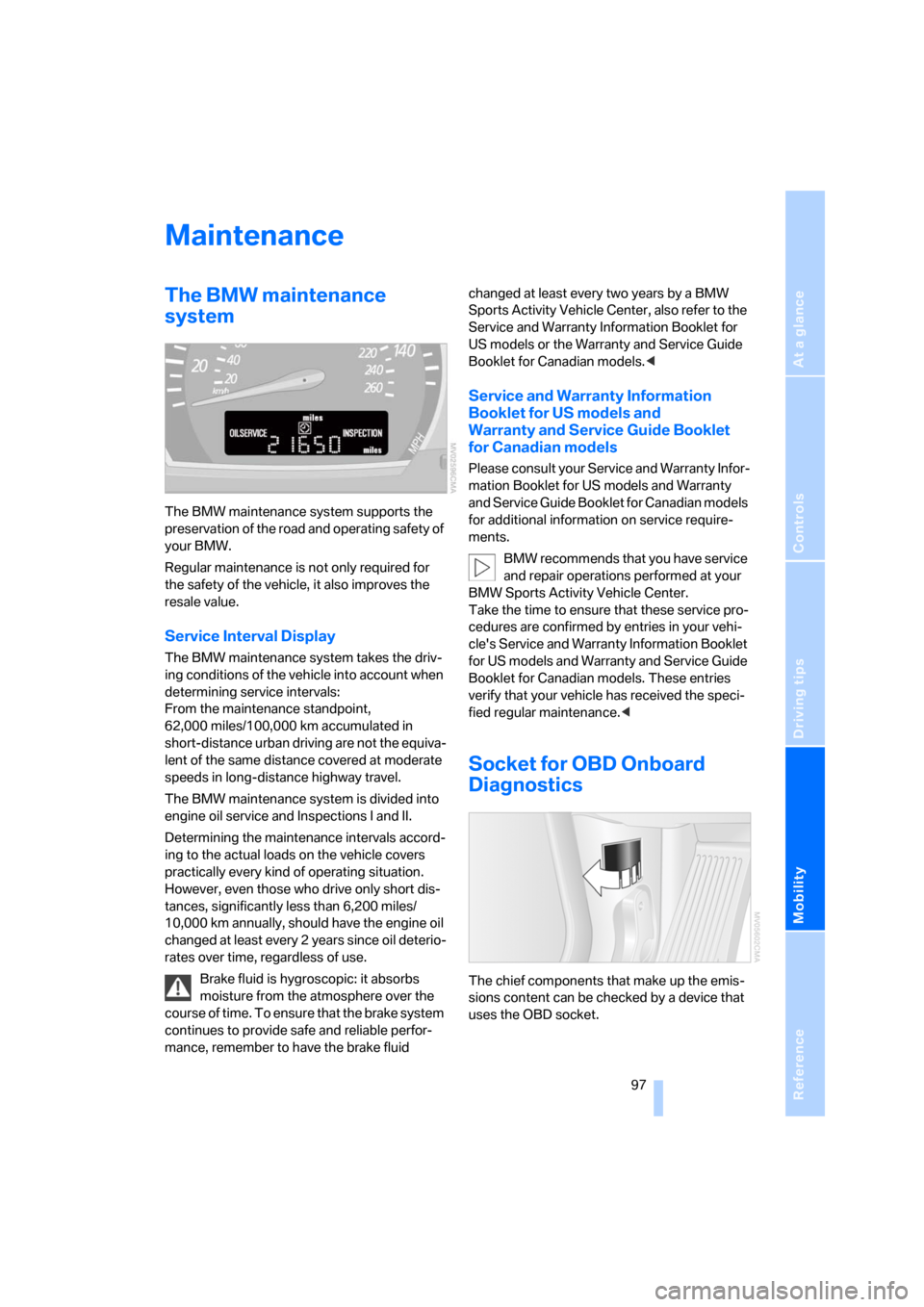
Service Interval Display
The BMW maintenance system takes the driv-
ing conditions of the vehicle into account when
determining service intervals:
From the maintenance standpoint,
62,000 miles/100,000 km accumulated in
short-distance urban driving are not the equiva-
lent of the same distance covered at moderate
speeds in long-distance highway travel.
The BMW maintenance system is divided into
engine oil service and Inspections I and II.
Determining the maintenance intervals accord-
ing to the actual loads on the vehicle covers
practically every kind of operating situation.
However, even those who drive only short dis-
tances, significantly less than 6,200 miles/
10,000 km annually, should have the engine oil
changed at least every 2 years since oil deterio-
rates over time, regardless of use.
Brake fluid is hygroscopic: it absorbs
moisture from the atmosphere over the
course of time. To ensure that the brake system
continues to provide safe and reliable perfor-
mance, remember to have the brake fluid changed at least every two years by a BMW
Sports Activity Vehicle Center, also refer to the
Service and Warranty Information Booklet for
US models or the Warranty and Service Guide
Booklet for Canadian models.<
Service and Warranty Information
Booklet for US models and
Warranty and Service Guide Booklet
for Canadian models
Please consult your Service and Warranty Infor-
mation Booklet for US models and Warranty
and Service Guide Booklet for Canadian models
for additional information on service require-
ments.
BMW recommends that you have service
and repair operations performed at your
BMW Sports Activity Vehicle Center.
Take the time to ensure that these service pro-
cedures are confirmed by entries in your vehi-
cle's Service and Warranty Information Booklet
for US models and Warranty and Service Guide
Booklet for Canadian models. These entries
verify that your vehicle has received the speci-
fied regular maintenance.<
Socket for OBD Onboard
Diagnostics
The chief components that make up the emis-
sions content can be checked by a device that
uses the OBD socket.
Page 100 of 133

Maintenance
98 This socket is located under a cover on the left
side of the driver's footwell, just under the dash-
board.
Emissions values
The warning lamp lights up. Exhaust
values are deteriorating. Have the vehi-
cle checked as soon as possible.
Under certain conditions, the indicator will flash.
This indicates a serious rate of engine misfire.
When this occurs, you should reduce speed
and consult the nearest BMW Sports Activity
Vehicle Center as soon as possible. Severe
engine misfire even for only a short period of
time can seriously damage emission control
components, especially the catalytic converter.
Display of the previously described mal-
function on Canadian models.
When the fuel filler cap is not properly
tightened, the OBD system can detect
the vapor leak and the indicator lamp will light
up. If the filler cap is subsequently tightened,
the indicator lamp should go out within a few
days.<
Event data recorders
Your vehicle may be equipped with one or more
sensing and diagnostic modules or a recording
device capable of recording or transmitting cer-
tain vehicle data or information. In addition, if
you have a Subscription Service Agreement for
the BMW Assist system, certain vehicle infor-
mation may be transmitted or recorded in order
to provide such services.
Care
You can find useful information on caring for
your BMW in the Caring for your vehicle bro-
chure.
Page 106 of 133
Replacing components
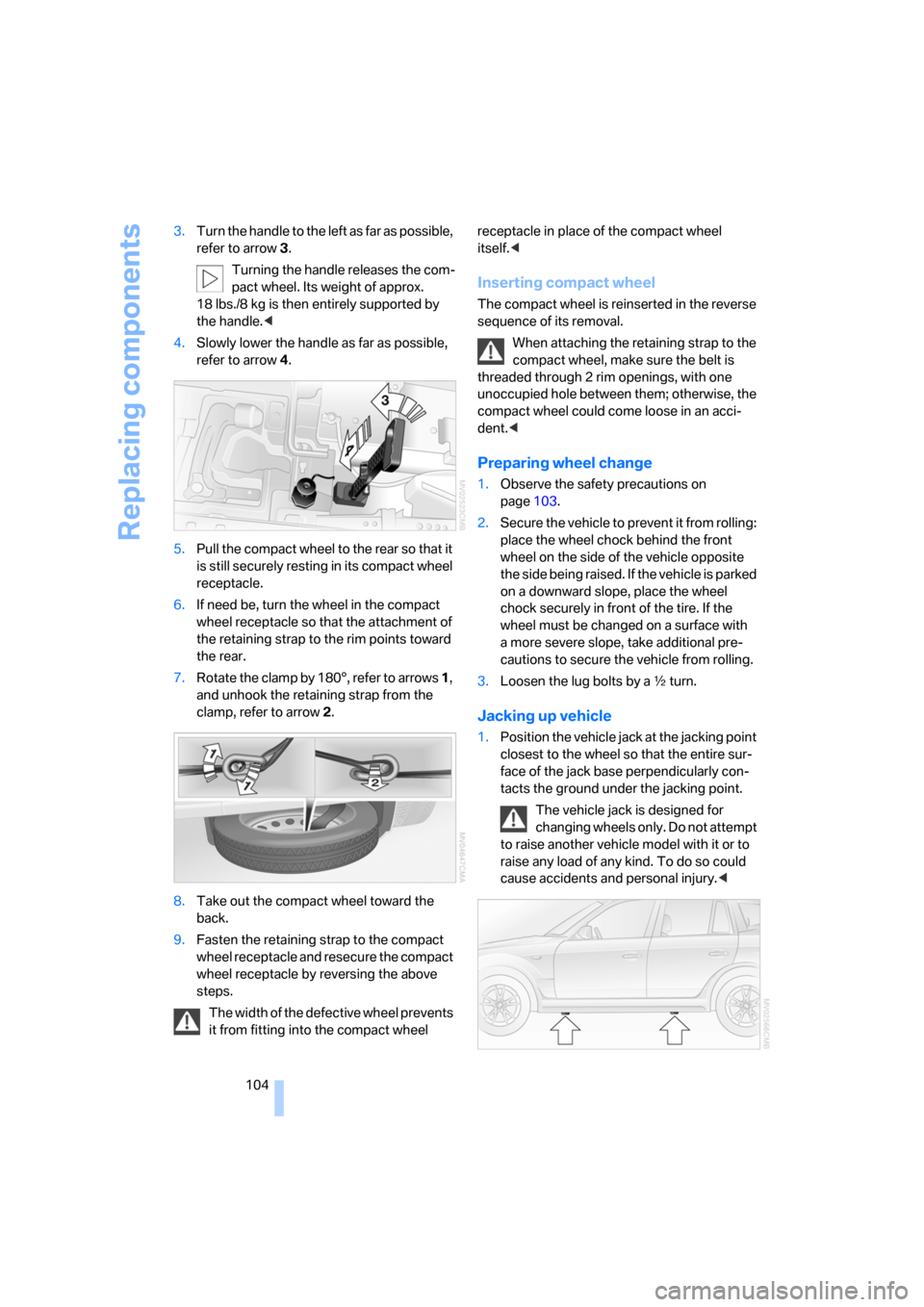
104 3.Turn the handle to the left as far as possible,
refer to arrow3.
Turning the handle releases the com-
pact wheel. Its weight of approx.
18 lbs./8 kg is then entirely supported by
the handle.<
4.Slowly lower the handle as far as possible,
refer to arrow4.
5.Pull the compact wheel to the rear so that it
is still securely resting in its compact wheel
receptacle.
6.If need be, turn the wheel in the compact
wheel receptacle so that the attachment of
the retaining strap to the rim points toward
the rear.
7.Rotate the clamp by 180°, refer to arrows 1,
and unhook the retaining strap from the
clamp, refer to arrow 2.
8.Take out the compact wheel toward the
back.
9.Fasten the retaining strap to the compact
wheel receptacle and resecure the compact
wheel receptacle by reversing the above
steps.
The width of the defective wheel prevents
it from fitting into the compact wheel receptacle in place of the compact wheel
itself.<
Inserting compact wheel
The compact wheel is reinserted in the reverse
sequence of its removal.
When attaching the retaining strap to the
compact wheel, make sure the belt is
threaded through 2 rim openings, with one
unoccupied hole between them; otherwise, the
compact wheel could come loose in an acci-
dent.<
Preparing wheel change
1.Observe the safety precautions on
page103.
2.Secure the vehicle to prevent it from rolling:
place the wheel chock behind the front
wheel on the side of the vehicle opposite
the side being raised. If the vehicle is parked
on a downward slope, place the wheel
chock securely in front of the tire. If the
wheel must be changed on a surface with
a more severe slope, take additional pre-
cautions to secure the vehicle from rolling.
3.Loosen the lug bolts by a γ turn.
Jacking up vehicle
1.Position the vehicle jack at the jacking point
closest to the wheel so that the entire sur-
face of the jack base perpendicularly con-
tacts the ground under the jacking point.
The vehicle jack is designed for
changing wheels only. Do not attempt
to raise another vehicle model with it or to
raise any load of any kind. To do so could
cause accidents and personal injury.<
Page 120 of 133
Everything from A to Z
118
Everything from A to Z
Index
A
ABS Antilock Brake
System48
– indicator lamp12
Accessories, refer to For your
own safety6
Accident, refer to Receiving
assistance107
Acknowledgment signal for
locking/unlocking
vehicle19,20
Activated-charcoal filter64
Adaptive Head Light57
Adding engine oil94
Adjusting seats27
– electrically27
– mechanically27
– mechanically Sports seat28
Airbags53
– deactivating front passenger
side33,54
– indicator lamp for front
passenger airbags54
– sitting safely26
– warning lamp54
Air circulation, refer to Recir-
culated-air mode60,63
Air conditioner59
Air distribution
– air conditioner60
– automatic climate control63
Airing, refer to
Ventilation61,64
Air outlets, refer to
Ventilation61,64
Air pressure, refer to Tire
inflation pressure86
Air vents, refer to
Ventilation61,64
Air volume60
– adjusting manually63AKI, refer to Fuel
specifications85
Alarm system24
– avoiding unintentional
alarms25
All-season tires, refer to
Special characteristics of
winter tires90
All wheel drive, refer to
xDrive49
Anchorage points73
Antifreeze
– coolant95
– washer fluid41
Antifreeze protection,
coolant95
Antilock Brake System
ABS48
– indicator lamp12
Anti-theft alarm system, refer
to Alarm system18,24
Approved axle load, refer to
Weights116
Approved engine oils95
Approved gross vehicle
weight, refer to Weights116
Armrest
– front67
– rear68
Artificial leather, refer to
Caring for your vehicle
brochure
Ashtray68
AUC Automatic recirculated-
air control63
Automatic
– air distribution63
– air volume63
– recirculated-air control
AUC63
Automatic car wash, refer to
Caring for your vehicle
brochureAutomatic climate control62
Automatic cruise control41
Automatic curb monitor31
Automatic deactivation of
front passenger airbags54
Automatic headlamp
control56
Automatic transmission with
Steptronic38
– indicator lamp39
– interlock36
– selector lever interlock38
– shiftlock38
– towing109
– tow starting110
AUTO program63
Average fuel consumption46
– setting units45
Average speed46
– setting units45
Avoiding unintentional
alarms25
Axle loads, refer to
Weights116
B
Backrest, refer to Seats27
Backrest contour, refer to
Lumbar support28
Backup lamps
– bulb replacement102
– refer to Tail lamps102
Bandages, refer to First-aid
kit108
Bar, towing110
Battery105
– disposal106
– indicator lamp12
– jump starting108
– power failure106
– remote control18
– warning lamp105