rear window BMW X3 3.0I 2007 E83 Owner's Manual
[x] Cancel search | Manufacturer: BMW, Model Year: 2007, Model line: X3 3.0I, Model: BMW X3 3.0I 2007 E83Pages: 139, PDF Size: 4.74 MB
Page 25 of 139
Reference
At a glance
Controls
Driving tips
Mobility
23
In the back, separate switches are provided in
the armrests.
For convenience operation using the remote
control or the door lock, refer to pages20, 21.
After switching off ignition
You can operate the windows for up to 1 minute
as long as no door has been opened.
Pinch protection system
If the closing force rises beyond a predefined
threshold when a window is being closed, the
system will interrupt the closing of the window
prior to lowering it slightly.
Despite the presence of the pinch protec-
tion system, inspect the window's travel
path prior to closing it, as the safety system
might fail to detect certain kinds of obstruc-
tions, such as very thin objects, and the window
would continue closing.
Do not install any accessories in the movement
range of the window as this could impair the
function of the pinch protection system.<
Closing without pinch protection
system
When there is danger outside or when, for
example, ice on the window prevents a normal
closing, press the switch past the resistance
point and hold it there. The window will close
without the pinch protection system.
Following interruptions in electrical
power supply
After disconnecting the battery, the pinch pro-
tection system must be reinitialized. To do this,
open and close the windows once and continue
pull the switch for longer than approx. 2 sec-
onds after closing.
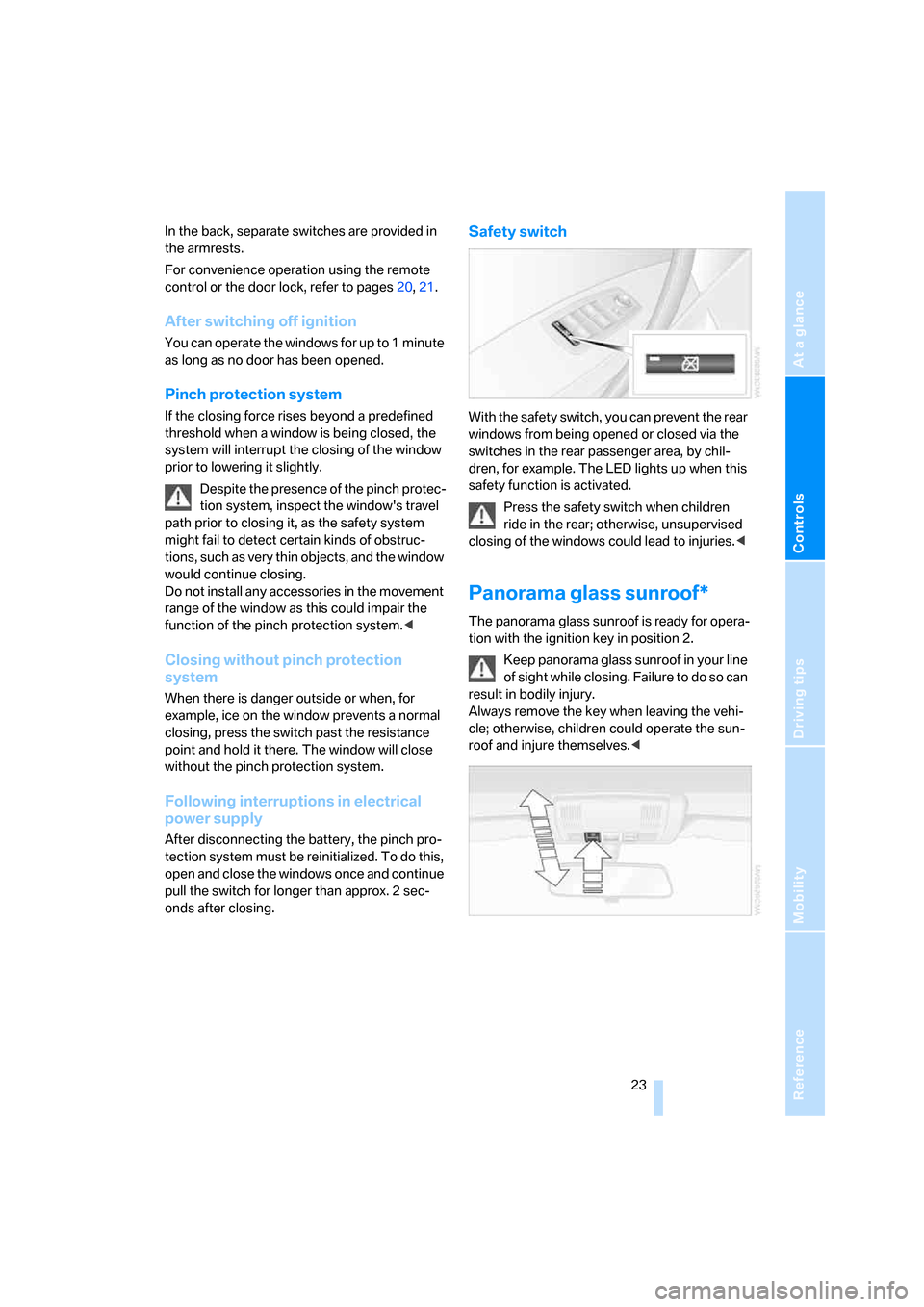
Safety switch
With the safety switch, you can prevent the rear
windows from being opened or closed via the
switches in the rear passenger area, by chil-
dren, for example. The LED lights up when this
safety function is activated.
Press the safety switch when children
ride in the rear; otherwise, unsupervised
closing of the windows could lead to injuries.<
Panorama glass sunroof*
The panorama glass sunroof is ready for opera-
tion with the ignition key in position 2.
Keep panorama glass sunroof in your line
of sight while closing. Failure to do so can
result in bodily injury.
Always remove the key when leaving the vehi-
cle; otherwise, children could operate the sun-
roof and injure themselves.<
Page 38 of 139
Transporting children safely
36 Outer seats:
1.Slide head restraint upward.
2.Guide upper tether strap between the sup-
ports of the head restraint.
3.Attach tether strap hook to attachment
point.
4.Slide head restraint into the lowest position.
5.Pull tether strap tight.
Middle seat:
1.Fold center armrest slightly forward.
2.Guide tether strap through the opening.
3.Fold center armrest back.
4.Attach tether strap hook to attachment
point.
5.Pull tether strap tight.
When using the cargo area cover:
Guide tether strap through between the rear
seat backrest and the cargo area cover.
When driving
With side airbags in the rear, make sure
that children do not lean out of the child's
seat toward the door panel; otherwise, injuries
can result if the side airbags are triggered.<
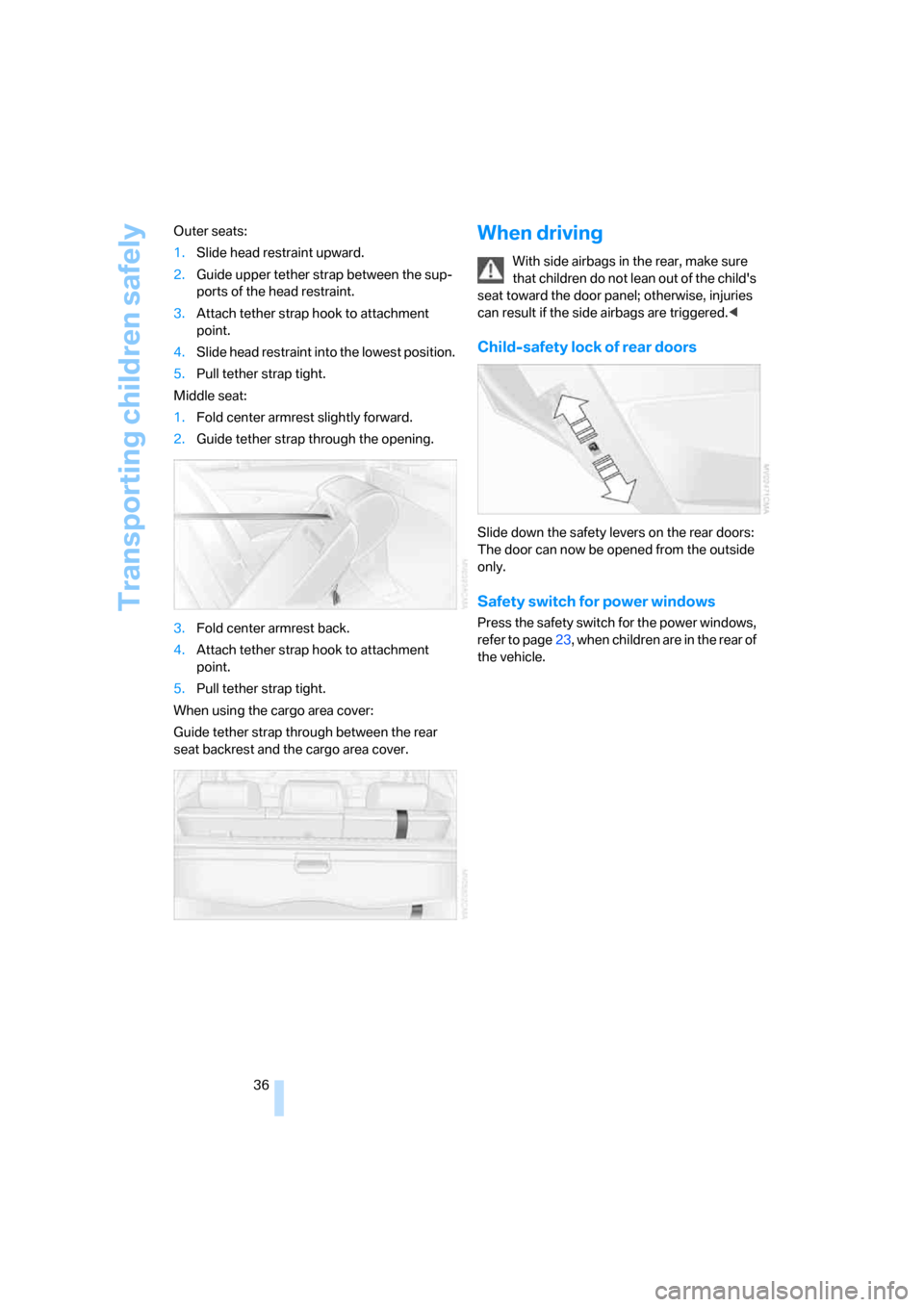
Child-safety lock of rear doors
Slide down the safety levers on the rear doors:
The door can now be opened from the outside
only.
Safety switch for power windows
Press the safety switch for the power windows,
refer to page23, when children are in the rear of
the vehicle.
Page 44 of 139
Driving
42
Fast wipe
The wipers operate at normal speed when the
vehicle is not moving, not on vehicles with rain
sensor.
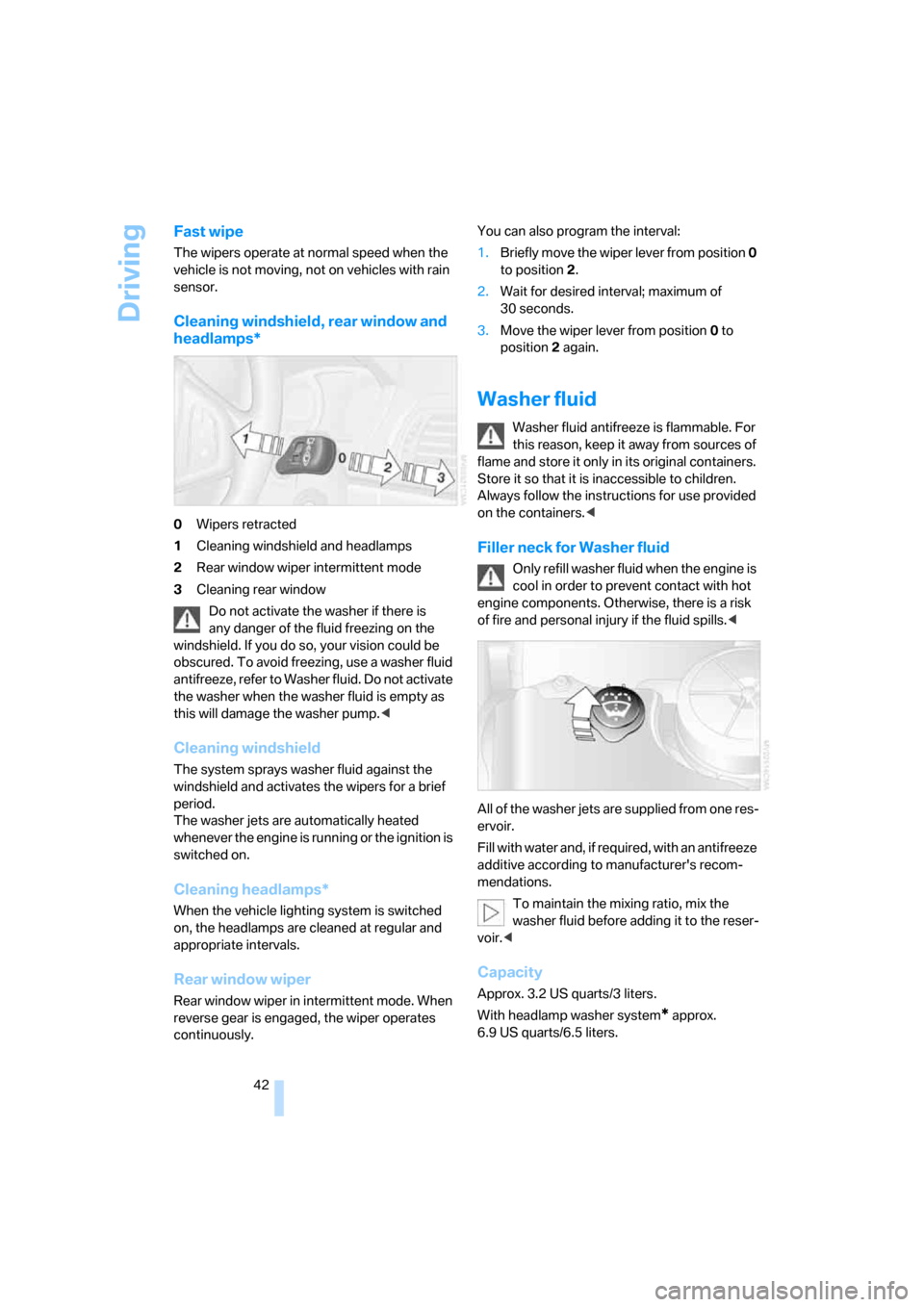
Cleaning windshield, rear window and
headlamps*
0Wipers retracted
1Cleaning windshield and headlamps
2Rear window wiper intermittent mode
3Cleaning rear window
Do not activate the washer if there is
any danger of the fluid freezing on the
windshield. If you do so, your vision could be
obscured. To avoid freezing, use a washer fluid
antifreeze, refer to Washer fluid. Do not activate
the washer when the washer fluid is empty as
this will damage the washer pump.<
Cleaning windshield
The system sprays washer fluid against the
windshield and activates the wipers for a brief
period.
The washer jets are automatically heated
whenever the engine is running or the ignition is
switched on.
Cleaning headlamps*
When the vehicle lighting system is switched
on, the headlamps are cleaned at regular and
appropriate intervals.
Rear window wiper
Rear window wiper in intermittent mode. When
reverse gear is engaged, the wiper operates
continuously.You can also program the interval:
1.Briefly move the wiper lever from position 0
to position 2.
2.Wait for desired interval; maximum of
30 seconds.
3.Move the wiper lever from position 0 to
position 2 again.
Washer fluid
Washer fluid antifreeze is flammable. For
this reason, keep it away from sources of
flame and store it only in its original containers.
Store it so that it is inaccessible to children.
Always follow the instructions for use provided
on the containers.<
Filler neck for Washer fluid
O nly refill was her fluid when the engine is
cool in order to prevent contact with hot
engine components. Otherwise, there is a risk
of fire and personal injury if the fluid spills.<
All of the washer jets are supplied from one res-
ervoir.
Fill with water and, if required, with an antifreeze
additive according to manufacturer's recom-
mendations.
To maintain the mixing ratio, mix the
washer fluid before adding it to the reser-
voir.<
Capacity
Approx. 3.2 US quarts/3 liters.
With headlamp washer system
* approx.
6.9 US quarts/6.5 liters.
Page 63 of 139
Reference
At a glance
Controls
Driving tips
Mobility
61
Air conditioner
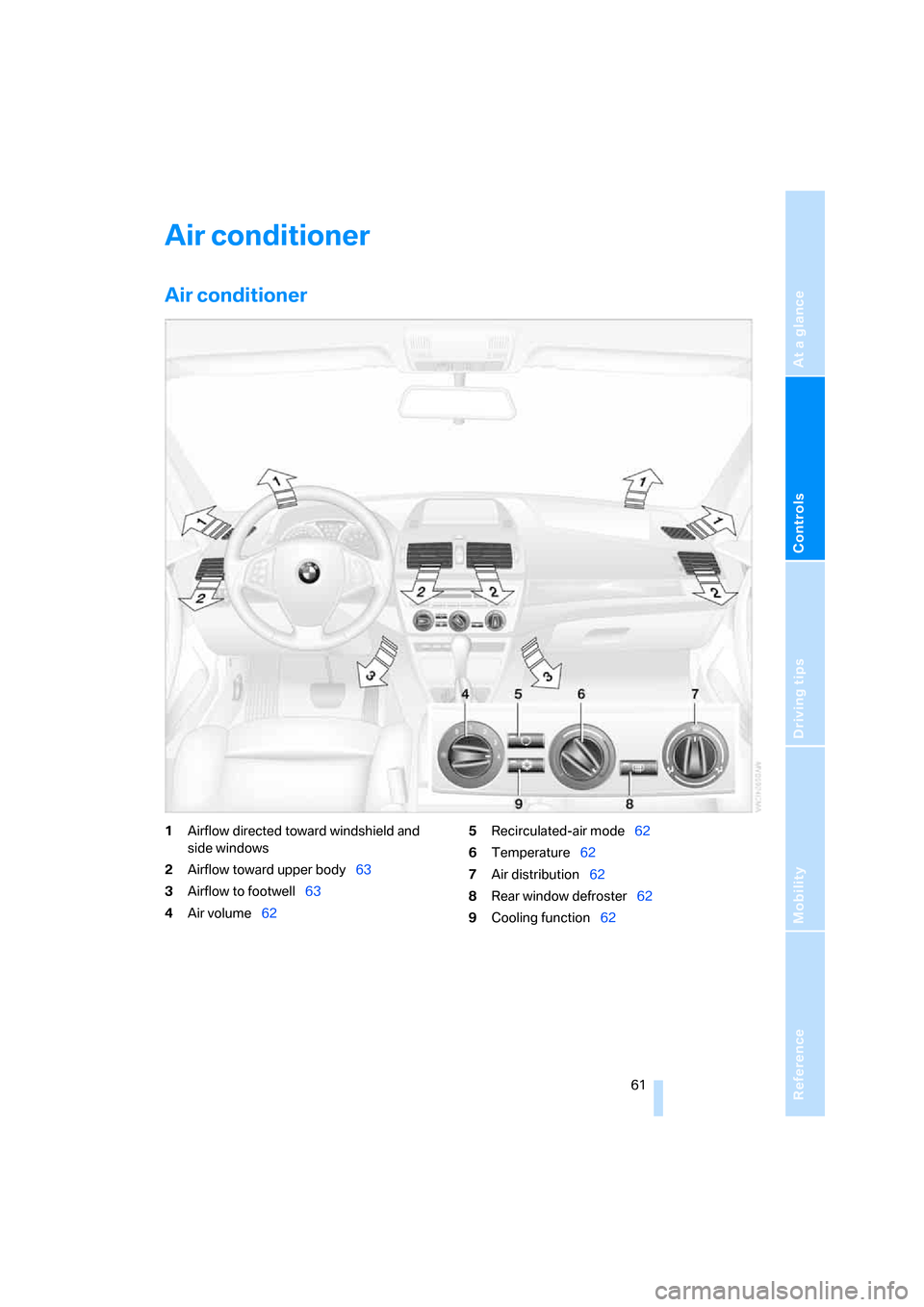
Air conditioner
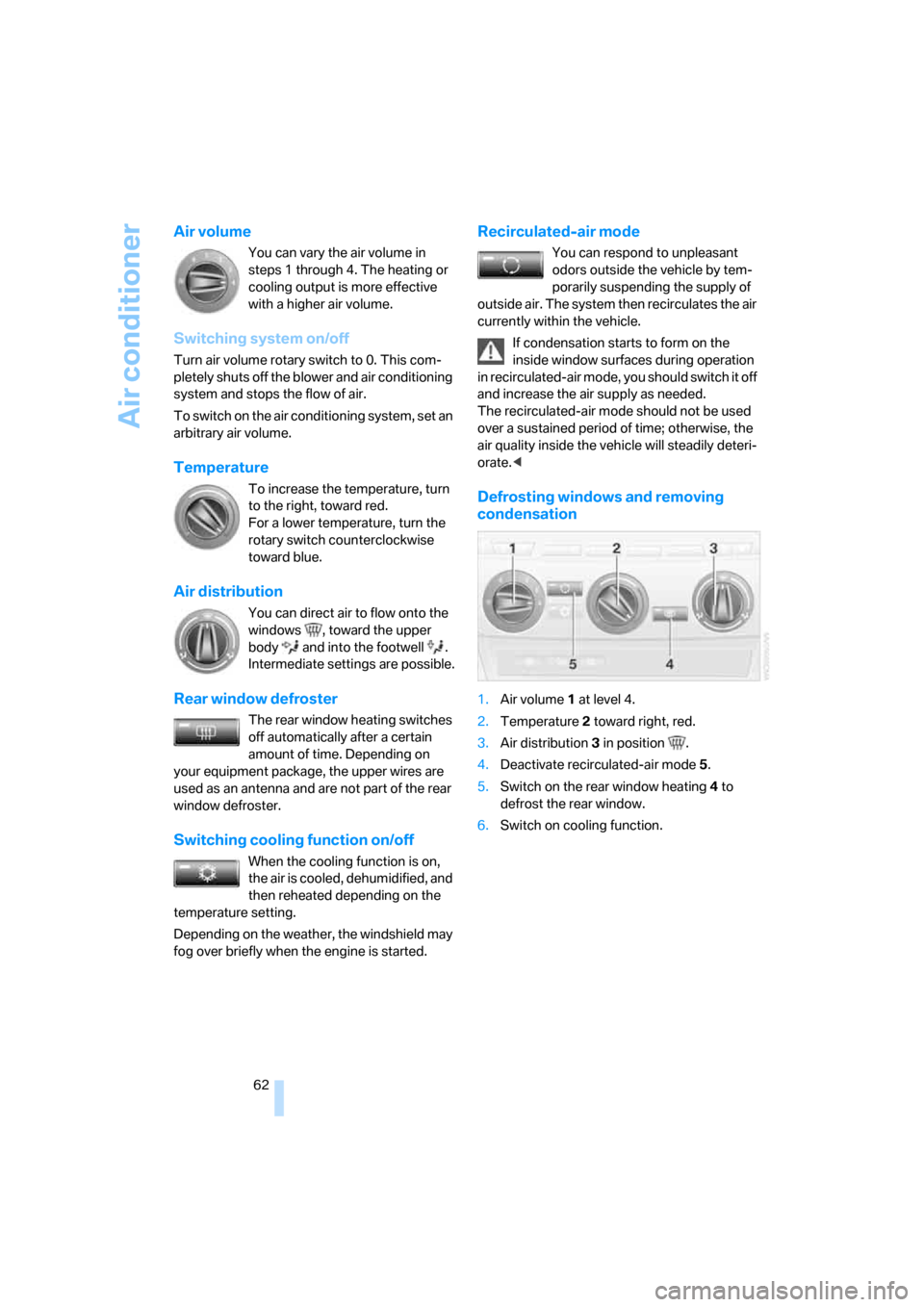
1Airflow directed toward windshield and
side windows
2Airflow toward upper body63
3Airflow to footwell63
4Air volume625Recirculated-air mode62
6Temperature62
7Air distribution62
8Rear window defroster62
9Cooling function62
Page 64 of 139
Air conditioner
62
Air volume
You can vary the air volume in
steps 1 through 4. The heating or
cooling output is more effective
with a higher air volume.
Switching system on/off
Turn air volume rotary switch to 0. This com-
pletely shuts off the blower and air conditioning
system and stops the flow of air.
To switch on the air conditioning system, set an
arbitrary air volume.
Temperature
To increase the temperature, turn
to the right, toward red.
For a lower temperature, turn the
rotary switch counterclockwise
toward blue.
Air distribution
You can direct air to flow onto the
windows , toward the upper
body and into the footwell .
Intermediate settings are possible.
Rear window defroster
The rear window heating switches
off automatically after a certain
amount of time. Depending on
your equipment package, the upper wires are
used as an antenna and are not part of the rear
window defroster.
Switching cooling function on/off
When the cooling function is on,
the air is cooled, dehumidified, and
then reheated depending on the
temperature setting.
Depending on the weather, the windshield may
fog over briefly when the engine is started.
Recirculated-air mode
You can respond to unpleasant
odors outside the vehicle by tem-
porarily suspending the supply of
outside air. The system then recirculates the air
currently within the vehicle.
If condensation starts to form on the
inside window surfaces during operation
in recirculated-air mode, you should switch it off
and increase the air supply as needed.
The recirculated-air mode should not be used
over a sustained period of time; otherwise, the
air quality inside the vehicle will steadily deteri-
orate.<
Defrosting windows and removing
condensation
1.Air volume 1 at level 4.
2.Temperature 2 toward right, red.
3.Air distribution 3 in position .
4.Deactivate recirculated-air mode 5.
5.Switch on the rear window heating 4 to
defrost the rear window.
6.Switch on cooling function.
Page 66 of 139
Air conditioner
64
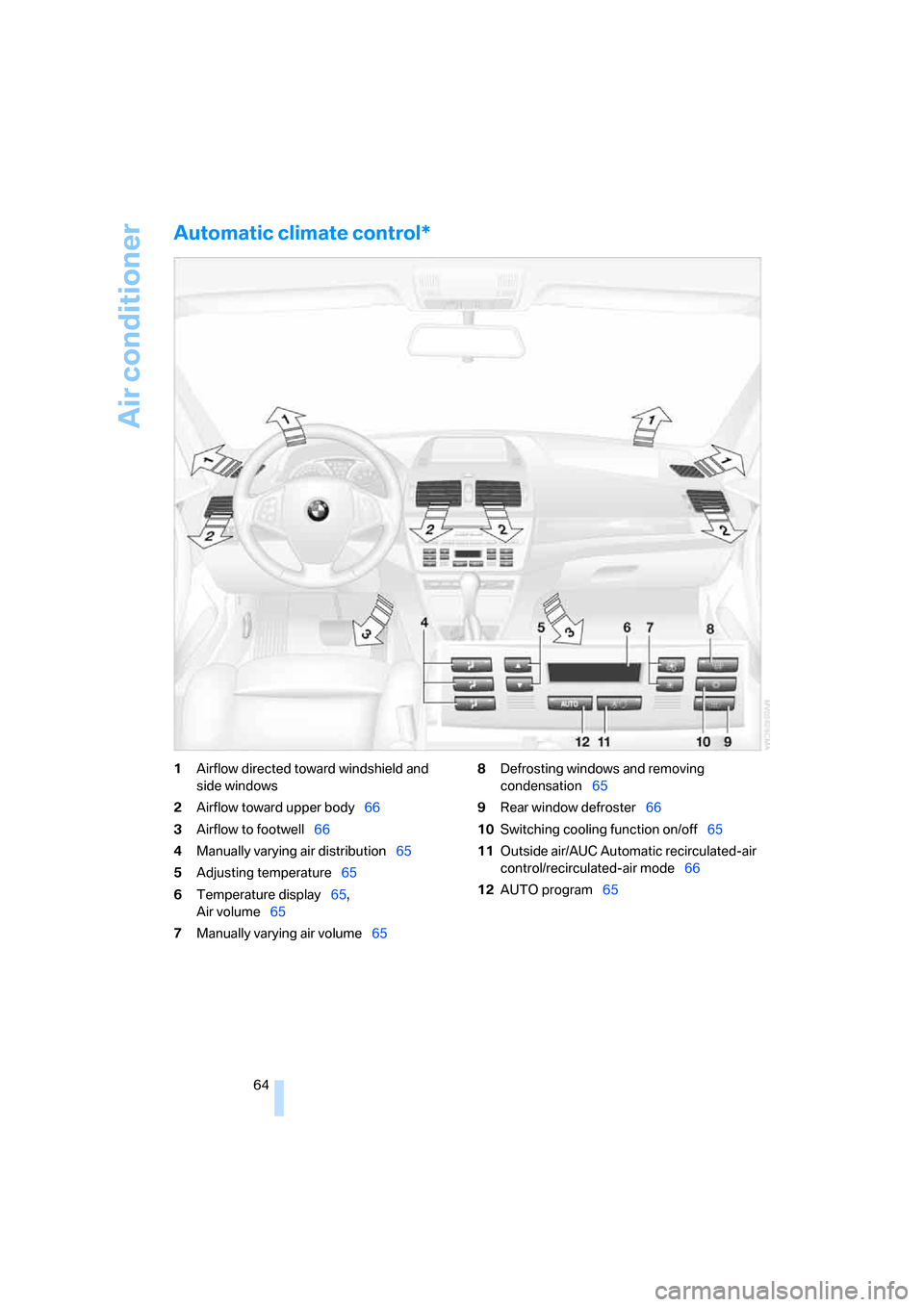
Automatic climate control*
1Airflow directed toward windshield and
side windows
2Airflow toward upper body66
3Airflow to footwell66
4Manually varying air distribution65
5Adjusting temperature65
6Temperature display65,
Air volume65
7Manually varying air volume658Defrosting windows and removing
condensation65
9Rear window defroster66
10Switching cooling function on/off65
11Outside air/AUC Automatic recirculated-air
control/recirculated-air mode66
12AUTO program65
Page 68 of 139
Air conditioner
66
AUC Automatic Recirculated-air
Control/recirculated air mode
You can set the desired operating
mode by pressing the button
repeatedly:
>LEDs off: outside air continuously flows into
the vehicle.
>Left LED on, AUC mode: a sensor detects
pollutants in the outside air. The system
suspends the supply of outside air as
needed and recirculates the air currently
within the vehicle. As soon as the concen-
tration of pollutants in the outside air has
decreased sufficiently, the system switches
automatically back to supplying outside air.
>Right LED on, recirculated-air mode: the
outside air supply into the vehicle is shut off
continuously. The system then recirculates
the air currently within the vehicle.
If the windows fog over in recirculated-air
mode, then press the AUTO button or
switch off the recirculated air mode and
increase the air volume as needed.
The recirculated-air mode should not be used
over a sustained period of time; otherwise, the
air quality inside the vehicle will steadily deteri-
orate.<
Rear window defroster
The rear window heating switches
off automatically after a certain
amount of time. Depending on
your equipment package, the upper wires are
used as an antenna and are not part of the rear
window defroster.
Ventilation
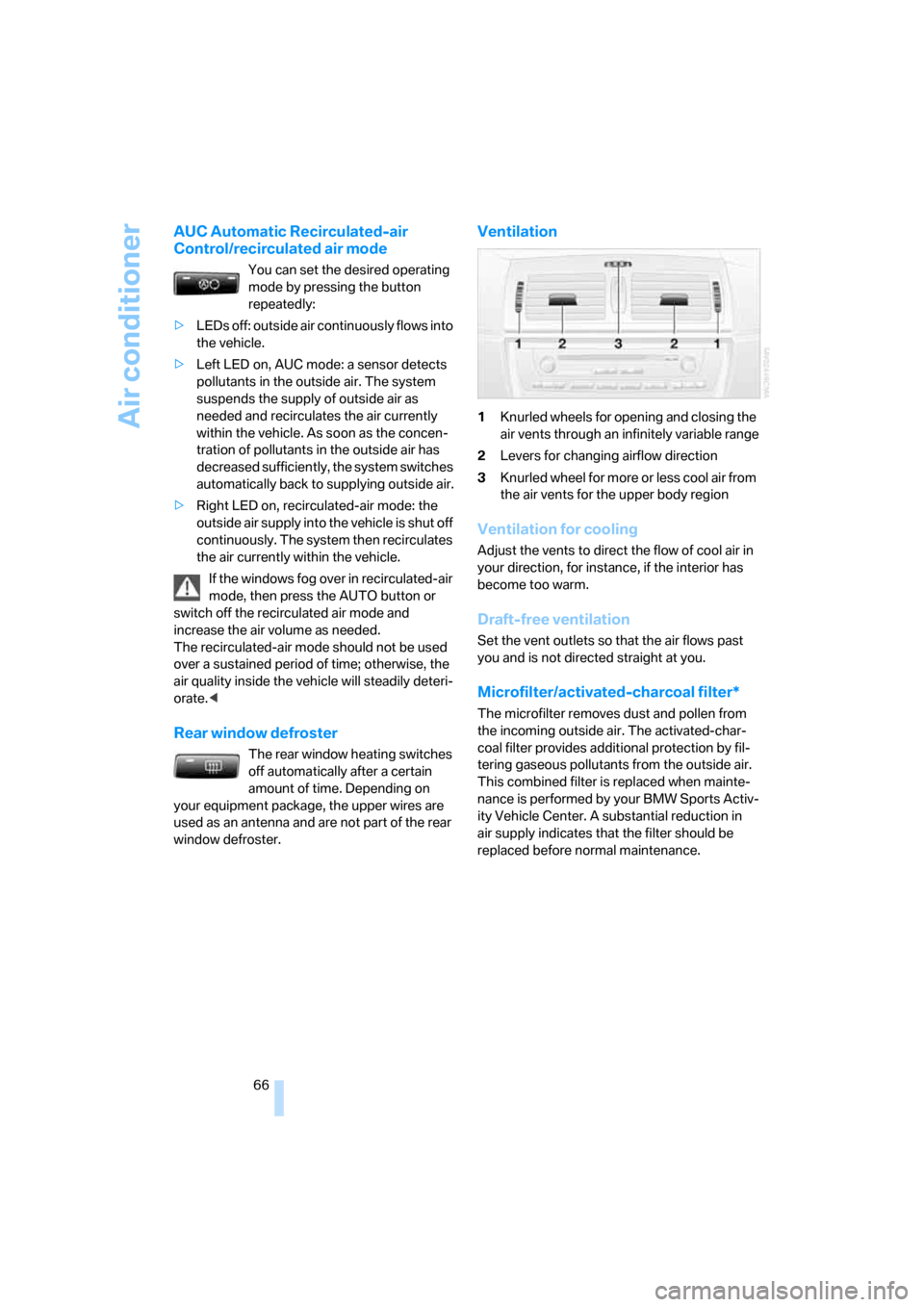
1Knurled wheels for opening and closing the
air vents through an infinitely variable range
2Levers for changing airflow direction
3Knurled wheel for more or less cool air from
the air vents for the upper body region
Ventilation for cooling
Adjust the vents to direct the flow of cool air in
your direction, for instance, if the interior has
become too warm.
Draft-free ventilation
Set the vent outlets so that the air flows past
you and is not directed straight at you.
Microfilter/activated-charcoal filter*
The microfilter removes dust and pollen from
the incoming outside air. The activated-char-
coal filter provides additional protection by fil-
tering gaseous pollutants from the outside air.
This combined filter is replaced when mainte-
nance is performed by your BMW Sports Activ-
ity Vehicle Center. A substantial reduction in
air supply indicates that the filter should be
replaced before normal maintenance.
Page 117 of 139
Reference
At a glance
Controls
Driving tips
Mobility
115
Starting engine
1.Start the engine of the assisting vehicle and
let it run at a slightly elevated idling speed
for a few minutes.
2.Start the engine on the other vehicle in the
usual way.
If the first start attempt is not successful,
wait a few minutes before another attempt
in order to allow the discharged battery to
recharge.
3.Let the engines run for a few minutes.
4.Disconnect the jumper cables by reversing
the connection sequence.
If need be, have the battery checked and
recharged.
Never use spray fluids to start the
engine.<
Tow starting and towing
Obey all applicable laws and guidelines
for tow starting and towing.<
Do not allow any passengers other than
the driver to ride in a vehicle that is being
towed.<
Using tow fitting
The threaded tow fitting is stored in the
onboard tool kit, refer to page104, and must
always remain in the vehicle. It can be screwed
in at the front or rear of the BMW.
Only use the tow fitting that comes with
the vehicle and screw it in as far as it will
go. Use the tow fitting only for towing on roads.
Avoid lateral loading of the tow fitting, e.g. do
not lift the vehicle by the tow fitting. Otherwise,
the tow fitting and the vehicle can be dam-
aged.<
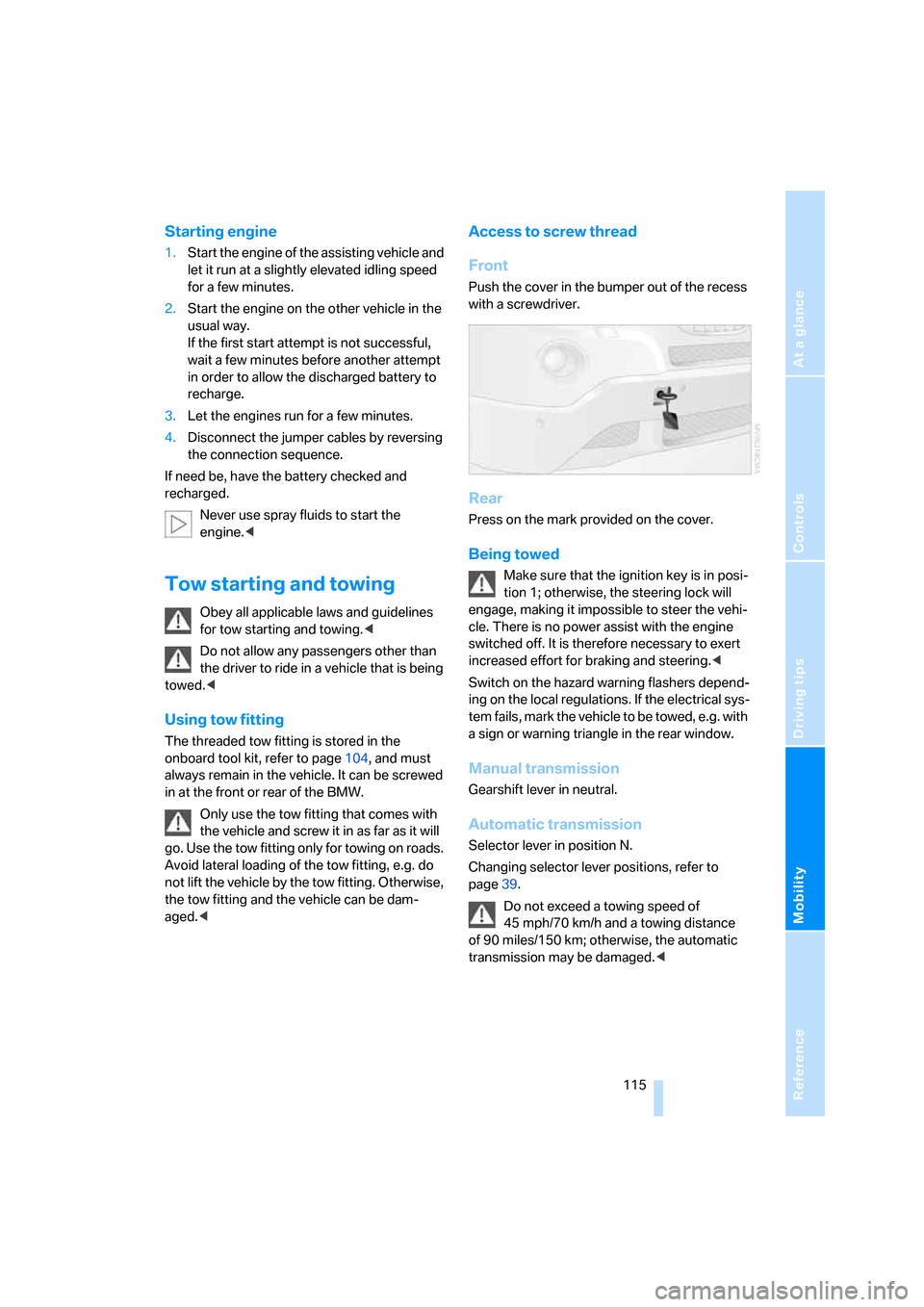
Access to screw thread
Front
Push the cover in the bumper out of the recess
with a screwdriver.
Rear
Press on the mark provided on the cover.
Being towed
Make sure that the ignition key is in posi-
tion 1; otherwise, the steering lock will
engage, making it impossible to steer the vehi-
cle. There is no power assist with the engine
switched off. It is therefore necessary to exert
increased effort for braking and steering.<
Switch on the hazard warning flashers depend-
ing on the local regulations. If the electrical sys-
tem fails, mark the vehicle to be towed, e.g. with
a sign or warning triangle in the rear window.
Manual transmission
Gearshift lever in neutral.
Automatic transmission
Selector lever in position N.
Changing selector lever positions, refer to
page39.
Do not exceed a towing speed of
45 mph/70 km/h and a towing distance
of 90 miles/150 km; otherwise, the automatic
transmission may be damaged.<
Page 128 of 139
Everything from A to Z
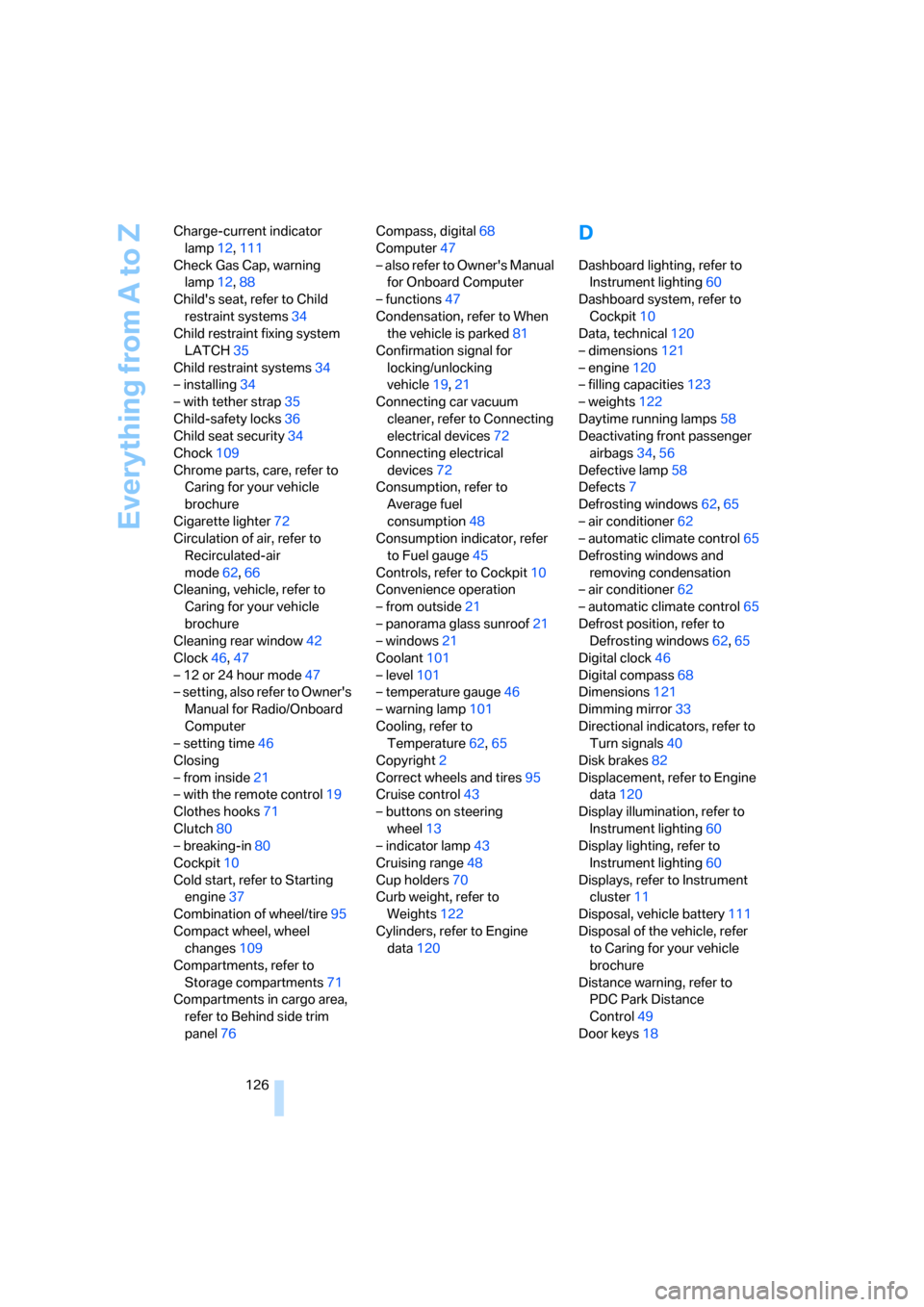
126 Charge-current indicator
lamp12,111
Check Gas Cap, warning
lamp12,88
Child's seat, refer to Child
restraint systems34
Child restraint fixing system
LATCH35
Child restraint systems34
– installing34
– with tether strap35
Child-safety locks36
Child seat security34
Chock109
Chrome parts, care, refer to
Caring for your vehicle
brochure
Cigarette lighter72
Circulation of air, refer to
Recirculated-air
mode62,66
Cleaning, vehicle, refer to
Caring for your vehicle
brochure
Cleaning rear window42
Clock46,47
– 12 or 24 hour mode47
– setting, also refer to Owner's
Manual for Radio/Onboard
Computer
– setting time46
Closing
– from inside21
– with the remote control19
Clothes hooks71
Clutch80
– breaking-in80
Cockpit10
Cold start, refer to Starting
engine37
Combination of wheel/tire95
Compact wheel, wheel
changes109
Compartments, refer to
Storage compartments71
Compartments in cargo area,
refer to Behind side trim
panel76Compass, digital68
Computer47
– also refer to Owner's Manual
for Onboard Computer
– functions47
Condensation, refer to When
the vehicle is parked81
Confirmation signal for
locking/unlocking
vehicle19,21
Connecting car vacuum
cleaner, refer to Connecting
electrical devices72
Connecting electrical
devices72
Consumption, refer to
Average fuel
consumption48
Consumption indicator, refer
to Fuel gauge45
Controls, refer to Cockpit10
Convenience operation
– from outside21
– panorama glass sunroof21
– windows21
Coolant101
– level101
– temperature gauge46
– warning lamp101
Cooling, refer to
Temperature62,65
Copyright2
Correct wheels and tires95
Cruise control43
– buttons on steering
wheel13
– indicator lamp43
Cruising range48
Cup holders70
Curb weight, refer to
Weights122
Cylinders, refer to Engine
data120
D
Dashboard lighting, refer to
Instrument lighting60
Dashboard system, refer to
Cockpit10
Data, technical120
– dimensions121
– engine120
– filling capacities123
– weights122
Daytime running lamps58
Deactivating front passenger
airbags34,56
Defective lamp58
Defects7
Defrosting windows62,65
– air conditioner62
– automatic climate control65
Defrosting windows and
removing condensation
– air conditioner62
– automatic climate control65
Defrost position, refer to
Defrosting windows62,65
Digital clock46
Digital compass68
Dimensions121
Dimming mirror33
Directional indicators, refer to
Turn signals40
Disk brakes82
Displacement, refer to Engine
data120
Display illumination, refer to
Instrument lighting60
Display lighting, refer to
Instrument lighting60
Displays, refer to Instrument
cluster11
Disposal, vehicle battery111
Disposal of the vehicle, refer
to Caring for your vehicle
brochure
Distance warning, refer to
PDC Park Distance
Control49
Door keys18
Page 130 of 139
Everything from A to Z
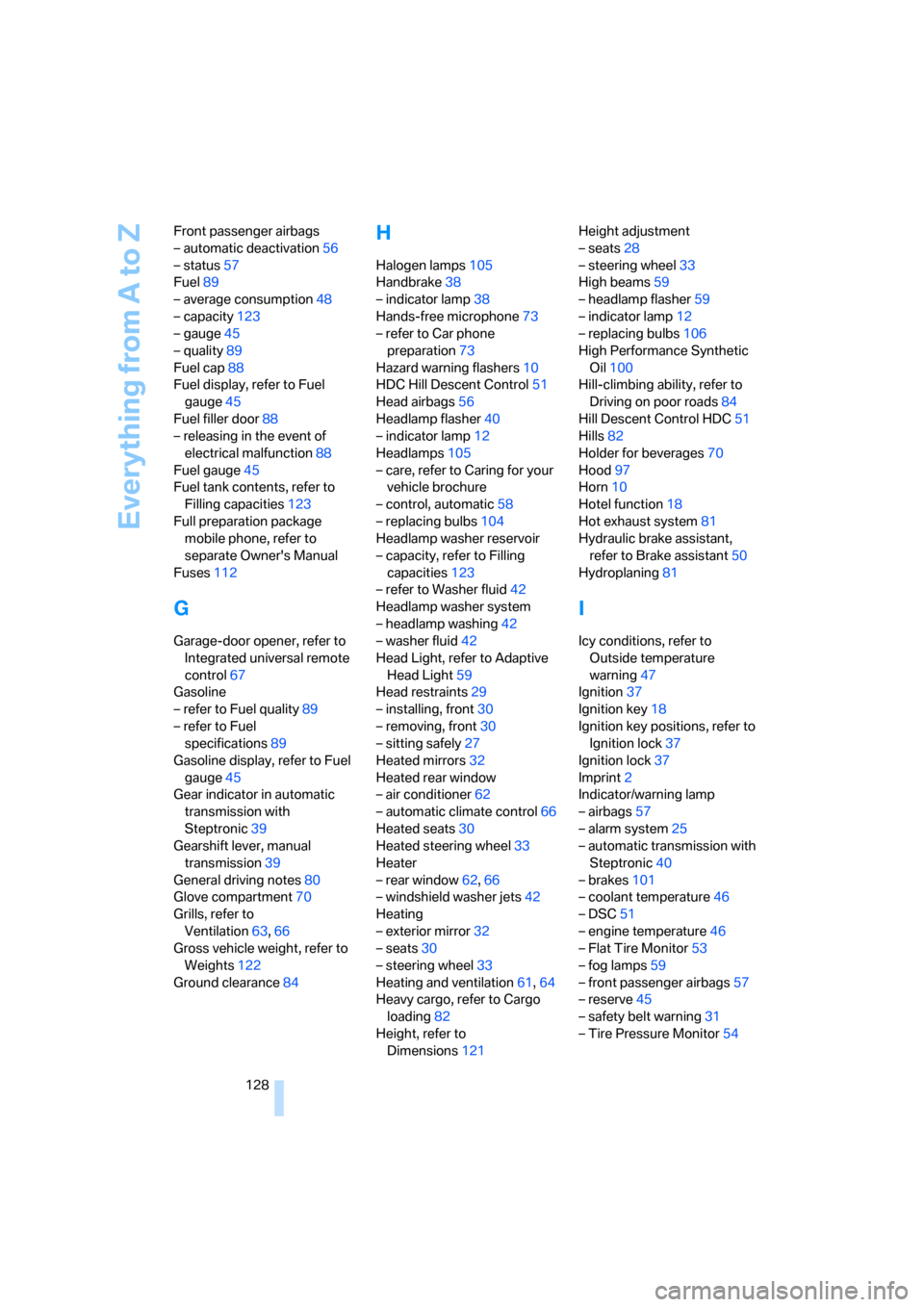
128 Front passenger airbags
– automatic deactivation56
– status57
Fuel89
– average consumption48
– capacity123
– gauge45
– quality89
Fuel cap88
Fuel display, refer to Fuel
gauge45
Fuel filler door88
– releasing in the event of
electrical malfunction88
Fuel gauge45
Fuel tank contents, refer to
Filling capacities123
Full preparation package
mobile phone, refer to
separate Owner's Manual
Fuses112
G
Garage-door opener, refer to
Integrated universal remote
control67
Gasoline
– refer to Fuel quality89
– refer to Fuel
specifications89
Gasoline display, refer to Fuel
gauge45
Gear indicator in automatic
transmission with
Steptronic39
Gearshift lever, manual
transmission39
General driving notes80
Glove compartment70
Grills, refer to
Ventilation63,66
Gross vehicle weight, refer to
Weights122
Ground clearance84
H
Halogen lamps105
Handbrake38
– indicator lamp38
Hands-free microphone73
– refer to Car phone
preparation73
Hazard warning flashers10
HDC Hill Descent Control51
Head airbags56
Headlamp flasher40
– indicator lamp12
Headlamps105
– care, refer to Caring for your
vehicle brochure
– control, automatic58
– replacing bulbs104
Headlamp washer reservoir
– capacity, refer to Filling
capacities123
– refer to Washer fluid42
Headlamp washer system
– headlamp washing42
– washer fluid42
Head Light, refer to Adaptive
Head Light59
Head restraints29
– installing, front30
– removing, front30
– sitting safely27
Heated mirrors32
Heated rear window
– air conditioner62
– automatic climate control66
Heated seats30
Heated steering wheel33
Heater
– rear window62,66
– windshield washer jets42
Heating
– exterior mirror32
– seats30
– steering wheel33
Heating and ventilation61,64
Heavy cargo, refer to Cargo
loading82
Height, refer to
Dimensions121Height adjustment
– seats28
– steering wheel33
High beams59
– headlamp flasher59
– indicator lamp12
– replacing bulbs106
High Performance Synthetic
Oil100
Hill-climbing ability, refer to
Driving on poor roads
84
Hill Descent Control HDC51
Hills82
Holder for beverages70
Hood97
Horn10
Hotel function18
Hot exhaust system81
Hydraulic brake assistant,
refer to Brake assistant50
Hydroplaning81
I
Icy conditions, refer to
Outside temperature
warning47
Ignition37
Ignition key18
Ignition key positions, refer to
Ignition lock37
Ignition lock37
Imprint2
Indicator/warning lamp
– airbags57
– alarm system25
– automatic transmission with
Steptronic40
– brakes101
– coolant temperature46
– DSC51
– engine temperature46
– Flat Tire Monitor53
– fog lamps59
– front passenger airbags57
– reserve45
– safety belt warning31
– Tire Pressure Monitor54