fuel BMW X3 3.0SI 2008 User Guide
[x] Cancel search | Manufacturer: BMW, Model Year: 2008, Model line: X3 3.0SI, Model: BMW X3 3.0SI 2008Pages: 140, PDF Size: 3.36 MB
Page 58 of 140
Technology for comfort, convenience and safety
56 The compact wheel is not equipped with the
required TPM electronics and is not monitored
when mounted.
When driving with the compact wheel, the sys-
tem indicates a malfunction.
Have the damaged tire replaced by your BMW
Sports Activity Vehicle Center or a workshop
that is familiar with TPM and works in accor-
dance with BMW repair procedures, using
appropriately trained personnel.
Malfunction
The yellow warning lamp flashes and
then lights up continuously. Flat tires
cannot be detected.
Such a message is displayed in the following
situations:
>When a malfunction is occurring:
Have the system checked
>When a wheel without TPM electronics is
mounted, e.g. a compact wheel
>When TPM is experiencing temporary inter-
ference from other systems or devices that
use the same frequency
NHTSA/FMVSS-required explanation
of 138 Tire Pressure Monitoring
System
Each tire, including the spare, should be
checked monthly when cold and inflated to the
inflation pressure recommended by the vehicle
manufacturer on the vehicle placard or tire infla-
tion pressure label. If your vehicle has tires of a
different size than the size indicated on the
vehicle placard or tire inflation pressure label,
then you should determine the proper tire infla-
tion pressure for those tires. As an added safety
feature, your vehicle has been equipped with a
tire pressure monitoring system, TPMS, that
illuminates a low tire pressure warning lamp
when one or more of your tires are significantly
under-inflated. When the low tire pressure
warning lamp lights up, you should stop and
check your tires as soon as possible, and inflate
them to the proper pressure. Driving on a signif-
icantly underinflated tire causes the tire to over-
heat and can lead to tire failure. Underinflation also reduces fuel efficiency and tire tread life,
and may affect the vehicle's handling and stop-
ping ability. Please note that the TPMS is not a
substitute for proper tire maintenance, and it is
the driver's responsibility to maintain correct
tire pressure, even if underinflation has not
reached the level to trigger illumination of the
TPMS low tire pressure warning lamp.
The TPMS malfunction indicator is combined
with the low tire pressure warning lamp. When
the system detects a malfunction, the warning
lamp will flash for approximately one minute and
then remain continuously illuminated. This
sequence will continue upon subsequent vehi-
cle startups as long as the malfunction exists.
When the malfunction indicator is illuminated,
the system may not be able to detect or signal
low tire pressure as intended. TPMS malfunc-
tions may occur for a variety of reasons, includ-
ing the installation of replacement or alternate
tires or wheels on the vehicle that prevent the
TPMS from functioning properly. Always check
the TPMS malfunction warning lamp after
replacing one or more tires or wheels on your
vehicle to ensure that the replacement or alter-
nate tires and wheels allow the TPMS to con-
tinue to function properly.Brake force display
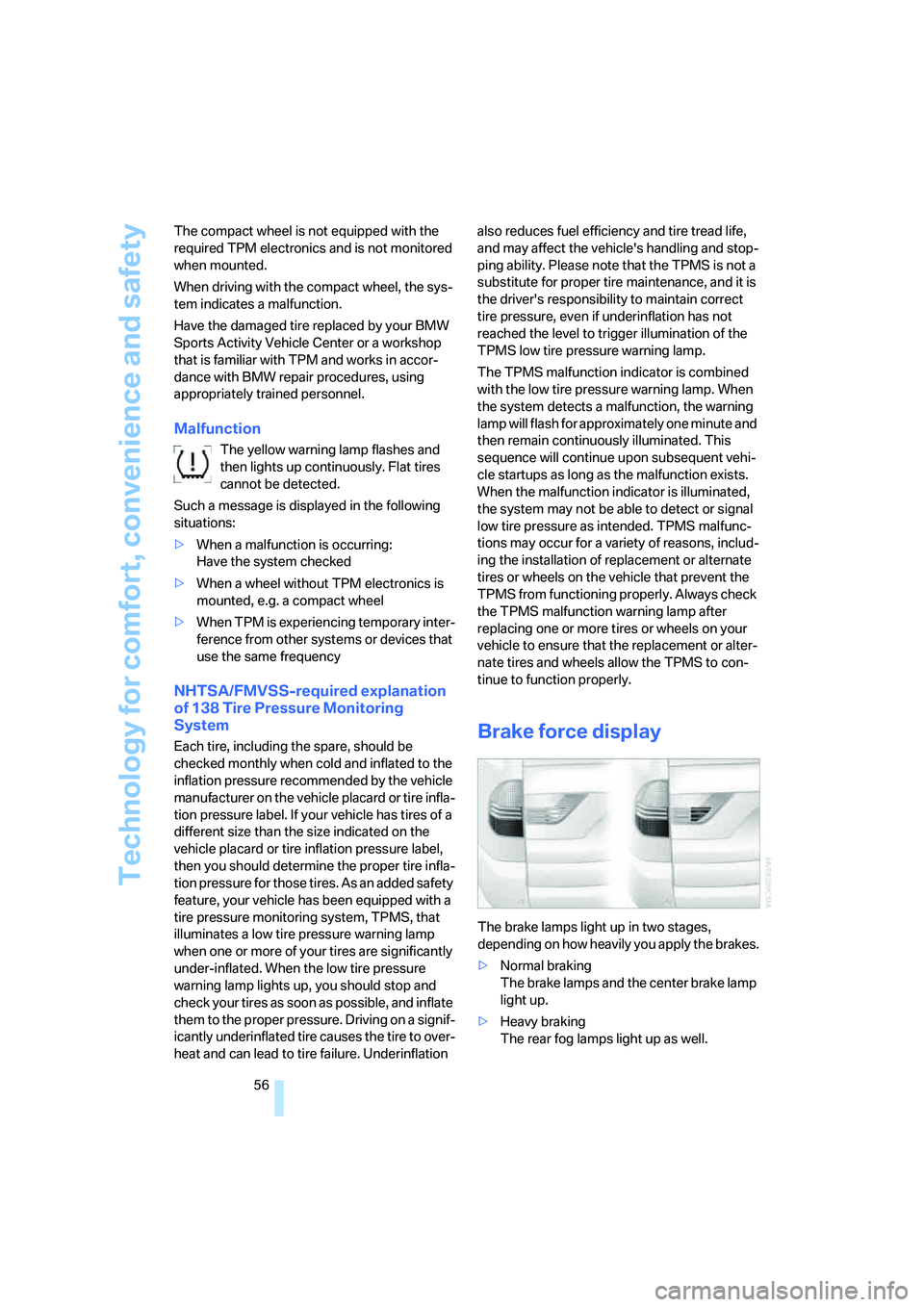
The brake lamps light up in two stages,
depending on how heavily you apply the brakes.
>Normal braking
The brake lamps and the center brake lamp
light up.
>Heavy braking
The rear fog lamps light up as well.
Page 85 of 140
Reference
At a glance
Controls
Driving tips
Mobility
83
Saving fuel
The fuel consumption of your vehicle is depen-
dent on various factors. You can improve your
vehicle's fuel consumption and reduce the
strain on the environment with several mea-
sures, your driving style and regular mainte-
nance.
Removing unnecessary cargo
Additional weight increases fuel consumption.
Removing attached parts following use
Remove auxiliary mirrors, roof or rear luggage
racks which are no longer required following
use. Attached parts on the vehicle impair the
aerodynamics and increase the fuel consump-
tion.
Closing windows and panorama glass
sunroof
An open panorama glass sunroof or an open
window also increases the aerodynamic drag,
and with it the fuel consumption.
Checking tire inflation pressures
regularly
Check the tire inflation pressures at least twice
a month and before starting off on a longer trip
and correct them if necessary.
An insufficient tire inflation pressure increases
the rolling resistance, therefore increasing fuel
consumption and tire wear.
Driving off immediately
Do not allow the engine to warm up by leaving it
running while the vehicle remains stationary.
Instead, drive off immediately at a moderate
engine speed. This enables a cold engine to
reach its operating temperature most rapidly.
Looking well ahead when driving
Avoid unnecessary acceleration and braking by
maintaining a corresponding distance to the
vehicle driving ahead. Driving smoothly and
looking ahead reduces fuel consumption.
Avoiding high engine speeds
Only use 1st gear when starting off. Accelerate
briskly from 2nd gear while avoiding high
engine speeds and shifting up prematurely.
When the desired speed is reached, shift into
the highest possible gear and drive at constant
speed at the lowest possible engine speed.
Always remember: driving at low engine speeds
decreases fuel consumption and reduces wear.
Using overrun conditions
When approaching a red light, take your foot off
the accelerator and allow the vehicle to coast in
the highest possible gear.
On a downhill stretch of road, take your foot off
the accelerator and allow the vehicle to coast in
the suitable gear.
The flow of fuel is interrupted in overrun.
Switching off the engine during longer
stops
Switch off the engine during longer stops, e.g.
at traffic lights, railroad crossings or in traffic
jams. You already save fuel from approx. 4 sec-
onds with the engine switched off.
Switching off functions currently not
required
Functions like the air conditioner, seat heating
or the rear-window defroster require a lot of
energy and consume additional fuel. This plays
a major role especially when driving in urban
and in stop-and-go traffic. Therefore, switch off
these functions when they are not really
required.
Having maintenance carried out
Have regular maintenance performed on the
vehicle to achieve optimum the economy and
service life of your vehicle. BMW recommends
having maintenance performed by a BMW
Sports Activity Vehicle Center. Also observe
the BMW maintenance system, refer to
page105.
Page 93 of 140
Mobility
This section helps you maintain your mobility
by supplying important information on
vital topics including fuels and lubricants,
wheels and tires, service, maintenance
and breakdown assistance.
Mobility
Page 94 of 140
Refueling
92
Refueling
Fuel cap
Opening
Always switch off the engine before
refueling. Otherwise, no fuel can be dis-
pensed into the tank and the Service Engine
Soon lamp lights up.<
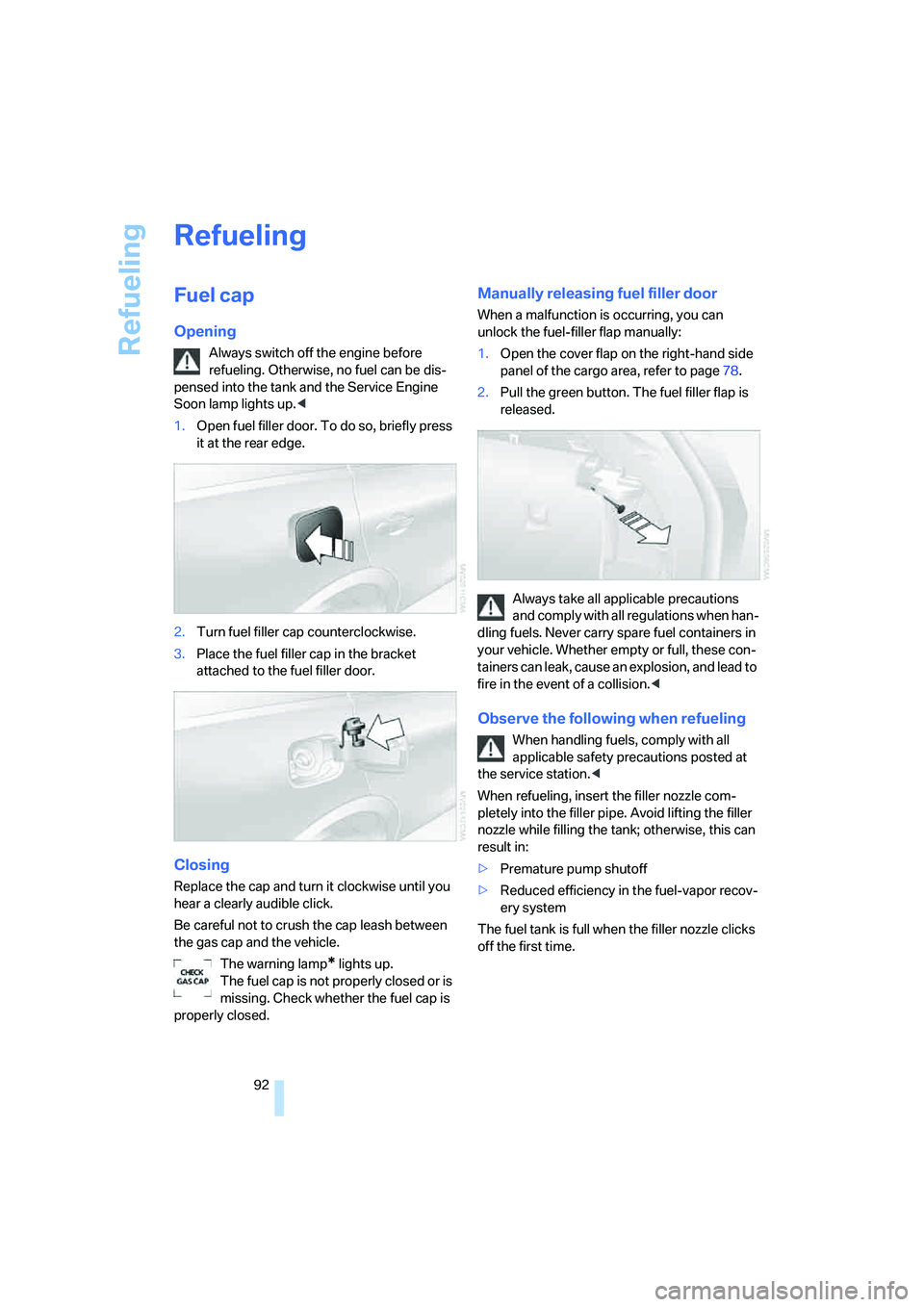
1.Open fuel filler door. To do so, briefly press
it at the rear edge.
2.Turn fuel filler cap counterclockwise.
3.Place the fuel filler cap in the bracket
attached to the fuel filler door.
Closing
Replace the cap and turn it clockwise until you
hear a clearly audible click.
Be careful not to crush the cap leash between
the gas cap and the vehicle.
The warning lamp
* lights up.
The fuel cap is not properly closed or is
missing. Check whether the fuel cap is
properly closed.
Manually releasing fuel filler door
When a malfunction is occurring, you can
unlock the fuel-filler flap manually:
1.Open the cover flap on the right-hand side
panel of the cargo area, refer to page78.
2.Pull the green button. The fuel filler flap is
released.
Always take all applicable precautions
and comply with all regulations when han-
dling fuels. Never carry spare fuel containers in
your vehicle. Whether empty or full, these con-
tainers can leak, cause an explosion, and lead to
fire in the event of a collision.<
Observe the following when refueling
When handling fuels, comply with all
applicable safety precautions posted at
the service station.<
When refueling, insert the filler nozzle com-
pletely into the filler pipe. Avoid lifting the filler
nozzle while filling the tank; otherwise, this can
result in:
>Premature pump shutoff
>Reduced efficiency in the fuel-vapor recov-
ery system
The fuel tank is full when the filler nozzle clicks
off the first time.
Page 95 of 140
Reference
At a glance
Controls
Driving tips
Mobility
93
Fuel tank capacity
Approx. 17.7 US gal/67 liters, including the
reserve capacity of approx. 2 US gal/8 liters.
Never attempt to continue driving until
the tank is completely empty; this can
negatively affect engine function and can dam-
age the vehicle.<
Fuel specifications
Never use leaded gasoline. Otherwise,
you will damage the catalytic converter.
Do not use flex fuel or E85, i.e. fuel that is com-
prised of 85 % ethanol as these can damage the
engine and fuel supply system.<
Required fuel
Super Premium Gasoline/AKI 91
This gasoline is highly recommended.
However, you may also use gasoline with a
lower AKI rating. The minimum AKI rating is 87.
If you use gasoline with this minimum AKI rat-
ing, the engine may produce knocking sounds
when starting at high outside temperatures.
This has no effect on the engine life.
Do not use any gasoline below the speci-
fied minimum fuel grade. Otherwise, the
engine could be damaged.<
Use high-quality brands
Field experience has indicated significant dif-
ferences in fuel quality: volatility, composition,
additives, etc., among gasolines offered for sale
in the United States and Canada. Fuels contain-
ing up to and including 10 % ethanol or other
oxygenates with up to 2.8 % oxygen by weight,
that is, 15 % MTBE or 3 % methanol plus an
equivalent amount of co-solvent, will not void
the applicable warranties with respect to
defects in materials or workmanship.The use of poor-quality fuels may result in
stalling, starting and drivability problems
especially under certain environmental condi-
tions such as high ambient temperature and
high altitude.
Should you encounter drivability problems that
you suspect could be related to the fuel you are
using, we recommend that you respond by
switching to a recognized high-quality brand
such as gasoline that is advertised as Top Tier
Detergent Gasoline.
Failure to comply with these recommendations
may also result in unscheduled maintenance.<
Page 100 of 140
Wheels and tires
98 age and related safety hazards. Make sure that
the new wheels are balanced.<
Retreaded tires
BMW does not recommend the use of
retreaded tires; otherwise, driving safety
may be reduced. The causes for this include the
possibly different tire casing structures and the
often wide variations in their age, which can
result in a limited service life.<
Correct wheels and tires
BMW recommends that you use only
wheel and tire combinations that BMW
has tested and approved for your particular
vehicle. Variations in factors such as manufac-
turing tolerances mean that even wheels and
tires with identical official size ratings could
actually have different dimensions than the
approved units – these differences could lead to
body contact and with it, the risk of severe acci-
dents. If non-approved wheels and tires are
used, BMW cannot evaluate their suitability,
and therefore cannot be held liable for driving
safety.<
You can ask your BMW Sports Activity Vehicle
Center for the correct wheel-and-tire combina-
tion.
The correct wheel-and-tire combination affects
various systems whose function would other-
wise be impaired, e.g. ABS, DSC or xDrive.
To maintain good handling and vehicle
response, use only tires of a single tread config-
uration from a single manufacturer. After tire
damage, always remember to have the original
wheel and tire combination remounted on the
vehicle as soon as possible.
Wheels equipped with electronics for
TPM Tire Pressure Monitor
When installing new tires or when changing
from summer tires to winter tires or vice versa,
only use wheels equipped with TPM electron-
ics; otherwise, the Tire Pressure Monitor can-
not detect a flat tire, refer to page55. Your
BMW Sports Activity Vehicle Center will be
happy to advise you in this regard.
Recommended tire brands
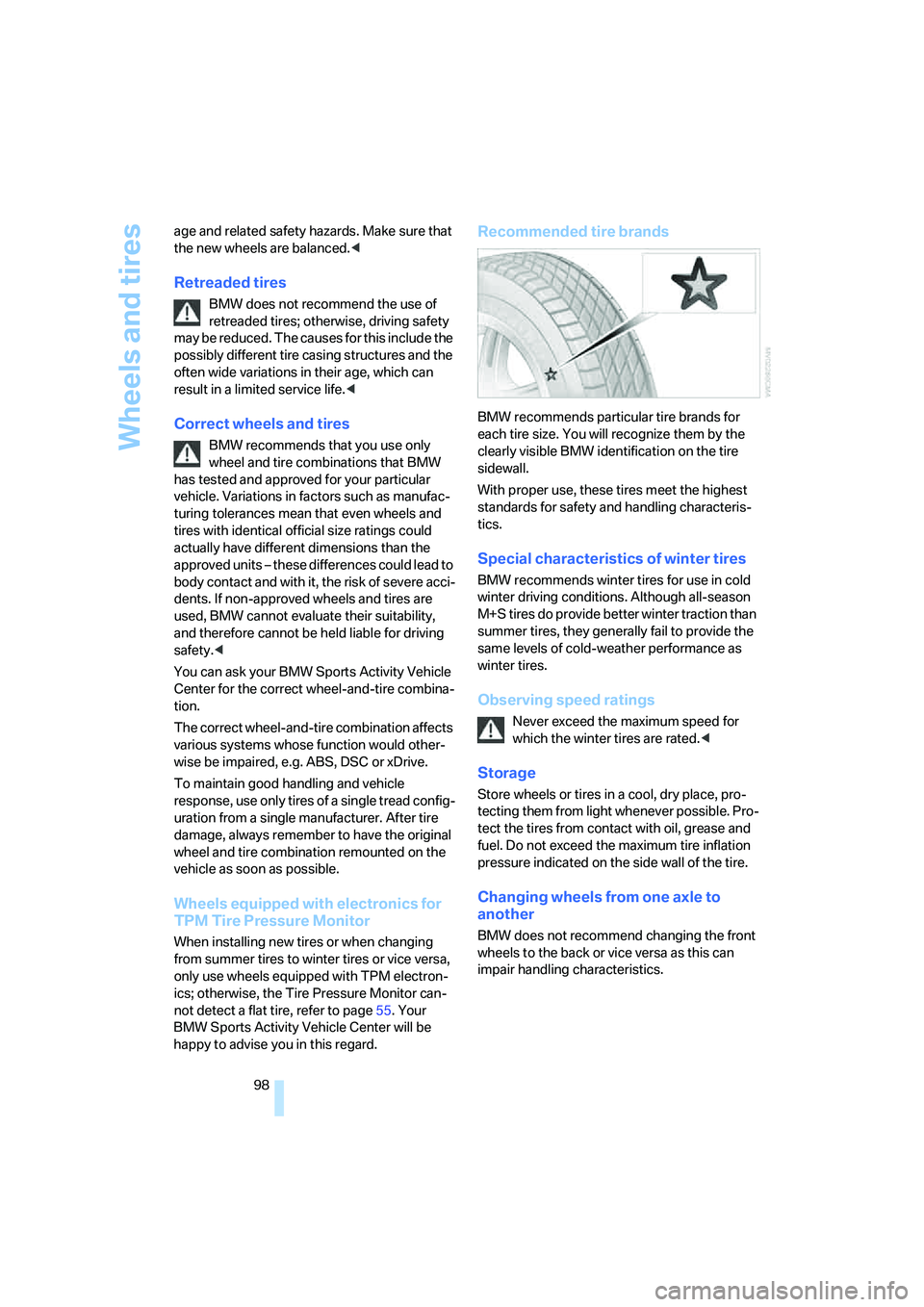
BMW recommends particular tire brands for
each tire size. You will recognize them by the
clearly visible BMW identification on the tire
sidewall.
With proper use, these tires meet the highest
standards for safety and handling characteris-
tics.
Special characteristics of winter tires
BMW recommends winter tires for use in cold
winter driving conditions. Although all-season
M+S tires do provide better winter traction than
summer tires, they generally fail to provide the
same levels of cold-weather performance as
winter tires.
Observing speed ratings
Never exceed the maximum speed for
which the winter tires are rated.<
Storage
Store wheels or tires in a cool, dry place, pro-
tecting them from light whenever possible. Pro-
tect the tires from contact with oil, grease and
fuel. Do not exceed the maximum tire inflation
pressure indicated on the side wall of the tire.
Changing wheels from one axle to
another
BMW does not recommend changing the front
wheels to the back or vice versa as this can
impair handling characteristics.
Page 104 of 140
Under the hood
102
Engine oil
Engine oil consumption depends on driving
style and operating conditions.
Warning lamp
Engine oil pressure
The warning lamp lights up red:
The engine oil pressure is too low.
Stop the vehicle immediately and
switch off the engine. Check the engine oil level
and top off as needed. If the oil level is correct:
Have the system checked immediately.
Do not continue driving. The engine could
be damaged because of inadequate lubri-
cation.<
Engine oil level
The warning lamp lights up yellow dur-
ing driving. An acoustic signal also
sounds and "+1.0 " is displayed in the
instrument cluster, refer to page102.
The oil level is at its absolute minimum; top off
engine oil as soon as possible. Until then, do not
drive more than approx. 125 miles/200 km.
The warning lamp lights up yellow after
the engine is switched off. In addition, a
signal sounds.
Top off engine oil at the earliest opportunity,
e.g. with your next refueling.
The warning lamp lights up yellow
within 30 seconds after starting the
engine:
The oil level sensor has failed. It is not possible
to take a current or meaningful measurement.
Have the system checked as soon as possible.
Checking oil level
Your vehicle is equipped with an electronic oil
level control.
For the most precise possible display of the oil
level, the engine must be at operating tempera-
ture, i.e. after at least 6.5 miles/10 km of unin-
terrupted driving. You can have the oil level dis-
played while you drive or while the vehicle is standing on a flat surface with the engine run-
ning.
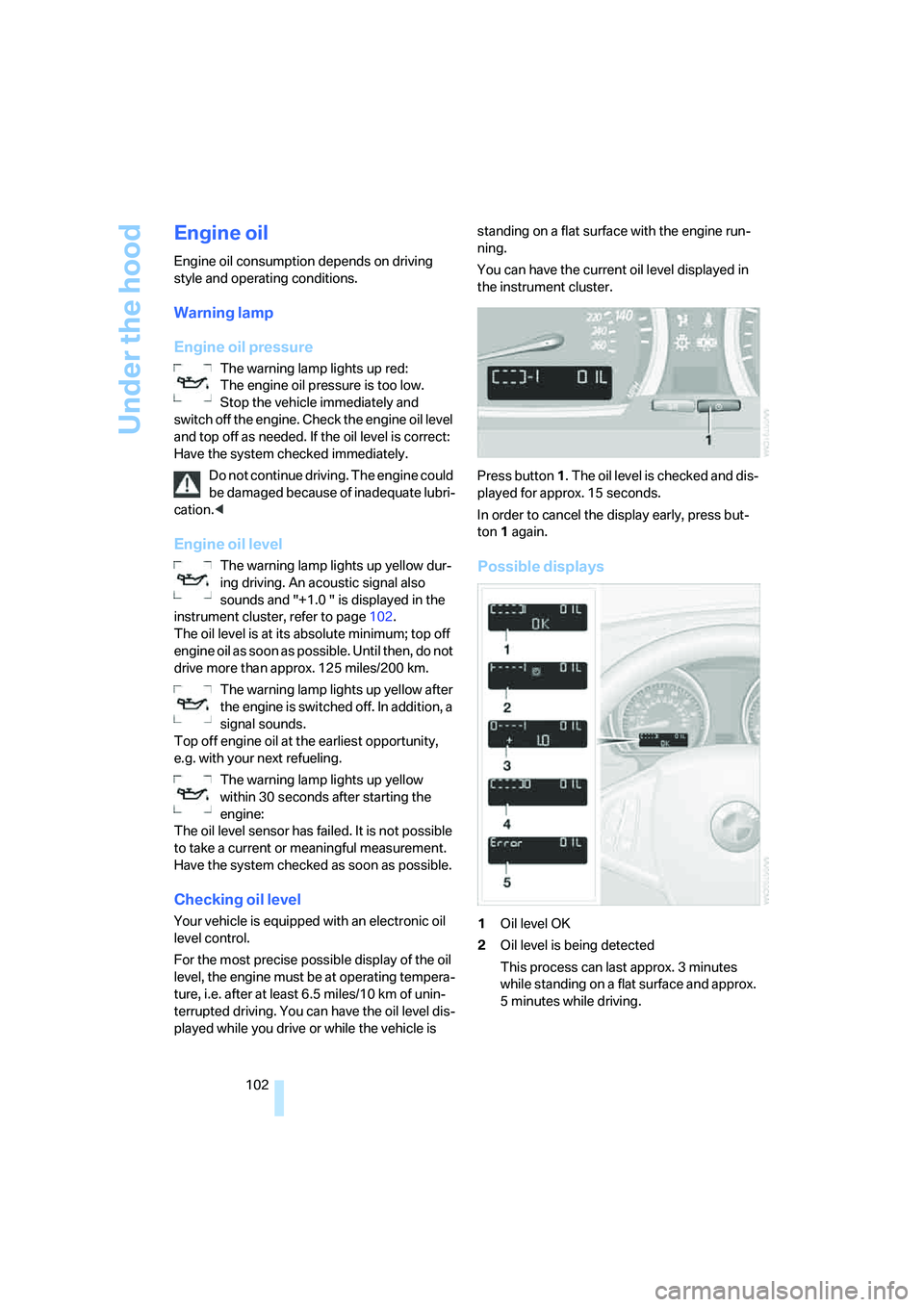
You can have the current oil level displayed in
the instrument cluster.
Press button1. The oil level is checked and dis-
played for approx. 15 seconds.
In order to cancel the display early, press but-
ton 1 again.
Possible displays
1Oil level OK
2Oil level is being detected
This process can last approx. 3 minutes
while standing on a flat surface and approx.
5 minutes while driving.
Page 108 of 140
Maintenance
106
Emissions values
The warning lamp lights up. Exhaust
values are deteriorating. Have the vehi-
cle checked as soon as possible.
Under certain conditions, the indicator will flash.
This indicates a serious rate of engine misfire.
When this occurs, you should reduce speed
and consult the nearest BMW Sports Activity
Vehicle Center as soon as possible. Severe
engine misfire even for only a short period of
time can seriously damage emission control
components, especially the catalytic converter.
Display of the previously described
malfunction on Canadian models.
When the fuel filler cap is not properly
tightened, the OBD system can detect
the vapor leak and the indicator lamp will light
up. If the filler cap is subsequently tightened,
the indicator lamp should go out within a few
days.<
Event data recorders
Your vehicle may be equipped with one or more
sensing and diagnostic modules or a recording
device capable of recording or transmitting cer-
tain vehicle data or information. In addition, if
you have a Subscription Service Agreement for
the BMW Assist system, certain vehicle infor-
mation may be transmitted or recorded in order
to provide such services.
Care
You can find useful information on caring for
your BMW in the Caring for your vehicle bro-
chure.
Page 126 of 140
Technical data
124
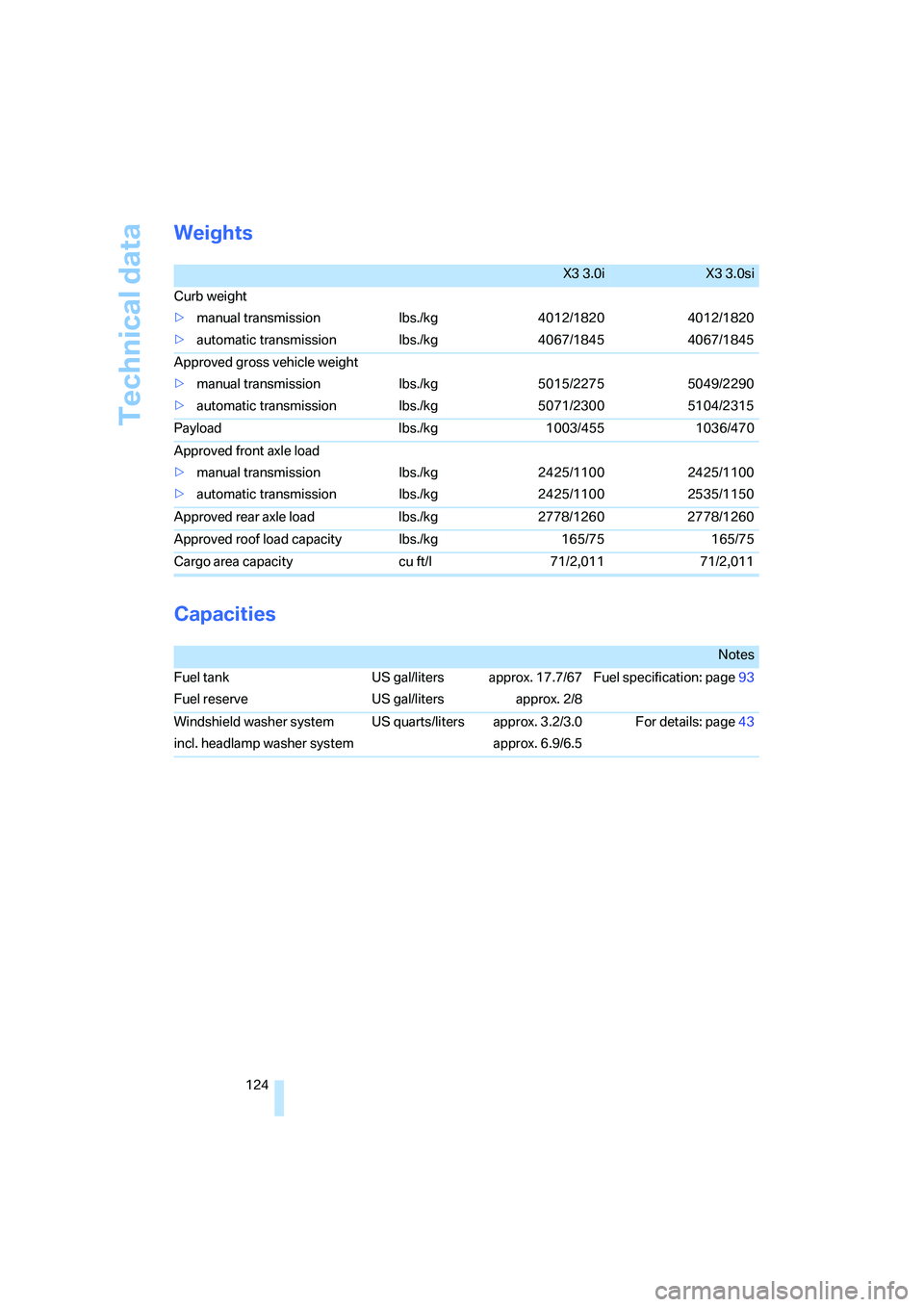
Weights
Capacities
X3 3.0iX3 3.0si
Curb weight
>manual transmission
>automatic transmissionlbs./kg
lbs./kg4012/1820
4067/18454012/1820
4067/1845
Approved gross vehicle weight
>manual transmission
>automatic transmissionlbs./kg
lbs./kg5015/2275
5071/23005049/2290
5104/2315
Payload lbs./kg 1003/455 1036/470
Approved front axle load
>manual transmission
>automatic transmissionlbs./kg
lbs./kg2425/1100
2425/11002425/1100
2535/1150
Approved rear axle load lbs./kg 2778/1260 2778/1260
Approved roof load capacity lbs./kg 165/75 165/75
Cargo area capacity cu ft/l 71/2,011 71/2,011
Notes
Fuel tank
Fuel reserve US gal/liters
US gal/litersapprox. 17.7/67
approx. 2/8Fuel specification: page93
Windshield washer system
incl. headlamp washer systemUS quarts/liters approx. 3.2/3.0
approx. 6.9/6.5For details: page43
Page 128 of 140
Everything from A to Z
126
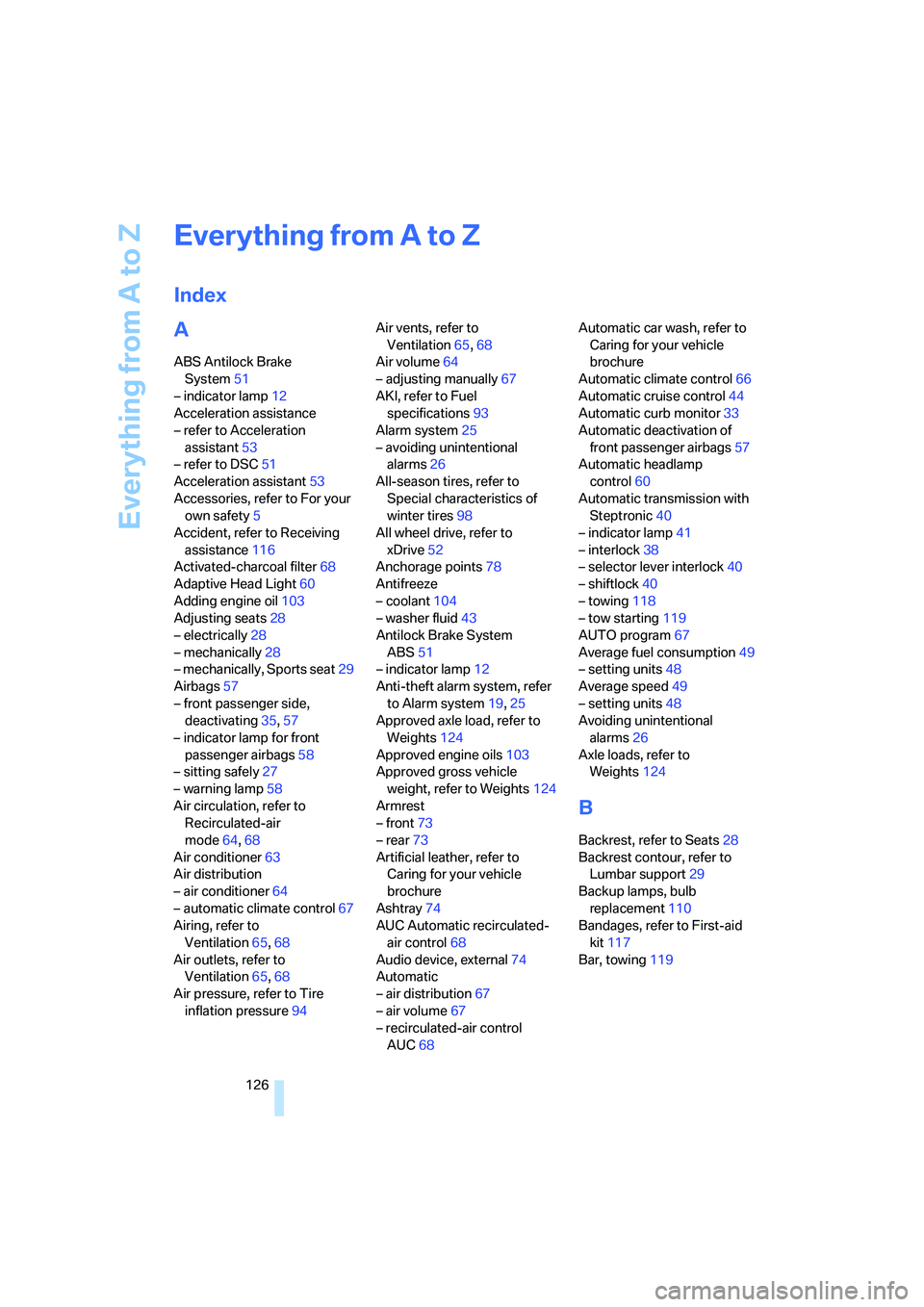
Everything from A to Z
Index
A
ABS Antilock Brake
System51
– indicator lamp12
Acceleration assistance
– refer to Acceleration
assistant53
– refer to DSC51
Acceleration assistant53
Accessories, refer to For your
own safety5
Accident, refer to Receiving
assistance116
Activated-charcoal filter68
Adaptive Head Light60
Adding engine oil103
Adjusting seats28
– electrically28
– mechanically28
– mechanically, Sports seat29
Airbags57
– front passenger side,
deactivating35,57
– indicator lamp for front
passenger airbags58
– sitting safely27
– warning lamp58
Air circulation, refer to
Recirculated-air
mode64,68
Air conditioner63
Air distribution
– air conditioner64
– automatic climate control67
Airing, refer to
Ventilation65,68
Air outlets, refer to
Ventilation65,68
Air pressure, refer to Tire
inflation pressure94Air vents, refer to
Ventilation65,68
Air volume64
– adjusting manually67
AKI, refer to Fuel
specifications93
Alarm system25
– avoiding unintentional
alarms26
All-season tires, refer to
Special characteristics of
winter tires98
All wheel drive, refer to
xDrive52
Anchorage points78
Antifreeze
– coolant104
– washer fluid43
Antilock Brake System
ABS51
– indicator lamp12
Anti-theft alarm system, refer
to Alarm system19,25
Approved axle load, refer to
Weights124
Approved engine oils103
Approved gross vehicle
weight, refer to Weights124
Armrest
– front73
– rear73
Artificial leather, refer to
Caring for your vehicle
brochure
Ashtray74
AUC Automatic recirculated-
air control68
Audio device, external74
Automatic
– air distribution67
– air volume67
– recirculated-air control
AUC68Automatic car wash, refer to
Caring for your vehicle
brochure
Automatic climate control66
Automatic cruise control44
Automatic curb monitor33
Automatic deactivation of
front passenger airbags57
Automatic headlamp
control60
Automatic transmission with
Steptronic40
– indicator lamp41
– interlock38
– selector lever interlock40
– shiftlock40
– towing118
– tow starting119
AUTO program67
Average fuel consumption49
– setting units48
Average speed49
– setting units48
Avoiding unintentional
alarms26
Axle loads, refer to
Weights124
B
Backrest, refer to Seats28
Backrest contour, refer to
Lumbar support29
Backup lamps, bulb
replacement110
Bandages, refer to First-aid
kit117
Bar, towing119