ESP BMW X3 3.0SI 2008 Owner's Manual
[x] Cancel search | Manufacturer: BMW, Model Year: 2008, Model line: X3 3.0SI, Model: BMW X3 3.0SI 2008Pages: 140, PDF Size: 3.36 MB
Page 81 of 140
Reference
At a glance
Controls
Driving tips
Mobility
79
the openings in the rails. To slide the lashing
eyes, press the button.
Read and follow instructions accompany-
ing the heavy-duty cargo straps.<
Adaptive attachment system*
The adaptive attachment system is to divide up
the cargo area. It is comprised of two brackets
with a telescoping rail and a retaining strap.
These brackets are guided in the two rails on
the cargo area floor.
Before using the adaptive attachment
system, fold the rear backrests into the
upright position until they engage and then
hang the partition net
* in position. Otherwise,
the cargo can be hurled into the passenger
compartment in the event of an accident.<
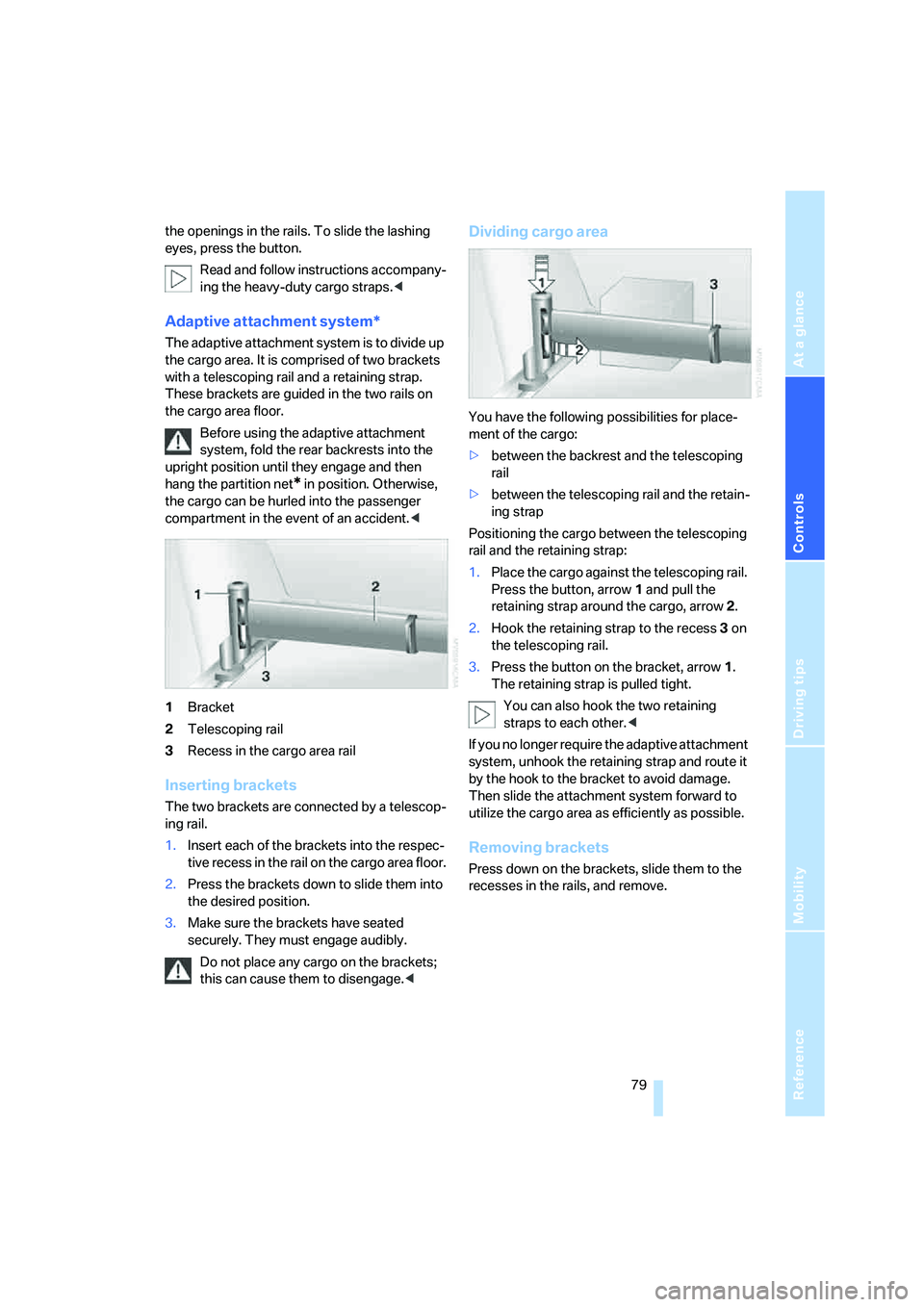
1Bracket
2Telescoping rail
3Recess in the cargo area rail
Inserting brackets
The two brackets are connected by a telescop-
ing rail.
1.Insert each of the brackets into the respec-
tive recess in the rail on the cargo area floor.
2.Press the brackets down to slide them into
the desired position.
3.Make sure the brackets have seated
securely. They must engage audibly.
Do not place any cargo on the brackets;
this can cause them to disengage.<
Dividing cargo area
You have the following possibilities for place-
ment of the cargo:
>between the backrest and the telescoping
rail
>between the telescoping rail and the retain-
ing strap
Positioning the cargo between the telescoping
rail and the retaining strap:
1.Place the cargo against the telescoping rail.
Press the button, arrow1 and pull the
retaining strap around the cargo, arrow2.
2.Hook the retaining strap to the recess3 on
the telescoping rail.
3.Press the button on the bracket, arrow1.
The retaining strap is pulled tight.
You can also hook the two retaining
straps to each other.<
If you no longer require the adaptive attachment
system, unhook the retaining strap and route it
by the hook to the bracket to avoid damage.
Then slide the attachment system forward to
utilize the cargo area as efficiently as possible.
Removing brackets
Press down on the brackets, slide them to the
recesses in the rails, and remove.
Page 85 of 140
Reference
At a glance
Controls
Driving tips
Mobility
83
Saving fuel
The fuel consumption of your vehicle is depen-
dent on various factors. You can improve your
vehicle's fuel consumption and reduce the
strain on the environment with several mea-
sures, your driving style and regular mainte-
nance.
Removing unnecessary cargo
Additional weight increases fuel consumption.
Removing attached parts following use
Remove auxiliary mirrors, roof or rear luggage
racks which are no longer required following
use. Attached parts on the vehicle impair the
aerodynamics and increase the fuel consump-
tion.
Closing windows and panorama glass
sunroof
An open panorama glass sunroof or an open
window also increases the aerodynamic drag,
and with it the fuel consumption.
Checking tire inflation pressures
regularly
Check the tire inflation pressures at least twice
a month and before starting off on a longer trip
and correct them if necessary.
An insufficient tire inflation pressure increases
the rolling resistance, therefore increasing fuel
consumption and tire wear.
Driving off immediately
Do not allow the engine to warm up by leaving it
running while the vehicle remains stationary.
Instead, drive off immediately at a moderate
engine speed. This enables a cold engine to
reach its operating temperature most rapidly.
Looking well ahead when driving
Avoid unnecessary acceleration and braking by
maintaining a corresponding distance to the
vehicle driving ahead. Driving smoothly and
looking ahead reduces fuel consumption.
Avoiding high engine speeds
Only use 1st gear when starting off. Accelerate
briskly from 2nd gear while avoiding high
engine speeds and shifting up prematurely.
When the desired speed is reached, shift into
the highest possible gear and drive at constant
speed at the lowest possible engine speed.
Always remember: driving at low engine speeds
decreases fuel consumption and reduces wear.
Using overrun conditions
When approaching a red light, take your foot off
the accelerator and allow the vehicle to coast in
the highest possible gear.
On a downhill stretch of road, take your foot off
the accelerator and allow the vehicle to coast in
the suitable gear.
The flow of fuel is interrupted in overrun.
Switching off the engine during longer
stops
Switch off the engine during longer stops, e.g.
at traffic lights, railroad crossings or in traffic
jams. You already save fuel from approx. 4 sec-
onds with the engine switched off.
Switching off functions currently not
required
Functions like the air conditioner, seat heating
or the rear-window defroster require a lot of
energy and consume additional fuel. This plays
a major role especially when driving in urban
and in stop-and-go traffic. Therefore, switch off
these functions when they are not really
required.
Having maintenance carried out
Have regular maintenance performed on the
vehicle to achieve optimum the economy and
service life of your vehicle. BMW recommends
having maintenance performed by a BMW
Sports Activity Vehicle Center. Also observe
the BMW maintenance system, refer to
page105.
Page 86 of 140
Things to remember when driving
84
General driving notes
Closing the liftgate
Operate the vehicle only when the liftgate
is completely closed; otherwise, exhaust
fumes could enter the interior of the vehicle.<
If special circumstances should make it abso-
lutely necessary to operate the vehicle with the
liftgate open:
1.Close all windows and the panorama glass
sunroof.
2.Greatly increase the air supply of the air
conditioning system or automatic climate
control, refer to page64 or67.
Hot exhaust system
High temperatures occur in the exhaust
system of every vehicle. Do not remove
the heat shields installed adjacent to various
sections of the exhaust system, and never apply
undercoating to them. When driving, standing
at idle, and parking, take care to avoid possible
contact between the hot exhaust system and
any highly flammable materials such as hay,
leaves, grass, etc. Such contact could lead to
a fire, resulting in serious personal injury and
property damage. Do not touch hot exhaust
pipe, it can cause burns.<
When the vehicle is parked
Condensation forms in the air conditioner/auto-
matic climate control system during operation,
and then exits under the vehicle. Traces of con-
densed water under the vehicle are therefore
normal.
Before driving into a car wash
Fold in the exterior mirrors, refer to page33;
otherwise, they could be damaged due to the
width of the vehicle.
Deactivate the rain sensor; otherwise, damage
could result from undesired wiper activation,
refer to page42.
Hydroplaning
When driving on wet or slushy roads,
reduce road speed. If you do not, a wedge
of water can form between tires and road sur-
face. This phenomenon is referred to as hydro-
planing, and is characterized by a partial or
complete loss of contact between tires and
road surface, ultimately undermining your abil-
ity to steer and brake the vehicle.<
The danger of hydroplaning increases as tire
tread depth decreases, also refer to Minimum
tread depth on page97.
Driving through water
Do not drive through water on the road if it
is deeper than 20 in/50 cm, and then only
at walking speed. Otherwise, the vehicle's
engine, the electrical systems, and the trans-
mission may be damaged.<
Using handbrake on inclines
Do not hold the vehicle in place on slopes
by slipping or riding the clutch, use the
handbrake instead. Otherwise, greater clutch
wear will result.<
Safe braking
Your BMW is equipped with ABS as standard
equipment. In situations in which it is required, it
is best to apply the brakes fully. Since the vehi-
cle maintains steering responsiveness, you can
nevertheless avoid possible obstacles with a
minimum of steering effort.
Pulsation at the brake pedal combined with
sounds from the hydraulic circuits indicates to
the driver that ABS is in its active mode.
Wet roads
On wet roads or in heavy rain, briefly apply light
pressure to the brake pedal every few miles.
Watch traffic conditions to ensure that this
maneuver does not endanger other road users.
The heat that is generated by the brake applica-
tions helps to dry the brake pads and rotors.
The full braking force will then be available
when you need it.
Page 87 of 140
Reference
At a glance
Controls
Driving tips
Mobility
85
Hills
To prevent overheating and reduced effi-
ciency of the brake system, drive long or
steep downhill grades in the gear in which the
least braking is required. Otherwise, even light
but continuous pressure on the brake can lead
to high temperatures, brake wear and possibly
even brake failure.<
The braking action of the engine can be further
intensified by downshifting, all the way down to
first gear if need be. This strategy helps you
avoid placing excessive loads on the brake sys-
tem. Downshifting in manual mode of automatic
transmission, refer to page41. When descend-
ing hills slowly, use HDC Hill Descent Control,
refer to page52.
Never drive with the clutch depressed,
with the transmission in neutral, or with
the engine switched off; otherwise, you will
have neither the braking action of the engine or
nor its power assistance to the brakes or steer-
ing.
Never allow floor mats, carpeting, or other arti-
cles to protrude into the area around the brake
or accelerator pedals and obstruct their move-
ment.<
Corrosion on brake rotors
When the vehicle is driven only occasionally,
during extended periods when the vehicle is not
used at all, and in operating conditions where
brake applications are less frequent, there is an
increased tendency for corrosion to form on
rotors, while contaminants accumulate on the
brake pads. This occurs because the minimal
pressure which must be exerted by the pads
during brake applications to clean the rotors is
not reached.
Should corrosion form on the brake rotors, the
brakes will tend to respond with a pulsating
effect that even extended application will fail to
cure.
Brake pads
The warning lamp lights up.
The brake pads have reached their min-imum pad thickness. Have brake pads replaced
immediately.
Cargo loading
To avoid loading the tires beyond their
approved carrying capacity, never over-
load the vehicle. Overloading can lead to over-
heating of the tire and increases the rate at
which damage develops inside the tires. The
ultimate result can assume the form of a sudden
blow-out.<
Make sure that no fluids leak in the cargo
area; as otherwise the vehicle could be
damaged.<
Determining load limit
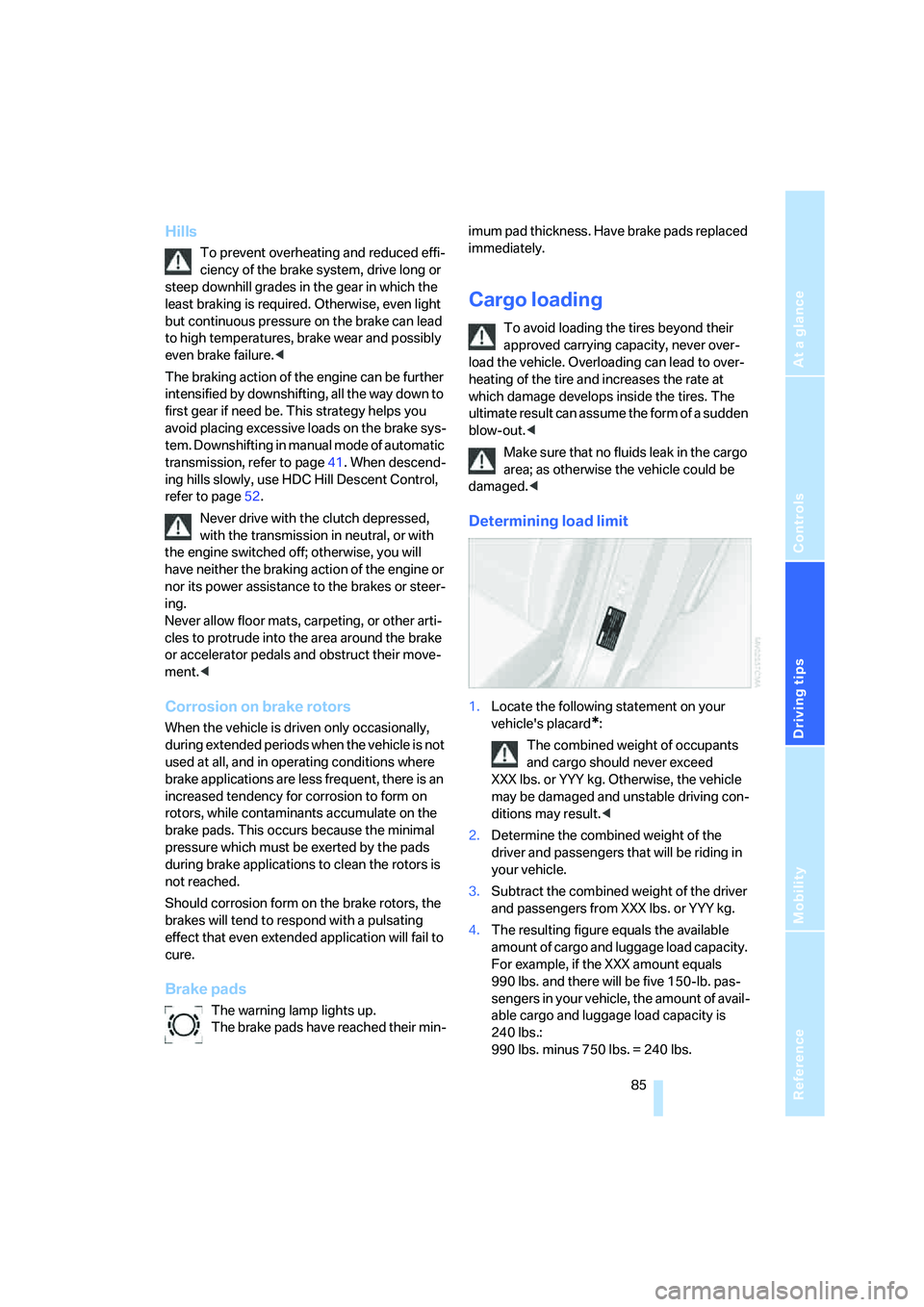
1.Locate the following statement on your
vehicle's placard
*:
The combined weight of occupants
and cargo should never exceed
XXX lbs. or YYY kg. Otherwise, the vehicle
may be damaged and unstable driving con-
ditions may result.<
2.Determine the combined weight of the
driver and passengers that will be riding in
your vehicle.
3.Subtract the combined weight of the driver
and passengers from XXX lbs. or YYY kg.
4.The resulting figure equals the available
amount of cargo and luggage load capacity.
For example, if the XXX amount equals
990 lbs. and there will be five 150-lb. pas-
sengers in your vehicle, the amount of avail-
able cargo and luggage load capacity is
240 lbs.:
990 lbs. minus 750 lbs. = 240 lbs.
Page 89 of 140
Reference
At a glance
Controls
Driving tips
Mobility
87
Roof-mounted luggage rack*
A special rack system is available as an optional
accessory for your BMW. Please familiarize
yourself with the information contained in the
installation instructions.
Loading luggage rack
Because roof racks raise the vehicle's center of
gravity when loaded, they have a major effect on
its handling and steering response. You should
therefore always remember not to exceed the
approved roof load capacity, the approved
gross vehicle weight, or the axle loads when
loading the rack.
These specifications can be found under
Weights on page124.
The roof load must be evenly distributed and
must not extend outward beyond the limits of
the loading surface. Always stow the heaviest
pieces on the bottom. Be sure that adequate
clearance is maintained for raising the glass
sunroof and that objects do not project into the
opening path of the liftgate.
Secure roof-mounted cargo correctly and
securely to prevent it from shifting or falling off
while you drive.
Drive smoothly. Avoid sudden acceleration and
braking maneuvers. Take corners gently.
Driving on poor roads
Your X3 is at home on all paved and unpaved
roads. It combines all-wheel drive with the
advantages of a normal passenger car.
Do not drive off-road, as otherwise the
vehicle may be damaged.<
When you are driving on poor roads, there are a
few points which you should strictly observe –
for your own safety and that of your passengers,
as well as to protect the vehicle:
>Familiarize yourself with the vehicle before
you begin driving. Do not take risks with the
vehicle under any circumstances.
>Always adapt your driving speed to the
road conditions. The more steep and uneven the roadway is, the lower the speed
should be.
>You can operate your vehicle on uphill and
downhill gradients with a maximum slope
of 50 %. If you wish to drive on uphill and
downhill grades of this nature, make sure
beforehand that the engine oil and coolant
levels are near the MAX mark, refer to
pages102 and104.
>When descending very steep hills, use
HDC Hill Descent Control, refer to page52.
It is possible to start off on inclines of up
to 32 %.
The permitted side tilt is 32 %.
>While driving, watch carefully for obstacles
such as rocks or holes. Try to avoid these
obstacles whenever possible.
>Avoid having the body make contact with
the ground, e.g. on the crests of hills and
bumpy roads. The ground clearance of the
vehicle is a maximum of approx. 8.0 in/
20 cm. Please be aware that the ground
clearance can vary depending on the load
and operating conditions of the vehicle.
>Do not drive in water that is deeper than
20 in/50 cm. If you must drive through water
up to that depth, drive at a walking speed
and do not stop.
After leaving the water, press on the foot-
brake gently several times while driving at a
low speed. The brake applications will help
to dry the brakes, thus preventing a reduc-
tion in braking performance caused by the
moisture.
To clean the handbrake, apply the lever
slightly at approx. 25 mph/40 km/h and con-
tinue to drive for approx. 200 yards/
200 meters, provided that traffic conditions
allow you to do so.
>Depending on the road condition, it can be
useful to temporarily activate DTC, refer to
DTC Dynamic Traction Control on page52.
>If the drive wheels spin on one side, depress
the accelerator pedal far enough to permit
the driving stability control systems to dis-
tribute the drive torque to the individual
wheels.
Page 95 of 140
Reference
At a glance
Controls
Driving tips
Mobility
93
Fuel tank capacity
Approx. 17.7 US gal/67 liters, including the
reserve capacity of approx. 2 US gal/8 liters.
Never attempt to continue driving until
the tank is completely empty; this can
negatively affect engine function and can dam-
age the vehicle.<
Fuel specifications
Never use leaded gasoline. Otherwise,
you will damage the catalytic converter.
Do not use flex fuel or E85, i.e. fuel that is com-
prised of 85 % ethanol as these can damage the
engine and fuel supply system.<
Required fuel
Super Premium Gasoline/AKI 91
This gasoline is highly recommended.
However, you may also use gasoline with a
lower AKI rating. The minimum AKI rating is 87.
If you use gasoline with this minimum AKI rat-
ing, the engine may produce knocking sounds
when starting at high outside temperatures.
This has no effect on the engine life.
Do not use any gasoline below the speci-
fied minimum fuel grade. Otherwise, the
engine could be damaged.<
Use high-quality brands
Field experience has indicated significant dif-
ferences in fuel quality: volatility, composition,
additives, etc., among gasolines offered for sale
in the United States and Canada. Fuels contain-
ing up to and including 10 % ethanol or other
oxygenates with up to 2.8 % oxygen by weight,
that is, 15 % MTBE or 3 % methanol plus an
equivalent amount of co-solvent, will not void
the applicable warranties with respect to
defects in materials or workmanship.The use of poor-quality fuels may result in
stalling, starting and drivability problems
especially under certain environmental condi-
tions such as high ambient temperature and
high altitude.
Should you encounter drivability problems that
you suspect could be related to the fuel you are
using, we recommend that you respond by
switching to a recognized high-quality brand
such as gasoline that is advertised as Top Tier
Detergent Gasoline.
Failure to comply with these recommendations
may also result in unscheduled maintenance.<
Page 96 of 140
Wheels and tires
94
Wheels and tires
Tire inflation pressure
Information for your safety
The condition of the tires and the maintenance
of the specified tire pressure are crucial not only
to the tire's service life, but also to driving com-
fort and most importantly, driving safety.
Checking pressure
Only check tire inflation pressure when the tires
are cold. This means after a maximum of
1.25 miles/2 km driving or when the vehicle has
been parked for at least 2 hours. When tires are
warm, the tire inflation pressure increases.
Check the tire inflation pressure regularly
and correct it as needed, even on the
compact wheel: at least twice a month and
before starting long trips. If you fail to observe
this precaution, you may be driving on tires with
incorrect tire pressures, a condition that can not
only compromise your vehicle's driving stability,
but also lead to tire damage and the risk of an
accident.
Do not drive with deflated, i.e. flat tires. A flat tire
will seriously impair your vehicle's handling and
braking response. Attempts to drive on a flat tire
can lead to loss of control over the vehicle.<
After correcting the tire inflation pressure,
reinitialize the Flat Tire Monitor
* or
reset the Tire Pressure Monitor
*, refer to
pages54, 55.<
Pressure specifications
The table on the next page provides all the cor-
rect inflation pressures for the specified tire
sizes at ambient temperature.
The inflation pressures in the table apply
to BMW-approved tire sizes and recom-
mended tire brands. Your BMW Sports Activity
Vehicle Center will be glad to supply this infor-
mation.
lowing:
>Tire size for your vehicle
>Load status
>Maximum permissible driving speed
Tire inflation pressures for speeds
up to 100 mph/160 km/h
For normal driving at speeds of up to 100 mph/
160 km/h and to achieve optimum driving com-
fort, take note of the tire inflation pressures
listed on the following page in the column for
speeds up to max. 100 mph/160 km/h and
adjust your tire pressure as needed.
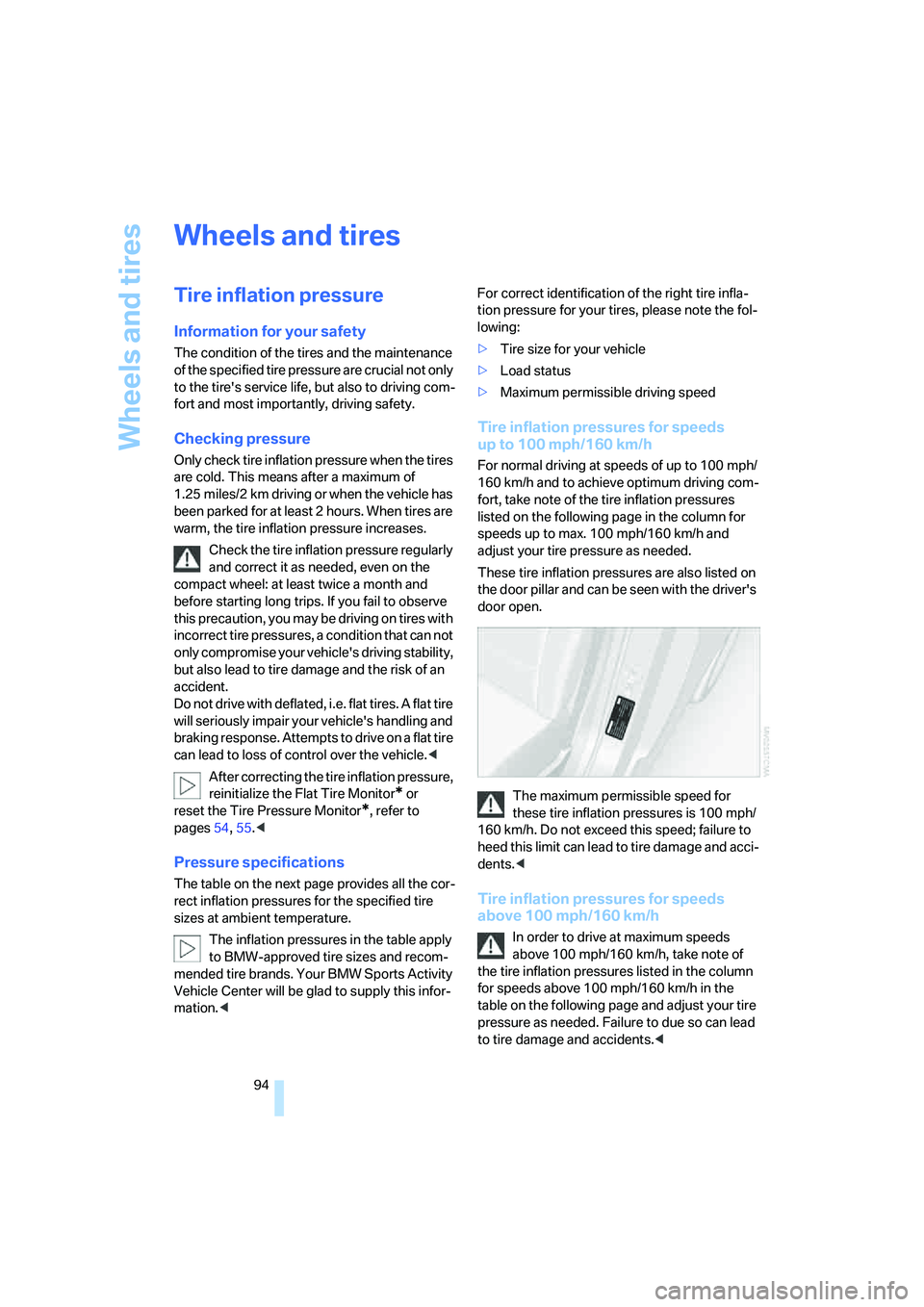
These tire inflation pressures are also listed on
the door pillar and can be seen with the driver's
door open.
The maximum permissible speed for
these tire inflation pressures is 100 mph/
160 km/h. Do not exceed this speed; failure to
heed this limit can lead to tire damage and acci-
dents.<
Tire inflation pressures for speeds
above 100 mph/160 km/h
In order to drive at maximum speeds
above 100 mph/160 km/h, take note of
the tire inflation pressures listed in the column
for speeds above 100 mph/160 km/h in the
table on the following page and adjust your tire
pressure as needed. Failure to due so can lead
to tire damage and accidents.<
Page 99 of 140
Reference
At a glance
Controls
Driving tips
Mobility
97
Temperature
The temperature grades are A, B, and C, A
being highest, and represent the tire's resis-
tance to the generation of heat and its ability to
dissipate heat when tested under controlled
conditions on a specified indoor laboratory test
wheel. Sustained high temperature can cause
the material of the tire to degenerate and
reduce tire life, and excessive temperature can
lead to sudden tire failure. The grade C corre-
sponds to a level of performance that all pas-
senger car tires must meet under the Federal
Motor Vehicle Safety Standard No. 109. Grades
B and A represent higher levels of performance
on the laboratory test wheel than the minimum
required by law.
The temperature grade for this tire is
established for a tire that is properly
inflated and not overloaded. Excessive speed,
underinflation, or excessive loading, either sep-
arately or in combination, can cause heat
buildup and possible tire failure.<
M+S
Winter and all-season tires.
These have better winter properties than sum-
mer tires.
Tire condition
Inspect your tires frequently for tread wear,
signs of damage and for foreign objects lodged
in the tread. Check the tread depth.
Minimum tread depth
The tread depth should not fall below 0.12 in/
3 mm. At tread depths below 0.12 in/3 mm,
there is an increased risk of high-speed hydro-
planing, even when only small amounts of water
are present on the road surface.
Winter tires display a noticeable loss in their
ability to cope with cold-weather driving condi-
tions once the tread wears to below 0.16 in/
4 mm. To ensure continued safety you should
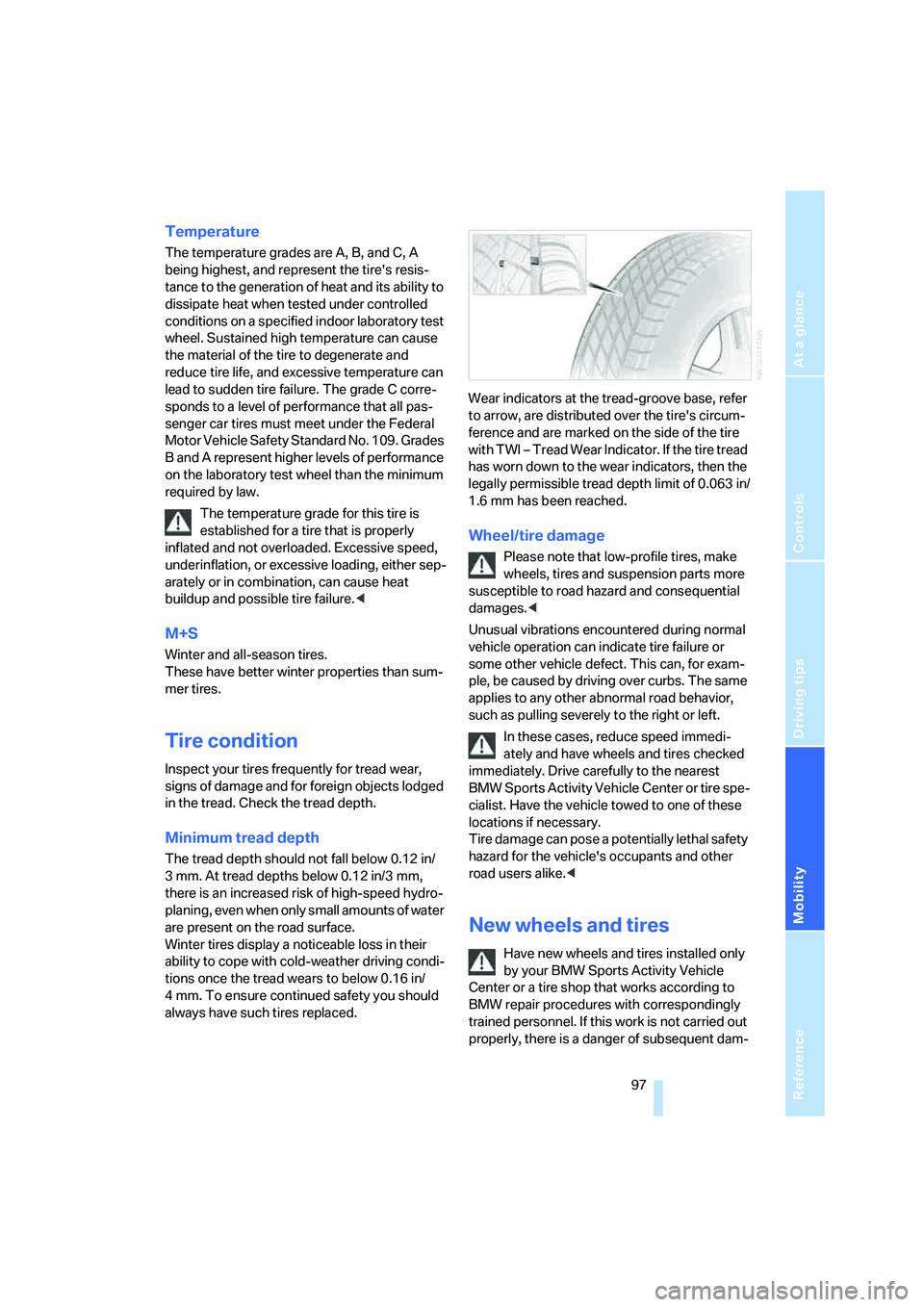
always have such tires replaced.Wear indicators at the tread-groove base, refer
to arrow, are distributed over the tire's circum-
ference and are marked on the side of the tire
with TWI – Tread Wear Indicator. If the tire tread
has worn down to the wear indicators, then the
legally permissible tread depth limit of 0.063 in/
1.6 mm has been reached.
Wheel/tire damage
Please note that low-profile tires, make
wheels, tires and suspension parts more
susceptible to road hazard and consequential
damages.<
Unusual vibrations encountered during normal
vehicle operation can indicate tire failure or
some other vehicle defect. This can, for exam-
ple, be caused by driving over curbs. The same
applies to any other abnormal road behavior,
such as pulling severely to the right or left.
In these cases, reduce speed immedi-
ately and have wheels and tires checked
immediately. Drive carefully to the nearest
BMW Sports Activity Vehicle Center or tire spe-
cialist. Have the vehicle towed to one of these
locations if necessary.
Tire damage can pose a potentially lethal safety
hazard for the vehicle's occupants and other
road users alike.<
New wheels and tires
Have new wheels and tires installed only
by your BMW Sports Activity Vehicle
Center or a tire shop that works according to
BMW repair procedures with correspondingly
trained personnel. If this work is not carried out
properly, there is a danger of subsequent dam-
Page 100 of 140
Wheels and tires
98 age and related safety hazards. Make sure that
the new wheels are balanced.<
Retreaded tires
BMW does not recommend the use of
retreaded tires; otherwise, driving safety
may be reduced. The causes for this include the
possibly different tire casing structures and the
often wide variations in their age, which can
result in a limited service life.<
Correct wheels and tires
BMW recommends that you use only
wheel and tire combinations that BMW
has tested and approved for your particular
vehicle. Variations in factors such as manufac-
turing tolerances mean that even wheels and
tires with identical official size ratings could
actually have different dimensions than the
approved units – these differences could lead to
body contact and with it, the risk of severe acci-
dents. If non-approved wheels and tires are
used, BMW cannot evaluate their suitability,
and therefore cannot be held liable for driving
safety.<
You can ask your BMW Sports Activity Vehicle
Center for the correct wheel-and-tire combina-
tion.
The correct wheel-and-tire combination affects
various systems whose function would other-
wise be impaired, e.g. ABS, DSC or xDrive.
To maintain good handling and vehicle
response, use only tires of a single tread config-
uration from a single manufacturer. After tire
damage, always remember to have the original
wheel and tire combination remounted on the
vehicle as soon as possible.
Wheels equipped with electronics for
TPM Tire Pressure Monitor
When installing new tires or when changing
from summer tires to winter tires or vice versa,
only use wheels equipped with TPM electron-
ics; otherwise, the Tire Pressure Monitor can-
not detect a flat tire, refer to page55. Your
BMW Sports Activity Vehicle Center will be
happy to advise you in this regard.
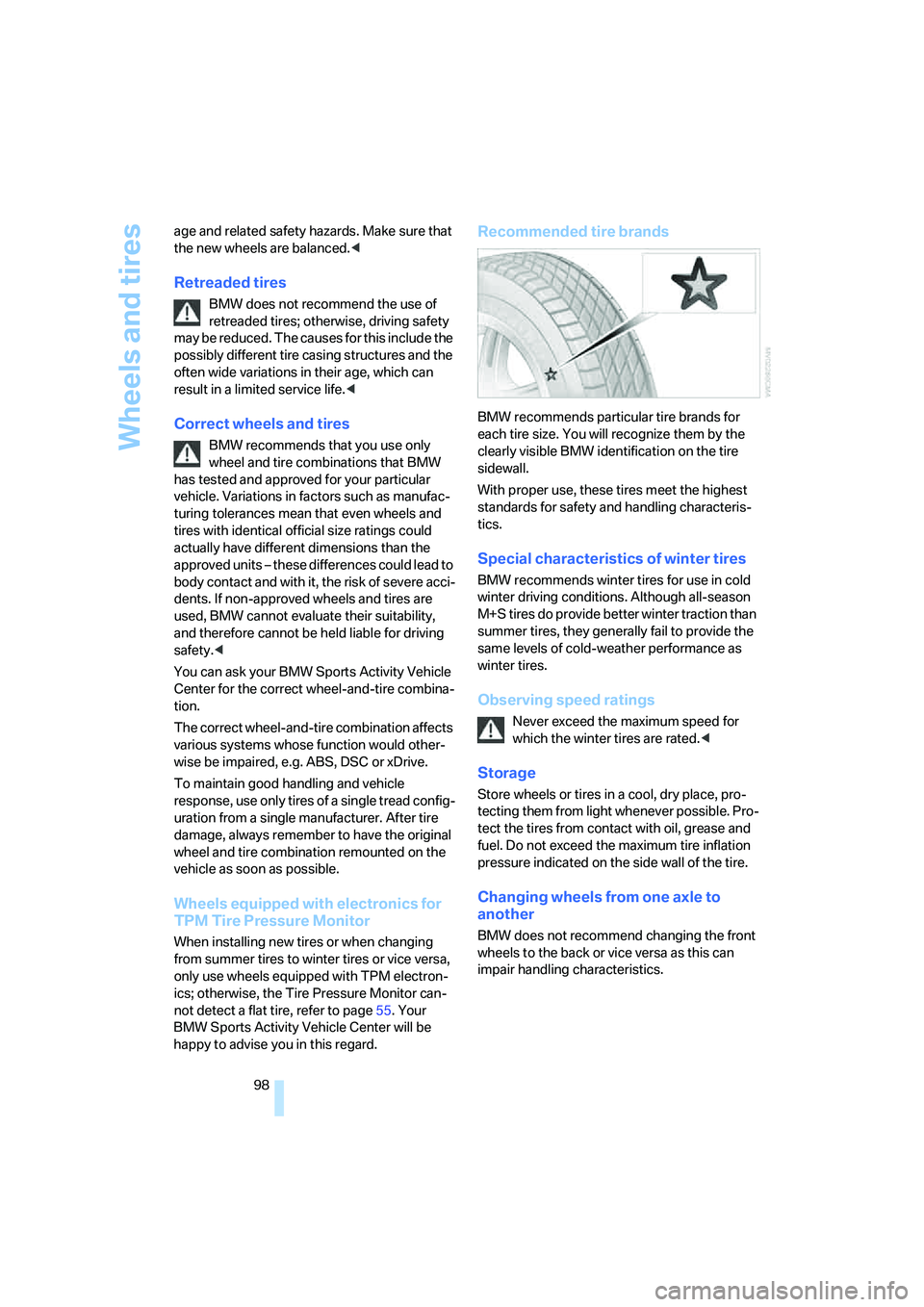
Recommended tire brands
BMW recommends particular tire brands for
each tire size. You will recognize them by the
clearly visible BMW identification on the tire
sidewall.
With proper use, these tires meet the highest
standards for safety and handling characteris-
tics.
Special characteristics of winter tires
BMW recommends winter tires for use in cold
winter driving conditions. Although all-season
M+S tires do provide better winter traction than
summer tires, they generally fail to provide the
same levels of cold-weather performance as
winter tires.
Observing speed ratings
Never exceed the maximum speed for
which the winter tires are rated.<
Storage
Store wheels or tires in a cool, dry place, pro-
tecting them from light whenever possible. Pro-
tect the tires from contact with oil, grease and
fuel. Do not exceed the maximum tire inflation
pressure indicated on the side wall of the tire.
Changing wheels from one axle to
another
BMW does not recommend changing the front
wheels to the back or vice versa as this can
impair handling characteristics.
Page 105 of 140
Reference
At a glance
Controls
Driving tips
Mobility
103
3Oil level at minimum
A t y o u r e a rl ie s t o p p ortunity, add 1 US quart/
1 l i t e r e n g i n e o i l , a l s o r e f e r t o A d d i n g e n g i n e
oil.
4Oil level too high
Have vehicle checked immediately;
otherwise, overfilled oil can lead to
engine damage.<
5Oil level sensor has failed
It is not possible to take a current or mean-
ingful measurement.
Do not add engine oil. It is possible to con-
tinue driving. Have the system checked as
soon as possible.
Adding engine oil
Add the maximum quantity of 1 US quart/1 liter
of oil only after the warning lamp in the instru-
ment cluster lights up, refer to page102, or
when the oil level measurement "+1.0 " appears
on the display.
Add oil within the next 125 miles/200 km;
otherwise, engine damage could result.<
Keep oil, grease, etc. out of reach of chil-
dren and heed warnings on the contain-
ers. Otherwise, you could endanger your
health.<
Oil change
Have the oil changed only by your BMW Sports
Activity Vehicle Center or a workshop that
works according to BMW repair procedures
with correspondingly trained personnel.
Approved engine oils
The quality of the engine oil selected has critical
significance for the operation and service life of
an engine. BMW continuously approves spe-
cific oils after confirming their suitability for use
in its vehicles with extensive testing.
Only use approved BMW High Performance
Synthetic Oil.
If you are unable to obtain BMW High Perfor-
mance Synthetic Oil, you can add small
amounts of another synthetic oil in between oil
changes. Only use oils with the API SH specifi-
cation or higher.
Ask your BMW Sports Activity Vehicle
Center for more details concerning BMW
High Performance Synthetic Oil or other
approved synthetic oils.<
You can also call BMW of North America at
1-800-831-1117 or visit the website
www.bmwusa.com to obtain this information.
BMW engines are designed to operate
without additives, and their use could
even lead to damage in some cases.<
Viscosity classes
Viscosity is the oil flow rating as defined in
SAE classes.
The selection of the correct SAE class depends
on the climate conditions in the area where you
typically drive your BMW.
Approved oils belong to SAE classes
5W-40 and 5W-30.<
These oils can be used for driving in all ambient
temperatures.