ignition BMW X3 3.0SI 2008 Owner's Guide
[x] Cancel search | Manufacturer: BMW, Model Year: 2008, Model line: X3 3.0SI, Model: BMW X3 3.0SI 2008Pages: 140, PDF Size: 3.36 MB
Page 118 of 140
Giving and receiving assistance
116
Giving and receiving assistance
Receiving assistance
The Roadside Assistance of the BMW Group
offers you assistance in the event of a break-
down around the clock, as well as on weekends
and public holidays.
The phone numbers of the Roadside Assis-
tance control center in your home country can
be found in the Contact brochure.
In the case of vehicles with the corresponding
equipment, you can use buttons in the head-
liner to contact Roadside Assistance or initiate
an emergency call.
When the emergency call is initiated, a tele-
phone connection is established to the BMW
Assist Response Center.
In vehicles with BMW Assist enabled, if the cur-
r e n t p o s i t io n o f yo ur v e h ic le c a n b e d e t er m i n ed ,
it will be transmitted to the BMW Assist
Response Center.
The conditions for initiating an emergency call
or contacting Roadside Assistance:
>Ignition key in position 1 or higher
>The car phone is logged on to a mobile tele-
phone network
>The emergency call system is operable
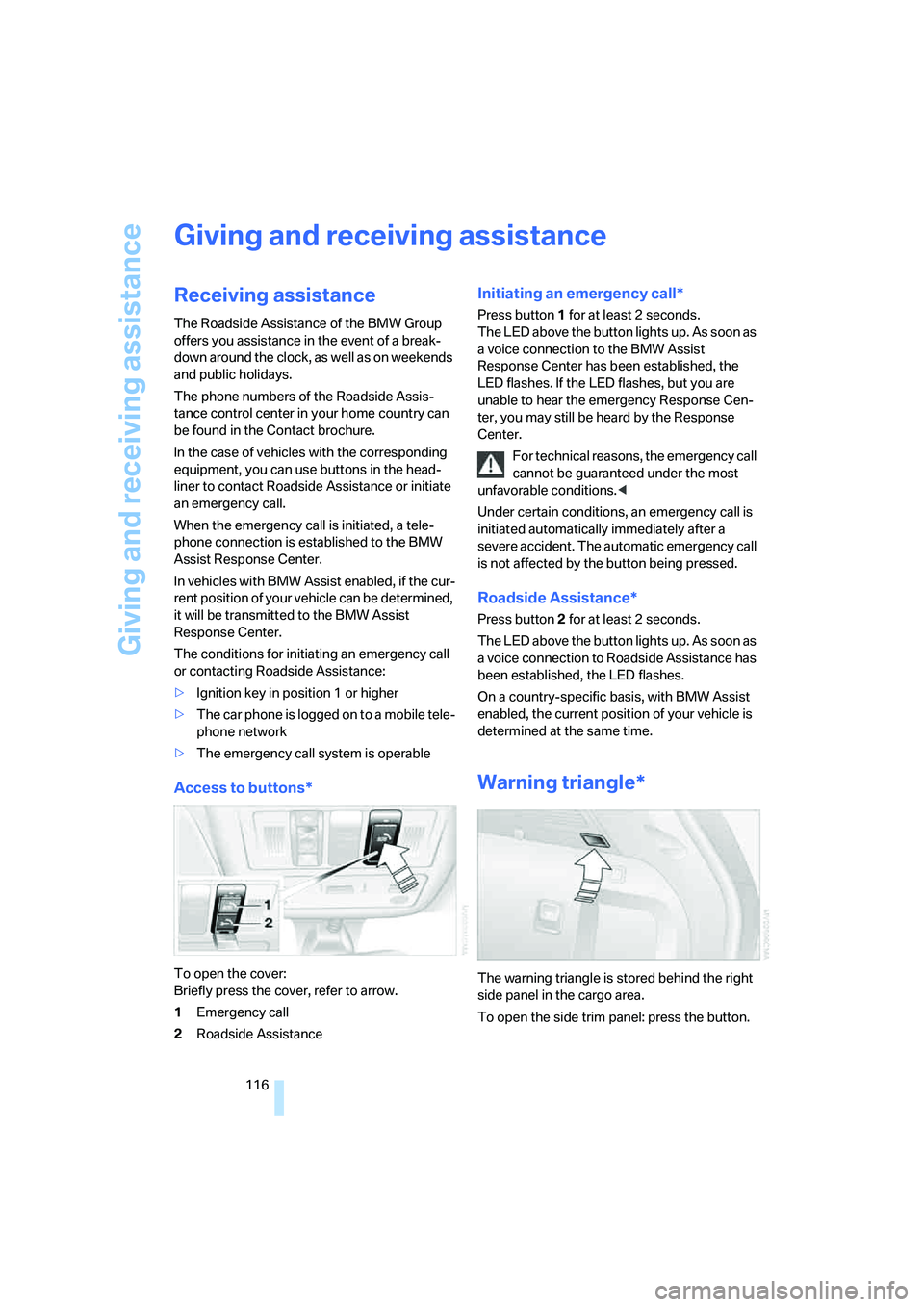
Access to buttons*
To open the cover:
Briefly press the cover, refer to arrow.
1Emergency call
2Roadside Assistance
Initiating an emergency call*
Press button 1 for at least 2 seconds.
The LED above the button lights up. As soon as
a voice connection to the BMW Assist
Response Center has been established, the
LED flashes. If the LED flashes, but you are
unable to hear the emergency Response Cen-
ter, you may still be heard by the Response
Center.
For technical reasons, the emergency call
cannot be guaranteed under the most
unfavorable conditions.<
Under certain conditions, an emergency call is
initiated automatically immediately after a
severe accident. The automatic emergency call
is not affected by the button being pressed.
Roadside Assistance*
Press button 2 for at least 2 seconds.
The LED above the button lights up. As soon as
a voice connection to Roadside Assistance has
been established, the LED flashes.
On a country-specific basis, with BMW Assist
enabled, the current position of your vehicle is
determined at the same time.
Warning triangle*
The warning triangle is stored behind the right
side panel in the cargo area.
To open the side trim panel: press the button.
Page 120 of 140
Giving and receiving assistance
118
Starting engine
1.Start the engine of the assisting vehicle and
let it run at a slightly elevated idling speed
for a few minutes.
2.Start the engine on the other vehicle in the
usual way.
If the first start attempt is not successful,
wait a few minutes before another attempt
in order to allow the discharged battery to
recharge.
3.Let the engines run for a few minutes.
4.Disconnect the jumper cables by reversing
the connection sequence.
If need be, have the battery checked and
recharged.
Never use spray fluids to start the
engine.<
Tow starting and towing
Obey all applicable laws and guidelines
for tow starting and towing.<
Do not allow any passengers other than
the driver to ride in a vehicle that is being
towed.<
Using tow fitting
The threaded tow fitting is stored in the
onboard tool kit, refer to page107, and must
always remain in the vehicle. It can be screwed
in at the front or rear of the BMW.
Only use the tow fitting that comes with
the vehicle and screw it in as far as it will
go. Use the tow fitting only for towing on roads.
Avoid lateral loading of the tow fitting, e.g. do
not lift the vehicle by the tow fitting. Otherwise,
the tow fitting and the vehicle can be dam-
aged.<
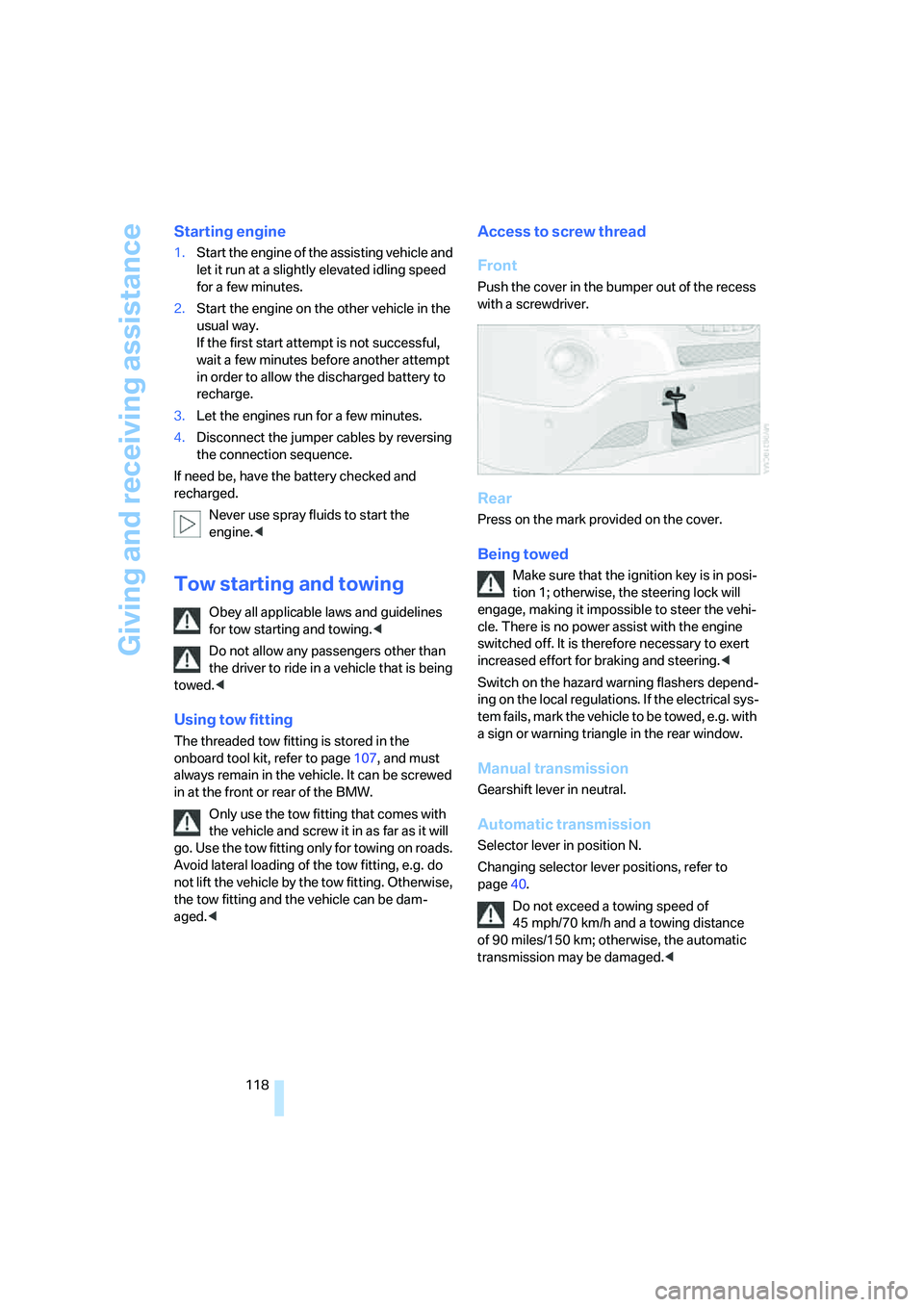
Access to screw thread
Front
Push the cover in the bumper out of the recess
with a screwdriver.
Rear
Press on the mark provided on the cover.
Being towed
Make sure that the ignition key is in posi-
tion 1; otherwise, the steering lock will
engage, making it impossible to steer the vehi-
cle. There is no power assist with the engine
switched off. It is therefore necessary to exert
increased effort for braking and steering.<
Switch on the hazard warning flashers depend-
ing on the local regulations. If the electrical sys-
tem fails, mark the vehicle to be towed, e.g. with
a sign or warning triangle in the rear window.
Manual transmission
Gearshift lever in neutral.
Automatic transmission
Selector lever in position N.
Changing selector lever positions, refer to
page40.
Do not exceed a towing speed of
45 mph/70 km/h and a towing distance
of 90 miles/150 km; otherwise, the automatic
transmission may be damaged.<
Page 121 of 140
Reference
At a glance
Controls
Driving tips
Mobility
119
Towing methods
To avoid damage, do not lift the vehicle by
the tow fitting or body and suspension
parts.<
In some countries, towing with tow bars or
ropes on public roads is not permitted. Familiar-
ize yourself with the regulations on towing in the
specific country.
With tow bar
The towing vehicle must not be lighter
than the vehicle to be towed; otherwise,
it will not be possible to safely control vehicle
response.<
The tow fittings used should be on the same
side on both vehicles. Should it prove impossi-
ble to avoid mounting the tow bar at an offset
angle, please observe the following:
>Clearance and maneuvering capability will
be strictly limited in corners.
>When mounted at an angle, the tow bar will
exert lateral forces, tending to push the
vehicle sideways.
Secure the tow bar to the tow fittings
only. Otherwise, other vehicle parts could
be damaged.<
With tow-rope
When starting off in the towing vehicle, make
sure that the tow-rope is taut.
To avoid jerking and the associated
stresses on vehicle components when
towing, always use nylon ropes or nylon straps.
Secure the tow rope to the tow fittings only.
Otherwise, other vehicle parts could be dam-
aged.<
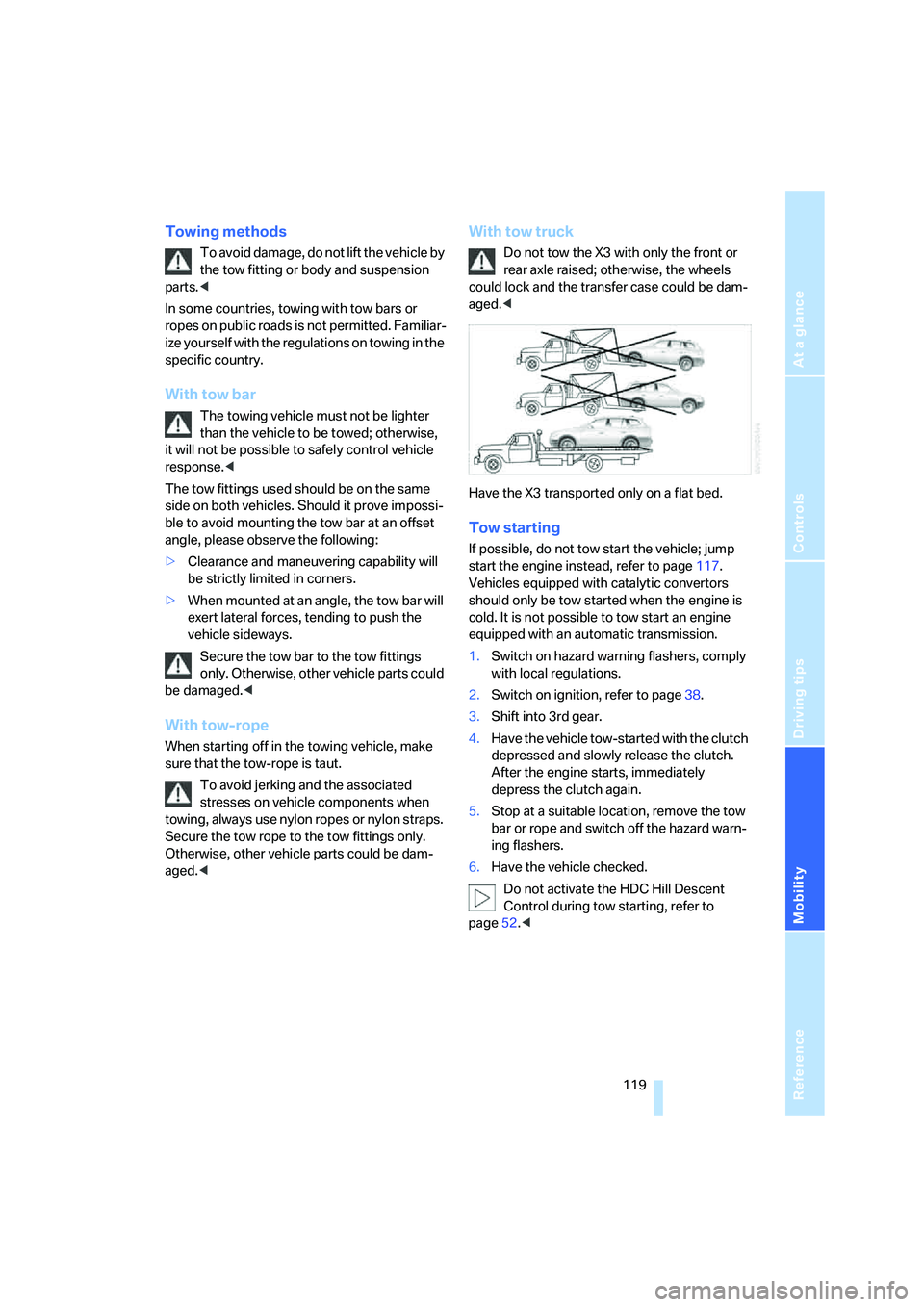
With tow truck
Do not tow the X3 with only the front or
rear axle raised; otherwise, the wheels
could lock and the transfer case could be dam-
aged.<
Have the X3 transported only on a flat bed.
Tow starting
If possible, do not tow start the vehicle; jump
start the engine instead, refer to page117.
Vehicles equipped with catalytic convertors
should only be tow started when the engine is
cold. It is not possible to tow start an engine
equipped with an automatic transmission.
1.Switch on hazard warning flashers, comply
with local regulations.
2.Switch on ignition, refer to page38.
3.Shift into 3rd gear.
4.Have the vehicle tow-started with the clutch
depressed and slowly release the clutch.
After the engine starts, immediately
depress the clutch again.
5.Stop at a suitable location, remove the tow
bar or rope and switch off the hazard warn-
ing flashers.
6.Have the vehicle checked.
Do not activate the HDC Hill Descent
Control during tow starting, refer to
page52.<
Page 132 of 140
Everything from A to Z
130 Front fog lamps61
– replacing bulbs110
Front passenger airbags
– automatic deactivation57
– status58
Fuel93
– average consumption49
– capacity124
– gauge46
– quality93
– saving83
Fuel cap92
Fuel display, refer to Fuel
gauge46
Fuel filler door92
– releasing in the event of
electrical malfunction92
Fuel gauge46
Fuel tank contents, refer to
Filling capacities124
Full preparation package
mobile phone, refer to
separate Owner's Manual
Fuses115
G
Garage-door opener, refer to
Integrated universal remote
control69
Gasoline
– refer to Fuel quality93
– refer to Fuel
specifications93
Gasoline display, refer to Fuel
gauge46
Gear indicator in automatic
transmission with
Steptronic40
Gearshift lever, manual
transmission40
General driving notes84
Glove compartment72
Grills, refer to
Ventilation65,68
Gross vehicle weight, refer to
Weights124
Ground clearance87
H
Halogen lamps108
Handbrake39
– indicator lamp39
Hands-free microphone75
– refer to Car phone
preparation75
Hazard warning flashers10
HDC Hill Descent Control52
Head airbags57
Headlamp control,
automatic60
Headlamp flasher41
– indicator lamp12
Headlamps108
– care, refer to Caring for your
vehicle brochure
– replacing bulbs107
Headlamp washer reservoir
– capacity, refer to Filling
capacities124
– refer to Washer fluid43
Headlamp washer system
– headlamp washing43
– washer fluid43
Head Light, refer to Adaptive
Head Light60
Head restraints29
– sitting safely27
Heated mirrors33
Heated rear window
– air conditioner64
– automatic climate control68
Heated seats31
Heated steering wheel34
Heater
– rear window64,68
– windshield washer jets43
Heating
– exterior mirror33
– seats31
– steering wheel34
Heating and ventilation63,66
Heavy cargo, refer to Cargo
loading85
Height, refer to
Dimensions123Height adjustment
– seats28
– steering wheel34
High beams60
– headlamp flasher60
– indicator lamp12
– replacing bulbs109
High Performance Synthetic
Oil103
Hill-climbing ability, refer to
Driving on poor roads87
Hill Descent Control HDC
52
Hills85
Holder for beverages72
Hood100
Horn10
Hotel function18
Hot exhaust system84
Hydraulic brake assistant,
refer to Brake assistant51
Hydroplaning84
I
Icy conditions, refer to
Outside temperature
warning48
Ignition38
Ignition key18
Ignition key positions, refer to
Ignition lock38
Ignition lock38
Imprint2
Indicator/warning lamp
– airbags58
– alarm system25
– automatic transmission with
Steptronic41
– brakes104
– coolant temperature47
– DSC52
– engine temperature47
– Flat Tire Monitor54
– fog lamps61
– front passenger airbags58
– reserve46
– safety belt warning32
– Tire Pressure Monitor55