tow BMW X5 3.0I 2001 User Guide
[x] Cancel search | Manufacturer: BMW, Model Year: 2001, Model line: X5 3.0I, Model: BMW X5 3.0I 2001Pages: 223, PDF Size: 2.66 MB
Page 107 of 223

IndexDataTechnologyRepairsCar careControlsOverview
107n
Automatic climate control
*
1 Airflow directed toward the wind-
shield and side windows
2 Airflow for the upper body
The side rotary dials provide infi-
nitely-variable regulation of the air
supply, while the levers change the
airflow direction. The center rotary
dial controls the temperature of the
air as it flows out. Refer to page 111
3 Front footwell ventilation
4 Rear footwell ventilation
5 Air flow for the upper body in the
rear seat110
6 Automatic air distribution108
7 Individual air distribution108
8 Temperature control –
left-hand side108
9 Display for temperature and air
supply10910 Temperature control –
right-hand side108
11 To defrost windshield and side
windows109
12 Air conditioner109
13 Automatic recirculated air control
(AUC)110
14 Rear window defroster73, 110
15 Air supply109
16 Maximum cooling109
or using up residual heat110
17 Air grille for interior temperature
sensor – please keep clear and
unobstructed
Page 108 of 223
108n
Automatic climate control
*
Tips for pleasant drivingUse the automatic system; that is press
AUTO button 6. Select an interior
temperature that is comfortable for you
— we recommend +72 7 (+22 6).
When the outside temperature is above
+41 7 (+5 6), you can also use the air
conditioner 12. This will dry the air as
well as preventing condensation on the
window surfaces — if there are passen-
gers with damp clothing, for example.
Set the air outlets 2 so that the air flows
past you and is not directed straight at
you. Set the rotary dial between the
outlets 2 for the upper body to a central
position so that cooler air will help to
prevent fatigue during the journey.
Detailed setting options are described
for you in the following section.
Your vehicle is set in such a
manner that, when you unlock the
vehicle via remote control with your
personalized key, your own setting for
the automatic climate control is initi-
ated.<
Automatic air distribution
The AUTO program
assumes the adjustment of
the air distribution and the air supply for
you and also adapts the temperature to
external influences (summer, winter) to
meet preferences you can specify. This
program maintains a comfortable in-car
climate regardless of the season. Select
an interior temperature that is comfort-
able for you — we recommend +72 7
(+22 6).
The selected temperature and AUTO
for the air flow appear in the display 9.
Refer to the overview on page 106.
Open the air outlets for the upper body.
Switch on the air conditioner 12 in
warm weather. The maximum cooling
capacity is achieved when you set
rotary dial 3 (refer to page 110) to cold.
Individual air distribution
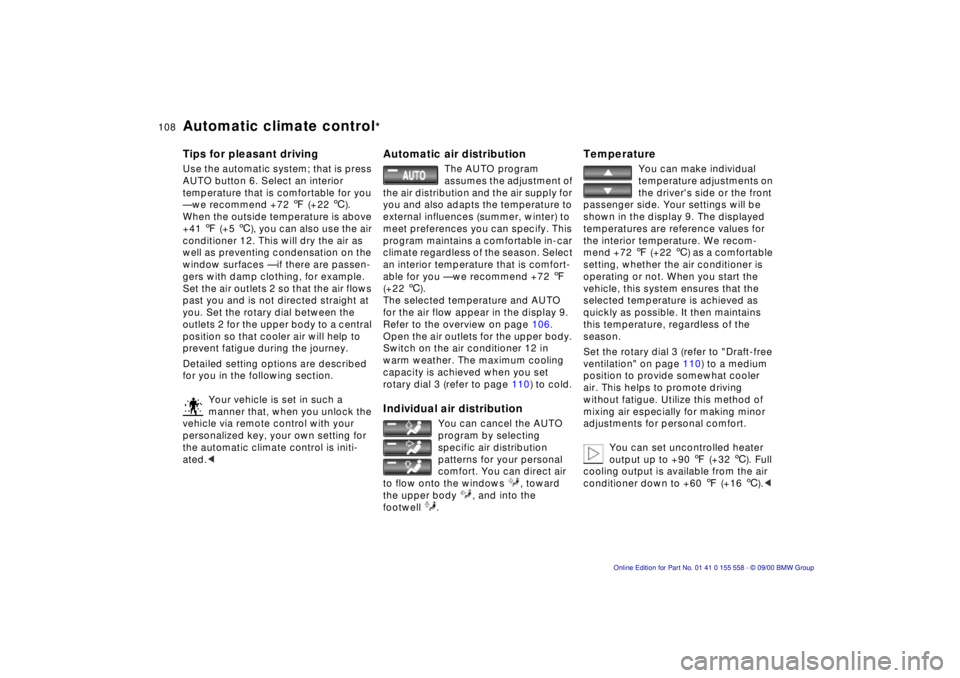
You can cancel the AUTO
program by selecting
specific air distribution
patterns for your personal
comfort. You can direct air
to flow onto the windows , toward
the upper body , and into the
footwell .
Temperature
You can make individual
temperature adjustments on
the driver's side or the front
passenger side. Your settings will be
shown in the display 9. The displayed
temperatures are reference values for
the interior temperature. We recom-
mend +72 7 (+22 6) as a comfortable
setting, whether the air conditioner is
operating or not. When you start the
vehicle, this system ensures that the
selected temperature is achieved as
quickly as possible. It then maintains
this temperature, regardless of the
season.
Set the rotary dial 3 (refer to "Draft-free
ventilation" on page 110) to a medium
position to provide somewhat cooler
air. This helps to promote driving
without fatigue. Utilize this method of
mixing air especially for making minor
adjustments for personal comfort.
You can set uncontrolled heater
output up to +90 7 (+32 6). Full
cooling output is available from the air
conditioner down to +60 7 (+16 6).<
Page 111 of 223
IndexDataTechnologyRepairsCar careControlsOverview
111n
Automatic climate control
*
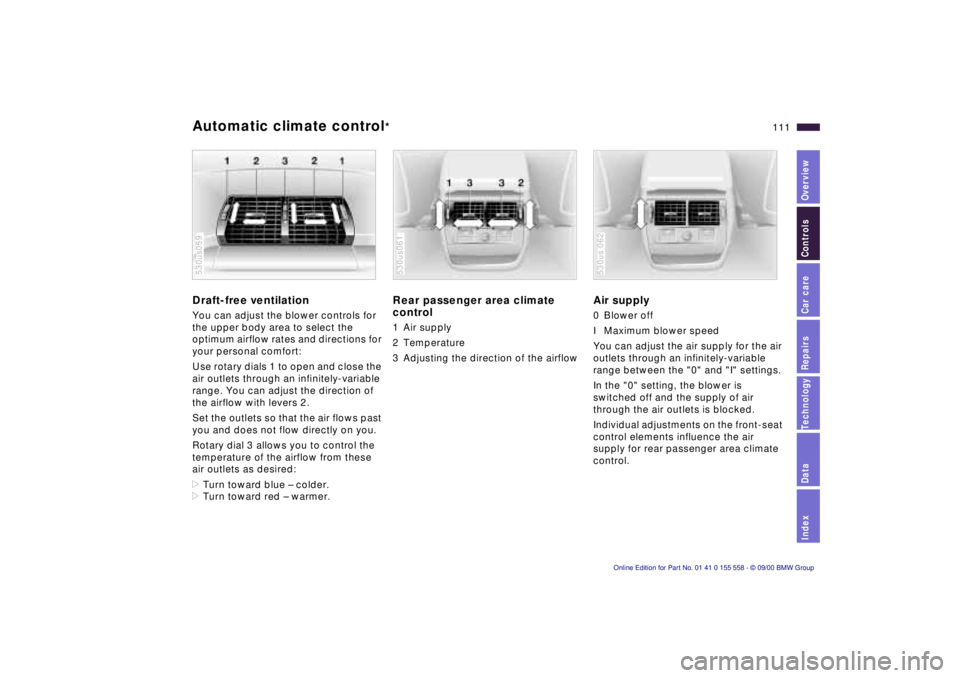
Draft-free ventilation You can adjust the blower controls for
the upper body area to select the
optimum airflow rates and directions for
your personal comfort:
Use rotary dials 1 to open and close the
air outlets through an infinitely-variable
range. You can adjust the direction of
the airflow with levers 2.
Set the outlets so that the air flows past
you and does not flow directly on you.
Rotary dial 3 allows you to control the
temperature of the airflow from these
air outlets as desired:
>Turn toward blue – colder.
>Turn toward red – warmer.530us059
Rear passenger area climate
control 1 Air supply
2 Temperature
3 Adjusting the direction of the airflow 530us061
Air supply0 Blower off
I Maximum blower speed
You can adjust the air supply for the air
outlets through an infinitely-variable
range between the "0" and "I" settings.
In the "0" setting, the blower is
switched off and the supply of air
through the air outlets is blocked.
Individual adjustments on the front-seat
control elements influence the air
supply for rear passenger area climate
control. 530us 062
Page 112 of 223
112n
Automatic climate control
*
Seat heating
*
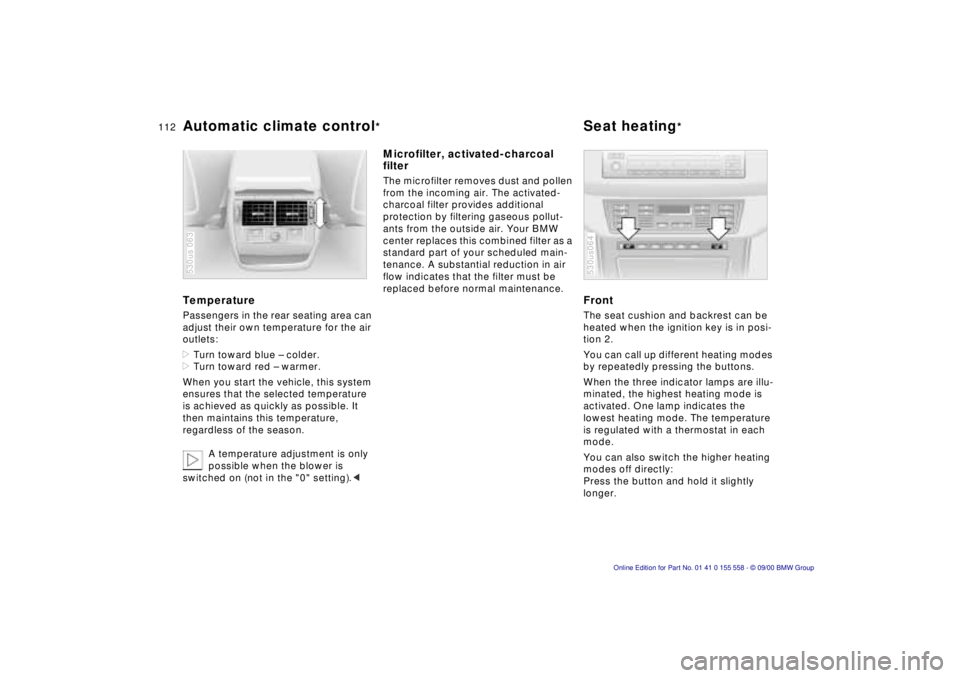
TemperaturePassengers in the rear seating area can
adjust their own temperature for the air
outlets:
>Turn toward blue – colder.
>Turn toward red – warmer.
When you start the vehicle, this system
ensures that the selected temperature
is achieved as quickly as possible. It
then maintains this temperature,
regardless of the season.
A temperature adjustment is only
possible when the blower is
switched on (not in the "0" setting).< 530us 063
Microfilter, activated-charcoal
filter The microfilter removes dust and pollen
from the incoming air. The activated-
charcoal filter provides additional
protection by filtering gaseous pollut-
ants from the outside air. Your BMW
center replaces this combined filter as a
standard part of your scheduled main-
tenance. A substantial reduction in air
flow indicates that the filter must be
replaced before normal maintenance.
Front The seat cushion and backrest can be
heated when the ignition key is in posi-
tion 2.
You can call up different heating modes
by repeatedly pressing the buttons.
When the three indicator lamps are illu-
minated, the highest heating mode is
activated. One lamp indicates the
lowest heating mode. The temperature
is regulated with a thermostat in each
mode.
You can also switch the higher heating
modes off directly:
Press the button and hold it slightly
longer.530us064
Page 116 of 223
116n
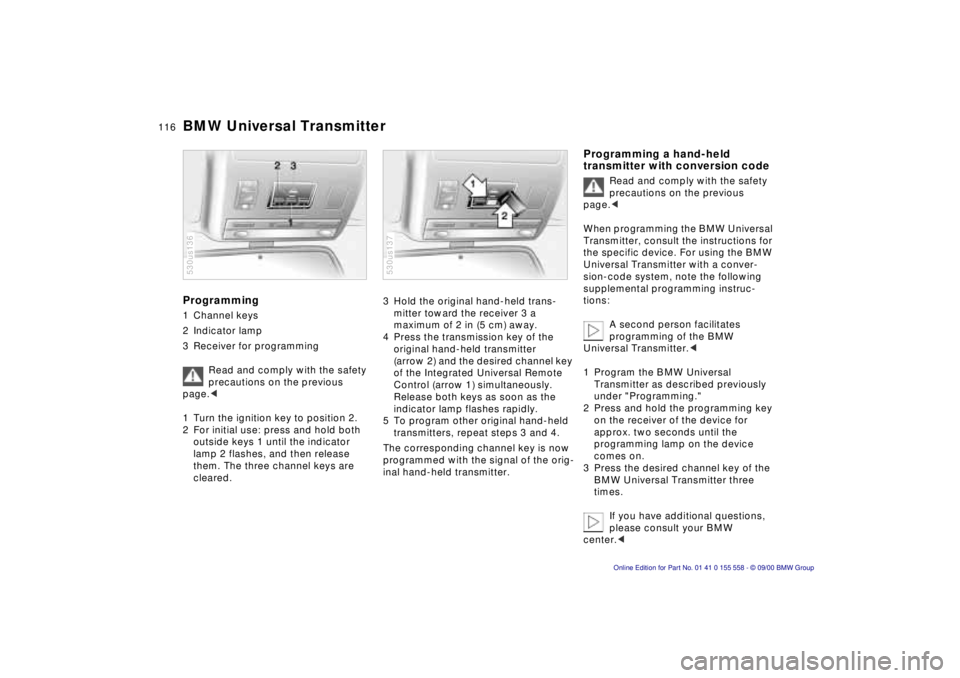
BMW Universal TransmitterProgramming 1 Channel keys
2 Indicator lamp
3 Receiver for programming
Read and comply with the safety
precautions on the previous
page.<
1 Turn the ignition key to position 2.
2 For initial use: press and hold both
outside keys 1 until the indicator
lamp 2 flashes, and then release
them. The three channel keys are
cleared.530us136
3 Hold the original hand-held trans-
mitter toward the receiver 3 a
maximum of 2 in (5 cm) away.
4 Press the transmission key of the
original hand-held transmitter
(arrow 2) and the desired channel key
of the Integrated Universal Remote
Control (arrow 1) simultaneously.
Release both keys as soon as the
indicator lamp flashes rapidly.
5 To program other original hand-held
transmitters, repeat steps 3 and 4.
The corresponding channel key is now
programmed with the signal of the orig-
inal hand-held transmitter. 530us137
Programming a hand-held
transmitter with conversion code
Read and comply with the safety
precautions on the previous
page.<
When programming the BMW Universal
Transmitter, consult the instructions for
the specific device. For using the BMW
Universal Transmitter with a conver-
sion-code system, note the following
supplemental programming instruc-
tions:
A second person facilitates
programming of the BMW
Universal Transmitter.<
1 Program the BMW Universal
Transmitter as described previously
under "Programming."
2 Press and hold the programming key
on the receiver of the device for
approx. two seconds until the
programming lamp on the device
comes on.
3 Press the desired channel key of the
BMW Universal Transmitter three
times.
If you have additional questions,
please consult your BMW
center.<
Page 125 of 223
IndexDataTechnologyRepairsCar careControlsOverview
125n
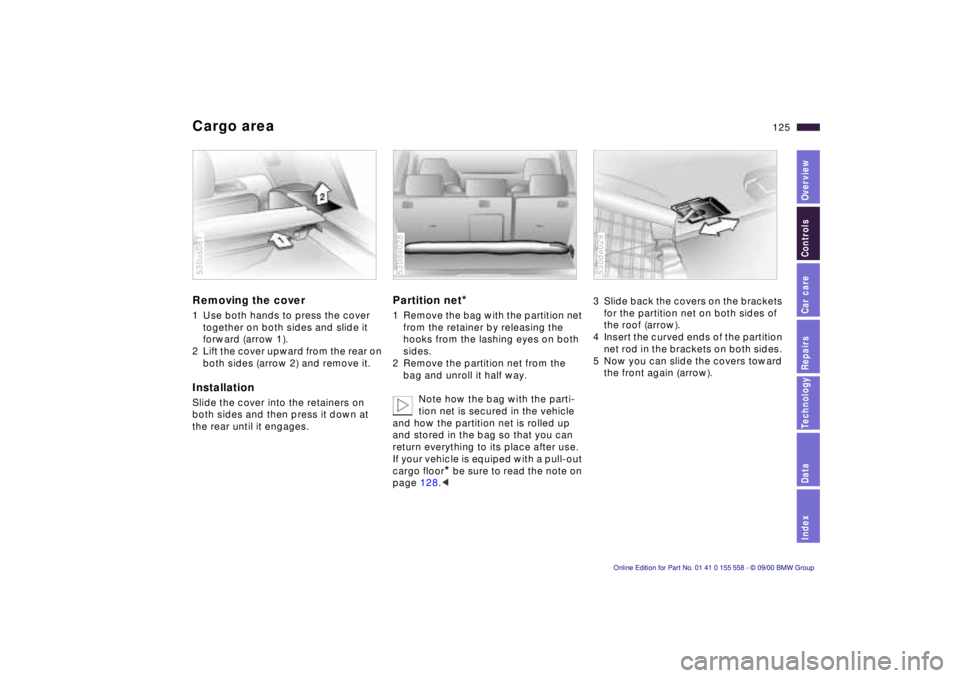
Cargo areaRemoving the cover 1 Use both hands to press the cover
together on both sides and slide it
forward (arrow 1).
2 Lift the cover upward from the rear on
both sides (arrow 2) and remove it.InstallationSlide the cover into the retainers on
both sides and then press it down at
the rear until it engages.530us081
Partition net
*
1 Remove the bag with the partition net
from the retainer by releasing the
hooks from the lashing eyes on both
sides.
2 Remove the partition net from the
bag and unroll it half way.
Note how the bag with the parti-
tion net is secured in the vehicle
and how the partition net is rolled up
and stored in the bag so that you can
return everything to its place after use.
If your vehicle is equiped with a pull-out
cargo floor
* be sure to read the note on
page 128.<
530de028
3 Slide back the covers on the brackets
for the partition net on both sides of
the roof (arrow).
4 Insert the curved ends of the partition
net rod in the brackets on both sides.
5 Now you can slide the covers toward
the front again (arrow). 530de029
Page 129 of 223
IndexDataTechnologyRepairsCar careControlsOverview
129n
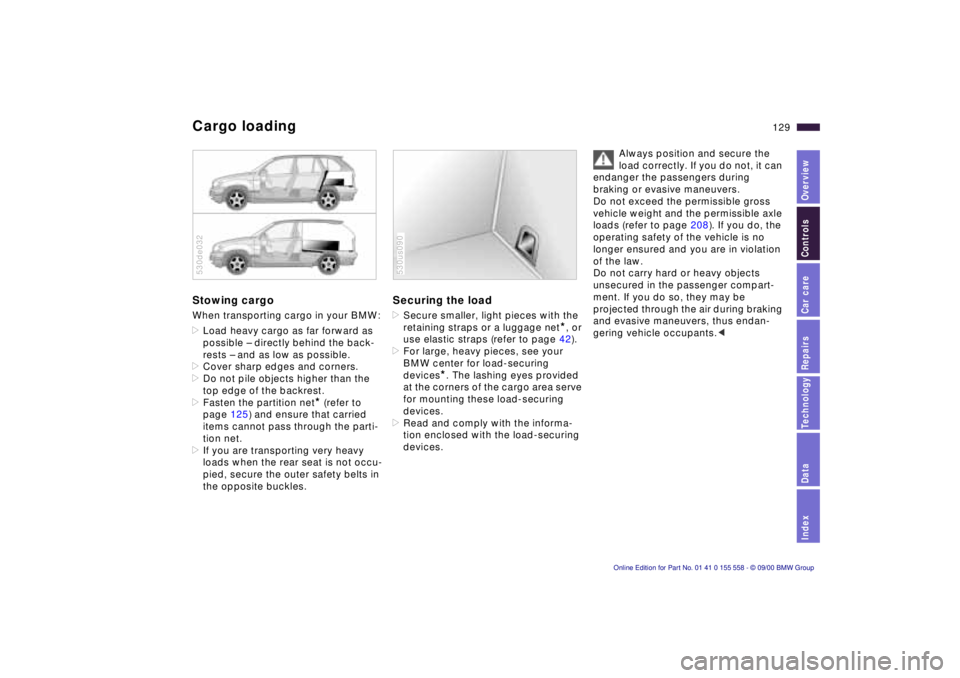
Cargo loadingStowing cargo When transporting cargo in your BMW:
>Load heavy cargo as far forward as
possible – directly behind the back-
rests – and as low as possible.
>Cover sharp edges and corners.
>Do not pile objects higher than the
top edge of the backrest.
>Fasten the partition net
* (refer to
page 125) and ensure that carried
items cannot pass through the parti-
tion net.
>If you are transporting very heavy
loads when the rear seat is not occu-
pied, secure the outer safety belts in
the opposite buckles.
530de032
Securing the load >Secure smaller, light pieces with the
retaining straps or a luggage net
*, or
use elastic straps (refer to page 42).
>For large, heavy pieces, see your
BMW center for load-securing
devices
*. The lashing eyes provided
at the corners of the cargo area serve
for mounting these load-securing
devices.
>Read and comply with the informa-
tion enclosed with the load-securing
devices.
530us090
Always position and secure the
load correctly. If you do not, it can
endanger the passengers during
braking or evasive maneuvers.
Do not exceed the permissible gross
vehicle weight and the permissible axle
loads (refer to page 208). If you do, the
operating safety of the vehicle is no
longer ensured and you are in violation
of the law.
Do not carry hard or heavy objects
unsecured in the passenger compart-
ment. If you do so, they may be
projected through the air during braking
and evasive maneuvers, thus endan-
gering vehicle occupants.<
Page 134 of 223

134n
Break-in proceduresTo ensure that your vehicle provides
maximum economy throughout a long
service life, we request that you
observe the following suggestions: Engine and axle drive Up to 1,200 miles (2,000 km):
Drive at varying engine speeds and
road speeds, but do not exceed
4,500 rpm and the following road
speeds during this initial period:
BMW X5 3.0i: 100 mph (160 km/h)
BMW X5 4.4i: 106 mph (170 km/h)
Obey your local and state maximum
speed limits.
Refrain from using full throttle and avoid
pressing the accelerator beyond the
kickdown point.
Once you have driven 1,200 miles
(2,000 km), engine and vehicle speeds
can gradually be increased.
You should also comply with these
break-in procedures if the engine or
one of the axle drives is replaced later
in the course of the vehicle service life.
TiresDue to technical factors associated
with their manufacture, tires do not
achieve their full traction potential until
an initial break-in period has elapsed.
For this reason, drive with extra care
during the initial 200 miles (300 km).
Obey your local and state maximum
speed limits.
When the vehicle is operated on
wet or slushy roads, a wedge of
water may form between the tire and
the road surface. This phenomenon is
referred to as aquaplaning, or hydro-
planing, and can lead to partial or
complete loss of traction, vehicle
control and braking effectiveness.
Reduce your speed on wet roads.<
Brake systemApprox. 300 miles (500 km) must
elapse before the brake pads and discs
achieve the optimal pad-surface and
wear patterns required for trouble-free
operation and long service life later on.
To break in the separate parking brake
drums, apply the parking brake lightly
when coasting to a standstill (at a traffic
signal, for instance), provided that
traffic conditions allow you to do so.
To avoid corrosion, repeat this proce-
dure from time to time.
The brake lamps do not light up
when the parking brake is applied.
Vacuum for the brake system servo unit
on your BMW is available only when the
engine is running. When you move the
vehicle with the engine shut off – when
towing, for instance – substantially
higher levels of pedal force will be
required to brake the vehicle.<
Page 136 of 223

136n
General driving notes Catalytic converter
Brakes:
Do not drive with your foot resting
on the brake pedal. Even light but
consistent pedal pressure can lead to
high temperatures, brake wear and
possibly even brake failure.
Aquaplaning:
When driving on wet or slushy roads,
reduce vehicle speed. If you do not, a
wedge of water may form between the
tires and the road surface. This
phenomenon is referred to as aqua-
planing or hydroplaning. It is character-
ized by a partial or complete loss of
contact between the tires and the road
surface. The ultimate results are loss of
steering and braking control.
Cargo area cover:
Do not place heavy or hard objects on
the cargo area cover. These objects
could endanger vehicle occupants
during heavy brake applications or
evasive maneuvers.
Clothes hooks:
When suspending articles of clothing
from the hooks, be sure that they will
not obstruct the driver's vision. Do not
hang heavy objects on the hooks. If you
do so, they could cause personal injury
during braking or evasive maneuvers.< The catalytic converter reduces harmful
exhaust emissions.
It is designed for use with unleaded fuel
only. Even minute quantities of lead
would be enough to permanently
damage both the catalytic converter
and the system oxygen sensor.
To ensure efficient, trouble-free engine
operation and avoid potential damage:
>Be sure to comply with the scheduled
maintenance requirements.
>Fill the fuel tank well before it is
empty.
>Tow-start the vehicle only when the
engine is cold, since unburned fuel
may otherwise reach the catalytic
converter. It is better to start the
vehicle with an outside starting aid.
>Avoid other situations in which the
fuel is not burned, or burns incom-
pletely, such as engaging the starter
frequently or for extended periods, or
repeated start attempts in which the
engine does not start (stopping and
restarting an engine which is running
properly does not present a problem).
Never allow the engine to run with
any of the spark plug cables discon-
nected.
Page 145 of 223
IndexDataTechnologyRepairsCar careControlsOverview
145n
Information for your safetyThe factory-approved radial tires are
matched to the vehicle and have been
selected to provide optimum safety and
driving comfort on your vehicle.
It is not merely the tire's service life, but
also driving comfort and – above all else
– driving safety which depend on the
condition of the tires and the mainte-
nance of the specified tire pressure.
Incorrect inflation pressure is a frequent
cause of tire damage. It also signifi-
cantly influences the roadholding ability
of your BMW.
Check tire inflation pressures –
including the spare wheel – regu-
larly (refer to page 30), at least every
two weeks and before beginning a
longer trip. If this is not done, incorrect
tire pressures can cause driving insta-
bility and tire damage, ultimately
resulting in an accident.<
Tire tread – Tire damageInspect your tires frequently for tread
wear, signs of damage and for foreign
objects lodged in the tread. Check the
tread pattern depth.
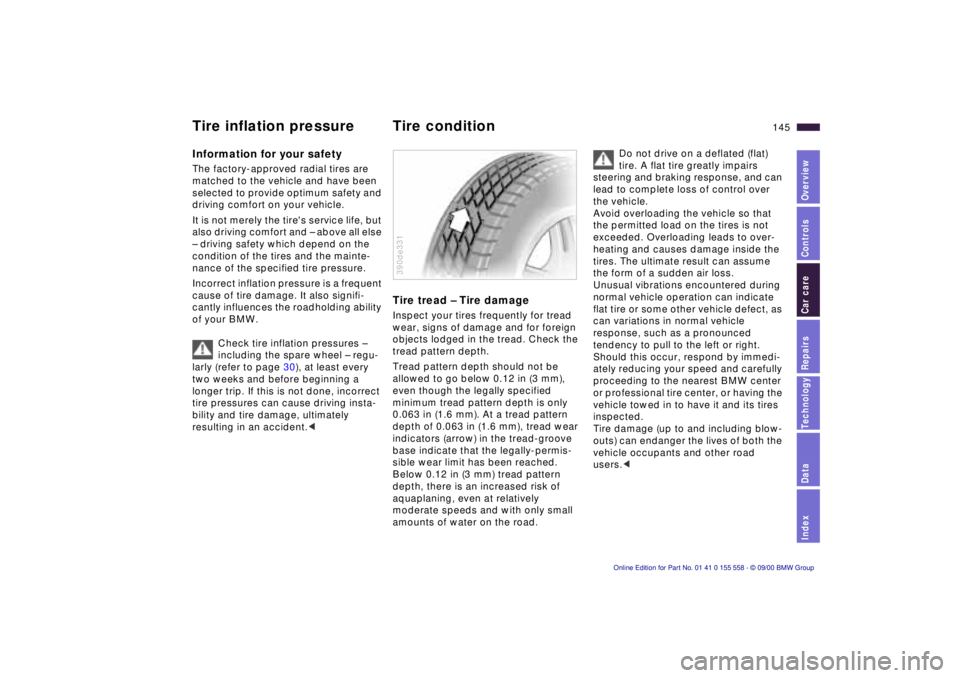
Tread pattern depth should not be
allowed to go below 0.12 in (3 mm),
even though the legally specified
minimum tread pattern depth is only
0.063 in (1.6 mm). At a tread pattern
depth of 0.063 in (1.6 mm), tread wear
indicators (arrow) in the tread-groove
base indicate that the legally-permis-
sible wear limit has been reached.
Below 0.12 in (3 mm) tread pattern
depth, there is an increased risk of
aquaplaning, even at relatively
moderate speeds and with only small
amounts of water on the road. 390de331
Do not drive on a deflated (flat)
tire. A flat tire greatly impairs
steering and braking response, and can
lead to complete loss of control over
the vehicle.
Avoid overloading the vehicle so that
the permitted load on the tires is not
exceeded. Overloading leads to over-
heating and causes damage inside the
tires. The ultimate result can assume
the form of a sudden air loss.
Unusual vibrations encountered during
normal vehicle operation can indicate
flat tire or some other vehicle defect, as
can variations in normal vehicle
response, such as a pronounced
tendency to pull to the left or right.
Should this occur, respond by immedi-
ately reducing your speed and carefully
proceeding to the nearest BMW center
or professional tire center, or having the
vehicle towed in to have it and its tires
inspected.
Tire damage (up to and including blow-
outs) can endanger the lives of both the
vehicle occupants and other road
users.<
Tire inflation pressure Tire condition