tow BMW X5 3.0I 2001 Owner's Manual
[x] Cancel search | Manufacturer: BMW, Model Year: 2001, Model line: X5 3.0I, Model: BMW X5 3.0I 2001Pages: 223, PDF Size: 2.66 MB
Page 157 of 223
IndexDataTechnologyRepairsCar careControlsOverview
157n
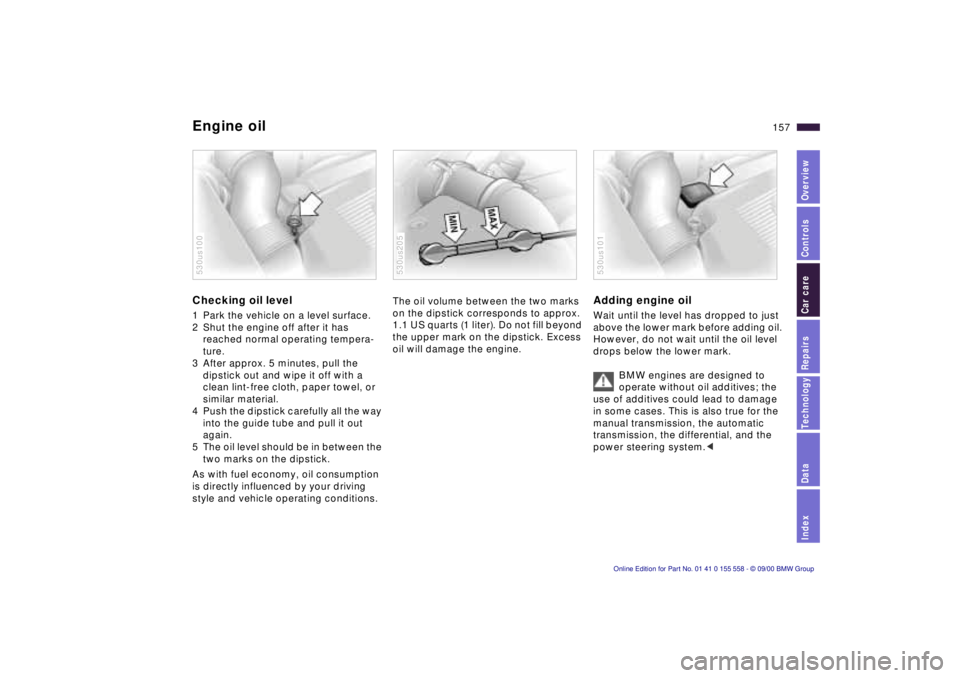
Engine oilChecking oil level1 Park the vehicle on a level surface.
2 Shut the engine off after it has
reached normal operating tempera-
ture.
3 After approx. 5 minutes, pull the
dipstick out and wipe it off with a
clean lint-free cloth, paper towel, or
similar material.
4 Push the dipstick carefully all the way
into the guide tube and pull it out
again.
5 The oil level should be in between the
two marks on the dipstick.
As with fuel economy, oil consumption
is directly influenced by your driving
style and vehicle operating conditions. 530us100
The oil volume between the two marks
on the dipstick corresponds to approx.
1.1 US quarts (1 liter). Do not fill beyond
the upper mark on the dipstick. Excess
oil will damage the engine.530us205
Adding engine oilWait until the level has dropped to just
above the lower mark before adding oil.
However, do not wait until the oil level
drops below the lower mark.
BMW engines are designed to
operate without oil additives; the
use of additives could lead to damage
in some cases. This is also true for the
manual transmission, the automatic
transmission, the differential, and the
power steering system.< 530us101
Page 173 of 223
IndexDataTechnologyRepairsCar careControlsOverview
Overview
Controls and features
Operation, care
and maintenance
Owner service procedures
Technical data
Index Advanced technology
173n
Replacement procedures:
Onboard tool kit174
Windshield wiper blades174
Lamps and bulbs175
Changing a wheel181
Battery185
Fuses187
In case of electrical
malfunction:
Fuel filler door188
Sliding/Tilt sunroof188
Liftgate188
Tailgate189
Assistance, giving and
receiving:
Jump-starting190
Towing the vehicle191
Repairs
Page 174 of 223
174n
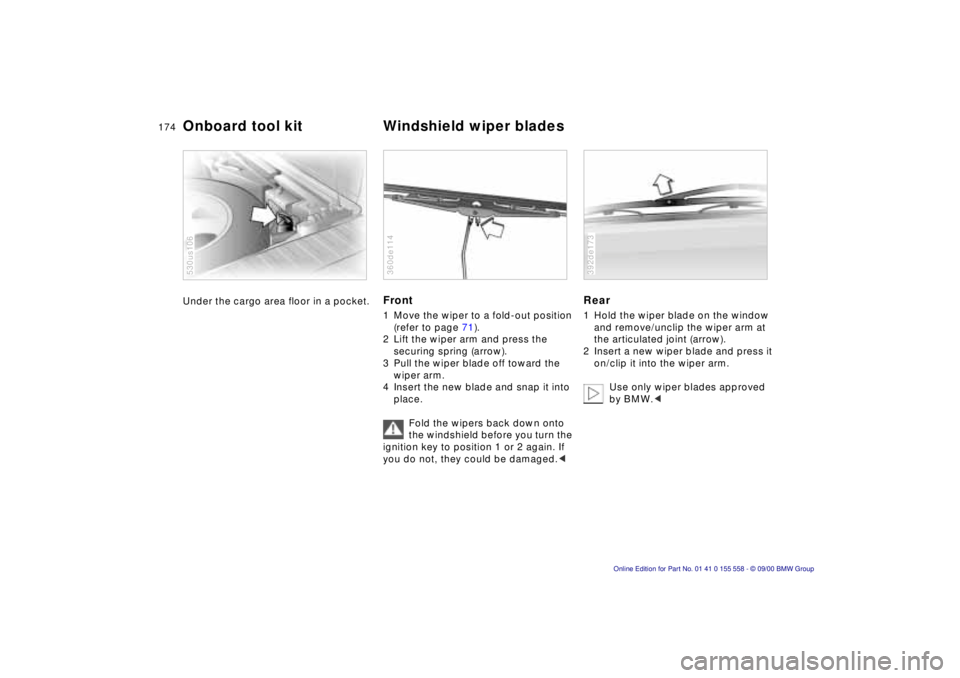
Under the cargo area floor in a pocket.
530us106
Front 1 Move the wiper to a fold-out position
(refer to page 71).
2 Lift the wiper arm and press the
securing spring (arrow).
3 Pull the wiper blade off toward the
wiper arm.
4 Insert the new blade and snap it into
place.
Fold the wipers back down onto
the windshield before you turn the
ignition key to position 1 or 2 again. If
you do not, they could be damaged.< 360de114
Rear
1 Hold the wiper blade on the window
and remove/unclip the wiper arm at
the articulated joint (arrow).
2 Insert a new wiper blade and press it
on/clip it into the wiper arm.
Use only wiper blades approved
by BMW.< 392de173
Onboard tool kit Windshield wiper blades
Page 188 of 223
188n
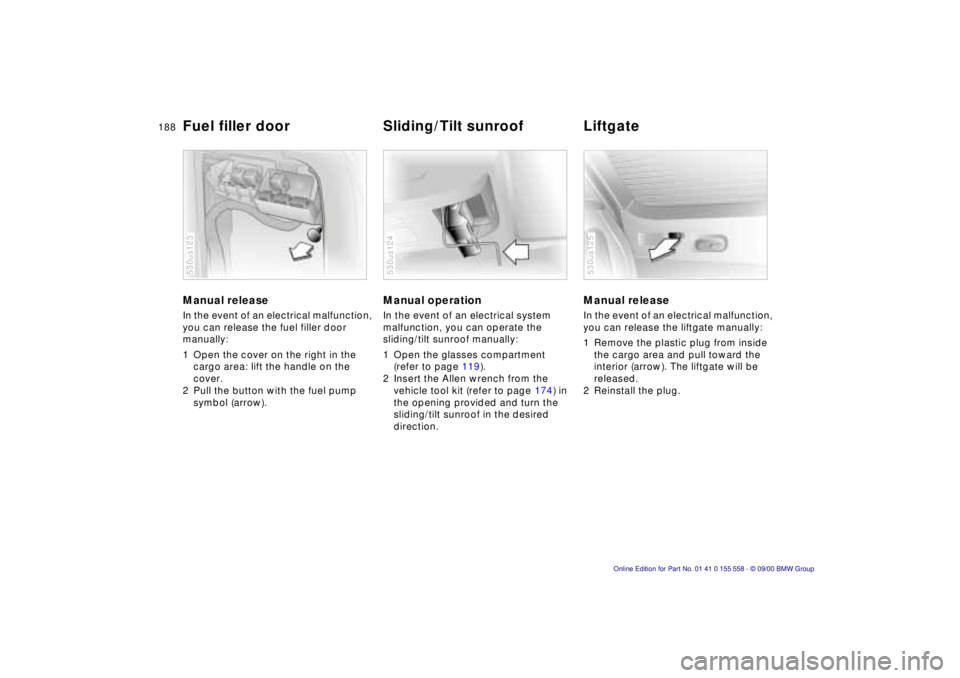
Manual release In the event of an electrical malfunction,
you can release the fuel filler door
manually:
1 Open the cover on the right in the
cargo area: lift the handle on the
cover.
2 Pull the button with the fuel pump
symbol (arrow). 530us123
Manual operationIn the event of an electrical system
malfunction, you can operate the
sliding/tilt sunroof manually:
1 Open the glasses compartment
(refer to page 119).
2 Insert the Allen wrench from the
vehicle tool kit (refer to page 174) in
the opening provided and turn the
sliding/tilt sunroof in the desired
direction.530us124
Manual release In the event of an electrical malfunction,
you can release the liftgate manually:
1 Remove the plastic plug from inside
the cargo area and pull toward the
interior (arrow). The liftgate will be
released.
2 Reinstall the plug. 530us125
Fuel filler door Sliding/Tilt sunroof Liftgate
Page 189 of 223
IndexDataTechnologyRepairsCar careControlsOverview
189n
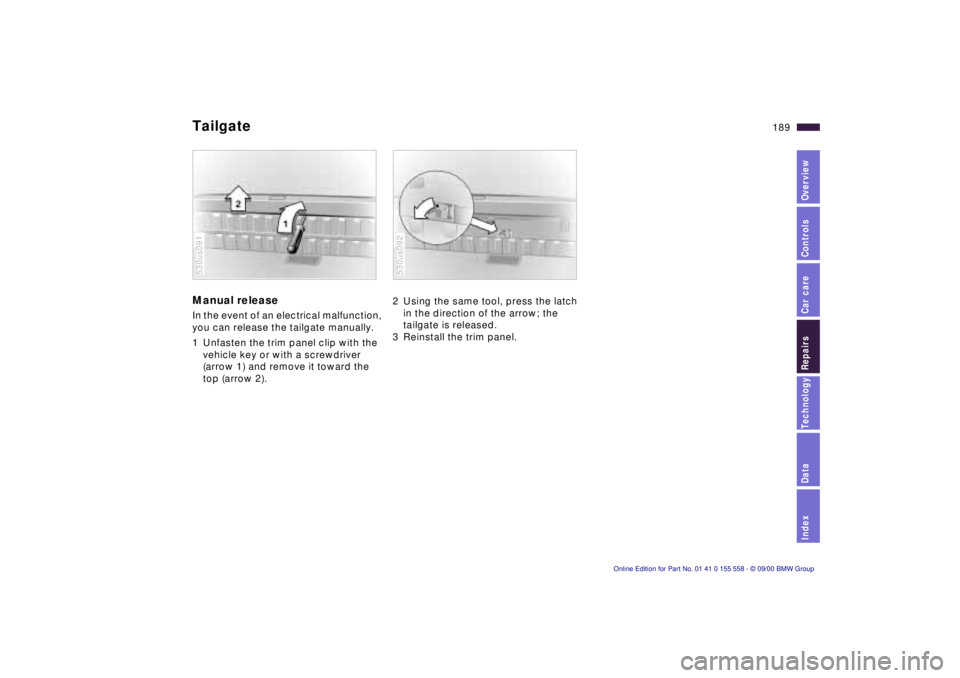
TailgateManual release In the event of an electrical malfunction,
you can release the tailgate manually.
1 Unfasten the trim panel clip with the
vehicle key or with a screwdriver
(arrow 1) and remove it toward the
top (arrow 2).530us091
2 Using the same tool, press the latch
in the direction of the arrow; the
tailgate is released.
3 Reinstall the trim panel. 530us092
Page 191 of 223
IndexDataTechnologyRepairsCar careControlsOverview
191n
Jump-starting Towing the vehicle 6 Start the engine on the support
vehicle and let it run.
7 Start the engine on the vehicle
needing the jump-start, and allow it
to run as usual. If the first start
attempt is not successful, wait a few
minutes before another attempt in
order to allow the discharged battery
to recharge.
8 Before disconnecting the jumper
cables from your BMW, turn on the
rear window defroster and set the
blower to the highest speed;
allow the engine to run approx.
10 seconds. This will prevent a
voltage surge from the voltage regu-
lator to the electrical accessories.
9 Then disconnect the jumper cables in
reverse sequence.
Have the battery recharged if neces-
sary.
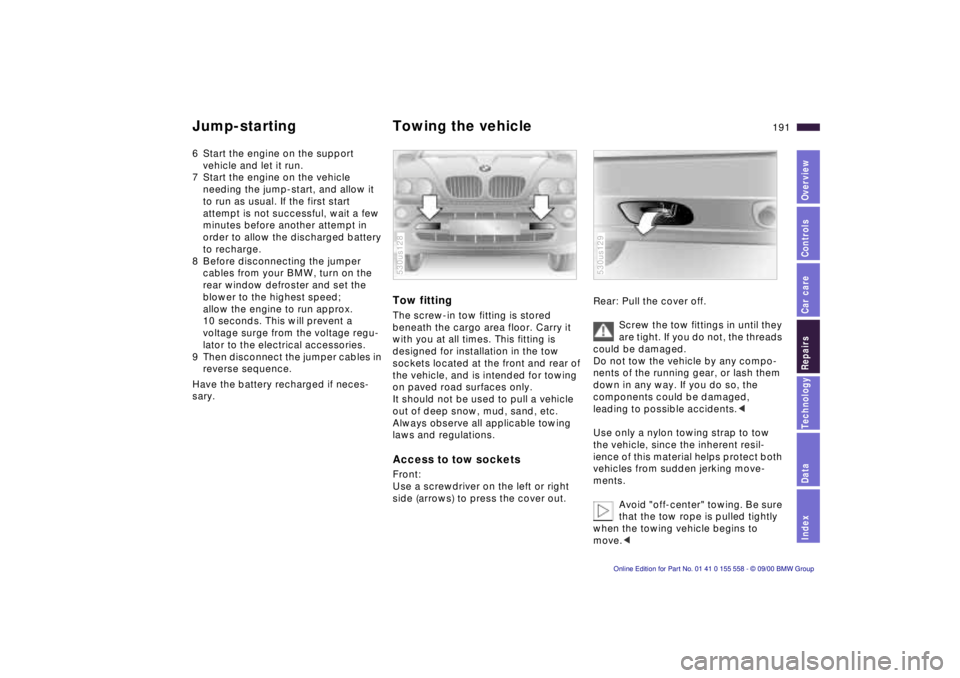
Tow fitting The screw-in tow fitting is stored
beneath the cargo area floor. Carry it
with you at all times. This fitting is
designed for installation in the tow
sockets located at the front and rear of
the vehicle, and is intended for towing
on paved road surfaces only.
It should not be used to pull a vehicle
out of deep snow, mud, sand, etc.
Always observe all applicable towing
laws and regulations. Access to tow sockets Front:
Use a screwdriver on the left or right
side (arrows) to press the cover out. 530us128
Rear: Pull the cover off.
Screw the tow fittings in until they
are tight. If you do not, the threads
could be damaged.
Do not tow the vehicle by any compo-
nents of the running gear, or lash them
down in any way. If you do so, the
components could be damaged,
leading to possible accidents.<
Use only a nylon towing strap to tow
the vehicle, since the inherent resil-
ience of this material helps protect both
vehicles from sudden jerking move-
ments.
Avoid "off-center" towing. Be sure
that the tow rope is pulled tightly
when the towing vehicle begins to
move.< 530us129
Page 192 of 223
192n
Towing the vehicle
The towed vehicle should always
be the lighter of the two vehicles.
If this is not the case, it is no longer
possible to control vehicle response.<
Tow-starting It is not possible to start the engine of a
vehicle equipped with an automatic
transmission by towing or pushing.
For instructions on jump starting: refer
to page 190.
Never attempt to use your vehicle to
push another car. If you do so, damage
to the energy-absorbing bumpers could
result.
Towing a vehicle with automatic
transmission1 Place the selector lever in position N.
2 Towing speed:
Max. 45 mph (70 km/h).
3 Towing distance:
Max. 95 miles (150 km).
4 Leave the ignition key at position 1 to
ensure that the brake lamps, turn
signals, horn and windshield wipers
remain operative, and to prevent the
steering lock from engaging.
5 Switch on the hazard warning
flashers (comply with country-
specific regulations).
Find some means of identifying the
vehicle in tow, for instance, place a sign
or warning triangle in the rear window.
Make sure that the ignition key
remains in position 1 even when
the electrical system has failed. This will
prevent the steering lock from
engaging. The steering and brakes are
without power assist when the engine is
not running. This means that increased
effort is required for steering and
braking.<
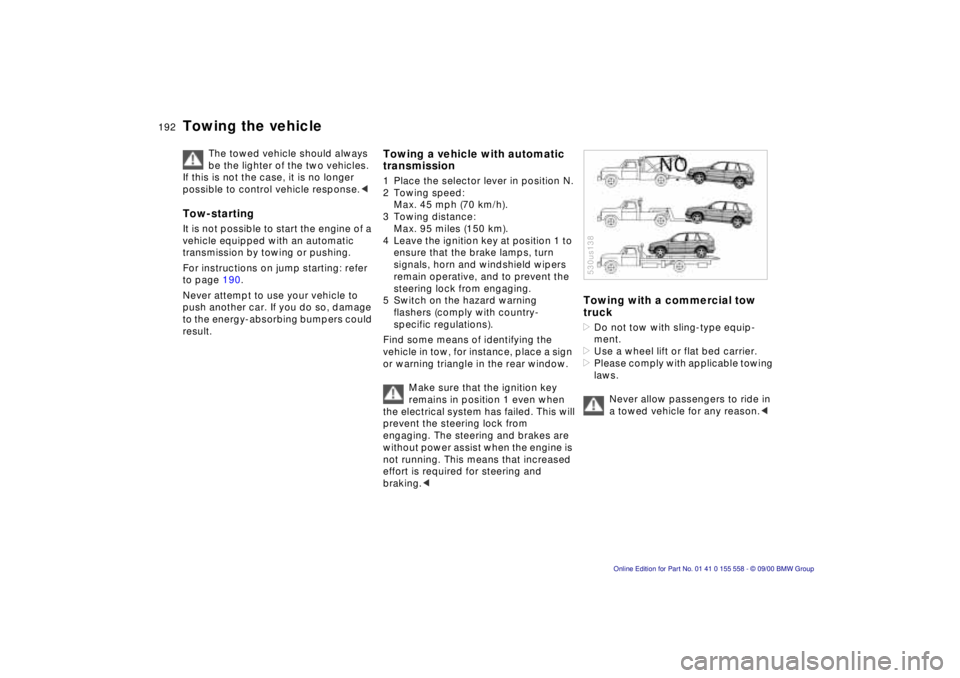
Towing with a commercial tow
truck>Do not tow with sling-type equip-
ment.
>Use a wheel lift or flat bed carrier.
>Please comply with applicable towing
laws.
Never allow passengers to ride in
a towed vehicle for any reason.< 530us138
Page 193 of 223

IndexDataTechnologyRepairsCar careControlsOverview
193n
Towing the vehicleTowing with a raised axle1 Place the gearshift lever or selector
lever in "Neutral."
2 Turn the ignition key to position 0 or
take it out.
3 Towing speed:
Maximum 30 mph (50 km/h).
4 Towing distance:
Maximum 95 miles (150 km).
Remove the rear driveshaft for
longer towing distances with the
front axle lifted; remove the front drive-
shaft for towing over longer distances
with the rear axle lifted. Failure to
comply with this will result in damage to
the transfer box.<
Page 201 of 223
Index
Data
Technology
Repairs
Car care
Controls
Overview
201nFront axle Integrated rear suspensionLevel control system*
At the same time, particular attention
has been devoted to maintaining the
driving performance you have come
to expect from BMW.
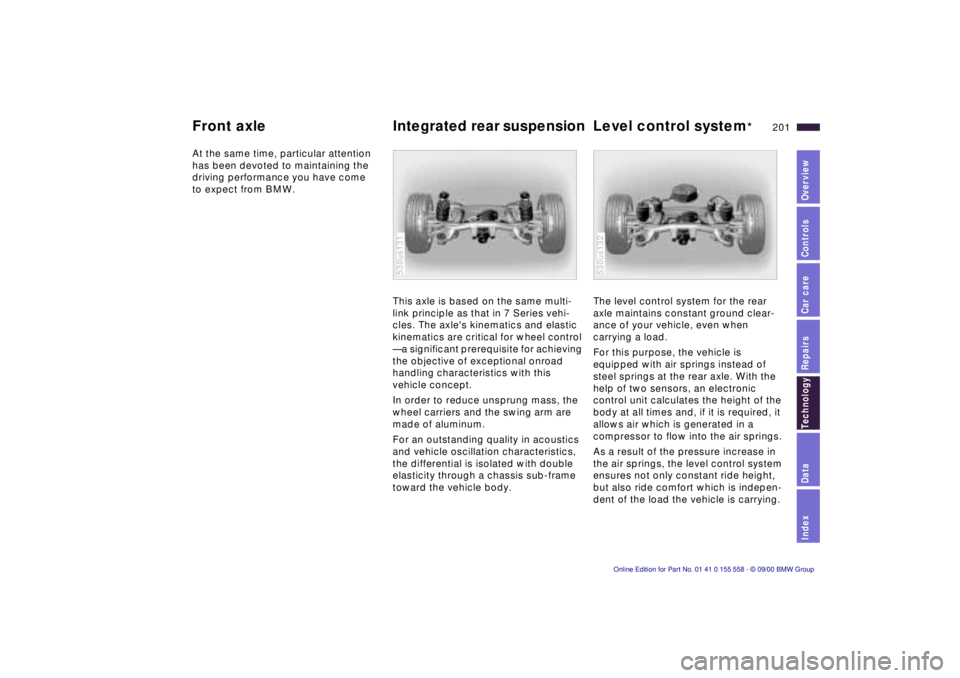
This axle is based on the same multi-
link principle as that in 7 Series vehi-
cles. The axle's kinematics and elastic
kinematics are critical for wheel control
— a significant prerequisite for achieving
the objective of exceptional onroad
handling characteristics with this
vehicle concept.
In order to reduce unsprung mass, the
wheel carriers and the swing arm are
made of aluminum.
For an outstanding quality in acoustics
and vehicle oscillation characteristics,
the differential is isolated with double
elasticity through a chassis sub-frame
toward the vehicle body.
530us131
The level control system for the rear
axle maintains constant ground clear-
ance of your vehicle, even when
carrying a load.
For this purpose, the vehicle is
equipped with air springs instead of
steel springs at the rear axle. With the
help of two sensors, an electronic
control unit calculates the height of the
body at all times and, if it is required, it
allows air which is generated in a
compressor to flow into the air springs.
As a result of the pressure increase in
the air springs, the level control system
ensures not only constant ride height,
but also ride comfort which is indepen-
dent of the load the vehicle is carrying.
530us132
Page 216 of 223

Everything from A to Z
E
EBV (Electronic Brake Force Distribution) 138
Electric power windows 45
Electrical malfunction fuel filler door 188t
liftgate 188t
sliding/tilt sunroof 188t
tailgate 189t
Electrical system 210
Electronic Brake Force Distribution (EBV) 138
Electronic immobilizer 35
Elements of operation 16
Emergency operation doors 36t
fuel filler door 188t
liftgate 188t
sliding/tilt sunroof 188t
tailgate 189t
Energy Control 77
Engine 24
Engine compartment 152
Engine coolant 160
Engine oil 157
consumption 157
grades 158
level 24
pressure 22
Engine output 206
Engine specifications 206Error indicators
79
Estimated time of arrival 90
Exterior finish 164
Exterior mirrors 53
Exterior rearview mirrors, automatic dimming
feature 54
F
Failure messages 79t
Failure of an electrical accessory 187t
Filling the windshield washer reservoir 156t
First-aid kit 28
Fittings, tow-starting and towing 191t
Flashlight 118
Flat tire 145, 180 t
Fog lamps 98
bulb replacement 176t
Folding rear backrest 124
Footbrake 140
Footwell lamps 99
bulb replacement 178t
Four-wheel drive 197
Front area lighting 99
Front axle 200
Front fog lamps 98
Front seat adjustment 48Frost protection,
radiator 160
Fuel 30
capacity 209
display 77
gauge 77
quality 30
specifications 30
Fuel consumption 90
average 90
Fuel filler door 29
Fuses 187t
G
Garage-door opener 115
Gasoline 30
General driving notes 136
Glasses compartment 119
Glove compartment 117
bulb replacement 179t
Gross vehicle weight 208
Ground clearance 135
H
Handbrake66
Handsfree system 118
Hazard warning flashers 28
Hazard warning triangle 28
HDC (Hill Descent Control) 95
Head restraints 49Headlamp covers,
care 163t, 175 t
Headlamp flasher 70
Headlamp washer system 156
Headlamp washers 72
Heated seats 112
Heated steering wheel 113
Heating and ventilation 100, 106
Heating while stopped 110
Heating, rapid 105
Heavy cargo 129
Height 207
Height adjustment seats 48
steering wheel 52
HiFi system 199
High beams 25, 98
bulb replacement 175t
High-mount brake lamp 177
Hill Descent Control (HDC) 95
Holder for cans, refer to cup holder 119
Hood release 151t
Horn 26, 27
Hydraulic Brake Assistant refer to DBC 24, 138