jump start BMW X5 3.0I 2001 Owners Manual
[x] Cancel search | Manufacturer: BMW, Model Year: 2001, Model line: X5 3.0I, Model: BMW X5 3.0I 2001Pages: 223, PDF Size: 2.66 MB
Page 12 of 223

Contents
Operation, care and maintenanceOwner service proceduresAdvanced technology
Under the hood:
Hood 151
Engine compartment 152
Washer fluid 156
Washer nozzles 156
Engine oil 157
Coolant 160
Brake fluid 161
Vehicle Identification Number 161
Care and maintenance:
The BMW Maintenance
System 162
Caring for your vehicle 163
Airbags 168
Vehicle storage 168
Laws and regulations:
Technical modifications 169
California Proposition 65 Warning 169
OBD interface socket 170
Replacement procedures:
Onboard tool kit174
Windshield wiper blades 174
Lamps and bulbs 175
Changing a wheel 180
Battery 185
Fuses 187
In case of electrical
malfunction:
Fuel filler door 188
Sliding/Tilt sunroof 188
Liftgate 188
Tailgate 189
Assistance, giving and
receiving:
Jump-starting 190
Towing the vehicle 191 Airbags
196
Adaptive Transmission Control (ATC) 196
Four-wheel drive 197
Dynamic Stability Control (DSC) 197
Radio reception 198
Safety belt tensioner 198
DSP sound system 199
Rearview mirrors with automatic dimmer 199
Rain sensor 200
Front axle 200
Integrated rear suspension 201
Level control system 201
Xenon lamps 202
Page 65 of 223
Index
Data
Technology
Repairs
Car care
Controls
Overview
65nStarting the engine Switching off the engine
Do not press the accelerator pedal
while starting the engine.
BMW X5 3.0i:
Do not actuate the starter for too
short a time. Do not turn it for more
than approx. 20 seconds. Release the
ignition key immediately as soon as the
engine starts.
BMW X5 4.4i:
Your BMW is equipped with the conve-
nience starting feature. Simply turn the
key to position 3 (starter) and then
release it immediately.
The starter continues to operate auto-
matically.
The automatic starting mode will not
operate if the battery voltage is low.
The engine can be started by means of
jump-starting (refer to page 190).<
Do not allow the engine to warm up
by leaving it running while the vehicle
remains stationary. Instead, begin to
drive immediately at a moderate engine
speed.Should the engine fail to start on the
first attempt (if it is very hot or cold, for
instance):
> Press the accelerator pedal halfway
down while engaging the starter.
Cold starts at very low temperatures,
from approx. +5 7 (–15 6) and at alti-
tudes above 3,300 ft (1,000 meters):
> For the initial start attempt, allow the
starter to remain engaged somewhat
longer (approx. 10 seconds).
> Press the accelerator pedal halfway
down while engaging the starter.
Engine idle speed is controlled by the
engine computer system. Increased
speeds at startup are normal and
should decrease as the engine warms
up. If engine speed does not decrease,
service is required.
To prevent the battery from discharging,
always deactivate electrical devices
that are not in use. Switch the ignition
off when the vehicle is not being driven. Turn the ignition key to position 1 or 0.
Never remove the ignition key
while the vehicle is rolling. If you
did so, the ignition lock would engage
when the steering wheel is turned.
Always remove the ignition key and
engage the steering lock before leaving
the vehicle.
Vehicles with manual transmission:
Always engage the parking brake when
parking on slopes and inclined
surfaces. Even placing the lever in
1st gear or reverse may not provide
adequate resistance to rolling.
Vehicles with automatic transmission:
Place the selector lever in "Park." <
Vehicles with automatic transmission:
The vehicle must be stationary and the
selector lever in "Park" before you can
remove the ignition key.
Page 70 of 223
70nAutomatic transmission with Steptronic*Indicator/Headlamp flasher
Electronic transmission control
module
If the indicator lamp comes on
or the message "TRANS.FAIL-
SAFE PROG" appears in the
Check Control
*, there is a fault in the
transmission system.
Bring the vehicle to a stop. Move the
transmission selector lever to "P." Set
the parking brake and turn the engine
off (ignition key to position 0).
Wait a few seconds, then start the
engine.
If the indicator lamp goes out after a
few seconds, normal transmission
performance has been restored. You
may continue to drive as usual. If the
indicator lamp does not go out, you can
place the selector lever in all positions.
However, the vehicle will now only drive
forward with limited gear selection.
If this happens, avoid extreme engine
loads and consult the nearest BMW
center.
Do not work in the engine
compartment when a drive gear
(forward or reverse) is engaged. If you
do this, the vehicle could move. <
Information on jump-starting, tow-
starting and towing begins on
page 190.
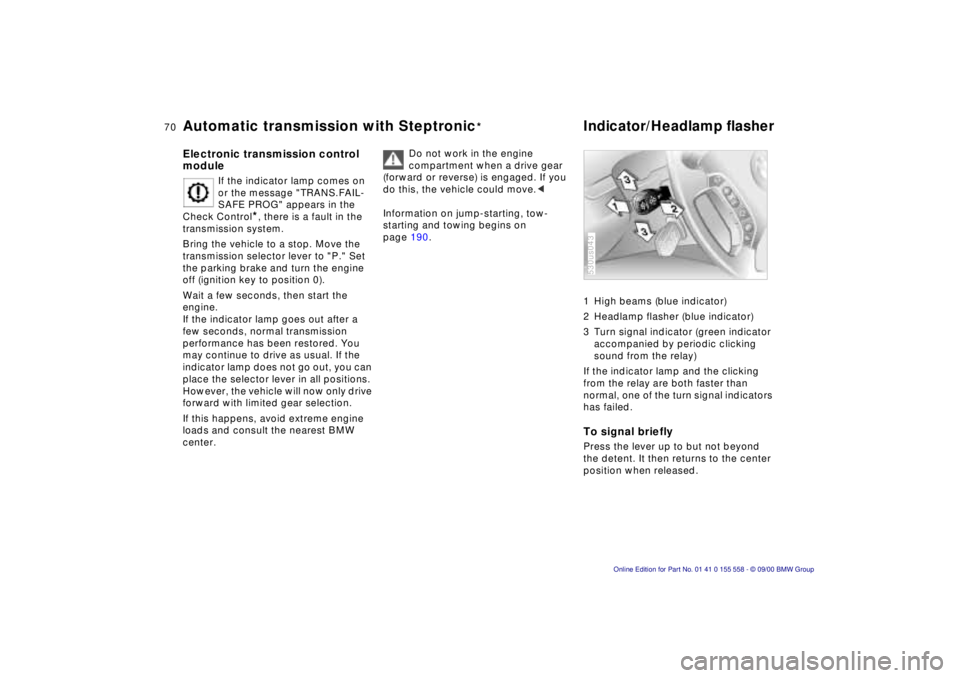
1 High beams (blue indicator)
2 Headlamp flasher (blue indicator)
3 Turn signal indicator (green indicator
accompanied by periodic clicking
sound from the relay)
If the indicator lamp and the clicking
from the relay are both faster than
normal, one of the turn signal indicators
has failed.
To signal briefly
Press the lever up to but not beyond
the detent. It then returns to the center
position when released.
530us043
Page 153 of 223
IndexDataTechnologyRepairsCar careControlsOverview
153n
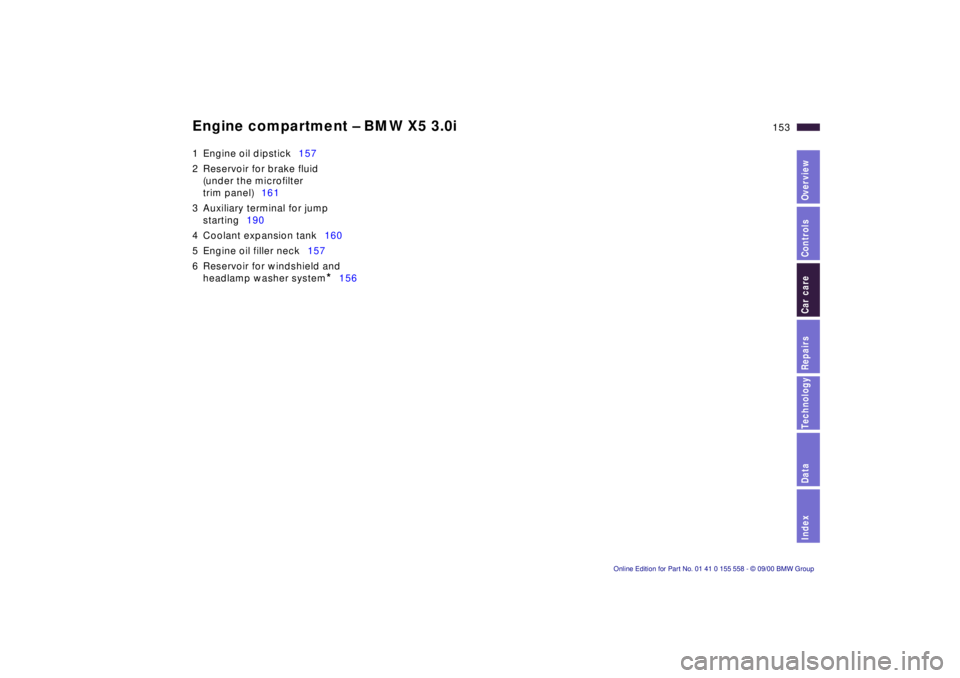
Engine compartment – BMW X5 3.0i1 Engine oil dipstick157
2 Reservoir for brake fluid
(under the microfilter
trim panel)161
3 Auxiliary terminal for jump
starting190
4 Coolant expansion tank160
5 Engine oil filler neck157
6 Reservoir for windshield and
headlamp washer system
*
156
Page 155 of 223
IndexDataTechnologyRepairsCar careControlsOverview
155n
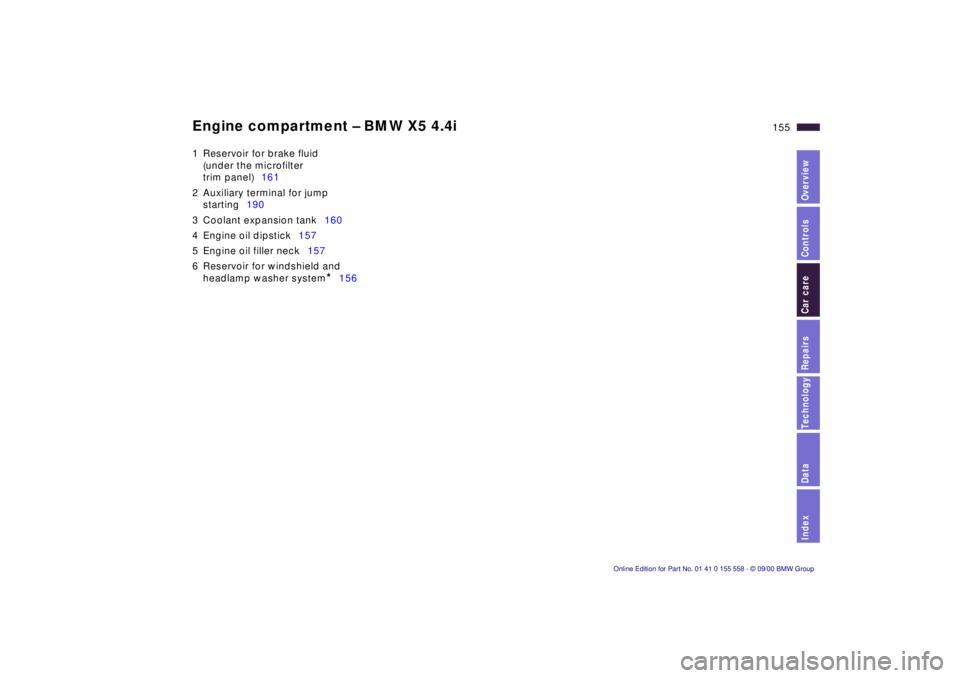
Engine compartment – BMW X5 4.4i 1 Reservoir for brake fluid
(under the microfilter
trim panel)161
2 Auxiliary terminal for jump
starting190
3 Coolant expansion tank160
4 Engine oil dipstick157
5 Engine oil filler neck157
6 Reservoir for windshield and
headlamp washer system
*
156
Page 173 of 223
IndexDataTechnologyRepairsCar careControlsOverview
Overview
Controls and features
Operation, care
and maintenance
Owner service procedures
Technical data
Index Advanced technology
173n
Replacement procedures:
Onboard tool kit174
Windshield wiper blades174
Lamps and bulbs175
Changing a wheel181
Battery185
Fuses187
In case of electrical
malfunction:
Fuel filler door188
Sliding/Tilt sunroof188
Liftgate188
Tailgate189
Assistance, giving and
receiving:
Jump-starting190
Towing the vehicle191
Repairs
Page 186 of 223
186n
BatteryCharging the battery Charge the battery in the vehicle only
when the engine is not running. Use the
connections provided in the engine
compartment (for correct connections,
refer to "Jump-starting" on page 190).
The service life specified for the
battery can be achieved only if it
is always kept adequately charged.
Have the charge condition of the
battery checked frequently if the vehicle
is used primarily for driving short
distances.<
Before performing any work on
the electrical system, disconnect
the cable from the negative terminal. If
you do not, short circuits can create the
risk of fire or personal injury.<
If you plan to park the vehicle longer
than 4 weeks, have the battery discon-
nected from the vehicle's electrical
system by disconnecting the cable from
the negative terminal. Then have the
battery charged with an appropriate
battery charger.
If the vehicle will not be driven for a
period longer than 12 weeks, have the
battery removed, charged and store it
in a clean and cool (frost-free) area.
Recharge the battery at least every
three months during storage. Also,
recharge the battery before it is
installed. If you fail to do so, it will not
be serviceable. Every time the battery is
discharged, especially over extended
periods, its service life is reduced. Do not disconnect the battery
when the engine is running. If
you do so, the ensuing voltage surge
will damage the vehicle's onboard elec-
tronics.
Do not make any modifications in the
wires to the positive terminal. If you do
so, the protective function of the safety
battery terminal is no longer ensured.
Repair and disposal must be performed
by trained technicians only.<
Return used batteries to a recy-
cling point or your BMW center.
Maintain the battery in an upright posi-
tion for transport and storage. Secure
the battery against tilting during trans-
port.<
Page 190 of 223
190n
Do not use spray starter fluids to start
the engine.
If the battery is discharged, the engine
can be started with the use of two
jumper cables and the battery of
another vehicle. Always use jumper
cables with fully insulated handles on
the terminal clamps.
Do not touch the parts conducting
current while the engine is
running. Failure to comply with this
creates a risk of fatal injury.<
Carefully comply with the following
instructions to avoid personal injury and
damage to one or both vehicles:
1 Be sure that the battery on the
support vehicle is also rated at
12 volts, and that the capacities of
the two batteries (Ah) are roughly
comparable (printed on casing).
2 Leave your battery connected to the
vehicle's electrical system.
3 Make sure that there is no contact
between the bodywork of the two
vehicles – this creates a risk of short
circuits.
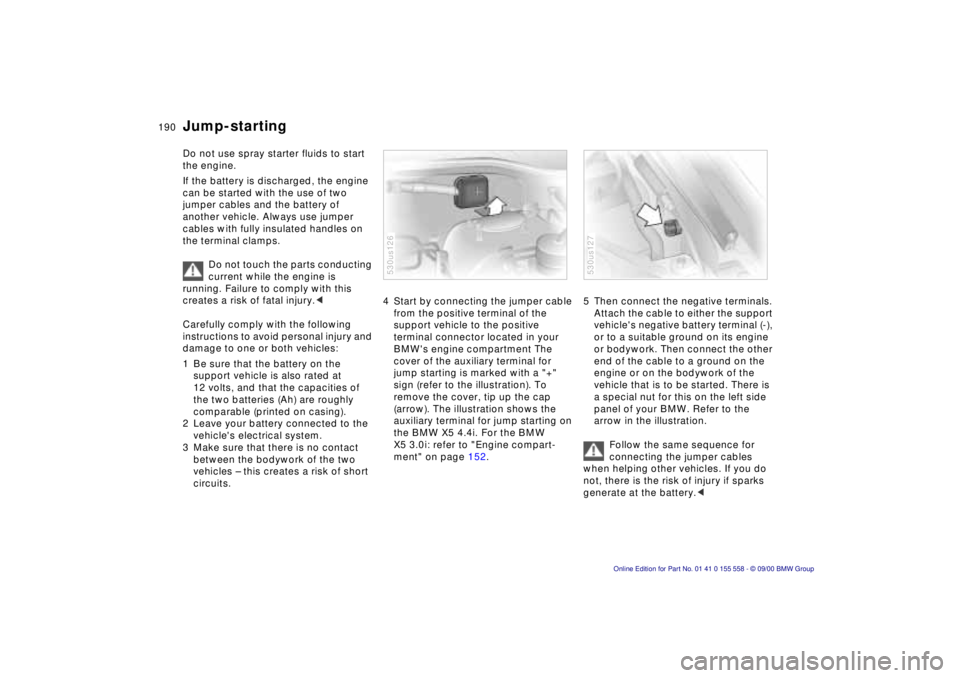
4 Start by connecting the jumper cable
from the positive terminal of the
support vehicle to the positive
terminal connector located in your
BMW's engine compartment The
cover of the auxiliary terminal for
jump starting is marked with a "+"
sign (refer to the illustration). To
remove the cover, tip up the cap
(arrow). The illustration shows the
auxiliary terminal for jump starting on
the BMW X5 4.4i. For the BMW
X5 3.0i: refer to "Engine compart-
ment" on page 152.530us126
5 Then connect the negative terminals.
Attach the cable to either the support
vehicle's negative battery terminal (-),
or to a suitable ground on its engine
or bodywork. Then connect the other
end of the cable to a ground on the
engine or on the bodywork of the
vehicle that is to be started. There is
a special nut for this on the left side
panel of your BMW. Refer to the
arrow in the illustration.
Follow the same sequence for
connecting the jumper cables
when helping other vehicles. If you do
not, there is the risk of injury if sparks
generate at the battery.< 530us127
Jump-starting
Page 191 of 223
IndexDataTechnologyRepairsCar careControlsOverview
191n
Jump-starting Towing the vehicle 6 Start the engine on the support
vehicle and let it run.
7 Start the engine on the vehicle
needing the jump-start, and allow it
to run as usual. If the first start
attempt is not successful, wait a few
minutes before another attempt in
order to allow the discharged battery
to recharge.
8 Before disconnecting the jumper
cables from your BMW, turn on the
rear window defroster and set the
blower to the highest speed;
allow the engine to run approx.
10 seconds. This will prevent a
voltage surge from the voltage regu-
lator to the electrical accessories.
9 Then disconnect the jumper cables in
reverse sequence.
Have the battery recharged if neces-
sary.
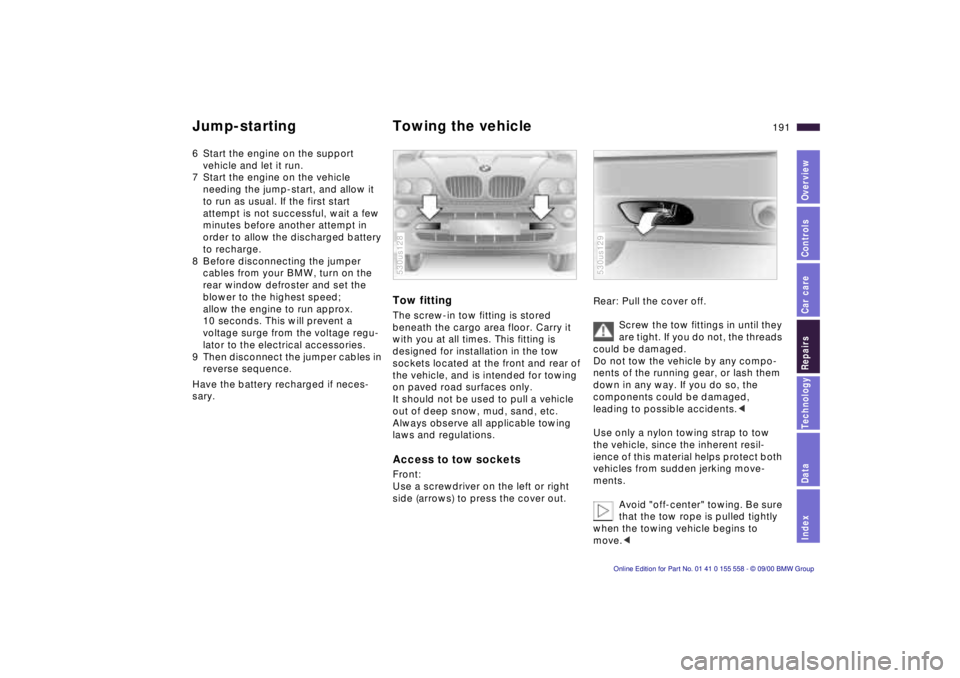
Tow fitting The screw-in tow fitting is stored
beneath the cargo area floor. Carry it
with you at all times. This fitting is
designed for installation in the tow
sockets located at the front and rear of
the vehicle, and is intended for towing
on paved road surfaces only.
It should not be used to pull a vehicle
out of deep snow, mud, sand, etc.
Always observe all applicable towing
laws and regulations. Access to tow sockets Front:
Use a screwdriver on the left or right
side (arrows) to press the cover out. 530us128
Rear: Pull the cover off.
Screw the tow fittings in until they
are tight. If you do not, the threads
could be damaged.
Do not tow the vehicle by any compo-
nents of the running gear, or lash them
down in any way. If you do so, the
components could be damaged,
leading to possible accidents.<
Use only a nylon towing strap to tow
the vehicle, since the inherent resil-
ience of this material helps protect both
vehicles from sudden jerking move-
ments.
Avoid "off-center" towing. Be sure
that the tow rope is pulled tightly
when the towing vehicle begins to
move.< 530us129
Page 192 of 223
192n
Towing the vehicle
The towed vehicle should always
be the lighter of the two vehicles.
If this is not the case, it is no longer
possible to control vehicle response.<
Tow-starting It is not possible to start the engine of a
vehicle equipped with an automatic
transmission by towing or pushing.
For instructions on jump starting: refer
to page 190.
Never attempt to use your vehicle to
push another car. If you do so, damage
to the energy-absorbing bumpers could
result.
Towing a vehicle with automatic
transmission1 Place the selector lever in position N.
2 Towing speed:
Max. 45 mph (70 km/h).
3 Towing distance:
Max. 95 miles (150 km).
4 Leave the ignition key at position 1 to
ensure that the brake lamps, turn
signals, horn and windshield wipers
remain operative, and to prevent the
steering lock from engaging.
5 Switch on the hazard warning
flashers (comply with country-
specific regulations).
Find some means of identifying the
vehicle in tow, for instance, place a sign
or warning triangle in the rear window.
Make sure that the ignition key
remains in position 1 even when
the electrical system has failed. This will
prevent the steering lock from
engaging. The steering and brakes are
without power assist when the engine is
not running. This means that increased
effort is required for steering and
braking.<
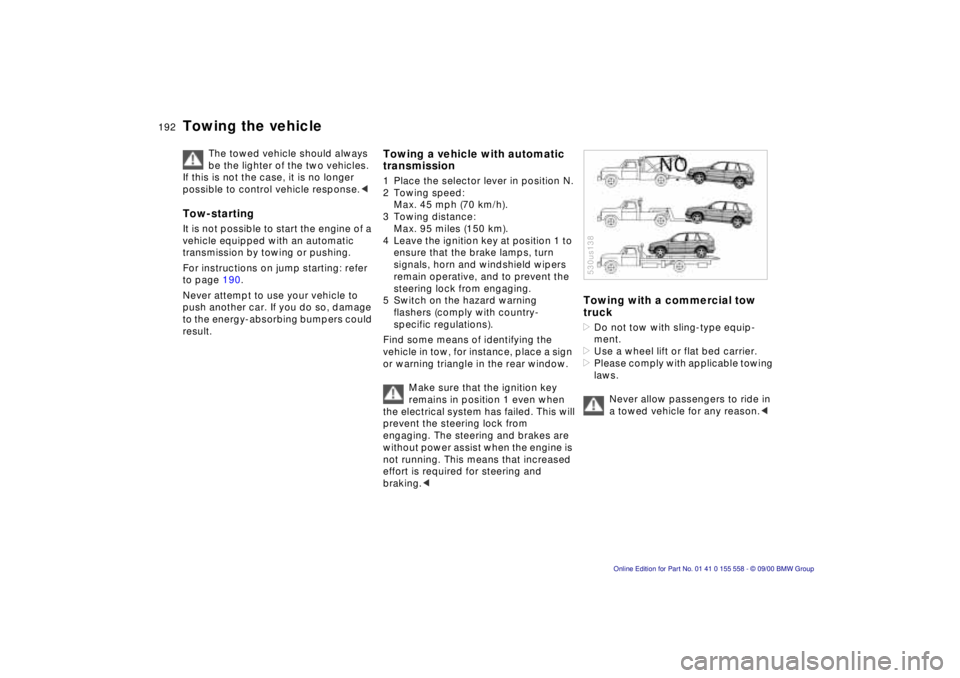
Towing with a commercial tow
truck>Do not tow with sling-type equip-
ment.
>Use a wheel lift or flat bed carrier.
>Please comply with applicable towing
laws.
Never allow passengers to ride in
a towed vehicle for any reason.< 530us138