light BMW X5 3.0I 2002 User Guide
[x] Cancel search | Manufacturer: BMW, Model Year: 2002, Model line: X5 3.0I, Model: BMW X5 3.0I 2002Pages: 185, PDF Size: 2.7 MB
Page 53 of 185
53n
OverviewControlsMaintenanceRepairsDataIndex
Steering wheel heating
*
Mirrors
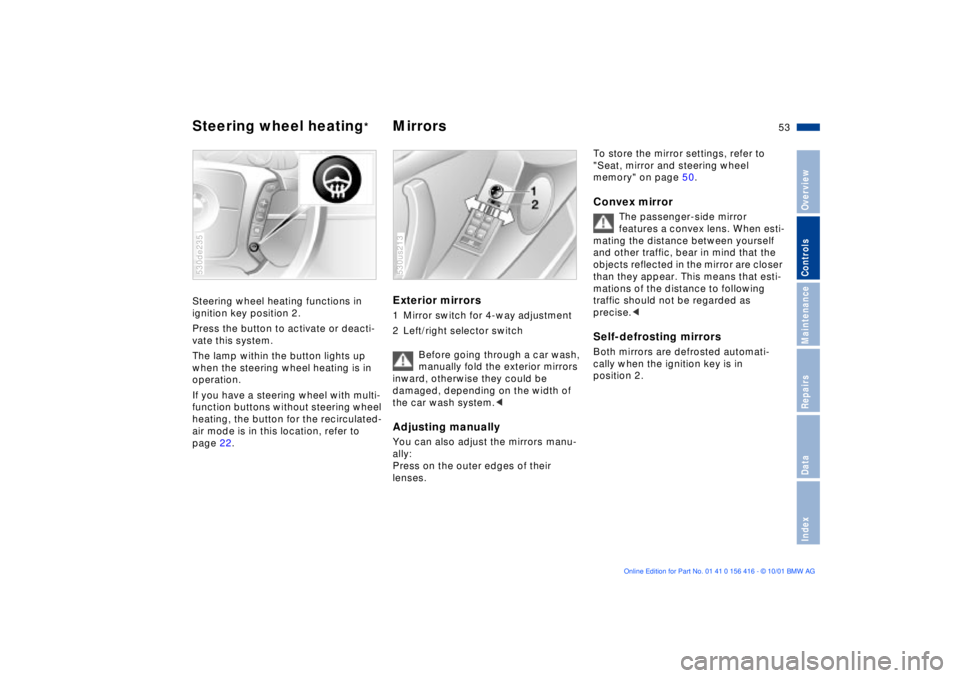
Steering wheel heating functions in
ignition key position 2.
Press the button to activate or deacti-
vate this system.
The lamp within the button lights up
when the steering wheel heating is in
operation.
If you have a steering wheel with multi-
function buttons without steering wheel
heating, the button for the recirculated-
air mode is in this location, refer to
page 22.530de235
Exterior mirrors 1 Mirror switch for 4-way adjustment
2 Left/right selector switch
Before going through a car wash,
manually fold the exterior mirrors
inward, otherwise they could be
damaged, depending on the width of
the car wash system.
Press on the outer edges of their
lenses. 530us213
To store the mirror settings, refer to
"Seat, mirror and steering wheel
memory" on page 50. Convex mirror
The passenger-side mirror
features a convex lens. When esti-
mating the distance between yourself
and other traffic, bear in mind that the
objects reflected in the mirror are closer
than they appear. This means that esti-
mations of the distance to following
traffic should not be regarded as
precise.<
Self-defrosting mirrorsBoth mirrors are defrosted automati-
cally when the ignition key is in
position 2.
Page 57 of 185
57n
OverviewControlsMaintenanceRepairsDataIndex
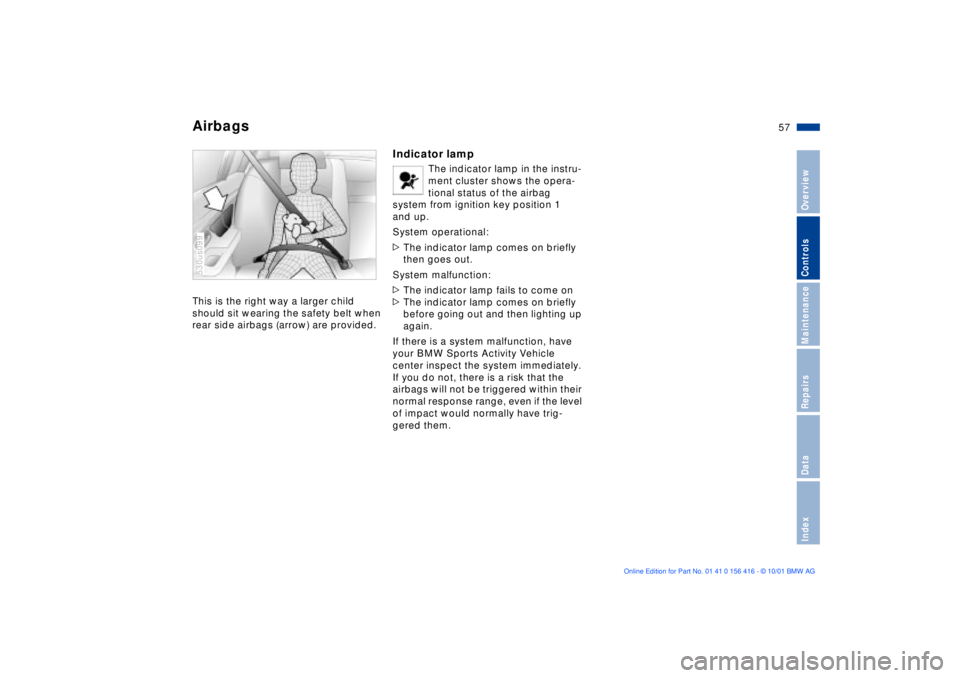
AirbagsThis is the right way a larger child
should sit wearing the safety belt when
rear side airbags (arrow) are provided. 530us099
Indicator lamp
The indicator lamp in the instru-
ment cluster shows the opera-
tional status of the airbag
system from ignition key position 1
and up.
System operational:
>The indicator lamp comes on briefly
then goes out.
System malfunction:
>The indicator lamp fails to come on
>The indicator lamp comes on briefly
before going out and then lighting up
again.
If there is a system malfunction, have
your BMW Sports Activity Vehicle
center inspect the system immediately.
If you do not, there is a risk that the
airbags will not be triggered within their
normal response range, even if the level
of impact would normally have trig-
gered them.
Page 62 of 185
62n
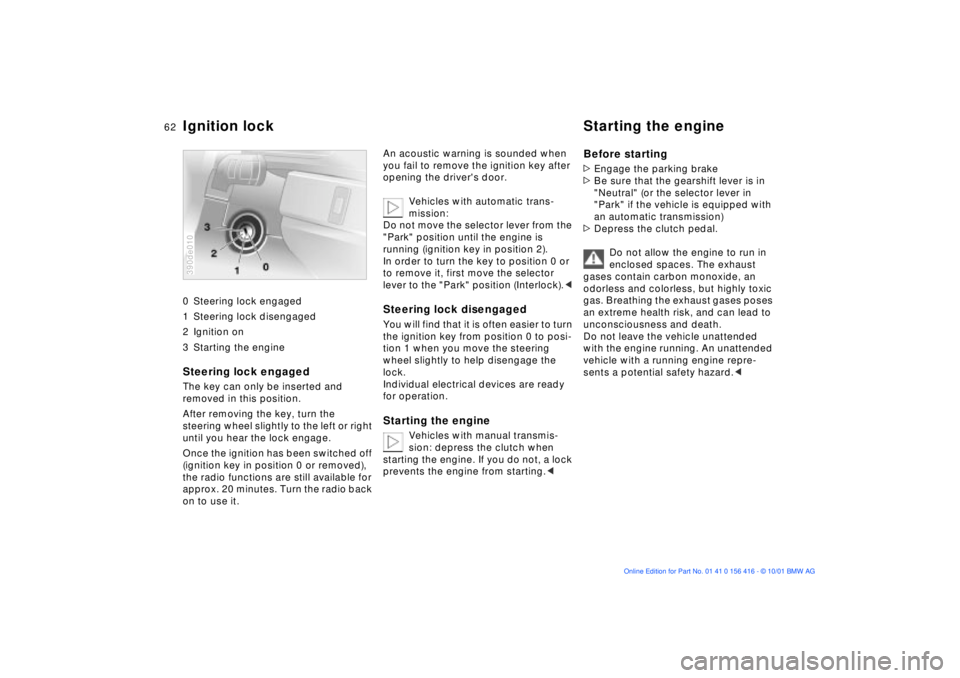
0 Steering lock engaged
1 Steering lock disengaged
2 Ignition on
3 Starting the engine
Steering lock engaged The key can only be inserted and
removed in this position.
After removing the key, turn the
steering wheel slightly to the left or right
until you hear the lock engage.
Once the ignition has been switched off
(ignition key in position 0 or removed),
the radio functions are still available for
approx. 20 minutes. Turn the radio back
on to use it.390de010
An acoustic warning is sounded when
you fail to remove the ignition key after
opening the driver's door.
Vehicles with automatic trans-
mission:
Do not move the selector lever from the
"Park" position until the engine is
running (ignition key in position 2).
In order to turn the key to position 0 or
to remove it, first move the selector
lever to the "Park" position (Interlock).< Steering lock disengaged You will find that it is often easier to turn
the ignition key from position 0 to posi-
tion 1 when you move the steering
wheel slightly to help disengage the
lock.
Individual electrical devices are ready
for operation. Starting the engine
Vehicles with manual transmis-
sion: depress the clutch when
starting the engine. If you do not, a lock
prevents the engine from starting.<
Before starting >Engage the parking brake
>Be sure that the gearshift lever is in
"Neutral" (or the selector lever in
"Park" if the vehicle is equipped with
an automatic transmission)
>Depress the clutch pedal.
Do not allow the engine to run in
enclosed spaces. The exhaust
gases contain carbon monoxide, an
odorless and colorless, but highly toxic
gas. Breathing the exhaust gases poses
an extreme health risk, and can lead to
unconsciousness and death.
Do not leave the vehicle unattended
with the engine running. An unattended
vehicle with a running engine repre-
sents a potential safety hazard.<
Ignition lock Starting the engine
Page 64 of 185
64n
Switching off the engine Parking brakeTurn the ignition key to position 1 or 0.
Do not remove the ignition key
while the vehicle is still moving. If
you do so, the steering will lock.
Always remove the ignition key and
engage the steering lock before leaving
the vehicle.
Vehicles with manual transmission:
Always engage the parking brake when
parking on slopes and inclined
surfaces. Even placing the gearshift
lever in 1st gear or reverse may not
provide adequate resistance to rolling.
Vehicles with automatic transmission:
Place the selector lever in "Park".<
Vehicles with automatic transmission:
The vehicle must be stationary and the
selector lever in "Park" before you can
remove the ignition key.
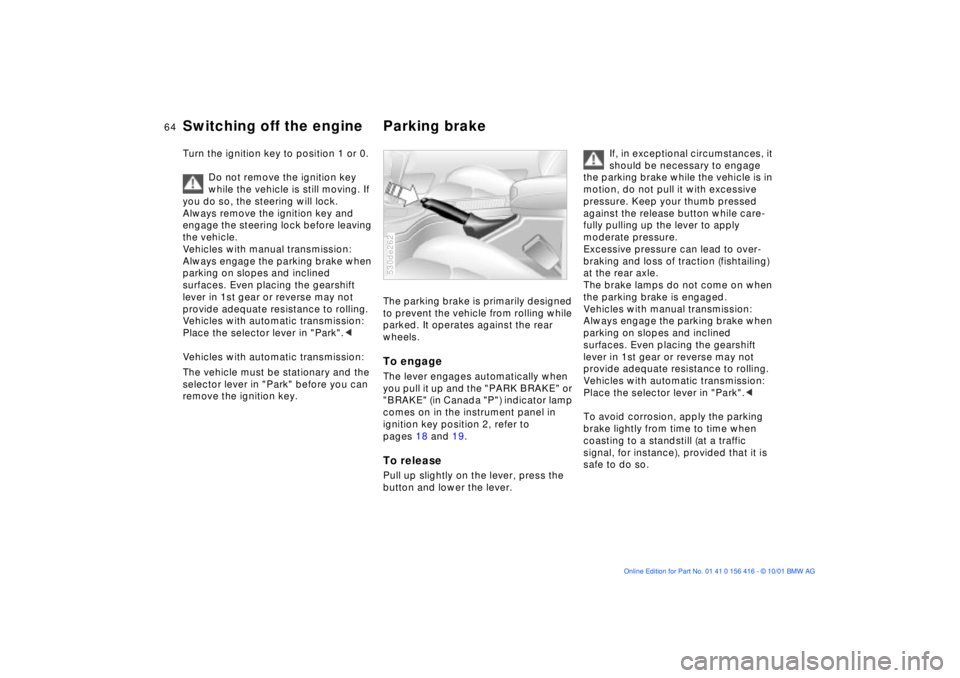
The parking brake is primarily designed
to prevent the vehicle from rolling while
parked. It operates against the rear
wheels.To engage The lever engages automatically when
you pull it up and the "PARK BRAKE" or
"BRAKE" (in Canada "P") indicator lamp
comes on in the instrument panel in
ignition key position 2, refer to
pages 18 and 19.To releasePull up slightly on the lever, press the
button and lower the lever. 530de262
If, in exceptional circumstances, it
should be necessary to engage
the parking brake while the vehicle is in
motion, do not pull it with excessive
pressure. Keep your thumb pressed
against the release button while care-
fully pulling up the lever to apply
moderate pressure.
Excessive pressure can lead to over-
braking and loss of traction (fishtailing)
at the rear axle.
The brake lamps do not come on when
the parking brake is engaged.
Vehicles with manual transmission:
Always engage the parking brake when
parking on slopes and inclined
surfaces. Even placing the gearshift
lever in 1st gear or reverse may not
provide adequate resistance to rolling.
Vehicles with automatic transmission:
Place the selector lever in "Park".<
To avoid corrosion, apply the parking
brake lightly from time to time when
coasting to a standstill (at a traffic
signal, for instance), provided that it is
safe to do so.
Page 70 of 185
70n
Washer/Wiper system Intermittent mode or rain sensor
*
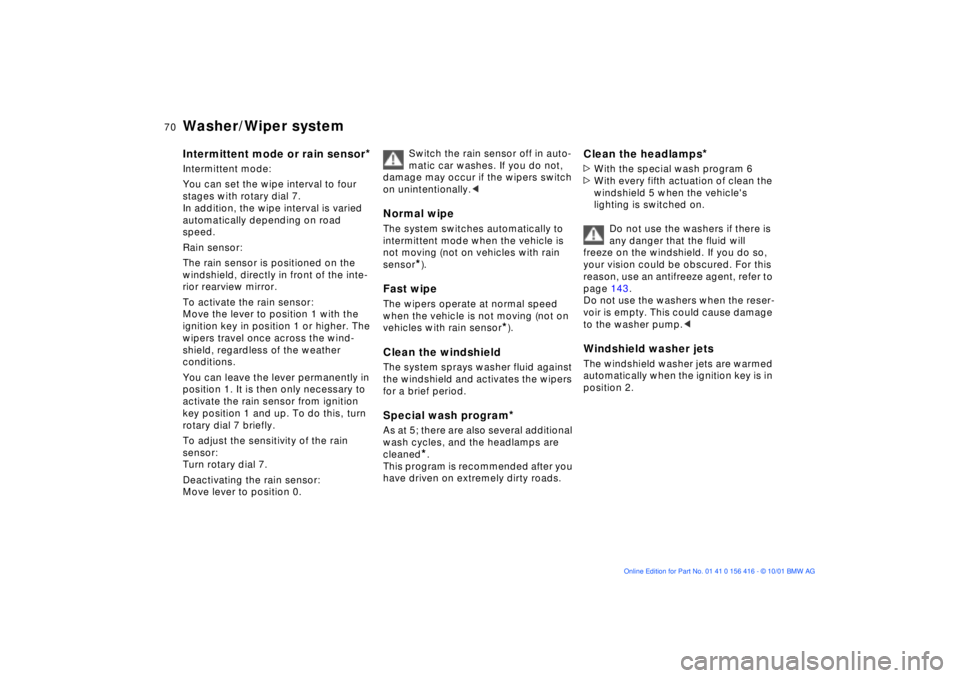
Intermittent mode:
You can set the wipe interval to four
stages with rotary dial 7.
In addition, the wipe interval is varied
automatically depending on road
speed.
Rain sensor:
The rain sensor is positioned on the
windshield, directly in front of the inte-
rior rearview mirror.
To activate the rain sensor:
Move the lever to position 1 with the
ignition key in position 1 or higher. The
wipers travel once across the wind-
shield, regardless of the weather
conditions.
You can leave the lever permanently in
position 1. It is then only necessary to
activate the rain sensor from ignition
key position 1 and up. To do this, turn
rotary dial 7 briefly.
To adjust the sensitivity of the rain
sensor:
Turn rotary dial 7.
Deactivating the rain sensor:
Move lever to position 0.Switch the rain sensor off in auto-
matic car washes. If you do not,
damage may occur if the wipers switch
on unintentionally.<
Normal wipe The system switches automatically to
intermittent mode when the vehicle is
not moving (not on vehicles with rain
sensor
*).
Fast wipe The wipers operate at normal speed
when the vehicle is not moving (not on
vehicles with rain sensor
*).
Clean the windshield The system sprays washer fluid against
the windshield and activates the wipers
for a brief period. Special wash program
*
As at 5; there are also several additional
wash cycles, and the headlamps are
cleaned
*.
This program is recommended after you
have driven on extremely dirty roads.
Clean the headlamps
*
>With the special wash program 6
>With every fifth actuation of clean the
windshield 5 when the vehicle's
lighting is switched on.
Do not use the washers if there is
any danger that the fluid will
freeze on the windshield. If you do so,
your vision could be obscured. For this
reason, use an antifreeze agent, refer to
page 143.
Do not use the washers when the reser-
voir is empty. This could cause damage
to the washer pump.< Windshield washer jetsThe windshield washer jets are warmed
automatically when the ignition key is in
position 2.
Page 75 of 185
75n
OverviewControlsMaintenanceRepairsDataIndex
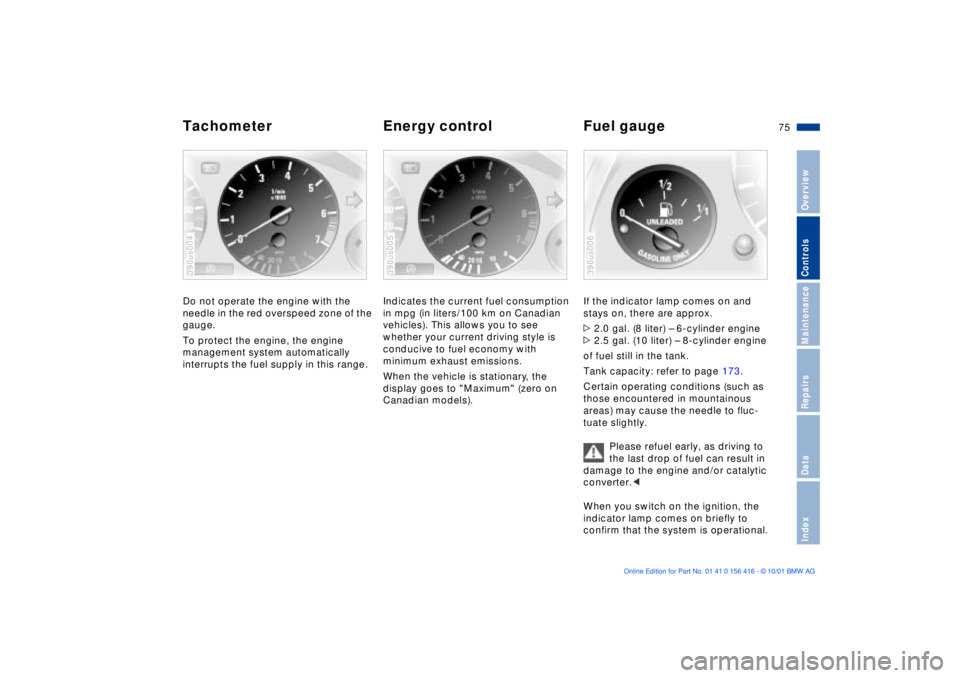
Tachometer Energy control Fuel gauge Do not operate the engine with the
needle in the red overspeed zone of the
gauge.
To protect the engine, the engine
management system automatically
interrupts the fuel supply in this range.390us004
Indicates the current fuel consumption
in mpg (in liters/100 km on Canadian
vehicles). This allows you to see
whether your current driving style is
conducive to fuel economy with
minimum exhaust emissions.
When the vehicle is stationary, the
display goes to "Maximum" (zero on
Canadian models).390us005
If the indicator lamp comes on and
stays on, there are approx.
>2.0 gal. (8 liter) Ð 6-cylinder engine
>2.5 gal. (10 liter) Ð 8-cylinder engine
of fuel still in the tank.
Tank capacity: refer to page 173.
Certain operating conditions (such as
those encountered in mountainous
areas) may cause the needle to fluc-
tuate slightly.
Please refuel early, as driving to
the last drop of fuel can result in
damage to the engine and/or catalytic
converter.<
When you switch on the ignition, the
indicator lamp comes on briefly to
confirm that the system is operational.390us006
Page 77 of 185
77n
OverviewControlsMaintenanceRepairsDataIndex
Check Control Graphic display
*
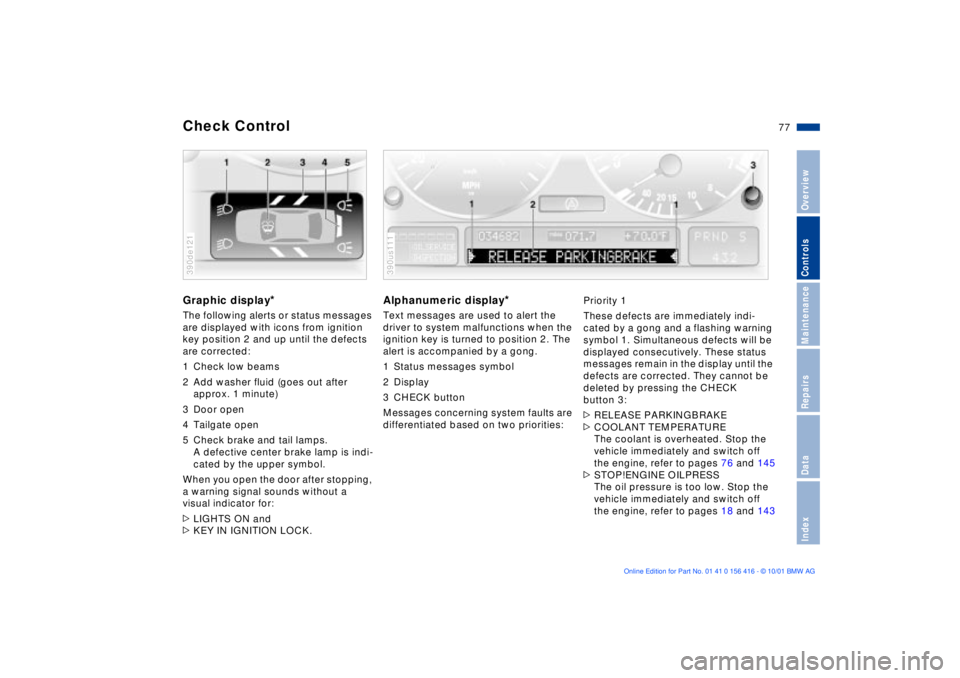
The following alerts or status messages
are displayed with icons from ignition
key position 2 and up until the defects
are corrected:
1 Check low beams
2 Add washer fluid (goes out after
approx. 1 minute)
3 Door open
4 Tailgate open
5 Check brake and tail lamps.
A defective center brake lamp is indi-
cated by the upper symbol.
When you open the door after stopping,
a warning signal sounds without a
visual indicator for:
>LIGHTS ON and
>KEY IN IGNITION LOCK. 390de121
Alphanumeric display
*
Text messages are used to alert the
driver to system malfunctions when the
ignition key is turned to position 2. The
alert is accompanied by a gong.
1 Status messages symbol
2 Display
3 CHECK button
Messages concerning system faults are
differentiated based on two priorities: 390us111
Priority 1
These defects are immediately indi-
cated by a gong and a flashing warning
symbol 1. Simultaneous defects will be
displayed consecutively. These status
messages remain in the display until the
defects are corrected. They cannot be
deleted by pressing the CHECK
button 3:
>RELEASE PARKINGBRAKE
>COOLANT TEMPERATURE
The coolant is overheated. Stop the
vehicle immediately and switch off
the engine, refer to pages 76 and 145
>STOP!ENGINE OILPRESS
The oil pressure is too low. Stop the
vehicle immediately and switch off
the engine, refer to pages 18 and 143
Page 78 of 185

78n
Check Control>CHECK BRAKE FLUID
Indicates that brake fluid is down to
approximately the minimum level.
Top off the brake fluid at the next
opportunity, refer to page 146. Have
the cause of the brake fluid loss diag-
nosed and corrected by your BMW
Sports Activity Vehicle center
>TIRE DEFECTIVE
*
Reduce vehicle speed immediately
and stop the vehicle. Avoid hard
brake applications. Do not oversteer,
refer to page 99
>SELFLEVEL SUSP.INACT
*
Please consult the nearest
BMW Sports Activity Vehicle center
>SELFLEVEL SUSP.INACT
*
"max. 35 mph/max. 60 km/h
*"
These displays appear consecutively.
Do not exceed a maximum speed of
35 mph (60 km/h).
Please consult the nearest BMW
Sports Activity Vehicle center
>SPEED LIMIT
*
You will see this message if the
programmed speed limit has been
exceeded, refer to page 86.Priority 2
These displays appear for 20 seconds
when the ignition key is turned to posi-
tion 2. The warning symbols remain
after the message disappears. You can
call up the messages again for display
by pressing the CHECK button.
>TRUNKLID OPEN
This message appears only at the
start of a trip
>DOOR OPEN
This message appears after a
minimal defined road speed has been
exceeded
>FASTEN SEAT BELTS
*
In addition to this message, an indi-
cator lamp with the safety belt icon
appears and an acoustical signal is
sounded
>WASHER FLUID LOW
The fluid level is too low; top off at
the next opportunity, refer to
page 143
>CHECK ENGINE OIL LEV
The oil level is at the absolute
minimum; refill as soon as possible,
refer to page 143. Do not drive more
than approx. 30 miles (50 km) until
you add oil >CHECK FILLER CAP
Check to see whether the fuel filler
cap has been closed properly, refer
to page 24. A fuel filler cap that has
not been closed all the way will set
off the Service Engine Soon lamp
>OUTSIDE TEMP. +23 7 (Ð5 6)
This display is only an example. The
current temperature is displayed at
outside temperatures of +37.5 7
(+3 6) and below, refer also to
page 74
>SET TIRE PRESSURE
*
The RDC has imported the current
inflation pressure in the tires as the
target values which the system will
monitor, refer to page 98
>CHECK TIRE PRESSURE
*
Check and correct the tire inflation
pressure to specifications at the
earliest opportunity (next stop to
refuel), refer to page 99
>TIRECONTROL INACTIVE
*
A temporary interference of the RDC
or a system fault, refer to page 99
>CHECK BRAKE LIGHTS
A lamp has failed or the electrical
circuit has a fault, refer to pages 155
and 156 or consult a BMW Sports
Activity Vehicle center.
Page 79 of 185
79n
OverviewControlsMaintenanceRepairsDataIndex
Check Control >CHECK LOWBEAM LIGHTS
CHECK SIDE LIGHTS
CHECK REAR LIGHTS
CHECK FRONT FOGLAMPS
CHECK LICPLATE LIGHT
CHECK HIGHBEAM LIGHT
CHECK BACK UP LIGHTS
Defective bulb or circuit, refer to
page 153 or consult a BMW Sports
Activity Vehicle center
>TRANS. FAILSAFE PROG
Please consult the nearest
BMW Sports Activity Vehicle center,
refer to page 68
>CHECK BRAKE LININGS
Have the brake pads inspected by
your BMW Sports Activity Vehicle
center, refer to page 135
>CHECK COOLANT LEVEL
Coolant too low, top off at the next
opportunity, refer to page 145
>ENGINE FAILSAFE PROG
There is a fault in the engine's elec-
tronic control system.
You can continue to drive with
reduced engine output or engine
speed. Have the system checked by
your BMW Sports Activity Vehicle
center.
Displays after completion of trip All of the malfunctions registered during
the trip appear consecutively when the
ignition key is turned to position 0.
The following displays will appear when
appropriate:
>LIGHTS ON
>KEY IN IGNITION LOCK
>CHECK ENGINE OIL LEV
Add engine oil at the next opportunity
(next stop to refuel), refer to
page 143.
This display appears when you open
the driver's door after parking the
vehicle. A supplementary gong is also
heard.
Status messages remain available for a
period of approx. three minutes after
the display goes out and the key is
removed from the ignition lock. Press
the CHECK button 3. If there were
multiple messages, press the CHECK
button repeatedly to view them all in
sequence.
To check the Check Control Press the CHECK button 3 with the
ignition key in position 2:
CHECK CONTROL OK appears in the
display.
No malfunctions are present in the
monitored systems.Computer You can find a description of the
computer on pages 80 and 86 as well
as in the Owner's Manual for the
Onboard Computer.
You can have the Check Control
and computer messages
displayed in a different language.<
Page 94 of 185
94n
Hill Descent Control (HDC) The concept HDC is a system for driving downhill in
steep terrain. This system reduces
vehicle speed on steep downhill gradi-
ents, thus allowing you to maintain
control of your BMW under these
conditions.
The vehicle moves at slightly more than
walking speed without active interven-
tion from the driver.
HDC is available for activation at
vehicle speeds below approx. 20 mph
(35 km/h). When driving down steep
hills with a speed below approx.
20 mph (35 km/h), the vehicle reduces
speed automatically down to slightly
more than walking speed (approx.
5 mph/8 km/h) and then maintains this
speed at a constant.
You can use the accelerator or brakes
to vary this automatically controlled
speed within a range extending from
approx. 3 mph (5 km/h) to 15 mph
(25 km/h).
You can use the +/Ð button to set the
cruise control to a target speed in the
range from approx. 3 mph (5 km/h) to
15 mph (25 km/h).
HDC is automatically deactivated once
vehicle speed again exceeds approx.
35 mph (60 km/h).
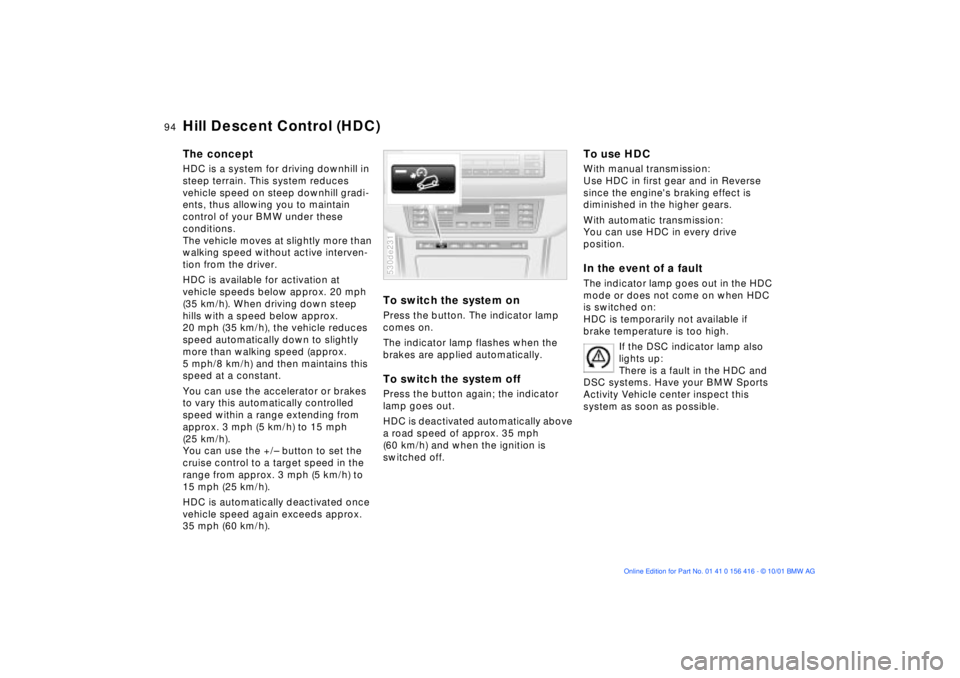
To switch the system onPress the button. The indicator lamp
comes on.
The indicator lamp flashes when the
brakes are applied automatically. To switch the system offPress the button again; the indicator
lamp goes out.
HDC is deactivated automatically above
a road speed of approx. 35 mph
(60 km/h) and when the ignition is
switched off. 530de231
To use HDC With manual transmission:
Use HDC in first gear and in Reverse
since the engine's braking effect is
diminished in the higher gears.
With automatic transmission:
You can use HDC in every drive
position. In the event of a faultThe indicator lamp goes out in the HDC
mode or does not come on when HDC
is switched on:
HDC is temporarily not available if
brake temperature is too high.
If the DSC indicator lamp also
lights up:
There is a fault in the HDC and
DSC systems. Have your BMW Sports
Activity Vehicle center inspect this
system as soon as possible.