maintenance BMW X5 3.0I 2003 Owner's Guide
[x] Cancel search | Manufacturer: BMW, Model Year: 2003, Model line: X5 3.0I, Model: BMW X5 3.0I 2003Pages: 183, PDF Size: 2.31 MB
Page 59 of 183
59n
OverviewControlsMaintenanceRepairsDataIndex
Transporting children safely
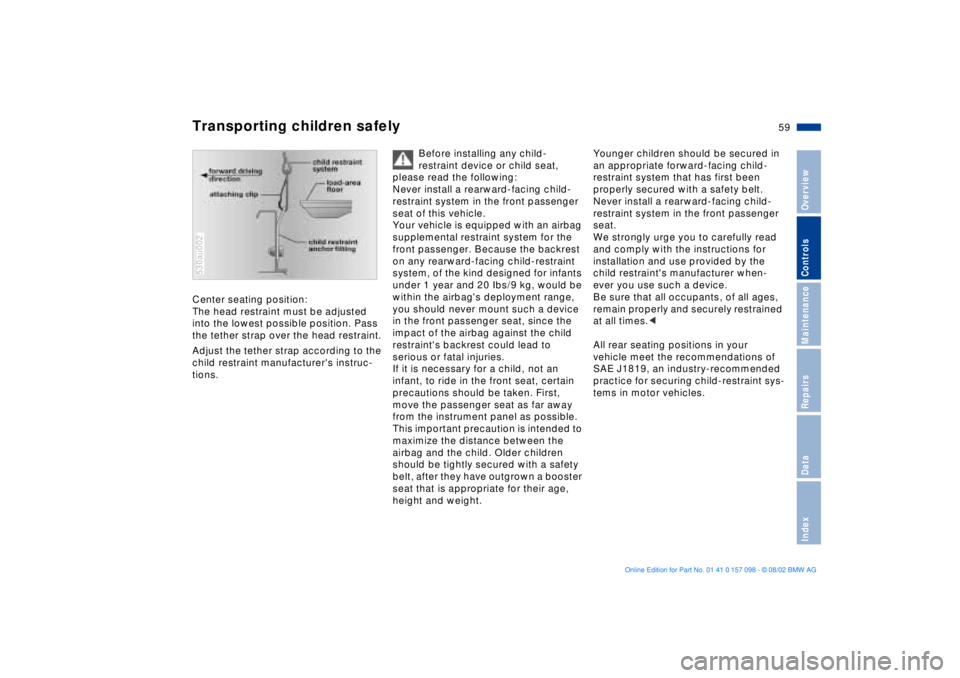
Center seating position:
The head restraint must be adjusted
into the lowest possible position. Pass
the tether strap over the head restraint.
Adjust the tether strap according to the
child restraint manufacturer's instruc-
tions.530au002
Before installing any child-
restraint device or child seat,
please read the following:
Never install a rearward-facing child-
restraint system in the front passenger
seat of this vehicle.
Your vehicle is equipped with an airbag
supplemental restraint system for the
front passenger. Because the backrest
on any rearward-facing child-restraint
system, of the kind designed for infants
under 1 year and 20 Ibs/9 kg, would be
within the airbag's deployment range,
you should never mount such a device
in the front passenger seat, since the
impact of the airbag against the child
restraint's backrest could lead to
serious or fatal injuries.
If it is necessary for a child, not an
infant, to ride in the front seat, certain
precautions should be taken. First,
move the passenger seat as far away
from the instrument panel as possible.
This important precaution is intended to
maximize the distance between the
airbag and the child. Older children
should be tightly secured with a safety
belt, after they have outgrown a booster
seat that is appropriate for their age,
height and weight.
Younger children should be secured in
an appropriate forward-facing child-
restraint system that has first been
properly secured with a safety belt.
Never install a rearward-facing child-
restraint system in the front passenger
seat.
We strongly urge you to carefully read
and comply with the instructions for
installation and use provided by the
child restraint's manufacturer when-
ever you use such a device.
Be sure that all occupants, of all ages,
remain properly and securely restrained
at all times.<
All rear seating positions in your
vehicle meet the recommendations of
SAE J1819, an industry-recommended
practice for securing child-restraint sys-
tems in motor vehicles.
Page 61 of 183
61n
OverviewControlsMaintenanceRepairsDataIndex
Vehicle Memory, Key Memory How the system functions You have probably frequently wished
that you could configure individual
functions of your vehicle to reflect your
own personal requirements. In engi-
neering your vehicle, BMW has
included several user-defined func-
tions in the vehicle's design. Your
BMW Sports Activity Vehicle center can
make these settings for you.
There are settings related to the vehicle
Ð Vehicle Memory Ð and settings related
to individuals Ð Key Memory. You can
configure up to four different basic
positions for four different persons. The
only requirement is that each person
uses his or her own remote control key. 463de029
When your vehicle is unlocked with the
remote control, the vehicle recognizes
the individual user by means of a data
exchange with the key, and makes
adjustments accordingly.
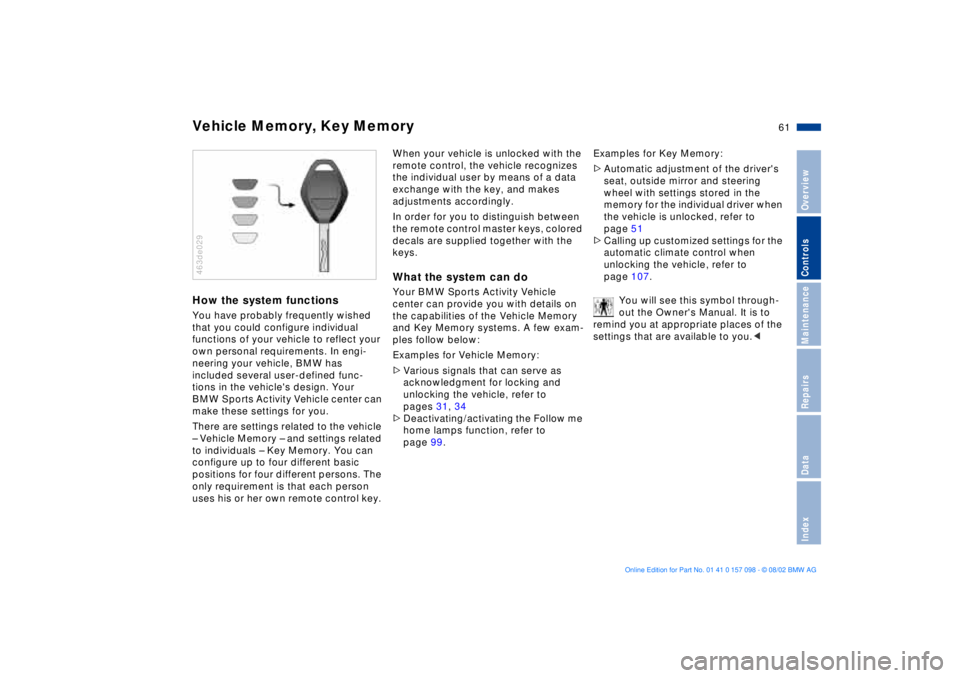
In order for you to distinguish between
the remote control master keys, colored
decals are supplied together with the
keys.What the system can doYour BMW Sports Activity Vehicle
center can provide you with details on
the capabilities of the Vehicle Memory
and Key Memory systems. A few exam-
ples follow below:
Examples for Vehicle Memory:
>Various signals that can serve as
acknowledgment for locking and
unlocking the vehicle, refer to
pages 31, 34
>Deactivating/activating the Follow me
home lamps function, refer to
page 99.Examples for Key Memory:
>Automatic adjustment of the driver's
seat, outside mirror and steering
wheel with settings stored in the
memory for the individual driver when
the vehicle is unlocked, refer to
page 51
>Calling up customized settings for the
automatic climate control when
unlocking the vehicle, refer to
page 107.
You will see this symbol through-
out the Owner's Manual. It is to
remind you at appropriate places of the
settings that are available to you.<
Page 63 of 183
63n
OverviewControlsMaintenanceRepairsDataIndex
Starting the engine Switching off the engineDo not press the accelerator pedal
while starting the engine.
BMW X5 3.0i:
Do not actuate the starter for too
short a time. Do not turn it for more
than approx. 20 seconds. Release the
ignition key immediately as soon as the
engine starts.
BMW X5 4.4i, 4.6is:
Your BMW is equipped with the conve-
nience starting feature. Simply turn the
ignition key to position 3 Ð starter Ð and
then release it immediately.
The starter actuation continues to
operate automatically for a certain
period of time and is stopped automati-
cally as soon as the engine has started.
The automatic starting mode will not
operate if the battery voltage is low.
The engine can be started by means of
jump-starting, refer to page 162.<
Do not allow the engine to warm up
by leaving it running while the vehicle
remains stationary. Instead, begin to
drive immediately at a moderate engine
speed.
Should the engine fail to start on the
first attempt, if it is very hot or cold, for
instance:
>Press the accelerator pedal halfway
down while engaging the starter.
Cold starts at altitudes above 3,300 ft/
1,000 meters and at very low tempera-
tures, from approx. +5 7/Ð15 6:
>For the initial start attempt, allow the
starter to remain engaged somewhat
longer, approx. 10 seconds.
Engine idle speed is controlled by the
engine computer system. Increased
speeds at start-up are normal and
should decrease as the engine warms
up. If engine speed does not decrease,
service is required.
To prevent the battery from discharging,
always switch off electrical devices that
are not in use. Switch the ignition off
when the vehicle is not being driven.
Extended starting attempts, char-
acterized by excessively frequent
or long periods with the starter
engaged, can lead to damage of the
catalytic converter.<
Turn the ignition key to position 1 or 0.
Do not remove the ignition key
while the vehicle is still moving. If
you do so, the steering will lock.
Always remove the ignition key and
engage the steering lock before leaving
the vehicle.
Vehicles with manual transmission:
Always engage the parking brake when
parking on slopes and inclined sur-
faces. Even placing the gearshift lever
in 1st gear or reverse may not provide
adequate resistance to rolling.
Vehicles with automatic transmission:
Place the selector lever in Park.<
Vehicles with automatic transmission:
The vehicle must be stationary and the
selector lever in Park before you can
remove the ignition key.
Page 65 of 183
65n
OverviewControlsMaintenanceRepairsDataIndex
Manual transmission Automatic transmission with Steptronic
*
Reverse Select Reverse only when the vehicle is
completely stopped. Press the gearshift
lever to the left to overcome the resis-
tance.
As you do this, the backup lamps will
turn on automatically when the ignition
key is in position 2.
Do not hold the vehicle in place on
slopes by slipping or riding the
clutch. Use the parking brake instead,
since a slipping clutch increases clutch
wear.<
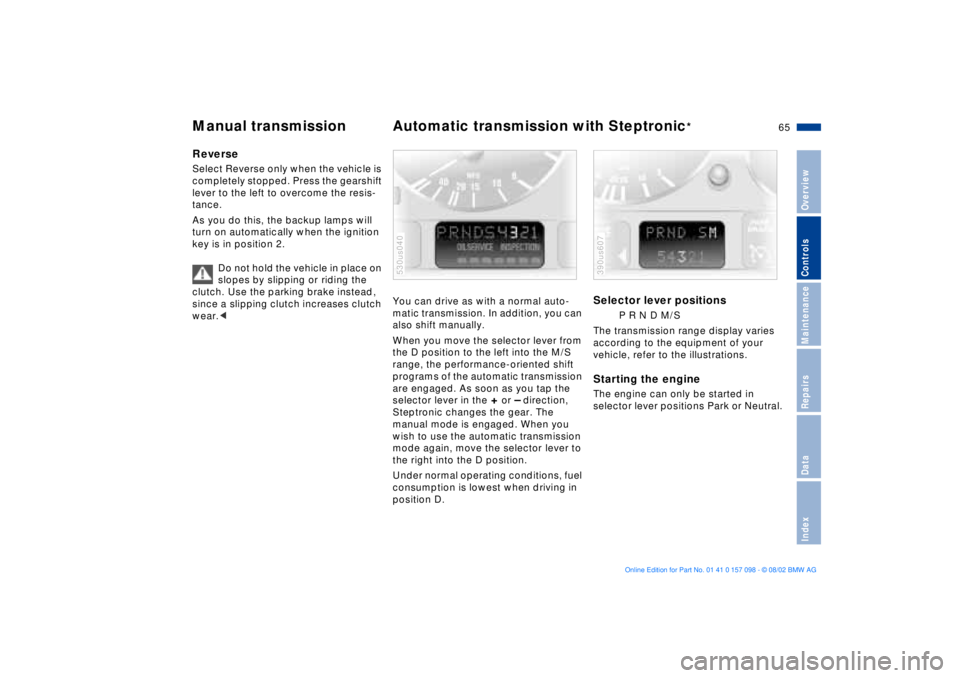
You can drive as with a normal auto-
matic transmission. In addition, you can
also shift manually.
When you move the selector lever from
the D position to the left into the M/S
range, the performance-oriented shift
programs of the automatic transmission
are engaged. As soon as you tap the
selector lever in the
+ or
Ð direction,
Steptronic changes the gear. The
manual mode is engaged. When you
wish to use the automatic transmission
mode again, move the selector lever to
the right into the D position.
Under normal operating conditions, fuel
consumption is lowest when driving in
position D.
530us040
Selector lever positions
P R N D M/S
The transmission range display varies
according to the equipment of your
vehicle, refer to the illustrations.
Starting the engine The engine can only be started in
selector lever positions Park or Neutral. 390us607
Page 67 of 183
67n
OverviewControlsMaintenanceRepairsDataIndex
Automatic transmission with Steptronic
*
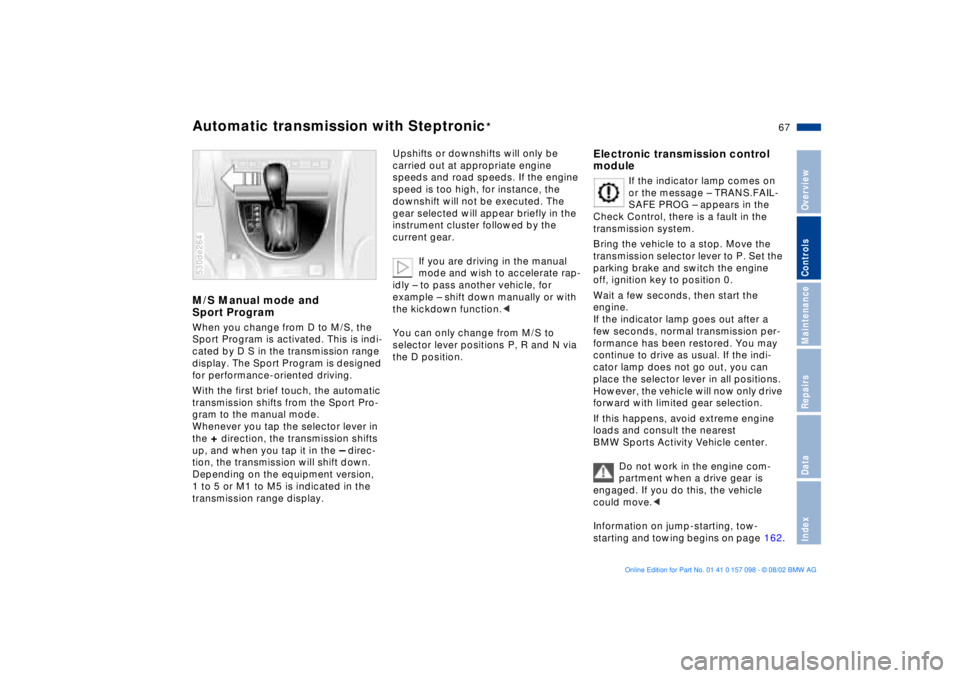
M/S Manual mode and
Sport Program When you change from D to M/S, the
Sport Program is activated. This is indi-
cated by D S in the transmission range
display. The Sport Program is designed
for performance-oriented driving.
With the first brief touch, the automatic
transmission shifts from the Sport Pro-
gram to the manual mode.
Whenever you tap the selector lever in
the
+ direction, the transmission shifts
up, and when you tap it in the
Ð direc-
tion, the transmission will shift down.
Depending on the equipment version,
1 to 5 or M1 to M5 is indicated in the
transmission range display.
530de264
Upshifts or downshifts will only be
carried out at appropriate engine
speeds and road speeds. If the engine
speed is too high, for instance, the
downshift will not be executed. The
gear selected will appear briefly in the
instrument cluster followed by the
current gear.
If you are driving in the manual
mode and wish to accelerate rap-
idly Ð to pass another vehicle, for
example Ð shift down manually or with
the kickdown function.<
You can only change from M/S to
selector lever positions P, R and N via
the D position.
Electronic transmission control
module
If the indicator lamp comes on
or the message Ð TRANS.FAIL-
SAFE PROG Ð appears in the
Check Control, there is a fault in the
transmission system.
Bring the vehicle to a stop. Move the
transmission selector lever to P. Set the
parking brake and switch the engine
off, ignition key to position 0.
Wait a few seconds, then start the
engine.
If the indicator lamp goes out after a
few seconds, normal transmission per-
formance has been restored. You may
continue to drive as usual. If the indi-
cator lamp does not go out, you can
place the selector lever in all positions.
However, the vehicle will now only drive
forward with limited gear selection.
If this happens, avoid extreme engine
loads and consult the nearest
BMW Sports Activity Vehicle center.
Do not work in the engine com-
partment when a drive gear is
engaged. If you do this, the vehicle
could move.<
Information on jump-starting, tow-
starting and towing begins on page 162.
Page 69 of 183
69n
OverviewControlsMaintenanceRepairsDataIndex
Washer/Wiper system/Rain sensor
*
Intermittent mode
Not on vehicles with rain sensor.
You can set the wipe interval to four
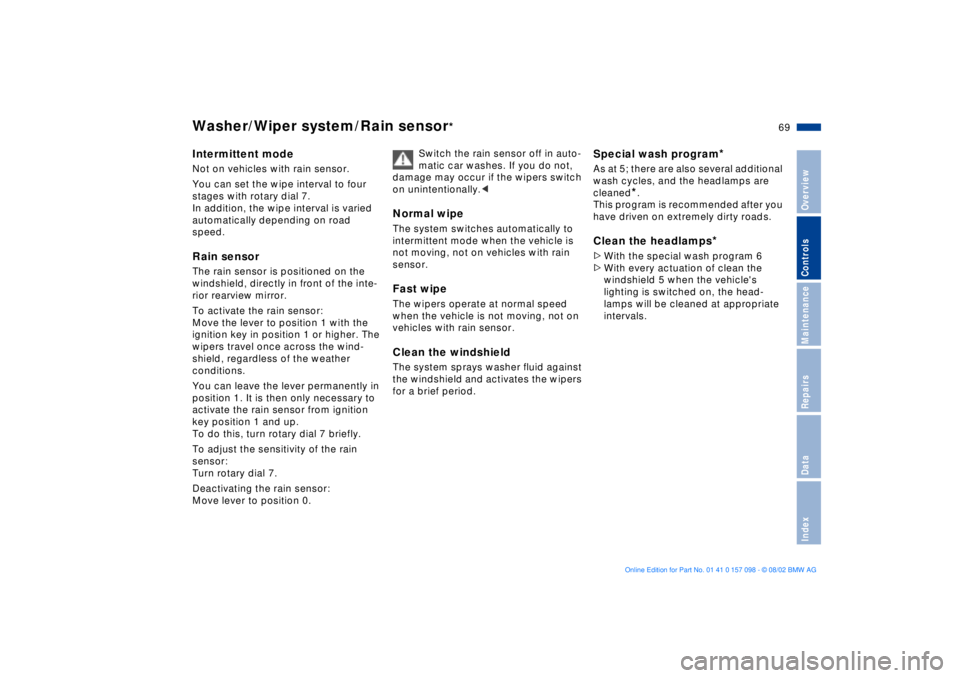
stages with rotary dial 7.
In addition, the wipe interval is varied
automatically depending on road
speed. Rain sensor The rain sensor is positioned on the
windshield, directly in front of the inte-
rior rearview mirror.
To activate the rain sensor:
Move the lever to position 1 with the
ignition key in position 1 or higher. The
wipers travel once across the wind-
shield, regardless of the weather
conditions.
You can leave the lever permanently in
position 1. It is then only necessary to
activate the rain sensor from ignition
key position 1 and up.
To do this, turn rotary dial 7 briefly.
To adjust the sensitivity of the rain
sensor:
Turn rotary dial 7.
Deactivating the rain sensor:
Move lever to position 0.Switch the rain sensor off in auto-
matic car washes. If you do not,
damage may occur if the wipers switch
on unintentionally.<
Normal wipe The system switches automatically to
intermittent mode when the vehicle is
not moving, not on vehicles with rain
sensor. Fast wipe The wipers operate at normal speed
when the vehicle is not moving, not on
vehicles with rain sensor. Clean the windshield The system sprays washer fluid against
the windshield and activates the wipers
for a brief period.
Special wash program
*
As at 5; there are also several additional
wash cycles, and the headlamps are
cleaned
*.
This program is recommended after you
have driven on extremely dirty roads.
Clean the headlamps
*
>With the special wash program 6
>With every actuation of clean the
windshield 5 when the vehicle's
lighting is switched on, the head-
lamps will be cleaned at appropriate
intervals.
Page 71 of 183
71n
OverviewControlsMaintenanceRepairsDataIndex
Cruise control
*
You can automatically maintain and
store any desired vehicle speed above
approx. 20 mph/30 km/h.
You can use cruise control whenever
the system is active while the engine is
running.
To activate the system From ignition key position 2:
Press button; the indicator lamp in the
instrument cluster comes on, refer to
page 22. You can now use the cruise
control.
Do not use cruise control on
twisting roads, when high traffic
density prevents driving at a constant
speed, when the road surface is slick Ð
snow, rain, ice Ð or when the road sur-
face is loose Ð rocks, gravel or sand.< To deactivate the systemPress the button repeatedly until the
indicator lamp in the instrument cluster
goes out.
The cruise control is also deactivated
when the ignition key is turned into
position 0.
The speed stored in the memory is
deleted.
To maintain and store speed or
to accelerate Press button
+ briefly:
The system maintains and stores the
current vehicle speed. Every time you
briefly touch the button, the speed
increases by approx. 0.6 mph/1 km/h.
Press and hold button
+ :
The vehicle accelerates without pres-
sure on the accelerator pedal. When
you release the button, the system
maintains and stores the current speed.
If, on a downhill gradient, the
engine's braking effect is not suffi-
cient, the controlled speed can be
exceeded. Speed can drop on uphill
grades if the engine output is insuffi-
cient.<
Page 73 of 183
73n
OverviewControlsMaintenanceRepairsDataIndex
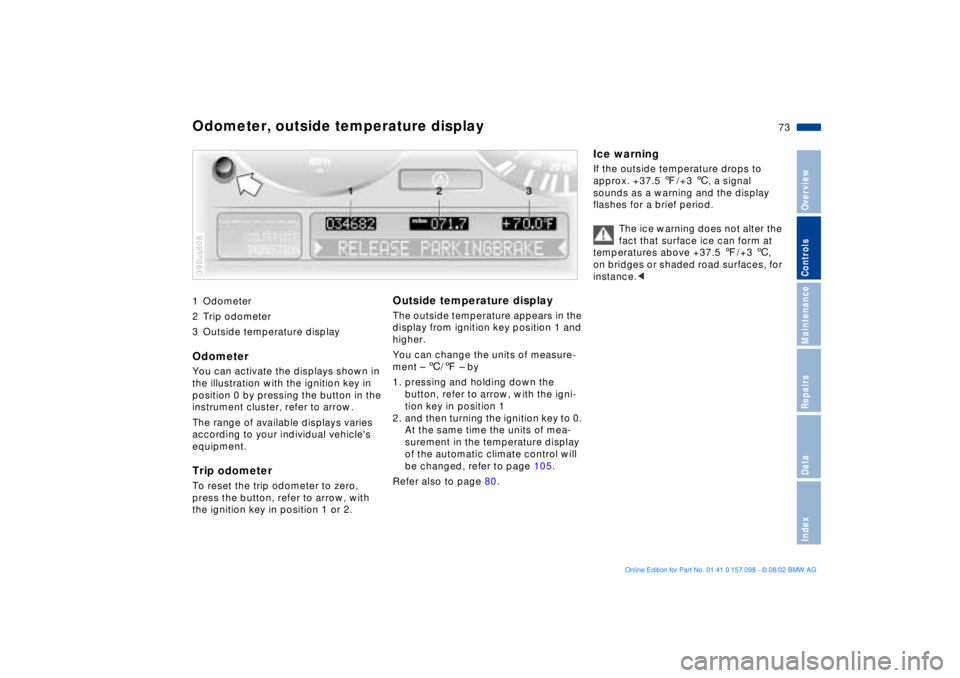
1 Odometer
2 Trip odometer
3 Outside temperature displayOdometerYou can activate the displays shown in
the illustration with the ignition key in
position 0 by pressing the button in the
instrument cluster, refer to arrow.
The range of available displays varies
according to your individual vehicle's
equipment.Trip odometer To reset the trip odometer to zero,
press the button, refer to arrow, with
the ignition key in position 1 or 2. 390us608
Outside temperature display The outside temperature appears in the
display from ignition key position 1 and
higher.
You can change the units of measure-
ment Ð 6/7 Ð by
1. pressing and holding down the
button, refer to arrow, with the igni-
tion key in position 1
2. and then turning the ignition key to 0.
At the same time the units of mea-
surement in the temperature display
of the automatic climate control will
be changed, refer to page 105.
Refer also to page 80.
Ice warning If the outside temperature drops to
approx. +37.5 7/+3 6, a signal
sounds as a warning and the display
flashes for a brief period.
The ice warning does not alter the
fact that surface ice can form at
temperatures above +37.5 7/+3 6,
on bridges or shaded road surfaces, for
instance.<
Odometer, outside temperature display
Page 75 of 183
75n
OverviewControlsMaintenanceRepairsDataIndex
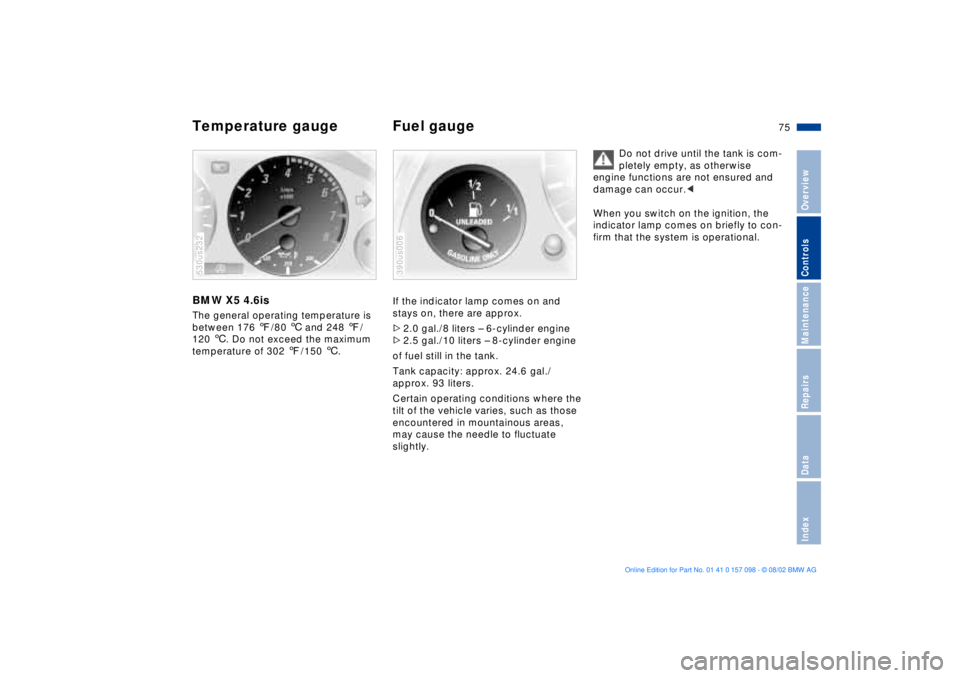
Temperature gauge Fuel gauge BMW X5 4.6isThe general operating temperature is
between 176 7/80 6 and 248 7/
120 6. Do not exceed the maximum
temperature of 302 7/150 6.530us232
If the indicator lamp comes on and
stays on, there are approx.
>2.0 gal./8 liters Ð 6-cylinder engine
>2.5 gal./10 liters Ð 8-cylinder engine
of fuel still in the tank.
Tank capacity: approx. 24.6 gal./
approx. 93 liters.
Certain operating conditions where the
tilt of the vehicle varies, such as those
encountered in mountainous areas,
may cause the needle to fluctuate
slightly.390us006
Do not drive until the tank is com-
pletely empty, as otherwise
engine functions are not ensured and
damage can occur.<
When you switch on the ignition, the
indicator lamp comes on briefly to con-
firm that the system is operational.
Page 76 of 183
76n
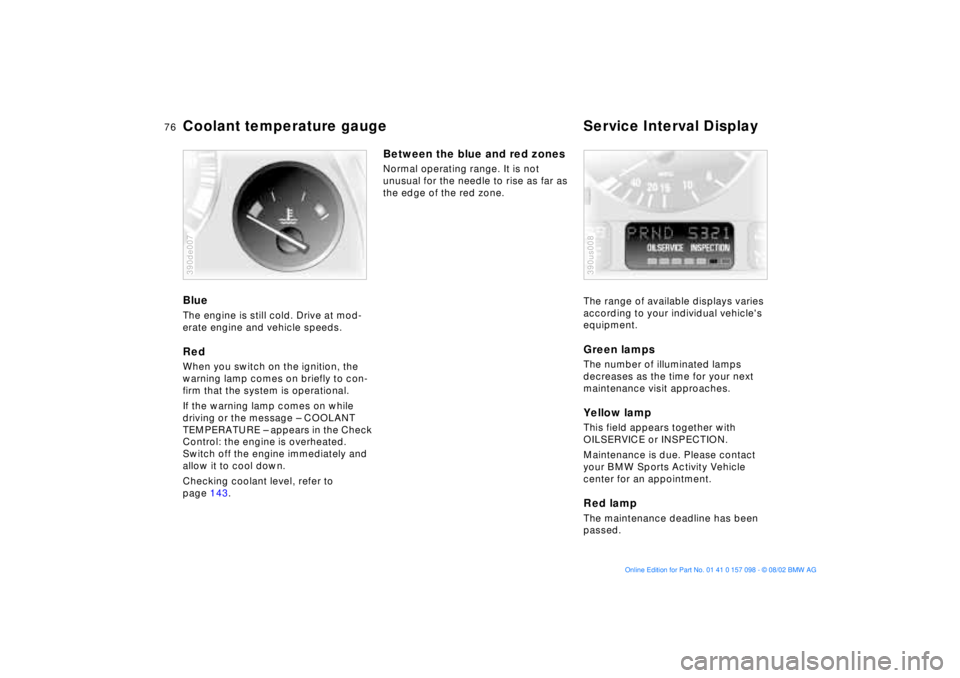
Coolant temperature gauge Service Interval Display Blue The engine is still cold. Drive at mod-
erate engine and vehicle speeds.Red When you switch on the ignition, the
warning lamp comes on briefly to con-
firm that the system is operational.
If the warning lamp comes on while
driving or the message Ð COOLANT
TEMPERATURE Ð appears in the Check
Control: the engine is overheated.
Switch off the engine immediately and
allow it to cool down.
Checking coolant level, refer to
page 143. 390de007
Between the blue and red zones Normal operating range. It is not
unusual for the needle to rise as far as
the edge of the red zone.
The range of available displays varies
according to your individual vehicle's
equipment.
Green lamps The number of illuminated lamps
decreases as the time for your next
maintenance visit approaches.Yellow lamp This field appears together with
OILSERVICE or INSPECTION.
Maintenance is due. Please contact
your BMW Sports Activity Vehicle
center for an appointment.Red lamp The maintenance deadline has been
passed.390us008