ECU BMW X5 3.0I 2005 E53 Owner's Guide
[x] Cancel search | Manufacturer: BMW, Model Year: 2005, Model line: X5 3.0I, Model: BMW X5 3.0I 2005 E53Pages: 200, PDF Size: 3.55 MB
Page 127 of 200
127n
OverviewControlsMaintenanceRepairsDataIndex
Cargo area Partition net
*
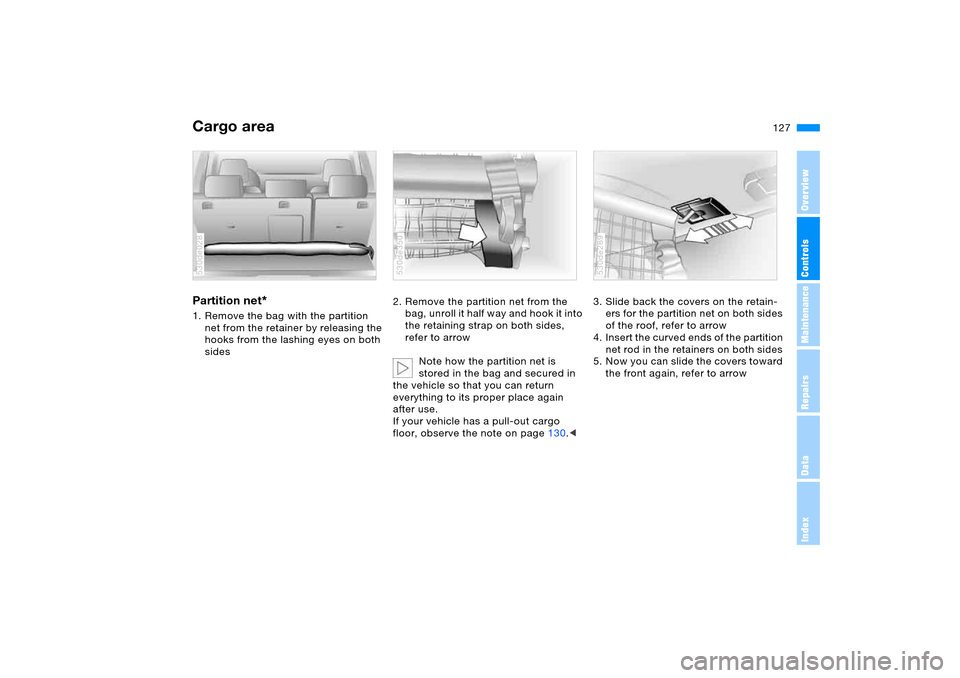
1. Remove the bag with the partition
net from the retainer by releasing the
hooks from the lashing eyes on both
sides530de028
2. Remove the partition net from the
bag, unroll it half way and hook it into
the retaining strap on both sides,
refer to arrow
Note how the partition net is
stored in the bag and secured in
the vehicle so that you can return
everything to its proper place again
after use.
If your vehicle has a pull-out cargo
floor, observe the note on page130.<530de350
3. Slide back the covers on the retain-
ers for the partition net on both sides
of the roof, refer to arrow
4. Insert the curved ends of the partition
net rod in the retainers on both sides
5. Now you can slide the covers toward
the front again, refer to arrow530de289
Page 128 of 200
128n
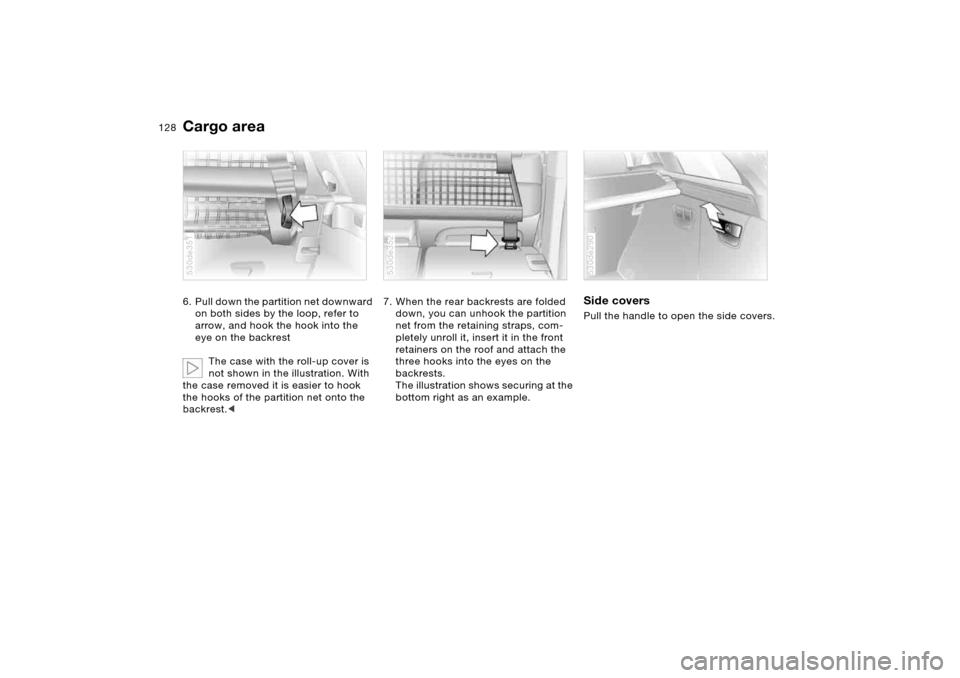
Cargo area 6. Pull down the partition net downward
on both sides by the loop, refer to
arrow, and hook the hook into the
eye on the backrest
The case with the roll-up cover is
not shown in the illustration. With
the case removed it is easier to hook
the hooks of the partition net onto the
backrest.<530de351
7. When the rear backrests are folded
down, you can unhook the partition
net from the retaining straps, com-
pletely unroll it, insert it in the front
retainers on the roof and attach the
three hooks into the eyes on the
backrests.
The illustration shows securing at the
bottom right as an example.530de352
Side covers Pull the handle to open the side covers.530de290
Page 130 of 200
130n
Cargo area Pull-out cargo floor
*
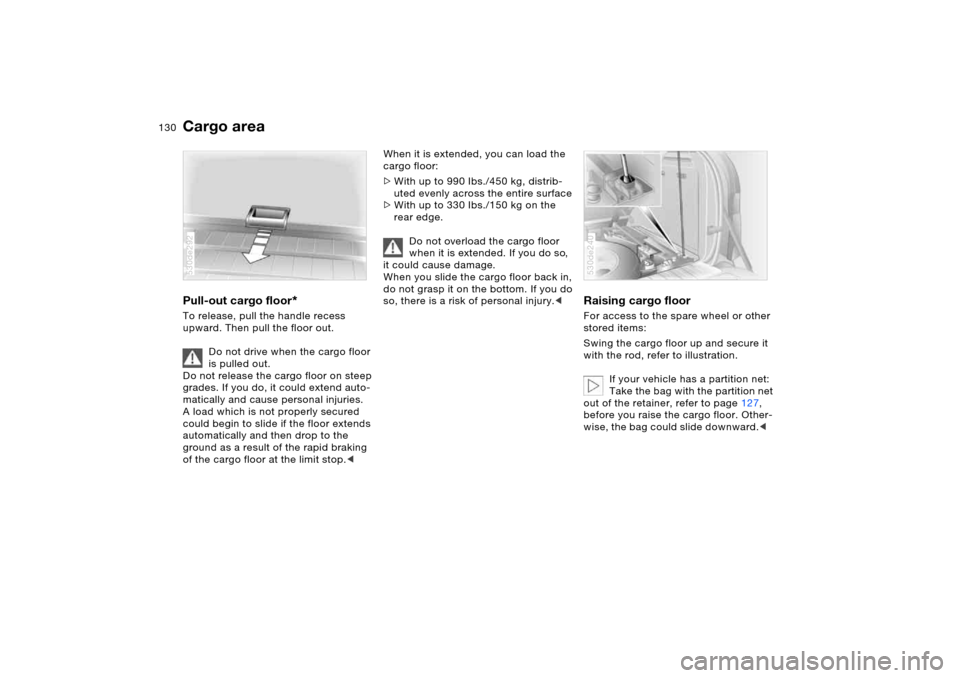
To release, pull the handle recess
upward. Then pull the floor out.
Do not drive when the cargo floor
is pulled out.
Do not release the cargo floor on steep
grades. If you do, it could extend auto-
matically and cause personal injuries.
A load which is not properly secured
could begin to slide if the floor extends
automatically and then drop to the
ground as a result of the rapid braking
of the cargo floor at the limit stop.< 530de292
When it is extended, you can load the
cargo floor:
>With up to 990 Ibs./450 kg, distrib-
uted evenly across the entire surface
>With up to 330 Ibs./150 kg on the
rear edge.
Do not overload the cargo floor
when it is extended. If you do so,
it could cause damage.
When you slide the cargo floor back in,
do not grasp it on the bottom. If you do
so, there is a risk of personal injury.<
Raising cargo floor For access to the spare wheel or other
stored items:
Swing the cargo floor up and secure it
with the rod, refer to illustration.
If your vehicle has a partition net:
Take the bag with the partition net
out of the retainer, refer to page127,
before you raise the cargo floor. Other-
wise, the bag could slide downward.< 530de240
Page 132 of 200
132n
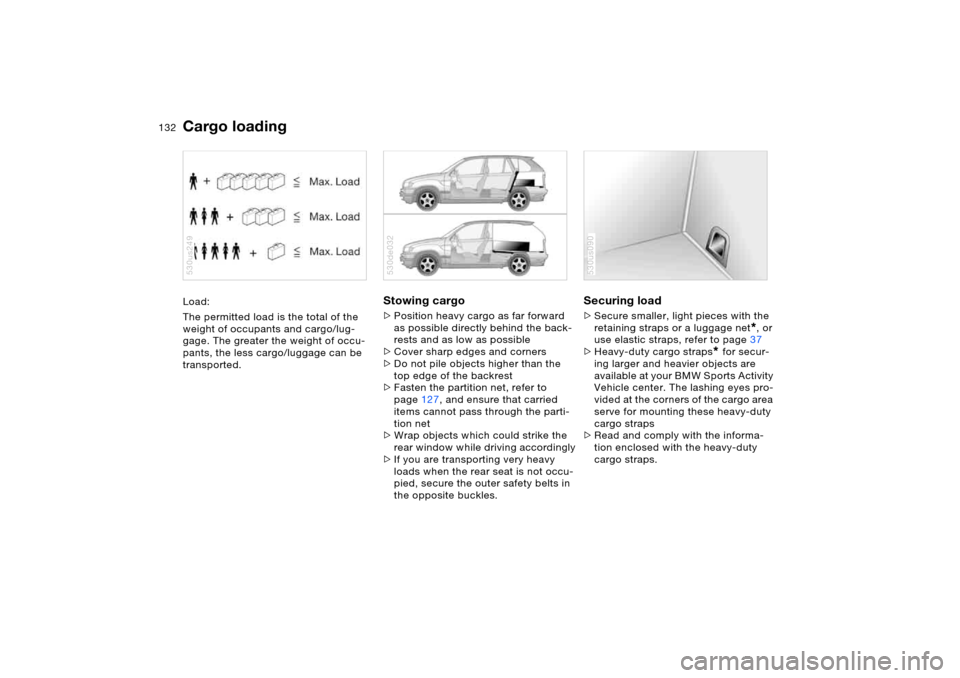
Cargo loadingLoad:
The permitted load is the total of the
weight of occupants and cargo/lug-
gage. The greater the weight of occu-
pants, the less cargo/luggage can be
transported.530us249
Stowing cargo >Position heavy cargo as far forward
as possible directly behind the back-
rests and as low as possible
>Cover sharp edges and corners
>Do not pile objects higher than the
top edge of the backrest
>Fasten the partition net, refer to
page127, and ensure that carried
items cannot pass through the parti-
tion net
>Wrap objects which could strike the
rear window while driving accordingly
>If you are transporting very heavy
loads when the rear seat is not occu-
pied, secure the outer safety belts in
the opposite buckles. 530de032
Securing load >Secure smaller, light pieces with the
retaining straps or a luggage net
*, or
use elastic straps, refer to page37
>Heavy-duty cargo straps
* for secur-
ing larger and heavier objects are
available at your BMW Sports Activity
Vehicle center. The lashing eyes pro-
vided at the corners of the cargo area
serve for mounting these heavy-duty
cargo straps
>Read and comply with the informa-
tion enclosed with the heavy-duty
cargo straps.
530us090
Page 133 of 200
133n
OverviewControlsMaintenanceRepairsDataIndex
Cargo loading Roof-mounted luggage rack
*
Always position and secure the
load as described above. If you do
not, it can even endanger the passen-
gers during braking or evasive maneu-
vers.
Do not exceed the permissible gross
vehicle weight and the permissible axle
loads, refer to page180. If you do, the
operating safety of the vehicle is no
longer ensured and you are in violation
of the law.
You should never transport heavy or
hard objects unsecured in the passen-
ger compartment, as they could fly
around and pose a safety hazard to the
vehicle's occupants even during abrupt
braking or evasive maneuvers.<
A special rack system is available as an
option for your BMW. Please comply
with the precautions included with the
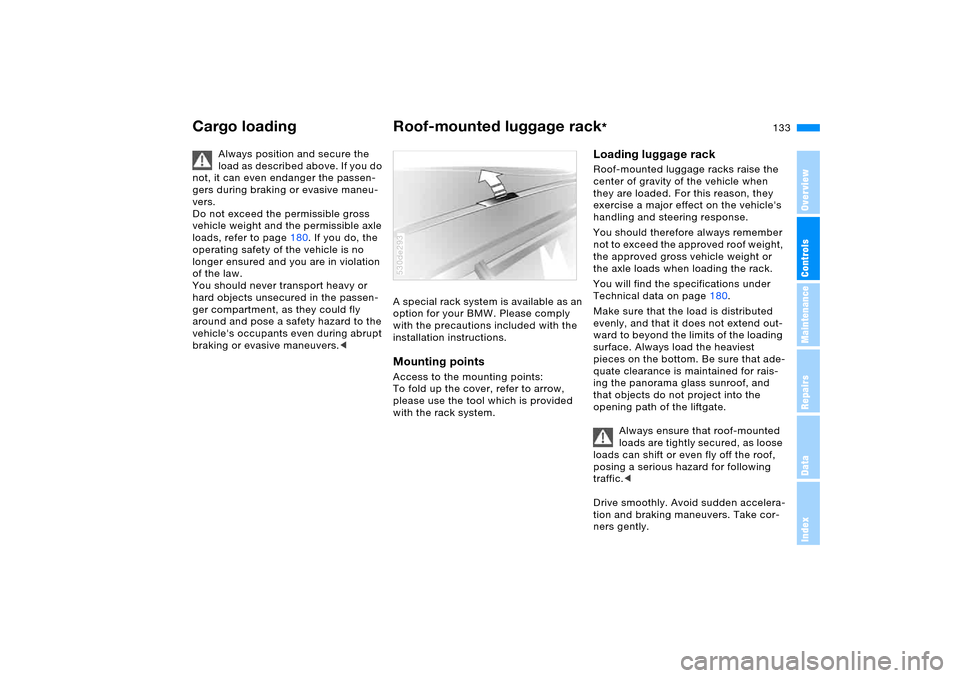
installation instructions.Mounting pointsAccess to the mounting points:
To fold up the cover, refer to arrow,
please use the tool which is provided
with the rack system.530de293
Loading luggage rackRoof-mounted luggage racks raise the
center of gravity of the vehicle when
they are loaded. For this reason, they
exercise a major effect on the vehicle's
handling and steering response.
You should therefore always remember
not to exceed the approved roof weight,
the approved gross vehicle weight or
the axle loads when loading the rack.
You will find the specifications under
Technical data on page180.
Make sure that the load is distributed
evenly, and that it does not extend out-
ward to beyond the limits of the loading
surface. Always load the heaviest
pieces on the bottom. Be sure that ade-
quate clearance is maintained for rais-
ing the panorama glass sunroof, and
that objects do not project into the
opening path of the liftgate.
Always ensure that roof-mounted
loads are tightly secured, as loose
loads can shift or even fly off the roof,
posing a serious hazard for following
traffic.<
Drive smoothly. Avoid sudden accelera-
tion and braking maneuvers. Take cor-
ners gently.
Page 148 of 200
148n
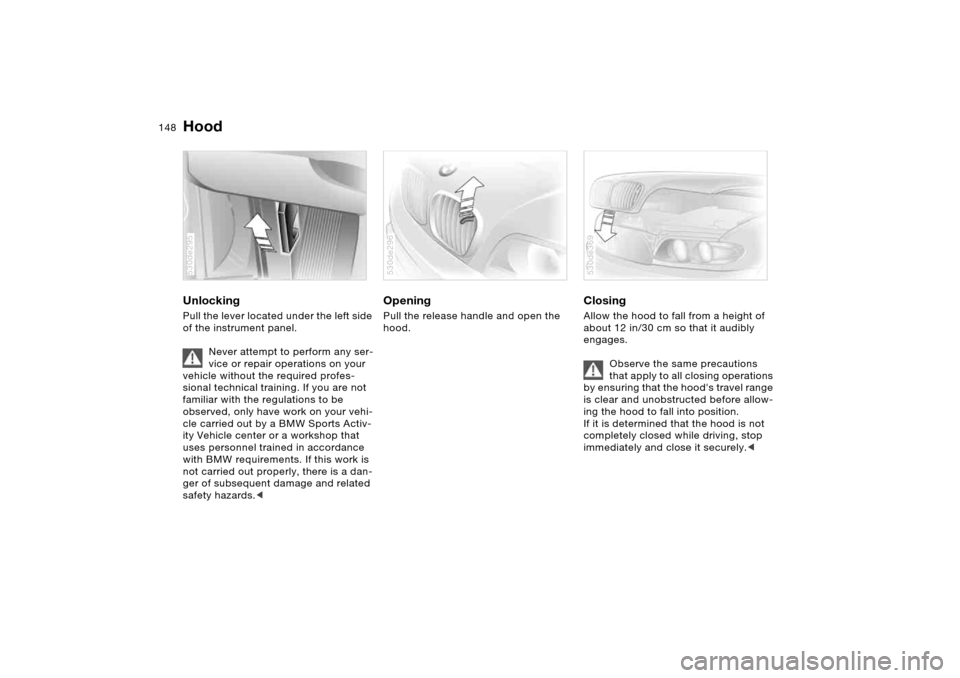
Hood Unlocking Pull the lever located under the left side
of the instrument panel.
Never attempt to perform any ser-
vice or repair operations on your
vehicle without the required profes-
sional technical training. If you are not
familiar with the regulations to be
observed, only have work on your vehi-
cle carried out by a BMW Sports Activ-
ity Vehicle center or a workshop that
uses personnel trained in accordance
with BMW requirements. If this work is
not carried out properly, there is a dan-
ger of subsequent damage and related
safety hazards.< 530de295
Opening Pull the release handle and open the
hood. 530de296
Closing Allow the hood to fall from a height of
about 12 in/30 cm so that it audibly
engages.
Observe the same precautions
that apply to all closing operations
by ensuring that the hood's travel range
is clear and unobstructed before allow-
ing the hood to fall into position.
If it is determined that the hood is not
completely closed while driving, stop
immediately and close it securely.< 530de369
Page 158 of 200
158n
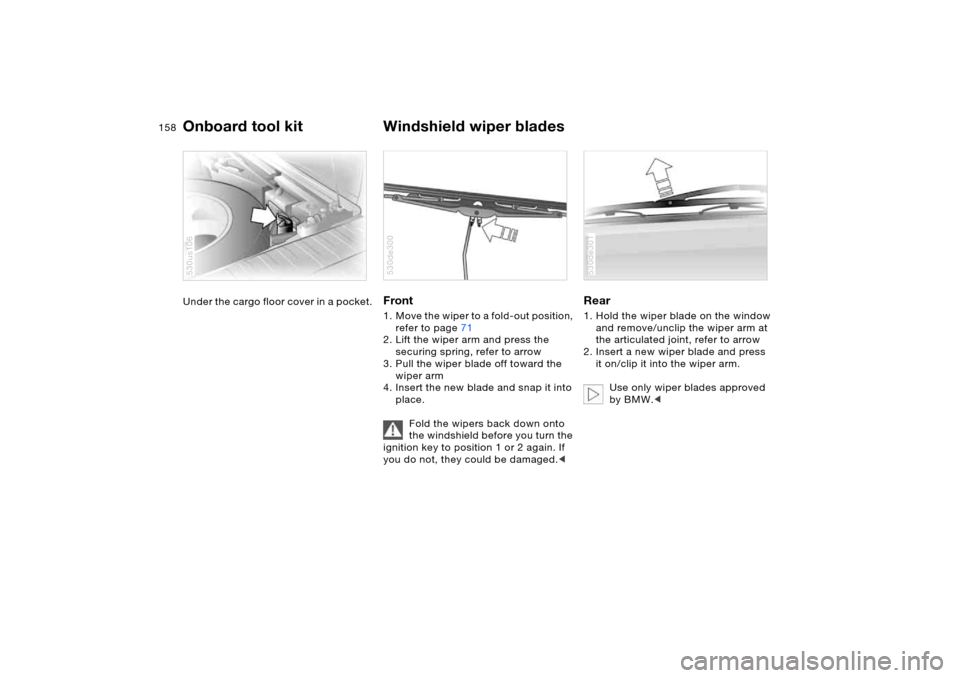
Under the cargo floor cover in a pocket.
530us106
Front 1. Move the wiper to a fold-out position,
refer to page71
2. Lift the wiper arm and press the
securing spring, refer to arrow
3. Pull the wiper blade off toward the
wiper arm
4. Insert the new blade and snap it into
place.
Fold the wipers back down onto
the windshield before you turn the
ignition key to position 1 or 2 again. If
you do not, they could be damaged.< 530de300
Rear 1. Hold the wiper blade on the window
and remove/unclip the wiper arm at
the articulated joint, refer to arrow
2. Insert a new wiper blade and press
it on/clip it into the wiper arm.
Use only wiper blades approved
by BMW.< 530de301
Onboard tool kit Windshield wiper blades
Page 167 of 200
167n
OverviewControlsMaintenanceRepairsDataIndex
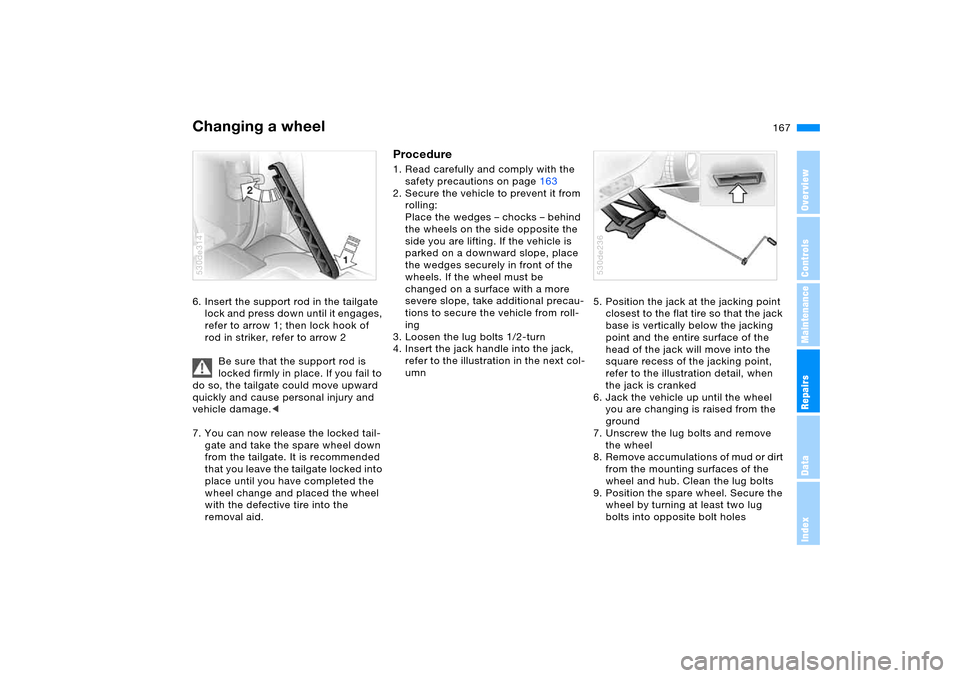
Changing a wheel 6. Insert the support rod in the tailgate
lock and press down until it engages,
refer to arrow 1; then lock hook of
rod in striker, refer to arrow 2
Be sure that the support rod is
locked firmly in place. If you fail to
do so, the tailgate could move upward
quickly and cause personal injury and
vehicle damage.<
7. You can now release the locked tail-
gate and take the spare wheel down
from the tailgate. It is recommended
that you leave the tailgate locked into
place until you have completed the
wheel change and placed the wheel
with the defective tire into the
removal aid. 530de314
Procedure1. Read carefully and comply with the
safety precautions on page163
2. Secure the vehicle to prevent it from
rolling:
Place the wedges – chocks – behind
the wheels on the side opposite the
side you are lifting. If the vehicle is
parked on a downward slope, place
the wedges securely in front of the
wheels. If the wheel must be
changed on a surface with a more
severe slope, take additional precau-
tions to secure the vehicle from roll-
ing
3. Loosen the lug bolts 1/2-turn
4. Insert the jack handle into the jack,
refer to the illustration in the next col-
umn5. Position the jack at the jacking point
closest to the flat tire so that the jack
base is vertically below the jacking
point and the entire surface of the
head of the jack will move into the
square recess of the jacking point,
refer to the illustration detail, when
the jack is cranked
6. Jack the vehicle up until the wheel
you are changing is raised from the
ground
7. Unscrew the lug bolts and remove
the wheel
8. Remove accumulations of mud or dirt
from the mounting surfaces of the
wheel and hub. Clean the lug bolts
9. Position the spare wheel. Secure the
wheel by turning at least two lug
bolts into opposite bolt holes
530de236
Page 168 of 200
168n
Changing a wheel Vehicle battery 10. Screw in the remaining lug bolts.
Tighten all the bolts securely in a
diagonal pattern
11. Lower the jack and remove it from
beneath the vehicle
12. Tighten the lug bolts in a diagonal
pattern
13. Check and correct the tire inflation
pressure at the earliest opportunity.
After mounting the spare wheel or
correcting the inflation pressure,
reinitialize the Flat Tire Monitor,
refer to page102.
Protect valve stems and valves from dirt
using screw-on valve stem caps. Dirt in
the valve stems frequently leads to slow
leaks.
The vehicle jack is designed for
changing wheels only. Do not
attempt to raise another vehicle model
with it or to raise any load of any kind.
To do so could cause accidents and
personal injury.
To ensure safety, always have the lug
bolts checked with a calibrated torque
wrench as soon as possible to ensure
that they are tightened to the specified
torque. The tightening torque is
101 ft-lb/140 Nm.<
Store the wheel and the tools in the
order opposite that for removal.
Before removing the support rod,
be sure that the tailgate is held
down firmly. If you fail to do so, it could
retract sharply upward and cause per-
sonal injury and vehicle damage.
After you remove the rod, close the tail-
gate carefully. Continue to hold it firmly
until it is completely closed.<
If light-alloy wheels other than Genuine
BMW light-alloy wheels have been
mounted, it may be necessary to use
different lug bolts for those wheels.
Replace the defective tire as soon as
possible and have the new wheel/tire
balanced. Driving with spare wheel
Do not exceed a speed of
130 mph/210 km/h, otherwise tire
damage could lead to accidents.<
With certain wheel-and-tire com-
binations the size of the spare
wheel differs from that of the other
wheels. To restore the original state,
the normal wheel should be remounted
as soon as possible.<
Battery posts, terminals and
related accessories contain lead
and lead compounds. Wash hands after
handling.<
Battery care The battery is maintenance-free, that is,
the original electrolyte will normally last
for the service life of the battery under
moderate climatic conditions. Your
BMW Sports Activity Vehicle center will
be glad to advise in all matters con-
cerning the battery.Charging battery Only charge the battery in the vehicle
via the terminals in the engine compart-
ment with the engine off. For correct
connections, refer to Jump starting on
page171. Disposal
Following replacement, have old
batteries disposed of by your
BMW Sports Activity Vehicle center or
hand them in to a recycling center.
Maintain the battery in an upright posi-
tion for transport and storage. Always
restrain the battery to prevent it from
tipping over during transport.<
Page 174 of 200
174n
Tow-starting and towing>The freedom of movement is
restricted during cornering
>The angled position of the tow bar
creates lateral forces.
Only secure the tow bar on the
tow fittings. Otherwise, damage
could result on other vehicle compo-
nent.<
With tow-rope:
When starting off in the towing vehicle,
make sure that the tow-rope is taut.
Use nylon ropes or nylon straps
for towing, and avoid all too sud-
den jerking movements. Only secure
tow-ropes on the tow fitting. Otherwise,
damage could result on other vehicle
component.<
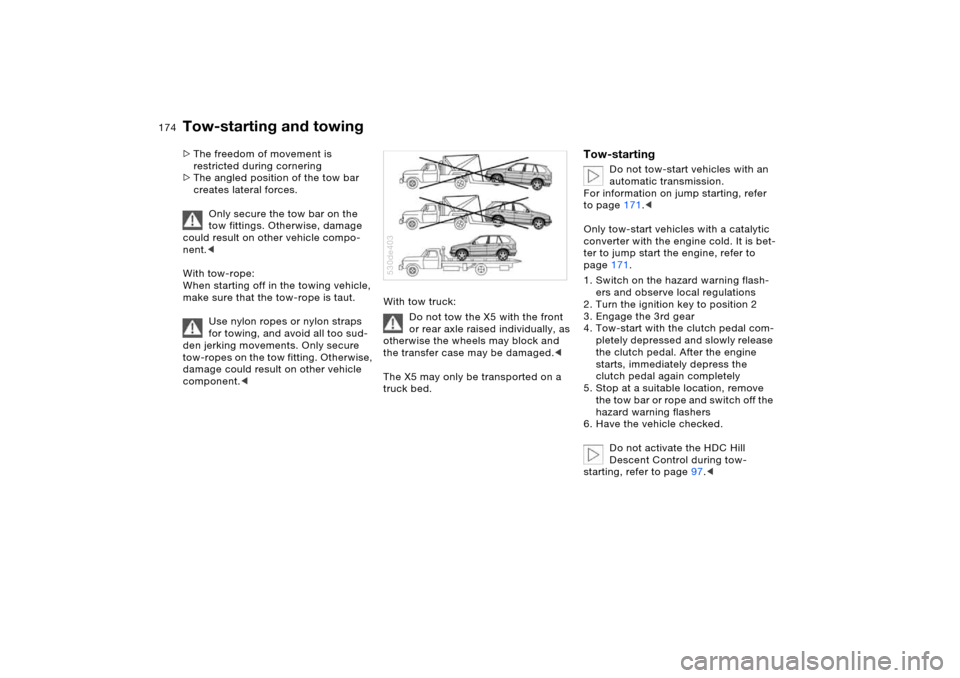
With tow truck:
Do not tow the X5 with the front
or rear axle raised individually, as
otherwise the wheels may block and
the transfer case may be damaged.<
The X5 may only be transported on a
truck bed.530de403
Tow-starting
Do not tow-start vehicles with an
automatic transmission.
For information on jump starting, refer
to page171.<
Only tow-start vehicles with a catalytic
converter with the engine cold. It is bet-
ter to jump start the engine, refer to
page171.
1. Switch on the hazard warning flash-
ers and observe local regulations
2. Turn the ignition key to position 2
3. Engage the 3rd gear
4. Tow-start with the clutch pedal com-
pletely depressed and slowly release
the clutch pedal. After the engine
starts, immediately depress the
clutch pedal again completely
5. Stop at a suitable location, remove
the tow bar or rope and switch off the
hazard warning flashers
6. Have the vehicle checked.
Do not activate the HDC Hill
Descent Control during tow-
starting, refer to page97.<