ignition BMW X5 3.0I 2005 E53 Service Manual
[x] Cancel search | Manufacturer: BMW, Model Year: 2005, Model line: X5 3.0I, Model: BMW X5 3.0I 2005 E53Pages: 200, PDF Size: 3.55 MB
Page 118 of 200
118n
Integrated universal remote control
*
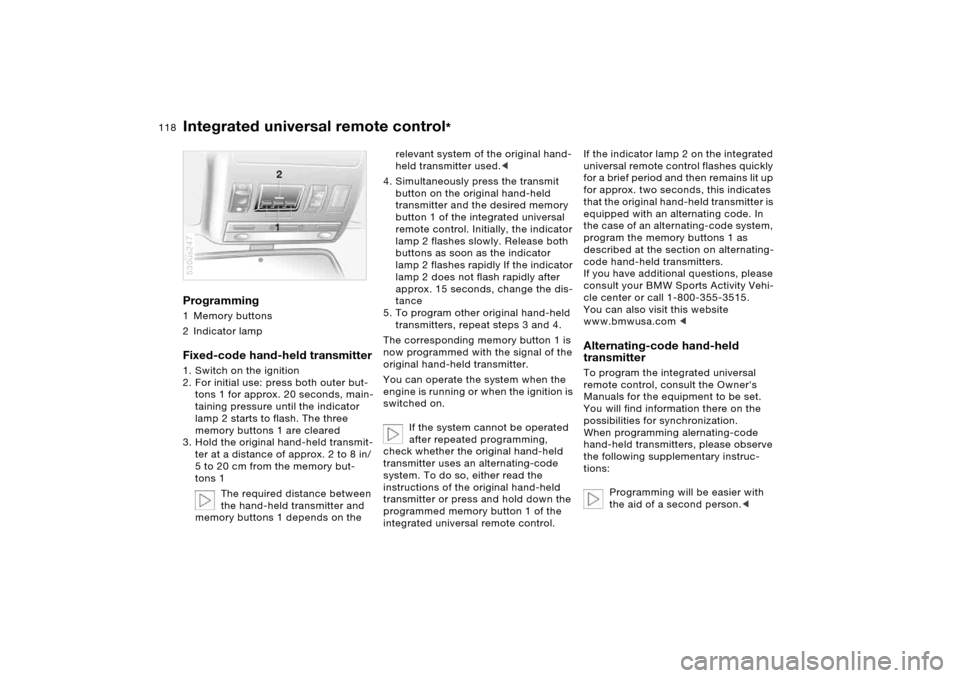
Programming 1 Memory buttons
2 Indicator lampFixed-code hand-held transmitter1. Switch on the ignition
2. For initial use: press both outer but-
tons 1 for approx. 20 seconds, main-
taining pressure until the indicator
lamp 2 starts to flash. The three
memory buttons 1 are cleared
3. Hold the original hand-held transmit-
ter at a distance of approx. 2 to 8 in/
5 to 20 cm from the memory but-
tons 1
The required distance between
the hand-held transmitter and
memory buttons 1 depends on the 530us247
relevant system of the original hand-
held transmitter used.<
4. Simultaneously press the transmit
button on the original hand-held
transmitter and the desired memory
button 1 of the integrated universal
remote control. Initially, the indicator
lamp 2 flashes slowly. Release both
buttons as soon as the indicator
lamp 2 flashes rapidly If the indicator
lamp 2 does not flash rapidly after
approx. 15 seconds, change the dis-
tance
5. To program other original hand-held
transmitters, repeat steps 3 and 4.
The corresponding memory button 1 is
now programmed with the signal of the
original hand-held transmitter.
You can operate the system when the
engine is running or when the ignition is
switched on.
If the system cannot be operated
after repeated programming,
check whether the original hand-held
transmitter uses an alternating-code
system. To do so, either read the
instructions of the original hand-held
transmitter or press and hold down the
programmed memory button 1 of the
integrated universal remote control.
If the indicator lamp 2 on the integrated
universal remote control flashes quickly
for a brief period and then remains lit up
for approx. two seconds, this indicates
that the original hand-held transmitter is
equipped with an alternating code. In
the case of an alternating-code system,
program the memory buttons 1 as
described at the section on alternating-
code hand-held transmitters.
If you have additional questions, please
consult your BMW Sports Activity Vehi-
cle center or call 1-800-355-3515.
You can also visit this website
www.bmwusa.com
remote control, consult the Owner's
Manuals for the equipment to be set.
You will find information there on the
possibilities for synchronization.
When programming alernating-code
hand-held transmitters, please observe
the following supplementary instruc-
tions:
Programming will be easier with
the aid of a second person.<
Page 122 of 200
122n
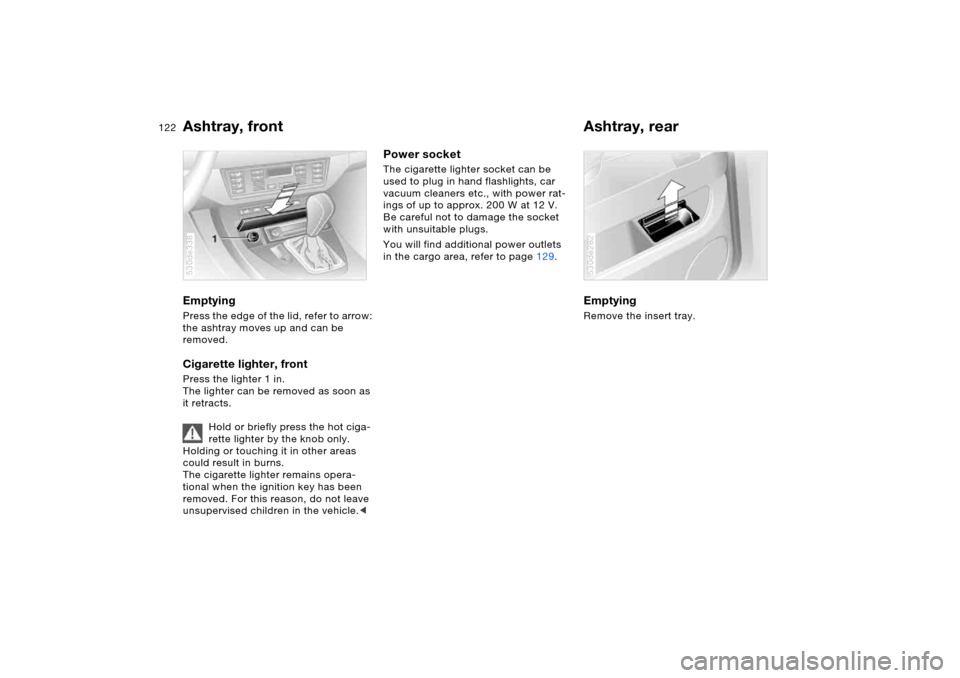
Ashtray, front Ashtray, rear Emptying Press the edge of the lid, refer to arrow:
the ashtray moves up and can be
removed.Cigarette lighter, front Press the lighter 1 in.
The lighter can be removed as soon as
it retracts.
Hold or briefly press the hot ciga-
rette lighter by the knob only.
Holding or touching it in other areas
could result in burns.
The cigarette lighter remains opera-
tional when the ignition key has been
removed. For this reason, do not leave
unsupervised children in the vehicle.< 530de338
Power socket The cigarette lighter socket can be
used to plug in hand flashlights, car
vacuum cleaners etc., with power rat-
ings of up to approx. 200 W at 12 V.
Be careful not to damage the socket
with unsuitable plugs.
You will find additional power outlets
in the cargo area, refer to page129.
Emptying Remove the insert tray. 530de282
Page 123 of 200
123n
OverviewControlsMaintenanceRepairsDataIndex
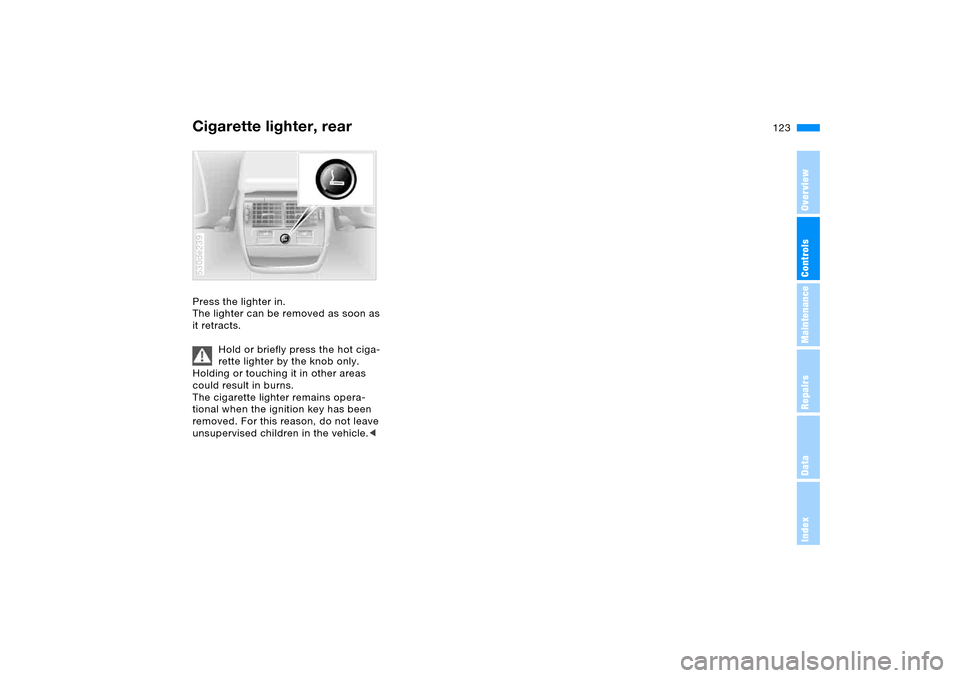
Cigarette lighter, rear Press the lighter in.
The lighter can be removed as soon as
it retracts.
Hold or briefly press the hot ciga-
rette lighter by the knob only.
Holding or touching it in other areas
could result in burns.
The cigarette lighter remains opera-
tional when the ignition key has been
removed. For this reason, do not leave
unsupervised children in the vehicle.< 530de239
Page 137 of 200
137n
OverviewControlsMaintenanceRepairsDataIndex
General driving notesClosing liftgate/tailgate
Operate the vehicle only when the
tailgate and liftgate are completely
closed. Otherwise, exhaust fumes
could enter into the passenger com-
partment.<
However, if special circumstances
should make it absolutely necessary
to operate the vehicle with the liftgate/
tailgate open:
1. Close all windows and the panorama
glass sunroof
2. Increase the air supply for the air
conditioner or automatic climate
control to a high level, refer to
page108 or112.
Hot exhaust system
Extreme temperatures occur at
the catalytic converter on this and
every catalyst-equipped vehicle. Do not
remove the heat shields installed adja-
cent to various sections of the exhaust
system, and never apply undercoating
to them. When driving, standing at idle
and while parking take care to avoid
possible contact between a hot exhaust
system and any highly flammable mate-
rials such as hay, leaves, grass etc.
Otherwise there is a danger of ignition
and of a fire with the risk of serious inju-
ries and damage.
mobile radio devices such as por-
table phones inside the vehicle unless
they are directly connected to the
external antenna. Otherwise, it is
impossible to prevent a mutual interfer-
ence of the vehicle electronics with the
portable phone device. Also, there is no
guarantee that the radiation generated
by the transmission will be conveyed
out from the interior of the vehicle.<
When vehicle is parked Condensation forms in the air condi-
tioner system during operation, and
then exits under the vehicle. Traces of
water on the ground are therefore nor-
mal.Brakes
Do not drive with your foot resting
on the brake pedal. Even light but
consistent pedal pressure can lead to
excessively high temperatures, brake
wear and possibly even brake failure.<
Road hazards
If road hazards, obstacles or curbs
are unavoidable, only drive over
them very slowly and carefully, as oth-
erwise the wheels and suspension
parts, especially on vehicles fitted with
low profile tires, can be damaged.<
For more information on wheels and
tires, refer to page144.
Before driving into a car washFold in the exterior mirrors, refer to
page54, as otherwise they could be
damaged due to the width of the vehi-
cle.Hydroplaning
When driving on wet or slushy
roads, reduce road speed. If you
do not, a wedge of water can form
between tires and road surface. This
state can cause a partial or total loss of
contact with the road surface, of brak-
ing control and of control over the vehi-
cle.<
Page 158 of 200
158n
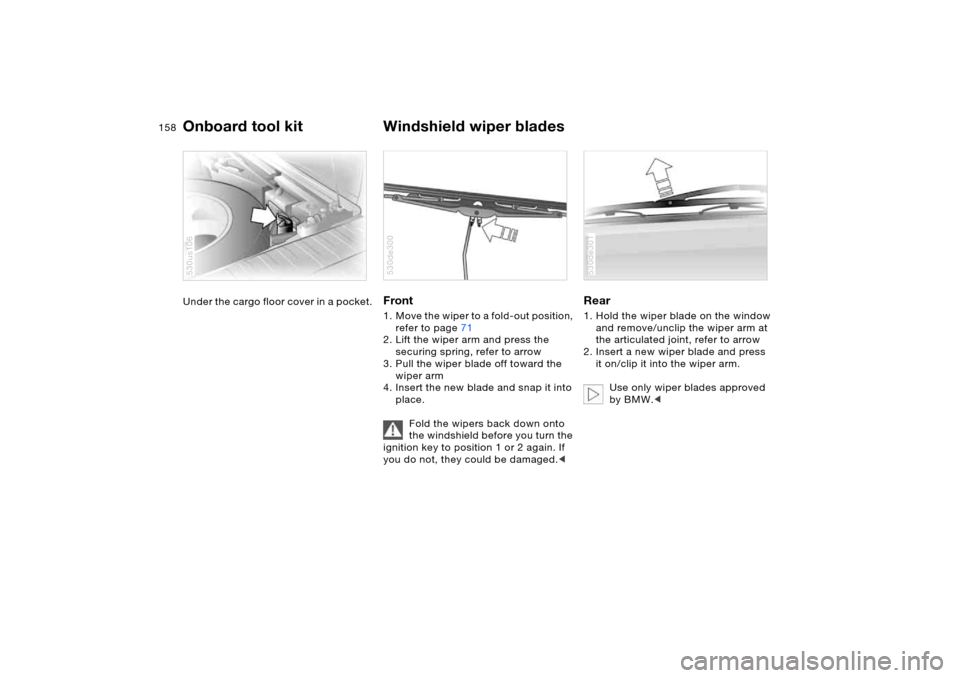
Under the cargo floor cover in a pocket.
530us106
Front 1. Move the wiper to a fold-out position,
refer to page71
2. Lift the wiper arm and press the
securing spring, refer to arrow
3. Pull the wiper blade off toward the
wiper arm
4. Insert the new blade and snap it into
place.
Fold the wipers back down onto
the windshield before you turn the
ignition key to position 1 or 2 again. If
you do not, they could be damaged.< 530de300
Rear 1. Hold the wiper blade on the window
and remove/unclip the wiper arm at
the articulated joint, refer to arrow
2. Insert a new wiper blade and press
it on/clip it into the wiper arm.
Use only wiper blades approved
by BMW.< 530de301
Onboard tool kit Windshield wiper blades
Page 170 of 200
170n
The Roadside Assistance of the BMW
Group offers you assistance in the
event of a breakdown around the clock,
also at weekends and on public holi-
days.
The phone numbers of the Roadside
Assistance control center in your home
country can be found in the BMW
Dealer Directory.
In the case of vehicles with the corre-
sponding equipment, you can use
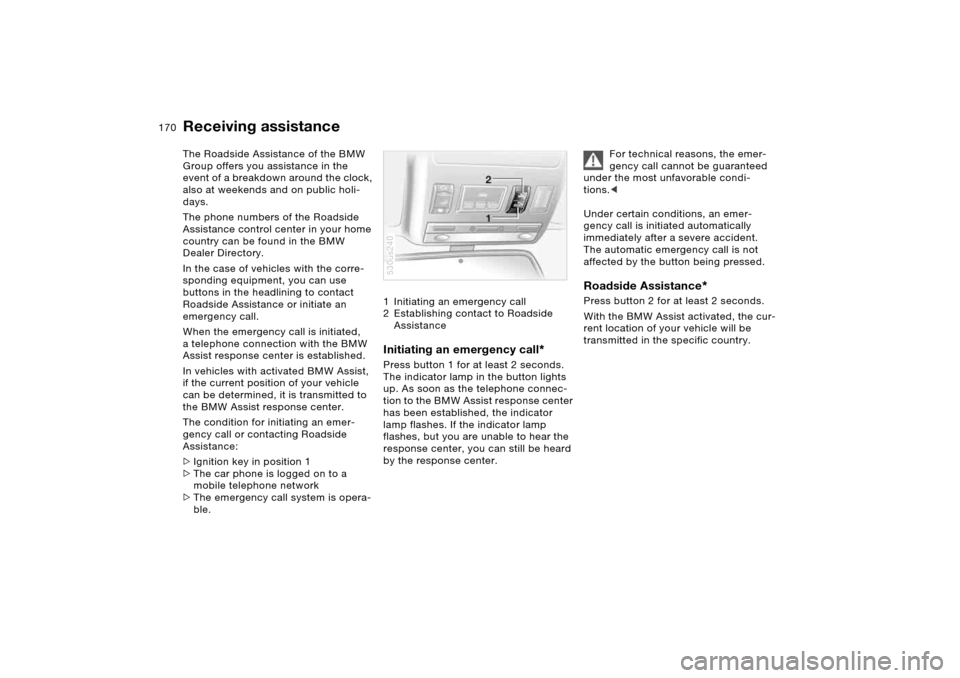
buttons in the headlining to contact
Roadside Assistance or initiate an
emergency call.
When the emergency call is initiated,
a telephone connection with the BMW
Assist response center is established.
In vehicles with activated BMW Assist,
if the current position of your vehicle
can be determined, it is transmitted to
the BMW Assist response center.
The condition for initiating an emer-
gency call or contacting Roadside
Assistance:
>Ignition key in position 1
>The car phone is logged on to a
mobile telephone network
>The emergency call system is opera-
ble.1 Initiating an emergency call
2 Establishing contact to Roadside
Assistance
Initiating an emergency call
*
Press button 1 for at least 2 seconds.
The indicator lamp in the button lights
up. As soon as the telephone connec-
tion to the BMW Assist response center
has been established, the indicator
lamp flashes. If the indicator lamp
flashes, but you are unable to hear the
response center, you can still be heard
by the response center.530us240
For technical reasons, the emer-
gency call cannot be guaranteed
under the most unfavorable condi-
tions.<
Under certain conditions, an emer-
gency call is initiated automatically
immediately after a severe accident.
The automatic emergency call is not
affected by the button being pressed.
Roadside Assistance
*
Press button 2 for at least 2 seconds.
With the BMW Assist activated, the cur-
rent location of your vehicle will be
transmitted in the specific country.
Receiving assistance
Page 173 of 200
173n
OverviewControlsMaintenanceRepairsDataIndex
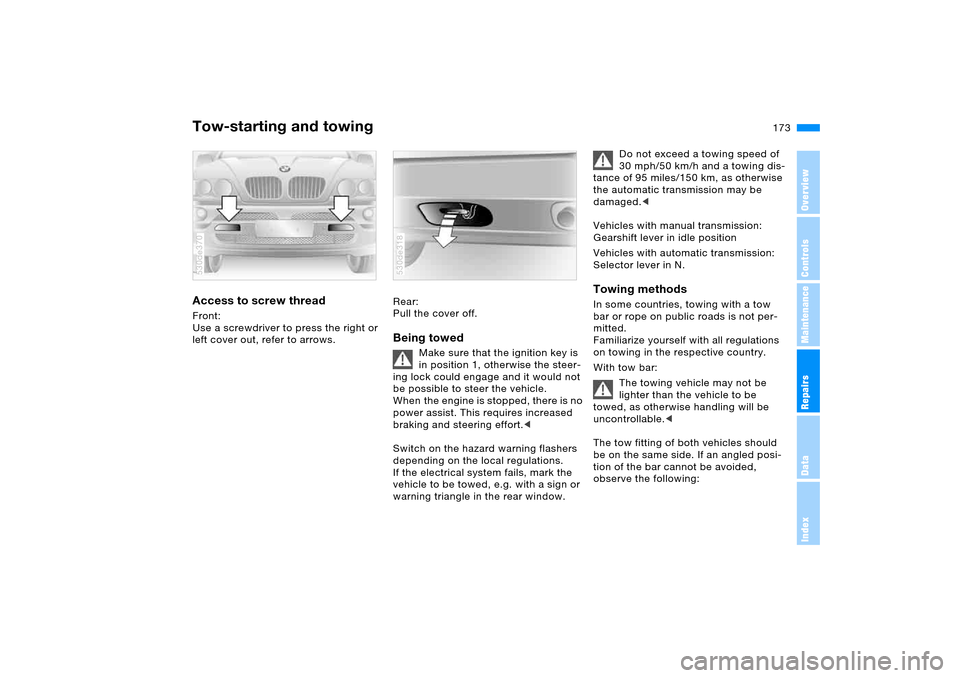
Tow-starting and towingAccess to screw thread Front:
Use a screwdriver to press the right or
left cover out, refer to arrows. 530de370
Rear:
Pull the cover off. Being towed
Make sure that the ignition key is
in position 1, otherwise the steer-
ing lock could engage and it would not
be possible to steer the vehicle.
When the engine is stopped, there is no
power assist. This requires increased
braking and steering effort.<
Switch on the hazard warning flashers
depending on the local regulations.
If the electrical system fails, mark the
vehicle to be towed, e.g. with a sign or
warning triangle in the rear window.
530de318
Do not exceed a towing speed of
30 mph/50 km/h and a towing dis-
tance of 95 miles/150 km, as otherwise
the automatic transmission may be
damaged.<
Vehicles with manual transmission:
Gearshift lever in idle position
Vehicles with automatic transmission:
Selector lever in N.
Towing methodsIn some countries, towing with a tow
bar or rope on public roads is not per-
mitted.
Familiarize yourself with all regulations
on towing in the respective country.
With tow bar:
The towing vehicle may not be
lighter than the vehicle to be
towed, as otherwise handling will be
uncontrollable.<
The tow fitting of both vehicles should
be on the same side. If an angled posi-
tion of the bar cannot be avoided,
observe the following:
Page 174 of 200
174n
Tow-starting and towing>The freedom of movement is
restricted during cornering
>The angled position of the tow bar
creates lateral forces.
Only secure the tow bar on the
tow fittings. Otherwise, damage
could result on other vehicle compo-
nent.<
With tow-rope:
When starting off in the towing vehicle,
make sure that the tow-rope is taut.
Use nylon ropes or nylon straps
for towing, and avoid all too sud-
den jerking movements. Only secure
tow-ropes on the tow fitting. Otherwise,
damage could result on other vehicle
component.<
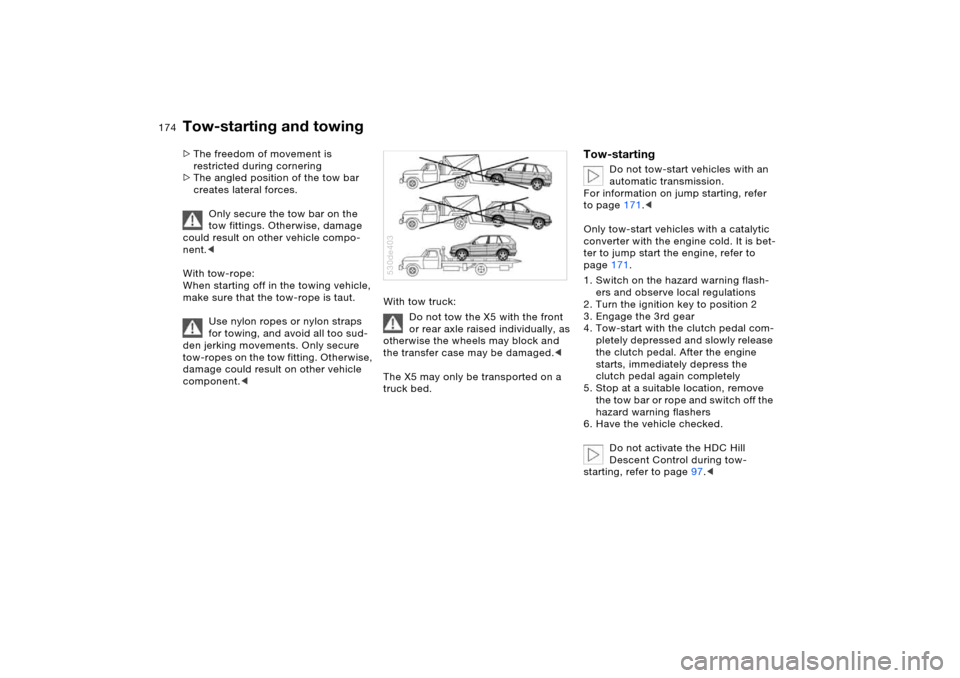
With tow truck:
Do not tow the X5 with the front
or rear axle raised individually, as
otherwise the wheels may block and
the transfer case may be damaged.<
The X5 may only be transported on a
truck bed.530de403
Tow-starting
Do not tow-start vehicles with an
automatic transmission.
For information on jump starting, refer
to page171.<
Only tow-start vehicles with a catalytic
converter with the engine cold. It is bet-
ter to jump start the engine, refer to
page171.
1. Switch on the hazard warning flash-
ers and observe local regulations
2. Turn the ignition key to position 2
3. Engage the 3rd gear
4. Tow-start with the clutch pedal com-
pletely depressed and slowly release
the clutch pedal. After the engine
starts, immediately depress the
clutch pedal again completely
5. Stop at a suitable location, remove
the tow bar or rope and switch off the
hazard warning flashers
6. Have the vehicle checked.
Do not activate the HDC Hill
Descent Control during tow-
starting, refer to page97.<
Page 189 of 200
Everything from A to Z
189n
OverviewControlsMaintenanceRepairsDataIndex
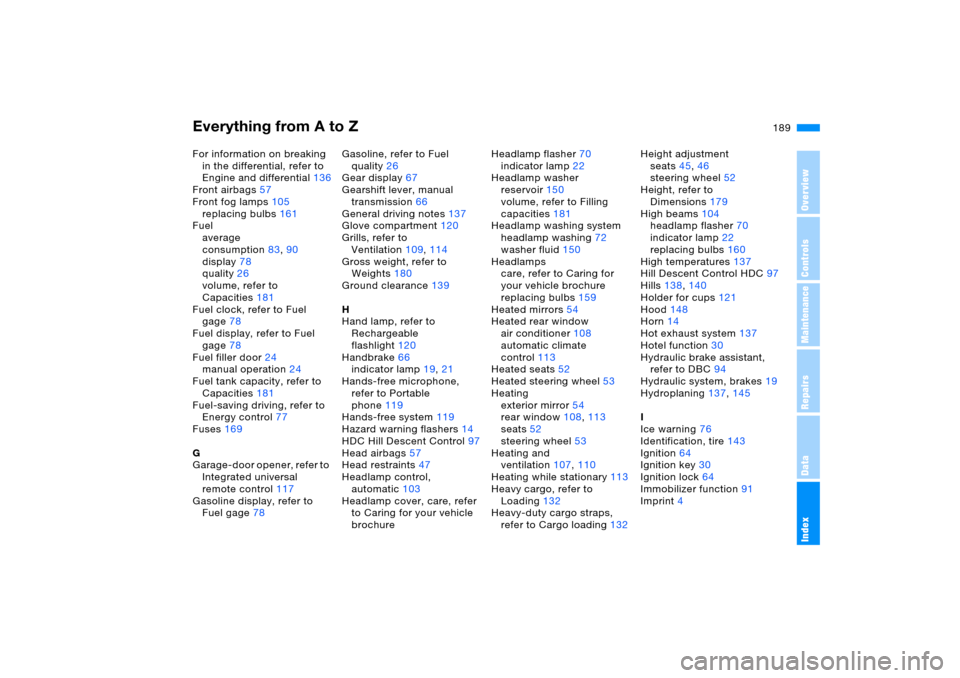
For information on breaking
in the differential, refer to
Engine and differential136
Front airbags57
Front fog lamps105
replacing bulbs161
Fuel
average
consumption83,90
display78
quality26
volume, refer to
Capacities181
Fuel clock, refer to Fuel
gage78
Fuel display, refer to Fuel
gage78
Fuel filler door24
manual operation24
Fuel tank capacity, refer to
Capacities181
Fuel-saving driving, refer to
Energy control77
Fuses169
G
Garage-door opener, refer to
Integrated universal
remote control117
Gasoline display, refer to
Fuel gage78Gasoline, refer to Fuel
quality26
Gear display67
Gearshift lever, manual
transmission66
General driving notes137
Glove compartment120
Grills, refer to
Ventilation109,114
Gross weight, refer to
Weights180
Ground clearance139
H
Hand lamp, refer to
Rechargeable
flashlight120
Handbrake66
indicator lamp19,21
Hands-free microphone,
refer to Portable
phone119
Hands-free system119
Hazard warning flashers14
HDC Hill Descent Control97
Head airbags57
Head restraints47
Headlamp control,
automatic103
Headlamp cover, care, refer
to Caring for your vehicle
brochureHeadlamp flasher70
indicator lamp22
Headlamp washer
reservoir150
volume, refer to Filling
capacities181
Headlamp washing system
headlamp washing72
washer fluid150
Headlamps
care, refer to Caring for
your vehicle brochure
replacing bulbs159
Heated mirrors54
Heated rear window
air conditioner108
automatic climate
control113
Heated seats52
Heated steering wheel53
Heating
exterior mirror54
rear window108,113
seats52
steering wheel53
Heating and
ventilation107,110
Heating while stationary113
Heavy cargo, refer to
Loading132
Heavy-duty cargo straps,
refer to Cargo loading132Height adjustment
seats45,46
steering wheel52
Height, refer to
Dimensions179
High beams104
headlamp flasher70
indicator lamp22
replacing bulbs160
High temperatures137
Hill Descent Control HDC97
Hills138,140
Holder for cups121
Hood148
Horn14
Hot exhaust system137
Hotel function30
Hydraulic brake assistant,
refer to DBC94
Hydraulic system, brakes19
Hydroplaning137,145
I
Ice warning76
Identification, tire143
Ignition64
Ignition key30
Ignition lock64
Immobilizer function91
Imprint4
Page 191 of 200
Everything from A to Z
191n
OverviewControlsMaintenanceRepairsDataIndex
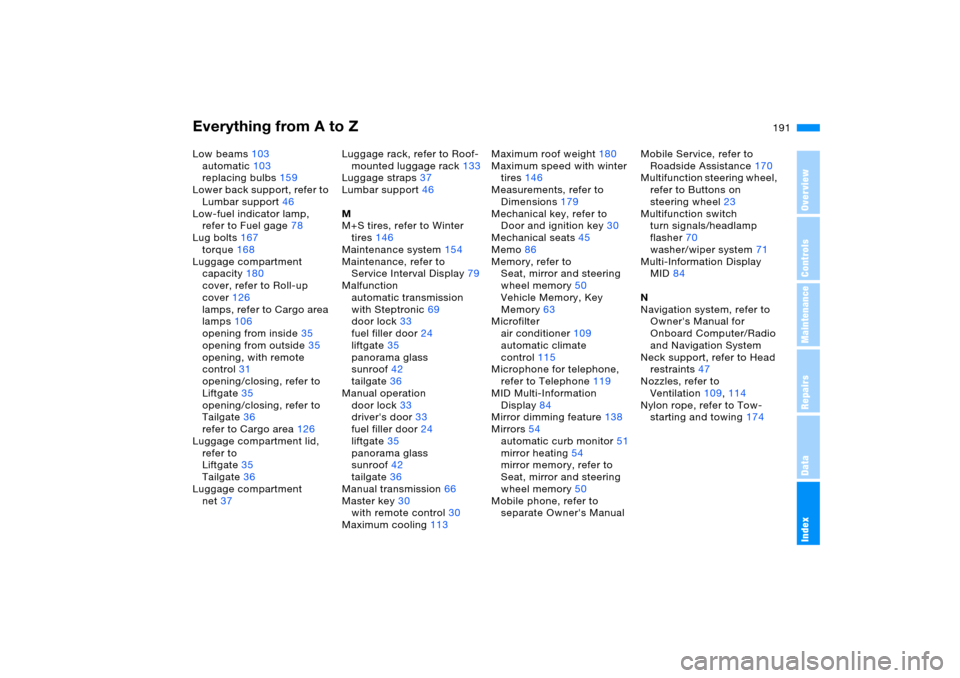
Low beams103
automatic103
replacing bulbs159
Lower back support, refer to
Lumbar support46
Low-fuel indicator lamp,
refer to Fuel gage78
Lug bolts167
torque168
Luggage compartment
capacity180
cover, refer to Roll-up
cover126
lamps, refer to Cargo area
lamps106
opening from inside35
opening from outside35
opening, with remote
control31
opening/closing, refer to
Liftgate35
opening/closing, refer to
Tailgate36
refer to Cargo area126
Luggage compartment lid,
refer to
Liftgate35
Tailgate36
Luggage compartment
net37Luggage rack, refer to Roof-
mounted luggage rack133
Luggage straps37
Lumbar support46
M
M+S tires, refer to Winter
tires146
Maintenance system154
Maintenance, refer to
Service Interval Display79
Malfunction
automatic transmission
with Steptronic69
door lock33
fuel filler door24
liftgate35
panorama glass
sunroof42
tailgate36
Manual operation
door lock33
driver's door33
fuel filler door24
liftgate35
panorama glass
sunroof42
tailgate36
Manual transmission66
Master key30
with remote control30
Maximum cooling113Maximum roof weight180
Maximum speed with winter
tires146
Measurements, refer to
Dimensions179
Mechanical key, refer to
Door and ignition key30
Mechanical seats45
Memo86
Memory, refer to
Seat, mirror and steering
wheel memory50
Vehicle Memory, Key
Memory63
Microfilter
air conditioner109
automatic climate
control115
Microphone for telephone,
refer to Telephone119
MID Multi-Information
Display84
Mirror dimming feature138
Mirrors54
automatic curb monitor51
mirror heating54
mirror memory, refer to
Seat, mirror and steering
wheel memory50
Mobile phone, refer to
separate Owner's ManualMobile Service, refer to
Roadside Assistance170
Multifunction steering wheel,
refer to Buttons on
steering wheel23
Multifunction switch
turn signals/headlamp
flasher70
washer/wiper system71
Multi-Information Display
MID84
N
Navigation system, refer to
Owner's Manual for
Onboard Computer/Radio
and Navigation System
Neck support, refer to Head
restraints47
Nozzles, refer to
Ventilation109,114
Nylon rope, refer to Tow-
starting and towing174