171 BMW X5 3.0I 2005 E53 Owner's Manual
[x] Cancel search | Manufacturer: BMW, Model Year: 2005, Model line: X5 3.0I, Model: BMW X5 3.0I 2005 E53Pages: 200, PDF Size: 3.55 MB
Page 6 of 200
ContentsOperation, maintenance
Owner service procedures
Special operating instructions:
Breaking-in136
General driving notes137
Driving your X5138
Safe braking140
Wheels and tires:
Tire inflation pressure141
Tire identification marks143
Wheel/tire condition144
Replacing wheels/tires146
Snow chains147
Under the hood:
Hood148
Engine compartment
essentials149
Washer fluid150
Engine oil150
Coolant152
Brake fluid153Care and maintenance:
The BMW Maintenance
System154
OBD interface socket155Replacement procedures:
Onboard tool kit158
Windshield wiper blades158
Lamps and bulbs159
Changing a tire163
Vehicle battery168
Fuses169
Assistance, giving and
receiving:
Receiving assistance170
Jump starting171
Tow-starting and towing172
Page 65 of 200
OverviewControlsMaintenanceRepairsDataIndex
65n
Starting engine Switching off engineDo not allow the engine to warm up
by leaving it running while the vehicle
remains stationary. Instead, begin to
drive immediately at a moderate engine
speed.
X5 3.0i:
Do not end the starting procedure
too soon, however at the latest after
approx. 20 seconds. Release the igni-
tion key immediately as soon as the
engine starts.
X5 4.4i, 4.8is:
Your BMW is equipped with the conve-
nience starting feature. Here, it is suffi-
cient to turn the ignition key only briefly
to position 3 'Start engine' and to let go
of it right away. The starter actuation
continues to operate automatically for a
certain period of time and is stopped
automatically as soon as the engine has
started.
The automatic starting mode will not
operate or will be canceled if the bat-
tery voltage is insufficient. The engine
can be jump started, refer to page171.Should the engine fail to start on the
first attempt, if it is very hot or cold, for
instance:
>Press the accelerator pedal halfway
down while engaging the starter.
Cold starts at altitudes above 3,300 ft/
1,000 meters and at very low tempera-
tures, from approx. +57/–156:
>For the initial starting attempt, allow
the starter to remain engaged some-
what longer, approx. 10 seconds.
Engine idle speed is controlled by the
engine computer system. Increased
speeds at startup are normal and
should decrease as the engine warms
up. If engine speed does not decrease,
service is required.
To prevent the battery from discharg-
ing, always switch off electrical devices
that are not in use. Switch the ignition
off when the vehicle is not being driven.
Extended starting attempts, char-
acterized by excessively frequent
or long periods with the starter
engaged, can lead to damage of the
catalytic converter.<
Manual transmission:
1. Turn the ignition key to position 1
or 0.
2. Shift into first gear or reverse.
Automatic transmission:
1. Shift into selector lever position P.
2. Turn the ignition key to position 1
or 0.
Do not remove the ignition key
when the vehicle is moving, as
otherwise the steering could lock.
When leaving the vehicle, always
remove the ignition key and lock the
steering.
Vehicles with manual transmission:
Always engage the handbrake when
parking on slopes and inclined sur-
faces. Even placing the gearshift lever
in 1st gear or reverse may not provide
adequate resistance to rolling.
Vehicles with automatic transmission:
Place the selector lever in Park.<
Vehicles with automatic transmission:
The vehicle must be stationary and the
selector lever in Park before you can
remove the ignition key.
Page 69 of 200
OverviewControlsMaintenanceRepairsDataIndex
69n
Automatic transmission with Steptronic
*
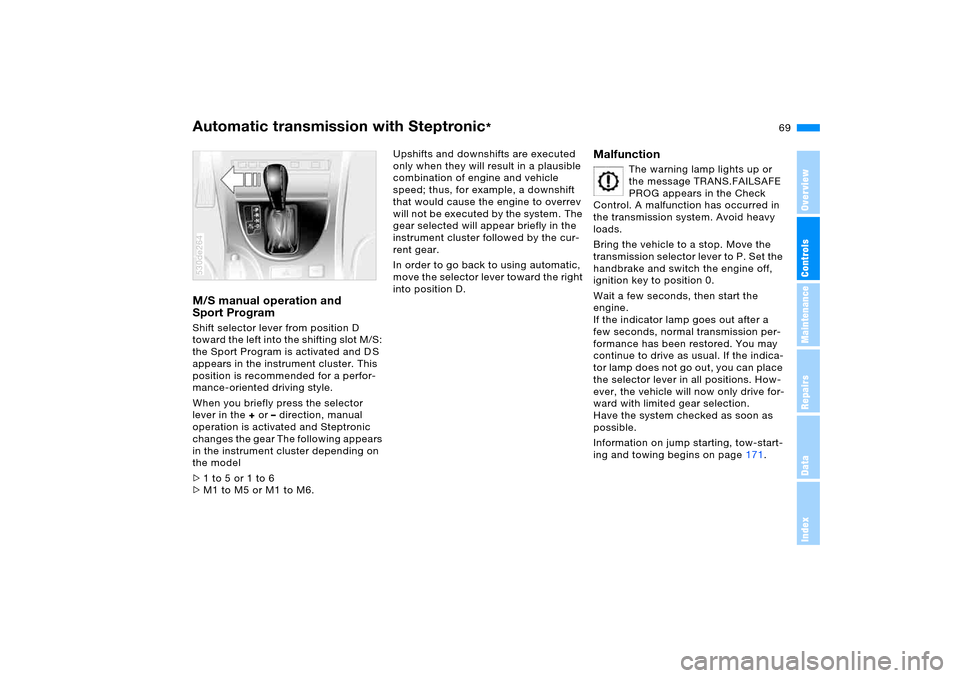
M/S manual operation and
Sport Program Shift selector lever from position D
toward the left into the shifting slot M/S:
the Sport Program is activated and D S
appears in the instrument cluster. This
position is recommended for a perfor-
mance-oriented driving style.
When you briefly press the selector
lever in the + or – direction, manual
operation is activated and Steptronic
changes the gear The following appears
in the instrument cluster depending on
the model
>1 to 5 or 1 to 6
>M1 to M5 or M1 to M6. 530de264
Upshifts and downshifts are executed
only when they will result in a plausible
combination of engine and vehicle
speed; thus, for example, a downshift
that would cause the engine to overrev
will not be executed by the system. The
gear selected will appear briefly in the
instrument cluster followed by the cur-
rent gear.
In order to go back to using automatic,
move the selector lever toward the right
into position D.
Malfunction
The warning lamp lights up or
the message TRANS.FAILSAFE
PROG appears in the Check
Control. A malfunction has occurred in
the transmission system. Avoid heavy
loads.
Bring the vehicle to a stop. Move the
transmission selector lever to P. Set the
handbrake and switch the engine off,
ignition key to position 0.
Wait a few seconds, then start the
engine.
If the indicator lamp goes out after a
few seconds, normal transmission per-
formance has been restored. You may
continue to drive as usual. If the indica-
tor lamp does not go out, you can place
the selector lever in all positions. How-
ever, the vehicle will now only drive for-
ward with limited gear selection.
Have the system checked as soon as
possible.
Information on jump starting, tow-start-
ing and towing begins on page171.
Page 143 of 200
143n
OverviewControlsMaintenanceRepairsDataIndex
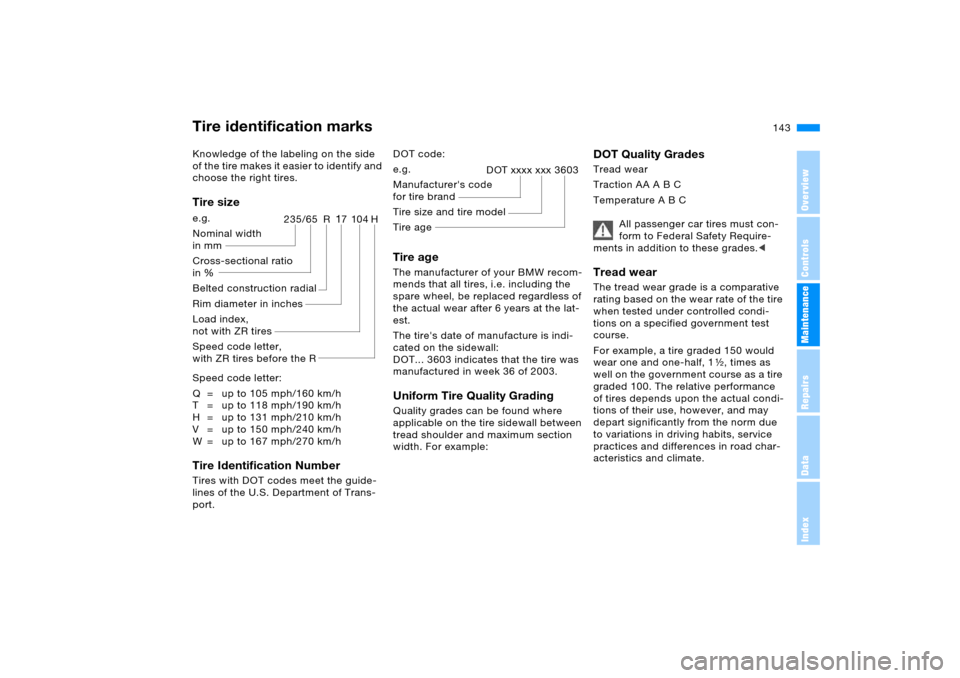
Tire identification marksKnowledge of the labeling on the side
of the tire makes it easier to identify and
choose the right tires.Tire sizeSpeed code letter:
Q = up to 105 mph/160 km/h
T = up to 118 mph/190 km/h
H = up to 131 mph/210 km/h
V = up to 150 mph/240 km/h
W = up to 167 mph/270 km/hTire Identification Number Tires with DOT codes meet the guide-
lines of the U.S. Department of Trans-
port. e.g.
Nominal width
in mm
Cross-sectional ratio
in Ξ
Belted construction radial
Rim diameter in inches
Load index,
not with ZR tires
Speed code letter,
with ZR tires before the R
235/65 R
17104H
DOT code:Tire age The manufacturer of your BMW recom-
mends that all tires, i.e. including the
spare wheel, be replaced regardless of
the actual wear after 6 years at the lat-
est.
The tire's date of manufacture is indi-
cated on the sidewall:
DOT... 3603 indicates that the tire was
manufactured in week 36 of 2003. Uniform Tire Quality Grading Quality grades can be found where
applicable on the tire sidewall between
tread shoulder and maximum section
width. For example: e.g.
Manufacturer's code
for tire brand
Tire size and tire model
Tire age
DOT xxxx xxx 3603
DOT Quality Grades Tread wear
Traction AA A B C
Temperature A B C
All passenger car tires must con-
form to Federal Safety Require-
ments in addition to these grades.< Tread wear The tread wear grade is a comparative
rating based on the wear rate of the tire
when tested under controlled condi-
tions on a specified government test
course.
For example, a tire graded 150 would
wear one and one-half, 1γ, times as
well on the government course as a tire
graded 100. The relative performance
of tires depends upon the actual condi-
tions of their use, however, and may
depart significantly from the norm due
to variations in driving habits, service
practices and differences in road char-
acteristics and climate.
Page 149 of 200
149n
OverviewControlsMaintenanceRepairsDataIndex
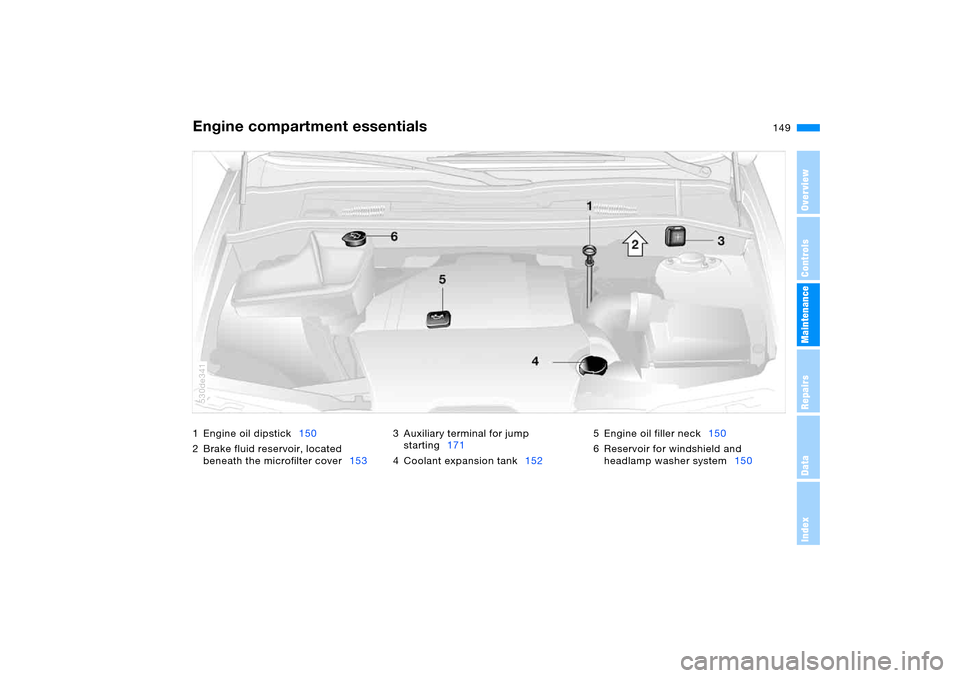
1Engine oil dipstick150
2 Brake fluid reservoir, located
beneath the microfilter cover1533 Auxiliary terminal for jump
starting171
4 Coolant expansion tank1525 Engine oil filler neck150
6 Reservoir for windshield and
headlamp washer system150Engine compartment essentials
530de341
Page 168 of 200
168n
Changing a wheel Vehicle battery 10. Screw in the remaining lug bolts.
Tighten all the bolts securely in a
diagonal pattern
11. Lower the jack and remove it from
beneath the vehicle
12. Tighten the lug bolts in a diagonal
pattern
13. Check and correct the tire inflation
pressure at the earliest opportunity.
After mounting the spare wheel or
correcting the inflation pressure,
reinitialize the Flat Tire Monitor,
refer to page102.
Protect valve stems and valves from dirt
using screw-on valve stem caps. Dirt in
the valve stems frequently leads to slow
leaks.
The vehicle jack is designed for
changing wheels only. Do not
attempt to raise another vehicle model
with it or to raise any load of any kind.
To do so could cause accidents and
personal injury.
To ensure safety, always have the lug
bolts checked with a calibrated torque
wrench as soon as possible to ensure
that they are tightened to the specified
torque. The tightening torque is
101 ft-lb/140 Nm.<
Store the wheel and the tools in the
order opposite that for removal.
Before removing the support rod,
be sure that the tailgate is held
down firmly. If you fail to do so, it could
retract sharply upward and cause per-
sonal injury and vehicle damage.
After you remove the rod, close the tail-
gate carefully. Continue to hold it firmly
until it is completely closed.<
If light-alloy wheels other than Genuine
BMW light-alloy wheels have been
mounted, it may be necessary to use
different lug bolts for those wheels.
Replace the defective tire as soon as
possible and have the new wheel/tire
balanced. Driving with spare wheel
Do not exceed a speed of
130 mph/210 km/h, otherwise tire
damage could lead to accidents.<
With certain wheel-and-tire com-
binations the size of the spare
wheel differs from that of the other
wheels. To restore the original state,
the normal wheel should be remounted
as soon as possible.<
Battery posts, terminals and
related accessories contain lead
and lead compounds. Wash hands after
handling.<
Battery care The battery is maintenance-free, that is,
the original electrolyte will normally last
for the service life of the battery under
moderate climatic conditions. Your
BMW Sports Activity Vehicle center will
be glad to advise in all matters con-
cerning the battery.Charging battery Only charge the battery in the vehicle
via the terminals in the engine compart-
ment with the engine off. For correct
connections, refer to Jump starting on
page171. Disposal
Following replacement, have old
batteries disposed of by your
BMW Sports Activity Vehicle center or
hand them in to a recycling center.
Maintain the battery in an upright posi-
tion for transport and storage. Always
restrain the battery to prevent it from
tipping over during transport.<
Page 171 of 200
171n
OverviewControlsMaintenanceRepairsDataIndex
Jump starting When your battery is discharged you
can used two jumper cables to start
your vehicle with power from the bat-
tery in a second vehicle. You can also
use the same method to help start
another vehicle. Use only jumper cables
with fully-insulated clamp handles.
To avoid the risk of potentially
fatal injury, always avoid all con-
tact with electrical components while
the engine is running. Carefully observe
the following instructions to avoid per-
sonal injury and/or damage to one or
both vehicles.<
Preparing1. Check whether the battery of the
other vehicle has a voltage of
12 Volts and approximately the same
capacitance in Ah. This information
can be found on the battery
2. Switch off the engine of the support
vehicle
3. Switch off any electrical systems and
components in both vehicles.
Ensure that no contact exists
between the bodywork on the two
vehicles, otherwise there is a danger of
short circuits.
sparks, always observe this
sequence when connecting jumper
cables.<
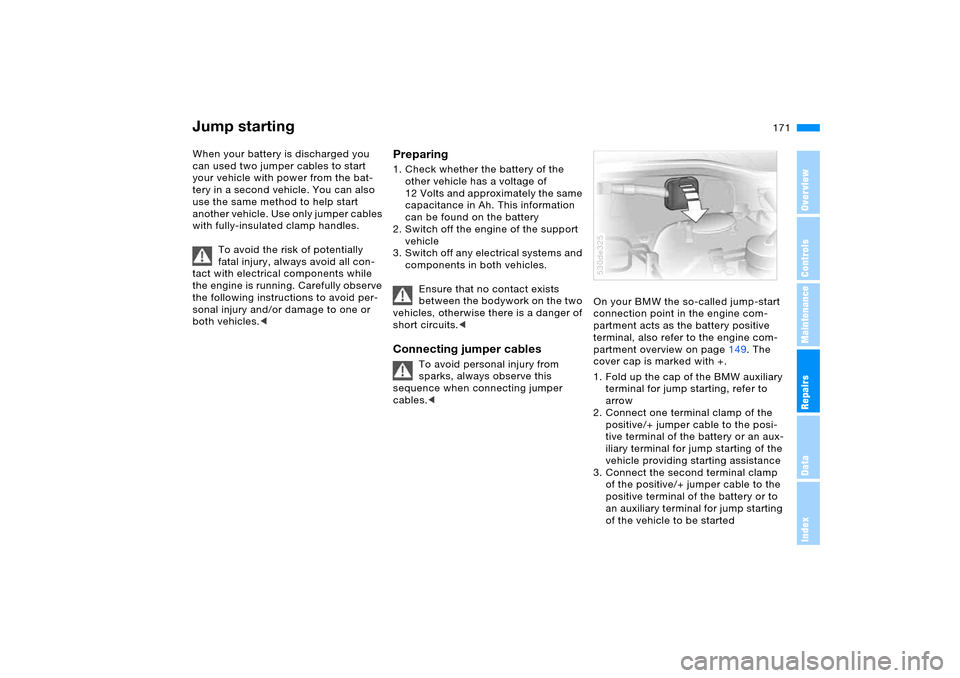
On your BMW the so-called jump-start
connection point in the engine com-
partment acts as the battery positive
terminal, also refer to the engine com-
partment overview on page149. The
cover cap is marked with +.
1. Fold up the cap of the BMW auxiliary
terminal for jump starting, refer to
arrow
2. Connect one terminal clamp of the
positive/+ jumper cable to the posi-
tive terminal of the battery or an aux-
iliary terminal for jump starting of the
vehicle providing starting assistance
3. Connect the second terminal clamp
of the positive/+ jumper cable to the
positive terminal of the battery or to
an auxiliary terminal for jump starting
of the vehicle to be started530de325
Page 174 of 200
174n
Tow-starting and towing>The freedom of movement is
restricted during cornering
>The angled position of the tow bar
creates lateral forces.
Only secure the tow bar on the
tow fittings. Otherwise, damage
could result on other vehicle compo-
nent.<
With tow-rope:
When starting off in the towing vehicle,
make sure that the tow-rope is taut.
Use nylon ropes or nylon straps
for towing, and avoid all too sud-
den jerking movements. Only secure
tow-ropes on the tow fitting. Otherwise,
damage could result on other vehicle
component.<
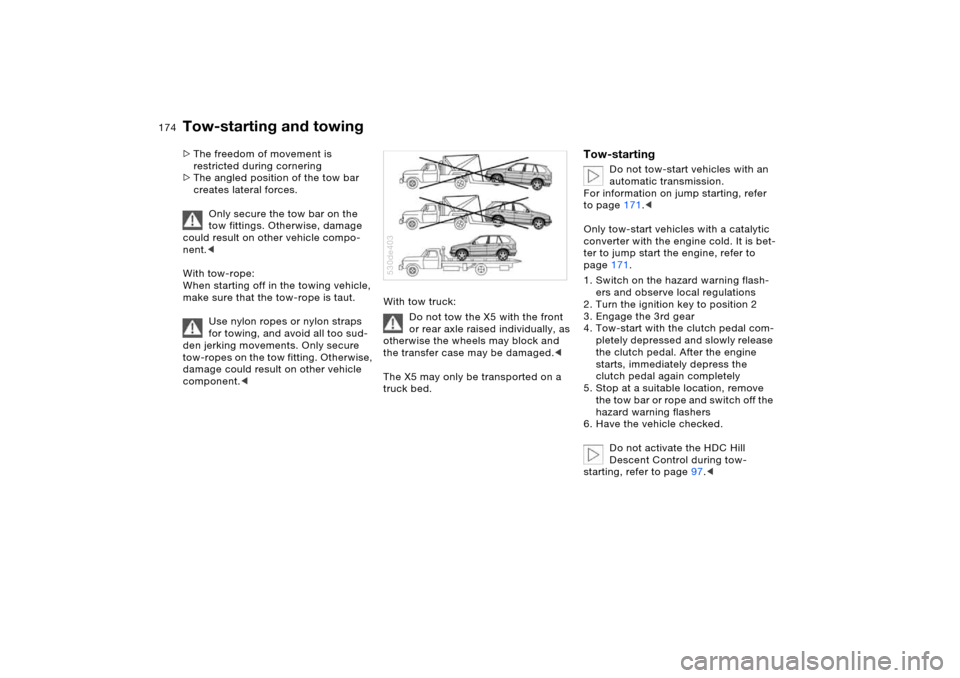
With tow truck:
Do not tow the X5 with the front
or rear axle raised individually, as
otherwise the wheels may block and
the transfer case may be damaged.<
The X5 may only be transported on a
truck bed.530de403
Tow-starting
Do not tow-start vehicles with an
automatic transmission.
For information on jump starting, refer
to page171.<
Only tow-start vehicles with a catalytic
converter with the engine cold. It is bet-
ter to jump start the engine, refer to
page171.
1. Switch on the hazard warning flash-
ers and observe local regulations
2. Turn the ignition key to position 2
3. Engage the 3rd gear
4. Tow-start with the clutch pedal com-
pletely depressed and slowly release
the clutch pedal. After the engine
starts, immediately depress the
clutch pedal again completely
5. Stop at a suitable location, remove
the tow bar or rope and switch off the
hazard warning flashers
6. Have the vehicle checked.
Do not activate the HDC Hill
Descent Control during tow-
starting, refer to page97.<
Page 185 of 200
Everything from A to Z
185n
OverviewControlsMaintenanceRepairsDataIndex
B
Backrests, refer to Adjusting
seats45,46
Backup lamps67
replacing bulbs161
Bandages, refer to First-aid
kit24
Bar, towing173
Battery168
disposal168
indicator lamp19
jump starting171
power failure169
remote control30
Belts, refer to Safety belts49
Beverage holder, refer to
Cup holders121
Black ice, refer to Ice
warning76
Blower
air conditioner108
automatic climate
control112
refer to Air
supply108,112
BMW High Performance
Synthetic Oil151
BMW Maintenance
System154Bottle holder, refer to Cup
holders121
Brake fluid153
adding153
level153
replacing153
warning lamp19
Brake Force Display101
Brake hydraulic system140
warning lamp19,20
Brake lamps, replacing
bulbs161
Brake pads140
breaking-in136
warning lamp19,21
Brake rotors
brake system140
breaking-in136
Brake system
brake fluid153
brake fluid level140,153
brake pads140
breaking-in136
disc brakes140
warning lamp19
Brake wear warning
brake pads140
indicator lamp19,21Brakes140
ABS94
brake fluid153
brake pads140
breaking-in136
handbrake66
indicator/warning
lamp19,20
Breakdown assistance, refer
to Roadside
Assistance170
Breakdown, Flat Tire
Monitor101
Breaking-in136
Buttons on steering
wheel23
C
California Proposition
65 Warning9
Calling, refer to telephone
Owner's Manual
Can holders, refer to Cup
holders121
Capacities181
cargo area180
Car care, refer to Caring for
your vehicle brochure
Car keys, refer to Keys30
Car radio, refer to Owner's
Manual for Radio/Onboard
ComputerCar telephone
preparation119
Car telephone, refer to
separate Owner's Manual
Car vacuum cleaner,
connecting, refer to
Power socket122
Car wash, refer to Caring for
your vehicle brochure
Car-care products, refer to
Caring for your vehicle
brochure
Care of paintwork, refer to
Caring for your vehicle
brochure
Care, refer to Caring for your
vehicle brochure
Cargo area126
capacity180
cover, refer to Roll-up
cover126
emergency operation,
refer to Unlocking
manually35,36
floor cover129
increasing capacity126
lamps106
lid, refer to Liftgate/
tailgate35,36
opening, remote
control31
Cargo floor, pull-out130
Page 190 of 200
Everything from A to ZIndependent ventilation116
activating/deactivating
switch-on times87
also refer to Owner's
Manual for Onboard
Computer
entering switch-on
times87
switching on and off
directly87
Indicating
elements15,17,18
Indicator lighting, refer to
Instrument lighting105
Indicator/warning lamp
airbags59
alarm system38
automatic transmission
with Steptronic69
brakes153
coolant temperature79
DSC95
engine temperature79
fasten safety belts49
Flat Tire Monitor102
front fog lamps105
reserve78
self-leveling
suspension98
Indicator/warning lamps,
overview19Individual air distribution112
Individual settings, refer to
Vehicle Memory, Key
Memory63
Inflation pressure
monitoring, refer to Flat
Tire Monitor101
Inflation pressure, tires141
INSPECTION79
Instrument cluster15,17,18
Instrument lighting105
Instrument panel, refer to
Cockpit14
Integrated universal remote
control117
Interface socket for Onboard
Diagnostics155
Interior lamps105
remote control31
Interior mirror, automatic
dimming feature138
Interior motion sensor39
switching off31,39
Interior rearview mirror55
compass55
Interlock, refer to Locking
steering64
Intermittent operation of
wipers71,73J
Jacking points167
Jump starting171
Jumpering, refer to Jump
starting171
K
Key Memory63
Keys30
Kick-down68
L
Lamps and bulbs159
Lamps, refer to Parking
lamps/low beams103
Lashing eyes, refer to
Securing load132
LATCH child-restraint fixing
system62
LEDs light-emitting
diodes163
Length, refer to
Dimensions179
License plate lamp
replacing bulbs162
Liftgate35
emergency operation,
refer to Unlocking
manually35
opening, remote
control31
remote control31Liftgate/tailgate
emergency operation,
refer to Unlocking
manually35,36
opening from inside35
opening from outside35
unlocking manually35,36
Light switch103
Light-alloy wheels, care,
refer to Caring for your
vehicle brochure
Light-emitting diodes
LEDs163
Lighter122,123
Lighting of instruments105
Lights on warning103
Limit88
Limit speed, refer to Speed
limit88
Load, refer to Cargo
loading131
Lock buttons, doors, refer to
Locking34
Locking
from inside34
from outside31
Locking and unlocking doors
from inside34
from outside31
Locking, vehicle
from inside34
from outside31