Heat BMW X5 3.0I 2006 E53 User Guide
[x] Cancel search | Manufacturer: BMW, Model Year: 2006, Model line: X5 3.0I, Model: BMW X5 3.0I 2006 E53Pages: 202, PDF Size: 4.13 MB
Page 78 of 202
78n
Check Control >CHECK BRAKE FLUID
Level has dropped approx. to mini-
mum. Have the brake fluid replen-
ished as soon as possible, refer to
page155. Have the reason for the
brake fluid loss eliminated by your
BMW Sports Activity Vehicle center
>DSC/4x4 INACTIVE
DSC and/or four-wheel drive system
xDrive has failed.
The stabilizing interventions of DSC
and/or the four-wheel drive system
xDrive are no longer available. Drive
may be being exerted exclusively via
the rear axle.
Have the system checked at the
nearest BMW Sports Activity Vehicle
center.
For additional information, refer to
page94
>SELFLEVEL SUSP.INACT
*
Please consult the nearest BMW
Sports Activity Vehicle center
>SELFLEVEL SUSP.INACT*
MAX. 35 MPH/MAX. 60 KM/H
*
These messages are displayed con-
secutively.
Do not exceed a maximum speed of
35 mph/60 km/h.
Please consult the nearest BMW
Sports Activity Vehicle center>TRANSMISS'N OVERHEAT
*
Reduce speed immediately and stop
at a suitable location so that the sys-
tem can cool down again. Please
contact the nearest BMW Sports
Activity Vehicle center.
>LIMIT
*
Display when the programmed road-
speed limit is exceeded, refer to
page85.
Priority 2
These displays appear for 20 seconds
as of ignition key position 2. The warn-
ing symbols remain after the message
disappears. You can open the mes-
sages again for display by pressing the
CHECK button.
>TRUNKLID OPEN
This message only appears when
starting off
>DOOR OPEN
This message appears after a minimal
defined road speed has been
exceeded
>FASTEN SEAT BELTS
*
In addition, the indicator lamp with
the belt symbol lights up and an
acoustic signal sounds
>WASHER FLUID LOW
Too low, top up at the next opportu-
nity, refer to page152>CHECK ENGINE OIL LEV
The oil level is at the absolute mini-
mum point. Therefore, have the
engine oil replenished as soon as
possible, refer to page152. Until
then, do not drive more than approx.
30 miles/50 km.
>CHECK GAS CAP
Check to see whether the fuel filler
cap has been closed properly, refer
to page25
>OUTSIDE TEMP. +237/–56
This display is only an example. The
current temperature is displayed at
outside temperatures of +37.57/
+36 and below, refer also to
page73
>CHECK BRAKE LIGHTS
A lamp has failed or the electrical
circuit has a malfunction, refer to
page163 or consult a BMW Sports
Activity Vehicle center
>CHECK LOWBEAM LIGHTS
CHECK SIDE LIGHTS
CHECK REAR LIGHTS
CHECK FRONT FOGLAMPS
CHECK LICPLATE LIGHT
CHECK HIGHBEAM LIGHT
CHECK BACK UP LIGHTS
The respective lamp may have failed
or the electrical circuit may be defec-
tive, refer to page161 or consult a
BMW Sports Activity Vehicle center
Page 96 of 202
96n
2-axle self-leveling suspension
*
The concept Your vehicle is equipped with 2-axle
self-leveling suspension acting on both
the front and rear suspension. This sys-
tem combines automatic self-leveling,
which compensates for variations in
front-to-rear load-distribution patterns,
with a selection feature allowing drivers
to choose from among several ride-
height options.
You may choose from among the fol-
lowing ride heights:
>Normal
The standard setting is intended for
most operating conditions, including
trailer towing
>Off-Road
Increased level for more ground
clearance
>Access
Lowers vehicle for more convenient
cargo handling or easier passenger
entries and exits.
Changes in ride height are initiated
either manually, using the control but-
ton, refer to page 97, or automatically in
response to specific speeds. When the
ride height is selected manually, the
driver has the additional option of revis-
ing the ride-height selection by entering a new command during the adjustment
process.
When the vehicle is stationary, the sys-
tem executes ride-height changes in
both directions – up and down – when-
ever the doors are closed. The tailgate/
liftgate may be open. The system raises
the vehicle only when the engine is run-
ning.
The system's automatic self-leveling
feature automatically compensates for
variations in the vehicle's load.
The ground clearance of the vehicle
6.5-9 in/16.5-22 cm, depending on the
level selected.
Frequent changes in ride height
initiated at short intervals can
overheat the compressor, causing the
system to briefly suspend active opera-
tion.<
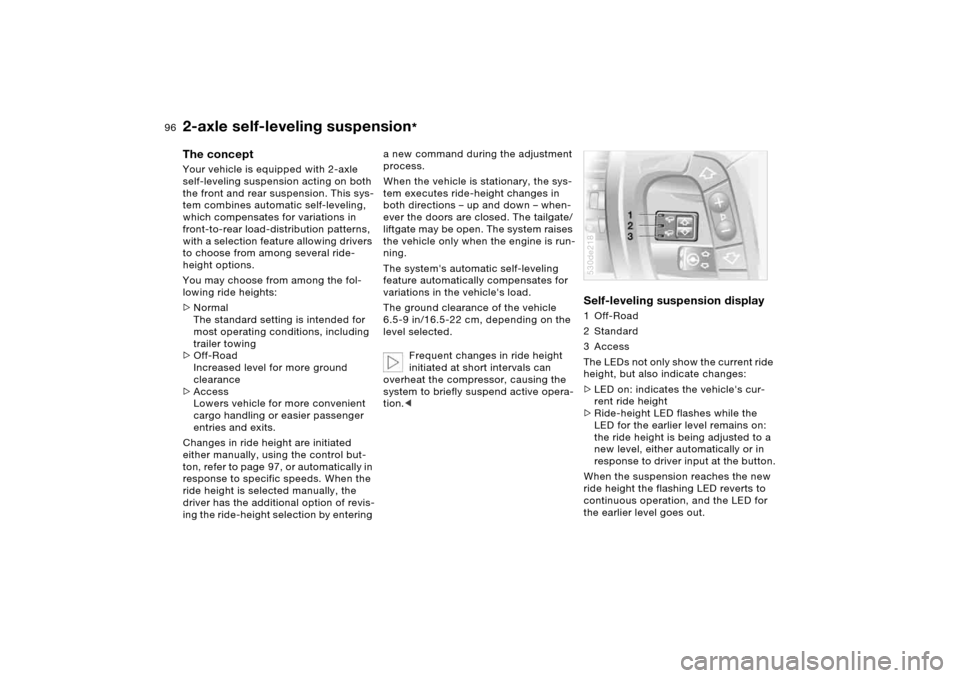
Self-leveling suspension display 1 Off-Road
2Standard
3 Access
The LEDs not only show the current ride
height, but also indicate changes:
>LED on: indicates the vehicle's cur-
rent ride height
>Ride-height LED flashes while the
LED for the earlier level remains on:
the ride height is being adjusted to a
new level, either automatically or in
response to driver input at the button.
When the suspension reaches the new
ride height the flashing LED reverts to
continuous operation, and the LED for
the earlier level goes out.530de218
Page 105 of 202
105n
OverviewControlsMaintenanceRepairsDataIndex
Air conditioner Temperature
The graduations on the dial
provide general reference val-
ues for the interior tempera-
ture. 707/226 is recom-
mended as a comfortable setting. After
driving begins, the selected tempera-
ture is reached as quickly as possible
and kept constant by the control sys-
tem.
Air distribution
You can direct air to flow onto
the windows , toward the
upper body and into the
footwell . All intermediate
settings are possible. In the setting,
there is a low flow of air onto the win-
dows to keep them free of condensa-
tion.
Air supply
You can adjust the air supply
through an infinitely-variable
range. The heating and venti-
lation become more and more
effective as the air supply settings are
increased. In the 0 setting, the blower
and climate control are switched off
and the outside air supply is blocked.
Rear window defroster
When the rear window
defroster is activated, the
LED lights up. The rear window
defroster switches off automatically.
Air conditioning
The air is cooled and dehu-
midified and — depending on
the temperature setting — warmed
again. Depending on the weather, the
windshield may fog over briefly when
the engine is started. You can reduce
condensation forming on the windows
by switching on the air conditioning.
During air conditioning, condensa-
tion forms, which then exits under
the vehicle. Traces of water on the
ground are therefore normal.<
Recirculated-air mode
You can respond to unpleas-
ant odors outside the vehicle
by temporarily switching off the outside
air supply. The system then recirculates
the air currently within the vehicle.
You can also use the button on the
steering wheel to switch over to the
recirculated-air mode, refer to page 23.
If the windows fog over in the
recirculated-air mode, switch the
recirculated-air mode off and increase
the air supply as required.<
Page 108 of 202
108n
Automatic climate control
*
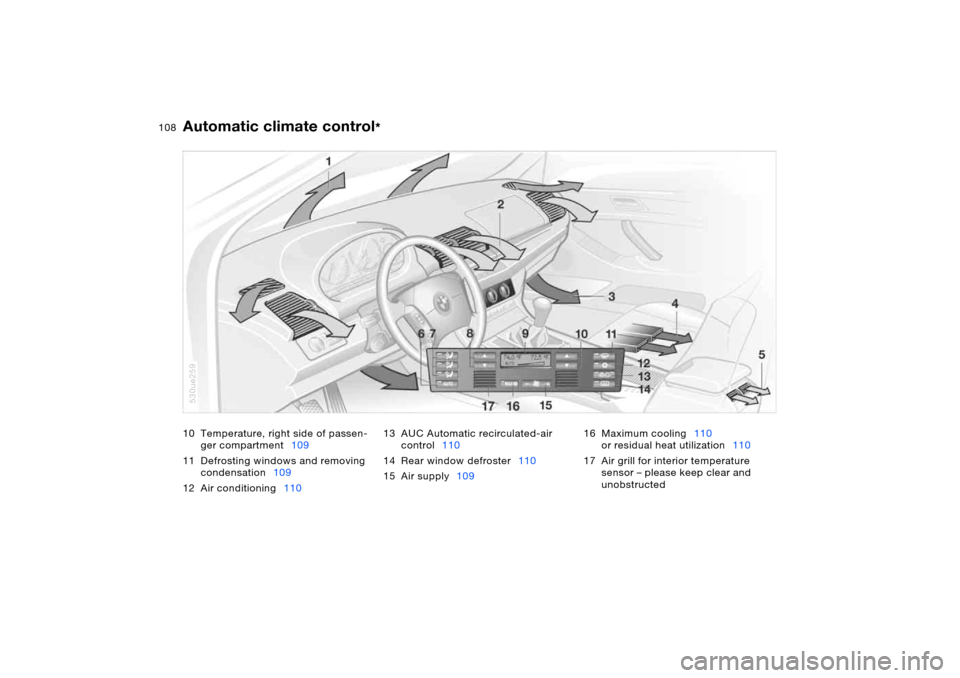
10 Temperature, right side of passen-
ger compartment109
11 Defrosting windows and removing
condensation109
12 Air conditioning11013 AUC Automatic recirculated-air
control110
14 Rear window defroster110
15 Air supply10916 Maximum cooling110
or residual heat utilization110
17 Air grill for interior temperature
sensor – please keep clear and
unobstructed
530ue259
Page 109 of 202
109n
OverviewControlsMaintenanceRepairsDataIndex
Automatic climate control
*
Tips for pleasant drivingFor nearly all conditions, AUTO pro-
gram 6 offers the optimal air distribution
and airflow volume. Select the interior
temperature that is comfortable for you.
Detailed setting options are described
for you in the following section.
Your BMW Sports Activity Vehicle
center can program the settings of
your vehicle in such a manner that,
when you unlock the vehicle with your
individualized key, your own personal-
ized setting for the automatic climate
control is initiated.< Automatic air distribution
The AUTO program
adjusts the airflow and dis-
tribution patterns for you while also
using your preselected temperature
setting as the basis for adjusting the
interior climate to adapt to external
influences: summer, winter.
Individual air distribution
You can cancel the AUTO
program by selecting spe-
cific air distribution patterns
for your personal comfort,
the automatic air supply
remains in operation. You can direct air
to flow onto the windows , toward
the upper body , and into the foot-
well . You can reactivate the auto-
matic air distribution mode by pressing
the AUTO button.
Temperature
Set the desired tempera-
ture individually on the
driver's and front passen-
ger side.
The automatic climate control adjusts
this temperature as quickly as possible
at any time of year, if necessary with the
maximum cooling or heating capacity,
and then keeps it constant.
When switching between differ-
ent temperature settings in rapid
succession, the automatic climate con-
trol does not have sufficient time to
adjust the set temperature.<
To change the units of measure in the
display 7/6, refer to page73 or80.Air supply
In the AUTO program,
the air supply is automati-
cally controlled, and AUTO appears on
the display 9, refer to overview on
page107. You can vary the air supply
by pressing the left or right half of the
button. When your setting is displayed
as bars, the automatic air supply is
switched off. Automatic air distribution
maintains its setting. You can reactivate
the automatic air supply by pressing the
AUTO button.
When you press the left side of the but-
ton during operation at minimum blower
speed, all displays are canceled: the
blower, heating and air conditioner are
switched off. The outside air supply is
closed. You can switch the system back
on by pressing any button of the auto-
matic climate control, except the MAX
button 16.
Defrosting windows and removing
condensation
Quickly remove ice and
condensation from the
windshield and front side windows.
Page 110 of 202
110n
Automatic climate control
*
Air conditioning
The air is cooled and
dehumidified and —
depending on the temperature setting —
warmed again. Depending on the
weather, the windshield may fog over
briefly when the engine is started. You
can reduce condensation forming on
the windows by switching on the air
conditioning.
During air conditioning, condensa-
tion forms, which then exits under
the vehicle. That traces of water on the
ground are therefore normal.<
Maximum cooling
Maximally cooled air is
obtained as quickly as possi-
ble from an outside temperature above
327/06 and with the engine running.
The automatic climate control changes
over to the lowest temperature and
switches into the recirculated-air mode.
The maximum air quantity only flows
out of the vents for the upper body.
Therefore, open these vents for maxi-
mum cooling.
AUC Automatic recirculated-air
control
You can respond to
unpleasant odors or pollut-
ants in the immediate environment by
shutting off the supply of outside air.
The system then recirculates the air
currently within the vehicle. In AUC
operating mode, a sensor detects pol-
lutants in the external air and controls
the shut-off automatically.
Press the button repeatedly to run
through the following control sequence
>LEDs off: outside air supply opera-
tional
>Left LED on, AUC mode: the system
detects pollutants in the outside air
and blocks the flow of air when nec-
essary. The system then recirculates
the air currently within the vehicle.
Depending on the air quality, the
automatic system then switches back
and forth between outside air supply
and recirculation of the air within the
vehicle
>Right LED on: the outside air supply
into the vehicle is shut off continu-
ously. The system then recirculates
the air currently within the vehicle.
You can also use the button on the
steering wheel to switch between Off
and recirculated-air mode or between
AUC and recirculated-air mode, refer to
page23.
If the windows fog over in the
recirculated-air mode, switch the
recirculated-air mode off and increase
the air supply as required.< Rear window defroster
When the rear window
defroster is activated, the
LED lights up. The rear window
defroster switches off automatically
after a while.
Residual heat
Press the button when the
motor is switched off, but
warm.
The heat stored in the engine is utilized
for heating the interior when the engine
has been switched off – while waiting at
a railroad crossing, for instance.
This function may be activated when
the outside temperature is below
approx. 597/156, the engine is at
operating temperature, and the battery
Page 130 of 202
130n
Cargo loading
Avoid overloading the vehicle
so that the permissible loading
capacity of the tires is not exceeded.
Overloading can lead to overheating
and increases the rate at which damage
develops inside the tires. The ultimate
result can assume the form of a sudden
air loss.<
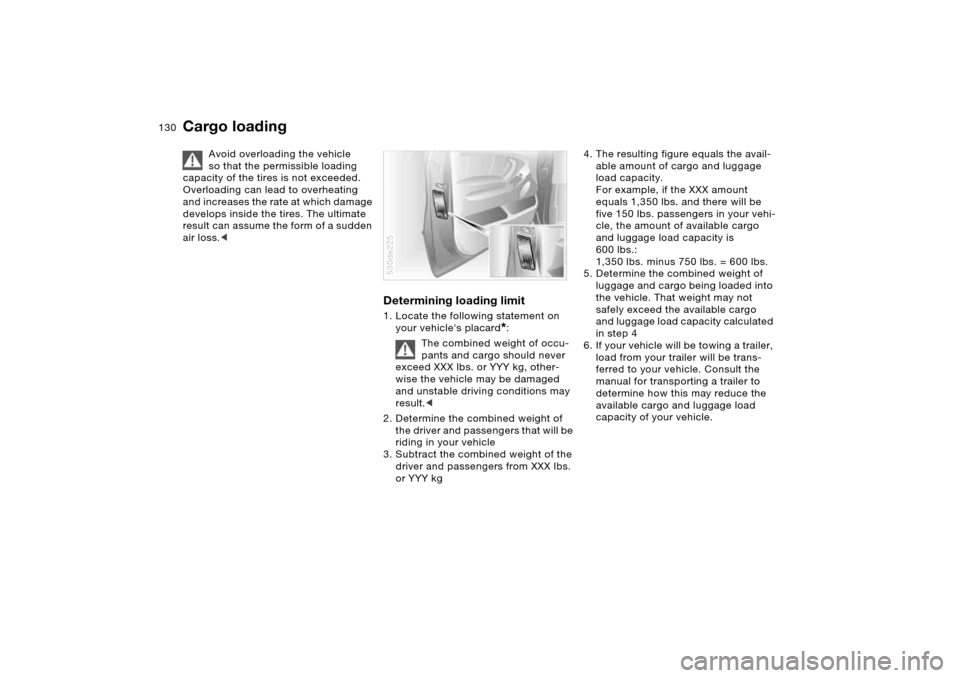
Determining loading limit1. Locate the following statement on
your vehicle's placard
*:
The combined weight of occu-
pants and cargo should never
exceed XXX lbs. or YYY kg, other-
wise the vehicle may be damaged
and unstable driving conditions may
result.<
2. Determine the combined weight of
the driver and passengers that will be
riding in your vehicle
3. Subtract the combined weight of the
driver and passengers from XXX lbs.
or YYY kg
530de225
4. The resulting figure equals the avail-
able amount of cargo and luggage
load capacity.
For example, if the XXX amount
equals 1,350 lbs. and there will be
five 150 lbs. passengers in your vehi-
cle, the amount of available cargo
and luggage load capacity is
600 lbs.:
1,350 lbs. minus 750 lbs. = 600 lbs.
5. Determine the combined weight of
luggage and cargo being loaded into
the vehicle. That weight may not
safely exceed the available cargo
and luggage load capacity calculated
in step 4
6. If your vehicle will be towing a trailer,
load from your trailer will be trans-
ferred to your vehicle. Consult the
manual for transporting a trailer to
determine how this may reduce the
available cargo and luggage load
capacity of your vehicle.
Page 137 of 202
137n
OverviewControlsMaintenanceRepairsDataIndex
General driving notesClosing liftgate/tailgate
Operate the vehicle only when the
tailgate and liftgate are completely
closed. Otherwise, exhaust fumes
could enter into the passenger com-
partment.<
However, if special circumstances
should make it absolutely necessary to
operate the vehicle with the liftgate/tail-
gate open:
1. Close all windows and the panorama
glass roof
2. Increase the air supply for the air
conditioner or automatic climate
control to a high level, refer to
page105 or109.
Hot exhaust system
Extreme temperatures occur on
the exhaust system on any vehi-
cle. Do not remove the heat shields
installed adjacent to it, and never apply
undercoating to them. When driving,
standing at idle and while parking, take
care to avoid possible contact between
a hot exhaust system and any highly
flammable materials such as hay,
leaves, grass etc. Otherwise, there is a
danger of ignition and fire, with the risk
of serious injuries and damage.<
Mobile communications devices
in vehicle
BMW advises against using
mobile communications devices
such as mobile phones inside the vehi-
cle unless they are directly connected
to the external antenna. Otherwise, it is
impossible to prevent a mutual interfer-
ence of the vehicle electronics with the
mobile phone device. Also, there is no
guarantee that the radiation generated
by the transmission will be conveyed
out from the interior of the vehicle.<
When vehicle is parked Condensation forms in the air condi-
tioner system during operation and then
exits under the vehicle. Traces of water
on the ground are therefore normal.Brakes
Do not drive with your foot resting
on the brake pedal. Even light but
consistent pedal pressure can lead to
excessively high temperatures, brake
wear and possibly even brake failure.<
Road hazards
If road hazards, obstacles or curbs
are unavoidable, only drive over
them very slowly and carefully, other-
wise the wheels and suspension parts,
especially on vehicles fitted with low
profile tires, can be damaged.<
For more information on wheels and
tires, refer to page146.
Before driving into a car washFold in the exterior mirrors, refer to
page53, otherwise they could be dam-
aged due to the width of the vehicle.Hydroplaning
When driving on wet or slushy
roads, reduce road speed. If you
do not, a wedge of water can form
between tires and road surface. This
state can cause a partial or total loss
of contact with the road surface, of
braking control and of control over the
vehicle.<
Page 140 of 202
140n
Safe braking Emergency stops You brake most effectively when you
apply maximum pedal pressure in situa-
tions requiring it: emergency stops.
Since the vehicle maintains steering
responsiveness, you can nevertheless
avoid possible obstacles with a mini-
mum of steering effort.
Pulsation at the brake pedal combined
with sounds from the hydraulic circuits
indicates to the driver that ABS is in its
active mode.Brake fluid level If the brake fluid level is too low and
brake pedal travel has become longer,
there may be a malfunction in one of
the two brake system's hydraulic cir-
cuits.
Proceed to the nearest BMW
Sports Activity Vehicle center.
In so doing, increased pressure on the
brake pedal may be required, and slight
pulling to the side and longer braking
distances may result. Please remember
to adapt your driving style accord-
ingly.<
Disk brakes When the vehicle is driven only occa-
sionally, during extended periods when
the vehicle is not used at all, and in
operating conditions where brake appli-
cations are less frequent, there is an
increased tendency for corrosion to
form on rotors, while contaminants
accumulate on the brake pads. This
occurs because the minimal pressure
that the pads must exert to clean the
rotors during brake applications is not
reached.
If the brake rotors are corroded, they
will tend to respond to braking with a
pulsating effect that even extended
application will fail to cure.
When driving in wet conditions and in
heavy rain, it is advisable to apply light
pressure to the brake pedal from time
to time. Monitor traffic conditions to
ensure that this maneuver does not
endanger other road users. The heat
generated in this process helps dry the
pads and rotors to ensure that the brak-
ing force is then immediately available
when required.
Extended or steep mountain descents
should be driven in the gear in which
only minimal periodic brake application
is required. This avoids excessive strain on the brakes and possible impairment
of braking action.
Do not drive with the clutch pedal
depressed, at idle or with the
engine switched off, as otherwise there
will be no engine braking effect or
power assistance for braking and steer-
ing.
BMW recommends having brake
inspections performed at a BMW
Sports Activity Vehicle center only. If
you do not, parts of the 4-wheel drive
system could be damaged.
No floor mats, carpets or other objects
may lie in the area of pedal travel, as
otherwise pedal operation may be
impaired.<
Brake pads
For your own safety: use only
brake pads that BMW has
approved for your particular vehicle
model. BMW cannot evaluate non-
approved brake pads to determine if
they are suited for use, and therefore
cannot ensure the operating safety of
the vehicle if they are installed.<
Page 146 of 202
146n
Tire identification marks Wheel/tire condition Traction The traction grades, from highest to
lowest, are AA, A, B, and C.
Those grades represent the tire's ability
to stop on wet pavement as measured
under controlled conditions on speci-
fied government test surfaces of
asphalt and concrete. A tire marked C
may have poor traction performance.
The traction grade assigned to
this tire is based on straight-ahead
braking traction tests, and does not
include acceleration, cornering, hydro-
planing, or peak traction characteris-
tics.< TemperatureThe temperature grades are A, the
highest, B, and C, representing the
tire's resistance to the generation of
heat and its ability to dissipate heat
when tested under controlled condi-
tions on a specified indoor laboratory
test wheel.
Sustained high temperature can cause
the material of the tire to degenerate
and reduce tire life, and excessive tem-
perature can lead to a sudden flat tire.
The grade C corresponds to a level of
performance which all passenger car
tires must meet under the Federal
Motor Vehicle Safety Standard No. 109.
Grades B and A represent higher levels
of performance on the laboratory test
wheel than the minimum required by
law.
The temperature grade for this tire
is established for a tire that is
properly inflated and not overloaded.
Excessive speed, underinflation, or
excessive loading, either separately or
in combination, can cause heat buildup
and possible a tire failure.< M+SWinter and all-season tires.
These have better winter properties
than summer tires.
Wheel/tire damage Inspect your wheels and tires frequently
for tread wear, signs of damage and for
foreign objects lodged in the tread.
Check the tread pattern depth.
Please note that low-profile tires
make your wheels, tires and sus-
pension parts more susceptible to road
hazard and consequential damages.
Unusual vibrations encountered during
normal vehicle operation can indicate
tire failure or some other vehicle mal-
function. This can, for example, be
caused by driving over curbs. This is
also true for irregularities in the vehi-
cle's handling characteristics, such as a
pronounced tendency to pull to the left
or right. Should this occur, respond by
immediately reducing your speed.
Carefully proceed – or have your vehicle
towed – to the nearest BMW Sports
Activity Vehicle center or tire dealer to
have the wheels or tires inspected.
Tire damage, extending to sudden and
complete loss of pressure in extreme
cases, can pose a potentially lethal
safety hazard for the vehicle's occu-
pants and other road users alike.<