maintenance BMW X5 3.0I 2006 E53 User Guide
[x] Cancel search | Manufacturer: BMW, Model Year: 2006, Model line: X5 3.0I, Model: BMW X5 3.0I 2006 E53Pages: 202, PDF Size: 4.13 MB
Page 19 of 202
19n
OverviewControlsMaintenanceRepairsDataIndex
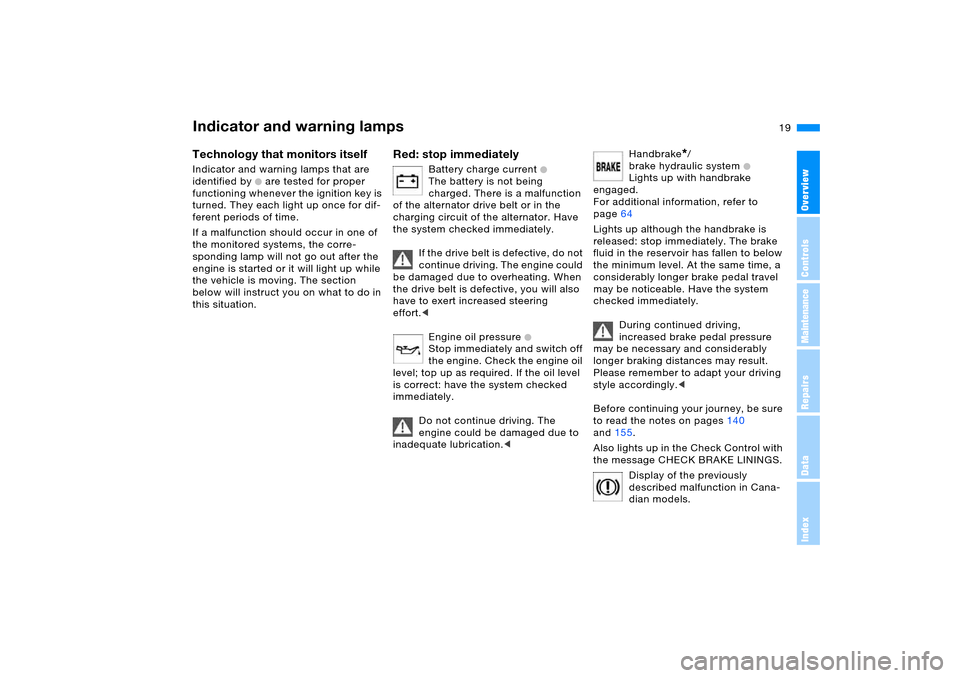
Indicator and warning lamps Technology that monitors itself Indicator and warning lamps that are
identified by
+ are tested for proper
functioning whenever the ignition key is
turned. They each light up once for dif-
ferent periods of time.
If a malfunction should occur in one of
the monitored systems, the corre-
sponding lamp will not go out after the
engine is started or it will light up while
the vehicle is moving. The section
below will instruct you on what to do in
this situation.
Red: stop immediately
Battery charge current
+
The battery is not being
charged. There is a malfunction
of the alternator drive belt or in the
charging circuit of the alternator. Have
the system checked immediately.
If the drive belt is defective, do not
continue driving. The engine could
be damaged due to overheating. When
the drive belt is defective, you will also
have to exert increased steering
effort.<
Engine oil pressure
+
Stop immediately and switch off
the engine. Check the engine oil
level; top up as required. If the oil level
is correct: have the system checked
immediately.
Do not continue driving. The
engine could be damaged due to
inadequate lubrication.<
Handbrake
*/
brake hydraulic system
+
Lights up with handbrake
engaged.
For additional information, refer to
page64
Lights up although the handbrake is
released: stop immediately. The brake
fluid in the reservoir has fallen to below
the minimum level. At the same time, a
considerably longer brake pedal travel
may be noticeable. Have the system
checked immediately.
During continued driving,
increased brake pedal pressure
may be necessary and considerably
longer braking distances may result.
Please remember to adapt your driving
style accordingly.<
Before continuing your journey, be sure
to read the notes on pages140
and155.
Also lights up in the Check Control with
the message CHECK BRAKE LININGS.
Display of the previously
described malfunction in Cana-
dian models.
Page 21 of 202
21n
OverviewControlsMaintenanceRepairsDataIndex
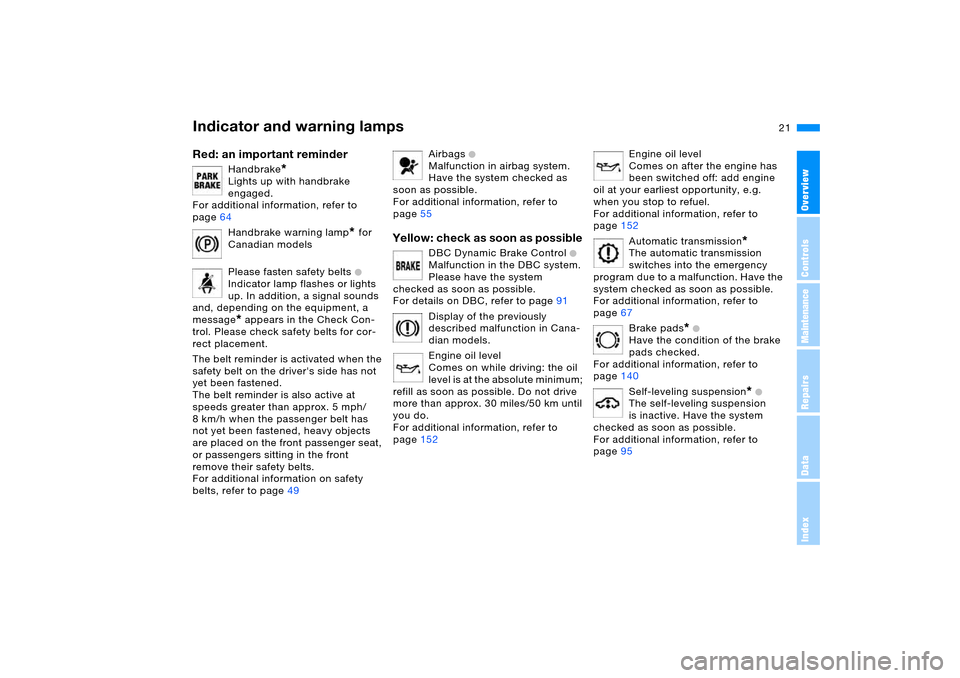
Indicator and warning lamps Red: an important reminder
Handbrake
*
Lights up with handbrake
engaged.
For additional information, refer to
page64
Handbrake warning lamp
* for
Canadian models
Please fasten safety belts +
Indicator lamp flashes or lights
up. In addition, a signal sounds
and, depending on the equipment, a
message* appears in the Check Con-
trol. Please check safety belts for cor-
rect placement.
The belt reminder is activated when the
safety belt on the driver's side has not
yet been fastened.
The belt reminder is also active at
speeds greater than approx. 5 mph/
8 km/h when the passenger belt has
not yet been fastened, heavy objects
are placed on the front passenger seat,
or passengers sitting in the front
remove their safety belts.
For additional information on safety
belts, refer to page49
Airbags
+
Malfunction in airbag system.
Have the system checked as
soon as possible.
For additional information, refer to
page55
Yellow: check as soon as possible
DBC Dynamic Brake Control
+
Malfunction in the DBC system.
Please have the system
checked as soon as possible.
For details on DBC, refer to page91
Display of the previously
described malfunction in Cana-
dian models.
Engine oil level
Comes on while driving: the oil
level is at the absolute minimum;
refill as soon as possible. Do not drive
more than approx. 30 miles/50 km until
you do.
For additional information, refer to
page152
Engine oil level
Comes on after the engine has
been switched off: add engine
oil at your earliest opportunity, e.g.
when you stop to refuel.
For additional information, refer to
page152
Automatic transmission
*
The automatic transmission
switches into the emergency
program due to a malfunction. Have the
system checked as soon as possible.
For additional information, refer to
page67
Brake pads
* +
Have the condition of the brake
pads checked.
For additional information, refer to
page140
Self-leveling suspension
* +
The self-leveling suspension
is inactive. Have the system
checked as soon as possible.
For additional information, refer to
page95
Page 23 of 202
23n
OverviewControlsMaintenanceRepairsDataIndex
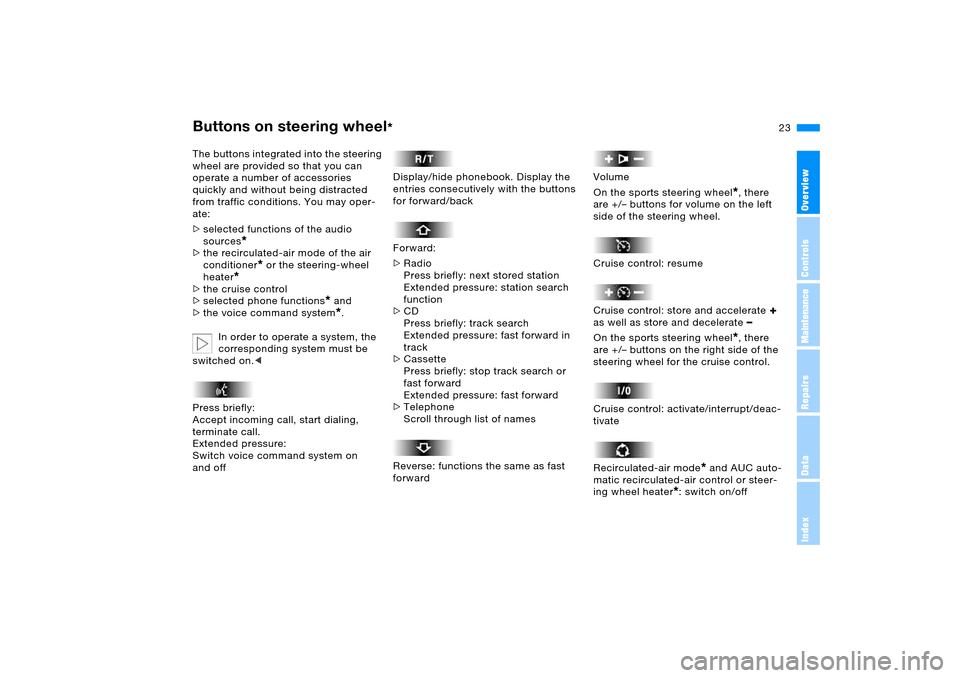
Buttons on steering wheel
*
The buttons integrated into the steering
wheel are provided so that you can
operate a number of accessories
quickly and without being distracted
from traffic conditions. You may oper-
ate:
>selected functions of the audio
sources
*
>the recirculated-air mode of the air
conditioner
* or the steering-wheel
heater
*
>the cruise control
>selected phone functions
* and
>the voice command system*.
In order to operate a system, the
corresponding system must be
switched on.<
Press briefly:
Accept incoming call, start dialing,
terminate call.
Extended pressure:
Switch voice command system on
and off
Display/hide phonebook. Display the
entries consecutively with the buttons
for forward/back
Forward:
>Radio
Press briefly: next stored station
Extended pressure: station search
function
>CD
Press briefly: track search
Extended pressure: fast forward in
track
>Cassette
Press briefly: stop track search or
fast forward
Extended pressure: fast forward
>Telephone
Scroll through list of names
Reverse: functions the same as fast
forward
Volume
On the sports steering wheel
*, there
are +/– buttons for volume on the left
side of the steering wheel.
Cruise control: resume
Cruise control: store and accelerate
+
as well as store and decelerate
–
On the sports steering wheel
*, there
are +/– buttons on the right side of the
steering wheel for the cruise control.
Cruise control: activate/interrupt/deac-
tivate
Recirculated-air mode
* and AUC auto-
matic recirculated-air control or steer-
ing wheel heater
*: switch on/off
Page 25 of 202
25n
OverviewControlsMaintenanceRepairsDataIndex
Refueling
When handling fuels, always
observe any safety guidelines
posted at the service station. Never
carry spare fuel containers in your vehi-
cle. Whether empty or full, these con-
tainers can leak, cause an explosion, or
lead to fire in the event of a collision.<
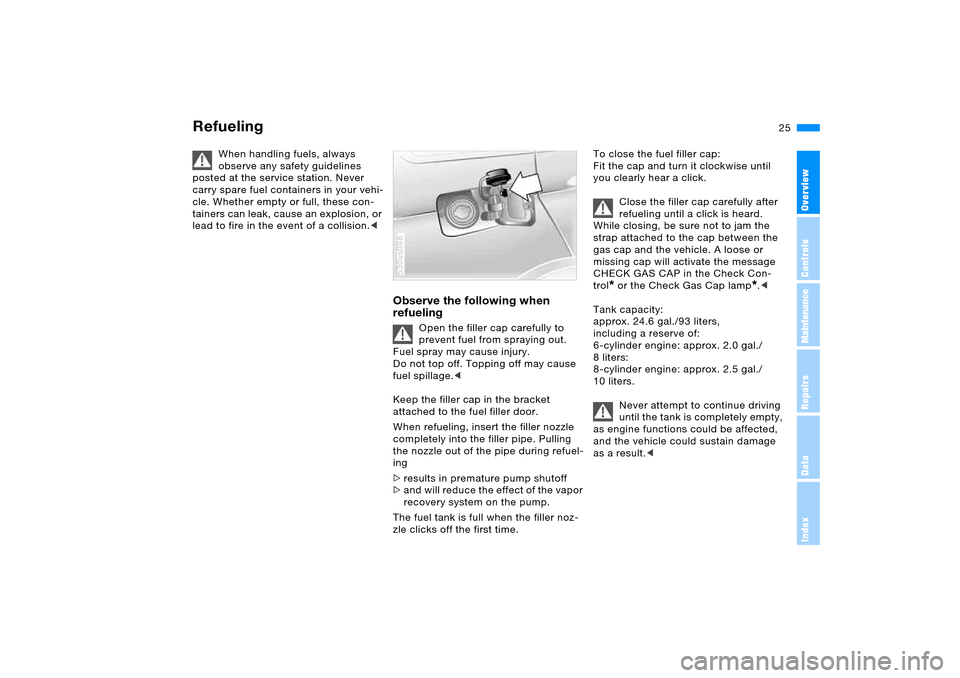
Observe the following when
refueling
Open the filler cap carefully to
prevent fuel from spraying out.
Fuel spray may cause injury.
Do not top off. Topping off may cause
fuel spillage.<
Keep the filler cap in the bracket
attached to the fuel filler door.
When refueling, insert the filler nozzle
completely into the filler pipe. Pulling
the nozzle out of the pipe during refuel-
ing
>results in premature pump shutoff
>and will reduce the effect of the vapor
recovery system on the pump.
The fuel tank is full when the filler noz-
zle clicks off the first time.
530us008
To close the fuel filler cap:
Fit the cap and turn it clockwise until
you clearly hear a click.
Close the filler cap carefully after
refueling until a click is heard.
While closing, be sure not to jam the
strap attached to the cap between the
gas cap and the vehicle. A loose or
missing cap will activate the message
CHECK GAS CAP in the Check Con-
trol
* or the Check Gas Cap lamp
*.<
Tank capacity:
approx. 24.6 gal./93 liters,
including a reserve of:
6-cylinder engine: approx. 2.0 gal./
8 liters:
8-cylinder engine: approx. 2.5 gal./
10 liters.
Never attempt to continue driving
until the tank is completely empty,
as engine functions could be affected,
and the vehicle could sustain damage
as a result.<
Page 26 of 202
26n
Fuel specifications The engine uses lead-free gasoline
only.Required fuelPremium Unleaded Gasoline,
Minimum Octane Rating: 91.
Minimum Octane Rating corresponds to
the Anti Knock Index AKI and is deter-
mined according to the so-called
(R+M)/2 method.
Do not use leaded gasoline: use of
leaded fuel will permanently dam-
age the lambda probe and catalytic
converter of your vehicle.<
Use high-quality brandsField experience has indicated signifi-
cant differences in fuel quality: volatility,
composition, additives, etc., among
gasolines offered for sale in the United
States and Canada. Fuels containing up
to and including 10 % ethanol or other
oxygenates with up to 2.8 % oxygen by
weight, that is, 15 % MTBE or 3 % meth-
anol plus an equivalent amount of co-
solvent, will not void the applicable
warranties with respect to defects in
materials or workmanship.The use of poor-quality fuels may
result in drivability, starting and
stalling problems, especially under cer-
tain environmental conditions such as
high ambient temperature and high alti-
tude.
Should you encounter drivability prob-
lems that you suspect could be related
to the fuel you are using, we recom-
mend that you respond by switching to
a recognized high-quality brand.
Failure to comply with these recom-
mendations may also result in unsched-
uled maintenance.<
Page 27 of 202
27n
OverviewControlsMaintenanceRepairsDataIndex
Page 29 of 202
29n
OverviewControlsMaintenanceRepairsDataIndex
Overview
Controls and features
Operation, maintenance
Index Technical data
Controls
Owner service procedures
Page 31 of 202
31n
OverviewControlsMaintenanceRepairsDataIndex
Opening and closing: from outsideUsing remote control When you engage/release the vehicle
locks, you also activate/deactivate the
anti-theft system, arm/disarm the alarm
system, and switch the interior lamps
on/off.
Protect the remote control against
unauthorized use by handing over
only the spare key, for example when
using hotel valet parking.<
You can find more detailed information
on the alarm system on page38.
Since passengers or animals
remaining in the vehicle might be
able to lock the doors from the inside,
take the vehicle's keys with you so that
the vehicle can be opened again from
the outside at any time.<
Unlocking vehiclePress the button.
Press the button once to unlock the
driver's door and the fuel filler door
only; press a second time to unlock all
remaining doors as well as the liftgate/
tailgate. Convenience opening modePress the button briefly and then hold
down.
The windows and the panorama glass
roof open. Locking and securing Press the button.
As a confirmation that the vehicle is
correctly locked, the hazard warning
flashers light up.
If you so desire, you can have this
function deactivated if your vehi-
cle is not equipped with an alarm sys-
tem.<
Switching on interior lamps If the vehicle is locked, press the but-
ton.
With this function, you can also search
for your vehicle, e.g. when parked in an
underground garage.Switching off tilt alarm sensor and
interior motion sensor
Press the button once again immedi-
ately after locking.
For more detailed information, refer to
page39. Opening liftgate Briefly press the button.
The liftgate will open slightly, regardless
of whether it was previously locked or
unlocked.
Page 33 of 202
33n
OverviewControlsMaintenanceRepairsDataIndex
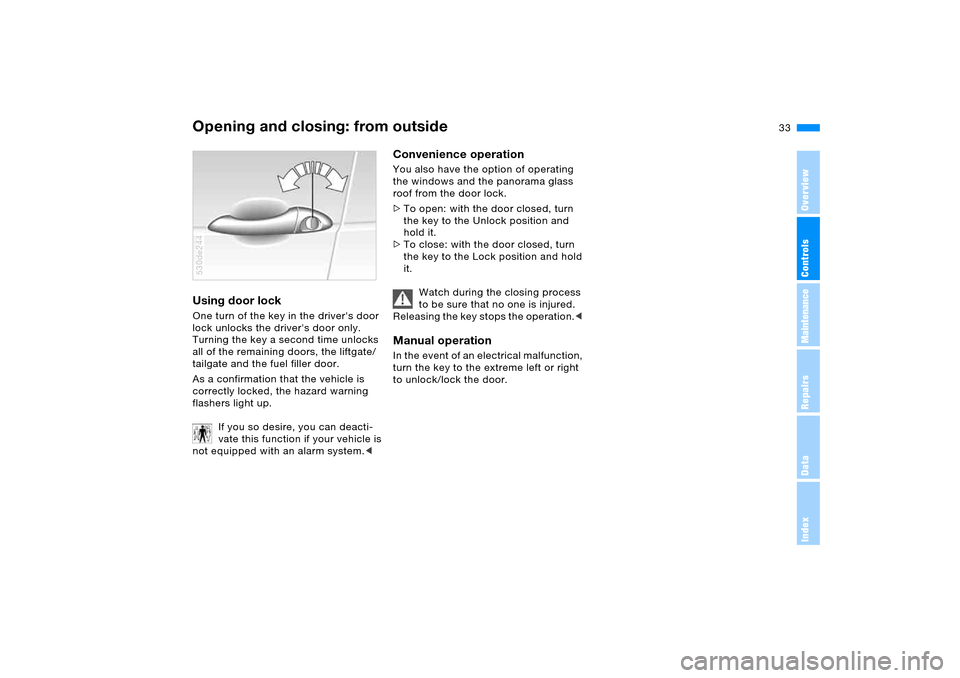
Opening and closing: from outsideUsing door lock One turn of the key in the driver's door
lock unlocks the driver's door only.
Turning the key a second time unlocks
all of the remaining doors, the liftgate/
tailgate and the fuel filler door.
As a confirmation that the vehicle is
correctly locked, the hazard warning
flashers light up.
If you so desire, you can deacti-
vate this function if your vehicle is
not equipped with an alarm system.< 530de244
Convenience operation You also have the option of operating
the windows and the panorama glass
roof from the door lock.
>To open: with the door closed, turn
the key to the Unlock position and
hold it.
>To close: with the door closed, turn
the key to the Lock position and hold
it.
Watch during the closing process
to be sure that no one is injured.
Releasing the key stops the operation.< Manual operation In the event of an electrical malfunction,
turn the key to the extreme left or right
to unlock/lock the door.
Page 35 of 202
35n
OverviewControlsMaintenanceRepairsDataIndex
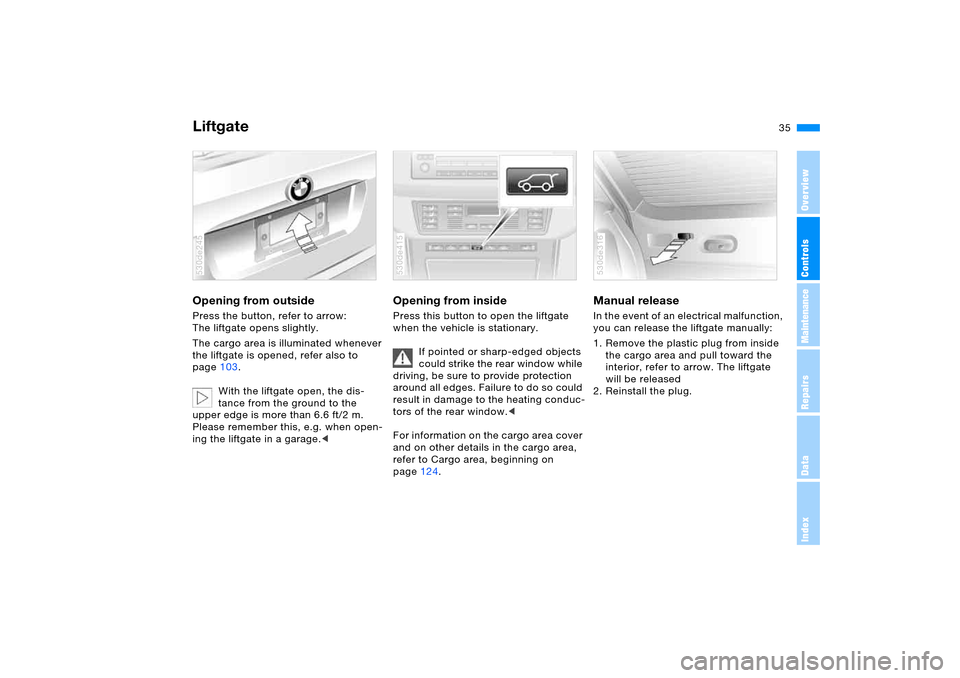
LiftgateOpening from outside Press the button, refer to arrow:
The liftgate opens slightly.
The cargo area is illuminated whenever
the liftgate is opened, refer also to
page103.
With the liftgate open, the dis-
tance from the ground to the
upper edge is more than 6.6 ft/2 m.
Please remember this, e.g. when open-
ing the liftgate in a garage.<530de245
Opening from inside Press this button to open the liftgate
when the vehicle is stationary.
If pointed or sharp-edged objects
could strike the rear window while
driving, be sure to provide protection
around all edges. Failure to do so could
result in damage to the heating conduc-
tors of the rear window.<
For information on the cargo area cover
and on other details in the cargo area,
refer to Cargo area, beginning on
page124.530de415
Manual release In the event of an electrical malfunction,
you can release the liftgate manually:
1. Remove the plastic plug from inside
the cargo area and pull toward the
interior, refer to arrow. The liftgate
will be released
2. Reinstall the plug. 530de316