ABS BMW X5 4.4I 2000 User Guide
[x] Cancel search | Manufacturer: BMW, Model Year: 2000, Model line: X5 4.4I, Model: BMW X5 4.4I 2000Pages: 201, PDF Size: 1.93 MB
Page 124 of 201

124n
Winter operation Rubber seals and components In order to prevent the weather-strip-
ping from freezing, apply BMW rubber
treatment or silicone spray to the seals
on the doors, hood and tailgate.
A full range of car care products is
available from your BMW center.< Snow chains Mount BMW snow chains
* only on tire
size 235/65 R 17. Always mount chains
in pairs and on the rear wheels only.
Read and comply with the chain manu-
facturer's safety precautions. Do not
exceed a maximum speed of 30 mph
(50 km/h).
Starting offWhen starting in deep snow or "rock-
ing" the vehicle free, it may be advis-
able to deactivate the DSC system
briefly. Refer to page 83.
Driving on low-traction road
surfaces Use smooth, gentle pressure to control
the accelerator pedal and avoid exces-
sive engine speeds. Maintain an ade-
quate distance between yourself and
the car ahead. BrakingWinter road conditions substantially re-
duce the amount of traction available
between the tires and the road surface.
The resulting increases in braking dis-
tance are considerable and should be
kept in mind at all times.
ABS is intended to prevent the wheels
from locking during brake applications,
thus helping to maintain vehicle stability
and steering response. If the ABS does not respond in a critical
braking situation and the wheels lock:
Reduce the pressure on the brake
pedal until the wheels just start to roll
again while still maintaining enough
force to continue braking. Following
that, increase pedal pressure again.
Reduce the pressure as the wheels
lock, then reapply pressure. Repeat this
braking sequence.
This type of staggered braking will re-
duce the braking distance, and the ve-
hicle still remains responsive to steer-
ing.
You can then attempt to steer around
hazards after you have reduced pres-
sure on the brake pedal.
Do not shift down on slick road
surfaces if you want to decelerate.
Doing so could cause the wheels to
lose traction and skid, thus resulting in
the loss of vehicle control.<
Page 130 of 201

130n
Wheel and tire combinations The right choice Use only tires approved by BMW. Refer
to page 132.
Due to the high speeds this vehicle can
reach, the use of specific brands, spec-
ifications and sizes is mandatory. Con-
sult any BMW center for details.
Comply with all local/national regula-
tions.
The correct wheel-tire combina-
tion affects different systems such
as ABS, ATC and DSC. The function of
these systems is impaired if improper
wheel-tire combinations are used.
For this reason, use only tires of the
same brand and tread pattern. If you
have mounted winter tires and must use
the spare wheel following a flat tire, for
example, remount the approved wheel-
tire combination as soon as possible.<
Codes on the tires and wheels The tire codes will aid you in selecting
the correct tire.
Codes on radial tires:
The speed rating indicates the ap-
proved maximum speed for the tire.
Summer tires:
S = up to 112 mph (180 km/h)
T = up to 118 mph (190 km/h)
H = up to 130 mph (210 km/h)
V = up to 150 mph (240 km/h)
W = up to 167 mph (270 km/h)
Y = up to 186 mph (300 km/h)
ZR= over 150 mph (240 km/h) Example:
Nominal width
in mm
Aspect ratio in X
Belt rating code for
radial tires
Rim diameter in inches
Load rating
Speed rating
235/65 R 17 104 H
All-Season, All-Terrain and Winter tires:
Q M+S = up to 100 mph (160 km/h)
T M+S = up to 118 mph (190 km/h)
H M+S = up to 130 mph (210 km/h)
Codes stamped on light-alloy wheels:
Protect valve stems from dirt by using
screw-on valve stem caps. Dirt in the
valves frequently leads to slow leaks. Rim width
in inches
Code letter for
flange type
Symbol for full-drop
center rim
Rim diameter in inches
Special Extended Hump
on the 2 rim shoulders
7.5 x 17 SEH 2
J
Page 141 of 201
IndexDataTechnologyRepairsCar careControlsOverview
141n
Brake fluid Vehicle IdentiÞcation No.
If the indicator lamp for the
brake hydraulic system appears
or if the CHECK BRAKE FLUID
warning appears in the Check
Control
*: the brake fluid level is
too low in the reservoir.
The brake fluid reservoir is located un-
der the microfilter housing trim panel
on the driver's side of the vehicle. For
adding brake fluid or for determining
and correcting the cause of brake fluid
loss, consult your BMW center. Your
BMW center is familiar with the specifi-
cations for factory-approved brake
fluids (DOT 4).
Brake fluid loss may result in extended
brake pedal travel. For this situation,
refer to the notes on page 123.
Brake fluid is hygroscopic, that is,
it absorbs moisture from the air
over time.
In order to ensure the safety and reli-
ability of the brake system, have the
brake fluid changed every two years by
an authorized BMW center. Refer also
to the Service and Warranty Information
Booklet (US models) or the Warranty
and Service Guide Booklet (Canadian
models).
Brake fluid is toxic and damages the
vehicle's paint. You should always store
it in its original container and in a loca-
tion which is out of reach of children.
Do not spill the fluid and do not fill the
brake fluid reservoir beyond the "MAX"
mark. The brake fluid could ignite upon
contact with hot engine parts and
cause serious burns.<
Comply with the applicable envi-
ronmental laws regulating the dis-
posal of brake fluid.<
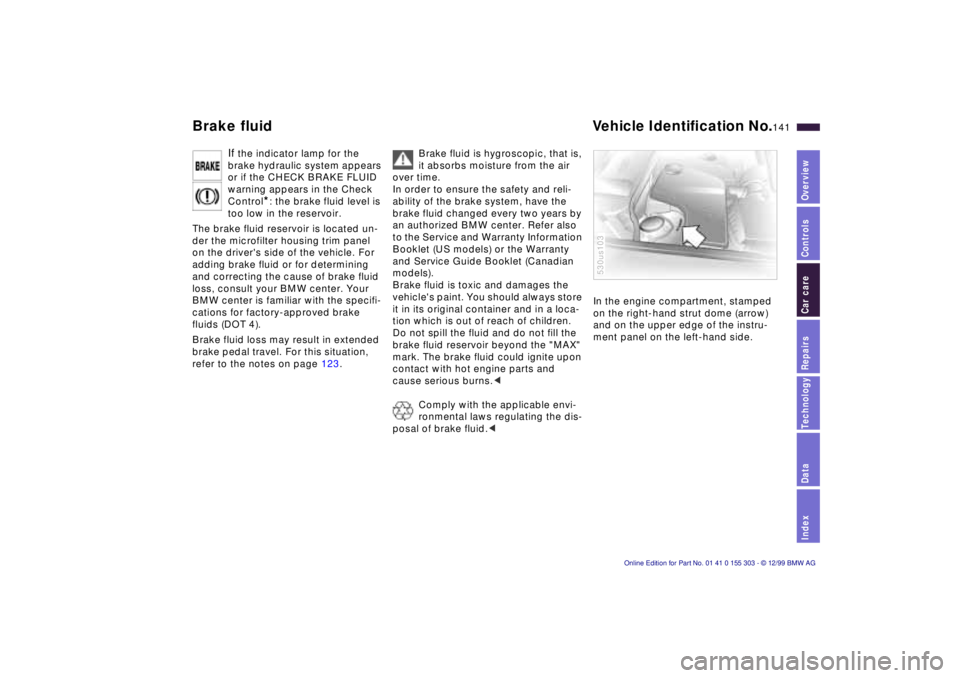
In the engine compartment, stamped
on the right-hand strut dome (arrow)
and on the upper edge of the instru-
ment panel on the left-hand side. 530us103
Page 172 of 201
172n
Towing the vehicle
The towed vehicle should always
be the lighter of the two vehicles.
If this is not the case, it is no longer
possible to control vehicle response.<
Tow-starting It is not possible to start the engine of a
vehicle equipped with automatic trans-
mission by towing or pushing.
For instructions on jump starting: refer
to page 170.
Never attempt to use your vehicle to
push another car. If you do so, damage
to the energy-absorbing bumpers could
result.
Towing 1 Place the selector lever in "Neutral".
2 Towing speed:
Max. 45 mph (70 km/h).
3 Towing distance:
Max. 95 miles (150 km).
4 Leave the ignition key at position 1 to
ensure that the brake lamps, turn sig-
nals, horn and windshield wipers re-
main operative, and to prevent the
steering lock detent from engaging.
5 Switch on the hazard-warning system
(comply with country-specific regula-
tions).
Find some means of identifying the ve-
hicle in tow, for instance, place a sign
or warning triangle in the rear window.
Make sure that the ignition key re-
mains in position 1 even when the
electrical system has failed. This will
prevent the steering lock from engag-
ing. The steering and brakes are with-
out power assist when the engine is not
running. This means that increased ef-
fort is required for steering and brak-
ing.<
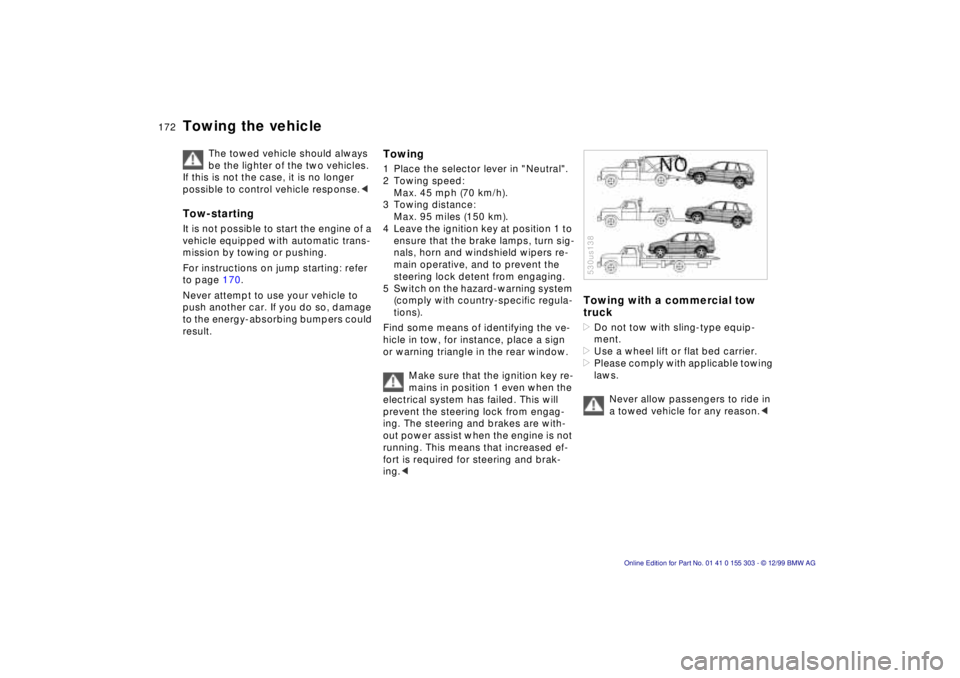
Towing with a commercial tow
truck >Do not tow with sling-type equip-
ment.
>Use a wheel lift or flat bed carrier.
>Please comply with applicable towing
laws.
Never allow passengers to ride in
a towed vehicle for any reason.< 530us138
Page 192 of 201

Everything from A to ZAABS (Antilock Brake
System)119
Accessories6
Activated-charcoal filter95
Adaptive Transmission
Control (ATC)176
Adding engine oil137
Adding washer fluid136
Adjusting seats48
Adjusting the steering
wheel51
Adjusting the
temperature92
Air conditioner93
Air distribution92
Air nozzles90
Air outlets90
Air pressure30, 127
Air supply93
Airbags23, 57, 148, 176
Alarm system43
Antennas126
Antifreeze140
Antifreeze, radiator123
Antilock Brake System
(ABS)119
Anti-theft alarm system43
Anti-theft protection37
Approved gross vehicle
weight186
Aquaplaning118, 127
Ashtray103AUC (Automatic recirculated
air control)93
Automatic car washes143
Automatic climate
control90
Removing condensation
from the windows93
Automatic cruise control72
Automatic curb monitor54
Automatic dimming, interior
rearview mirror53
Automatic recirculated air
control (AUC)93
Automatic steering wheel
adjustment52
Automatic transmission with
Steptronic66
Average fuel
consumption80
Average speed80
Axle loads186
BBackup lamps67
Bulb replacement157
Battery165, 188
Capacity188
Charge166
Discharged170
Belts56
Beverage holder102
Blower93
BMW comfort seat50BMW High Performance
Synthetic Oil138
BMW sports seat50
BMW Universal
Transmitter98
Body-cavity protectant144
Brake fluid141
Brake hydraulic system22
Brake lamps, bulb
replacement157
Brake pads24
Brakes122
Malfunctions123
Break-in procedures116
Bulb replacement155
CCapacities187
Car Memory55
Car radio
reception126, 178
Car wash143
Care, exterior144
Care, interior146
Cargo area42, 107
Capacity186
Opening from the
inside41
Cargo area cover107
Cargo area lamps87
Cargo floor, pull-out111
Cargo loading112Caring for the vehicle
finish145
Catalytic converter118
CBC (Cornering Brake
Control)120
Cellular phones102, 126
refer to the separate
Owner's Manual
Center (high-mount) brake
lamp157
Central locking system36
Button40
Changing a tire160
Changing a wheel160
Charge indicator lamp22
Check air pressure30
CHECK button77
Check Control77
Check engine oil level137
Checking tire pressure30
Child restraint systems57
Child's seat57
Child-safety locks62
Cigarette lighter103
Clean the windshield70
Climate control in the rear
passenger area94
Clock, refer to the Radio or
Onboard Computer
Owner's Manual
Cockpit16
Code, refer to the Radio
Owner's Manual126