ABS BMW X5 4.4I 2000 Owners Manual
[x] Cancel search | Manufacturer: BMW, Model Year: 2000, Model line: X5 4.4I, Model: BMW X5 4.4I 2000Pages: 201, PDF Size: 1.93 MB
Page 11 of 201

11n
Controls and features
Operation, care and maintenance
Lamps:
Side lamps/Low beams86
Instrument lightning86
High beams/Parking lamps87
Fog lamps87
Interior lamps87
Reading lamps88
Controlling the climate for
pleasant driving:
Automatic climate control90
Seat heating96
Steering wheel heating96
Roller sun blind97
Independent ventilation
system97
Cabin convenience:
BMW Universal Transmitter98
Glove compartment101
Storage compartments101
Cellular phone102
Cup holders102
Ashtray, front103
Cigarette lighter103
Ashtray, rear104
Loading and transporting:
Ski bag105
Cargo area
Fold the rear backrests
down107
Cargo area cover107
Partition net108
Cover panels in the cargo
area109
Power outlets110
Pull-out cargo floor111
Cargo loading112
Roof-mounted luggage rack113
Special operating instructions:
Break-in procedures116
Driving your BMW X5117
General driving notes118
Catalytic converter118
Antilock Brake System
(ABS)119
Disc brakes122
Brake system123
Winter operation123
Power steering125
Level control system125
Cellular phone126
Radio reception126
Wheels and tires:
Tire inflation pressure127
Tire condition127
Tire replacement128
Tire rotation129
Wheel and tire
combinations130
Winter tires131
Snow chains131
Approved wheel and tire
specifications132
Page 19 of 201

IndexDataTechnologyRepairsCar careControlsOverview
19n
Instrument cluster
There are two versions, depending on
the equipment on your vehicle.
1 Fuel gauge with indicator lamp for
fuel reserve75
2 Indicator lamp for turn signal
indicator24
3 Speedometer
4 Indicator lamp for high beams24
5 Tachometer and Energy Control75
6 Engine coolant thermometer with
"Coolant temperature too high"
indicator76
7 Indicator and warning lamps (clock-
wise) for:
>
Parking brake/Brake hydraulic
system, Dynamic Brake Control
(DBC)22, 24
>
Antilock Brake System (ABS)23
>
Brake pads24
>
Airbags23
>
Automatic transmission24
>
Please fasten safety belts23
>
Cruise control25
8 Selector lever and program display
for automatic transmission66
9 Service Interval Display7610 Onboard computer display Ð
Operation via the turn signal lever:
Refer to page 80:
>
Outside temperature
>
Average fuel consumption
>
Cruising range
>
Average speed
11 Indicator lamp for Dynamic Stability
Control (DSC)24
12 Indicator lamp for level control
system24
13 Odometer and trip odometer74
14 Indicator for Check Control77
15 Reset button for trip odometer74
16 Indicator and warning lamps
(clockwise) for:
>
Fog lamps25
>
Battery charge current22
>
Engine oil level/Engine oil
pressure24, 22
>
Engine Power Control24
>
Service Engine Soon24
Page 21 of 201

IndexDataTechnologyRepairsCar careControlsOverview
21n
Instrument cluster
*
There are two versions, depending on
the equipment on your vehicle
1 Fuel gauge with indicator lamp for
fuel reserve75
2 Indicator lamp for turn signal
indicator25
3 Speedometer
4 Indicator lamp for high beams25
5 Tachometer and Energy Control75
6 Engine coolant temperature
gauge76
7 Indicator and warning lamps
(clockwise) for:
>
Parking brake23
>
Brake hydraulic system/Dynamic
Brake Control (DBC)22, 24
>
Antilock Brake System (ABS)23
>
Airbags23
>
Please fasten safety belts23
>
Cruise control25
8 CHECK button77
9 Selector lever and program display
for automatic transmission6610 Outside temperature display74
11 Indicator lamp for Dynamic Stability
Control (DSC)24
12 Trip odometer74
13 Indicator for Check Control
*
77
14 Odometer74
15 Service Interval Display76
16 Reset button for trip odometer74
17 Indicator and warning lamps
(clockwise) for:
>
Fog lamps25
>
Battery charge current22
>
Engine oil pressure22
>
Service Engine Soon24
Page 23 of 201
IndexDataTechnologyRepairsCar careControlsOverview
23n
Indicator and warning lamps Yellow: stop immediately
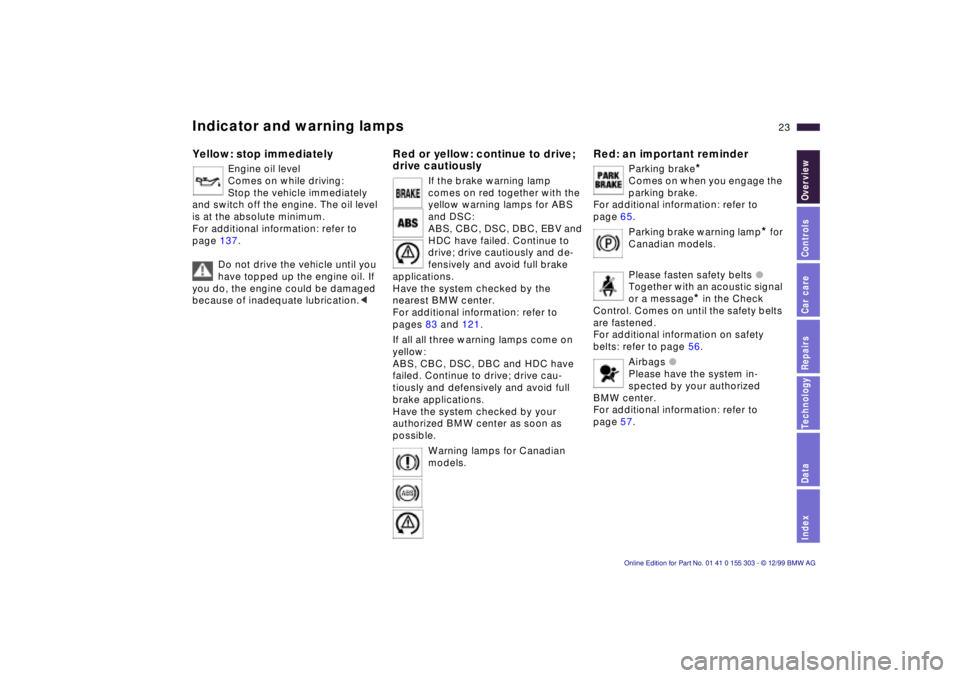
Engine oil level
Comes on while driving:
Stop the vehicle immediately
and switch off the engine. The oil level
is at the absolute minimum.
For additional information: refer to
page 137.
Do not drive the vehicle until you
have topped up the engine oil. If
you do, the engine could be damaged
because of inadequate lubrication.<
Red or yellow: continue to drive;
drive cautiously
If the brake warning lamp
comes on red together with the
yellow warning lamps for ABS
and DSC:
ABS, CBC, DSC, DBC, EBV and
HDC have failed. Continue to
drive; drive cautiously and de-
fensively and avoid full brake
applications.
Have the system checked by the
nearest BMW center.
For additional information: refer to
pages 83 and 121.
If all all three warning lamps come on
yellow:
ABS, CBC, DSC, DBC and HDC have
failed. Continue to drive; drive cau-
tiously and defensively and avoid full
brake applications.
Have the system checked by your
authorized BMW center as soon as
possible.
Warning lamps for Canadian
models.
Red: an important reminder
Parking brake
*
Comes on when you engage the
parking brake.
For additional information: refer to
page 65.
Parking brake warning lamp
* for
Canadian models.
Please fasten safety belts l
Together with an acoustic signal
or a message
* in the Check
Control. Comes on until the safety belts
are fastened.
For additional information on safety
belts: refer to page 56.
Airbags l
Please have the system in-
spected by your authorized
BMW center.
For additional information: refer to
page 57.
Page 42 of 201
42n
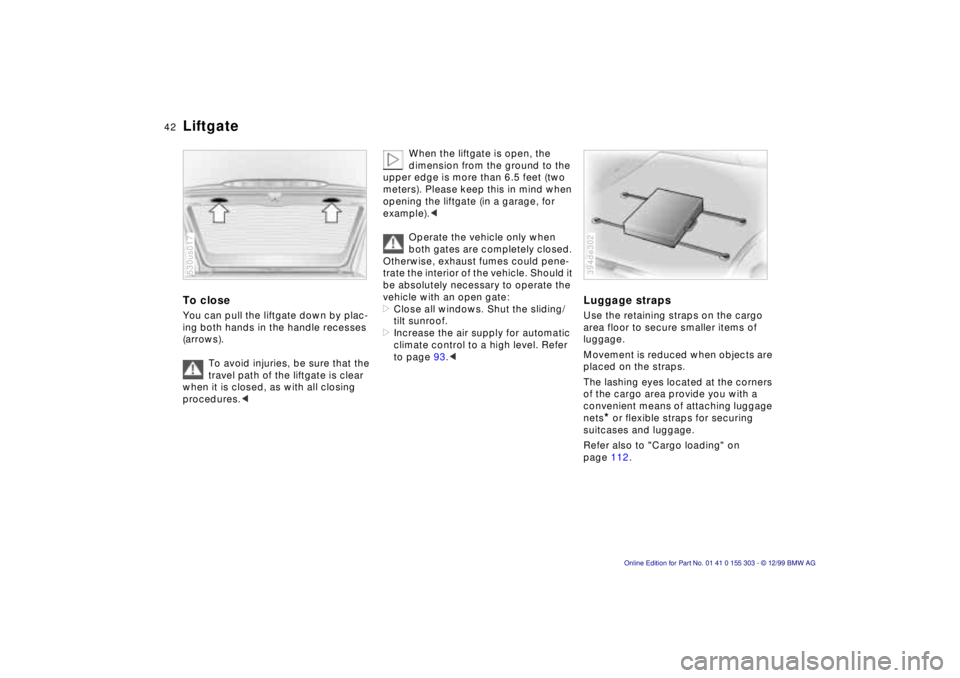
Liftgate To close You can pull the liftgate down by plac-
ing both hands in the handle recesses
(arrows).
To avoid injuries, be sure that the
travel path of the liftgate is clear
when it is closed, as with all closing
procedures.< 530us017
When the liftgate is open, the
dimension from the ground to the
upper edge is more than 6.5 feet (two
meters). Please keep this in mind when
opening the liftgate (in a garage, for
example).<
Operate the vehicle only when
both gates are completely closed.
Otherwise, exhaust fumes could pene-
trate the interior of the vehicle. Should it
be absolutely necessary to operate the
vehicle with an open gate:
>Close all windows. Shut the sliding/
tilt sunroof.
>Increase the air supply for automatic
climate control to a high level. Refer
to page 93.<
Luggage straps Use the retaining straps on the cargo
area floor to secure smaller items of
luggage.
Movement is reduced when objects are
placed on the straps.
The lashing eyes located at the corners
of the cargo area provide you with a
convenient means of attaching luggage
nets
* or flexible straps for securing
suitcases and luggage.
Refer also to "Cargo loading" on
page 112.
394de302
Page 115 of 201
IndexDataTechnologyRepairsCar careControlsOverview
Overview
Controls and features
Operation, care
and maintenance
Owner service procedures
Technical data
Index Advanced technology
115n
Car care Special operating instructions:
Break-in procedures116
Driving your BMW X5117
General driving notes118
Catalytic converter118
Antilock Brake System
(ABS)119
Disc brakes122
Brake system123
Winter operation123
Power steering125
Level control system125
Cellular phone126
Radio reception126
Wheels and tires:
Tire inflation pressure127
Tire condition127
Tire replacement128
Tire rotation129
Wheel and tire
combinations130
Winter tires131
Snow chains131
Approved wheel and tire
specifications132Under the hood:
Hood133
Engine compartment134
Washer fluid136
Washer nozzles136
Engine oil137
Coolant140
Brake fluid141
Vehicle Identification No.141
Care and maintenance:
The BMW Maintenance
System142
Caring for your vehicle143
Airbags148
Vehicle storage148
Laws and regulations:
Technical modifications149
OBD interface socket150
Page 119 of 201

IndexDataTechnologyRepairsCar careControlsOverview
119n
Catalytic converter Antilock Brake System (ABS)
Be sure to comply with the in-
structions above to prevent un-
burned fuel from reaching the catalytic
converter. Otherwise, the catalytic con-
verter could respond by overheating,
leading to serious damage.
Extreme temperatures occur at the cat-
alytic converter on this and every cata-
lyst-equipped vehicle. Heat shields are
installed adjacent to some sections of
the exhaust system. Never remove
these shields; do not apply undercoat-
ing to their surfaces. When driving,
standing at idle, and parking the vehi-
cle, take care to avoid contact between
the exhaust system and flammable ma-
terials (grass, hay, leaves, etc.). Such
contact could lead to a fire, resulting in
serious personal injury and property
damage.<
The concept ABS enhances active safety by helping
to prevent the wheels from locking un-
der braking. This is because: locked
wheels are dangerous. When the front
wheels slide, the driver loses steering
control over the vehicle. Traction loss at
the rear wheels can cause the rear end
to break into an uncontrolled skid.
With ABS, you will achieve the shortest-
possible braking distances under all
given conditions (braking while driving
straight ahead or in curves, different
road surfaces).
ABS is designed to meet two essential
requirements during every brake appli-
cation:
>To help provide vehicle stability.
>To help retain steering and maneu-
vering capability on all types of road
surfaces (asphalt, cement, dirt, wet
surfaces, snow and ice).
Braking with ABS The system becomes operative once
the vehicle exceeds a speed of approx.
6 mph (10 km/h). The ABS is deactivated
whenever the vehicle's speed drops
back below approx. 4 mph
(6 km/h).
To shorten the braking distance Ñ espe-
cially on steep, poor road surfaces when
driving slowly straight ahead Ñ the sys-
tem allows one or both front wheels to
lock for a short time. Nevertheless, the
vehicle still retains steering response
since this "poor road logic" is deacti-
vated again automatically as you steer.
If you are in a situation that requires full
braking, you will exploit the full beneÞts
of the ABS system if you apply maxi-
mum brake pressure ("panic stop").
Since the vehicle maintains steering
responsiveness, you can avoid possible
obstacles with a minimum of steering
effort, despite the full brake application.
The ABS system's closed-loop control
circuit cycles in fractions of a second.
A pulsation at the brake pedal, together
with the sounds associated with the
hydraulic controls, tells you that the
brake system is within its maximum
limit range and reminds you that you
Page 120 of 201
120n
Antilock Brake System (ABS) should adapt road speed to the road
conditions.
On road surfaces that have a loose sur-
face layer on a firm base with good
traction (on gravel, deep sand or snow,
for example), braking distances may be
longer than with locked wheels.This is
also true if snow chains are mounted.
However, ABS continues to provide en-
hanced vehicle stability and steering re-
sponse under these conditions. Information for your safety Not even ABS can suspend the laws of
physics. ABS alone cannot prevent
accidents when the brakes are applied
without an adequate safety distance
between vehicles, if the vehicle is
driven with excessive speed, or if aqua-
planing occurs. Responsibility for these
types of situations remains in the hands
(and at the feet) of the driver. You
should never allow the added safety of
ABS to lull you into a false sense of
security, or mislead you into taking
increased risks that could affect your
own safety and that of others.
Do not make any modifications to
the ABS system.
Service procedures on ABS are to be
performed by authorized technicians
only.<
Cornering Brake Control (CBC) CBC is an advanced engineering de-
sign of the ABS. When braking during
cornering with high lateral accelera-
tion, or when braking during a lane
change, vehicle stability is further im-
proved and the steering response is
enhanced. Electronic Brake Force Distribu-
tion (EBV) EBV governs brake application pres-
sure at the rear wheels to achieve sta-
ble brake response.
If the EBV fails (refer to the next
page), avoid full or "panic" brake
applications. Full or panic brake appli-
cations can result in overbraking at the
rear axle, and braking stability is no
longer ensured.<
Dynamic Brake Control (DBC)
If you apply the brakes rapidly, this sys-
tem automatically produces the maxi-
mum braking force boost and thus
helps to achieve the shortest possible
braking distance during "panic stops."
All of the benefits of the ABS system
are exploited under these circum-
stances.
Do not reduce the pressure on the
brake pedal for the duration of the
brake application. When the brake
pedal is released, the DBC is deacti-
vated.
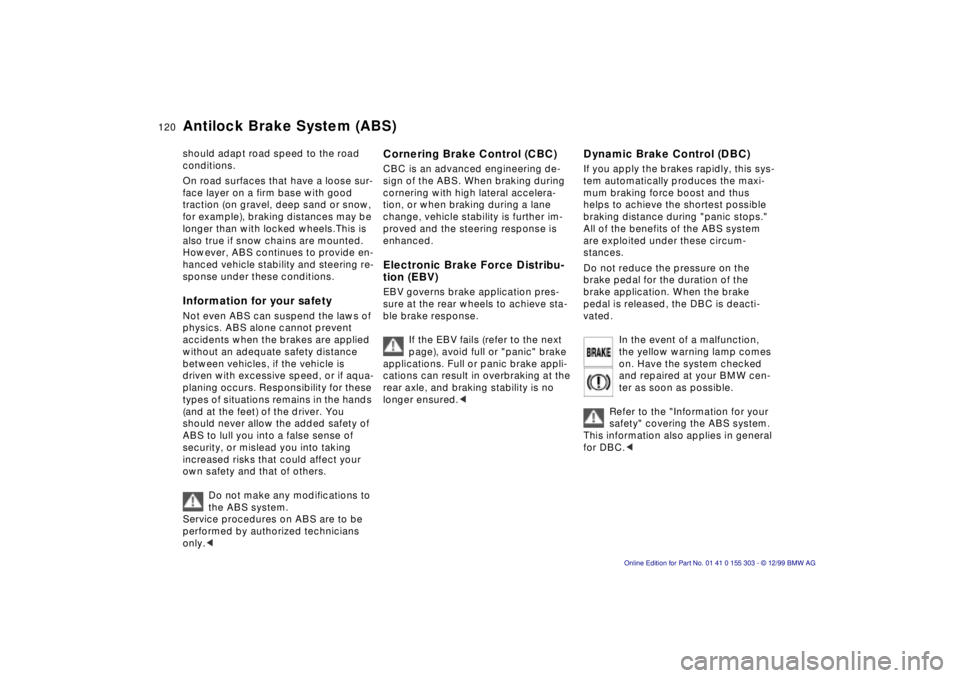
In the event of a malfunction,
the yellow warning lamp comes
on. Have the system checked
and repaired at your BMW cen-
ter as soon as possible.
Refer to the "Information for your
safety" covering the ABS system.
This information also applies in general
for DBC.<
Page 121 of 201
IndexDataTechnologyRepairsCar careControlsOverview
121n
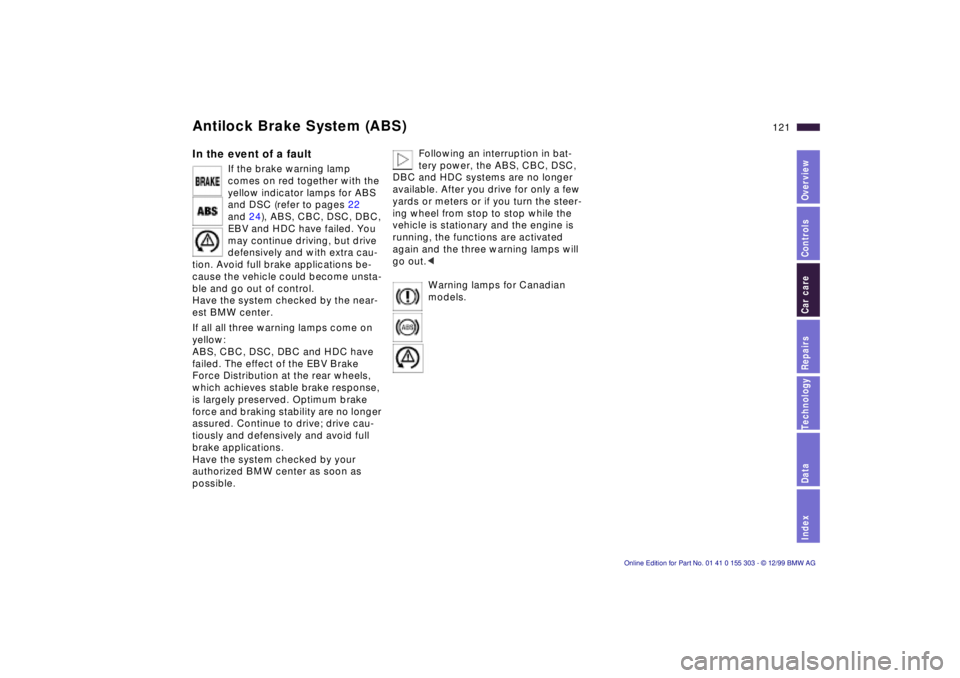
Antilock Brake System (ABS) In the event of a fault
If the brake warning lamp
comes on red together with the
yellow indicator lamps for ABS
and DSC (refer to pages 22
and 24), ABS, CBC, DSC, DBC,
EBV and HDC have failed. You
may continue driving, but drive
defensively and with extra cau-
tion. Avoid full brake applications be-
cause the vehicle could become unsta-
ble and go out of control.
Have the system checked by the near-
est BMW center.
If all all three warning lamps come on
yellow:
ABS, CBC, DSC, DBC and HDC have
failed. The effect of the EBV Brake
Force Distribution at the rear wheels,
which achieves stable brake response,
is largely preserved. Optimum brake
force and braking stability are no longer
assured. Continue to drive; drive cau-
tiously and defensively and avoid full
brake applications.
Have the system checked by your
authorized BMW center as soon as
possible.
Following an interruption in bat-
tery power, the ABS, CBC, DSC,
DBC and HDC systems are no longer
available. After you drive for only a few
yards or meters or if you turn the steer-
ing wheel from stop to stop while the
vehicle is stationary and the engine is
running, the functions are activated
again and the three warning lamps will
go out.<
Warning lamps for Canadian
models.
Page 122 of 201

122n
Disc brakes Disc brakes furnish optimum decelera-
tion and braking control and greater
fade resistance under heavy use.
When the vehicle is driven only occa-
sionally, during extended periods when
the vehicle is not used at all, and in op-
erating conditions where brake applica-
tions are less frequent, there is an in-
creased tendency for corrosion of the
rotors and accumulation of contamina-
tion on the brake pads. This occurs be-
cause the minimal pressure which must
be exerted by the pads to clean the ro-
tors by brake applications is not
reached.
If the brake rotors are corroded, they
will tend to respond to braking with a
pulsating effect which even extended
application will fail to cure.
For your own safety: use only
brake pads that BMW has re-
leased for your particular vehicle
model. BMW cannot evaluate non-ap-
proved brake pads to determine if they
are suited for use, and therefore cannot
ensure the operating safety of the vehi-
cle if they are installed.<
Driving notes When driving in wet conditions and in
heavy rain, it is advisable to apply light
pressure to the brake pedal every few
miles (kilometers). Watch traffic condi-
tions to ensure that this maneuver does
not endanger other road users. The
heat which is generated by the brake
applications helps to dry the brake
pads and rotors.
Maximum braking force is obtained
while the wheels continue to rotate,
peaking when the wheels remain on the
verge of locking without actually doing
so. ABS maintains this state automati-
cally. If the ABS fails, you should revert
to the staggered braking technique
(refer to page 124).
Extended or steep mountain descents
do not necessarily have to lead to re-
duced braking efficiency. Move the se-
lector lever to the appropriate lower
range in which only minimal periodic
brake applications are required.
You can increase the engine's braking
effect by selecting progressively lower
gears, downshifting as far as 1st gear,
on steep descents. If engine braking should prove to be in-
adequate, you should still avoid ex-
tended, continuous braking. Instead of
maintaining low to moderate pressure
over an extended period of time, you
should decelerate by applying more
substantial pressure to the brake pedal
(watch for following traffic), then releas-
ing the pedal, then repeating the appli-
cation. This staggered braking tech-
nique allows the brakes to cool in the
intervals between active braking
phases, preventing overheating and en-
suring that full braking capacity remains
available at all times.
Do not coast with the selector le-
ver in ÒNeutralÒ. Do not drive with
the engine shut off. The engine pro-
vides no braking effect when the trans-
mission is in ÒNeutralÒ, and there is no
power-assist for braking or steering
when the engine is not running.
Have brake inspections performed at
an authorized BMW center only. If you
do not, parts of the four-wheel drive
system could be damaged.
Never allow floor mats, carpets or any
other objects to protrude into the area
around the accelerator and brake ped-
als and obstruct their movement.<