ECO mode BMW X5 4.4I 2000 User Guide
[x] Cancel search | Manufacturer: BMW, Model Year: 2000, Model line: X5 4.4I, Model: BMW X5 4.4I 2000Pages: 201, PDF Size: 1.93 MB
Page 91 of 201

IndexDataTechnologyRepairsCar careControlsOverview
91n
Automatic climate control 1 Air flow directed toward the wind-
shield and side windows
2 Air flow for the upper body
The side rotary dials provide infi-
nitely-variable regulation of the air
supply, while the levers change the
airflow direction. The center rotary
dial controls the temperature of the
air as it flows out. Refer to page 94
3 Front footwell ventilation
4 Rear footwell ventilation
5 Air flow for the upper body in the
rear seat94
6 Automatic air distribution92
7 Individual air distribution92
8 Temperature control Ð
left-hand side92
9 Display for temperature and air
supply9310 Temperature control Ð
right-hand side92
11 To defrost windshield and side
windows93
12 Air conditioner93
13 Automatic recirculated air control
(AUC)93
14 Rear window defroster71, 94
15 Air supply93
16 Residual heat mode94
17 Air grille for interior temperature
sensor Ð please keep clear and un-
obstructed
Page 93 of 201
IndexDataTechnologyRepairsCar careControlsOverview
93n
Automatic climate control Air supply
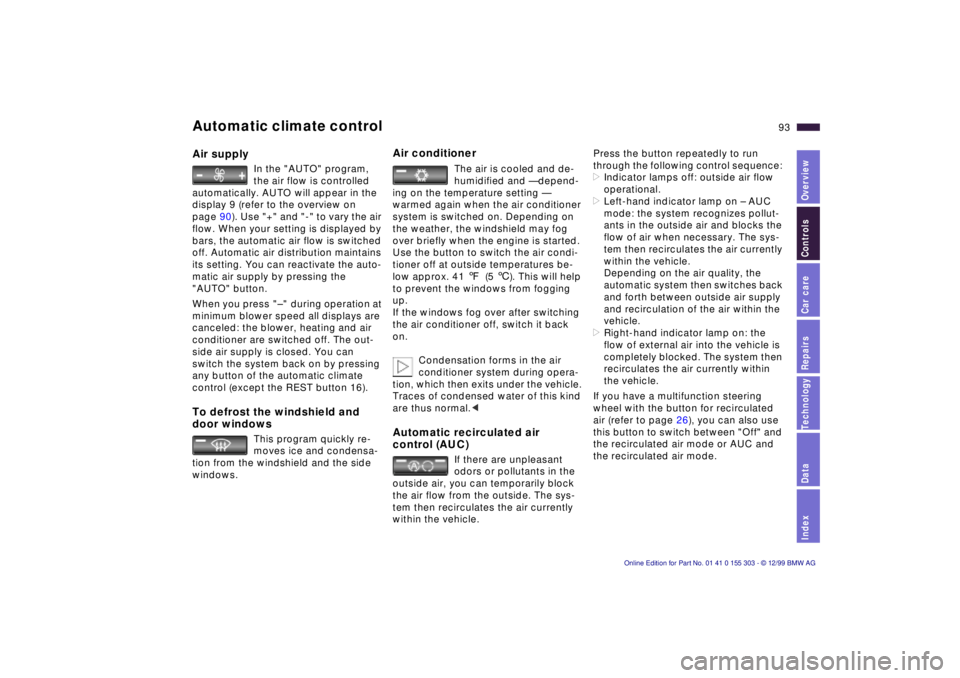
In the "AUTO" program,
the air flow is controlled
automatically. AUTO will appear in the
display 9 (refer to the overview on
page 90). Use "+" and "-" to vary the air
flow. When your setting is displayed by
bars, the automatic air flow is switched
off. Automatic air distribution maintains
its setting. You can reactivate the auto-
matic air supply by pressing the
"AUTO" button.
When you press "Ð " during operation at
minimum blower speed all displays are
canceled: the blower, heating and air
conditioner are switched off. The out-
side air supply is closed. You can
switch the system back on by pressing
any button of the automatic climate
control (except the REST button 16).
To defrost the windshield and
door windows
This program quickly re-
moves ice and condensa-
tion from the windshield and the side
windows.
Air conditioner
The air is cooled and de-
humidified and Ñ depend-
ing on the temperature setting Ñ
warmed again when the air conditioner
system is switched on. Depending on
the weather, the windshield may fog
over briefly when the engine is started.
Use the button to switch the air condi-
tioner off at outside temperatures be-
low approx. 41 7(5 6). This will help
to prevent the windows from fogging
up.
If the windows fog over after switching
the air conditioner off, switch it back
on.
Condensation forms in the air
conditioner system during opera-
tion, which then exits under the vehicle.
Traces of condensed water of this kind
are thus normal.<
Automatic recirculated air
control (AUC)
If there are unpleasant
odors or pollutants in the
outside air, you can temporarily block
the air flow from the outside. The sys-
tem then recirculates the air currently
within the vehicle.
Press the button repeatedly to run
through the following control sequence:
>Indicator lamps off: outside air flow
operational.
>Left-hand indicator lamp on Ð AUC
mode: the system recognizes pollut-
ants in the outside air and blocks the
flow of air when necessary. The sys-
tem then recirculates the air currently
within the vehicle.
Depending on the air quality, the
automatic system then switches back
and forth between outside air supply
and recirculation of the air within the
vehicle.
>Right-hand indicator lamp on: the
flow of external air into the vehicle is
completely blocked. The system then
recirculates the air currently within
the vehicle.
If you have a multifunction steering
wheel with the button for recirculated
air (refer to page 26), you can also use
this button to switch between "Off" and
the recirculated air mode or AUC and
the recirculated air mode.
Page 121 of 201
IndexDataTechnologyRepairsCar careControlsOverview
121n
Antilock Brake System (ABS) In the event of a fault
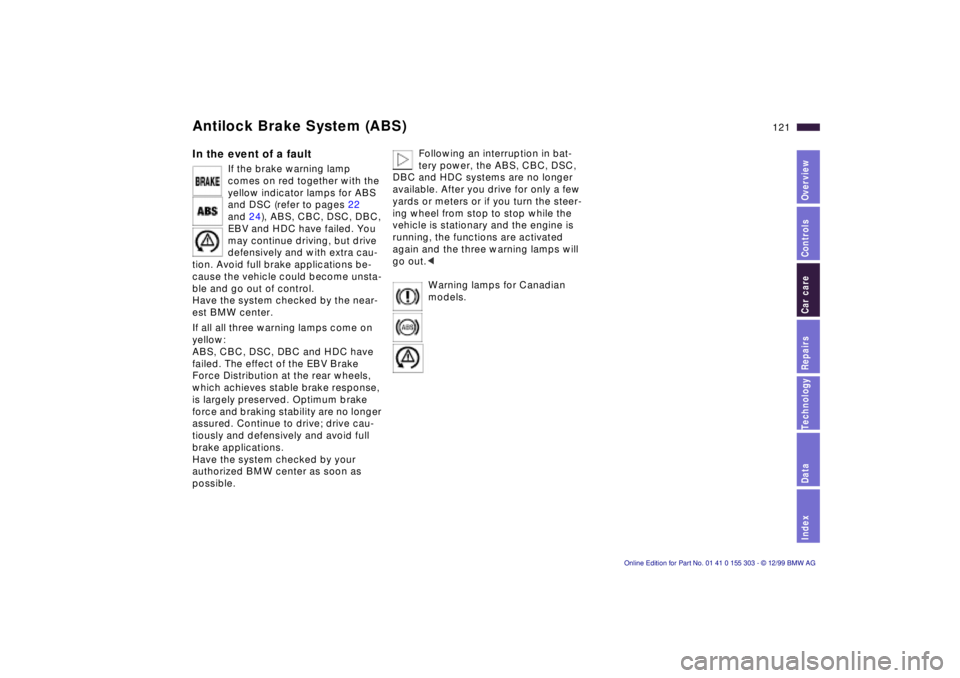
If the brake warning lamp
comes on red together with the
yellow indicator lamps for ABS
and DSC (refer to pages 22
and 24), ABS, CBC, DSC, DBC,
EBV and HDC have failed. You
may continue driving, but drive
defensively and with extra cau-
tion. Avoid full brake applications be-
cause the vehicle could become unsta-
ble and go out of control.
Have the system checked by the near-
est BMW center.
If all all three warning lamps come on
yellow:
ABS, CBC, DSC, DBC and HDC have
failed. The effect of the EBV Brake
Force Distribution at the rear wheels,
which achieves stable brake response,
is largely preserved. Optimum brake
force and braking stability are no longer
assured. Continue to drive; drive cau-
tiously and defensively and avoid full
brake applications.
Have the system checked by your
authorized BMW center as soon as
possible.
Following an interruption in bat-
tery power, the ABS, CBC, DSC,
DBC and HDC systems are no longer
available. After you drive for only a few
yards or meters or if you turn the steer-
ing wheel from stop to stop while the
vehicle is stationary and the engine is
running, the functions are activated
again and the three warning lamps will
go out.<
Warning lamps for Canadian
models.
Page 123 of 201
IndexDataTechnologyRepairsCar careControlsOverview
123n
Brake system Winter operation Brake fluid level
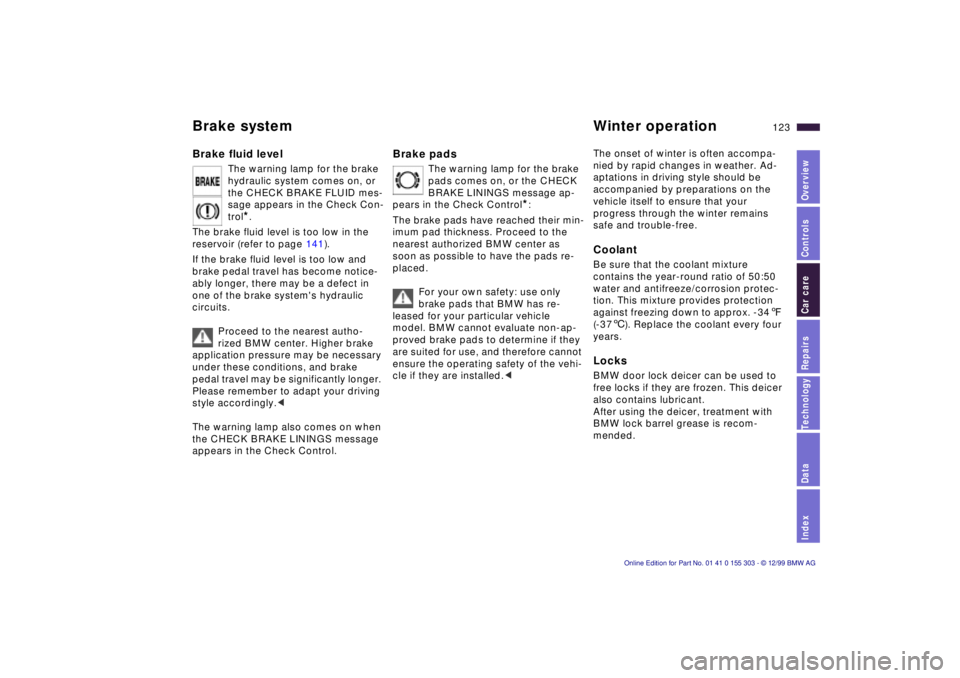
The warning lamp for the brake
hydraulic system comes on, or
the CHECK BRAKE FLUID mes-
sage appears in the Check Con-
trol
*.
The brake fluid level is too low in the
reservoir (refer to page 141).
If the brake fluid level is too low and
brake pedal travel has become notice-
ably longer, there may be a defect in
one of the brake system's hydraulic
circuits.
Proceed to the nearest autho-
rized BMW center. Higher brake
application pressure may be necessary
under these conditions, and brake
pedal travel may be significantly longer.
Please remember to adapt your driving
style accordingly.<
The warning lamp also comes on when
the CHECK BRAKE LININGS message
appears in the Check Control.
Brake pads
The warning lamp for the brake
pads comes on, or the CHECK
BRAKE LININGS message ap-
pears in the Check Control
*:
The brake pads have reached their min-
imum pad thickness. Proceed to the
nearest authorized BMW center as
soon as possible to have the pads re-
placed.
For your own safety: use only
brake pads that BMW has re-
leased for your particular vehicle
model. BMW cannot evaluate non-ap-
proved brake pads to determine if they
are suited for use, and therefore cannot
ensure the operating safety of the vehi-
cle if they are installed.<
The onset of winter is often accompa-
nied by rapid changes in weather. Ad-
aptations in driving style should be
accompanied by preparations on the
vehicle itself to ensure that your
progress through the winter remains
safe and trouble-free. Coolant Be sure that the coolant mixture
contains the year-round ratio of 50:50
water and antifreeze/corrosion protec-
tion. This mixture provides protection
against freezing down to approx. -347
(-376). Replace the coolant every four
years. Locks BMW door lock deicer can be used to
free locks if they are frozen. This deicer
also contains lubricant.
After using the deicer, treatment with
BMW lock barrel grease is recom-
mended.
Page 127 of 201
IndexDataTechnologyRepairsCar careControlsOverview
127n
Information for your safety The factory-approved radial tires are
matched to the vehicle and have been
selected to provide optimum safety and
driving comfort on your vehicle.
It is not merely the tire's service life, but
also driving comfort and Ð above all else
Ð driving safety which depend on the
condition of the tires and the mainte-
nance of the specified tire pressure.
Incorrect inflation pressure is a frequent
cause of tire damage. It also signifi-
cantly influences the roadholding ability
of your BMW.
Check tire inflation pressures Ð
including the spare wheel Ð regu-
larly, at least every two weeks and
before beginning a longer trip. If this is
not done, incorrect tire pressures can
cause driving instability and tire
damage, ultimately resulting in an
accident.<
Tire tread Ð Tire damage Inspect your tires frequently for tread
wear, signs of damage and for foreign
objects lodged in the tread. Check the
tread depth.
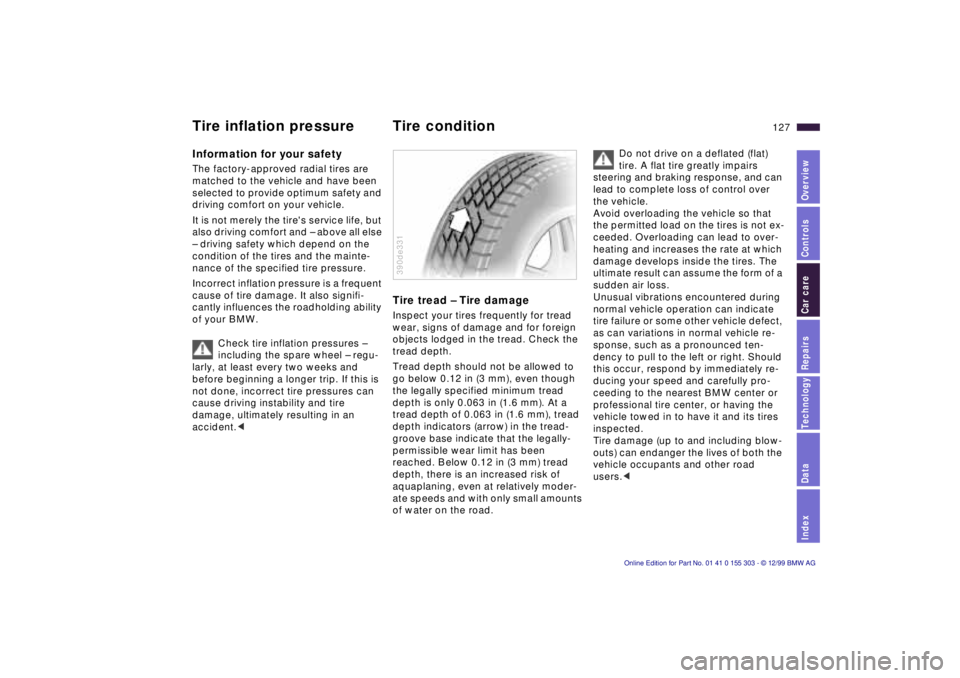
Tread depth should not be allowed to
go below 0.12 in (3 mm), even though
the legally specified minimum tread
depth is only 0.063 in (1.6 mm). At a
tread depth of 0.063 in (1.6 mm), tread
depth indicators (arrow) in the tread-
groove base indicate that the legally-
permissible wear limit has been
reached. Below 0.12 in (3 mm) tread
depth, there is an increased risk of
aquaplaning, even at relatively moder-
ate speeds and with only small amounts
of water on the road. 390de331
Do not drive on a deflated (flat)
tire. A flat tire greatly impairs
steering and braking response, and can
lead to complete loss of control over
the vehicle.
Avoid overloading the vehicle so that
the permitted load on the tires is not ex-
ceeded. Overloading can lead to over-
heating and increases the rate at which
damage develops inside the tires. The
ultimate result can assume the form of a
sudden air loss.
Unusual vibrations encountered during
normal vehicle operation can indicate
tire failure or some other vehicle defect,
as can variations in normal vehicle re-
sponse, such as a pronounced ten-
dency to pull to the left or right. Should
this occur, respond by immediately re-
ducing your speed and carefully pro-
ceeding to the nearest BMW center or
professional tire center, or having the
vehicle towed in to have it and its tires
inspected.
Tire damage (up to and including blow-
outs) can endanger the lives of both the
vehicle occupants and other road
users.<
Tire inflation pressure Tire condition
Page 141 of 201
IndexDataTechnologyRepairsCar careControlsOverview
141n
Brake fluid Vehicle IdentiÞcation No.
If the indicator lamp for the
brake hydraulic system appears
or if the CHECK BRAKE FLUID
warning appears in the Check
Control
*: the brake fluid level is
too low in the reservoir.
The brake fluid reservoir is located un-
der the microfilter housing trim panel
on the driver's side of the vehicle. For
adding brake fluid or for determining
and correcting the cause of brake fluid
loss, consult your BMW center. Your
BMW center is familiar with the specifi-
cations for factory-approved brake
fluids (DOT 4).
Brake fluid loss may result in extended
brake pedal travel. For this situation,
refer to the notes on page 123.
Brake fluid is hygroscopic, that is,
it absorbs moisture from the air
over time.
In order to ensure the safety and reli-
ability of the brake system, have the
brake fluid changed every two years by
an authorized BMW center. Refer also
to the Service and Warranty Information
Booklet (US models) or the Warranty
and Service Guide Booklet (Canadian
models).
Brake fluid is toxic and damages the
vehicle's paint. You should always store
it in its original container and in a loca-
tion which is out of reach of children.
Do not spill the fluid and do not fill the
brake fluid reservoir beyond the "MAX"
mark. The brake fluid could ignite upon
contact with hot engine parts and
cause serious burns.<
Comply with the applicable envi-
ronmental laws regulating the dis-
posal of brake fluid.<
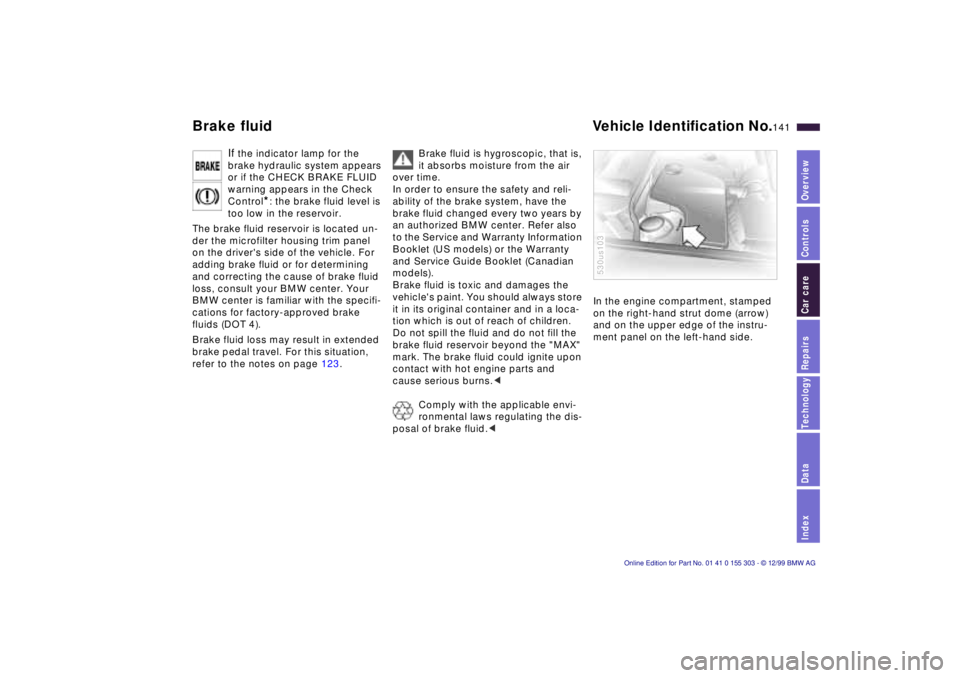
In the engine compartment, stamped
on the right-hand strut dome (arrow)
and on the upper edge of the instru-
ment panel on the left-hand side. 530us103
Page 165 of 201
IndexDataTechnologyRepairsCar careControlsOverview
165n
Battery Battery location The battery is located in the floor of the
vehicle below the spare wheel. Battery care The battery is maintenance-free, that is,
the original electrolyte will normally last
for the service life of the battery under
moderate climatic conditions.
For all questions that regard the
battery, please consult your BMW
center. Since the battery is mainte-
nance-free, the following is for your in-
formation only.<
Symbols You will find the following symbols on
your vehicle battery. To avoid injury,
please comply with the corresponding
precautions whenever you work with or
near the battery.
Before handling the battery,
please read the following infor-
mation:
Wear eye protection. Do not al-
low particles containing battery
acid or lead to come into con-
tact with your eyes, your skin, or your
clothing.
Battery acid is extremely corro-
sive. Wear eye protection and
protective gloves. Do not tip the
battery. Battery acid can leak from the
ventilation openings.
Do not allow children to have
access to batteries and battery
acid.
Never allow sparks or open
flame near the battery. Do not
smoke in the vicinity of the bat-
tery. Avoid sparks from electrical cables
or electrical equipment. Turn the key to
position 0 in the steering lock when you
are disconnecting or connecting the
battery. Never short-circuit the battery
terminals. This creates a risk of injury
from high-energy sparks.
A highly-explosive gas is
generated when the battery is
charged.
If you happen to get acid in your
eyes, rinse thoroughly for
15 minutes with clear water.
Following that, consult a physician im-
mediately. If you get acid spray on your
skin or clothing, rinse with plenty of wa-
ter. If electrolyte is accidentally swal-
lowed, consult a physician immediately.
In order to protect the battery
case from ultraviolet radiation,
do not place it in direct sunlight.
A discharged battery can freeze. Store
the battery in areas where temperature
remains above freezing.
Page 195 of 201

Everything from A to Z
195n
IndexDataTechnologyRepairsCar careControlsOverview
Master key34
Memory54
Microfilter95
MID (Multi-Information
Display), refer to the Radio
Owner's Manual
Mirror52
Mirror defrosting52
Mirror memory54
Mobile phones126
Modifications,
technical6, 149
Multifunction steering
wheel26
Multi-Information Display
(MID), refer to the Radio
Owner's ManualNNavigation system, refer to
the separate Owner's
ManualOOBD interface socket150
Odometer74
Oil additives137
Oil change interval, see the
Service and Warranty
Information Booklet (US
models) or the Warranty
and Service Guide Booklet
(Canadian models)Oil consumption137
Oil dipstick137
Oil grades138
Oil level, indicator
lamp23, 24
Oil pressure, indicator
lamp22
OILSERVICE76
Onboard computer80
refer also to the Onboard
computer Owner's Manual
Onboard monitor
refer to the separate
Owner's Manual
Onboard tool kit154
Opening and closing
From the inside40
From the outside36
Operating range80
Outlets, ventilation90
Output184
Outside temperature
display74
Outside temperature in the
onboard computer80
PPaintwork, minor
repairs145
Paintwork, waxing145
Park Distance Control
(PDC)82
Parking aid82Parking brake23, 65
Parking in the winter125
Parking lamps87
Passenger side mirror tilt
function54
PDC (Park Distance
Control)82
Playing cassettes, refer to
the Radio Owner's
Manual126
Playing CDs, refer to the
Radio Owner's
Manual126
"Please wear your safety
belt" warning lamp23
Pocket flashlight101
Pollen95
Poor driving conditions117
Power rear-seat
backrests51
Power seat48
Power steering125
Power windows45
Safety switch46
Pressure, tires127
Pre-warmed seats96
Pull-out cargo floor111
RRadio reception126, 178
Radio, refer to the Radio
Owner's Manual126
Reading lamps88
Rear backrests, folding
down107
Rear lamps157
Rear passenger area climate
control94
Rear seats, power51
Rear view mirror52
Rear window
defroster71, 94
Rear window wiper71
Rear window wiper, wiper
blade replacement154
Rear-seat backrest, folding
down107
Rear-seat backrests,
power51
Recirculated air mode93
Reclining seat48
Refueling29
Remote control37
Removing condensation
from the windows93
Replacement key34
Replacement of tires128
Reservoir, washer
system136
Residual heat94
Page 197 of 201

Everything from A to Z
197n
IndexDataTechnologyRepairsCar careControlsOverview
UUniversal Transmitter98
Used batteries166VValve caps130
Vanity mirror53
Vehicle battery165, 188
Vehicle care, interior146
Vehicle Identification
No.141
Vehicle immobilizer35
Vehicle jack160, 163
Vehicle keys34
Vehicle removal from
service148
Ventilation94
Ventilation in the rear94
Ventilation while parked97
Ventilation, draft-free94
Vinyl care146
Viscosity138WWarm feet Ð cool head94
Warning lamps22
Warnings77
Warranty and Service Guide
(Canadian models)142
Washer reservoir, filling136
Washer/Wiper system69
Washing your vehicle143Waxing, paintwork145
Weights186
Wheelbase185
Wheels and tires130, 132
Width185
Windows45
Convenience
operation36
Remote control38
Windshield washer nozzle
adjustment136
Windshield washer reservoir,
filling136
Windshield wiper69
Windshield wiper blade
replacement154
Winter driving124
Winter operation123
Winter tires130, 131
Wiper blade
replacement154
Wipers69
Work in the engine
compartment133
XXenon lamps156, 181