engine oil BMW X5 4.4I 2000 User Guide
[x] Cancel search | Manufacturer: BMW, Model Year: 2000, Model line: X5 4.4I, Model: BMW X5 4.4I 2000Pages: 201, PDF Size: 1.93 MB
Page 115 of 201
IndexDataTechnologyRepairsCar careControlsOverview
Overview
Controls and features
Operation, care
and maintenance
Owner service procedures
Technical data
Index Advanced technology
115n
Car care Special operating instructions:
Break-in procedures116
Driving your BMW X5117
General driving notes118
Catalytic converter118
Antilock Brake System
(ABS)119
Disc brakes122
Brake system123
Winter operation123
Power steering125
Level control system125
Cellular phone126
Radio reception126
Wheels and tires:
Tire inflation pressure127
Tire condition127
Tire replacement128
Tire rotation129
Wheel and tire
combinations130
Winter tires131
Snow chains131
Approved wheel and tire
specifications132Under the hood:
Hood133
Engine compartment134
Washer fluid136
Washer nozzles136
Engine oil137
Coolant140
Brake fluid141
Vehicle Identification No.141
Care and maintenance:
The BMW Maintenance
System142
Caring for your vehicle143
Airbags148
Vehicle storage148
Laws and regulations:
Technical modifications149
OBD interface socket150
Page 117 of 201

IndexDataTechnologyRepairsCar careControlsOverview
117n
Driving your BMW X5 Your BMW is right at home on all roads
and byways Ð even where the pavement
ends. It combines permanent four-
wheel drive with the agility of a typical
passenger car. On bad roads When you are driving on bad roads,
there are a few points which you should
strictly heed Ñ for your own safety, for
that of your passengers, and for the
safekeeping of the vehicle:
>Familiarize yourself with the vehicle
before you begin driving. Do not take
risks with the vehicle under any cir-
cumstances.
>Always adapt vehicle speed to road
conditions Ð the steeper and more
uneven the road surface is, the
slower the vehicle's speed should be.
>You can operate your vehicle on up-
hill and downhill gradients with a
maximum slope of 50 %. If you intend
to drive on either an uphill or downhill
gradient of this steepness, check to
be sure in advance that the engine oil
and coolant levels are both near the
"max" mark. Refer to page 137
and 140.
When driving down steep slopes, use
the Hill Descent Control (HDC). Refer
to page 84. Starting from a full stop is possible on
uphill gradients of up to 32 %.
The permitted side tilt is also 50 %.
>While driving, watch carefully for ob-
stacles such as rocks or holes. Try to
avoid these obstacles whenever pos-
sible.
>On hill crests and bumpy roads, for
example, be careful to prevent the
body from "bottoming" (contact be-
tween the body and the ground).
The ground clearance of the vehicle
is:
Ð 8 inches (200 mm) with up to four
passengers
Ð 7 inches (180 mm) fully loaded.
>Do not drive in water that is deeper
than 20 inches (50 cm). If you must
drive through water up to that depth,
drive at a walking speed and do not
stop.
After leaving the water, press on the
footbrake gently several times while
driving at a low speed. The brake ap-
plications will help to dry the brakes,
thus preventing a reduction in brak-
ing performance caused by the mois-
ture.
Back onto the paved road In recommending that you observe the
following points after driving on adverse
road surfaces, it is not as a "beauty
treatment" for your BMW. Instead, it is
intended for the maintenance of driving
safety:
>Clean accumulations of dirt from the
body and check the undercarriage for
damage.
>Clean mud, snow, ice and other ma-
terials from the wheels and tires.
Check the tires for damage.
>Check to determine whether rocks,
gravel or accumulations of dirt on the
brake rotors and calipers could influ-
ence braking performance. Remove
all such foreign objects.
>In order to clean the brake rotors,
apply the footbrake gently several
times while driving at a low speed. Be
sure that following traffic is not en-
dangered by this.
>For cleaning the parking brake, apply
the lever slightly at approx. 25 mph
(40 km/h) and continue to drive for
approx. 200 yards (200 meters), pro-
vided that traffic conditions allow you
to do so.
Page 135 of 201

IndexDataTechnologyRepairsCar careControlsOverview
135n
Engine compartment Ð BMW X5 4.4i 1 Reservoir for brake fluid
(under the microfilter
trim panel)141
2 Auxiliary terminal for jump
starting170
3 Coolant expansion tank140
4 Engine oil dipstick137
5 Engine oil filler neck137
6 Reservoir for windshield and
headlamp washer system
*
136
Page 137 of 201
IndexDataTechnologyRepairsCar careControlsOverview
137n
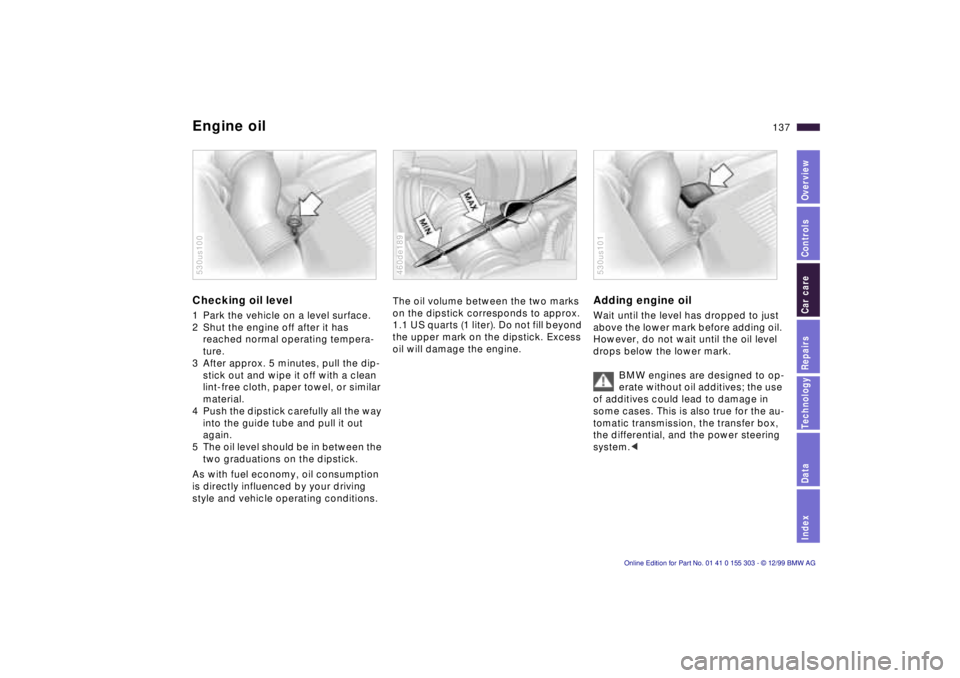
Engine oil Checking oil level 1 Park the vehicle on a level surface.
2 Shut the engine off after it has
reached normal operating tempera-
ture.
3 After approx. 5 minutes, pull the dip-
stick out and wipe it off with a clean
lint-free cloth, paper towel, or similar
material.
4 Push the dipstick carefully all the way
into the guide tube and pull it out
again.
5 The oil level should be in between the
two graduations on the dipstick.
As with fuel economy, oil consumption
is directly influenced by your driving
style and vehicle operating conditions. 530us100
The oil volume between the two marks
on the dipstick corresponds to approx.
1.1 US quarts (1 liter). Do not fill beyond
the upper mark on the dipstick. Excess
oil will damage the engine. 460de189
Adding engine oil Wait until the level has dropped to just
above the lower mark before adding oil.
However, do not wait until the oil level
drops below the lower mark.
BMW engines are designed to op-
erate without oil additives; the use
of additives could lead to damage in
some cases. This is also true for the au-
tomatic transmission, the transfer box,
the differential, and the power steering
system.< 530us101
Page 138 of 201
138n
Engine oil Specified engine oils The quality of the engine oil selected
has critical significance for the opera-
tion and service life of an engine. Based
on extensive testing, BMW recom-
mends only certain types of engine oil.
Use only approved "BMW High Perfor-
mance Synthetic Oil."
If you are unable to obtain "BMW High
Performance Synthetic Oil," you can
add small amounts of synthetic oil in
between oil changes. Use only oils with
the API SH specification or higher.
Ask your authorized BMW center
for details concerning the specific
"BMW High Performance Synthetic Oil"
or "synthetic oils" which have been ap-
proved.<
You can also call BMW of North Amer-
ica at 1-800-831-1117 or visit this web-
site: www.bmwusa.com to obtain this
information.
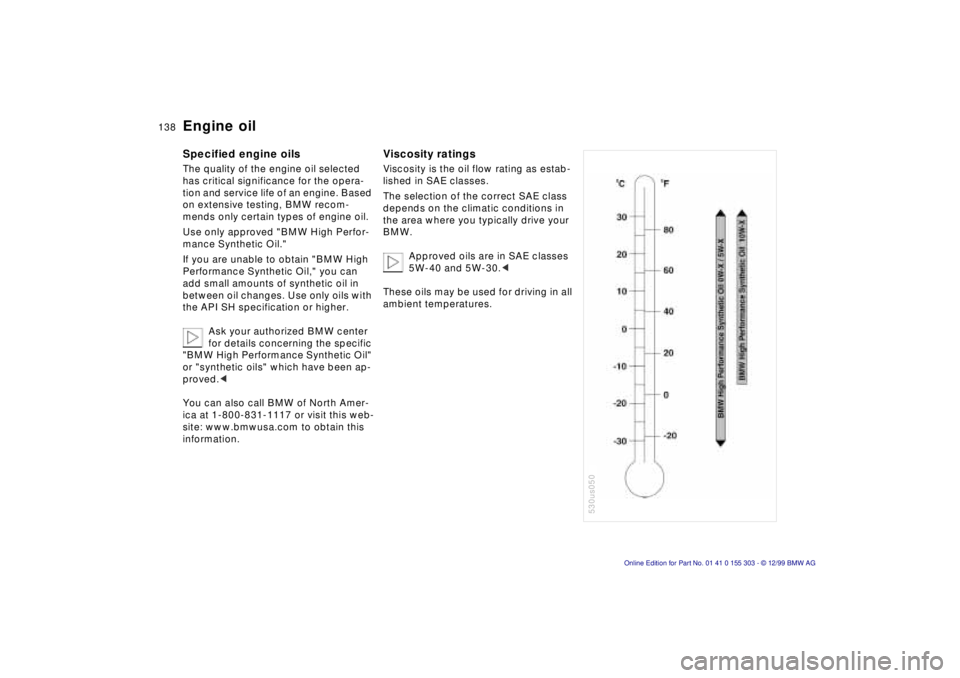
Viscosity ratings Viscosity is the oil flow rating as estab-
lished in SAE classes.
The selection of the correct SAE class
depends on the climatic conditions in
the area where you typically drive your
BMW.
Approved oils are in SAE classes
5W-40 and 5W-30.<
These oils may be used for driving in all
ambient temperatures.
530us050
Page 139 of 201

IndexDataTechnologyRepairsCar careControlsOverview
139n
Engine oil
Comply with the applicable envi-
ronmental laws regulating the dis-
posal of used oil.<
Recommendation: have the oil changed
by your BMW center.
Continuous exposure to used oil
has caused cancer in laboratory
testing. For this reason, any skin areas
that come into contact with oil should
be thoroughly washed with soap and
water.
Always store oils, grease and similar
materials so that they are inaccessible
to children. Comply with warning labels
and information on containers.<
Page 142 of 201
142n
The BMW Maintenance System has
been designed as a reliable means of
providing maximum driving and operat-
ing safety Ð and as cost-effectively as
possible for you.
Please keep in mind that regular main-
tenance is not only necessary for the
safety of your vehicle, but also plays a
significant role in maintaining the resale
value of the vehicle.
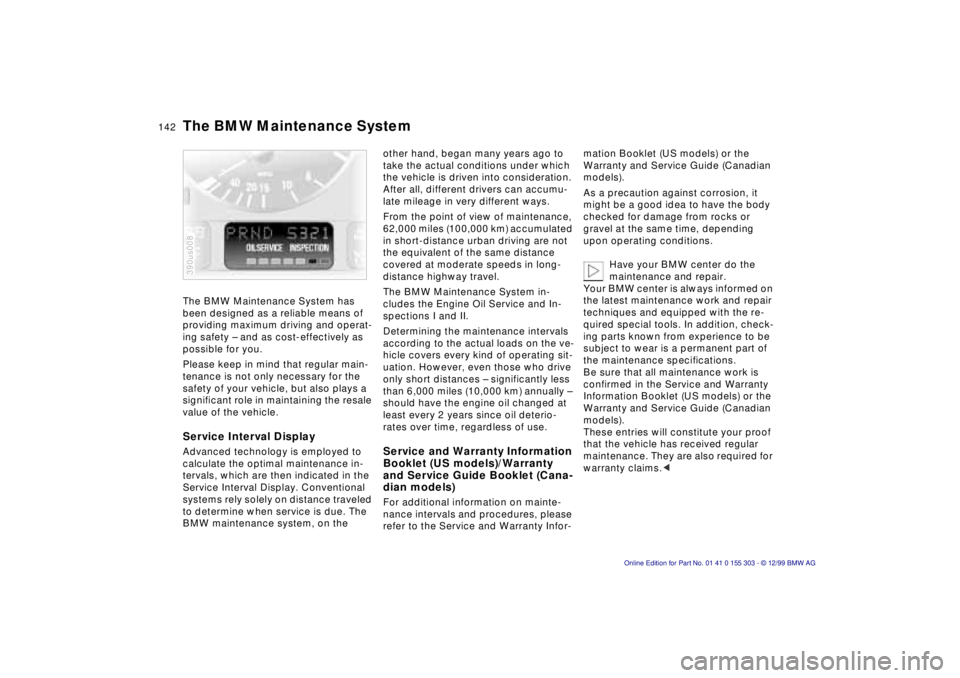
Service Interval Display Advanced technology is employed to
calculate the optimal maintenance in-
tervals, which are then indicated in the
Service Interval Display. Conventional
systems rely solely on distance traveled
to determine when service is due. The
BMW maintenance system, on the 390us008
other hand, began many years ago to
take the actual conditions under which
the vehicle is driven into consideration.
After all, different drivers can accumu-
late mileage in very different ways.
From the point of view of maintenance,
62,000 miles (100,000 km) accumulated
in short-distance urban driving are not
the equivalent of the same distance
covered at moderate speeds in long-
distance highway travel.
The BMW Maintenance System in-
cludes the Engine Oil Service and In-
spections I and II.
Determining the maintenance intervals
according to the actual loads on the ve-
hicle covers every kind of operating sit-
uation. However, even those who drive
only short distances Ð significantly less
than 6,000 miles (10,000 km) annually Ð
should have the engine oil changed at
least every 2 years since oil deterio-
rates over time, regardless of use. Service and Warranty Information
Booklet (US models)/Warranty
and Service Guide Booklet (Cana-
dian models) For additional information on mainte-
nance intervals and procedures, please
refer to the Service and Warranty Infor-mation Booklet (US models) or the
Warranty and Service Guide (Canadian
models).
As a precaution against corrosion, it
might be a good idea to have the body
checked for damage from rocks or
gravel at the same time, depending
upon operating conditions.
Have your BMW center do the
maintenance and repair.
Your BMW center is always informed on
the latest maintenance work and repair
techniques and equipped with the re-
quired special tools. In addition, check-
ing parts known from experience to be
subject to wear is a permanent part of
the maintenance specifications.
Be sure that all maintenance work is
confirmed in the Service and Warranty
Information Booklet (US models) or the
Warranty and Service Guide (Canadian
models).
These entries will constitute your proof
that the vehicle has received regular
maintenance. They are also required for
warranty claims.<
The BMW Maintenance System
Page 187 of 201

IndexDataTechnologyRepairsCar careControlsOverview
187n
Capacities
Notes
Fuel tank
Reserve gal. (liters)
gal. (liters) approx. 24.2 (approx. 92)
approx. 2.6 (approx. 10) Fuel specification: page 30
Windshield washer system
with headlamp washer system quarts (liters) approx. 8.2 (approx. 7.8) For details: page 136
Cooling system including
heater circuit quarts (liters) 12.7 (12.0) For details: page 140
Engine oil and filter change quarts (liters) 8.5 (8.0) "BMW High Performance
Synthetic Oil".
For details: page 138
Automatic transmission, transfer box
and differential Ð Ð Lifetime fluid, no fluid
change required
Page 192 of 201

Everything from A to ZAABS (Antilock Brake
System)119
Accessories6
Activated-charcoal filter95
Adaptive Transmission
Control (ATC)176
Adding engine oil137
Adding washer fluid136
Adjusting seats48
Adjusting the steering
wheel51
Adjusting the
temperature92
Air conditioner93
Air distribution92
Air nozzles90
Air outlets90
Air pressure30, 127
Air supply93
Airbags23, 57, 148, 176
Alarm system43
Antennas126
Antifreeze140
Antifreeze, radiator123
Antilock Brake System
(ABS)119
Anti-theft alarm system43
Anti-theft protection37
Approved gross vehicle
weight186
Aquaplaning118, 127
Ashtray103AUC (Automatic recirculated
air control)93
Automatic car washes143
Automatic climate
control90
Removing condensation
from the windows93
Automatic cruise control72
Automatic curb monitor54
Automatic dimming, interior
rearview mirror53
Automatic recirculated air
control (AUC)93
Automatic steering wheel
adjustment52
Automatic transmission with
Steptronic66
Average fuel
consumption80
Average speed80
Axle loads186
BBackup lamps67
Bulb replacement157
Battery165, 188
Capacity188
Charge166
Discharged170
Belts56
Beverage holder102
Blower93
BMW comfort seat50BMW High Performance
Synthetic Oil138
BMW sports seat50
BMW Universal
Transmitter98
Body-cavity protectant144
Brake fluid141
Brake hydraulic system22
Brake lamps, bulb
replacement157
Brake pads24
Brakes122
Malfunctions123
Break-in procedures116
Bulb replacement155
CCapacities187
Car Memory55
Car radio
reception126, 178
Car wash143
Care, exterior144
Care, interior146
Cargo area42, 107
Capacity186
Opening from the
inside41
Cargo area cover107
Cargo area lamps87
Cargo floor, pull-out111
Cargo loading112Caring for the vehicle
finish145
Catalytic converter118
CBC (Cornering Brake
Control)120
Cellular phones102, 126
refer to the separate
Owner's Manual
Center (high-mount) brake
lamp157
Central locking system36
Button40
Changing a tire160
Changing a wheel160
Charge indicator lamp22
Check air pressure30
CHECK button77
Check Control77
Check engine oil level137
Checking tire pressure30
Child restraint systems57
Child's seat57
Child-safety locks62
Cigarette lighter103
Clean the windshield70
Climate control in the rear
passenger area94
Clock, refer to the Radio or
Onboard Computer
Owner's Manual
Cockpit16
Code, refer to the Radio
Owner's Manual126
Page 193 of 201

Everything from A to Z
193n
IndexDataTechnologyRepairsCar careControlsOverview
Cold start64
Comfort seat50
Compartments101
Computer80
Configuring the settings55
Contamination on
paintwork144
Convenience operation of
windows and sliding/tilt
sunroof36
Convenience starting
feature64
Coolant123, 140
Coolant, antifreeze123
Cornering Brake Control
(CBC)120
Cruise control72
Cup holder102
Curb weight186DDashboard16
Data link connector for On-
Board Diagnostics150
Date, refer to the Radio or
Onboard Computer
Owner's Manual
Daytime-driving lamp86
DBC (Dynamic Brake
Control)24, 120Deep water117
Defrosting the windows93
Digital clock, refer to the
Radio or Onboard
Computer Owner's Manual
Digital sound processor179
Dimensions185
Dipstick, engine oil137
Disc brakes122
Displacement184
Display lighting86
Displays18, 20
Distance warning82
Diversity Antenna
system178
Divided rear backrest107
Door keys34
Door locks, care123
Doors
Manual operation36
Remote control38
Unlocking and locking36
Drive belts188
Driving through water117
Driving your BMW X5117
DSC (Dynamic Stability
Control)24, 83, 177
DSP amplifier, refer to the
Radio Owner's ManualDynamic Brake Control
(DBC)24, 120
Dynamic Stability Control
(DSC)24, 83, 177
EEBV (Electronic Brake Force
Distribution)120
Electric power windows45
Electrical malfunction
Fuel filler door168
Liftgate168
Sliding/Tilt sunroof168
Tailgate169
Electrical system188
Electronic Brake Force
Distribution (EBV)120
Electronic immobilizer35
Elements of operation16
Emergency operation
Doors36
Fuel filler door168
Sliding/Tilt sunroof168
Tailgate168
Energy Control75
Engine compartment134
Engine coolant140
Engine knock control30
Engine oil consumption137
Engine oil grades138
Engine oil level24Engine oil pressure22
Engine output184
Engine specifications184
Error indicators77
Exterior finish144
Exterior mirrors52
FFailure of an electrical
accessory167
Failure warnings77
Filler cap cover29
First-aid kit28
Fittings, tow-starting and
towing171
Flashlight101
Flat tire127, 160
Fog lamps87
Bulb replacement156
Folding rear backrest107
Footbrake122
Footwell lamps88
Bulb replacement158
Front area lighting88
Front fog lamps87
Front seat adjustment48
Frost protection,
radiator140
Fuel30
Fuel capacity187
Fuel display75