flat tire BMW X5 4.4I 2000 User Guide
[x] Cancel search | Manufacturer: BMW, Model Year: 2000, Model line: X5 4.4I, Model: BMW X5 4.4I 2000Pages: 201, PDF Size: 1.93 MB
Page 131 of 201

IndexDataTechnologyRepairsCar careControlsOverview
131n
Winter tires Snow chains
*
Choosing the right tire BMW recommends special winter tires
(M+S radial tires) for driving in adverse
winter road conditions. While the All-
Season tires with M+S designation that
are mounted as standard equipment
provide better winter traction than sum-
mer tires, they generally do not achieve
the performance of winter tires.
For safe tracking and steering re-
sponse, install winter tires made by the
same manufacturer having the same
tread configuration on all four wheels.
Mount only winter tires approved by
BMW. Any BMW center will be glad to
provide you with information for select-
ing the best winter tires for your partic-
ular driving conditions.
Do not exceed specified
maximum speeds
Never exceed the maximum
speed for which winter tires are
rated.
Unprofessional attempts by laymen to
service tires can lead to damage and
accidents.
Have this work performed by skilled
professionals only. Any BMW center
has the required technical knowledge
and the proper equipment and will be
happy to assist you.<
Tire condition, tire pressure Once winter tires wear to a tread depth
below 0.16 in (4 mm), their performance
under winter driving conditions deterio-
rates noticeably. Worn tires should
therefore be replaced for safety consid-
erations.
Comply with the specified tire inflation
pressures Ñ and be sure to have the
wheel and tire assemblies balanced
every time you change the tires. Storage Store tires in a cool, dry place, away
from light whenever possible. Protect
the tires against contact with oil, grease
and fuel.
The use of narrow-link BMW snow
chains is approved only in pairs on the
rear wheels and only with tire size
235/65 R 17. Comply with all manufac-
turer's safety precautions when mount-
ing the chains.
Page 163 of 201
IndexDataTechnologyRepairsCar careControlsOverview
163n
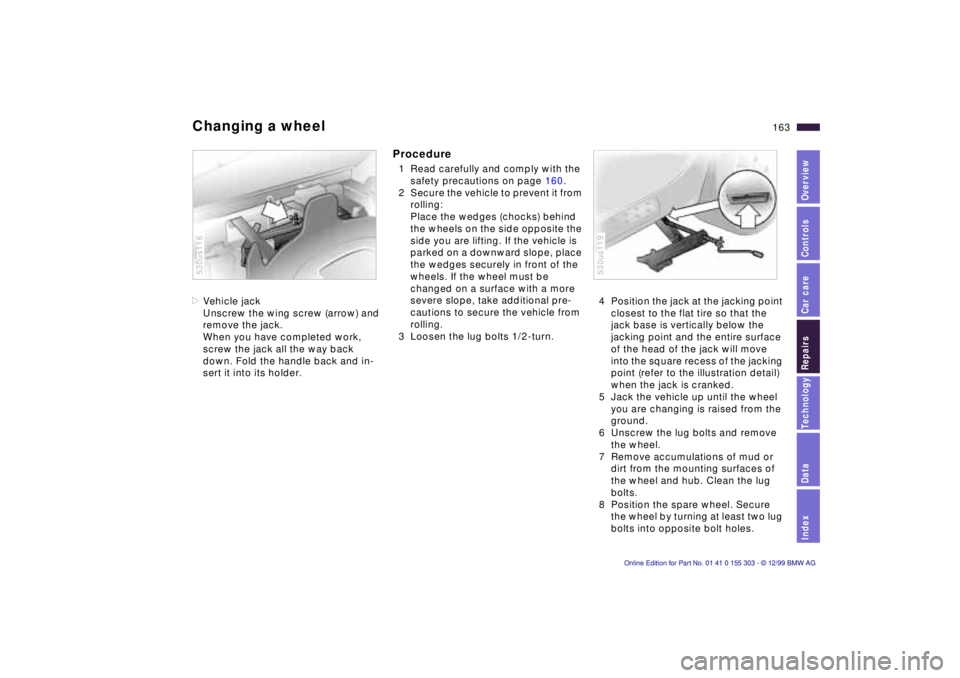
Changing a wheel >Vehicle jack
Unscrew the wing screw (arrow) and
remove the jack.
When you have completed work,
screw the jack all the way back
down. Fold the handle back and in-
sert it into its holder. 530us116
Procedure 1 Read carefully and comply with the
safety precautions on page 160.
2 Secure the vehicle to prevent it from
rolling:
Place the wedges (chocks) behind
the wheels on the side opposite the
side you are lifting. If the vehicle is
parked on a downward slope, place
the wedges securely in front of the
wheels. If the wheel must be
changed on a surface with a more
severe slope, take additional pre-
cautions to secure the vehicle from
rolling.
3 Loosen the lug bolts 1/2-turn. 4 Position the jack at the jacking point
closest to the flat tire so that the
jack base is vertically below the
jacking point and the entire surface
of the head of the jack will move
into the square recess of the jacking
point (refer to the illustration detail)
when the jack is cranked.
5 Jack the vehicle up until the wheel
you are changing is raised from the
ground.
6 Unscrew the lug bolts and remove
the wheel.
7 Remove accumulations of mud or
dirt from the mounting surfaces of
the wheel and hub. Clean the lug
bolts.
8 Position the spare wheel. Secure
the wheel by turning at least two lug
bolts into opposite bolt holes.
530us119
Page 164 of 201

164n
Changing a wheel 9 Screw in the remaining lug bolts.
Tighten all the bolts securely.
10 Lower the jack and remove it from
beneath the vehicle.
11 Tighten the lug bolts in a diagonal
pattern.
12 Check and correct the tire inflation
pressure at the earliest opportunity.
The vehicle jack is designed for
changing wheels only. Do not at-
tempt to raise another vehicle model
with it or to raise any load of any kind.
To do so could cause accidents and
personal injury.
To ensure continued safety, have the
tightness of the lug bolts checked with
a calibrated lug wrench [torque specifi-
cation: 94 ft-lb (130 Nm)] at the earliest
opportunity.<
Store the wheel and the tools in the or-
der opposite that for removal. Be sure
that the jack is first placed back into its
original position.
Before removing the support rod,
be sure that the tailgate is held
down firmly. If you fail to do so, it could
retract sharply upward and cause per-
sonal injury and vehicle damage.
After you remove the rod, close the tail-
gate carefully. Continue to hold it firmly
until it is completely closed.<
If light-alloy wheels other than original
BMW light-alloy wheels have been
mounted, it may be necessary to use
different lug bolts for those wheels.
Replace the defective tire as soon as
possible and have the new wheel/tire
balanced.
The spare wheel has a size
235/65 R 17 tire. If you have
mounted tires on your vehicle with a
different size, have wheels and tires of
the same size and specification rein-
stalled as soon as possible.
When the spare wheel is mounted, the
maximum speed rating is 130 mph
(210 km/h).<
Page 176 of 201
176n
Deceleration sensors continuously
monitor the physical forces acting upon
the vehicle. If, as the result of a frontal
collision, vehicle deceleration is
reached at which the protection of the
safety belts alone is no longer ade-
quate, the gas generators of the driver-
side and passenger-side airbags are ig-
nited simultaneously. However, the
passenger-side airbag is only triggered
if an additional sensor has recognized
that the passenger seat is occupied.
In the event of a side collision, the head
protection and side airbags in the front
or rear
* are triggered if necessary.
390de319
The airbags located under the marked
covers inflate and unfold in a matter of
a few milliseconds. In this process, they
tear through the designed separation
points of the upholstered covers or
press them out.
Because the inflation process must be
virtually instantaneous, it is necessarily
accompanied by a certain amount of ig-
nition and inflation noise. The gas re-
quired to inflate the airbags is not dan-
gerous, and the associated smoke then
dissipates.
The entire process is completed within
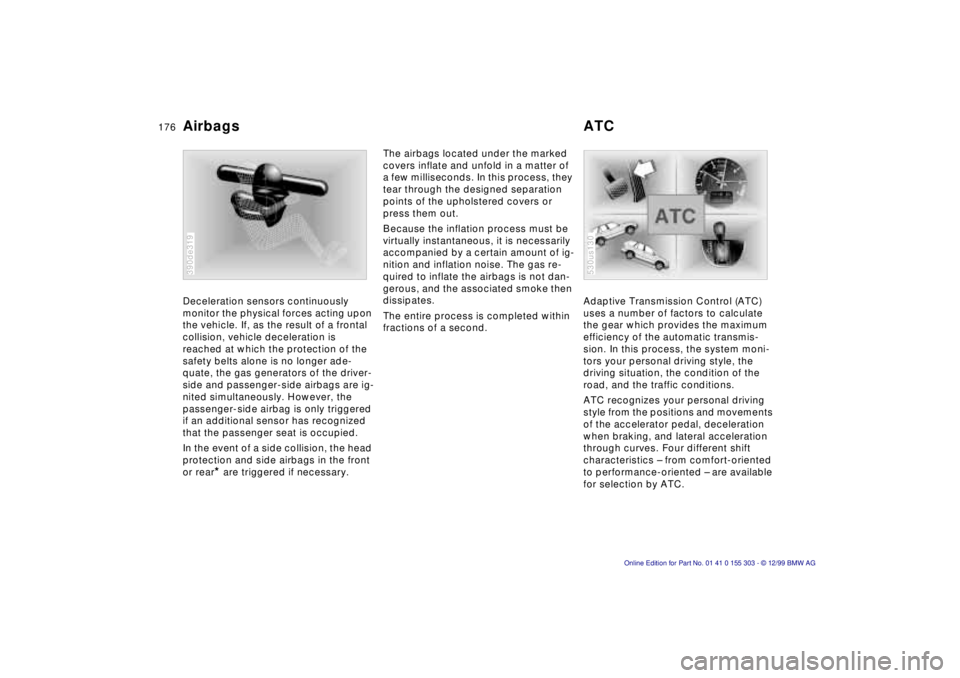
fractions of a second. Adaptive Transmission Control (ATC)
uses a number of factors to calculate
the gear which provides the maximum
efficiency of the automatic transmis-
sion. In this process, the system moni-
tors your personal driving style, the
driving situation, the condition of the
road, and the traffic conditions.
ATC recognizes your personal driving
style from the positions and movements
of the accelerator pedal, deceleration
when braking, and lateral acceleration
through curves. Four different shift
characteristics Ð from comfort-oriented
to performance-oriented Ð are available
for selection by ATC.
530us130
Airbags ATC
Page 193 of 201

Everything from A to Z
193n
IndexDataTechnologyRepairsCar careControlsOverview
Cold start64
Comfort seat50
Compartments101
Computer80
Configuring the settings55
Contamination on
paintwork144
Convenience operation of
windows and sliding/tilt
sunroof36
Convenience starting
feature64
Coolant123, 140
Coolant, antifreeze123
Cornering Brake Control
(CBC)120
Cruise control72
Cup holder102
Curb weight186DDashboard16
Data link connector for On-
Board Diagnostics150
Date, refer to the Radio or
Onboard Computer
Owner's Manual
Daytime-driving lamp86
DBC (Dynamic Brake
Control)24, 120Deep water117
Defrosting the windows93
Digital clock, refer to the
Radio or Onboard
Computer Owner's Manual
Digital sound processor179
Dimensions185
Dipstick, engine oil137
Disc brakes122
Displacement184
Display lighting86
Displays18, 20
Distance warning82
Diversity Antenna
system178
Divided rear backrest107
Door keys34
Door locks, care123
Doors
Manual operation36
Remote control38
Unlocking and locking36
Drive belts188
Driving through water117
Driving your BMW X5117
DSC (Dynamic Stability
Control)24, 83, 177
DSP amplifier, refer to the
Radio Owner's ManualDynamic Brake Control
(DBC)24, 120
Dynamic Stability Control
(DSC)24, 83, 177
EEBV (Electronic Brake Force
Distribution)120
Electric power windows45
Electrical malfunction
Fuel filler door168
Liftgate168
Sliding/Tilt sunroof168
Tailgate169
Electrical system188
Electronic Brake Force
Distribution (EBV)120
Electronic immobilizer35
Elements of operation16
Emergency operation
Doors36
Fuel filler door168
Sliding/Tilt sunroof168
Tailgate168
Energy Control75
Engine compartment134
Engine coolant140
Engine knock control30
Engine oil consumption137
Engine oil grades138
Engine oil level24Engine oil pressure22
Engine output184
Engine specifications184
Error indicators77
Exterior finish144
Exterior mirrors52
FFailure of an electrical
accessory167
Failure warnings77
Filler cap cover29
First-aid kit28
Fittings, tow-starting and
towing171
Flashlight101
Flat tire127, 160
Fog lamps87
Bulb replacement156
Folding rear backrest107
Footbrake122
Footwell lamps88
Bulb replacement158
Front area lighting88
Front fog lamps87
Front seat adjustment48
Frost protection,
radiator140
Fuel30
Fuel capacity187
Fuel display75
Page 194 of 201

Everything from A to ZFuel filler door release after
electrical fault168
Fuel gauge75
Fuel quality30
Fuel tank capacity187
Fuses167GGarage-door opener98
Gasoline30
General driving notes118
Glasses compartment102
Glove compartment101
Glove compartment lamp,
bulb replacement159
Gross vehicle weight186
Ground clearance117HHandbrake65
Handsfree system102
Hazard warning flashers28
Hazard warning triangle28
HDC (Hill Descent
Control)84
Head restraints49
Headlamp covers,
care143, 155
Headlamp flasher69
Headlamp washer
system136Headlamp washers70
Heated steering wheel96
Heating and ventilation90
Heating while stopped94
Heavy cargo112
Height185
Height adjustment, seats48
Height adjustment, steering
wheel51
HiFi system179
High beams25, 87
Bulb replacement155
Hill Descent Control
(HDC)84
Hood release133
Horn26, 27
Hydraulic Brake Assistant
refer to DBC24, 120
IIce warning74
Identification number141
Identification, tires130
Ignition key34
Ignition lock63
Independent ventilation97
Indicator lamps22
Inflation pressure31, 127
INSPECTION76
Instrument cluster18, 20
Instrument lighting86Instrument panel20
Instruments18
Integrated rear axle180
Interference indicators77
Interference, cellular
phone126
Interior and exterior rearview
mirrors, automatic
dimming feature53
Interior lamps87
Bulb replacement158
Remote control38
Interior mirror53
Interior motion sensor44
Interior rearview mirror,
automatic dimming
feature179
Interlock63
Intermittent switch69
JJump-starting170KKey Memory55
Keys34
Keys with radio remote
control34
Kickdown67
LLashing eyes42, 112
Leather care147
Length185
Level control
system24, 125, 181
License plate lamp, bulb
replacement158
Liftgate42, 168
Light switch86
Light-alloy wheel132
Lighter103
Lights-on warning86
Load-securing devices112
Louvers90
Low beams86
Bulb replacement155
Low-fuel warning lamp75
Lug bolts163
Lug wrench160
Luggage net42
Luggage space42
Luggage straps42
Lumbar support49MM+S tires131
Maintenance76, 142
Manual operation
Doors36
Liftgate168
Sliding/Tilt sunroof168
Tailgate169
Page 196 of 201

Everything from A to ZRestraint system57
Reverse67
Rims130
Roof load capacity186
Roof-mounted luggage
rack113
Rubber parts124SSafety belt height
adjustment56
Safety belt tensioner178
Safety belts56
Safety lock buttons40
Seat heating96
Seat memory54
Seat, power48
Securing cargo42, 112
Securing the load112
Selector lever, automatic
transmission66
Service and Warranty
Information Booklet (US
models)142
Service Interval
Display76, 142
Servotronic125
Shiftlock66
Shoulder support50
Shutting off the engine65
Side airbags57
Side Impact Head Protection
System57Side lamps86
Bulb replacement156
Ski bag105
Skidcontrol125
Sliding/Tilt sunroof46
Closing following an
electrical malfunction168
Convenience
operation36
Power loss47
Remote control38
Slippery roads124
Snow chains124, 131
Socket104
Spare key34
Spare tire161
Spare wheel161
Spark plugs188
Speaker102
Special wash program70
Speed control72
Speedometer18, 20
Sports seat50
Starting64
Starting problems
64, 118, 170, 171
Steering125
Steering wheel
adjustment51
Automatic52
Steering wheel heating96
Steering wheel lock63
Steering wheel memory54Steptronic66
Storage compartments101
Storage compartments in the
cargo area109
Storing the vehicle148
Summer tires130
Sun visors53
Switching off the vehicle65
Symbols4
Synthetic oils138
TTachometer75
Tail lamps157
Bulb replacement157
Tailgate42
Opening from the
inside41
Opening from the
outside41
Radio control
operation39
Release following an
electrical malfunction168
Technical
modifications6, 149
Telephone hookup102
Telephone, refer to the
separate Owner's Manual
Temperature display,
outside
temperature74, 80
Temperature gauge76Temperature layering94
Thigh support
adjustment50
Third brake lamp157
Tilt alarm38, 44
Tilt function, passenger side
mirror54
Timer, refer to the Radio
Owner's Manual
Tire code130
Tire damage127
Tire inflation
pressure31, 127
Tire renewal128
Tire rotation between front
and rear129
Tire specifications132
Tire tread127
Tools154
Torque184
Tow fittings171
Towing171
Tow-starting172
Track width185
Traction Control System
refer to DSC83
Transmission66
Tread depth, tires127
Trip odometer74
Turn signal indicator69
Bulb
replacement156, 157
Turning circle185
Page 198 of 201
Owner service proceduresAAdding brake fluid141
Adding coolant140
Adding engine oil137
Adding washer fluid136
Adjusting washer
nozzles136
Air pressure30, 127
Avoiding unintentional
alarms44BBattery, discharged170
Brakes, brake faults123CChanging a wheel160
Charging the battery166
Check Control77
Check oil level137
Checking tire pressure30DDeactivating the interior
motion sensor38, 44
Deactivating the tilt sensor
alarm system38, 44
Defrosting the windows93
Difficult steering125
Doors, manual operation36
EElectrical malfunction
Fuel filler door168
Liftgate168
Sliding/Tilt sunroof168
Tailgate169
Emergency operation
Doors36
Fuel filler door168
Liftgate168
Sliding/Tilt sunroof168
Tailgate169
Engine oil grades138FFailure messages77
Failure of an electrical
accessory167
Fault displays77
Filling the windshield washer
reservoir136
First-aid kit28
Fittings, tow-starting and
towing171
Flat tire160
Fog lamp, bulb
replacement156
Footwell lamps, bulb
replacement158
GGlove compartment lamp,
bulb replacement158HHazard warning flashers28
Hazard warning triangle28
Headlamp covers,
care143, 155
High beams, bulb
replacement155
Hood release133IIndicator lamps22
Interior lamps, bulb
replacement158JJump-starting170LLevel control system,
inactive125
License plate lamps, bulb
replacement158
Liftgate
Release following an
electrical malfunction168Low beams, bulb
replacement155
Lug wrench160
MMaintenance76, 142
Malfunction displays77
Manual operation
Doors36
Liftgate168
Sliding/Tilt sunroof168
Tailgate169OOil grades138
Onboard tool kit154PPressure, tires30, 127RRear window wiper, wiper
blade replacement154
Releasing the fuel filler door
following an electrical
malfunction168
Releasing the hood133
Releasing the tailgate
following an electrical
malfunction169
Page 199 of 201
Owner service procedures
199n
IndexDataTechnologyRepairsCar careControlsOverview
Removal aid for the spare
wheel161
Removing condensation
from the windows93
Replacement key34
Replacing bulbs155
Replacing fuses167
Replacing windshield wiper
blades154
Reservoir, washer
system136SSide lamps, bulb
replacement156
Sliding/Tilt sunroof
Closing following an
electrical malfunction168
Power loss47
Snow chains131
Spare key34
Spare tire161
Spare wheel
removal aid161
Starting assistance170
Starting problems
64, 118, 170, 171
TTailgate
Release following an
electrical malfunction169
Tire damage127
Tire inflation
pressure30, 127
Tools154
Tow fittings171
Towing171
Tow-starting172
Turn signal indicator, bulb
replacement156, 157UUse antifreeze, radiator140WWarning lamps22
Warning messages77
Wiper blade
replacement154
Work in the engine
compartment133
Page 200 of 201
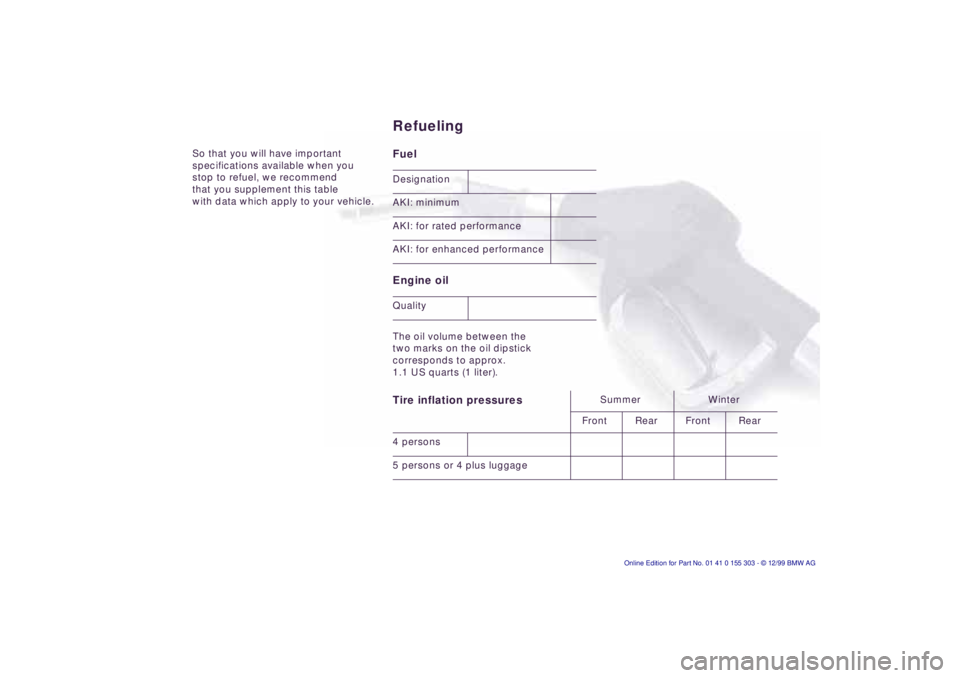
So that you will have important
specifications available when you
stop to refuel, we recommend
that you supplement this table
with data which apply to your vehicle.
Fuel
Engine oil The oil volume between the
two marks on the oil dipstick
corresponds to approx.
1.1 US quarts (1 liter). Designation
AKI: minimum
AKI: for rated performance
AKI: for enhanced performance
QualityTire inflation pressures
Summer Winter
Front Rear Front Rear
4 persons
5 persons or 4 plus luggage
Refueling