ECU BMW X5 4.4I 2001 Owner's Manual
[x] Cancel search | Manufacturer: BMW, Model Year: 2001, Model line: X5 4.4I, Model: BMW X5 4.4I 2001Pages: 223, PDF Size: 2.66 MB
Page 130 of 223

130n
Roof-mounted luggage rack
*
Roof-mounted luggage racks raise the
center of gravity of the vehicle when
they are loaded. For this reason, they
exercise a major effect on the vehicle's
handling and steering response.
You should therefore always remember
not to exceed the approved roof
weight, the approved gross vehicle
weight or the axle weights when
loading the rack. You will find the
specifications under "Technical Data"
on page 208.
Make sure that the load is not too
heavy, and attempt to distribute it
evenly. Always load the heaviest pieces
first (on the bottom). Be sure that
adequate clearance is maintained for
raising the sliding/tilt sunroof, and that
objects do not project into the opening
path of the liftgate. Secure the roof luggage correctly and
securely to prevent it from shifting or
being lost during driving (danger to
following traffic).
Drive smoothly. Avoid sudden accelera-
tion and braking maneuvers. Take
corners gently.
The roof load increases the aerody-
namic resistance. Increased fuel
consumption is the immediate results.
Page 138 of 223

138n
Antilock Brake System (ABS)should adapt road speed to the road
conditions.
On road surfaces that have a loose
surface layer on a firm base with good
traction (on gravel, deep sand or snow,
for example), braking distances may be
longer than with locked wheels.This is
also true if snow chains are mounted.
However, ABS continues to provide
enhanced vehicle stability and steering
response under these conditions. Information for your safety Not even ABS can suspend the laws of
physics. ABS alone cannot prevent
accidents when the brakes are applied
without an adequate safety distance
between vehicles, if the vehicle is
driven with excessive speed, or if aqua-
planing occurs. Responsibility for these
types of situations remains in the hands
(and at the feet) of the driver. You
should never allow the added safety of
ABS to lull you into a false sense of
security, or mislead you into taking
increased risks that could affect your
own safety and that of others.
Do not make any modifications to
the ABS system.
Service procedures on ABS are to be
performed by authorized technicians
only.<
Cornering Brake Control (CBC) CBC is an advanced engineering
design of the ABS. When braking
during cornering with high lateral accel-
eration, or when braking during a lane
change, vehicle stability is further
improved and the steering response is
enhanced. Electronic Brake Force
Distribution (EBV) EBV governs brake application pres-
sure at the rear wheels to achieve
stable brake response.
If the EBV fails (refer to the next
page), avoid full or "panic" brake
applications. Full or panic brake appli-
cations can result in overbraking at the
rear axle, and braking stability is no
longer ensured.<
Dynamic Brake Control (DBC)
If you apply the brakes rapidly, this
system automatically produces the
maximum braking force boost and thus
helps to achieve the shortest possible
braking distance during "panic stops."
All of the benefits of the ABS system
are exploited under these circum-
stances.
Do not reduce the pressure on the
brake pedal for the duration of the
brake application. When the brake
pedal is released, the DBC is deacti-
vated.
In the event of a malfunction,
the yellow warning lamp comes
on. Have the system checked
and repaired at your BMW
center as soon as possible.
Refer to the "Information for your
safety" covering the ABS system.
This information also applies in general
for DBC.<
Page 151 of 223
IndexDataTechnologyRepairsCar careControlsOverview
151n
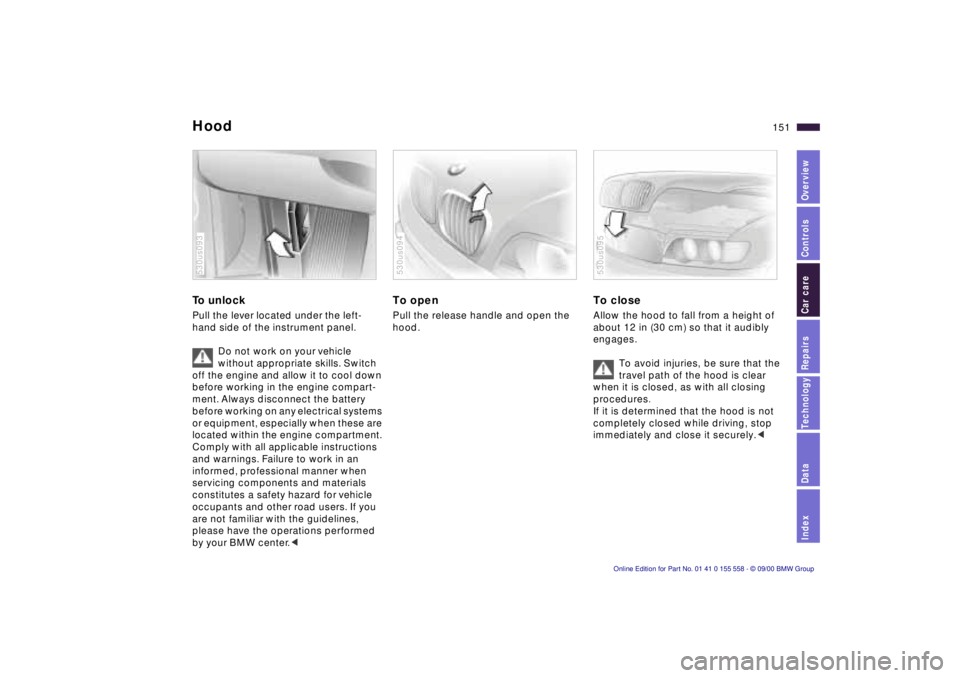
HoodTo unlock Pull the lever located under the left-
hand side of the instrument panel.
Do not work on your vehicle
without appropriate skills. Switch
off the engine and allow it to cool down
before working in the engine compart-
ment. Always disconnect the battery
before working on any electrical systems
or equipment, especially when these are
located within the engine compartment.
Comply with all applicable instructions
and warnings. Failure to work in an
informed, professional manner when
servicing components and materials
constitutes a safety hazard for vehicle
occupants and other road users. If you
are not familiar with the guidelines,
please have the operations performed
by your BMW center.< 530us093
To open Pull the release handle and open the
hood. 530us094
To close Allow the hood to fall from a height of
about 12 in (30 cm) so that it audibly
engages.
To avoid injuries, be sure that the
travel path of the hood is clear
when it is closed, as with all closing
procedures
.
If it is determined that the hood is not
completely closed while driving, stop
immediately and close it securely.< 530us095
Page 167 of 223

IndexDataTechnologyRepairsCar careControlsOverview
167n
Caring for your vehicleLeather care The leather
* upholstery used by BMW
is a natural product of the highest
quality, processed using state-of-the-
art methods to ensure that it will main-
tain its high quality for years to come,
provided that it is properly cared for.
Because this product is manufactured
using natural materials, you must make
allowance for its special characteristics
as well as for the peculiarities of its use
and care.
Regular periodic cleaning and care are
essential, as dust and road dirt act as
abrasives in the pores and creases of
the material. This leads to wear spots
and premature brittleness on the
surface of the leather. We therefore
suggest that you clean the leather with
a vacuum cleaner or dust cloth at
frequent intervals.
For cleaning use BMW leather cleaning
foam.
Since dirt and grease gradually affect
the protective surface layer of the
leather, the cleaned surfaces should be
treated with a BMW leather care agent.
This also acts as an antistatic agent. For protection against dampness or
moisture, treat the leather with a BMW
impregnating agent.
We recommend that you perform this
procedure twice a year on leather
exposed to normal use.
Spills should be wiped up immediately.
Remove grease and oil stains without
rubbing, but rather by dabbing with
spot remover.
If the upholstery is to be exposed to
intense sunlight or if the vehicle is to be
stored for an extended period, cover all
leather surfaces (or, better yet, the
windows) to prevent fading.
A full range of car-care products is
available from your BMW center.<
Cleaning agents can contain
substances that are dangerous or
pose health risks. For this reason,
always read and comply with the warn-
ings and danger notices on the
package.
Open the doors or windows on your
vehicle before cleaning the interior.
Never clean your vehicle with cleaning
agents (or solvents) not specifically
intended for this purpose.<
Page 174 of 223
174n
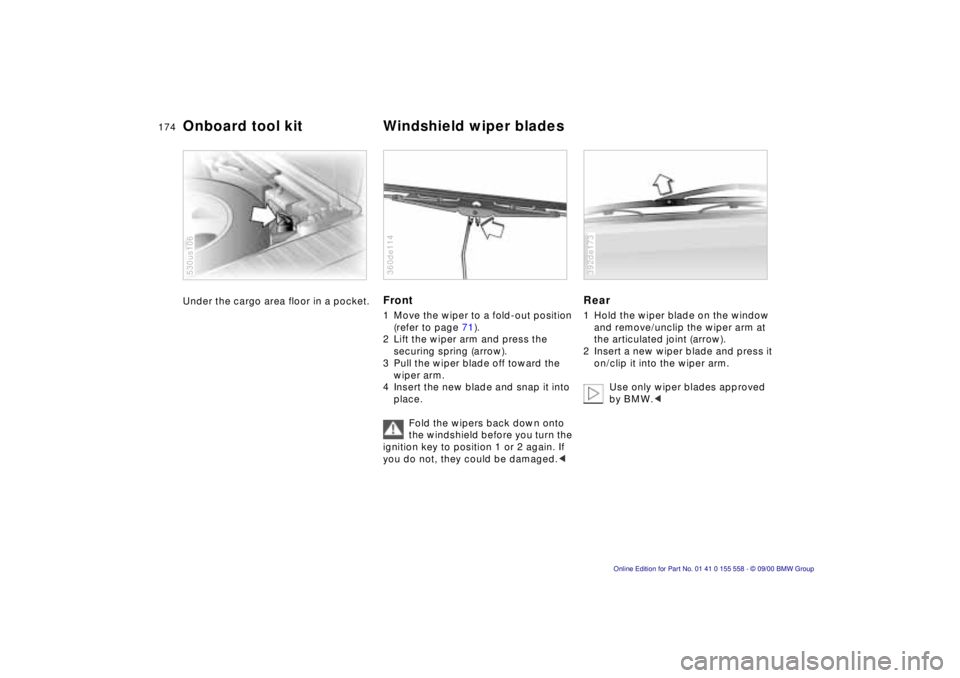
Under the cargo area floor in a pocket.
530us106
Front 1 Move the wiper to a fold-out position
(refer to page 71).
2 Lift the wiper arm and press the
securing spring (arrow).
3 Pull the wiper blade off toward the
wiper arm.
4 Insert the new blade and snap it into
place.
Fold the wipers back down onto
the windshield before you turn the
ignition key to position 1 or 2 again. If
you do not, they could be damaged.< 360de114
Rear
1 Hold the wiper blade on the window
and remove/unclip the wiper arm at
the articulated joint (arrow).
2 Insert a new wiper blade and press it
on/clip it into the wiper arm.
Use only wiper blades approved
by BMW.< 392de173
Onboard tool kit Windshield wiper blades
Page 175 of 223
IndexDataTechnologyRepairsCar careControlsOverview
175n
Lamps and bulbsThe lamps and bulbs are essential
factors contributing to the safety of your
vehicle. For this reason, follow the
instructions below carefully when
replacing a bulb. If you are not familiar
with any of the procedures, consult
your BMW center.
Do not touch the glass portion of a
new bulb with your bare hands
since even small amounts of impurities
burn into the surface and reduce the
service life of the bulb. Use a clean
cloth, paper napkin, or a similar mate-
rial, or hold the bulb by its metallic
base.<
A replacement bulb set is available from
your BMW center.
Whenever working on the elec-
trical system, switch off the elec-
trical accessory you are working on or
disconnect the cable from the negative
terminal of the battery. Failure to do this
could result in short circuits.
To prevent injuries and damage,
comply with any instructions provided
by the bulb manufacturer.<
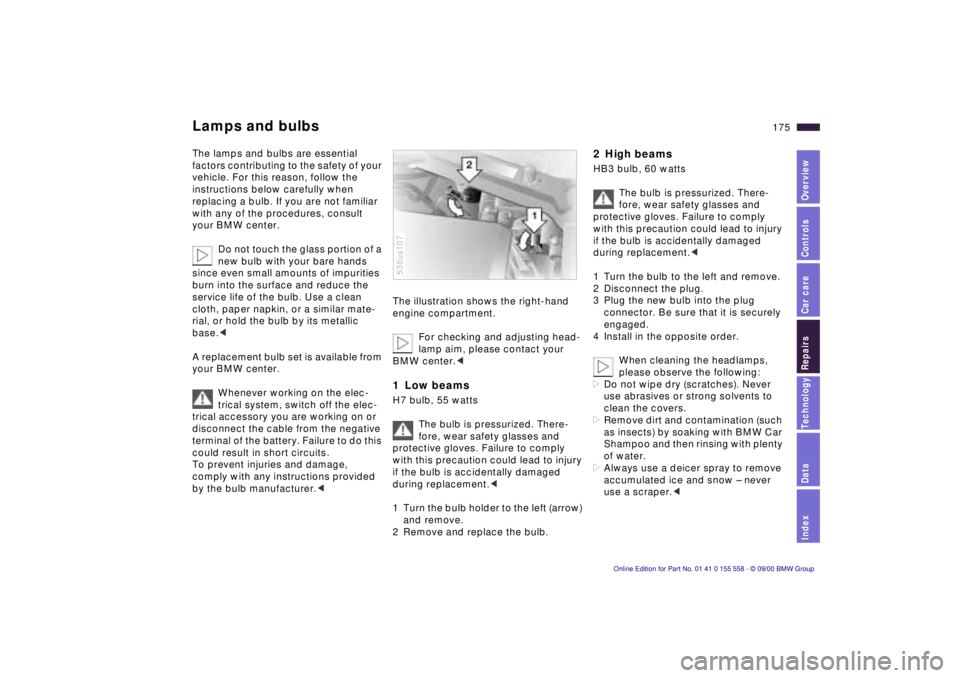
The illustration shows the right-hand
engine compartment.
For checking and adjusting head-
lamp aim, please contact your
BMW center.< 1 Low beams H7 bulb, 55 watts
The bulb is pressurized. There-
fore, wear safety glasses and
protective gloves. Failure to comply
with this precaution could lead to injury
if the bulb is accidentally damaged
during replacement.<
1 Turn the bulb holder to the left (arrow)
and remove.
2 Remove and replace the bulb. 530us107
2 High beamsHB3 bulb, 60 watts
The bulb is pressurized. There-
fore, wear safety glasses and
protective gloves. Failure to comply
with this precaution could lead to injury
if the bulb is accidentally damaged
during replacement.<
1 Turn the bulb to the left and remove.
2 Disconnect the plug.
3 Plug the new bulb into the plug
connector. Be sure that it is securely
engaged.
4 Install in the opposite order.
When cleaning the headlamps,
please observe the following:
>Do not wipe dry (scratches). Never
use abrasives or strong solvents to
clean the covers.
>Remove dirt and contamination (such
as insects) by soaking with BMW Car
Shampoo and then rinsing with plenty
of water.
>Always use a deicer spray to remove
accumulated ice and snow – never
use a scraper.<
Page 183 of 223
IndexDataTechnologyRepairsCar careControlsOverview
183n
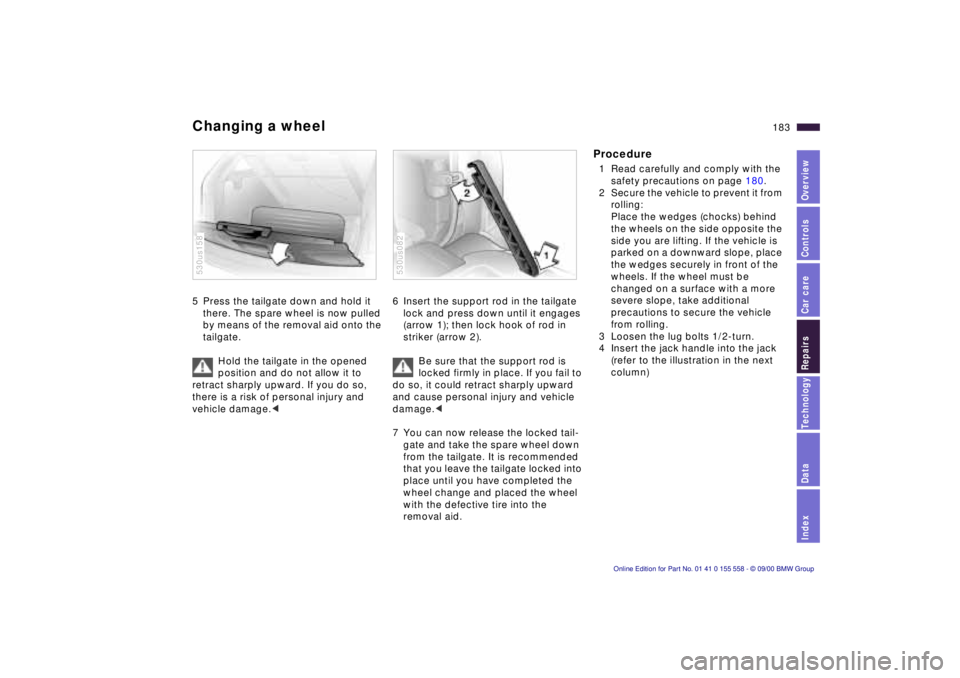
Changing a wheel5 Press the tailgate down and hold it
there. The spare wheel is now pulled
by means of the removal aid onto the
tailgate.
Hold the tailgate in the opened
position and do not allow it to
retract sharply upward. If you do so,
there is a risk of personal injury and
vehicle damage.< 530us158
6 Insert the support rod in the tailgate
lock and press down until it engages
(arrow 1); then lock hook of rod in
striker (arrow 2).
Be sure that the support rod is
locked firmly in place. If you fail to
do so, it could retract sharply upward
and cause personal injury and vehicle
damage.<
7 You can now release the locked tail-
gate and take the spare wheel down
from the tailgate. It is recommended
that you leave the tailgate locked into
place until you have completed the
wheel change and placed the wheel
with the defective tire into the
removal aid.530us082
Procedure1 Read carefully and comply with the
safety precautions on page 180.
2 Secure the vehicle to prevent it from
rolling:
Place the wedges (chocks) behind
the wheels on the side opposite the
side you are lifting. If the vehicle is
parked on a downward slope, place
the wedges securely in front of the
wheels. If the wheel must be
changed on a surface with a more
severe slope, take additional
precautions to secure the vehicle
from rolling.
3 Loosen the lug bolts 1/2-turn.
4 Insert the jack handle into the jack
(refer to the illustration in the next
column)
Page 184 of 223
184n
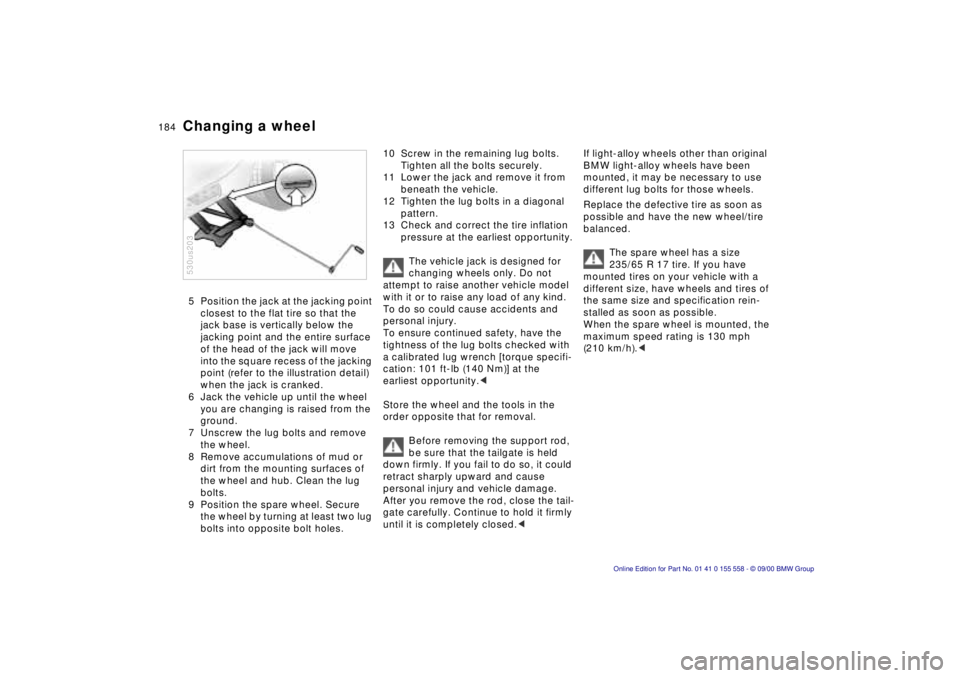
Changing a wheel5 Position the jack at the jacking point
closest to the flat tire so that the
jack base is vertically below the
jacking point and the entire surface
of the head of the jack will move
into the square recess of the jacking
point (refer to the illustration detail)
when the jack is cranked.
6 Jack the vehicle up until the wheel
you are changing is raised from the
ground.
7 Unscrew the lug bolts and remove
the wheel.
8 Remove accumulations of mud or
dirt from the mounting surfaces of
the wheel and hub. Clean the lug
bolts.
9 Position the spare wheel. Secure
the wheel by turning at least two lug
bolts into opposite bolt holes.530us203
10 Screw in the remaining lug bolts.
Tighten all the bolts securely.
11 Lower the jack and remove it from
beneath the vehicle.
12 Tighten the lug bolts in a diagonal
pattern.
13 Check and correct the tire inflation
pressure at the earliest opportunity.
The vehicle jack is designed for
changing wheels only. Do not
attempt to raise another vehicle model
with it or to raise any load of any kind.
To do so could cause accidents and
personal injury.
To ensure continued safety, have the
tightness of the lug bolts checked with
a calibrated lug wrench [torque specifi-
cation: 101 ft-lb (140 Nm)] at the
earliest opportunity.<
Store the wheel and the tools in the
order opposite that for removal.
Before removing the support rod,
be sure that the tailgate is held
down firmly. If you fail to do so, it could
retract sharply upward and cause
personal injury and vehicle damage.
After you remove the rod, close the tail-
gate carefully. Continue to hold it firmly
until it is completely closed.<
If light-alloy wheels other than original
BMW light-alloy wheels have been
mounted, it may be necessary to use
different lug bolts for those wheels.
Replace the defective tire as soon as
possible and have the new wheel/tire
balanced.
The spare wheel has a size
235/65 R 17 tire. If you have
mounted tires on your vehicle with a
different size, have wheels and tires of
the same size and specification rein-
stalled as soon as possible.
When the spare wheel is mounted, the
maximum speed rating is 130 mph
(210 km/h).<
Page 186 of 223

186n
BatteryCharging the battery Charge the battery in the vehicle only
when the engine is not running. Use the
connections provided in the engine
compartment (for correct connections,
refer to "Jump-starting" on page 190).
The service life specified for the
battery can be achieved only if it
is always kept adequately charged.
Have the charge condition of the
battery checked frequently if the vehicle
is used primarily for driving short
distances.<
Before performing any work on
the electrical system, disconnect
the cable from the negative terminal. If
you do not, short circuits can create the
risk of fire or personal injury.<
If you plan to park the vehicle longer
than 4 weeks, have the battery discon-
nected from the vehicle's electrical
system by disconnecting the cable from
the negative terminal. Then have the
battery charged with an appropriate
battery charger.
If the vehicle will not be driven for a
period longer than 12 weeks, have the
battery removed, charged and store it
in a clean and cool (frost-free) area.
Recharge the battery at least every
three months during storage. Also,
recharge the battery before it is
installed. If you fail to do so, it will not
be serviceable. Every time the battery is
discharged, especially over extended
periods, its service life is reduced. Do not disconnect the battery
when the engine is running. If
you do so, the ensuing voltage surge
will damage the vehicle's onboard elec-
tronics.
Do not make any modifications in the
wires to the positive terminal. If you do
so, the protective function of the safety
battery terminal is no longer ensured.
Repair and disposal must be performed
by trained technicians only.<
Return used batteries to a recy-
cling point or your BMW center.
Maintain the battery in an upright posi-
tion for transport and storage. Secure
the battery against tilting during trans-
port.<
Page 217 of 223

Everything from A to Z217n
Index
Data
Technology
Repairs
Car care
Controls
Overview
I
Ice warning 76
Identification number 161
Identification, tires 148
Ignition key 34
Ignition lock 64
Independent ventilation 87
Independent ventilation system 114
Indicator lamps 22
Inflation pressure 31, 145
INSPECTION 78
Instrument cluster 18, 20
Instrument lighting 97
Instrument panel 18, 20
Integrated rear suspension 201
Intensive cleaning system 72
Interference indicators 79
Interference, cellular phone 144
Interior lamps 98
bulb replacement 178t
remote control 38
Interior mirror 54
Interior motion sensor 44
Interior rearview mirror, automatic dimming
feature 199
Interlock 64
Intermittent wipe 71
J
Jack181, 183
Jump-starting 190t
K
Key Memory 56
Keys 34
Keys with radio remote control 34
Kickdown 69
L
Lamps and bulbs 175
Lashing eyes 129
LATCH attachment of the child seat 63
Leather care 167
Length 207
Level control system 24, 201
inactive 143t
License plate lamps, bulb replacement 178t
Liftgate 41, 42
release following an
electrical
malfunction 188t
Light switch 97
Light-alloy wheel 150
Lighter 120
LIGHTS ON warning 97LIMIT
88
Load-securing devices 129
Louvers 100, 106
Low beams 97
bulb replacement 175t
Low-fuel warning lamp 77
Lug bolts 183
Lug wrench 180t
Luggage compartment, refer to cargo area 124
Luggage net 42
Luggage straps 42
Lumbar support 50
M
M+S radial tires149
Maintenance 78t , 162 t
Malfunction displays 79t
Manual operation doors 36t
liftgate 188t
sliding/tilt sunroof 188t
tailgate 189t
Manual transmission 67
Master key 34
Maximum cooling 109
Mechanical seat 49
Memo 86
Memory 55
Microfilter 104, 112
MID (Multi-Information Display) 84 Mirror defrosting
53
Mirror memory 55
Mirrors 53
Mobile phone 144
Modifications, technical 6, 169
Moonroof 46
Motion sensor, interior 44
Multifunction steering wheel 26
Multi-Information Display (MID) 84
N
Navigation system, refer to
the separate Owner's
Manual
O
OBD interface socket 170
Odometer 76
Oil additives 157
consumption 157t
dipstick 157t
grades 158
Oil change interval, refer to
the Service and Warranty
Information Booklet (US
models) or to the Warranty
and Service Guide Booklet
(Canadian models)