transmission BMW X5 4.4I 2001 Owner's Manual
[x] Cancel search | Manufacturer: BMW, Model Year: 2001, Model line: X5 4.4I, Model: BMW X5 4.4I 2001Pages: 223, PDF Size: 2.66 MB
Page 180 of 223
180n
Changing a wheel
Safety measures in the event of a
flat tire or wheel change: stop the
vehicle as far as possible from passing
traffic. Park on a firm, flat, surface.
Switch on the hazard warning flashers.
Turn the steering wheel to the straight-
ahead position, remove the key and
engage the steering lock. Shift into 1st or
reverse (selector lever in "Park" with
automatic transmission) and engage the
parking brake. All passengers should be
outside the vehicle and well away from
your immediate working area (behind a
guardrail, for instance). If a warning
triangle or portable hazard warning lamp
is required, set it up on the roadside at
an appropriate distance from the rear of
the vehicle. Comply with all safety guide-
lines and regulations. Change the wheel
only on a level, firm surface which is not
slippery. Avoid jacking the vehicle up on
a soft or slippery surface (snow, ice, very
smooth surfaces, etc.), since it could
slide sideways. Position the jack on a
firm support surface. Do not place
wooden blocks or similar objects under
the jack. If this is done, the jack might not
be able to reach its full support capacity
because of the limited height. Do not lie
under the vehicle or start the engine
when the vehicle is supported by the
jack. Failure to comply with this creates a
risk of fatal injury.<
What you will need In order to avoid rattling noises later,
note the position of the tools when you
remove them and return them to their
original position when you are through
using them.
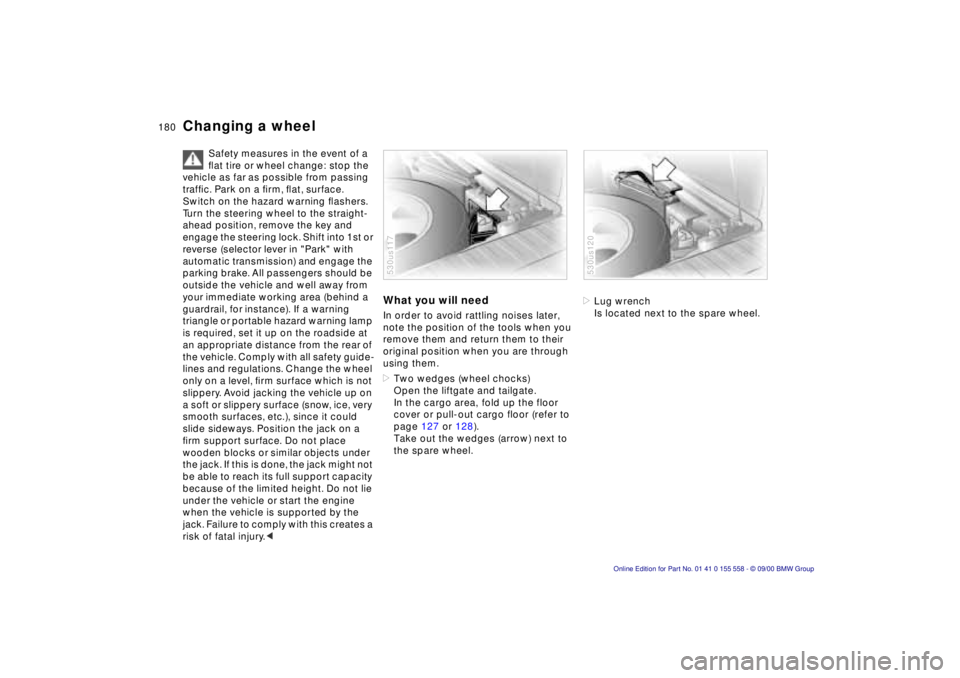
>Two wedges (wheel chocks)
Open the liftgate and tailgate.
In the cargo area, fold up the floor
cover or pull-out cargo floor (refer to
page 127 or 128).
Take out the wedges (arrow) next to
the spare wheel. 530us117
>Lug wrench
Is located next to the spare wheel. 530us120
Page 192 of 223
192n
Towing the vehicle
The towed vehicle should always
be the lighter of the two vehicles.
If this is not the case, it is no longer
possible to control vehicle response.<
Tow-starting It is not possible to start the engine of a
vehicle equipped with an automatic
transmission by towing or pushing.
For instructions on jump starting: refer
to page 190.
Never attempt to use your vehicle to
push another car. If you do so, damage
to the energy-absorbing bumpers could
result.
Towing a vehicle with automatic
transmission1 Place the selector lever in position N.
2 Towing speed:
Max. 45 mph (70 km/h).
3 Towing distance:
Max. 95 miles (150 km).
4 Leave the ignition key at position 1 to
ensure that the brake lamps, turn
signals, horn and windshield wipers
remain operative, and to prevent the
steering lock from engaging.
5 Switch on the hazard warning
flashers (comply with country-
specific regulations).
Find some means of identifying the
vehicle in tow, for instance, place a sign
or warning triangle in the rear window.
Make sure that the ignition key
remains in position 1 even when
the electrical system has failed. This will
prevent the steering lock from
engaging. The steering and brakes are
without power assist when the engine is
not running. This means that increased
effort is required for steering and
braking.<
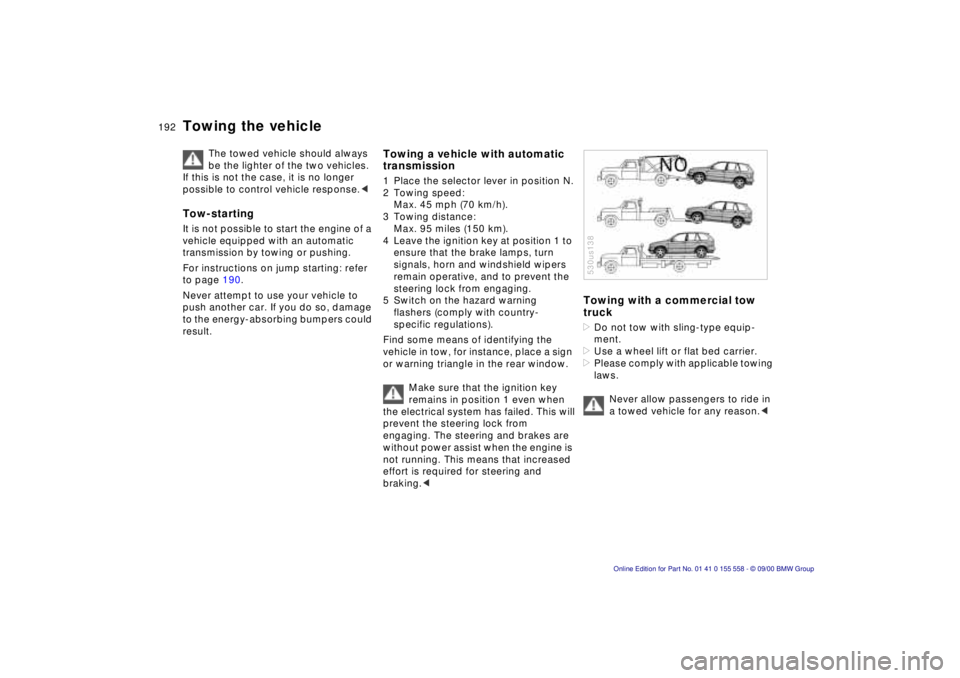
Towing with a commercial tow
truck>Do not tow with sling-type equip-
ment.
>Use a wheel lift or flat bed carrier.
>Please comply with applicable towing
laws.
Never allow passengers to ride in
a towed vehicle for any reason.< 530us138
Page 195 of 223
IndexDataTechnologyRepairsCar careControlsOverview
Overview
Controls and features
Operation, care
and maintenance
Owner service procedures
Technical data
Index Advanced technology
195n
Airbags196
Adaptive Transmission Control
(ATC)196
Four-wheel drive197
Dynamic Stability Control
(DSC)197
Radio reception198
Safety belt tensioner198
DSP sound system199
Rearview mirrors with automatic
dimmer199
Rain sensor200
Front axle200
Integrated rear suspension201
Level control system201
Xenon lamps202
Technology
Page 196 of 223
196n
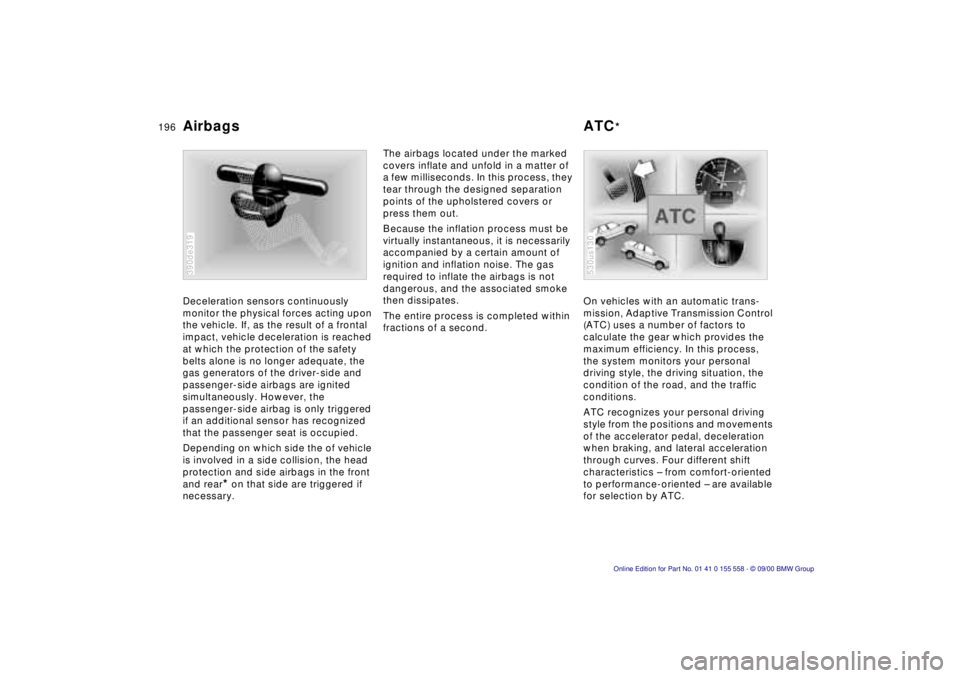
Deceleration sensors continuously
monitor the physical forces acting upon
the vehicle. If, as the result of a frontal
impact, vehicle deceleration is reached
at which the protection of the safety
belts alone is no longer adequate, the
gas generators of the driver-side and
passenger-side airbags are ignited
simultaneously. However, the
passenger-side airbag is only triggered
if an additional sensor has recognized
that the passenger seat is occupied.
Depending on which side the of vehicle
is involved in a side collision, the head
protection and side airbags in the front
and rear
* on that side are triggered if
necessary.
390de319
The airbags located under the marked
covers inflate and unfold in a matter of
a few milliseconds. In this process, they
tear through the designed separation
points of the upholstered covers or
press them out.
Because the inflation process must be
virtually instantaneous, it is necessarily
accompanied by a certain amount of
ignition and inflation noise. The gas
required to inflate the airbags is not
dangerous, and the associated smoke
then dissipates.
The entire process is completed within
fractions of a second. On vehicles with an automatic trans-
mission, Adaptive Transmission Control
(ATC) uses a number of factors to
calculate the gear which provides the
maximum efficiency. In this process,
the system monitors your personal
driving style, the driving situation, the
condition of the road, and the traffic
conditions.
ATC recognizes your personal driving
style from the positions and movements
of the accelerator pedal, deceleration
when braking, and lateral acceleration
through curves. Four different shift
characteristics – from comfort-oriented
to performance-oriented – are available
for selection by ATC.
530us130
Airbags ATC
*
Page 197 of 223
IndexDataTechnologyRepairsCar careControlsOverview
197n
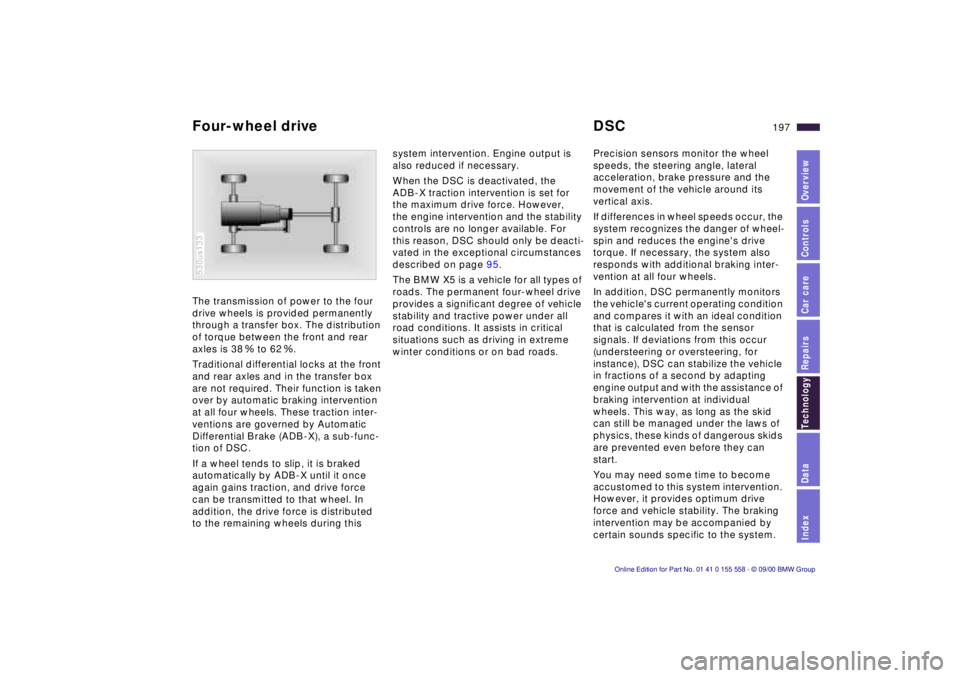
The transmission of power to the four
drive wheels is provided permanently
through a transfer box. The distribution
of torque between the front and rear
axles is 38% to 62%.
Traditional differential locks at the front
and rear axles and in the transfer box
are not required. Their function is taken
over by automatic braking intervention
at all four wheels. These traction inter-
ventions are governed by Automatic
Differential Brake (ADB-X), a sub-func-
tion of DSC.
If a wheel tends to slip, it is braked
automatically by ADB-X until it once
again gains traction, and drive force
can be transmitted to that wheel. In
addition, the drive force is distributed
to the remaining wheels during this
530us133
system intervention. Engine output is
also reduced if necessary.
When the DSC is deactivated, the
ADB-X traction intervention is set for
the maximum drive force. However,
the engine intervention and the stability
controls are no longer available. For
this reason, DSC should only be deacti-
vated in the exceptional circumstances
described on page 95.
The BMW X5 is a vehicle for all types of
roads. The permanent four-wheel drive
provides a significant degree of vehicle
stability and tractive power under all
road conditions. It assists in critical
situations such as driving in extreme
winter conditions or on bad roads. Precision sensors monitor the wheel
speeds, the steering angle, lateral
acceleration, brake pressure and the
movement of the vehicle around its
vertical axis.
If differences in wheel speeds occur, the
system recognizes the danger of wheel-
spin and reduces the engine's drive
torque. If necessary, the system also
responds with additional braking inter-
vention at all four wheels.
In addition, DSC permanently monitors
the vehicle's current operating condition
and compares it with an ideal condition
that is calculated from the sensor
signals. If deviations from this occur
(understeering or oversteering, for
instance), DSC can stabilize the vehicle
in fractions of a second by adapting
engine output and with the assistance of
braking intervention at individual
wheels. This way, as long as the skid
can still be managed under the laws of
physics, these kinds of dangerous skids
are prevented even before they can
start.
You may need some time to become
accustomed to this system intervention.
However, it provides optimum drive
force and vehicle stability. The braking
intervention may be accompanied by
certain sounds specific to the system.
Four-wheel drive DSC
Page 208 of 223

with manual transmission
with automatic transmission lbs. (kg)
lbs.")
208nWeights
BMW X5 3.0i BMW X5 4.4i
Curb weight (with one person, ready for operation, full tank of fuel, o\
ptions not included)
with manual transmission
with automatic transmission lbs. (kg)
lbs. (kg)4,519 (2050)
4,563 (2070) –
4,795 (2,175)
Approved gross vehicle weight
with manual transmission
with automatic transmission lbs. (kg)
lbs. (kg)6,005 (2,724)
6,005 (2,724) –
6,005 (2,724)
Approved front axle weight lbs. (kg) 2,787 (1,264) 2,787 (1,264)
Approved rear axle weight lbs. (kg) 3,307 (1,500) 3,307 (1,500)
Approved roof load capacity lbs. (kg) 220 (100)
Never exceed either the approved axle weights or the gross vehicle weigh\
t.
Cargo area capacity cu ft (l) 16.1 - 54.4 (455 - 1,540)
Page 209 of 223

Index
Data
Technology
Repairs
Car care
Controls
Overview
209nCapacities
Notes
Fuel tank
Reserve gal. (liters)
gal. (liters)approx. 24.6 (approx. 93)
approx. 2.0 (approx. 8) – BMW X5 3.0i
approx. 2.5 (approx. 10) – BMW X5 4.4i Fuel specification: page
30
Windshield washer system
with headlamp washer system quarts (liters) approx. 8.2 (approx. 7.8) For details: page
156
Cooling system including
heater circuit quarts (liters) 11.1 (10.5) – BMW X5 3.0i
12.7 (12.0) – BMW X5 4.4i For details: page
160
Engine oil and filter change quarts (liters) 7.9 (7.5) – BMW X5 3.0i 8.5 (8.0) – BMW X5 4.4i"BMW High Performance
Synthetic Oil"
For details: page
158
Manual and automatic transmission,
transfer box and differential – – Lifetime fluid, no fluid
change required
Page 214 of 223

Everything from A to Z
A
ABS (Antilock Brake System) 23, 137
Accessories 6
Activated-charcoal filter 112
Adaptive Transmission Control (ATC) 196
ADB-X (Automatic Differential Brake) 197
Adding brake fluid 161t
coolant 160t
engine oil 157t
washer fluid 156t
Adjusting head restraints 49t
mirrors 53t
seats 48t
steering wheel 52t
temperature 102 t, 108 t
washer nozzles 156t
Air conditioner 100
Air distribution 102, 108
Air outlets 100, 106
Air pressure 30t , 145 t
Air supply 102, 109
Airbags 23, 58 , 168 , 196
Alarm system 43
Antennas 144
Antifreeze 160
radiator 141 Antilock Brake System
(ABS) 23, 137
Anti-theft alarm system 43
Anti-theft protection 37
Approved gross vehicle weight 208
Aquaplaning 136, 145
Arrival time 90
Ashtray front 120
rear 121
AUC (Automatic recirculated air control) 110
Automatic car washes 163
Automatic climate control 106
removing condensation
from the windows 109
Automatic cruise control 74
Automatic curb monitor 55
Automatic Differential Brake (ADB-X) 197
Automatic dimming, interior rearview mirror 54
Automatic recirculated air
control (AUC) 110
Automatic transmission with Steptronic 68
Average fuel consumption 82
Average speed 82, 91 Avoiding unintentional
alarms 44t
Axle loads 208
B
Backup lamps 67
bulb replacement 177t
Battery 185, 210
capacity 210
charge 186t
discharged 190t
Belts 57
Beverage holder 119
Blower 102, 109
BMW comfort seat 50
BMW High Performance Synthetic Oil 158
BMW sports seat 51
BMW Universal Transmitter 115
Body-cavity protectant 164
Brake 140
fluid 161t
hydraulic system 22
malfunctions 141t
pads 24, 141
Brake system 141
bulb replacement 177t
Break-in procedures 134
Bulbs and lamps 175
C
California Proposition
65 Warning 169
Can holder, refer to cup holder 119
Capacities 209
Car jack 180
Car keys 34
Car Memory 56
Car radio reception 144, 198
Car vacuum cleaner power outlet 127t
socket 121t
Car wash 163
Care exterior 164
interior 166
Cargo area 42, 124
capacity 208
cover 124
lamps 98
opening from the
inside 41
Cargo floor, pull-out 128
Cargo loading 129
Caring for the vehicle finish 165
Catalytic converter 136
CBC (Cornering Brake Control) 138
Page 217 of 223

Everything from A to Z217n
Index
Data
Technology
Repairs
Car care
Controls
Overview
I
Ice warning 76
Identification number 161
Identification, tires 148
Ignition key 34
Ignition lock 64
Independent ventilation 87
Independent ventilation system 114
Indicator lamps 22
Inflation pressure 31, 145
INSPECTION 78
Instrument cluster 18, 20
Instrument lighting 97
Instrument panel 18, 20
Integrated rear suspension 201
Intensive cleaning system 72
Interference indicators 79
Interference, cellular phone 144
Interior lamps 98
bulb replacement 178t
remote control 38
Interior mirror 54
Interior motion sensor 44
Interior rearview mirror, automatic dimming
feature 199
Interlock 64
Intermittent wipe 71
J
Jack181, 183
Jump-starting 190t
K
Key Memory 56
Keys 34
Keys with radio remote control 34
Kickdown 69
L
Lamps and bulbs 175
Lashing eyes 129
LATCH attachment of the child seat 63
Leather care 167
Length 207
Level control system 24, 201
inactive 143t
License plate lamps, bulb replacement 178t
Liftgate 41, 42
release following an
electrical
malfunction 188t
Light switch 97
Light-alloy wheel 150
Lighter 120
LIGHTS ON warning 97LIMIT
88
Load-securing devices 129
Louvers 100, 106
Low beams 97
bulb replacement 175t
Low-fuel warning lamp 77
Lug bolts 183
Lug wrench 180t
Luggage compartment, refer to cargo area 124
Luggage net 42
Luggage straps 42
Lumbar support 50
M
M+S radial tires149
Maintenance 78t , 162 t
Malfunction displays 79t
Manual operation doors 36t
liftgate 188t
sliding/tilt sunroof 188t
tailgate 189t
Manual transmission 67
Master key 34
Maximum cooling 109
Mechanical seat 49
Memo 86
Memory 55
Microfilter 104, 112
MID (Multi-Information Display) 84 Mirror defrosting
53
Mirror memory 55
Mirrors 53
Mobile phone 144
Modifications, technical 6, 169
Moonroof 46
Motion sensor, interior 44
Multifunction steering wheel 26
Multi-Information Display (MID) 84
N
Navigation system, refer to
the separate Owner's
Manual
O
OBD interface socket 170
Odometer 76
Oil additives 157
consumption 157t
dipstick 157t
grades 158
Oil change interval, refer to
the Service and Warranty
Information Booklet (US
models) or to the Warranty
and Service Guide Booklet
(Canadian models)
Page 219 of 223

Everything from A to Z219n
Index
Data
Technology
Repairs
Car care
Controls
Overview
Safety defects, reporting 7
Safety lock buttons 40
Seat adjustment 48
Seat belts 57
Seat heating 112
Seat memory 55
Seat, mechanical 49
Seat, power 48
Securing cargo 42, 129
Selector lever, automatic transmission 68
Service and Warranty Information Booklet (US
models) 162
Service Interval Display 78, 162
Servotronic 143
Shiftlock 68
Shoulder support 50
Shutting off the engine 65
Side airbags 58
Side Impact Head Protection System 58
Side lamps 97
bulb replacement 176t
Ski bag 122
Skid control 143
Sliding 188 Sliding/tilt sunroof
46
closing following an
electrical
malfunction 188t
convenience operation 36
power loss 47t
remote control 38
Slippery roads 142
Snow chains 142, 149 t
Socket power supplies 121t
vacuum cleaner 121t
Sound system 199
Spare key 34
Spare tire 181t
Spare wheel 181
removal aid 182t
Spark plugs 210
Speaker 118
Special features of winter tires 149
Special wash program 72
Speed 91
Speed control 74
Speed limit 88, 89
Speedometer 18, 20
Sports seat 51
Starting assistance 190t
Starting problems 65t , 136 t, 190 t
Starting the engine 64, 65
Steering 143 Steering wheel
adjustment 52
heating 113
lock 64
memory 55
Steering wheel, refer also to Multifunction steering
wheel 26
Steptronic 68
Stopwatch 86
Storage compartments 118
in the cargo area 126
Storing the vehicle 168
Summer tires 148
Sun visors 54
Sunroof 46
Switching off the vehicle 65
Switch-on times input 87
Symbols 4
Synthetic oils 158
T
Tachometer77
Tail lamps 177t
bulb replacement 177t
Tailgate 41, 189
opening from the
inside 41
opening from the
outside 41
radio control operation 39release following an
electrical
malfunction
189t
Tank capacity 209
Technical modifications 6, 169
Telephone hookup 118
Telephone, refer to the separate Owner's Manual
Temperature display, outside
temperature 76, 82
Temperature gauge 78
Temperature layering 103, 111
Thigh support adjustment 51
Third brake lamp 177
Tilt alarm 38, 44
Tilt function, passenger side mirror 55
Time calling up 85
changing 85
of arrival, estimated 90
Timer 86
refer also to the onboard
monitor Owner's Manual
Tire 145
code 148
damage 145t
inflation
pressure 30t , 145 t