tire pressure BMW X5 4.4I 2001 Owners Manual
[x] Cancel search | Manufacturer: BMW, Model Year: 2001, Model line: X5 4.4I, Model: BMW X5 4.4I 2001Pages: 223, PDF Size: 2.66 MB
Page 10 of 223
Contents
Overview
Controls and features
Cockpit 16
Instrument cluster 18
Indicator and warning lamps 22
Multifunction steering wheel 26
Sports steering wheel 27
Hazard warning flashers 28
Warning triangle 28
First-aid kit 28
Refueling 29
Fuel specifications 30
Tire inflation pressure 30
Locks and security systems:
Keys34
Electronic vehicle immobilizer 35
Central locking system 36
Opening and closing – from the outside 36
Using the key 36
Using the remote control 37
Opening and closing – from the inside 40
Liftgate 41
Tailgate 41
Alarm system 43
Electric power windows 45
Sliding/Tilt sunroof with glass moonroof 46
Adjustments:
Seats48
Steering wheel 52
Mirrors 53
Seat, mirror and steering wheel memory 55
Car Memory, Key Memory 56
Passenger safety systems:
Safety belts57
Airbags 58
Transporting children safely 61
Driving:
Steering/Ignition lock64
Starting the engine 64
Switching off the engine 65
Parking brake 66
Manual transmission 67
Automatic transmission with Steptronic 68
Turn signal indicator/Headlamp flasher 70
Washer/Wiper system 71
Rear window defroster 73
Cruise control 74
Everything under control:
Odometer, outside temperature
display 76
Tachometer 77
Energy control 77
Fuel gauge 77
Coolant temperature gauge 78
Service Interval Display 78
Check Control 79
Computer 82
Multi-Information display (MID) 84
Digital clock in the MID 85
Computer in the MID 88
Contents
Page 11 of 223
11n
Controls and features
Operation, care and maintenance
Technology for safety and
driving convenience:
Park Distance Control (PDC) 93
Dynamic Stability Control (DSC) 94
Hill Descent Control (HDC) 95
Lamps:
Side lamps/Low beams97
Instrument lighting 97
High beams/Parking lamps 98
Fog lamps 98
Interior lamps 98
Reading lamps 99
Controlling the climate for
pleasant driving:
Air conditioner100
Automatic climate control 106
Seat heating 112
Steering wheel heating 113
Roller sun blind 113
Independent ventilation system 114
Cabin convenience:
BMW Universal Transmitter 115
Glove compartment 117
Storage compartments 118
Cellular phone 118
Cup holders 119
Glasses compartment 119
Ashtray, front 120
Cigarette lighter, front 120
Ashtray, rear 121
Cigarette lighter, rear 121
Loading and transporting:
Ski bag122
Cargo area Fold the rear backrests
down 124
Cargo area cover 124
Partition net 125
Cover panels in the cargo
area 126
Power outlets 127
Pull-out cargo floor 128
Cargo loading 129
Roof-mounted luggage rack 130
Special operating instructions:
Break-in procedures134
Driving your BMW X5 135
General driving notes 136
Catalytic converter 136
Antilock Brake System (ABS) 137
Disc brakes 140
Brake system 141
Winter operation 141
Power steering 143
Level control system 143
Cellular phone 144
Radio reception 144
Wheels and tires:
Tire inflation pressure 145
Tire condition 145
Tire replacement 146
Tire rotation 147
Wheel and tire combinations 148
Special features of winter tires 149
Snow chains 149
Approved wheel and tire
specifications 150
Page 15 of 223
Index
Data
Technology
Repairs
Car care
Controls
Overview
Overview
Controls and features Operation, care
and maintenance
Owner service procedures
Technical dataIndex
Advanced technology
15
n
Cockpit 16
Instrument cluster 18
Indicator and warning lamps 22
Multifunction steering wheel 26
Sports steering wheel 27
Hazard warning flashers 28
Warning triangle 28
First-aid kit 28
Refueling 29
Fuel specifications 30
Tire inflation pressure 30
Overview
Page 30 of 223
30nFuel specifications Tire inflation pressure
The engine uses lead-free gasoline
only.
Required fuel:
>Premium Unleaded Gasoline,
min. 91 AKI.
AKI = Anti Knock Index
Do not use leaded fuels. The use
of leaded fuels will cause perma-
nent damage to the system's oxygen
sensor and the catalytic converter. <
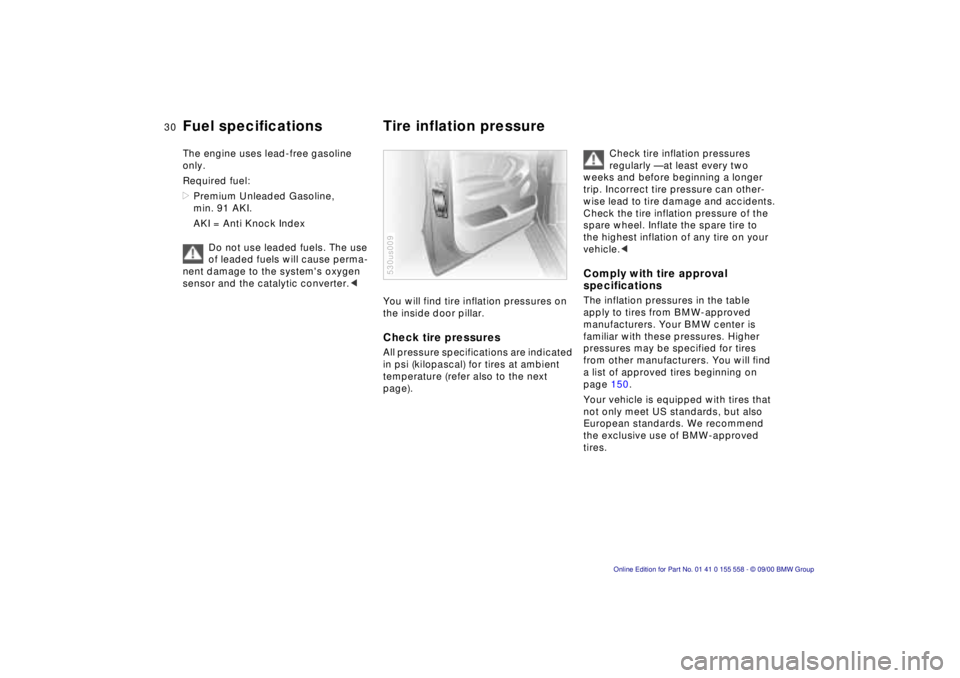
You will find tire inflation pressures on
the inside door pillar.
Check tire pressures
All pressure specifications are indicated
in psi (kilopascal) for tires at ambient
temperature (refer also to the next
page).
530us009
Check tire inflation pressures
regularly — at least every two
weeks and before beginning a longer
trip. Incorrect tire pressure can other-
wise lead to tire damage and accidents.
Check the tire inflation pressure of the
spare wheel. Inflate the spare tire to
the highest inflation of any tire on your
vehicle. <
Comply with tire approval
specifications
The inflation pressures in the table
apply to tires from BMW-approved
manufacturers. Your BMW center is
familiar with these pressures. Higher
pressures may be specified for tires
from other manufacturers. You will find
a list of approved tires beginning on
page 150.
Your vehicle is equipped with tires that
not only meet US standards, but also
European standards. We recommend
the exclusive use of BMW-approved
tires.
Page 31 of 223

Index
Data
Technology
Repairs
Car care
Controls
Overview
31nTire inflation pressure
BMW Tires
All pressure specifications in
the table are indicated in psi
(kilopascal) with cold tires
(cold = ambient temperature)
X5 All sizes 32 (220) 32 (220) 32 (220) 39 (270)
Page 57 of 223
Index
Data
Technology
Repairs
Car care
Controls
Overview
57n
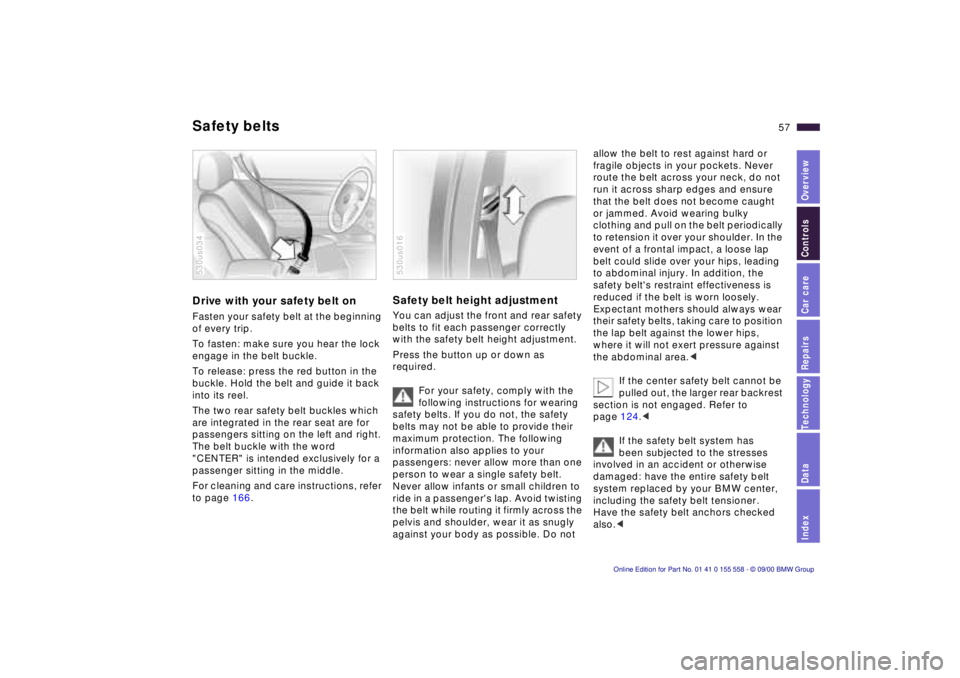
Drive with your safety belt on
Fasten your safety belt at the beginning
of every trip.
To fasten: make sure you hear the lock
engage in the belt buckle.
To release: press the red button in the
buckle. Hold the belt and guide it back
into its reel.
The two rear safety belt buckles which
are integrated in the rear seat are for
passengers sitting on the left and right.
The belt buckle with the word
"CENTER" is intended exclusively for a
passenger sitting in the middle.
For cleaning and care instructions, refer
to page 166.
530us034
Safety belt height adjustment
You can adjust the front and rear safety
belts to fit each passenger correctly
with the safety belt height adjustment.
Press the button up or down as
required.
For your safety, comply with the
following instructions for wearing
safety belts. If you do not, the safety
belts may not be able to provide their
maximum protection. The following
information also applies to your
passengers: never allow more than one
person to wear a single safety belt.
Never allow infants or small children to
ride in a passenger's lap. Avoid twisting
the belt while routing it firmly across the
pelvis and shoulder, wear it as snugly
against your body as possible. Do not
530us016
allow the belt to rest against hard or
fragile objects in your pockets. Never
route the belt across your neck, do not
run it across sharp edges and ensure
that the belt does not become caught
or jammed. Avoid wearing bulky
clothing and pull on the belt periodically
to retension it over your shoulder. In the
event of a frontal impact, a loose lap
belt could slide over your hips, leading
to abdominal injury. In addition, the
safety belt's restraint effectiveness is
reduced if the belt is worn loosely.
Expectant mothers should always wear
their safety belts, taking care to position
the lap belt against the lower hips,
where it will not exert pressure against
the abdominal area. <
If the center safety belt cannot be
pulled out, the larger rear backrest
section is not engaged. Refer to
page 124.<
If the safety belt system has
been subjected to the stresses
involved in an accident or otherwise
damaged: have the entire safety belt
system replaced by your BMW center,
including the safety belt tensioner.
Have the safety belt anchors checked
also. c
Safety belts
Page 133 of 223
IndexDataTechnologyRepairsCar careControlsOverview
Overview
Controls and features
Operation, care
and maintenance
Owner service procedures
Technical data
Index Advanced technology
133n
Under the hood:
Hood151
Engine compartment152
Washer fluid156
Washer nozzles156
Engine oil157
Coolant160
Brake fluid161
Vehicle Identification
Number161
Care and maintenance:
The BMW Maintenance
System162
Caring for your vehicle163
Airbags168
Vehicle storage168
Laws and regulations:
Technical modifications169
California Proposition
65 Warning169
OBD interface socket170
Car care Special operating instructions:
Break-in procedures134
Driving your BMW X5135
General driving notes136
Catalytic converter136
Antilock Brake System
(ABS)137
Disc brakes140
Brake system141
Winter operation141
Power steering143
Level control system143
Cellular phone144
Radio reception144
Wheels and tires:
Tire inflation pressure145
Tire condition145
Tire replacement146
Tire rotation147
Wheel and tire
combinations148
Special features of winter
tires149
Snow chains149
Approved wheel and tire
specifications150
Page 136 of 223
136n
General driving notes Catalytic converter
Brakes:
Do not drive with your foot resting
on the brake pedal. Even light but
consistent pedal pressure can lead to
high temperatures, brake wear and
possibly even brake failure.
Aquaplaning:
When driving on wet or slushy roads,
reduce vehicle speed. If you do not, a
wedge of water may form between the
tires and the road surface. This
phenomenon is referred to as aqua-
planing or hydroplaning. It is character-
ized by a partial or complete loss of
contact between the tires and the road
surface. The ultimate results are loss of
steering and braking control.
Cargo area cover:
Do not place heavy or hard objects on
the cargo area cover. These objects
could endanger vehicle occupants
during heavy brake applications or
evasive maneuvers.
Clothes hooks:
When suspending articles of clothing
from the hooks, be sure that they will
not obstruct the driver's vision. Do not
hang heavy objects on the hooks. If you
do so, they could cause personal injury
during braking or evasive maneuvers.< The catalytic converter reduces harmful
exhaust emissions.
It is designed for use with unleaded fuel
only. Even minute quantities of lead
would be enough to permanently
damage both the catalytic converter
and the system oxygen sensor.
To ensure efficient, trouble-free engine
operation and avoid potential damage:
>Be sure to comply with the scheduled
maintenance requirements.
>Fill the fuel tank well before it is
empty.
>Tow-start the vehicle only when the
engine is cold, since unburned fuel
may otherwise reach the catalytic
converter. It is better to start the
vehicle with an outside starting aid.
>Avoid other situations in which the
fuel is not burned, or burns incom-
pletely, such as engaging the starter
frequently or for extended periods, or
repeated start attempts in which the
engine does not start (stopping and
restarting an engine which is running
properly does not present a problem).
Never allow the engine to run with
any of the spark plug cables discon-
nected.
Page 142 of 223
142n
Winter operation Rubber seals and components In order to prevent the weather-strip-
ping from freezing, apply BMW rubber
treatment or silicone spray to the seals
on the doors, hood and liftgate/tailgate.
A full range of car care products is
available from your BMW center.< Snow chains Mount BMW snow chains
* only on tire
size 235/65 R 17. Always mount chains
in pairs and on the rear wheels only.
Read and comply with the chain manu-
facturer's safety precautions. Do not
exceed a maximum speed of 30 mph
(50 km/h).
Starting offWhen starting in deep snow or
"rocking" the vehicle free, it may be
advisable to deactivate the DSC system
briefly. Refer to page 94.
Driving on low-traction road
surfaces Use smooth, gentle pressure to control
the accelerator pedal. Avoid excessive
engine speeds and shift to the next
higher gear at an early point. Also shift
to the next lower gear at an early point
when approaching grades or slopes.
Maintain an adequate distance
between yourself and the car ahead. BrakingWinter road conditions substantially
reduce the amount of traction available
between the tires and the road surface.
The resulting increases in braking
distance are considerable and should
be kept in mind at all times.
ABS is intended to prevent the wheels
from locking during brake applications,
thus helping to maintain vehicle stability
and steering response. If the ABS does not respond in a critical
braking situation and the wheels lock:
Reduce the pressure on the brake
pedal until the wheels just start to roll
again while still maintaining enough
force to continue braking. Following
that, increase pedal pressure again.
Reduce the pressure as the wheels
lock, then reapply pressure. Repeat this
braking sequence.
This type of staggered braking will
reduce the braking distance, and the
vehicle still remains responsive to
steering.
You can then attempt to steer around
hazards after you have reduced pres-
sure on the brake pedal.
Do not shift down on slick road
surfaces if you want to decelerate.
Doing so could cause the wheels to
lose traction and skid, thus resulting in
the loss of vehicle control.<
Depress the clutch during hard
braking on road surfaces that
provide only poor or uneven traction.<
Page 145 of 223
IndexDataTechnologyRepairsCar careControlsOverview
145n
Information for your safetyThe factory-approved radial tires are
matched to the vehicle and have been
selected to provide optimum safety and
driving comfort on your vehicle.
It is not merely the tire's service life, but
also driving comfort and – above all else
– driving safety which depend on the
condition of the tires and the mainte-
nance of the specified tire pressure.
Incorrect inflation pressure is a frequent
cause of tire damage. It also signifi-
cantly influences the roadholding ability
of your BMW.
Check tire inflation pressures –
including the spare wheel – regu-
larly (refer to page 30), at least every
two weeks and before beginning a
longer trip. If this is not done, incorrect
tire pressures can cause driving insta-
bility and tire damage, ultimately
resulting in an accident.<
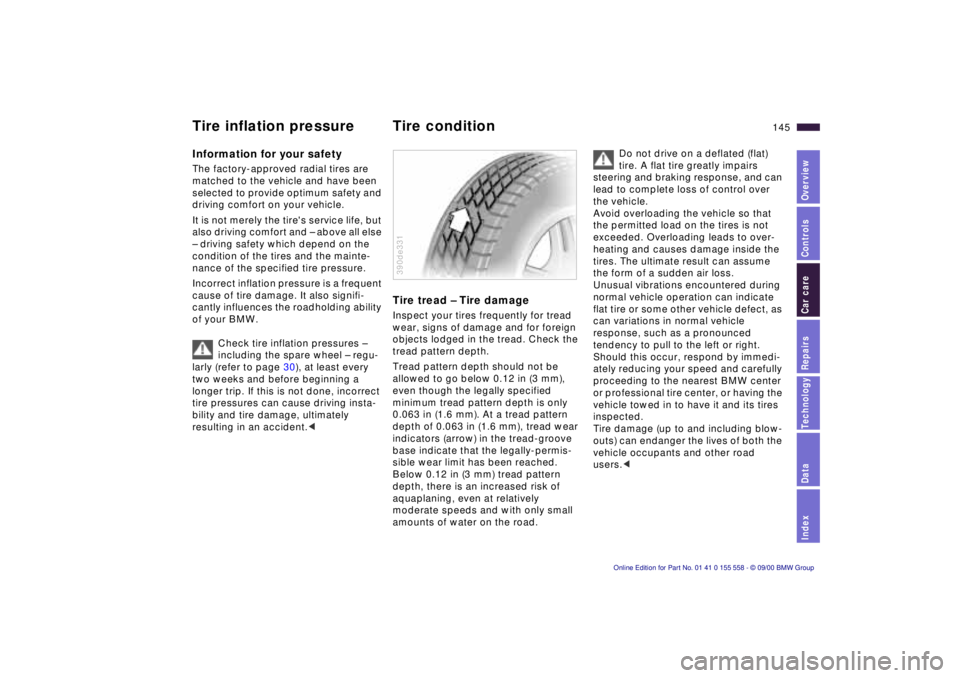
Tire tread – Tire damageInspect your tires frequently for tread
wear, signs of damage and for foreign
objects lodged in the tread. Check the
tread pattern depth.
Tread pattern depth should not be
allowed to go below 0.12 in (3 mm),
even though the legally specified
minimum tread pattern depth is only
0.063 in (1.6 mm). At a tread pattern
depth of 0.063 in (1.6 mm), tread wear
indicators (arrow) in the tread-groove
base indicate that the legally-permis-
sible wear limit has been reached.
Below 0.12 in (3 mm) tread pattern
depth, there is an increased risk of
aquaplaning, even at relatively
moderate speeds and with only small
amounts of water on the road. 390de331
Do not drive on a deflated (flat)
tire. A flat tire greatly impairs
steering and braking response, and can
lead to complete loss of control over
the vehicle.
Avoid overloading the vehicle so that
the permitted load on the tires is not
exceeded. Overloading leads to over-
heating and causes damage inside the
tires. The ultimate result can assume
the form of a sudden air loss.
Unusual vibrations encountered during
normal vehicle operation can indicate
flat tire or some other vehicle defect, as
can variations in normal vehicle
response, such as a pronounced
tendency to pull to the left or right.
Should this occur, respond by immedi-
ately reducing your speed and carefully
proceeding to the nearest BMW center
or professional tire center, or having the
vehicle towed in to have it and its tires
inspected.
Tire damage (up to and including blow-
outs) can endanger the lives of both the
vehicle occupants and other road
users.<
Tire inflation pressure Tire condition