warning BMW X5 4.4I 2002 User Guide
[x] Cancel search | Manufacturer: BMW, Model Year: 2002, Model line: X5 4.4I, Model: BMW X5 4.4I 2002Pages: 185, PDF Size: 2.7 MB
Page 23 of 185
23n
OverviewControlsMaintenanceRepairsDataIndex
Warning triangle
*
First-aid kit
*
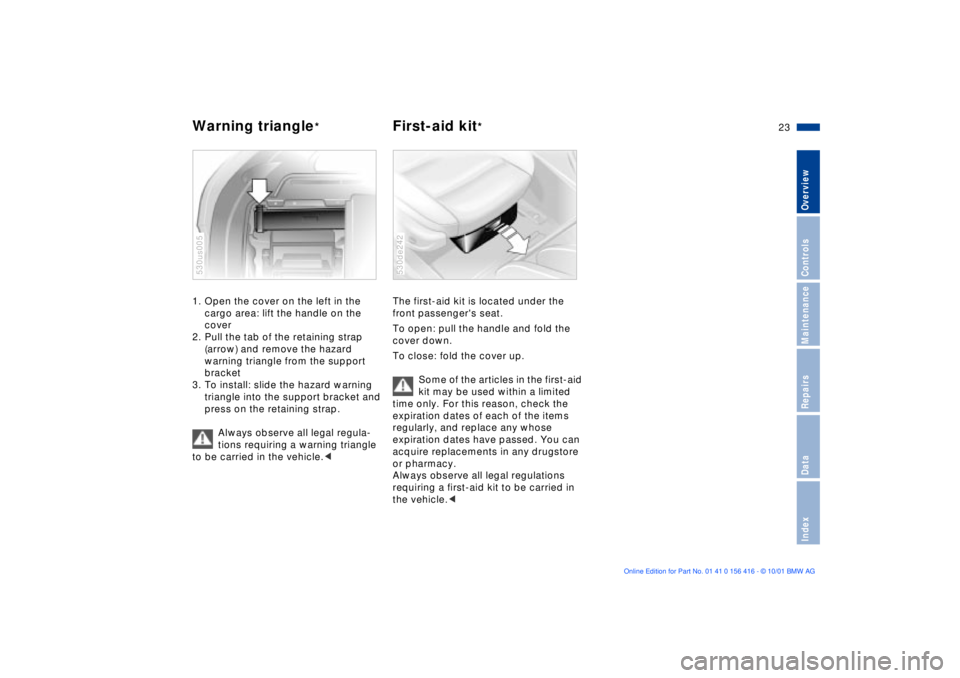
1. Open the cover on the left in the
cargo area: lift the handle on the
cover
2. Pull the tab of the retaining strap
(arrow) and remove the hazard
warning triangle from the support
bracket
3. To install: slide the hazard warning
triangle into the support bracket and
press on the retaining strap.
Always observe all legal regula-
tions requiring a warning triangle
to be carried in the vehicle.< 530us005
The first-aid kit is located under the
front passenger's seat.
To open: pull the handle and fold the
cover down.
To close: fold the cover up.
Some of the articles in the first-aid
kit may be used within a limited
time only. For this reason, check the
expiration dates of each of the items
regularly, and replace any whose
expiration dates have passed. You can
acquire replacements in any drugstore
or pharmacy.
Always observe all legal regulations
requiring a first-aid kit to be carried in
the vehicle.< 530de242
Page 30 of 185
30n
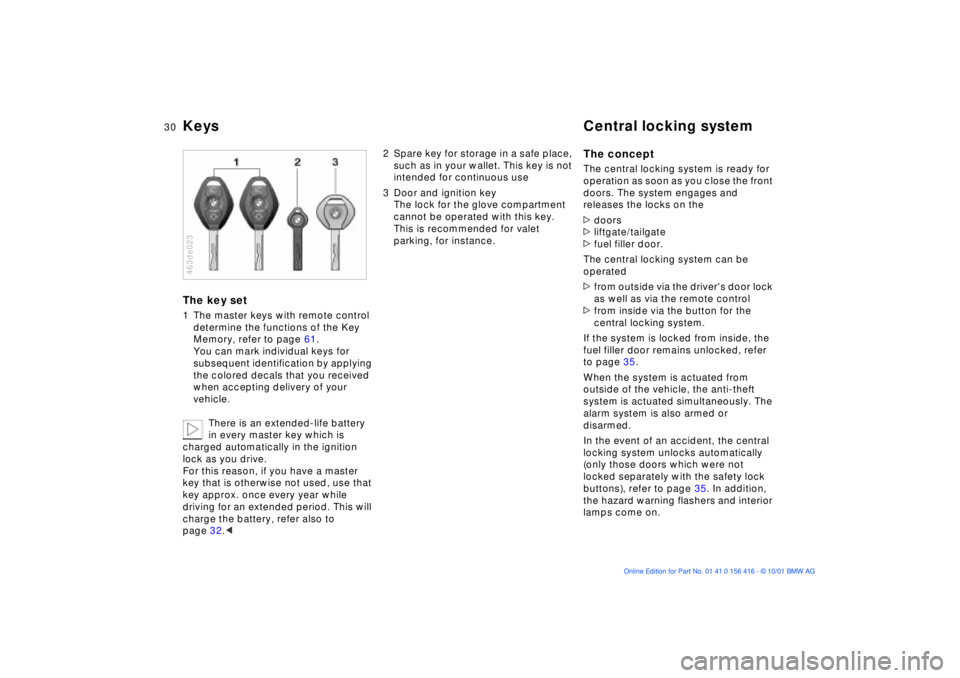
Keys Central locking system The key set1 The master keys with remote control
determine the functions of the Key
Memory, refer to page 61.
You can mark individual keys for
subsequent identification by applying
the colored decals that you received
when accepting delivery of your
vehicle.
There is an extended-life battery
in every master key which is
charged automatically in the ignition
lock as you drive.
For this reason, if you have a master
key that is otherwise not used, use that
key approx. once every year while
driving for an extended period. This will
charge the battery, refer also to
page 32.< 463de023
2 Spare key for storage in a safe place,
such as in your wallet. This key is not
intended for continuous use
3 Door and ignition key
The lock for the glove compartment
cannot be operated with this key.
This is recommended for valet
parking, for instance.
The concept The central locking system is ready for
operation as soon as you close the front
doors. The system engages and
releases the locks on the
>doors
>liftgate/tailgate
>fuel filler door.
The central locking system can be
operated
>from outside via the driver's door lock
as well as via the remote control
>from inside via the button for the
central locking system.
If the system is locked from inside, the
fuel filler door remains unlocked, refer
to page 35.
When the system is actuated from
outside of the vehicle, the anti-theft
system is actuated simultaneously. The
alarm system is also armed or
disarmed.
In the event of an accident, the central
locking system unlocks automatically
(only those doors which were not
locked separately with the safety lock
buttons), refer to page 35. In addition,
the hazard warning flashers and interior
lamps come on.
Page 39 of 185
39n
OverviewControlsMaintenanceRepairsDataIndex
Alarm system The concept The vehicle alarm system responds:
>When a door, the hood, or the liftgate
is opened
>To movement inside the vehicle (inte-
rior motion sensor)
>To variations in the vehicle tilt angle
such as occur during attempts to
steal the wheels or tow the vehicle
>To interruption of battery voltage.
The system responds to unauthorized
vehicle entry and attempted theft by
simultaneously activating the following:
>Sounding an acoustical alarm for
30 seconds
>The hazard warning flashers are acti-
vated for approx. five minutes
>The high beams flash on and off in
the same rhythm.
To arm and disarm the alarm
system When the vehicle is locked or unlocked
with the key or the remote control, the
alarm system is also simultaneously
armed or disarmed.
You can have different acknowl-
edgment signals set to confirm
system arming and disarming.<
You can still open the liftgate after the
system has been armed by pressing the
button of the remote control, refer to
page 33. When you close the liftgate, it
is secured again.
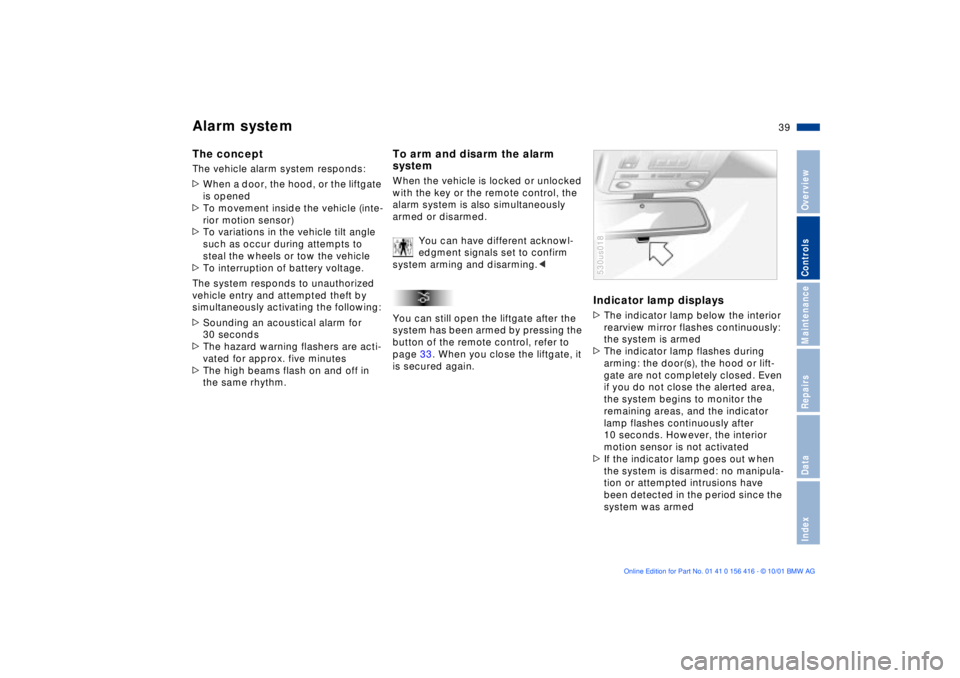
Indicator lamp displays>The indicator lamp below the interior
rearview mirror flashes continuously:
the system is armed
>The indicator lamp flashes during
arming: the door(s), the hood or lift-
gate are not completely closed. Even
if you do not close the alerted area,
the system begins to monitor the
remaining areas, and the indicator
lamp flashes continuously after
10 seconds. However, the interior
motion sensor is not activated
>If the indicator lamp goes out when
the system is disarmed: no manipula-
tion or attempted intrusions have
been detected in the period since the
system was armed530us018
Page 56 of 185
56n
Airbags
At all times, occupants should sit
upright and be properly restrained
(infants and small children in appro-
priate child-restraint systems; larger
children and adults using the safety
belts).
Never let an occupant's head rest near
or on a side airbag because the inflating
airbag could cause a serious or fatal
injury. Please note that the word
"Airbag" imprinted on the door trim
panel indicates the airbag's location.
Accident research shows that the
safest place for children in an auto-
mobile is in the rear seat. However, a
child sitting in the rear seat and not
properly restrained may place his or her
head on or near the airbag, if so
equipped.
For example, a child Ñ even though
belted Ñ may fall asleep with his or her
head against the side airbag. It may be
difficult for a driver to ensure that chil-
dren in the rear seat will remain prop-
erly positioned at all times and do not
place their heads on or near the side
airbag. Therefore, we recommend that
the rear side airbags, if provided, be
deactivated if you plan to transport
children in the rear seat.
The rear seat side airbags may already
have been deactivated, either at the
time of manufacture or by a BMW
Sports Activity Vehicle center. Labels in
the rear door opening should indicate
the status of your rear seat side
airbags. If you are uncertain of their
status, or wish to have the airbags acti-
vated or deactivated, please contact
your BMW Sports Activity Vehicle
center.<
Even when all these guidelines are
observed, there is still a small residual
risk of injuries to the face, hands and
arms occurring from airbag deployment
in isolated instances. The ignition and
inflation noise may provoke a mild
temporary hearing loss in extremely
sensitive individuals.
Airbag warning information is also
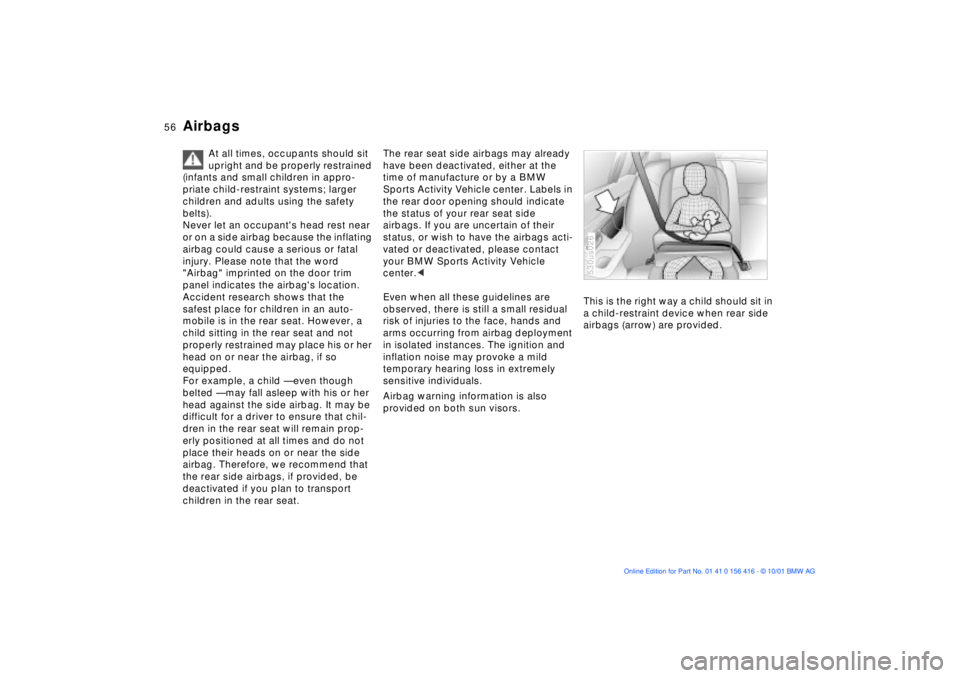
provided on both sun visors. This is the right way a child should sit in
a child-restraint device when rear side
airbags (arrow) are provided.
530us026
Page 62 of 185
62n
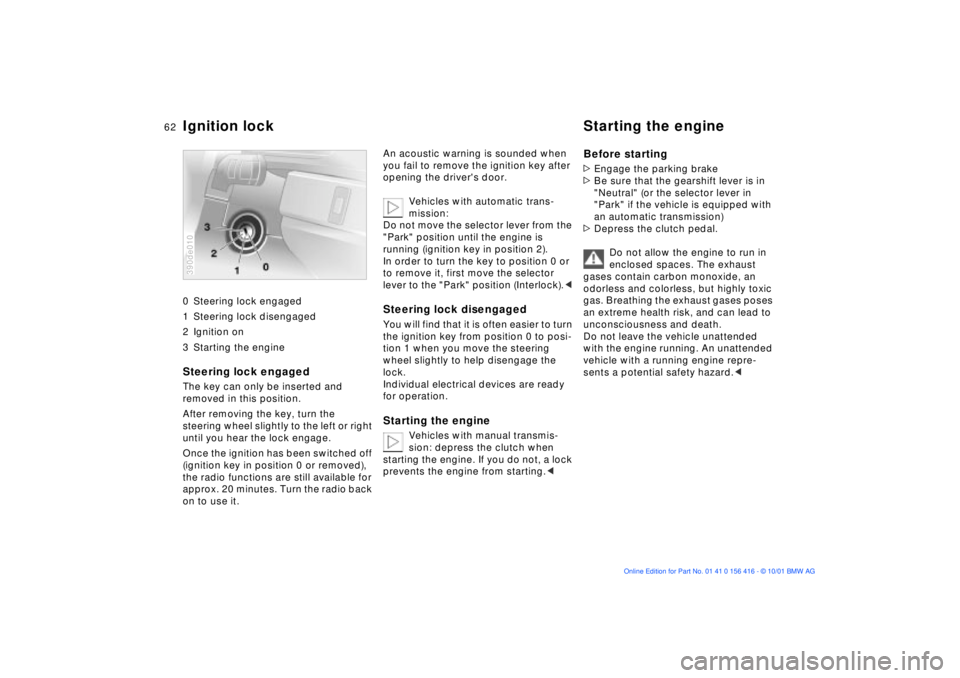
0 Steering lock engaged
1 Steering lock disengaged
2 Ignition on
3 Starting the engine
Steering lock engaged The key can only be inserted and
removed in this position.
After removing the key, turn the
steering wheel slightly to the left or right
until you hear the lock engage.
Once the ignition has been switched off
(ignition key in position 0 or removed),
the radio functions are still available for
approx. 20 minutes. Turn the radio back
on to use it.390de010
An acoustic warning is sounded when
you fail to remove the ignition key after
opening the driver's door.
Vehicles with automatic trans-
mission:
Do not move the selector lever from the
"Park" position until the engine is
running (ignition key in position 2).
In order to turn the key to position 0 or
to remove it, first move the selector
lever to the "Park" position (Interlock).< Steering lock disengaged You will find that it is often easier to turn
the ignition key from position 0 to posi-
tion 1 when you move the steering
wheel slightly to help disengage the
lock.
Individual electrical devices are ready
for operation. Starting the engine
Vehicles with manual transmis-
sion: depress the clutch when
starting the engine. If you do not, a lock
prevents the engine from starting.<
Before starting >Engage the parking brake
>Be sure that the gearshift lever is in
"Neutral" (or the selector lever in
"Park" if the vehicle is equipped with
an automatic transmission)
>Depress the clutch pedal.
Do not allow the engine to run in
enclosed spaces. The exhaust
gases contain carbon monoxide, an
odorless and colorless, but highly toxic
gas. Breathing the exhaust gases poses
an extreme health risk, and can lead to
unconsciousness and death.
Do not leave the vehicle unattended
with the engine running. An unattended
vehicle with a running engine repre-
sents a potential safety hazard.<
Ignition lock Starting the engine
Page 74 of 185
74n
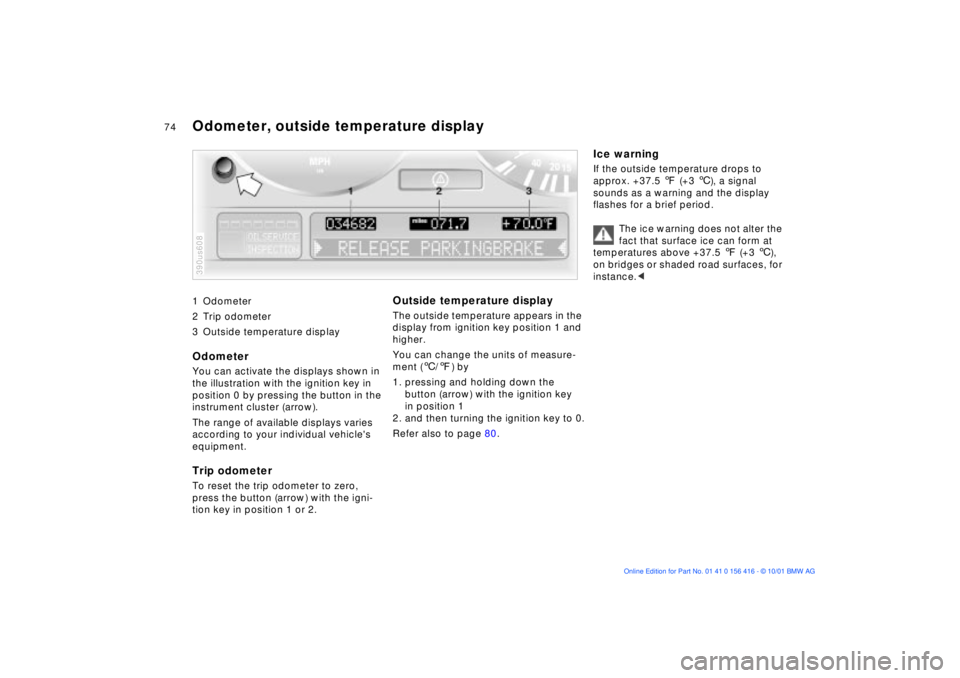
1 Odometer
2 Trip odometer
3 Outside temperature display
OdometerYou can activate the displays shown in
the illustration with the ignition key in
position 0 by pressing the button in the
instrument cluster (arrow).
The range of available displays varies
according to your individual vehicle's
equipment.Trip odometer To reset the trip odometer to zero,
press the button (arrow) with the igni-
tion key in position 1 or 2. 390us608
Outside temperature display The outside temperature appears in the
display from ignition key position 1 and
higher.
You can change the units of measure-
ment (6/7) by
1. pressing and holding down the
button (arrow) with the ignition key
in position 1
2. and then turning the ignition key to 0.
Refer also to page 80.
Ice warning If the outside temperature drops to
approx. +37.5 7 (+3 6), a signal
sounds as a warning and the display
flashes for a brief period.
The ice warning does not alter the
fact that surface ice can form at
temperatures above +37.5 7 (+3 6),
on bridges or shaded road surfaces, for
instance.<
Odometer, outside temperature display
Page 76 of 185
76n
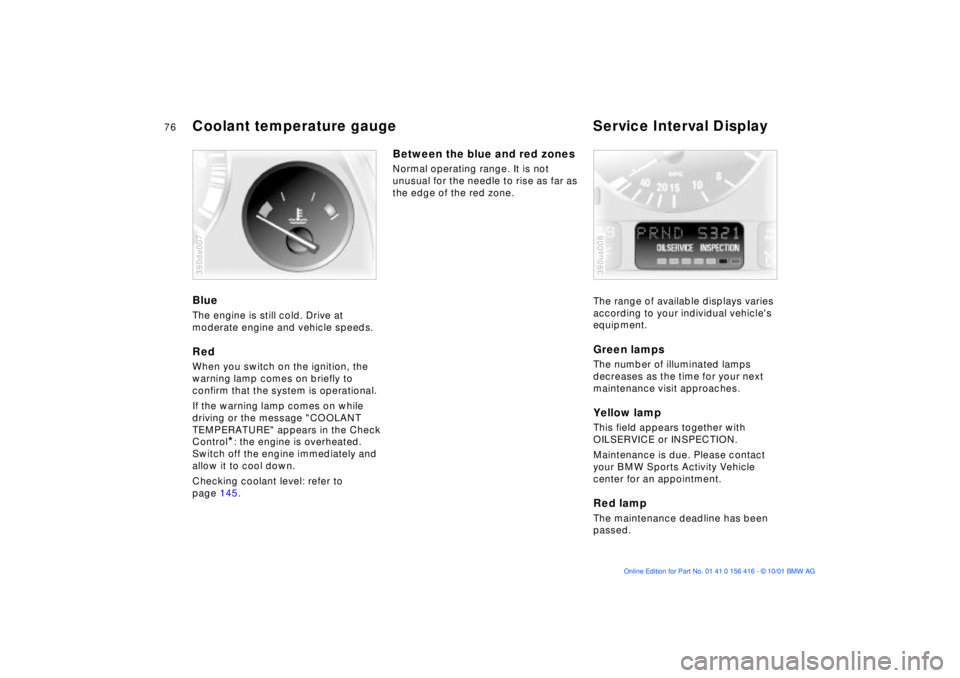
Coolant temperature gauge Service Interval Display Blue The engine is still cold. Drive at
moderate engine and vehicle speeds.Red When you switch on the ignition, the
warning lamp comes on briefly to
confirm that the system is operational.
If the warning lamp comes on while
driving or the message "COOLANT
TEMPERATURE" appears in the Check
Control
*: the engine is overheated.
Switch off the engine immediately and
allow it to cool down.
Checking coolant level: refer to
page 145.
390de007
Between the blue and red zones Normal operating range. It is not
unusual for the needle to rise as far as
the edge of the red zone.
The range of available displays varies
according to your individual vehicle's
equipment.
Green lamps The number of illuminated lamps
decreases as the time for your next
maintenance visit approaches.Yellow lamp This field appears together with
OILSERVICE or INSPECTION.
Maintenance is due. Please contact
your BMW Sports Activity Vehicle
center for an appointment.Red lamp The maintenance deadline has been
passed.390us008
Page 77 of 185
77n
OverviewControlsMaintenanceRepairsDataIndex
Check Control Graphic display
*
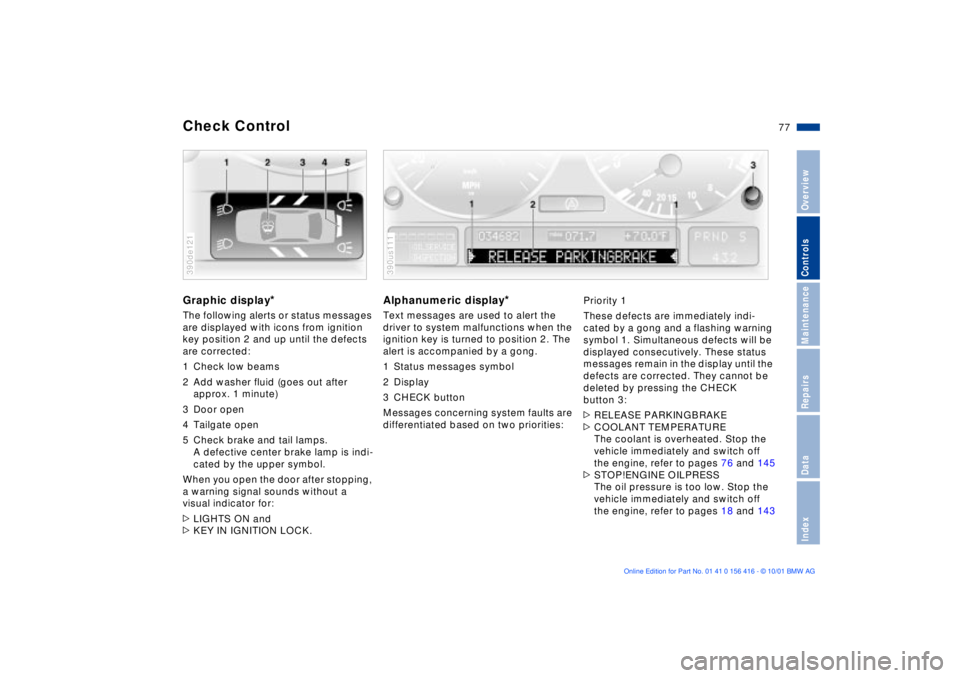
The following alerts or status messages
are displayed with icons from ignition
key position 2 and up until the defects
are corrected:
1 Check low beams
2 Add washer fluid (goes out after
approx. 1 minute)
3 Door open
4 Tailgate open
5 Check brake and tail lamps.
A defective center brake lamp is indi-
cated by the upper symbol.
When you open the door after stopping,
a warning signal sounds without a
visual indicator for:
>LIGHTS ON and
>KEY IN IGNITION LOCK. 390de121
Alphanumeric display
*
Text messages are used to alert the
driver to system malfunctions when the
ignition key is turned to position 2. The
alert is accompanied by a gong.
1 Status messages symbol
2 Display
3 CHECK button
Messages concerning system faults are
differentiated based on two priorities: 390us111
Priority 1
These defects are immediately indi-
cated by a gong and a flashing warning
symbol 1. Simultaneous defects will be
displayed consecutively. These status
messages remain in the display until the
defects are corrected. They cannot be
deleted by pressing the CHECK
button 3:
>RELEASE PARKINGBRAKE
>COOLANT TEMPERATURE
The coolant is overheated. Stop the
vehicle immediately and switch off
the engine, refer to pages 76 and 145
>STOP!ENGINE OILPRESS
The oil pressure is too low. Stop the
vehicle immediately and switch off
the engine, refer to pages 18 and 143
Page 78 of 185

78n
Check Control>CHECK BRAKE FLUID
Indicates that brake fluid is down to
approximately the minimum level.
Top off the brake fluid at the next
opportunity, refer to page 146. Have
the cause of the brake fluid loss diag-
nosed and corrected by your BMW
Sports Activity Vehicle center
>TIRE DEFECTIVE
*
Reduce vehicle speed immediately
and stop the vehicle. Avoid hard
brake applications. Do not oversteer,
refer to page 99
>SELFLEVEL SUSP.INACT
*
Please consult the nearest
BMW Sports Activity Vehicle center
>SELFLEVEL SUSP.INACT
*
"max. 35 mph/max. 60 km/h
*"
These displays appear consecutively.
Do not exceed a maximum speed of
35 mph (60 km/h).
Please consult the nearest BMW
Sports Activity Vehicle center
>SPEED LIMIT
*
You will see this message if the
programmed speed limit has been
exceeded, refer to page 86.Priority 2
These displays appear for 20 seconds
when the ignition key is turned to posi-
tion 2. The warning symbols remain
after the message disappears. You can
call up the messages again for display
by pressing the CHECK button.
>TRUNKLID OPEN
This message appears only at the
start of a trip
>DOOR OPEN
This message appears after a
minimal defined road speed has been
exceeded
>FASTEN SEAT BELTS
*
In addition to this message, an indi-
cator lamp with the safety belt icon
appears and an acoustical signal is
sounded
>WASHER FLUID LOW
The fluid level is too low; top off at
the next opportunity, refer to
page 143
>CHECK ENGINE OIL LEV
The oil level is at the absolute
minimum; refill as soon as possible,
refer to page 143. Do not drive more
than approx. 30 miles (50 km) until
you add oil >CHECK FILLER CAP
Check to see whether the fuel filler
cap has been closed properly, refer
to page 24. A fuel filler cap that has
not been closed all the way will set
off the Service Engine Soon lamp
>OUTSIDE TEMP. +23 7 (Ð5 6)
This display is only an example. The
current temperature is displayed at
outside temperatures of +37.5 7
(+3 6) and below, refer also to
page 74
>SET TIRE PRESSURE
*
The RDC has imported the current
inflation pressure in the tires as the
target values which the system will
monitor, refer to page 98
>CHECK TIRE PRESSURE
*
Check and correct the tire inflation
pressure to specifications at the
earliest opportunity (next stop to
refuel), refer to page 99
>TIRECONTROL INACTIVE
*
A temporary interference of the RDC
or a system fault, refer to page 99
>CHECK BRAKE LIGHTS
A lamp has failed or the electrical
circuit has a fault, refer to pages 155
and 156 or consult a BMW Sports
Activity Vehicle center.
Page 86 of 185
86n
Computer
** * * in the MID
Only make entries when the
vehicle is stationary Ð to avoid
endangering yourself or other road
users.<
Computer calculations begin at the
start of the journey.
Information can also be called up in the
display by remote control, refer to
page 90.
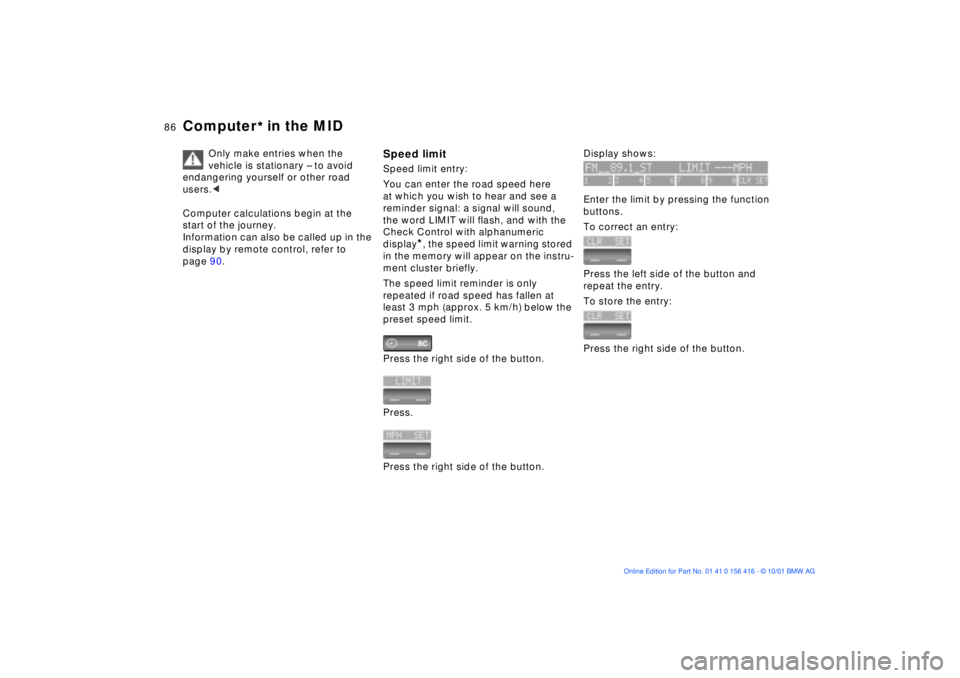
Speed limitSpeed limit entry:
You can enter the road speed here
at which you wish to hear and see a
reminder signal: a signal will sound,
the word LIMIT will flash, and with the
Check Control with alphanumeric
display
*, the speed limit warning stored
in the memory will appear on the instru-
ment cluster briefly.
The speed limit reminder is only
repeated if road speed has fallen at
least 3 mph (approx. 5 km/h) below the
preset speed limit.
Press the right side of the button.
Press.
Press the right side of the button.
Display shows:
Enter the limit by pressing the function
buttons.
To correct an entry:
Press the left side of the button and
repeat the entry.
To store the entry:
Press the right side of the button.