warning BMW X5 4.4I 2002 Owner's Manual
[x] Cancel search | Manufacturer: BMW, Model Year: 2002, Model line: X5 4.4I, Model: BMW X5 4.4I 2002Pages: 185, PDF Size: 2.7 MB
Page 91 of 185
91n
OverviewControlsMaintenanceRepairsDataIndex
The concept The PDC assists you when you are
parking. Acoustical signals inform you
of the distance to an obstacle. To do
this, four ultrasonic sensors in the front
and rear bumpers each measure the
distance to the nearest object. The
detection range of the front sensors
and the two sensors located at the
ends of the rear bumper is approxi-
mately 2 ft (60 cm), while the rear
center sensors can detect objects to a
distance of roughly 5 ft (1.50 m).Automatic functionThe system starts to operate auto-
matically about one second after you
select reverse with the ignition key in
position 2.
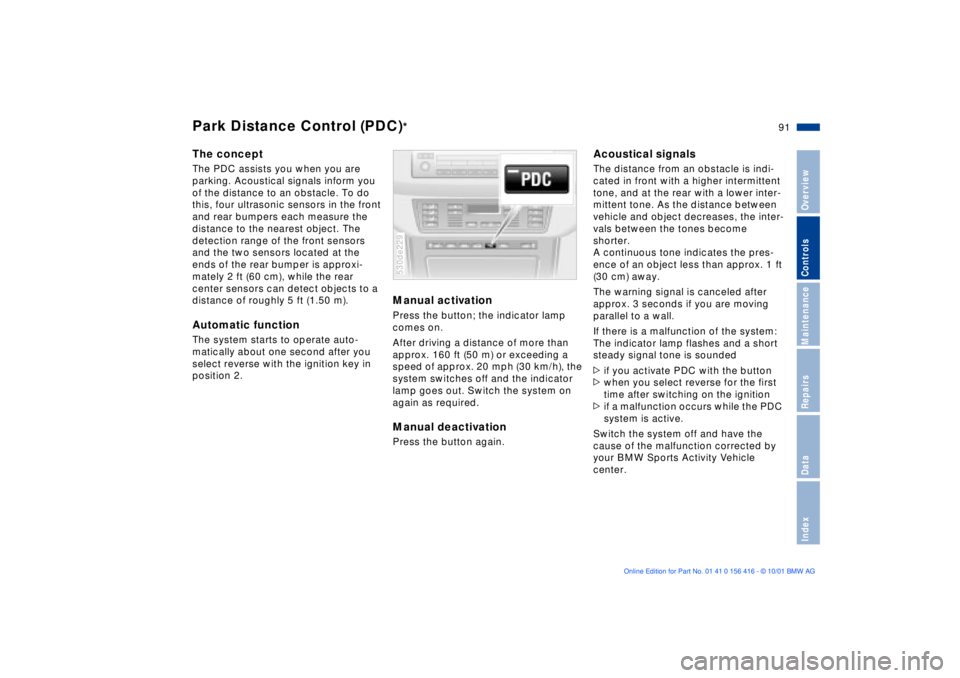
Manual activation Press the button; the indicator lamp
comes on.
After driving a distance of more than
approx. 160 ft (50 m) or exceeding a
speed of approx. 20 mph (30 km/h), the
system switches off and the indicator
lamp goes out. Switch the system on
again as required. Manual deactivationPress the button again. 530de229
Acoustical signals The distance from an obstacle is indi-
cated in front with a higher intermittent
tone, and at the rear with a lower inter-
mittent tone. As the distance between
vehicle and object decreases, the inter-
vals between the tones become
shorter.
A continuous tone indicates the pres-
ence of an object less than approx. 1 ft
(30 cm) away.
The warning signal is canceled after
approx. 3 seconds if you are moving
parallel to a wall.
If there is a malfunction of the system:
The indicator lamp flashes and a short
steady signal tone is sounded
>if you activate PDC with the button
>when you select reverse for the first
time after switching on the ignition
>if a malfunction occurs while the PDC
system is active.
Switch the system off and have the
cause of the malfunction corrected by
your BMW Sports Activity Vehicle
center.
Park Distance Control (PDC)
*
Page 95 of 185
95n
OverviewControlsMaintenanceRepairsDataIndex
Variable Ride Height
*
Variable Ride Height on both axles
*
The warning lamp for the Vari-
able Ride Height comes on, or
the message "SELFLEVEL
SUSP.INACT" appears in the Check
Control: there is a malfunction in the
Variable Ride Height.
Stop and inspect the vehicle. If it is
riding significantly lower in the rear than
in the front, or if it is sitting at an incline
(left rear compared to right rear),
consult the nearest BMW Sports
Activity Vehicle center. Drive with
appropriate caution in the meantime.
The vehicle has reduced ground clear-
ance or driving comfort is noticeably
reduced.
Even if the attitude of the vehicle is
normal, you should consult the nearest
BMW Sports Activity Vehicle center if
the warning lamp indicates a system
malfunction.
The conceptYour vehicle is equipped with Variable
Ride Height acting on both the front
and rear suspension. This system
combines automatic self-leveling,
which compensates for variations in
front-to-rear load-distribution patterns,
with a selection feature allowing drivers
to choose from among several ride-
height options.
You may choose from among the
following ride heights:
>Standard
The "standard" setting is intended for
most operating conditions, including
trailer towing
>Off-Road
Higher ride height for increased
ground clearance
>Access
Lowers vehicle for more convenient
cargo handling and easier passenger
ingress and exitsChanges in ride height are initiated
either manually, using the control
button (refer to page 96), or automati-
cally in response to specific speeds.
When the ride height is selected manu-
ally, the driver has the additional option
of revising the ride-height selection by
entering a new command during the
adjustment process.
When the vehicle is stationary, the
system executes ride-height changes in
both directions (up and down) when-
ever the doors are closed. The tailgate/
liftgate may be open. The system raises
the vehicle only when the engine is
running.
The system's automatic self-leveling
feature automatically compensates for
variations in the vehicle's load.
Frequent changes in ride height
initiated at short intervals can
overheat the compressor, causing the
system to briefly suspend active opera-
tion.<
Page 99 of 185
99n
OverviewControlsMaintenanceRepairsDataIndex
Tire Pressure Monitor (RDC)
*
Adaptive brake light
Flat tireIf there is a tire failure with a loss of
inflation pressure, the red indicator
lamp comes on or the message "TIRE
DEFECTIVE" appears in the Check
Control. In addition, a gong sounds.
If this occurs, reduce vehicle speed
immediately and stop the vehicle in a
safe location. Avoid hard brake applica-
tions. Do not oversteer. Replace the flat
tire.
The spare tire which is available in
your vehicle as standard equip-
ment is equipped with the electronics
required for RDC and, following activa-
tion of the system, is also monitored
after it is mounted.<
RDC cannot alert you to severe
and sudden tire damage caused
by external factors.<
Have the tires changed at your
BMW Sports Activity Vehicle
center.
Your BMW Sports Activity Vehicle
center has the information needed for
working with RDC and is equipped with
the necessary special tools.<
System malfunctionDuring the period of the malfunction,
the yellow indicator lamp comes on or
the message "TIRECONTROL INAC-
TIVE" appears in the Check Control.
You will also see the same message
>in the event of a system malfunction
>if a wheel is mounted without the
RDC electronics
>if, in addition to the spare tire, addi-
tional wheels with RDC electronics
are on board.
Please contact your BMW Sports
Activity Vehicle center for additional
information.The adaptive brake light (in preparation)
provides drivers of following vehicles
with an indication of the intensity with
which the brakes are being applied in
your own vehicle.
The display occurs in two stages:
>Normal braking:
The brake light units within the tail-
light clusters and the high-mount
brake light integrated within the rear
spoiler both light up with normal
intensity
>Hard braking or braking with ABS
active:
The taillights also come on, lighting
up with the same intensity as the
brake lights to provide a larger a
more conspicuous warning.
Page 100 of 185
100n
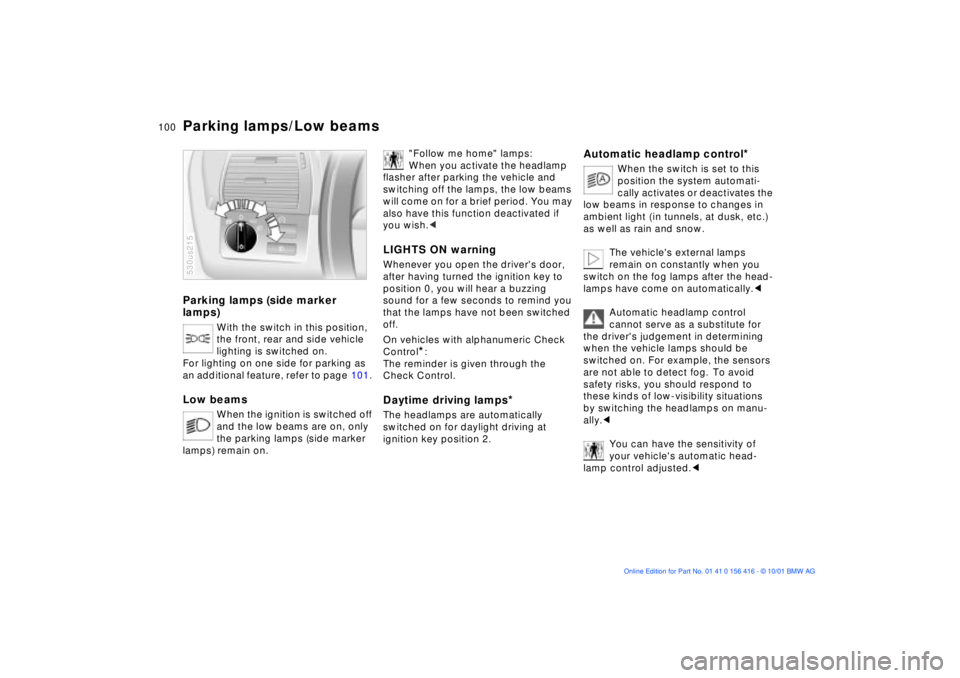
Parking lamps (side marker
lamps)
With the switch in this position,
the front, rear and side vehicle
lighting is switched on.
For lighting on one side for parking as
an additional feature, refer to page 101.
Low beams
When the ignition is switched off
and the low beams are on, only
the parking lamps (side marker
lamps) remain on.
530us215
"Follow me home" lamps:
When you activate the headlamp
flasher after parking the vehicle and
switching off the lamps, the low beams
will come on for a brief period. You may
also have this function deactivated if
you wish.<
LIGHTS ON warningWhenever you open the driver's door,
after having turned the ignition key to
position 0, you will hear a buzzing
sound for a few seconds to remind you
that the lamps have not been switched
off.
On vehicles with alphanumeric Check
Control
*:
The reminder is given through the
Check Control.
Daytime driving lamps
*
The headlamps are automatically
switched on for daylight driving at
ignition key position 2.
Automatic headlamp control
*
When the switch is set to this
position the system automati-
cally activates or deactivates the
low beams in response to changes in
ambient light ( in tunnels, at dusk, etc.)
as well as rain and snow.
The vehicle's external lamps
remain on constantly when you
switch on the fog lamps after the head-
lamps have come on automatically.<
Automatic headlamp control
cannot serve as a substitute for
the driver's judgement in determining
when the vehicle lamps should be
switched on. For example, the sensors
are not able to detect fog. To avoid
safety risks, you should respond to
these kinds of low-visibility situations
by switching the headlamps on manu-
ally.<
You can have the sensitivity of
your vehicle's automatic head-
lamp control adjusted.<
Parking lamps/Low beams
Page 122 of 185
122n
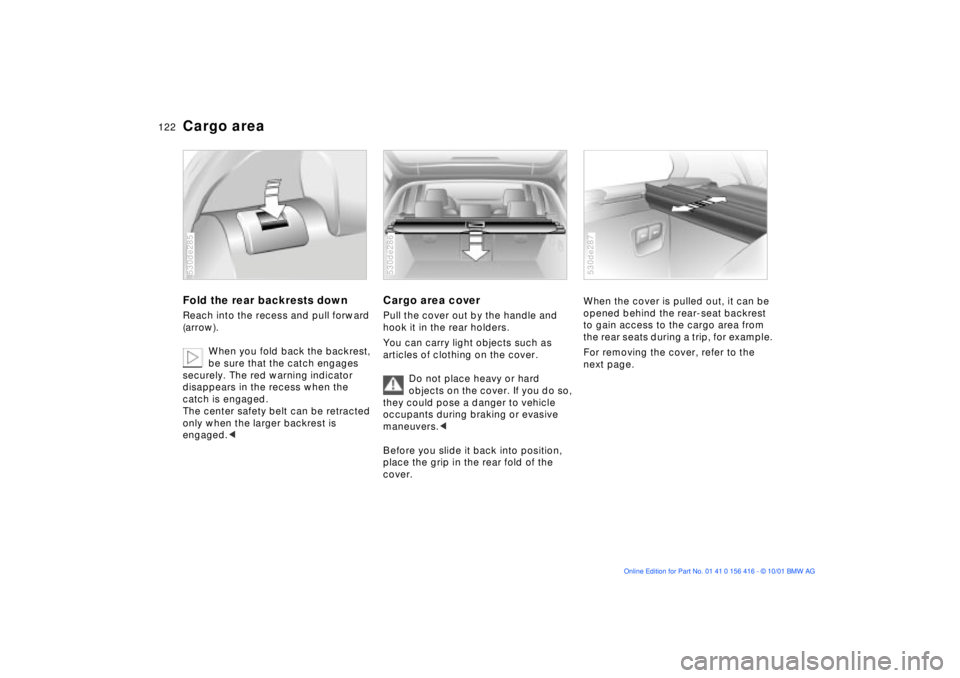
Cargo areaFold the rear backrests downReach into the recess and pull forward
(arrow).
When you fold back the backrest,
be sure that the catch engages
securely. The red warning indicator
disappears in the recess when the
catch is engaged.
The center safety belt can be retracted
only when the larger backrest is
engaged.< 530de285
Cargo area coverPull the cover out by the handle and
hook it in the rear holders.
You can carry light objects such as
articles of clothing on the cover.
Do not place heavy or hard
objects on the cover. If you do so,
they could pose a danger to vehicle
occupants during braking or evasive
maneuvers.<
Before you slide it back into position,
place the grip in the rear fold of the
cover. 530de286
When the cover is pulled out, it can be
opened behind the rear-seat backrest
to gain access to the cargo area from
the rear seats during a trip, for example.
For removing the cover, refer to the
next page. 530de287
Page 144 of 185
144n
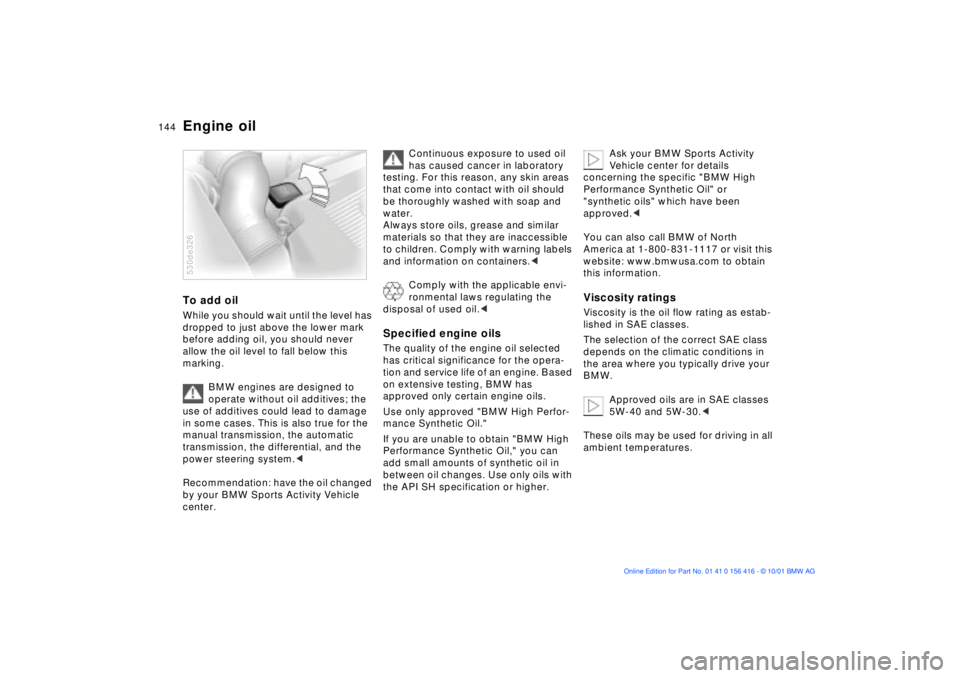
Engine oil To add oilWhile you should wait until the level has
dropped to just above the lower mark
before adding oil, you should never
allow the oil level to fall below this
marking.
BMW engines are designed to
operate without oil additives; the
use of additives could lead to damage
in some cases. This is also true for the
manual transmission, the automatic
transmission, the differential, and the
power steering system.<
Recommendation: have the oil changed
by your BMW Sports Activity Vehicle
center. 530de326
Continuous exposure to used oil
has caused cancer in laboratory
testing. For this reason, any skin areas
that come into contact with oil should
be thoroughly washed with soap and
water.
Always store oils, grease and similar
materials so that they are inaccessible
to children. Comply with warning labels
and information on containers.<
Comply with the applicable envi-
ronmental laws regulating the
disposal of used oil.<
Specified engine oils The quality of the engine oil selected
has critical significance for the opera-
tion and service life of an engine. Based
on extensive testing, BMW has
approved only certain engine oils.
Use only approved "BMW High Perfor-
mance Synthetic Oil."
If you are unable to obtain "BMW High
Performance Synthetic Oil," you can
add small amounts of synthetic oil in
between oil changes. Use only oils with
the API SH specification or higher.
Ask your BMW Sports Activity
Vehicle center for details
concerning the specific "BMW High
Performance Synthetic Oil" or
"synthetic oils" which have been
approved.<
You can also call BMW of North
America at 1-800-831-1117 or visit this
website: www.bmwusa.com to obtain
this information.
Viscosity ratings Viscosity is the oil flow rating as estab-
lished in SAE classes.
The selection of the correct SAE class
depends on the climatic conditions in
the area where you typically drive your
BMW.
Approved oils are in SAE classes
5W-40 and 5W-30.<
These oils may be used for driving in all
ambient temperatures.
Page 146 of 185
146n
Brake fluid
If the indicator lamp for the
brake hydraulic system appears
or if the CHECK BRAKE FLUID
warning appears in the Check
Control: the brake fluid level is
too low.
Add brake fluidThe brake fluid reservoir is located
under the microfilter housing trim panel
on the driver's side of the vehicle. For
adding brake fluid or for determining
and correcting the cause of brake fluid
loss, consult your BMW Sports Activity
Vehicle center. Your BMW Sports
Activity Vehicle center is familiar with
the specifications for factory-approved
brake fluids (DOT 4).
Brake fluid loss may result in extended
brake pedal travel. For this situation,
refer to the notes on page 135.
Brake fluid is hygroscopic, that is,
it absorbs moisture from the air
over time.
In order to ensure the safety and reli-
ability of the brake system, have the
brake fluid changed every two years by
a BMW Sports Activity Vehicle center.
Refer also to the Service and Warranty
Information Booklet (US models) or the
Warranty and Service Guide Booklet
(Canadian models).
Brake fluid is toxic and damages the
vehicle's paint. You should always store
it in its original container and in a loca-
tion which is out of reach of children.
Do not spill the fluid and do not fill the
brake fluid reservoir beyond the "MAX"
mark. The brake fluid could ignite upon
contact with hot engine parts and
cause serious burns.<
Comply with the applicable envi-
ronmental laws regulating the
disposal of brake fluid.<
Page 148 of 185

148n
Light-emitting diodes (LEDs) Light-emitting diodes installed behind
translucent lenses serve as the light
source for many of the controls and
displays in your vehicle. The concept
behind their operation is related to that
employed for lasers, and they are
formally designated as Class 1 light-
emitting diodes.
Do not remove the protective lens
and avoid staring directly at the
unfiltered beam for extended periods
(several hours), as inflammation of the
iris could result.<
California laws require us to state the
following warning:
Engine exhaust, some of its
constituents, and certain vehicle
components contain or emit chemicals
known to the State of California to
cause cancer and birth defects or other
reproductive harm.<
Technical modifications California Proposition 65 Warning
Page 149 of 185
149n
OverviewControlsMainte-RepairsDataIndex
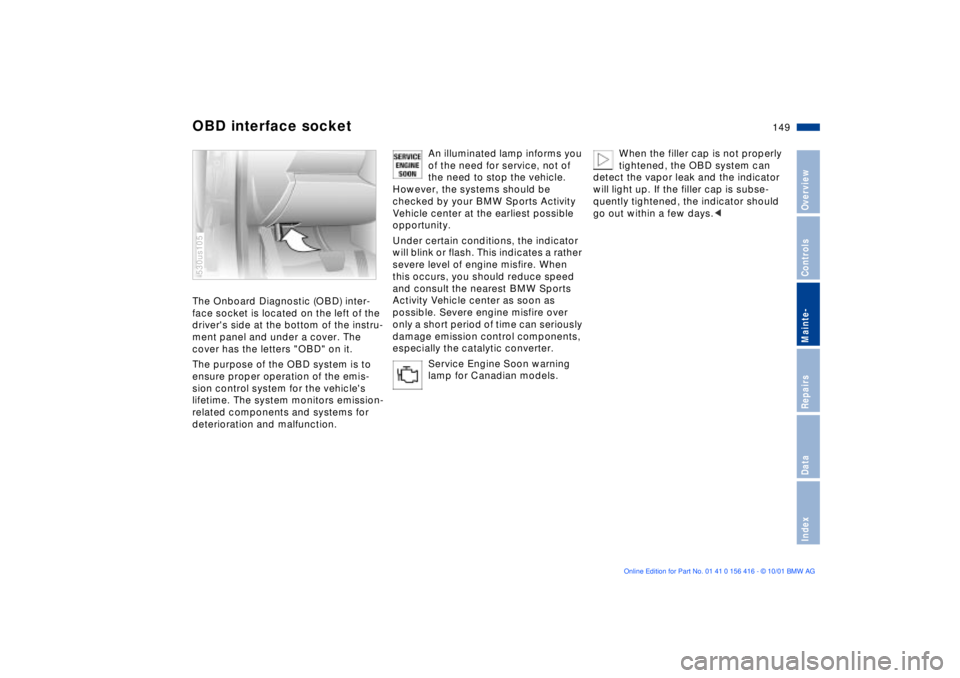
OBD interface socket The Onboard Diagnostic (OBD) inter-
face socket is located on the left of the
driver's side at the bottom of the instru-
ment panel and under a cover. The
cover has the letters "OBD" on it.
The purpose of the OBD system is to
ensure proper operation of the emis-
sion control system for the vehicle's
lifetime. The system monitors emission-
related components and systems for
deterioration and malfunction.530us105
An illuminated lamp informs you
of the need for service, not of
the need to stop the vehicle.
However, the systems should be
checked by your BMW Sports Activity
Vehicle center at the earliest possible
opportunity.
Under certain conditions, the indicator
will blink or flash. This indicates a rather
severe level of engine misfire. When
this occurs, you should reduce speed
and consult the nearest BMW Sports
Activity Vehicle center as soon as
possible. Severe engine misfire over
only a short period of time can seriously
damage emission control components,
especially the catalytic converter.
Service Engine Soon warning
lamp for Canadian models.
When the filler cap is not properly
tightened, the OBD system can
detect the vapor leak and the indicator
will light up. If the filler cap is subse-
quently tightened, the indicator should
go out within a few days.<
Page 156 of 185
156n
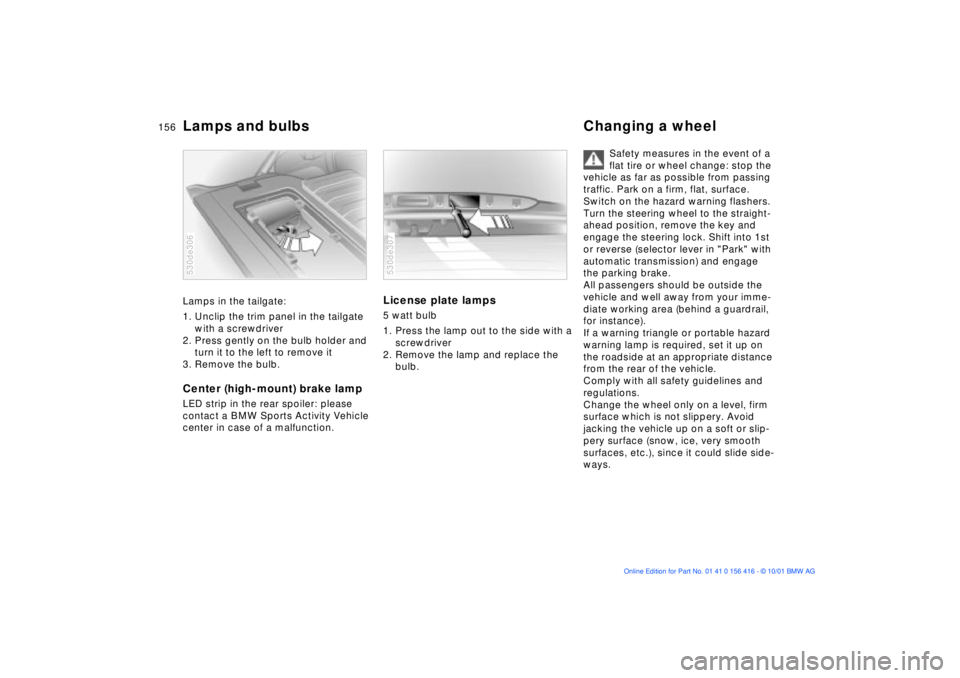
Lamps and bulbs Changing a wheel Lamps in the tailgate:
1. Unclip the trim panel in the tailgate
with a screwdriver
2. Press gently on the bulb holder and
turn it to the left to remove it
3. Remove the bulb. Center (high-mount) brake lamp LED strip in the rear spoiler: please
contact a BMW Sports Activity Vehicle
center in case of a malfunction. 530de306
License plate lamps 5 watt bulb
1. Press the lamp out to the side with a
screwdriver
2. Remove the lamp and replace the
bulb. 530de307
Safety measures in the event of a
flat tire or wheel change: stop the
vehicle as far as possible from passing
traffic. Park on a firm, flat, surface.
Switch on the hazard warning flashers.
Turn the steering wheel to the straight-
ahead position, remove the key and
engage the steering lock. Shift into 1st
or reverse (selector lever in "Park" with
automatic transmission) and engage
the parking brake.
All passengers should be outside the
vehicle and well away from your imme-
diate working area (behind a guardrail,
for instance).
If a warning triangle or portable hazard
warning lamp is required, set it up on
the roadside at an appropriate distance
from the rear of the vehicle.
Comply with all safety guidelines and
regulations.
Change the wheel only on a level, firm
surface which is not slippery. Avoid
jacking the vehicle up on a soft or slip-
pery surface (snow, ice, very smooth
surfaces, etc.), since it could slide side-
ways.