service BMW X5 4.4I 2003 User Guide
[x] Cancel search | Manufacturer: BMW, Model Year: 2003, Model line: X5 4.4I, Model: BMW X5 4.4I 2003Pages: 183, PDF Size: 2.31 MB
Page 24 of 183
24n
Warning triangle
*
First-aid kit
*
Refueling
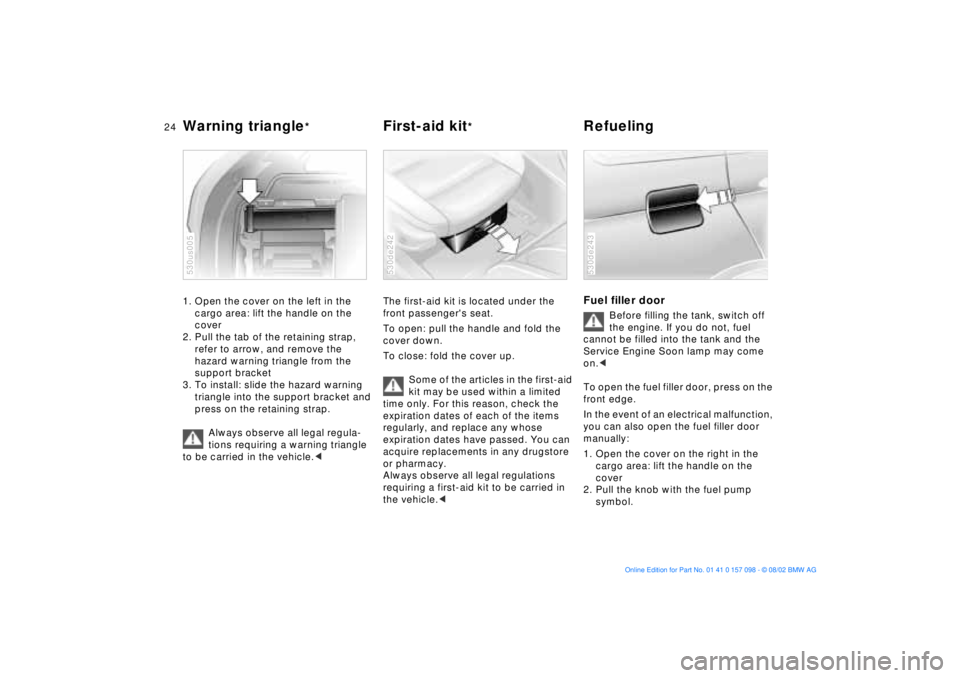
1. Open the cover on the left in the
cargo area: lift the handle on the
cover
2. Pull the tab of the retaining strap,
refer to arrow, and remove the
hazard warning triangle from the
support bracket
3. To install: slide the hazard warning
triangle into the support bracket and
press on the retaining strap.
Always observe all legal regula-
tions requiring a warning triangle
to be carried in the vehicle.< 530us005
The first-aid kit is located under the
front passenger's seat.
To open: pull the handle and fold the
cover down.
To close: fold the cover up.
Some of the articles in the first-aid
kit may be used within a limited
time only. For this reason, check the
expiration dates of each of the items
regularly, and replace any whose
expiration dates have passed. You can
acquire replacements in any drugstore
or pharmacy.
Always observe all legal regulations
requiring a first-aid kit to be carried in
the vehicle.< 530de242
Fuel filler door
Before filling the tank, switch off
the engine. If you do not, fuel
cannot be filled into the tank and the
Service Engine Soon lamp may come
on.<
To open the fuel filler door, press on the
front edge.
In the event of an electrical malfunction,
you can also open the fuel filler door
manually:
1. Open the cover on the right in the
cargo area: lift the handle on the
cover
2. Pull the knob with the fuel pump
symbol.
530de243
Page 29 of 183
29n
OverviewControlsMaintenanceRepairsDataIndex
Overview
Controls and features
Operation, maintenance
Index Technical data
Owner service procedures
Page 55 of 183
55n
OverviewControlsMaintenanceRepairsDataIndex
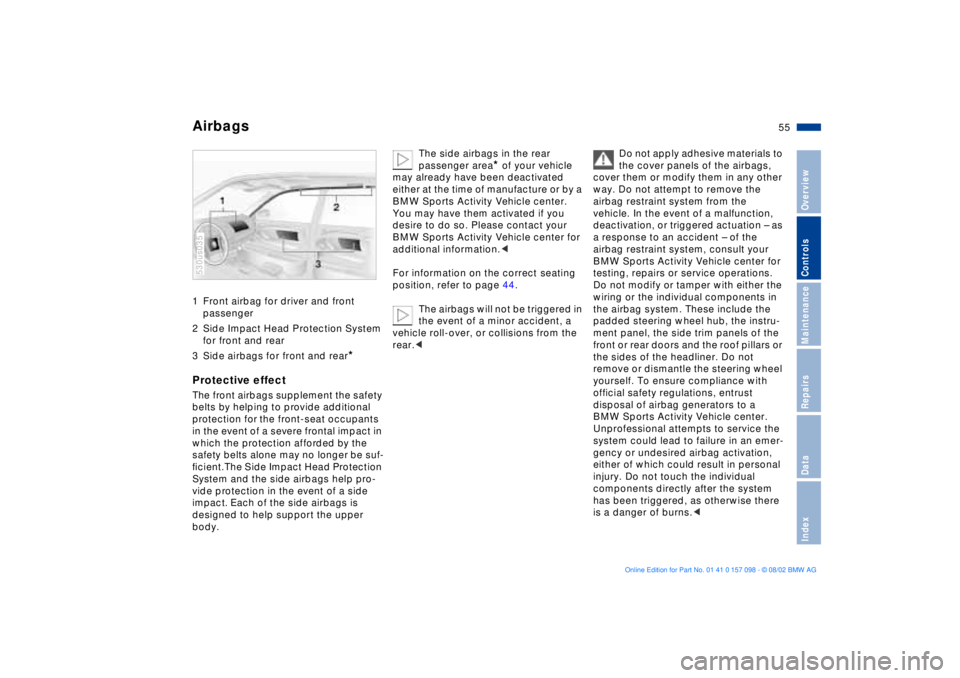
Airbags1 Front airbag for driver and front
passenger
2 Side Impact Head Protection System
for front and rear
3 Side airbags for front and rear
*
Protective effectThe front airbags supplement the safety
belts by helping to provide additional
protection for the front-seat occupants
in the event of a severe frontal impact in
which the protection afforded by the
safety belts alone may no longer be suf-
Þcient. The Side Impact Head Protection
System and the side airbags help pro-
vide protection in the event of a side
impact. Each of the side airbags is
designed to help support the upper
body. 530us035
The side airbags in the rear
passenger area
* of your vehicle
may already have been deactivated
either at the time of manufacture or by a
BMW Sports Activity Vehicle center.
You may have them activated if you
desire to do so. Please contact your
BMW Sports Activity Vehicle center for
additional information.<
For information on the correct seating
position, refer to page 44.
The airbags will not be triggered in
the event of a minor accident, a
vehicle roll-over, or collisions from the
rear.<
Do not apply adhesive materials to
the cover panels of the airbags,
cover them or modify them in any other
way. Do not attempt to remove the
airbag restraint system from the
vehicle. In the event of a malfunction,
deactivation, or triggered actuation Ð as
a response to an accident Ð of the
airbag restraint system, consult your
BMW Sports Activity Vehicle center for
testing, repairs or service operations.
Do not modify or tamper with either the
wiring or the individual components in
the airbag system. These include the
padded steering wheel hub, the instru-
ment panel, the side trim panels of the
front or rear doors and the roof pillars or
the sides of the headliner. Do not
remove or dismantle the steering wheel
yourself. To ensure compliance with
official safety regulations, entrust
disposal of airbag generators to a
BMW Sports Activity Vehicle center.
Unprofessional attempts to service the
system could lead to failure in an emer-
gency or undesired airbag activation,
either of which could result in personal
injury. Do not touch the individual
components directly after the system
has been triggered, as otherwise there
is a danger of burns.<
Page 63 of 183
63n
OverviewControlsMaintenanceRepairsDataIndex
Starting the engine Switching off the engineDo not press the accelerator pedal
while starting the engine.
BMW X5 3.0i:
Do not actuate the starter for too
short a time. Do not turn it for more
than approx. 20 seconds. Release the
ignition key immediately as soon as the
engine starts.
BMW X5 4.4i, 4.6is:
Your BMW is equipped with the conve-
nience starting feature. Simply turn the
ignition key to position 3 Ð starter Ð and
then release it immediately.
The starter actuation continues to
operate automatically for a certain
period of time and is stopped automati-
cally as soon as the engine has started.
The automatic starting mode will not
operate if the battery voltage is low.
The engine can be started by means of
jump-starting, refer to page 162.<
Do not allow the engine to warm up
by leaving it running while the vehicle
remains stationary. Instead, begin to
drive immediately at a moderate engine
speed.
Should the engine fail to start on the
first attempt, if it is very hot or cold, for
instance:
>Press the accelerator pedal halfway
down while engaging the starter.
Cold starts at altitudes above 3,300 ft/
1,000 meters and at very low tempera-
tures, from approx. +5 7/Ð15 6:
>For the initial start attempt, allow the
starter to remain engaged somewhat
longer, approx. 10 seconds.
Engine idle speed is controlled by the
engine computer system. Increased
speeds at start-up are normal and
should decrease as the engine warms
up. If engine speed does not decrease,
service is required.
To prevent the battery from discharging,
always switch off electrical devices that
are not in use. Switch the ignition off
when the vehicle is not being driven.
Extended starting attempts, char-
acterized by excessively frequent
or long periods with the starter
engaged, can lead to damage of the
catalytic converter.<
Turn the ignition key to position 1 or 0.
Do not remove the ignition key
while the vehicle is still moving. If
you do so, the steering will lock.
Always remove the ignition key and
engage the steering lock before leaving
the vehicle.
Vehicles with manual transmission:
Always engage the parking brake when
parking on slopes and inclined sur-
faces. Even placing the gearshift lever
in 1st gear or reverse may not provide
adequate resistance to rolling.
Vehicles with automatic transmission:
Place the selector lever in Park.<
Vehicles with automatic transmission:
The vehicle must be stationary and the
selector lever in Park before you can
remove the ignition key.
Page 76 of 183
76n
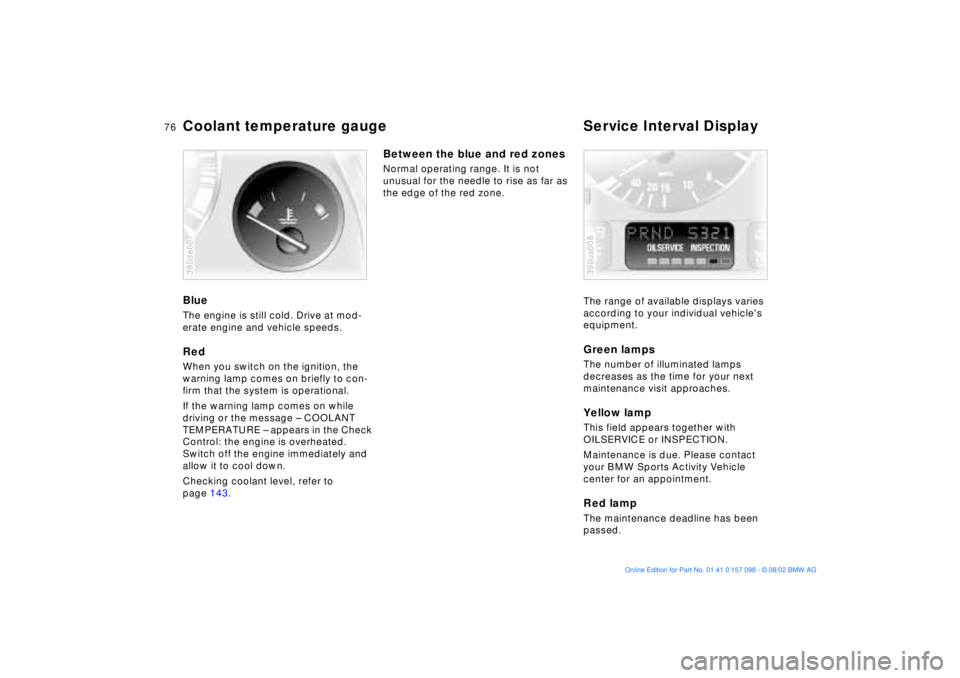
Coolant temperature gauge Service Interval Display Blue The engine is still cold. Drive at mod-
erate engine and vehicle speeds.Red When you switch on the ignition, the
warning lamp comes on briefly to con-
firm that the system is operational.
If the warning lamp comes on while
driving or the message Ð COOLANT
TEMPERATURE Ð appears in the Check
Control: the engine is overheated.
Switch off the engine immediately and
allow it to cool down.
Checking coolant level, refer to
page 143. 390de007
Between the blue and red zones Normal operating range. It is not
unusual for the needle to rise as far as
the edge of the red zone.
The range of available displays varies
according to your individual vehicle's
equipment.
Green lamps The number of illuminated lamps
decreases as the time for your next
maintenance visit approaches.Yellow lamp This field appears together with
OILSERVICE or INSPECTION.
Maintenance is due. Please contact
your BMW Sports Activity Vehicle
center for an appointment.Red lamp The maintenance deadline has been
passed.390us008
Page 92 of 183
92n
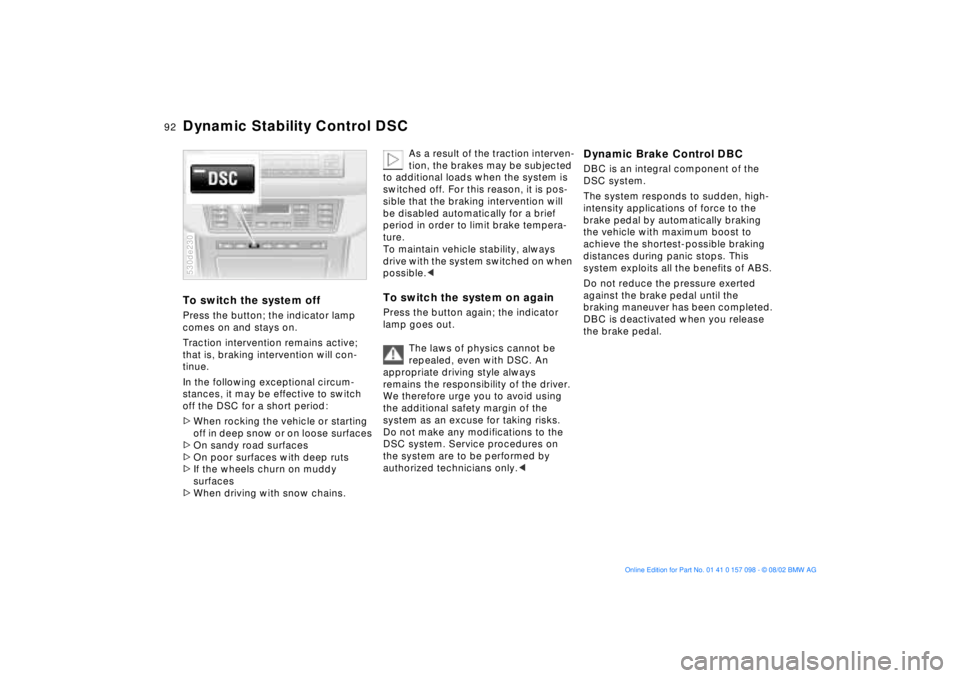
Dynamic Stability Control DSCTo switch the system offPress the button; the indicator lamp
comes on and stays on.
Traction intervention remains active;
that is, braking intervention will con-
tinue.
In the following exceptional circum-
stances, it may be effective to switch
off the DSC for a short period:
>When rocking the vehicle or starting
off in deep snow or on loose surfaces
>On sandy road surfaces
>On poor surfaces with deep ruts
>If the wheels churn on muddy
surfaces
>When driving with snow chains. 530de230
As a result of the traction interven-
tion, the brakes may be subjected
to additional loads when the system is
switched off. For this reason, it is pos-
sible that the braking intervention will
be disabled automatically for a brief
period in order to limit brake tempera-
ture.
To maintain vehicle stability, always
drive with the system switched on when
possible.<
To switch the system on againPress the button again; the indicator
lamp goes out.
The laws of physics cannot be
repealed, even with DSC. An
appropriate driving style always
remains the responsibility of the driver.
We therefore urge you to avoid using
the additional safety margin of the
system as an excuse for taking risks.
Do not make any modifications to the
DSC system. Service procedures on
the system are to be performed by
authorized technicians only.<
Dynamic Brake Control DBCDBC is an integral component of the
DSC system.
The system responds to sudden, high-
intensity applications of force to the
brake pedal by automatically braking
the vehicle with maximum boost to
achieve the shortest-possible braking
distances during panic stops. This
system exploits all the benefits of ABS.
Do not reduce the pressure exerted
against the brake pedal until the
braking maneuver has been completed.
DBC is deactivated when you release
the brake pedal.
Page 129 of 183
129n
OverviewControlsMaintenanceRepairsDataIndex
Overview
Controls and features
Operation, maintenance
Owner service procedures
Index Technical data
Mainte-
Page 130 of 183

130n
Break-in proceduresTo ensure that your vehicle provides
maximum economy throughout a long
service life, we request that you
observe the following instructions: Engine and differential Up to 1,200 miles/2,000 km:
Drive at varying engine speeds and
road speeds, but do not exceed
4,500 rpm and the following road
speeds during this initial period:
6-cylinder engines: 100 mph/160 km/h
8-cylinder engines: 106 mph/170 km/h
Obey your local and state maximum
speed limits.
Refrain from using full throttle and avoid
pressing the accelerator beyond the
kickdown point.
Once you have driven 1,200 miles/
2,000 km, engine and vehicle speeds
can gradually be increased.
You should also comply with these
break-in procedures should the engine
or one of the differentials be replaced
later in the course of the vehicle's ser-
vice life.
TiresDue to technical factors associated
with their manufacture, tires do not
achieve their full traction potential until
an initial break-in period has elapsed.
For this reason, drive with extra care
during the initial 200 miles/300 km.
Obey your local and state maximum
speed limits.
When the vehicle is operated on
wet or slushy roads, a wedge of
water may form between the tire and
the road surface. This phenomenon is
referred to as aquaplaning, or hydro-
planing, and can lead to partial or com-
plete loss of traction, vehicle control
and braking effectiveness. Reduce your
speed on wet roads.<
Brake systemApprox. 300 miles/500 km must elapse
before the brake pads and rotors
achieve the optimal pad-surface and
wear patterns required for trouble-free
operation and long service life later on.
To break in the separate parking brake
drums, apply the parking brake lightly
when coasting to a standstill at a traffic
signal, for instance, provided that traffic
conditions allow you to do so.
To avoid corrosion, repeat this proce-
dure from time to time.
The brake lamps do not light up
when the parking brake is applied.
Vacuum for the brake system servo unit
on your BMW is available only when the
engine is running. When you move the
vehicle with the engine switched off Ð
when towing, for instance Ð substan-
tially higher levels of pedal force will be
required to brake the vehicle.<
Page 134 of 183
134n
Information for your safety The factory-approved radial tires are
matched to the vehicle and have been
selected to provide optimum safety and
driving comfort on your vehicle when
used correctly.
It is not merely the tire's service life, but
also driving comfort and Ð above all else
Ð driving safety which depend on the
condition of the tires and the mainte-
nance of the specified tire pressure.
Incorrect inflation pressure is a
frequent cause of tire damage. It
also significantly influences the road-
holding ability of your BMW. Check tire
inflation pressures Ð including the spare
wheel Ð regularly, refer to page 26, at
least every two weeks and before
beginning a longer trip. If this is not
done, incorrect tire pressures can
cause driving instability and tire
damage, ultimately resulting in an
accident.<
Tire tread Ð Tire damage Inspect your tires frequently for tread
wear, signs of damage and for foreign
objects lodged in the tread. Check the
tread pattern depth.
Tread depth should not be allowed to
go below 0.12 in/3 mm, even though,
the legally specified minimum tread
depth, for example in Europe, is only
0.063 in/1.6 mm. Below a tread depth
of 0.12 in/3 mm there is an increased
risk of hydroplaning, even at relatively
moderate speeds and with only small
amounts of water on the road.
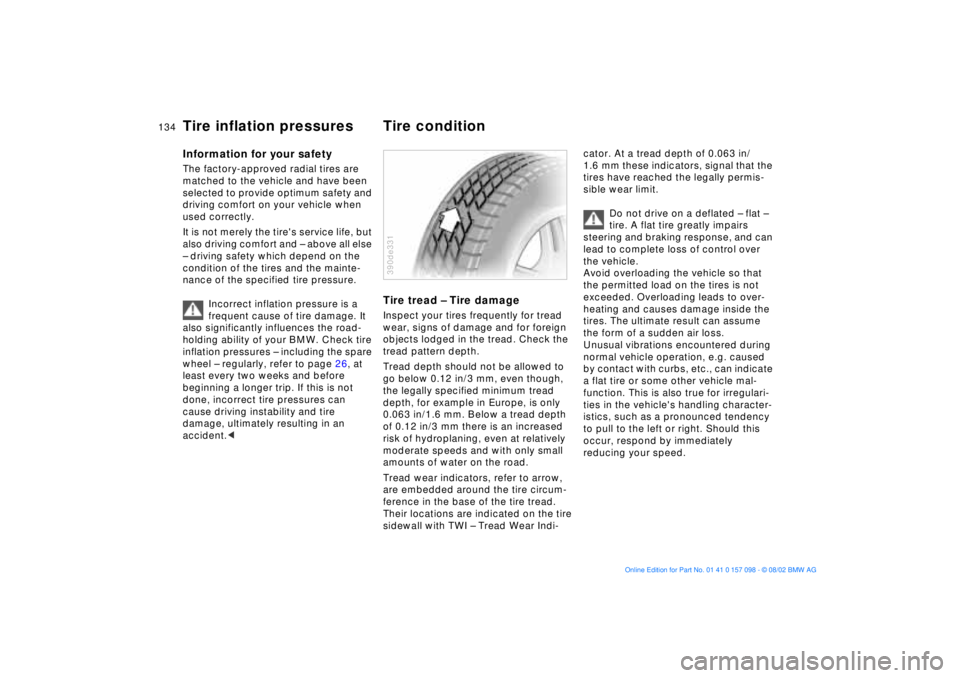
Tread wear indicators, refer to arrow,
are embedded around the tire circum-
ference in the base of the tire tread.
Their locations are indicated on the tire
sidewall with TWI Ð Tread Wear Indi-390de331
cator. At a tread depth of 0.063 in/
1.6 mm these indicators, signal that the
tires have reached the legally permis-
sible wear limit.
Do not drive on a deflated Ð flat Ð
tire. A flat tire greatly impairs
steering and braking response, and can
lead to complete loss of control over
the vehicle.
Avoid overloading the vehicle so that
the permitted load on the tires is not
exceeded. Overloading leads to over-
heating and causes damage inside the
tires. The ultimate result can assume
the form of a sudden air loss.
Unusual vibrations encountered during
normal vehicle operation, e.g. caused
by contact with curbs, etc., can indicate
a flat tire or some other vehicle mal-
function. This is also true for irregulari-
ties in the vehicle's handling character-
istics, such as a pronounced tendency
to pull to the left or right. Should this
occur, respond by immediately
reducing your speed.
Tire inflation pressures Tire condition
Page 135 of 183
135n
OverviewControlsMaintenanceRepairsDataIndex
Tire condition Tire replacement Proceed carefully to the nearest
BMW Sports Activity Vehicle center or
professional tire center, or have the
vehicle towed in to have it, its wheels
and tires inspected.
Tire damage up to and including blow-
outs can endanger the lives of both the
vehicle occupants and other road
users.<
DOT Quality GradesTread wear
Traction AA A B C
Temperature A B C
All passenger car tires must con-
form to Federal Safety Require-
ments in addition to these grades.< Tread wearThe tread wear grade is a comparative
rating based on the wear rate of the tire
when tested under controlled condi-
tions on a specified government test
course.
For example, a tire graded 150 would
wear one and one-half Ð 1g Ð times as
well on the government course as a tire
graded 100. The relative performance
of tires depends upon the actual condi-
tions of their use, however, and may
depart significantly from the norm due
to variations in driving habits, service
practices and differences in road char-
acteristics and climate.
TractionThe traction grades, from highest to
lowest, are AA, A, B, and C.
Those grades represent the tire's ability
to stop on wet pavement as measured
under controlled conditions on speci-
fied government test surfaces of
asphalt and concrete. A tire marked C
may have poor traction performance.
The traction grade assigned to
this tire is based on straight-
ahead braking traction tests, and does
not include acceleration, cornering,
hydroplaning, or peak traction charac-
teristics.<