Air BMW X5 4.4I 2004 E53 Manual PDF
[x] Cancel search | Manufacturer: BMW, Model Year: 2004, Model line: X5 4.4I, Model: BMW X5 4.4I 2004 E53Pages: 200, PDF Size: 3.91 MB
Page 127 of 200
125n
OverviewControlsMaintenanceRepairsDataIndex
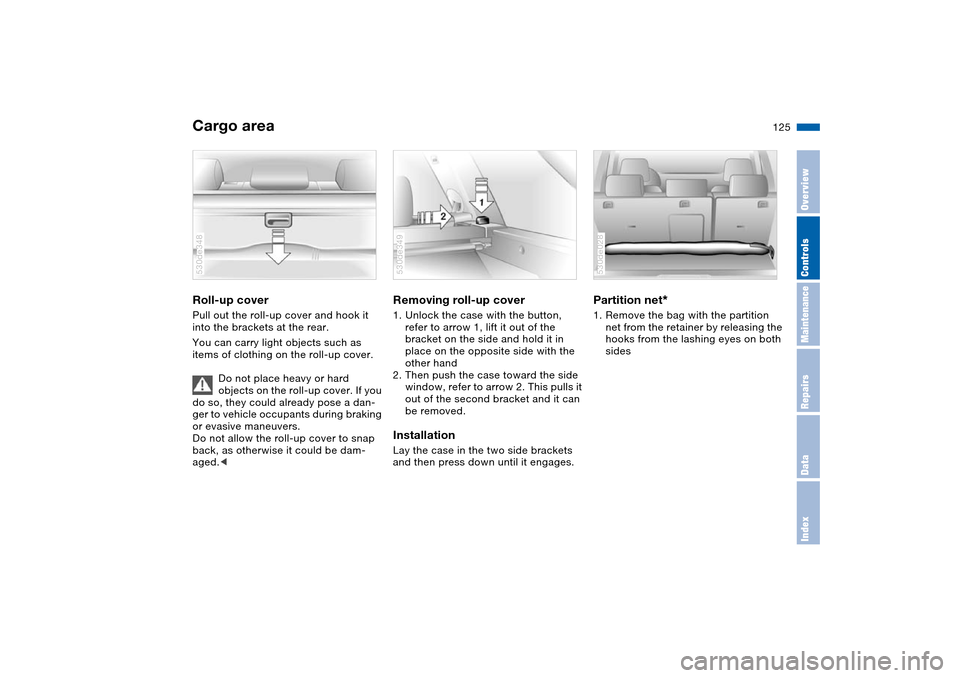
Cargo area Roll-up cover Pull out the roll-up cover and hook it
into the brackets at the rear.
You can carry light objects such as
items of clothing on the roll-up cover.
Do not place heavy or hard
objects on the roll-up cover. If you
do so, they could already pose a dan-
ger to vehicle occupants during braking
or evasive maneuvers.
Do not allow the roll-up cover to snap
back, as otherwise it could be dam-
aged.<530de348
Removing roll-up cover1. Unlock the case with the button,
refer to arrow 1, lift it out of the
bracket on the side and hold it in
place on the opposite side with the
other hand
2. Then push the case toward the side
window, refer to arrow 2. This pulls it
out of the second bracket and it can
be removed.InstallationLay the case in the two side brackets
and then press down until it engages.530de349
Partition net
*
1. Remove the bag with the partition
net from the retainer by releasing the
hooks from the lashing eyes on both
sides530de028
Page 129 of 200
127n
OverviewControlsMaintenanceRepairsDataIndex
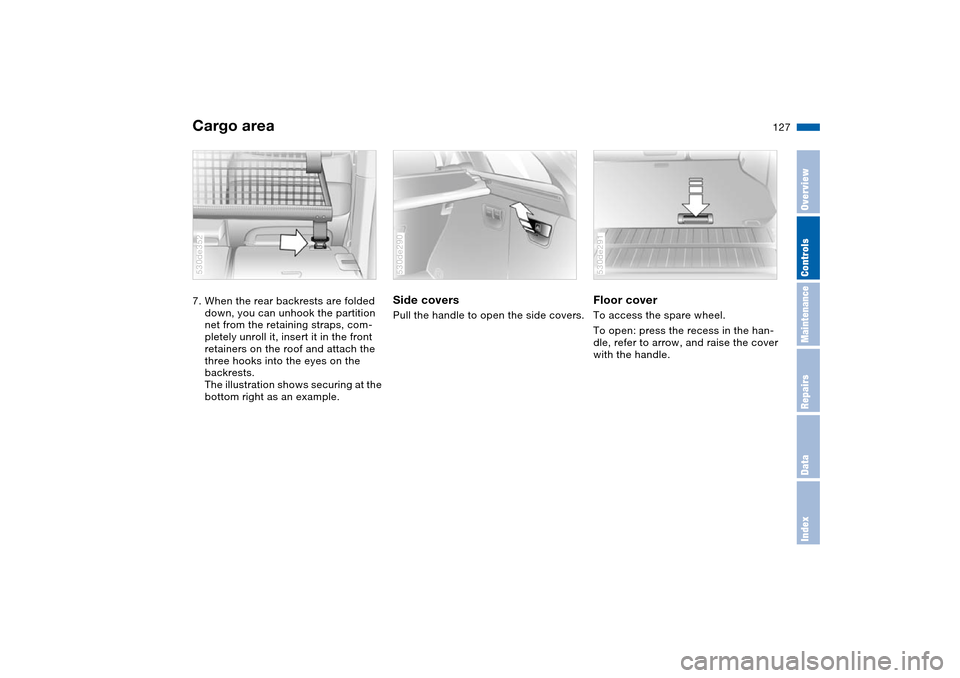
Cargo area 7. When the rear backrests are folded
down, you can unhook the partition
net from the retaining straps, com-
pletely unroll it, insert it in the front
retainers on the roof and attach the
three hooks into the eyes on the
backrests.
The illustration shows securing at the
bottom right as an example.530de352
Side covers Pull the handle to open the side covers.530de290
Floor cover To access the spare wheel.
To open: press the recess in the han-
dle, refer to arrow, and raise the cover
with the handle. 530de291
Page 131 of 200
129n
OverviewControlsMaintenanceRepairsDataIndex
Cargo areaWhen it is extended, you can load the
cargo floor:
>With up to 990 Ibs./450 kg, distrib-
uted evenly across the entire surface
>With up to 330 Ibs./150 kg on the
rear edge.
Do not overload the cargo floor
when it is extended. If you do so, it
could cause damage.
When you slide the cargo floor back in,
do not grasp it on the bottom. If you do
so, there is a risk of personal injury.<
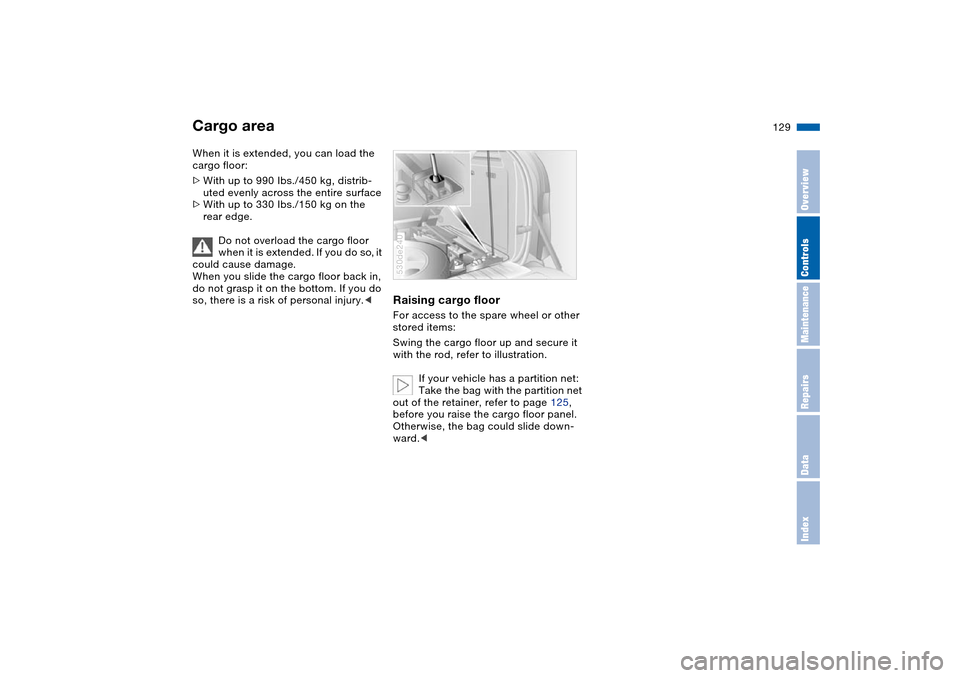
Raising cargo floor For access to the spare wheel or other
stored items:
Swing the cargo floor up and secure it
with the rod, refer to illustration.
If your vehicle has a partition net:
Take the bag with the partition net
out of the retainer, refer to page 125,
before you raise the cargo floor panel.
Otherwise, the bag could slide down-
ward.<530de240
Page 132 of 200
130n
Cargo loading
To avoid loading the tires beyond
their approved carrying capacity,
never overload the vehicle. Overloading
can lead to overheating and increases
the rate at which damage develops
inside the tires. The ultimate result can
assume the form of a sudden air loss.<
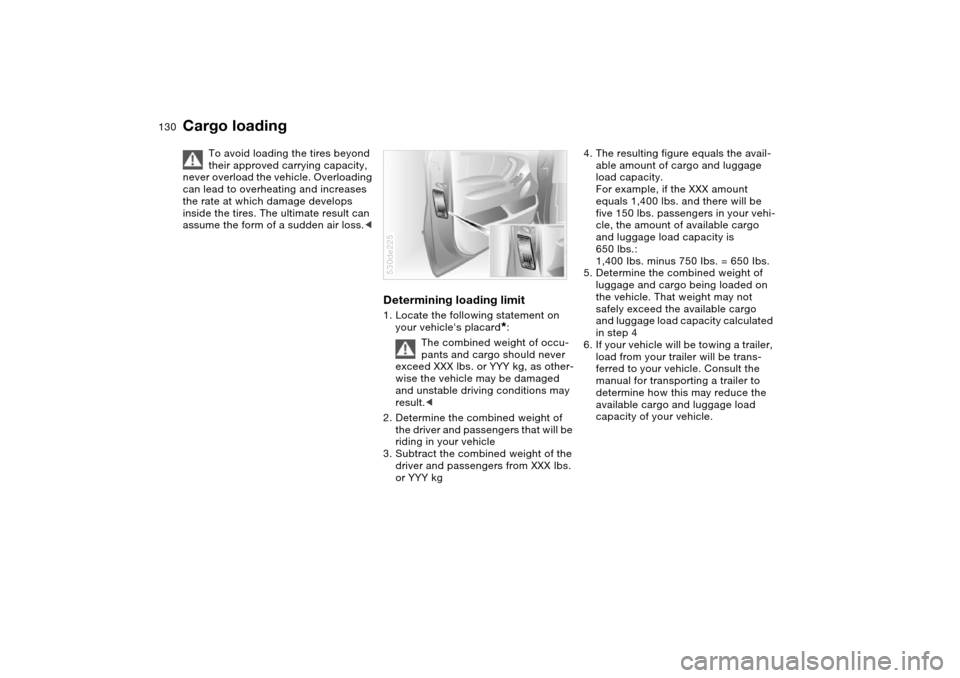
Determining loading limit1. Locate the following statement on
your vehicle's placard
*:
The combined weight of occu-
pants and cargo should never
exceed XXX lbs. or YYY kg, as other-
wise the vehicle may be damaged
and unstable driving conditions may
result.<
2. Determine the combined weight of
the driver and passengers that will be
riding in your vehicle
3. Subtract the combined weight of the
driver and passengers from XXX lbs.
or YYY kg
530de225
4. The resulting figure equals the avail-
able amount of cargo and luggage
load capacity.
For example, if the XXX amount
equals 1,400 lbs. and there will be
five 150 lbs. passengers in your vehi-
cle, the amount of available cargo
and luggage load capacity is
650 lbs.:
1,400 Ibs. minus 750 Ibs. = 650 Ibs.
5. Determine the combined weight of
luggage and cargo being loaded on
the vehicle. That weight may not
safely exceed the available cargo
and luggage load capacity calculated
in step 4
6. If your vehicle will be towing a trailer,
load from your trailer will be trans-
ferred to your vehicle. Consult the
manual for transporting a trailer to
determine how this may reduce the
available cargo and luggage load
capacity of your vehicle.
Page 133 of 200
131n
OverviewControlsMaintenanceRepairsDataIndex
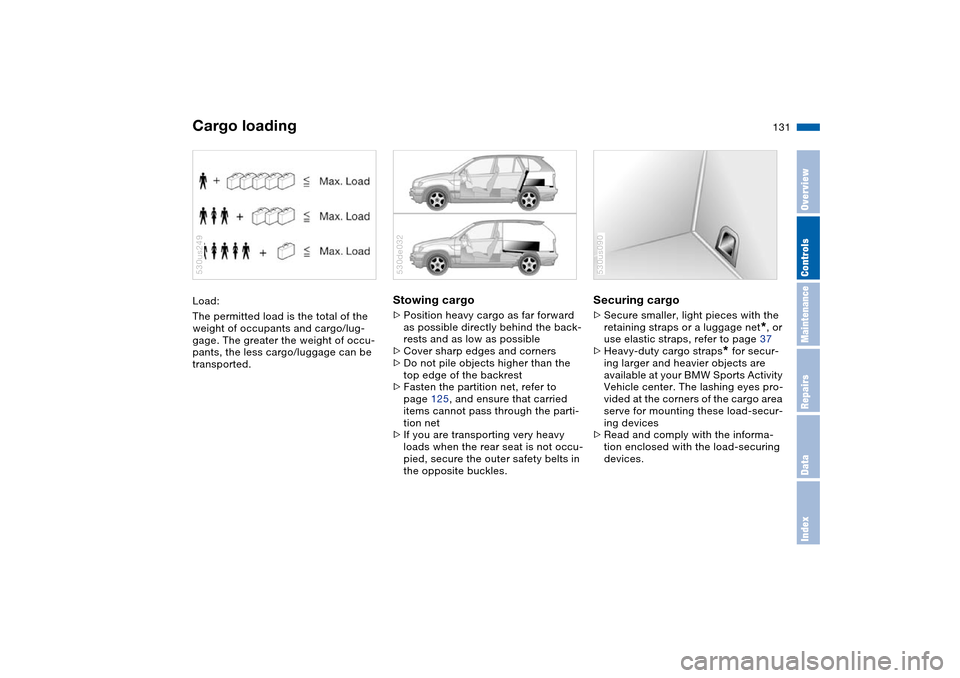
Cargo loadingLoad:
The permitted load is the total of the
weight of occupants and cargo/lug-
gage. The greater the weight of occu-
pants, the less cargo/luggage can be
transported.530us249
Stowing cargo >Position heavy cargo as far forward
as possible directly behind the back-
rests and as low as possible
>Cover sharp edges and corners
>Do not pile objects higher than the
top edge of the backrest
>Fasten the partition net, refer to
page 125, and ensure that carried
items cannot pass through the parti-
tion net
>If you are transporting very heavy
loads when the rear seat is not occu-
pied, secure the outer safety belts in
the opposite buckles. 530de032
Securing cargo >Secure smaller, light pieces with the
retaining straps or a luggage net
*, or
use elastic straps, refer to page 37
>Heavy-duty cargo straps
* for secur-
ing larger and heavier objects are
available at your BMW Sports Activity
Vehicle center. The lashing eyes pro-
vided at the corners of the cargo area
serve for mounting these load-secur-
ing devices
>Read and comply with the informa-
tion enclosed with the load-securing
devices.
530us090
Page 135 of 200

133n
OverviewControlsMaintenanceRepairsDataIndex
Page 137 of 200
135n
OverviewControlsMaintenanceRepairsDataIndex
Overview
Controls and features
Operation, maintenance
Owner service procedures
Index Technical data
Mainte-
Page 139 of 200
137n
OverviewControlsMaintenanceRepairsDataIndex
Driving your X5 On bad roads When you are driving on bad roads,
there are a few points which you should
strictly observe — for your own safety,
for that of your passengers, and for the
safety of the vehicle:
Driving on unpaved terrain can
cause damage to the vehicle.<
>Always adapt the driving speed to the
road conditions. The rougher or
steeper the road surface is, the lower
the speed should be
>You can operate your vehicle on
uphill and downhill gradients with a
maximum slope of 50 %. If you want
to drive on uphill or downhill gradi-
ents of this kind, make sure before-
hand that the engine oil and coolant
levels are near the max mark. Refer
to pages 148 and 150.
Use the HDC Hill Descent Control on
steep downhill gradients, refer to
page 96.
It is possible to start off on gradients
of up to 32 %.
The permitted side tilt is also 50 %
>While driving, watch carefully for
obstacles such as rocks or holes. Try
to avoid these obstacles whenever
possible
>Please note that, for example on
crests and bumpy roads, the body
can make ground contact.
The ground clearance of the vehicle
is:
– 8 in/200 mm with up to four persons
– 7 in/180 mm fully loaded, without
self-leveling suspension
>Only drive through water up to a
maximum depth of 20 in/50 cm and
only at walking speed, making sure
not to stop in the process.
After leaving the water, press on the
footbrake gently several times while
driving at a low speed. The brake
applications will help to dry the
brakes, thus preventing a reduction in
braking performance caused by the
moisture.
Back onto paved road In recommending that you observe the
following points after driving on adverse
road surfaces, it is not as a beauty
treatment for your BMW. Instead, it is
intended for the maintenance of driving
safety:
>Clean the largest accumulations of
dirt from the body and check the
underbody for damage
>Clean mud, snow, ice etc. from the
wheels and tires and check the
wheels for damage
>Check to determine whether rocks,
gravel or accumulations of dirt on the
brake rotors and calipers could influ-
ence braking performance. Remove
all such foreign objects
>In order to clean the brake rotors,
apply the footbrake gently several
times while driving at a low speed.
Be sure that following traffic is not
endangered by this
>For cleaning the handbrake, apply
the lever slightly at approx. 25 mph/
40 km/h and continue to drive for
approx. 200 yards/200 meters, pro-
vided that traffic conditions allow you
to do so.
Page 140 of 200
138n
General driving notesHot exhaust system
Extreme temperatures occur at
the catalytic converter on this and
every catalyst-equipped vehicle. Do not
remove the heat shields installed adja-
cent to various sections of the exhaust
system, and never apply undercoating
to them. When driving, standing at idle
and while parking take care to avoid
possible contact between a hot exhaust
system and any highly flammable mate-
rials such as hay, leaves, grass etc.
Such contact could lead to a fire, and
with it the risk of serious property dam-
age as well as personal injury.<
Parking vehicle Condensation forms in the air condi-
tioner system during operation, and
then exits under the vehicle. Traces of
condensed water under the vehicle are
thus normal.Brakes
Do not drive with your foot resting
on the brake pedal. Even light but
consistent pedal pressure can lead to
excessively high temperatures, brake
wear and possibly even brake failure.<
Road hazards
If road hazards, obstacles or
curbs are unavoidable, only drive
over them very slowly and carefully, as
otherwise the wheels and suspension
parts, especially on vehicles fitted with
low profile tires, can be damaged.<
For more information on wheels and
tires, refer to page 143.
Before driving into a car washFold in the door mirrors, refer to
page 54, as otherwise they could be
damaged due to the width of the vehi-
cle.Hydroplaning
When driving on wet or slushy
roads, reduce road speed. If you
do not, a wedge of water can form
between tires and road surface. This
state can cause a partial or total loss of
contact with the road surface, of brak-
ing control and of control over the vehi-
cle.<
Driving through water
Do not drive through water on
the road if it is deeper than 20 in/
50 cm, and then only at walking speed
at the most. Otherwise, the vehicle's
engine, the electrical systems and the
transmission may be damaged.<
Page 141 of 200
139n
OverviewControlsMaintenanceRepairsDataIndex
Safe braking Emergency stopsYou brake most effectively when you
apply maximum pedal pressure in situa-
tions requiring it: emergency stops.
Since the vehicle maintains steering
responsiveness, you can nevertheless
avoid possible obstacles with a mini-
mum of steering effort.
Pulsation at the brake pedal combined
with sounds from the hydraulic circuits
indicates to the driver that ABS is in its
active mode.Brake fluid level If the brake fluid level is too low and
brake pedal travel has become longer,
there may be a defect in one of the two
brake system's hydraulic circuits.
Proceed to the nearest BMW
Sports Activity Vehicle center.
Here increased pressure on the brake
pedal may be required, and slight pull-
ing to the side and longer braking dis-
tances may result. Please remember to
adapt your driving style accordingly.<
Disk brakes When the vehicle is driven only occa-
sionally, during extended periods when
the vehicle is not used at all, and in
operating conditions where brake appli-
cations are less frequent, there is an
increased tendency for corrosion to
form on rotors, while contaminants
accumulate on the brake pads. This
occurs because the minimal pressure
which must be exerted by the pads dur-
ing brake applications to clean the
rotors is not reached.
If the brake rotors are corroded, they
will tend to respond to braking with a
pulsating effect which even extended
application will fail to cure.
When driving in wet conditions and in
heavy rain, it is advisable to apply light
pressure to the brake pedal from time
to time. Monitor traffic conditions to
ensure that this maneuver does not
endanger other road users. The heat
generated in this process helps dry the
pads and rotors to ensure that the brak-
ing force is then immediately available
when required.
Extended or steep mountain descents
should be driven in the gear in which
only minimal periodic brake application
is required. This avoids excessive strain on the brakes and possible impairment
of the braking effect.
Do not coast with the clutch
depressed or with the transmis-
sion or selector lever in neutral. Do not
drive with the engine switched off. The
engine provides no braking effect when
the clutch is depressed or the transmis-
sion is in neutral, and there is no
power-assist for braking or steering
when the engine is not running.
BMW recommends having brake
inspections performed at a BMW
Sports Activity Vehicle center only. If
you do not, parts of the 4-wheel drive
system could be damaged.
Never allow floor mats, carpets or any
other objects to protrude into the area
around the accelerator, clutch and
brake pedals and obstruct their move-
ment.<
Brake pads
For your own safety: use only
brake pads that BMW has
released for your particular vehicle
model. BMW cannot evaluate non-
approved brake pads to determine if
they are suited for use, and therefore
cannot ensure the operating safety of
the vehicle if they are installed.<