light BMW X5 4.4I 2005 E53 Service Manual
[x] Cancel search | Manufacturer: BMW, Model Year: 2005, Model line: X5 4.4I, Model: BMW X5 4.4I 2005 E53Pages: 200, PDF Size: 3.55 MB
Page 113 of 200
113n
OverviewControlsMaintenanceRepairsDataIndex
Automatic climate control
*
Air conditioning
The air is cooled and
dehumidified and —
depending on the temperature setting —
warmed again. Depending on the
weather, the windshield may fog over
briefly when the engine is started. You
can reduce condensation forming on
the windows by switching on the air
conditioning.
During air conditioning condensa-
tion forms, which then exits under
the vehicle. That traces of water on the
ground are therefore normal.<
Maximum cooling
You will get maximum cool-
ing capacity using this pro-
gram if the engine is running and the
outside temperature is above approx.
417/56.
The temperature display 9 jumps to
607/166, the system switches over
to the recirculated-air mode, and the
maximum air supply flows from the ven-
tilation grills only. That is why you need
to keep these open if you select this
program.
AUC Automatic recirculated-air
control
You can respond to
unpleasant odors or pollut-
ants in the immediate environment by
shutting off the supply of outside air.
The system then recirculates the air
currently within the vehicle. In AUC
operating mode, a sensor detects pol-
lutants in the external air and controls
the shut-off automatically.
Press the button repeatedly to run
through the following control sequence
>Indicator lamps off: outside air supply
operational
>Left indicator lamp on, AUC mode:
the system recognizes pollutants in
the outside air and blocks the flow of
air when necessary. The system then
recirculates the air currently within
the vehicle.
Depending on the air quality, the
automatic system then switches back
and forth between outside air supply
and recirculation of the air within the
vehicle
>Right-hand indicator lamp on: the
outside air supply into the vehicle is
completely blocked. The system then
recirculates the air currently within
the vehicle.
With the button on the steering wheel
you can also switch between Off and
recirculated-air mode or AUC and recir-
culated-air mode, refer to page23.
If the windows fog over in the
recirculated-air mode, switch the
recirculated-air mode off and increase
the air supply as required.< Rear window defroster
When the rear window
defroster is activated, the
indicator lamp comes on. The rear win-
dow defroster switches off automati-
cally.
Residual heat
Press button when the motor
is switched off, but warm.
The heat which is stored in the engine
is utilized for heating the interior when
the engine has been switched off –
while waiting at a railroad crossing, for
instance.
This function may be activated when
the outside temperature is below
approx. 597/156, the engine is at
operating temperature, and the battery
is adequately charged. The LED on the
button will light up when all conditions
have been met.
Page 117 of 200
117n
OverviewControlsMaintenanceRepairsDataIndex
The concept The integrated universal remote control
can replace as many as three hand-
held transmitters for various remote-
controlled accessories, such as door
openers and house alarm systems.
The integrated universal remote control
recognizes and learns the transmitted
signal of each of the original hand-held
transmitters.
The signal of an original hand-held
transmitter can be programmed on one
of the three memory buttons 1. Follow-
ing that, each of the devices can be
actuated with the appropriately-pro-
grammed memory button 1. The indica-
tor lamp 2 flashes to confirm transmis-
sion of the signal.
Should you sell your vehicle one day,
be sure to delete the stored programs
beforehand for your safety, refer to
page119. To prevent possible damage or
injury, before programming or
using the integrated universal remote
control, always inspect the immediate
area to make certain that no people,
animals or objects are within the travel
range of the device. Also, comply with
the safety precautions of the original
hand-held transmitter.<
To Canadian residents:
During programming, your hand-
held transmitter may automatically stop
transmitting after two seconds, which
may not be long enough to program the
integrated universal remote control. If
you are programming from one of these
hand-held transmitters, the integrated
universal remote control's light may
begin to flash in a series of double-
blinks. If this occurs, continue to hold
the button of the integrated universal
remote control while you reactivate
your hand-held transmitter. You may
have to repeat this function several
times while programming.<
Checking compatibility
If you see this symbol on the
packaging or in the manual sup-
plied with the original hand-held
transmitter, it is safe to assume that it is
compatible with the integrated universal
remote control.
A list of compatible hand transmitters
is available via fax polling by calling
+49 (0)6838 907283 3333. For details,
please call the toll-free HomeLink Hot-
line at +49 (0)6838 907 277 or 0800
0466 35465 in Germany.
HomeLink is a registered trademark of
Johnson Controls.
Integrated universal remote control
*
Page 120 of 200
120n
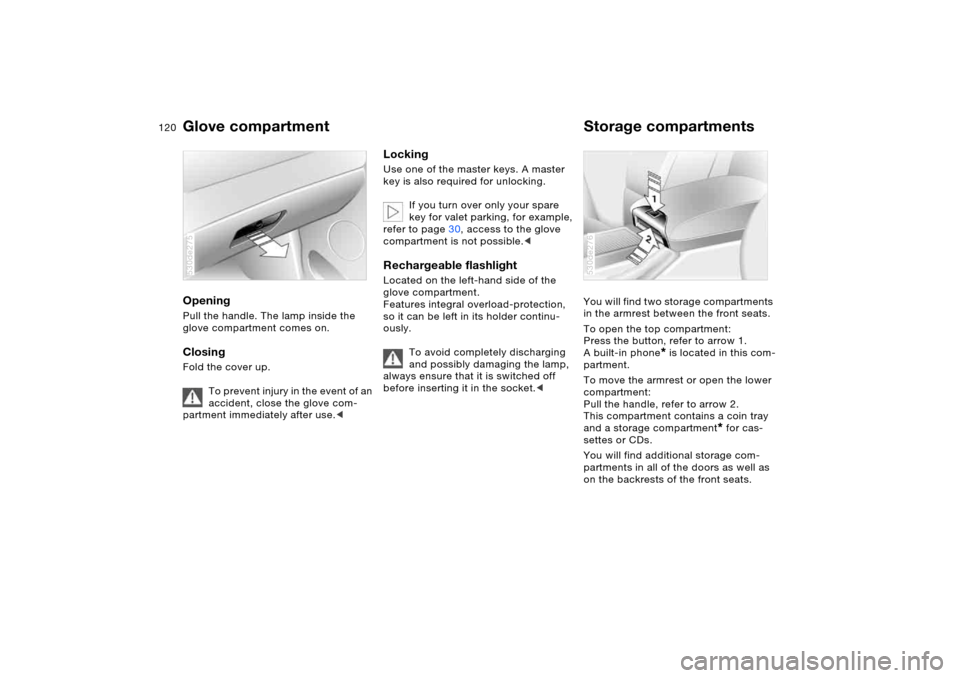
Glove compartment Storage compartments Opening Pull the handle. The lamp inside the
glove compartment comes on.Closing Fold the cover up.
To prevent injury in the event of an
accident, close the glove com-
partment immediately after use.< 530de275
Locking Use one of the master keys. A master
key is also required for unlocking.
If you turn over only your spare
key for valet parking, for example,
refer to page30, access to the glove
compartment is not possible.< Rechargeable flashlight Located on the left-hand side of the
glove compartment.
Features integral overload-protection,
so it can be left in its holder continu-
ously.
To avoid completely discharging
and possibly damaging the lamp,
always ensure that it is switched off
before inserting it in the socket.<
You will find two storage compartments
in the armrest between the front seats.
To open the top compartment:
Press the button, refer to arrow 1.
A built-in phone
* is located in this com-
partment.
To move the armrest or open the lower
compartment:
Pull the handle, refer to arrow 2.
This compartment contains a coin tray
and a storage compartment
* for cas-
settes or CDs.
You will find additional storage com-
partments in all of the doors as well as
on the backrests of the front seats.
530de276
Page 121 of 200
121n
OverviewControlsMaintenanceRepairsDataIndex
Storage compartments Cup holders Clothes hooks
When suspending clothing from
the hooks ensure that it will not
obstruct the driver's vision. Do not hang
heavy objects on the hooks. If you do
so, they could cause endanger passen-
gers during braking or evasive maneu-
vers.<
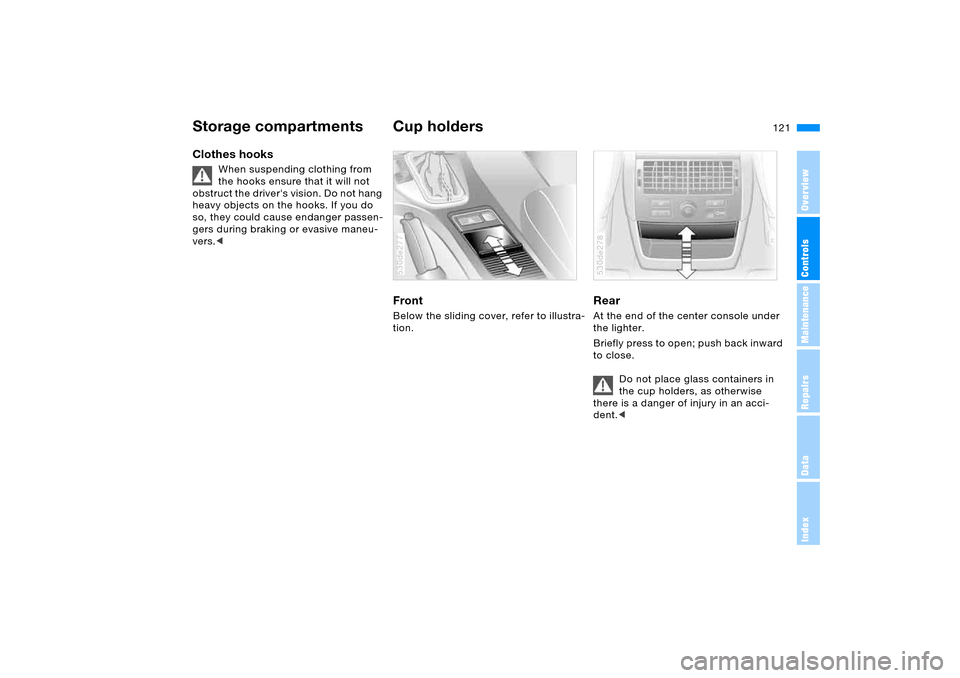
Front Below the sliding cover, refer to illustra-
tion.530de277
RearAt the end of the center console under
the lighter.
Briefly press to open; push back inward
to close.
Do not place glass containers in
the cup holders, as otherwise
there is a danger of injury in an acci-
dent.< 530de278
Page 122 of 200
122n
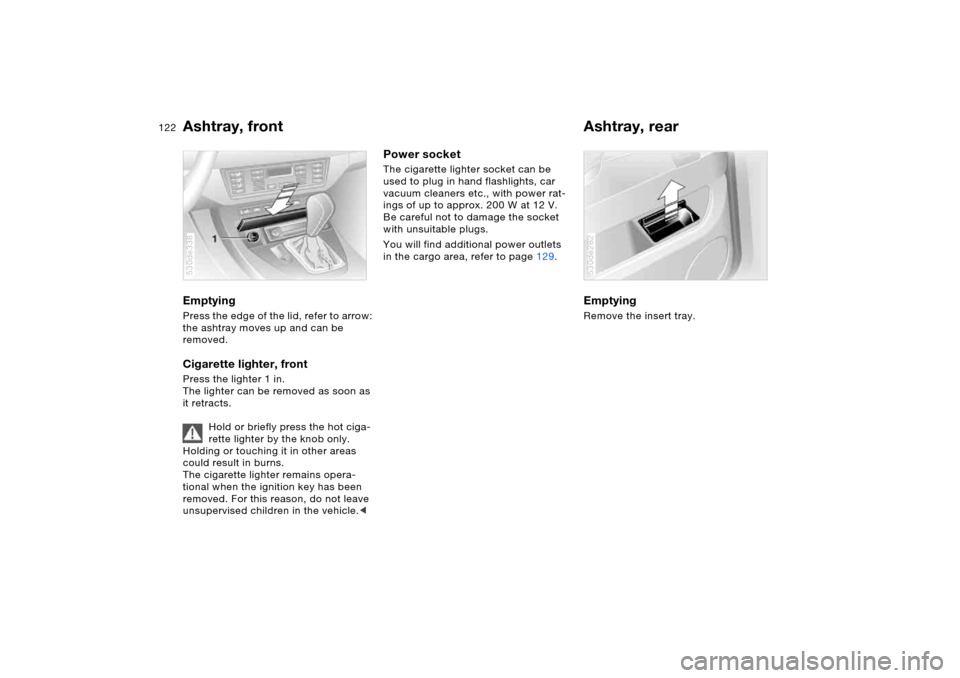
Ashtray, front Ashtray, rear Emptying Press the edge of the lid, refer to arrow:
the ashtray moves up and can be
removed.Cigarette lighter, front Press the lighter 1 in.
The lighter can be removed as soon as
it retracts.
Hold or briefly press the hot ciga-
rette lighter by the knob only.
Holding or touching it in other areas
could result in burns.
The cigarette lighter remains opera-
tional when the ignition key has been
removed. For this reason, do not leave
unsupervised children in the vehicle.< 530de338
Power socket The cigarette lighter socket can be
used to plug in hand flashlights, car
vacuum cleaners etc., with power rat-
ings of up to approx. 200 W at 12 V.
Be careful not to damage the socket
with unsuitable plugs.
You will find additional power outlets
in the cargo area, refer to page129.
Emptying Remove the insert tray. 530de282
Page 123 of 200
123n
OverviewControlsMaintenanceRepairsDataIndex
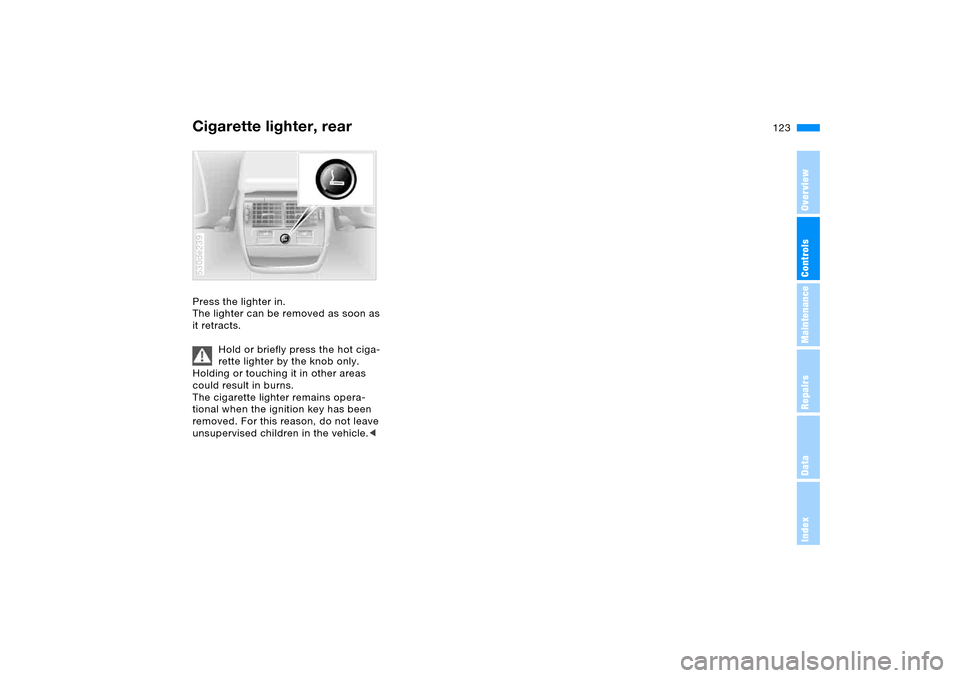
Cigarette lighter, rear Press the lighter in.
The lighter can be removed as soon as
it retracts.
Hold or briefly press the hot ciga-
rette lighter by the knob only.
Holding or touching it in other areas
could result in burns.
The cigarette lighter remains opera-
tional when the ignition key has been
removed. For this reason, do not leave
unsupervised children in the vehicle.< 530de239
Page 126 of 200
126n
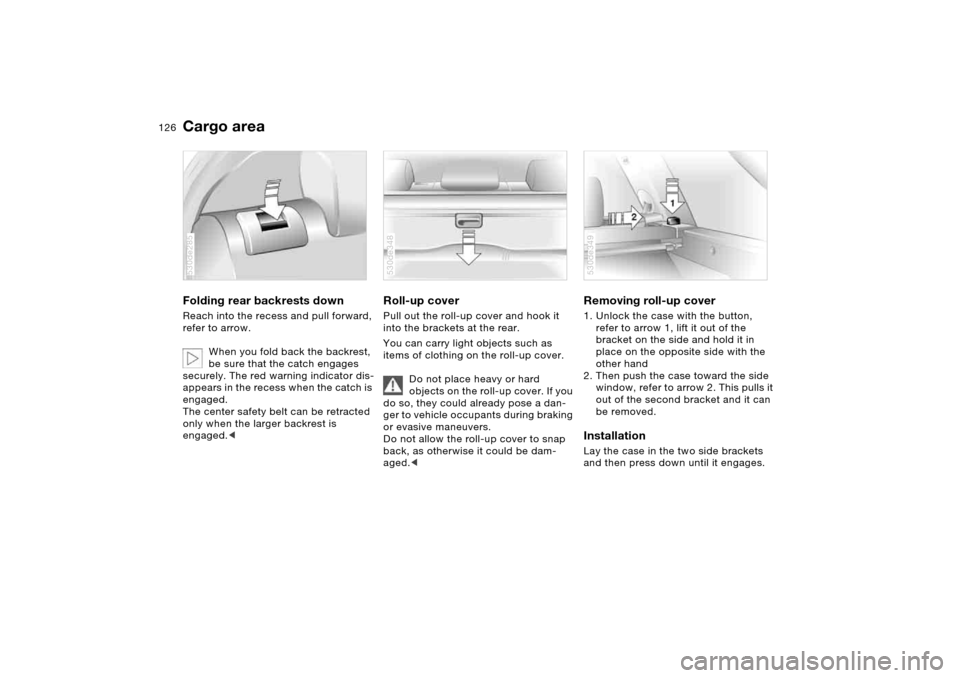
Cargo area Folding rear backrests down Reach into the recess and pull forward,
refer to arrow.
When you fold back the backrest,
be sure that the catch engages
securely. The red warning indicator dis-
appears in the recess when the catch is
engaged.
The center safety belt can be retracted
only when the larger backrest is
engaged.< 530de285
Roll-up cover Pull out the roll-up cover and hook it
into the brackets at the rear.
You can carry light objects such as
items of clothing on the roll-up cover.
Do not place heavy or hard
objects on the roll-up cover. If you
do so, they could already pose a dan-
ger to vehicle occupants during braking
or evasive maneuvers.
Do not allow the roll-up cover to snap
back, as otherwise it could be dam-
aged.<530de348
Removing roll-up cover1. Unlock the case with the button,
refer to arrow 1, lift it out of the
bracket on the side and hold it in
place on the opposite side with the
other hand
2. Then push the case toward the side
window, refer to arrow 2. This pulls it
out of the second bracket and it can
be removed.InstallationLay the case in the two side brackets
and then press down until it engages.530de349
Page 129 of 200
129n
OverviewControlsMaintenanceRepairsDataIndex
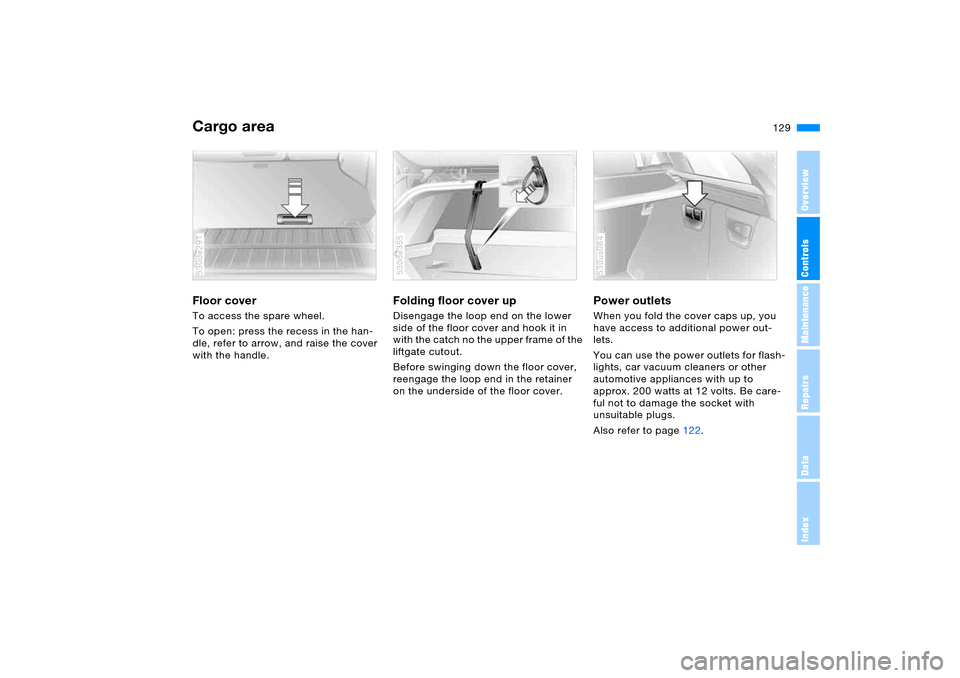
Cargo area Floor cover To access the spare wheel.
To open: press the recess in the han-
dle, refer to arrow, and raise the cover
with the handle. 530de291
Folding floor cover upDisengage the loop end on the lower
side of the floor cover and hook it in
with the catch no the upper frame of the
liftgate cutout.
Before swinging down the floor cover,
reengage the loop end in the retainer
on the underside of the floor cover.530de355
Power outlets When you fold the cover caps up, you
have access to additional power out-
lets.
You can use the power outlets for flash-
lights, car vacuum cleaners or other
automotive appliances with up to
approx. 200 watts at 12 volts. Be care-
ful not to damage the socket with
unsuitable plugs.
Also refer to page122. 530us084
Page 132 of 200
132n
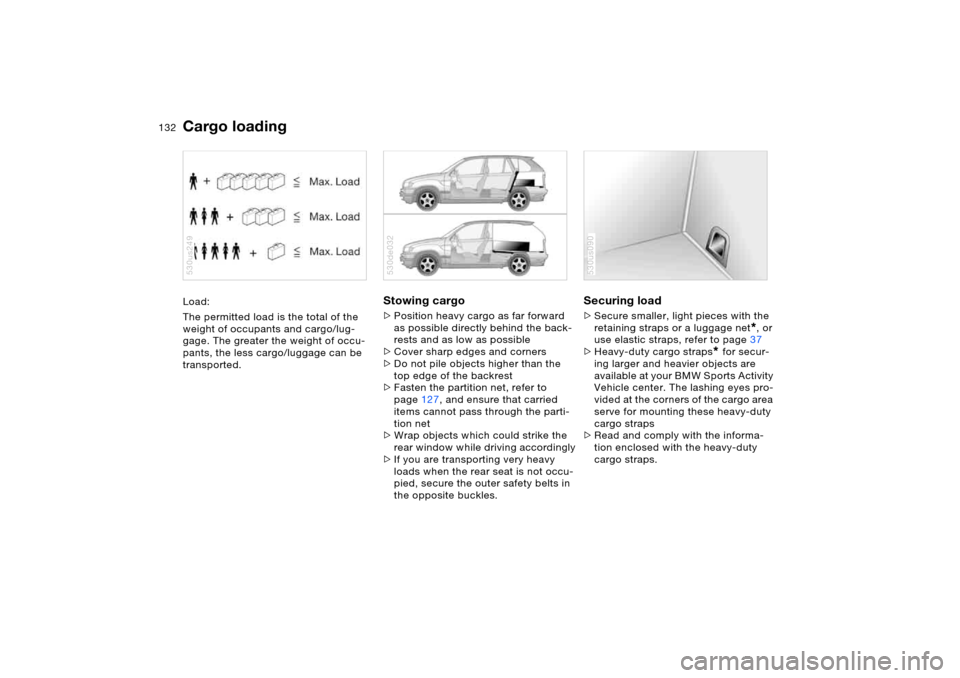
Cargo loadingLoad:
The permitted load is the total of the
weight of occupants and cargo/lug-
gage. The greater the weight of occu-
pants, the less cargo/luggage can be
transported.530us249
Stowing cargo >Position heavy cargo as far forward
as possible directly behind the back-
rests and as low as possible
>Cover sharp edges and corners
>Do not pile objects higher than the
top edge of the backrest
>Fasten the partition net, refer to
page127, and ensure that carried
items cannot pass through the parti-
tion net
>Wrap objects which could strike the
rear window while driving accordingly
>If you are transporting very heavy
loads when the rear seat is not occu-
pied, secure the outer safety belts in
the opposite buckles. 530de032
Securing load >Secure smaller, light pieces with the
retaining straps or a luggage net
*, or
use elastic straps, refer to page37
>Heavy-duty cargo straps
* for secur-
ing larger and heavier objects are
available at your BMW Sports Activity
Vehicle center. The lashing eyes pro-
vided at the corners of the cargo area
serve for mounting these heavy-duty
cargo straps
>Read and comply with the informa-
tion enclosed with the heavy-duty
cargo straps.
530us090
Page 136 of 200
136n
Moving parts should be allowed to
break in. To ensure that your vehicle
provides maximum economy through-
out a long service life, we request that
you observe the following instructions:
Engine and differential Up to 1,200 miles/2,000 km:
Drive at varying engine speeds and
road speeds, but do not exceed
4,500 rpm and the following road
speeds during this initial period:
6-cylinder engines: 100 mph/160 km/h
8-cylinder engines: 106 mph/170 km/h
Obey your local and state maximum
speed limits.
Avoid full-throttle operation and use of
the transmission's kick-down mode
during these initial miles.
Once you have driven 1,200 miles/
2,000 km, the engine and vehicle
speeds can be gradually increased.Tires Due to technical factors associated with
their manufacture, tires do not achieve
their full traction potential until after an
initial break-in period. Therefore, drive
reservedly during the first 200 miles/
300 km. Obey your local and state maximum
speed limits.
When the vehicle is operated on
wet or slushy roads, a wedge of
water may form between the tire and
the road surface. This phenomenon is
referred to as hydroplaning and can
lead to partial or complete loss of trac-
tion, vehicle control and braking effec-
tiveness. Reduce your speed on wet
roads.<
Brake system Brakes require an initial break-in period
of approx. 300 miles/500 km to achieve
optimal contact and wear patterns
between brake pads and rotors.
To break in the separate handbrake
drums, apply the handbrake lightly
when coasting to a standstill at a traffic
signal, for instance, provided that traffic
conditions allow you to do so.
To avoid corrosion, repeat this proce-
dure from time to time.
The brake lamps do not light up
when the handbrake is applied.
Vacuum for the brake system servo unit
on your BMW is available only when the
engine is running. When you move the
vehicle with the engine switched off,
when towing, for instance, substantially
higher levels of pedal force will be
required to brake the vehicle.<
ClutchThe function of the clutch is only at its
optimized level after a distance driven
of approx. 300 miles/500 km. During
this break-in period, engage the clutch
gently.Following component
replacementsObserve the break-in instructions again
if previously addressed components
must be replaced again during driving
later.
Breaking-in