warning BMW X5 4.6IS 2003 User Guide
[x] Cancel search | Manufacturer: BMW, Model Year: 2003, Model line: X5 4.6IS, Model: BMW X5 4.6IS 2003Pages: 183, PDF Size: 2.31 MB
Page 22 of 183
22n
Indicator and warning lamps Green: for your information
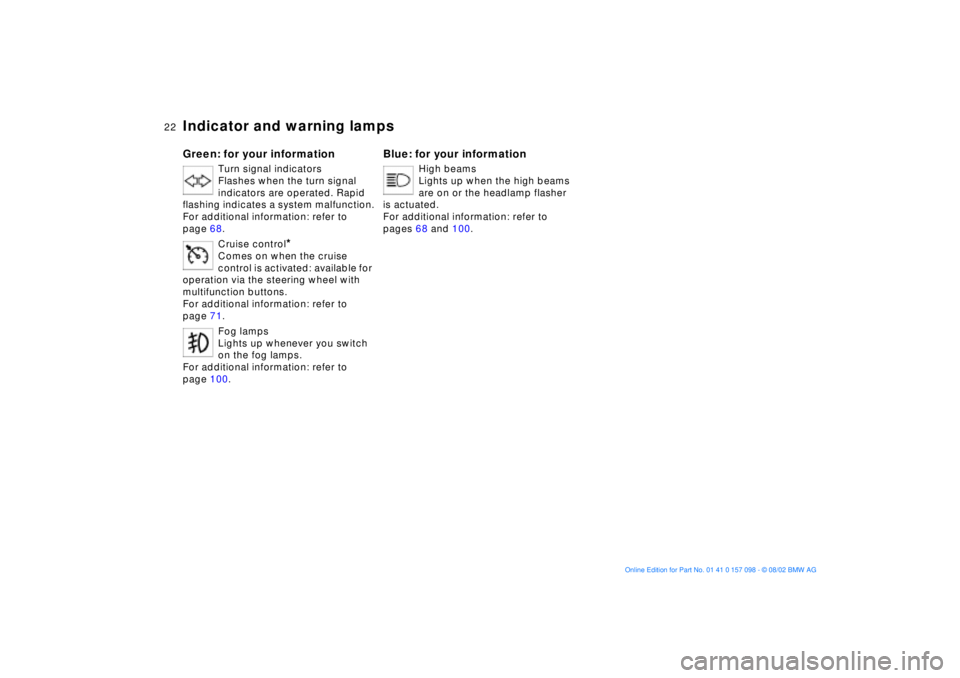
Turn signal indicators
Flashes when the turn signal
indicators are operated. Rapid
flashing indicates a system malfunction.
For additional information: refer to
page 68.
Cruise control
*
Comes on when the cruise
control is activated: available for
operation via the steering wheel with
multifunction buttons.
For additional information: refer to
page 71.
Fog lamps
Lights up whenever you switch
on the fog lamps.
For additional information: refer to
page 100.
Blue: for your information
High beams
Lights up when the high beams
are on or the headlamp flasher
is actuated.
For additional information: refer to
pages 68 and 100.
Page 24 of 183
24n
Warning triangle
*
First-aid kit
*
Refueling
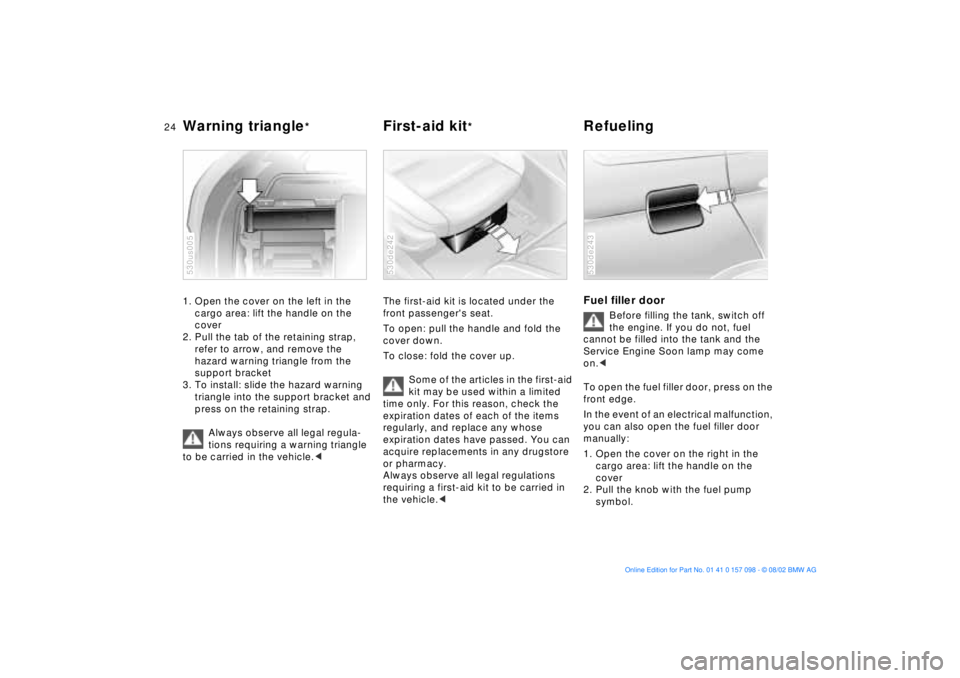
1. Open the cover on the left in the
cargo area: lift the handle on the
cover
2. Pull the tab of the retaining strap,
refer to arrow, and remove the
hazard warning triangle from the
support bracket
3. To install: slide the hazard warning
triangle into the support bracket and
press on the retaining strap.
Always observe all legal regula-
tions requiring a warning triangle
to be carried in the vehicle.< 530us005
The first-aid kit is located under the
front passenger's seat.
To open: pull the handle and fold the
cover down.
To close: fold the cover up.
Some of the articles in the first-aid
kit may be used within a limited
time only. For this reason, check the
expiration dates of each of the items
regularly, and replace any whose
expiration dates have passed. You can
acquire replacements in any drugstore
or pharmacy.
Always observe all legal regulations
requiring a first-aid kit to be carried in
the vehicle.< 530de242
Fuel filler door
Before filling the tank, switch off
the engine. If you do not, fuel
cannot be filled into the tank and the
Service Engine Soon lamp may come
on.<
To open the fuel filler door, press on the
front edge.
In the event of an electrical malfunction,
you can also open the fuel filler door
manually:
1. Open the cover on the right in the
cargo area: lift the handle on the
cover
2. Pull the knob with the fuel pump
symbol.
530de243
Page 30 of 183
30n
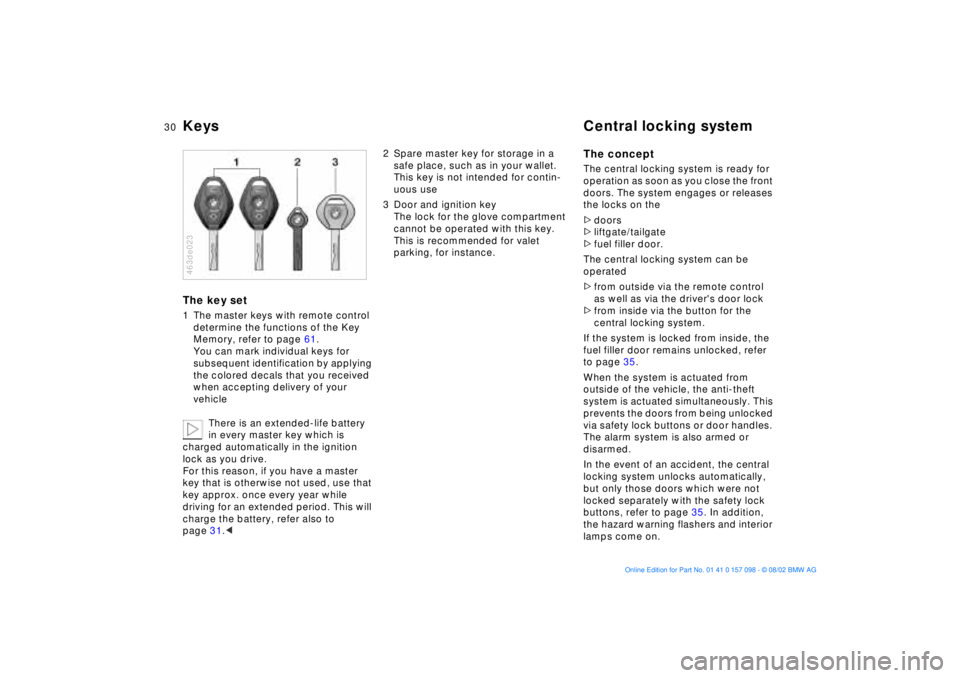
Keys Central locking system The key set1 The master keys with remote control
determine the functions of the Key
Memory, refer to page 61.
You can mark individual keys for
subsequent identification by applying
the colored decals that you received
when accepting delivery of your
vehicle
There is an extended-life battery
in every master key which is
charged automatically in the ignition
lock as you drive.
For this reason, if you have a master
key that is otherwise not used, use that
key approx. once every year while
driving for an extended period. This will
charge the battery, refer also to
page 31.< 463de023
2 Spare master key for storage in a
safe place, such as in your wallet.
This key is not intended for contin-
uous use
3 Door and ignition key
The lock for the glove compartment
cannot be operated with this key.
This is recommended for valet
parking, for instance.
The concept The central locking system is ready for
operation as soon as you close the front
doors. The system engages or releases
the locks on the
>doors
>liftgate/tailgate
>fuel filler door.
The central locking system can be
operated
>from outside via the remote control
as well as via the driver's door lock
>from inside via the button for the
central locking system.
If the system is locked from inside, the
fuel filler door remains unlocked, refer
to page 35.
When the system is actuated from
outside of the vehicle, the anti-theft
system is actuated simultaneously. This
prevents the doors from being unlocked
via safety lock buttons or door handles.
The alarm system is also armed or
disarmed.
In the event of an accident, the central
locking system unlocks automatically,
but only those doors which were not
locked separately with the safety lock
buttons, refer to page 35. In addition,
the hazard warning flashers and interior
lamps come on.
Page 39 of 183
39n
OverviewControlsMaintenanceRepairsDataIndex
Alarm system The concept The vehicle alarm system responds:
>When a door, the hood, or the liftgate
is opened
>To movement inside the vehicle Ð
interior motion sensor
>To variations in the vehicle tilt angle
such as occur during attempts to
steal the wheels or tow the vehicle
>To interruption of battery voltage.
The system responds to unauthorized
vehicle entry and attempted theft by
simultaneously activating the following:
>Sounding an acoustical alarm for
30 seconds
>The hazard warning flashers are acti-
vated for approx. five minutes
>The high beams flash on and off in
the same rhythm.
To arm and disarm the alarm
system When the vehicle is locked or unlocked
with the key or the remote control, the
alarm system is also simultaneously
armed or disarmed.
You can have different acknowl-
edgment signals set to confirm
system arming and disarming.<
You can still open the liftgate after the
system has been armed by pressing the
button of the remote control, refer to
page 32. When you close the liftgate, it
is secured again.
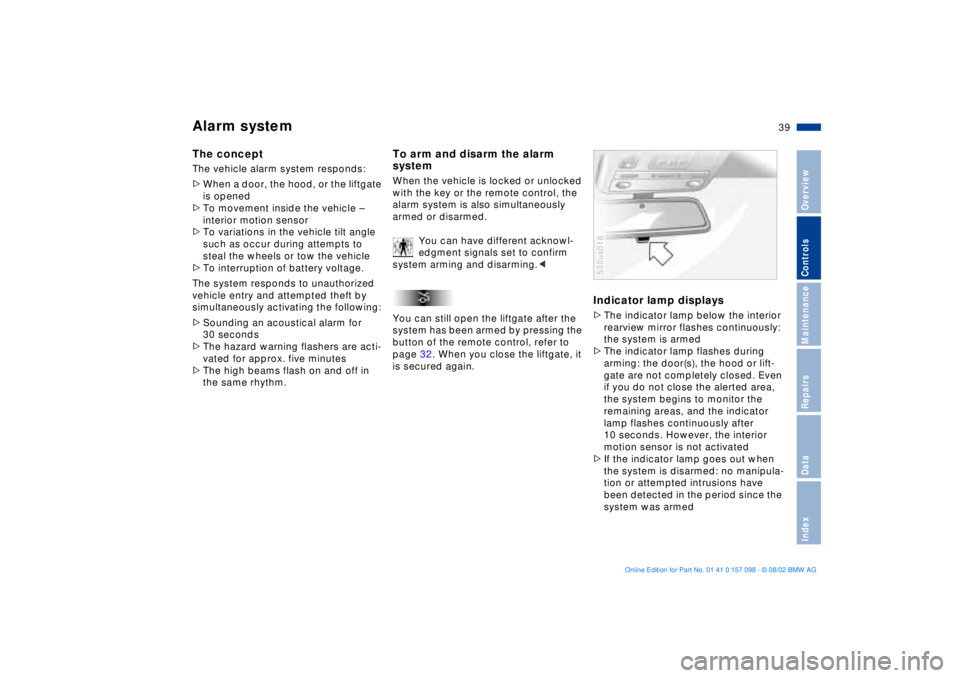
Indicator lamp displays>The indicator lamp below the interior
rearview mirror flashes continuously:
the system is armed
>The indicator lamp flashes during
arming: the door(s), the hood or lift-
gate are not completely closed. Even
if you do not close the alerted area,
the system begins to monitor the
remaining areas, and the indicator
lamp flashes continuously after
10 seconds. However, the interior
motion sensor is not activated
>If the indicator lamp goes out when
the system is disarmed: no manipula-
tion or attempted intrusions have
been detected in the period since the
system was armed530us018
Page 49 of 183
49n
OverviewControlsMaintenanceRepairsDataIndex
Safety beltsDrive with your safety belt on Even though there is an airbag, wear a
safety belt every time you get in the
vehicle, because airbags enhance
safety by providing added protection.To lockMake sure you hear the lock engage in
the belt buckle.
Please fasten safety belts
warning lamp
Lights up either for a few
seconds or until the belt is engaged.To unlock1. Press the red button in the buckle
2. Hold the belt
3. Guide the belt back into its reel.530us034
In the rear, the belt buckle with
the word CENTER is intended
exclusively for passengers sitting in the
middle.
If it is not possible to extract the center
belt, this indicates that the larger back-
rest is not securely locked, refer to
page 120.<
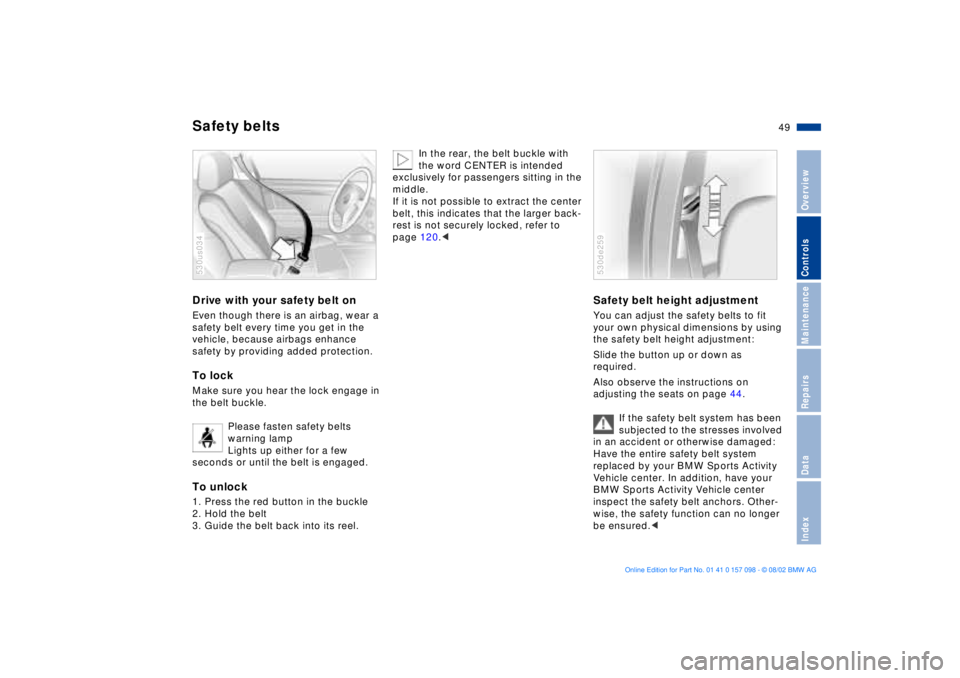
Safety belt height adjustmentYou can adjust the safety belts to fit
your own physical dimensions by using
the safety belt height adjustment:
Slide the button up or down as
required.
Also observe the instructions on
adjusting the seats on page 44.
If the safety belt system has been
subjected to the stresses involved
in an accident or otherwise damaged:
Have the entire safety belt system
replaced by your BMW Sports Activity
Vehicle center. In addition, have your
BMW Sports Activity Vehicle center
inspect the safety belt anchors. Other-
wise, the safety function can no longer
be ensured.c530de259
Page 56 of 183
56n
Airbags
At all times, occupants should sit
upright and be properly restrained
Ð infants and small children in appro-
priate child-restraint systems; larger
children and adults using the safety
belts.
Never let an occupant's head rest near
or on a side airbag because the inflating
airbag could cause a serious or fatal
injury. Please note that the word Airbag
imprinted on the door trim panel indi-
cates the airbag's location.
Accident research shows that the
safest place for children in an auto-
mobile is in the rear seat. However, a
child sitting in the rear seat and not
properly restrained may place his or her
head on or near the airbag, if so
equipped.
For example, a child Ñ even though
belted Ñ may fall asleep with his or her
head against the side airbag. It may be
difficult for a driver to ensure that chil-
dren in the rear seat will remain prop-
erly positioned at all times and do not
place their heads on or near the side
airbag. Therefore, we recommend that
the rear side airbags, if provided, be
deactivated if you plan to transport
children in the rear seat.
The rear seat side airbags may already
have been deactivated, either at the
time of manufacture or by a BMW
Sports Activity Vehicle center. Labels in
the rear door opening should indicate
the status of your rear seat side
airbags. If you are uncertain of their
status, or wish to have the airbags acti-
vated or deactivated, please contact
your BMW Sports Activity Vehicle
center.<
Even when all these guidelines are
observed, there is still a small residual
risk of injuries to the face, hands and
arms occurring from airbag deployment
in isolated instances. The ignition and
inflation noise may provoke a mild
temporary hearing loss in extremely
sensitive individuals.
Airbag warning information is also pro-
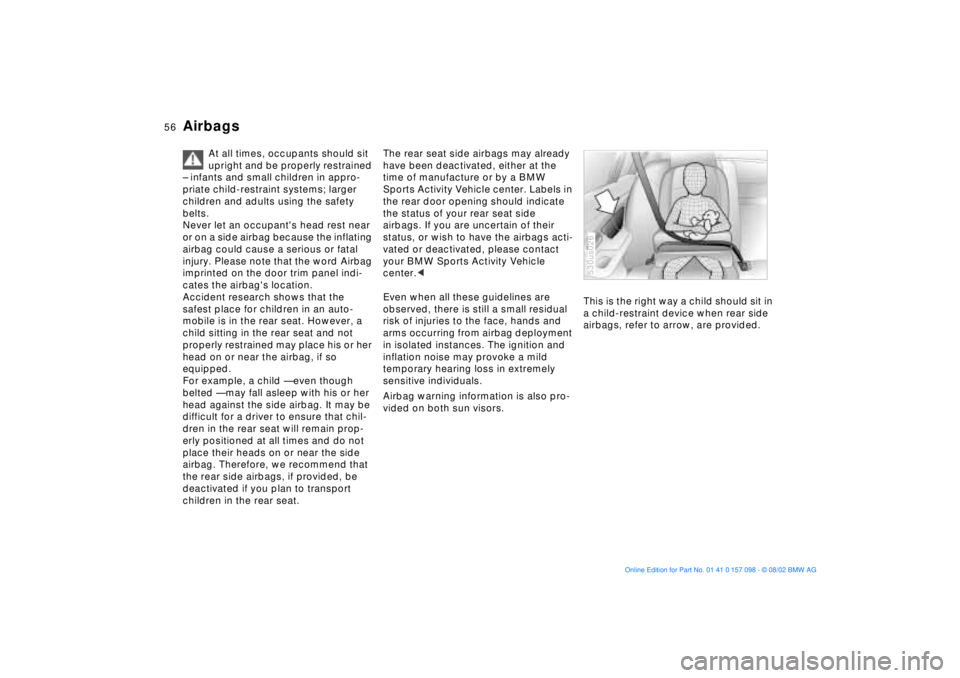
vided on both sun visors. This is the right way a child should sit in
a child-restraint device when rear side
airbags, refer to arrow, are provided.
530us026
Page 62 of 183
62n
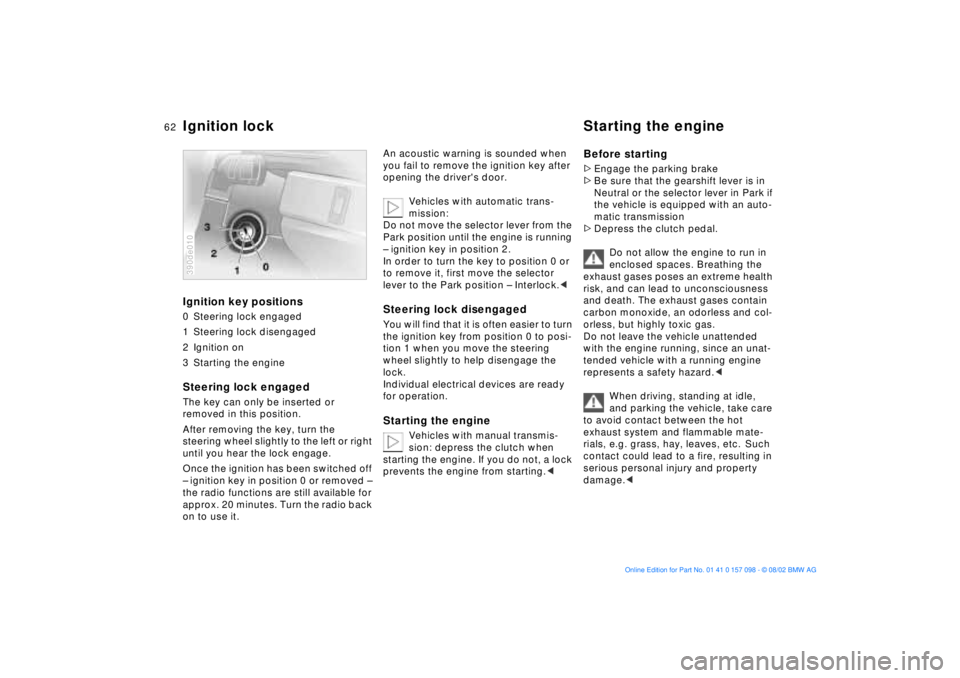
Ignition key positions0 Steering lock engaged
1 Steering lock disengaged
2 Ignition on
3 Starting the engineSteering lock engaged The key can only be inserted or
removed in this position.
After removing the key, turn the
steering wheel slightly to the left or right
until you hear the lock engage.
Once the ignition has been switched off
Ð ignition key in position 0 or removed Ð
the radio functions are still available for
approx. 20 minutes. Turn the radio back
on to use it.390de010
An acoustic warning is sounded when
you fail to remove the ignition key after
opening the driver's door.
Vehicles with automatic trans-
mission:
Do not move the selector lever from the
Park position until the engine is running
Ð ignition key in position 2.
In order to turn the key to position 0 or
to remove it, first move the selector
lever to the Park position Ð Interlock.< Steering lock disengaged You will find that it is often easier to turn
the ignition key from position 0 to posi-
tion 1 when you move the steering
wheel slightly to help disengage the
lock.
Individual electrical devices are ready
for operation. Starting the engine
Vehicles with manual transmis-
sion: depress the clutch when
starting the engine. If you do not, a lock
prevents the engine from starting.<
Before starting >Engage the parking brake
>Be sure that the gearshift lever is in
Neutral or the selector lever in Park if
the vehicle is equipped with an auto-
matic transmission
>Depress the clutch pedal.
Do not allow the engine to run in
enclosed spaces. Breathing the
exhaust gases poses an extreme health
risk, and can lead to unconsciousness
and death. The exhaust gases contain
carbon monoxide, an odorless and col-
orless, but highly toxic gas.
Do not leave the vehicle unattended
with the engine running, since an unat-
tended vehicle with a running engine
represents a safety hazard.<
When driving, standing at idle,
and parking the vehicle, take care
to avoid contact between the hot
exhaust system and flammable mate-
rials, e.g. grass, hay, leaves, etc. Such
contact could lead to a fire, resulting in
serious personal injury and property
damage.<
Ignition lock Starting the engine
Page 73 of 183
73n
OverviewControlsMaintenanceRepairsDataIndex
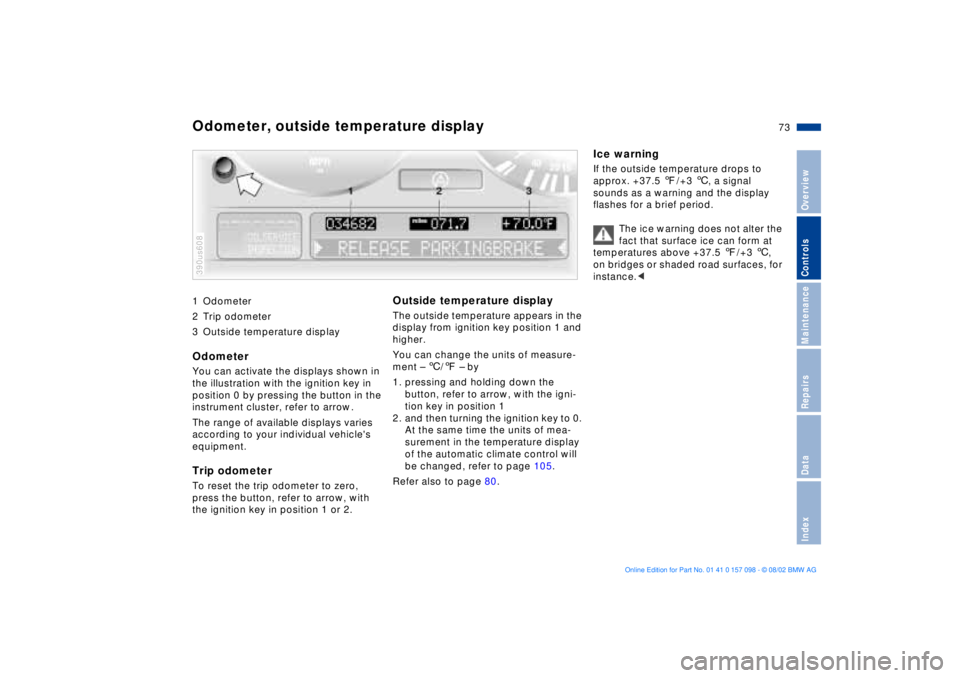
1 Odometer
2 Trip odometer
3 Outside temperature displayOdometerYou can activate the displays shown in
the illustration with the ignition key in
position 0 by pressing the button in the
instrument cluster, refer to arrow.
The range of available displays varies
according to your individual vehicle's
equipment.Trip odometer To reset the trip odometer to zero,
press the button, refer to arrow, with
the ignition key in position 1 or 2. 390us608
Outside temperature display The outside temperature appears in the
display from ignition key position 1 and
higher.
You can change the units of measure-
ment Ð 6/7 Ð by
1. pressing and holding down the
button, refer to arrow, with the igni-
tion key in position 1
2. and then turning the ignition key to 0.
At the same time the units of mea-
surement in the temperature display
of the automatic climate control will
be changed, refer to page 105.
Refer also to page 80.
Ice warning If the outside temperature drops to
approx. +37.5 7/+3 6, a signal
sounds as a warning and the display
flashes for a brief period.
The ice warning does not alter the
fact that surface ice can form at
temperatures above +37.5 7/+3 6,
on bridges or shaded road surfaces, for
instance.<
Odometer, outside temperature display
Page 74 of 183
74n
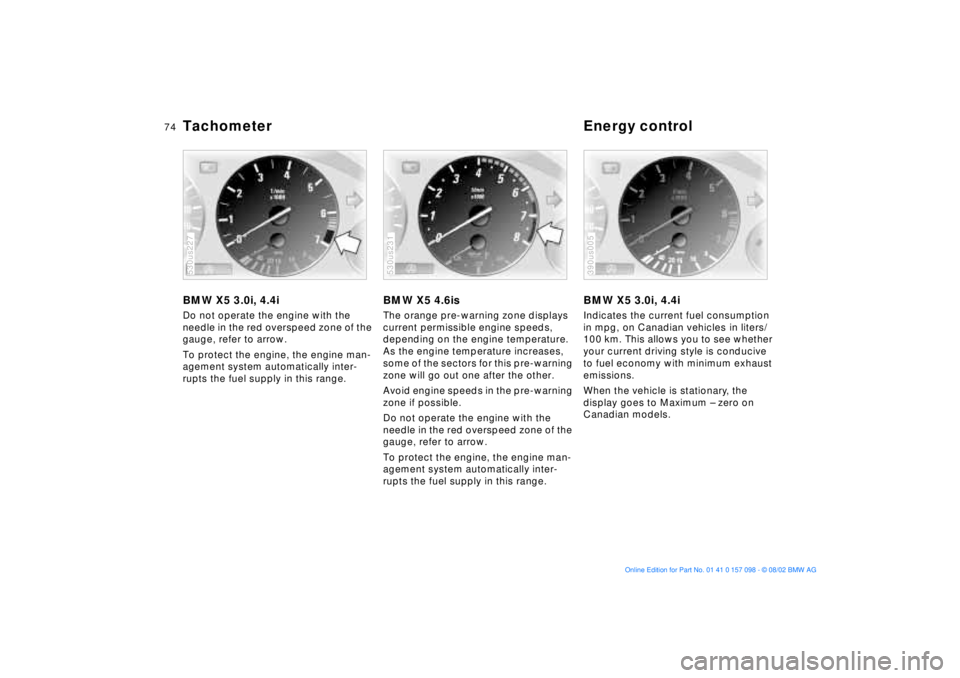
Tachometer Energy controlBMW X5 3.0i, 4.4iDo not operate the engine with the
needle in the red overspeed zone of the
gauge, refer to arrow.
To protect the engine, the engine man-
agement system automatically inter-
rupts the fuel supply in this range.530us227
BMW X5 4.6isThe orange pre-warning zone displays
current permissible engine speeds,
depending on the engine temperature.
As the engine temperature increases,
some of the sectors for this pre-warning
zone will go out one after the other.
Avoid engine speeds in the pre-warning
zone if possible.
Do not operate the engine with the
needle in the red overspeed zone of the
gauge, refer to arrow.
To protect the engine, the engine man-
agement system automatically inter-
rupts the fuel supply in this range.530us231
BMW X5 3.0i, 4.4iIndicates the current fuel consumption
in mpg, on Canadian vehicles in liters/
100 km. This allows you to see whether
your current driving style is conducive
to fuel economy with minimum exhaust
emissions.
When the vehicle is stationary, the
display goes to Maximum Ð zero on
Canadian models.390us005
Page 76 of 183
76n
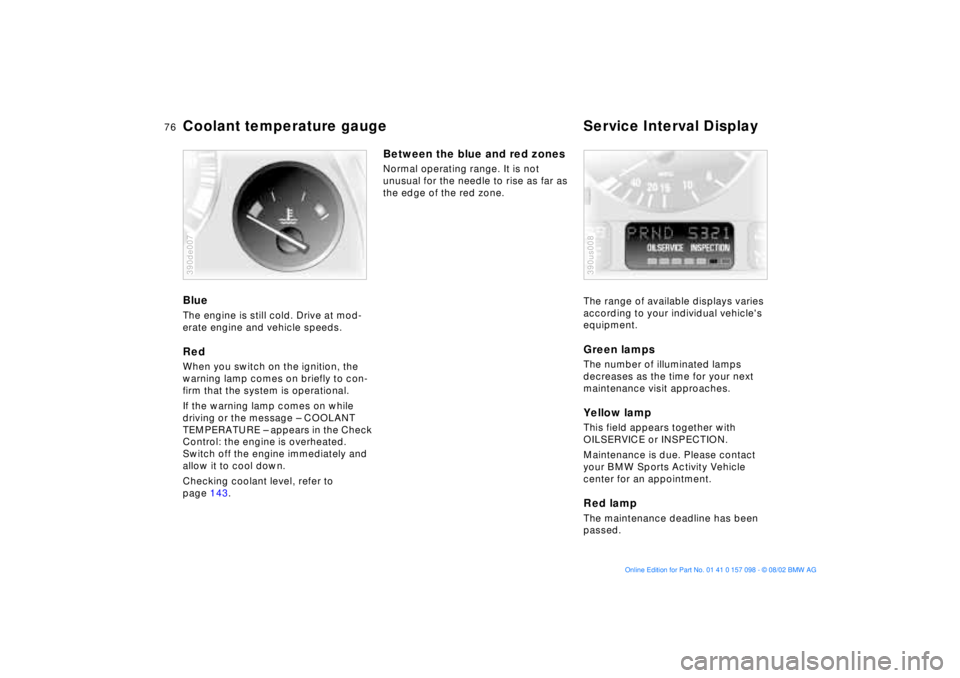
Coolant temperature gauge Service Interval Display Blue The engine is still cold. Drive at mod-
erate engine and vehicle speeds.Red When you switch on the ignition, the
warning lamp comes on briefly to con-
firm that the system is operational.
If the warning lamp comes on while
driving or the message Ð COOLANT
TEMPERATURE Ð appears in the Check
Control: the engine is overheated.
Switch off the engine immediately and
allow it to cool down.
Checking coolant level, refer to
page 143. 390de007
Between the blue and red zones Normal operating range. It is not
unusual for the needle to rise as far as
the edge of the red zone.
The range of available displays varies
according to your individual vehicle's
equipment.
Green lamps The number of illuminated lamps
decreases as the time for your next
maintenance visit approaches.Yellow lamp This field appears together with
OILSERVICE or INSPECTION.
Maintenance is due. Please contact
your BMW Sports Activity Vehicle
center for an appointment.Red lamp The maintenance deadline has been
passed.390us008